
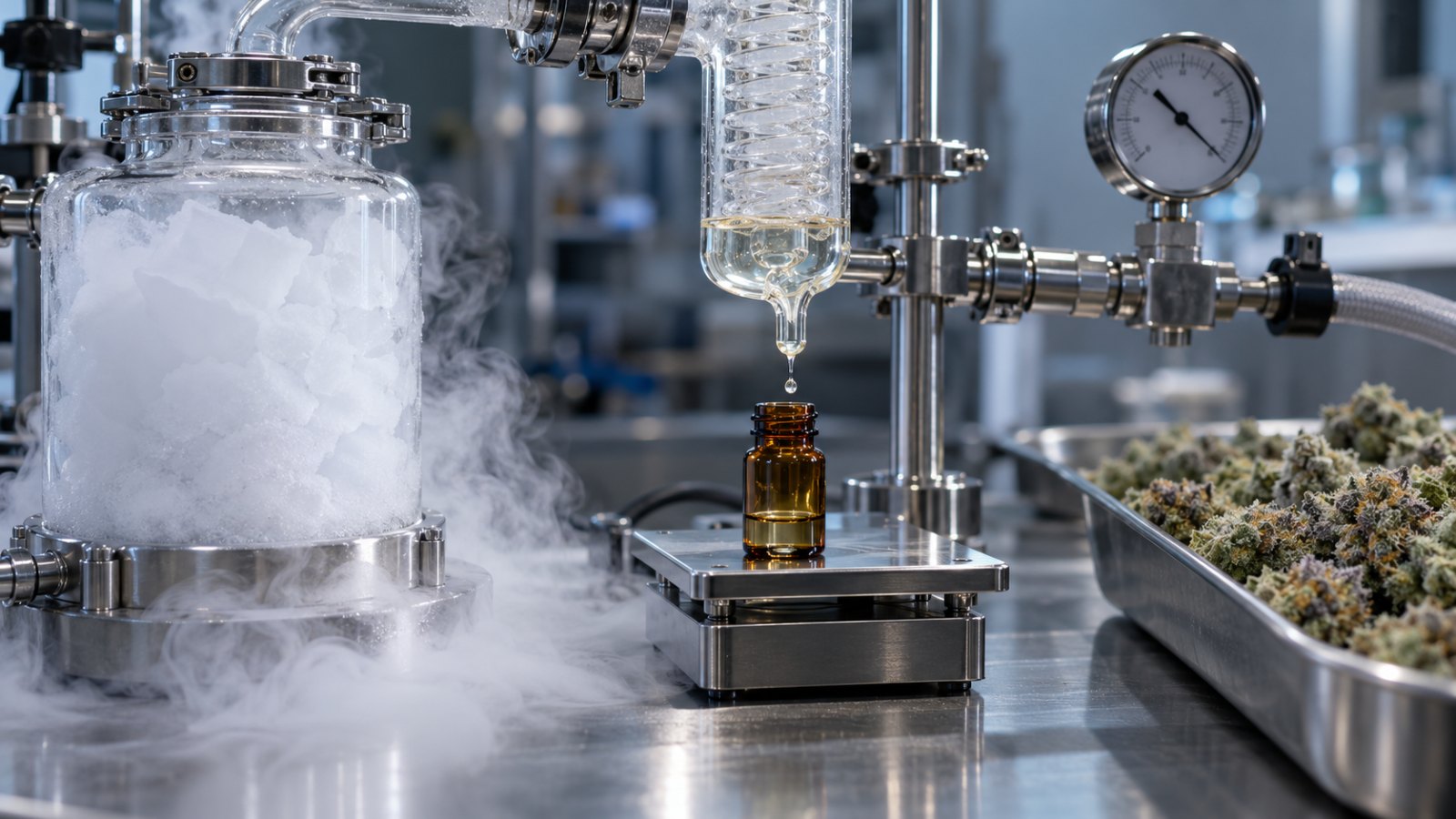
Why Most Terpene Extraction Fails Before the First Fraction
Terpenes are the most temperature-sensitive compounds in the cannabis plant. Every extraction method either preserves them or destroys them, and the difference comes down to a handful of variables that most operators get wrong. Boiling points, exposure time, solvent polarity, and post-extraction handling determine whether you end up with a full terpene profile or a flat, lifeless extract that smells like hay.
This guide covers every major terpene extraction method used in commercial cannabis processing. Not the marketing version. The real one: what each method actually captures, what it loses, and what it costs you per gram of isolated terpene.
Terpene Volatility: The Numbers That Matter
Before picking an extraction method, you need to understand what you are trying to capture. Cannabis produces over 200 terpenes, but the ones that define the product fall into two categories based on molecular weight and volatility.
Monoterpenes (C10H16, MW ~136 g/mol) are the most volatile. These are the first to evaporate during any thermal process:
- Myrcene: boiling point 167°C (333°F). The most abundant terpene in most cannabis cultivars. Earthy, musky.
- Limonene: boiling point 176°C (349°F). Citrus. Second most common.
- Alpha-pinene: boiling point 156°C (312°F). Pine. Lowest boiling point of the major terpenes.
- Beta-caryophyllene: boiling point 119°C (246°F) at reduced pressure. Technically a sesquiterpene (C15), but it behaves like a monoterpene in extraction systems because of its vapor pressure curve.
- Linalool: boiling point 198°C (388°F). Floral. More thermally stable than the others.
- Terpinolene: boiling point 186°C (367°F). Herbaceous, pine.
Sesquiterpenes (C15H24, MW ~204 g/mol) are heavier and more thermally stable. Humulene (bp 198°C), bisabolol (bp 153°C at 12 mmHg), and guaiol survive processing conditions that destroy monoterpenes entirely. They also carry less aroma intensity per molecule, so losing them matters less for flavor but more for entourage effect pharmacology.
The operational takeaway: any process that exceeds 150°C for more than a few seconds starts losing alpha-pinene. By 180°C, you are bleeding myrcene and limonene. Above 200°C, the monoterpene fraction is effectively gone. Every method below is evaluated against this reality.
Hydrocarbon Extraction: The Gold Standard for Terpene Preservation
Cold hydrocarbon extraction using butane, propane, or blends of both is the most effective commercial method for terpene preservation. The reason is simple thermodynamics: butane boils at -1°C and propane at -42°C. Running extraction at -40°C to -80°C means the solvent contacts biomass well below the volatilization threshold of every terpene in the plant. For a full setup walkthrough, see our BHO closed loop extraction guide.
How it works for terpenes: Butane and propane are nonpolar solvents that dissolve terpenes, cannabinoids, and lipids from trichome heads. At cold temperatures, terpene co-extraction is nearly complete because the compounds remain in liquid phase rather than volatilizing off. The key variables:
- Extraction temperature: -40°C to -80°C. Colder means better terpene retention but slower throughput.
- Solvent ratio: Higher propane blends (70/30 propane/butane) pull more terpenes because propane is a better terpene solvent at low temperatures.
- Contact time: 15-30 minutes per run. Longer soak times do not improve terpene yield significantly but increase wax co-extraction.
- Recovery temperature: This is where most operators lose their terpenes. Recovering solvent at too high a temperature strips monoterpenes along with the butane. Keep recovery below 90°F (32°C) for terpene-rich products.
Terpene yield: 2-5% of input biomass weight for fresh frozen material. Cured material yields 1-3% because drying already removes 30-50% of the volatile monoterpene fraction.
Cost per gram of crude terpene extract: $0.50-$2.00 depending on throughput and solvent costs. The lowest cost-per-gram of any method that preserves the full spectrum.
If you want to run a hydrocarbon terpene fraction without learning the cold trap and the purge the expensive way, the extraction training course walks the whole sequence on real equipment, from the -40C column to the first clean fraction.
CO2 Extraction: Tunable but Tricky
Supercritical CO2 gets marketed as the cleanest extraction method. That is true for residual solvent concerns. It is not true for terpene preservation unless you run it correctly, and most operators do not.
The problem: supercritical CO2 (above 31.1°C and 73.8 bar) is a strong solvent that pulls everything. Terpenes, cannabinoids, waxes, chlorophyll. The extraction is not selective at supercritical conditions. Subcritical CO2 (below 31.1°C, typically 15-25°C at 50-60 bar) is far more selective for terpenes because the lower density preferentially dissolves lighter, more volatile compounds.
The two-phase approach that works:
- Phase 1 (subcritical, terpene fraction): Run at 15-25°C, 50-60 bar for 30-60 minutes. Collect a terpene-rich light fraction. This is your cannabis-derived terpene (CDT) isolate.
- Phase 2 (supercritical, cannabinoid fraction): Increase to 40-60°C, 200-350 bar. Pull the remaining cannabinoids and heavier compounds.
The catch: Most commercial CO2 systems are designed for maximum cannabinoid throughput, not terpene isolation. Running a subcritical terpene pass adds 30-60 minutes per cycle and requires a separate collection vessel. Operators who skip this step and run supercritical-only get a crude that smells like extracted plant material, not cannabis flowers.
Terpene yield (subcritical fraction): 0.5-2% of input biomass. Lower than hydrocarbon because the temperature floor is higher (CO2 systems rarely go below 10°C efficiently).
Ethanol Extraction: Speed vs. Flavor
Cold ethanol extraction (-40°C to -80°C) captures terpenes alongside cannabinoids, but the polarity mismatch creates problems. Ethanol is a polar solvent. Terpenes are nonpolar. Ethanol dissolves terpenes, but it also pulls water-soluble compounds, chlorophyll, and sugars that hydrocarbon solvents leave behind.
The bigger problem is post-extraction processing. Removing ethanol from crude requires rotary evaporation or falling film evaporation at temperatures that exceed the boiling points of most monoterpenes. A rotovap running at 40°C under vacuum will strip myrcene and limonene along with the ethanol. You get your cannabinoids clean but your terpene profile gutted.
Workaround: Cold trap the evaporator condenser. Terpenes that volatilize during ethanol recovery condense in the cold trap alongside ethanol vapor. This recovered fraction can be reintroduced into the final product, but it is never as clean as a fraction that was never thermally stressed. Expect 40-60% monoterpene recovery from the cold trap versus 85-95% retention from cold hydrocarbon.
Bottom line: Ethanol is a throughput method. It processes 100-500 lbs of biomass per day in commercial centrifuge systems. But if terpene preservation is the priority, ethanol is the wrong tool. It is the workhorse for distillate production where terpenes get added back at formulation, not for live resin or full-spectrum products where native terpenes define the product.
Steam Distillation: The Original Terpene Extraction
Steam distillation is the oldest method for isolating volatile compounds from plant material. Steam passes through cannabis biomass, vaporizes the terpene fraction, and the condensed steam-terpene mixture separates by density in a Florentine flask. Simple, effective, and it produces a true essential oil that is 100% terpene with zero cannabinoid content.
The advantage: pure terpene isolate. No cannabinoids, no waxes, no chlorophyll. Cannabis-derived terpene (CDT) from steam distillation commands $200-$800 per liter wholesale depending on cultivar and purity.
The disadvantage: heat exposure. Steam is 100°C. Every terpene in the plant gets exposed to 100°C for the duration of the distillation run (typically 2-4 hours). Alpha-pinene degrades. Myrcene oxidizes. The terpene profile you recover is not identical to the terpene profile in the living plant. It is a thermally altered version of it. You get a usable, potent essential oil, but you lose the subtlety of the fresh flower profile.
Yield: 0.5-1.5% of dry biomass weight. Lower than hydrocarbon or CO2 because the steam only captures compounds that volatilize at atmospheric pressure, and many sesquiterpenes have boiling points above water’s capacity to carry them.
Steam distillation makes sense for operators who want pure CDT for formulation work. It does not make sense for operators trying to make a live resin or full-spectrum product where the terpene profile needs to match the cultivar.
Solventless Methods: Mechanical Terpene Preservation
Rosin pressing and ice water hash processing preserve terpenes by avoiding solvents and heat entirely (or nearly so). The terpene profile in a properly made live rosin is the closest commercial product to what the plant actually produced. The crystallization step that follows rosin pressing produces solventless THCA diamonds with fully preserved terpene profiles.
Ice water hash → freeze dry → rosin press: This pipeline keeps material at or below freezing from harvest through final product. Fresh frozen biomass is washed in ice water, separating trichome heads mechanically. The wet hash is freeze-dried at -40°C to -50°C under vacuum (sublimation, not evaporation, so no thermal terpene loss). The dried hash is pressed at 160-220°F (71-104°C) for 60-180 seconds.
Even at the pressing step, exposure time matters more than peak temperature. A 90-second press at 180°F loses fewer monoterpenes than a 180-second press at 170°F because cumulative thermal energy, not peak temperature alone, drives volatilization. The operator who presses cooler but longer is not necessarily preserving more terpenes.
Terpene content in live rosin: 5-15% of final product weight. Higher than any solvent-based crude because the mechanical separation concentrates trichome material (which is where terpenes are biosynthesized and stored) without diluting into a bulk solvent.
Terpene Fractionation via Short Path and Wiped Film Distillation
Molecular distillation systems (short path distillation and wiped film distillation) can isolate terpenes from crude extract as a post-extraction step. The crude is heated under deep vacuum (0.01-1 mmHg), and the terpene fraction volatilizes first because of its lower boiling points relative to cannabinoids. Our wiped film distillation guide covers the full setup for terpene stripping and cannabinoid isolation; for short path setups, see our complete short path distillation SOP.
In a wiped film system, terpene stripping happens in the first pass at 80-120°C with vacuum at 0.1-1 mmHg. The terpene fraction condenses on the internal condenser and drains into a separate collection flask. The cannabinoid-rich residue continues through subsequent passes at higher temperatures for THC/CBD isolation.
The quality trade-off: Terpenes collected via molecular distillation have already been through an extraction step (hydrocarbon, ethanol, or CO2). They have already been thermally stressed once during solvent recovery. The second thermal exposure during distillation degrades them further. The resulting terpene fraction is usable for reintroduction into distillate formulations but lacks the complexity of a first-pass fraction from cold hydrocarbon or the purity of steam-distilled CDT.
If terpene quality is the primary objective, do not rely on distillation fractionation as your only terpene source. Use it for recovering terpenes that would otherwise be lost in distillate production, not as a primary terpene extraction strategy.
Post-Extraction Handling: Where Most Terpenes Actually Die
Extraction method selection accounts for maybe 60% of terpene preservation. The other 40% is post-extraction handling, and most labs hemorrhage terpenes here without realizing it.
- Storage temperature: Terpene-rich extracts should be stored at -20°C or colder. Room temperature storage loses 1-3% of monoterpene content per week through headspace evaporation. In two months at room temperature, your myrcene concentration drops by half.
- Container headspace: Oxygen in the headspace oxidizes terpenes. Myrcene oxidizes to myrcene oxide, which smells different and has different pharmacological activity. Nitrogen-purge your containers. Use PTFE-lined lids, not bare metal.
- Light exposure: UV light catalyzes terpene isomerization and degradation. Amber glass or opaque containers. No clear glass. No plastic bags.
- Transfer losses: Every time you open a container, pour between vessels, or agitate a terpene-rich fraction, you lose volatiles to the atmosphere. Minimize transfers. Work in cold rooms when possible.
Choosing the Right Method: Decision Framework
The method depends on the product, not the preference:
- Live resin / HTFSE / sauce: Cold hydrocarbon. Nothing else preserves the full fresh-frozen terpene profile as effectively at commercial scale.
- Live rosin: Solventless pipeline (ice water hash → freeze dry → rosin press). Premium price point justifies the lower throughput.
- Pure CDT isolate for formulation: Steam distillation or subcritical CO2. Both produce a terpene fraction with minimal cannabinoid contamination.
- Distillate with terpene reintroduction: Ethanol or supercritical CO2 for bulk extraction, then purchase or produce CDT separately for formulation.
- Research / analytical: Subcritical CO2 or steam distillation for clean fraction analysis. Headspace solid-phase microextraction (HS-SPME) for non-destructive profiling.
Frequently Asked Questions
What is the best method for extracting terpenes from cannabis?
Cold hydrocarbon extraction (butane/propane at -40°C to -80°C) preserves the most complete terpene profile at commercial scale. It retains 85-95% of monoterpenes because the process temperature stays well below their boiling points. For pure terpene isolate without cannabinoids, steam distillation produces the cleanest fraction but alters the profile through heat exposure at 100°C.
What temperature destroys terpenes during extraction?
Alpha-pinene begins degrading above 150°C (312°F). Myrcene and limonene volatilize rapidly above 170-180°C. Above 200°C, the monoterpene fraction is effectively gone. However, cumulative thermal exposure matters as much as peak temperature. A process running at 120°C for 30 minutes can destroy more terpenes than one hitting 160°C for 5 seconds.
Can you extract terpenes separately from cannabinoids?
Yes. Subcritical CO2 extraction at 15-25°C and 50-60 bar preferentially dissolves terpenes before cannabinoids. Steam distillation produces pure terpene isolate with zero cannabinoid content. Molecular distillation (wiped film or short path) strips terpenes from crude extract in the first pass at 80-120°C under deep vacuum.
Why does my extract lose its smell after processing?
Solvent recovery is the most common culprit. Rotary evaporation above 40°C strips monoterpenes alongside the solvent. Cold trap your condenser to recover volatilized terpenes, and keep recovery temperatures below 32°C (90°F). Post-extraction storage above freezing also causes slow monoterpene loss through headspace evaporation, with myrcene dropping 50% in two months at room temperature.
What is the difference between cannabis-derived terpenes and botanical terpenes?
Cannabis-derived terpenes (CDTs) are extracted directly from cannabis plant material and contain the exact ratio of terpene compounds that the cultivar produced. Botanical terpenes are isolated from other plants (citrus for limonene, pine for pinene) and blended to approximate a cannabis profile. The individual molecules are identical, but CDTs carry minor and trace terpenes that botanical blends cannot replicate because those compounds are not commercially available as isolates.
How much terpene yield should I expect from fresh frozen cannabis?
Cold hydrocarbon extraction from fresh frozen material typically yields 2-5% terpenes by weight of input biomass. Steam distillation yields 0.5-1.5% of dry biomass. Subcritical CO2 yields 0.5-2%. Live rosin contains 5-15% terpenes by final product weight, but total mass recovery is lower because the mechanical process discards non-trichome material.
Does freezing cannabis preserve terpenes better than drying?
Freezing immediately after harvest preserves 30-50% more monoterpenes than traditional drying. Air drying at 60-70°F with 55-60% humidity for 10-14 days causes continuous terpene volatilization from the surface of trichome heads. Flash freezing to -40°C within 1-2 hours of harvest locks the terpene profile in place. This is why “live” products (live resin, live rosin) have stronger, more complex aromas than their cured equivalents.
Can I extract terpenes at home without expensive equipment?
Steam distillation can be done with a basic glass distillation kit ($100-300). Place cannabis in a round-bottom flask with water, heat to boiling, and collect the condensate. The oil layer floating on top of the water in your receiving flask is your terpene fraction. Yields are low (0.5-1% of dry weight) and the profile is heat-altered, but it produces a usable cannabis essential oil. For higher quality home extraction, a rosin press at 160-180°F preserves terpenes within the full-spectrum extract rather than isolating them.
Ready to level up your extraction game? Contact WKU Consulting for personalized guidance on building your extraction lab.
For more deep dives into cannabis chemistry, extraction SOPs, and lab design, subscribe to the WKU Consulting YouTube channel.
Watch a related video:
