
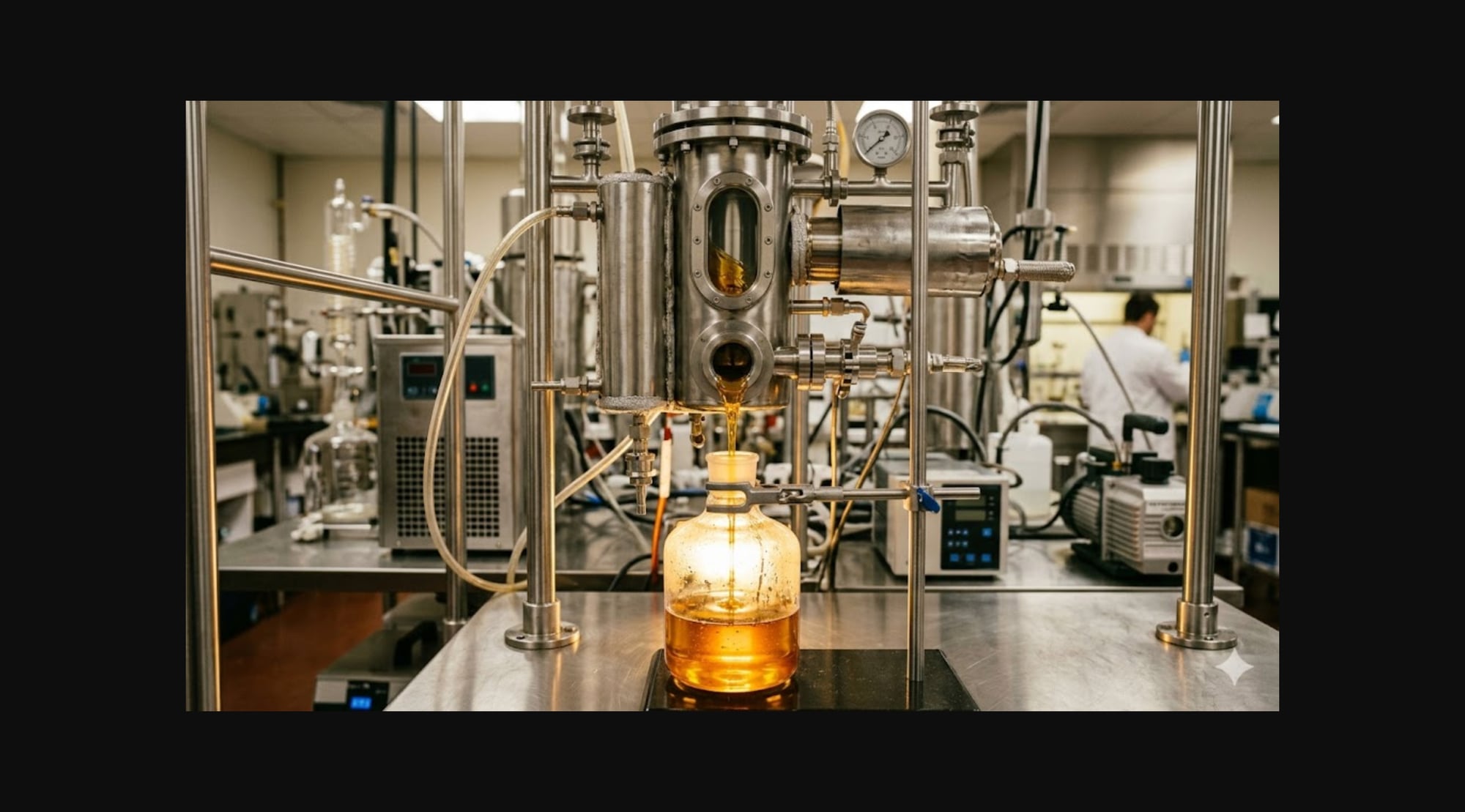
Wiped film distillation purifies cannabis crude oil to 90-95% total cannabinoids by spreading a sub-1mm film across a heated cylinder at 160-180°C under sub-100-micron vacuum. Residence time is 1-3 minutes (vs 10-60 minutes in short path), reducing thermal CBN formation from 4% to under 0.5%. A 2-inch Pope system processes 500-800 mL/hour at 30% rotor speed. Commercial labs running 10+ liters/day see 15-20% higher annual throughput and 5-10% higher average potency compared to equivalent short path setups, with distillate production costs dropping from $8 to $12 per gram (SPD) to $3 to $5 per gram (WFE) at scale.
Everything below assumes the crude entering the evaporator is already on spec. It rarely is by accident. Our guide to wiped film evaporator feed preparation covers the crude QC that decides your first-pass potency and color before you touch a single setting.
I have designed and built over two dozen extraction and post-processing laboratories, and wiped film evaporators are in nearly every single one. Here is why they matter and how they actually work.
📺 Watch the full video: “What is Wiped Film Distillation?”
What Is Wiped Film Distillation?
Wiped film distillation (WFD) is a continuous, thin-film distillation process where crude cannabis oil is spread into an extremely thin layer across a heated cylindrical surface using mechanical wiper blades. Under deep vacuum, cannabinoids evaporate from that thin film, travel a short distance to an internal condenser, and are collected as purified distillate.
The key difference from short path distillation: residence time. In a short path system, your oil sits in a heated boiling flask for 10 to 60 minutes. In a wiped film evaporator, the oil contacts the heated surface for 1 to 3 minutes. Less time on heat means less thermal degradation, less CBN formation, and higher cannabinoid potency in your final product.
How a Wiped Film Evaporator Works: Step by Step
1. Feed Introduction
Decarboxylated and winterized crude oil is pumped from a feed vessel into the top of the wiped film evaporator body. The feed rate is controlled precisely, typically measured in mL per minute, and directly affects film thickness and separation efficiency.
2. Film Formation
Inside the evaporator body, a rotating wiper assembly spreads the crude oil into a thin, uniform film across the heated inner wall. This film is typically less than 1mm thick. The thinner the film, the more efficient the heat transfer and the faster volatile compounds evaporate. Wiper rotation speed matters: on a 2-inch Pope system, 30% rotor speed is a solid starting point. Lower rotor speed also extends wiper blade, seal, and bearing life; the service intervals are in our equipment maintenance schedule.
3. Evaporation Under Vacuum
The evaporator body operates under deep vacuum, typically below 100 microns, with some systems running as low as 1 micron with diffusion pumps. Vacuum is critical because it reduces the boiling points of cannabinoids dramatically. At 0.75 microns, THC boils at roughly 120°C. At 20 microns, that jumps to around 200°C. At atmospheric pressure, THC would need temperatures above 388°C, which would destroy it entirely.
This is the Clausius-Clapeyron relationship in action: deeper vacuum equals lower boiling temperature equals less thermal damage to your cannabinoids.
4. Condensation and Collection
Evaporated cannabinoids travel the short distance from the heated wall to an internal condenser positioned in the center of the evaporator. Because the vapor path is so short (molecular distillation), there is minimal loss and excellent separation. The condensed distillate flows down the condenser surface and is collected in a separate vessel.
5. Residue Discharge
Heavier compounds that do not evaporate, including waxes, lipids, and high-molecular-weight compounds, are wiped down the heated wall by gravity and the mechanical action of the wipers. This residue (sometimes called “tails” or “bottoms”) is collected separately and can be further processed or discarded.
WFE vs. Short Path Distillation: Why It Matters
Both systems achieve the same fundamental goal: separating cannabinoids from everything else using heat and vacuum. But the engineering differences create real performance gaps.
Residence Time: SPD keeps your oil on heat for 10 to 60 minutes. WFE keeps it on heat for 1 to 3 minutes. Six hours on a 10-liter short path rig can generate roughly 4% CBN from thermal isomerization alone. WFE virtually eliminates this problem.
Throughput: Short path distillation is a batch process. You load a flask, run it, clean it, load again. Wiped film distillation runs continuously. Feed goes in one end, distillate and residue come out the other. For commercial operations processing hundreds of liters of crude per week, the throughput difference is enormous.
Consistency: WFE produces more consistent results run after run. The continuous nature of the process means you are not dealing with the variability that comes from batch-to-batch differences in heating profiles, vacuum depth, and operator technique.
Potency: WFE more consistently achieves above 90% THC and above 95% total cannabinoids compared to short path, which typically produces 75 to 85% THC on a good run. WFE can even produce acceptable product from material that was not winterized perfectly, something SPD struggles with.
Cost: Here is the tradeoff. A quality wiped film evaporator costs significantly more upfront than a short path system. For small operations running a few liters per day, short path distillation might make more economic sense. For anything above that, WFE pays for itself in throughput, consistency, and product quality.
WFE vs. Short Path: Head-to-Head Comparison
| Parameter | Wiped Film (WFE) | Short Path (SPD) | Why It Matters |
|---|---|---|---|
| Residence time | 1-3 minutes | 10-60 minutes | Less time on heat = less CBN formation |
| THC purity (typical) | 90-95% | 75-85% | WFE consistently exceeds 90% with proper prep |
| CBN formation per run | Under 0.5% | 2-4% | CBN is lost potency; 4% CBN = 4% THC destroyed |
| Throughput (2-inch system) | 500-800 mL/hr continuous | 200-400 mL/hr batch | WFE runs nonstop; SPD needs flask changes |
| Equipment cost (entry) | $30,000-$80,000 | $5,000-$15,000 | SPD wins on startup cost |
| Cost per gram distillate at scale | $3-5/g | $8-12/g | Labor + energy + CBN loss favors WFE above 5L/day |
| Vacuum requirement | Sub-100 microns (diffusion pump ideal) | 100-500 microns (rotary vane) | Deeper vacuum = lower temps = less degradation |
| Operator skill ceiling | Medium (set and monitor) | High (constant flask management) | WFE reduces batch-to-batch variability |
Critical Operating Parameters for Cannabis WFE
Getting good results from a wiped film evaporator requires understanding and controlling several key variables.
Temperature
For a two-pass system on a 2-inch Pope evaporator:
- First pass (terpene and solvent removal): approximately 105°C
- Second pass (cannabinoid collection): approximately 160°C
These numbers shift based on your vacuum depth, crude composition, and target cannabinoid profile. The main body cannabinoid fraction on any system typically falls in the 170 to 180°C range at sub-150-micron vacuum.
Vacuum Depth
Deeper is better, within reason. A rotary vane pump gets you to the 100 to 500 micron range. A diffusion pump can push below 1 micron. Running a diffusion pump typically yields about 5% higher cannabinoid content in your distillate compared to rotary vane alone, because you can run lower temperatures and minimize degradation.
Feed Rate
Too fast and the film becomes too thick for efficient evaporation. Too slow and you lose throughput. Optimal feed rate depends on your evaporator size, crude viscosity, and heating capacity. Start conservative and increase until you see distillate quality begin to drop.
Wiper Speed
The wiper assembly needs to spin fast enough to create a uniform thin film but not so fast that it throws material off the wall. On a Pope 2-inch system, 30% rotor speed is a reliable starting point. Adjust based on your crude viscosity and feed rate.
Operating Parameters by Target Product
| Target Product | Evaporator Temp | Vacuum (microns) | Feed Rate (mL/min) | Condenser Temp | Expected Purity | Common Failure |
|---|---|---|---|---|---|---|
| THC distillate (clear) | 160-175°C | Under 50 | 3-5 | 60-70°C | 90-95% THC | Dark color if crude not degummed |
| CBD distillate | 155-170°C | Under 100 | 4-6 | 55-65°C | 85-92% CBD | THC carryover if temp too high |
| Broad spectrum (THC-free) | 145-160°C | Under 30 | 2-4 | 50-60°C | 80-88% CBD, under 0.3% THC | Incomplete THC removal above 50 microns |
| High-terpene distillate | 130-150°C | 100-200 | 2-3 | 40-50°C | 75-85% cannabinoids | Terpene loss if condenser above 55°C |
| First pass (devol only) | 100-110°C | 200-500 | 5-8 | 30-40°C | N/A (prep step) | Solvent flash if residual ethanol over 2% |
Wiped film is one of the modules in our extraction training program, and the course walks the feed prep, the parameter matrix, and a first pass on a live unit rather than a slide deck: extractiontraining.com.
Preparing Your Crude for Wiped Film Distillation
WFE is not a magic box that turns bad crude into good distillate. Proper preparation upstream directly impacts your results.
Winterization: Remove waxes and lipids by dissolving crude in ethanol at a minimum of -40°C, filtering, and recovering the solvent. Some operators winterize between first and second pass for additional purity.
Decarboxylation: Convert THCA and CBDA to their neutral forms (THC and CBD) before distillation. This reduces viscosity and ensures your cannabinoids are in the correct molecular form for efficient evaporation.
Degumming: Phospholipid removal improves distillate clarity and prevents fouling of the evaporator surface. Particularly important for ethanol-extracted crude, which tends to carry more polar impurities.
Solvent Recovery: Ensure all residual extraction solvent is removed before feeding into the WFE. Residual butane, ethanol, or CO2-dissolved compounds will flash off in the evaporator and disrupt your vacuum.
First Pass vs. Second Pass
Most commercial WFE operations run a two-pass protocol.
First Pass: Removes residual solvents, terpenes, and light volatiles. This is your devol step. The “distillate” collected here is primarily terpenes and light fractions, not your target cannabinoids.
Second Pass: This is where cannabinoid separation happens. The cleaned, devolatilized crude from the first pass is fed back through the evaporator at higher temperature. The distillate collected from the second pass is your final product.
One thing a second pass will not do is separate THC from CBD. Both travel in the same fraction under vacuum, so a hemp distillate that tests hot stays hot through the still. The THC remediation guide covers the crystallization and chromatography steps that actually remove it.
Some operators achieve acceptable single-pass results with extremely clean, well-prepared crude. But for most real-world operations, two passes delivers significantly better purity and consistency.
Common Failures and How to Diagnose Them
Equipment manufacturers publish setup guides but not failure diagnostics. Every one of these problems has shown up in labs I have built or consulted for. The difference between a frustrating week and a quick fix is knowing which variable to check first.
| Symptom | Root Cause | Diagnostic Test | Corrective Action | Prevention |
|---|---|---|---|---|
| Dark or amber distillate | Thermal degradation from excessive heat or poor crude prep. Chlorophyll, oxidized terpenes, or phospholipids carry through. | Run test batch at 10°C lower evaporator temp. If color improves, heat was the issue. If not, crude prep is the problem. | Reduce evaporator temp by 5-10°C. If crude-related: add degumming step (citric acid wash at 60°C, 1% w/w). Re-winterize at -40°C minimum. | Always degum ethanol crude. Winterize at -40°C or below. Never exceed 180°C on second pass. |
| Low potency (under 85% THC) | Vacuum leak causing elevated boiling points. System running at 300+ microns instead of sub-100. | Run static vacuum test: good system holds under 50 microns for 30 minutes. If pressure rises over 10 microns/min, you have a leak. | Check all fittings, gaskets, glass joints. Replace cracked O-rings. Verify pump oil level. Add diffusion pump if running rotary vane only. | Vacuum test before every run. Replace O-rings every 50 runs. Change pump oil weekly during heavy use. |
| Cloudy or hazy distillate | Wax/lipid carryover from inadequate winterization. Lipids pass through as vapor then solidify on cooling. | Chill sample to -20°C for 2 hours. If precipitate forms, waxes present. Also check moisture: water above 500 ppm causes haze. | Re-winterize at -40°C or lower (not -20°C, which misses Type III lipids). Filter through 1-micron paper. | Winterize at -40°C minimum. -80°C ideal for full lipid removal. Use 1-micron final filtration. |
| Low yield (under 60% recovery) | Feed rate too fast, vacuum too shallow, or condenser temp wrong. Material passes through without evaporating. | Reduce feed rate by 50%. If yield improves, overfeeding. If not, check vacuum depth and condenser delta-T. | Slow feed to 2-3 mL/min (2-inch system). Verify vacuum below 100 microns. Set condenser 80-100°C below evaporator temp. | Start conservative on feed rate. Monitor residue: clear = good separation; dark with cannabinoid smell = cannabinoids escaping in residue. |
| Burnt or harsh smell | Terpene pyrolysis. Monoterpenes degrade above 150°C; sesquiterpenes above 180°C. | Collect terpene fraction separately during first pass. If terpene fraction normal but distillate harsh, second pass temp is too high. | Lower second pass temp by 10-15°C and compensate with deeper vacuum. | Never skip first pass. First pass removes terpenes before they pyrolyze during cannabinoid collection. |
| Wiper motor stalling | Crude too viscous (insufficient decarb or cold feed). Carbon buildup on wall increases drag. | Check crude viscosity: properly decarbed crude at 80°C should flow like warm honey, not cold molasses. | Ensure full decarb. Preheat crude to 80-90°C. Replace worn PTFE blades. Clean carbon with isopropanol. | Decarb completely. Maintain feed at 80°C. Replace blades every 200-300 hours. |
Who Needs Wiped Film Distillation?
If you are processing more than a few liters of crude per day and selling distillate as a finished product or as an input for edibles, vape cartridges, or other formulations, wiped film distillation is the standard. The consistency, throughput, and potency advantages over short path make it the obvious choice for any commercial cannabis or hemp operation.
For smaller operations or labs just getting started, short path distillation is a perfectly valid entry point. Learn the fundamentals of cannabinoid separation on a short path system, then scale up to wiped film when your volume demands it.
The bottom line: wiped film distillation is not a luxury. For commercial cannabis oil purification, it is the industry standard for a reason. The physics are in its favor, and the numbers speak for themselves.
