
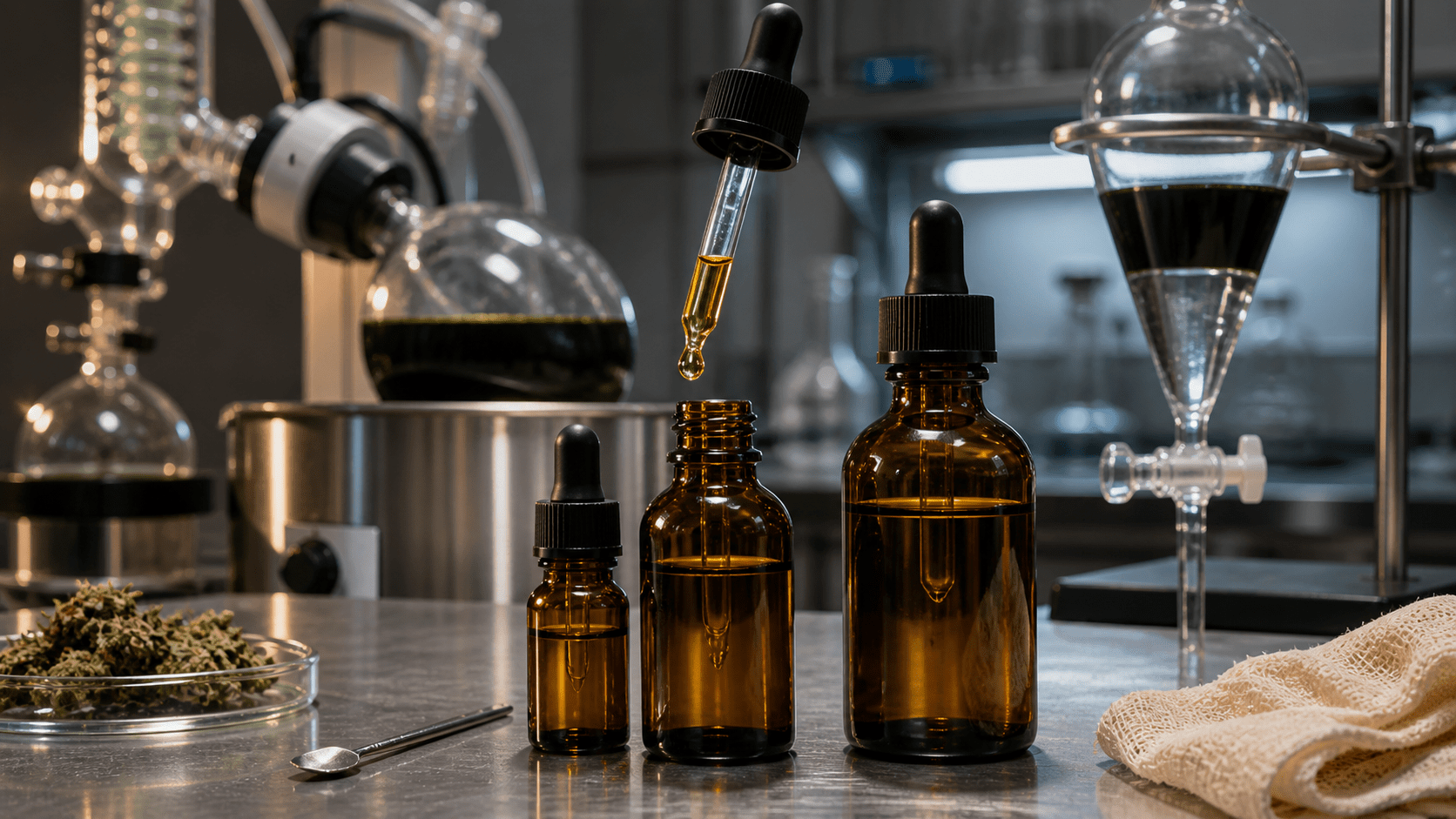
Most Cannabis Tinctures Fail Before the First Drop Hits Your Tongue
The problem is never the ethanol. The problem is decarboxylation control, extraction efficiency, and the dosing math that turns a good extraction into a reliable medicine. A tincture that varies 40% batch to batch is not a product. It is a liability.
Cannabis tinctures are ethanol-based extracts designed for sublingual or oral delivery. They have been the default dosage form for cannabis medicine since the 1800s, and they remain the most controllable, shelf-stable delivery method available to small producers and home extractors. The process is straightforward. The variables that determine whether your tincture is consistent or chaotic are not.
What Makes a Tincture Different from RSO or an Edible
RSO (Rick Simpson Oil) is a full crude extract. Everything comes through: cannabinoids, chlorophyll, waxes, lipids. A tincture is a filtered ethanol solution at a defined concentration. The ethanol serves dual purpose: solvent for extraction and carrier for delivery. Edibles require first-pass metabolism through the liver, converting delta-9 THC to 11-hydroxy-THC (a more potent metabolite with delayed onset). Sublingual tinctures bypass first-pass metabolism partially, absorbing through the mucous membrane under the tongue. That means faster onset (15-30 minutes vs 60-120 for edibles) and more predictable pharmacokinetics.
This is why tinctures are the preferred form for patients who need dose control. You can titrate in 0.25 mL increments. Try doing that with a brownie.
Tincture Method Comparison: Alcohol vs Glycerin vs Oil Infusion
Every tincture method trades something. Ethanol gets you the most cannabinoids with the least plant contamination. Glycerin gives you a sweeter, alcohol-free product at half the potency. Oil infusion is the simplest method but the slowest absorption. The table below shows what each method actually delivers.
| Method | Solvent | Extraction Temp | Contact Time | THC Recovery | Chlorophyll Pull | Best Application |
|---|---|---|---|---|---|---|
| QWET (Quick Wash Ethanol) | 190-proof ethanol | -20C to -40C | 3 to 5 minutes | 85 to 95% | Minimal | Clean, potent sublingual tincture |
| Traditional Soak | 190-proof ethanol | Room temperature | 2 to 4 weeks | 70 to 85% | High | Simple process, no special equipment |
| Glycerin Extraction | Food-grade vegetable glycerin | 170 to 180F (77 to 82C) | 4 to 8 hours | 30 to 50% | Moderate | Alcohol-free, lower potency |
| Oil Infusion (MCT/Coconut/Olive) | Carrier oil | 160 to 180F (71 to 82C) | 2 to 4 hours | 40 to 60% | Low to moderate | Cooking, topicals, edibles |
The QWET method is the only one that produces a tincture clean enough for sublingual use without a green, bitter taste. The cold temperature locks chlorophyll and waxes in the plant material while ethanol selectively dissolves cannabinoids and terpenes. Every minute past 5 minutes at room temperature pulls more chlorophyll. That is the difference between a golden tincture and a green one.
Carrier Oil Bioavailability: Why Your Oil Choice Changes the Pharmacokinetics
The carrier oil is not a neutral vehicle. Different fatty acid chain lengths take different absorption routes, which changes onset time, bioavailability, and duration. MCT oil goes through the portal vein directly to the liver (fast onset, shorter duration). Long-chain triglycerides like olive oil route through the lymphatic system (slower onset, longer duration, higher total absorption for some cannabinoids).
| Carrier Oil | Fat Type | Chain Length | Absorption Route | Sublingual Onset | Oral Bioavailability | Notes |
|---|---|---|---|---|---|---|
| MCT Oil (C8/C10) | Medium-chain triglycerides | 6 to 12 carbon | Portal vein (direct to liver) | 15 to 30 min | 20 to 35% | Fastest onset. Best for sublingual dosing. Tasteless. |
| Coconut Oil | Mixed MCT and LCT | 12 to 18 carbon | Lymphatic + portal | 30 to 60 min | 15 to 25% | Solidifies below 76F (24C). Versatile for cooking. |
| Olive Oil | Long-chain triglycerides | 18 carbon (oleic acid) | Lymphatic system | 45 to 90 min | 10 to 20% | Extended release profile. Strong flavor. Best for cooking. |
| Hemp Seed Oil | LCT with omega-3/6 | 18 carbon | Lymphatic system | 45 to 90 min | 10 to 20% | Anti-inflammatory omega profile. Nutty flavor. |
If your patient needs fast, predictable onset for breakthrough pain or anxiety, MCT oil is the carrier. If they need sustained release over 4 to 6 hours, olive oil or hemp seed oil provides that through lymphatic absorption. The carrier is not cosmetic. It is pharmacokinetic.
Shelf Life and Potency Degradation by Storage Condition
THC degrades to CBN through oxidation and light exposure. The rate depends entirely on storage conditions. A tincture stored correctly retains over 95% potency at 6 months. The same tincture in a clear glass bottle on a windowsill loses 25 to 35% in the same period. These numbers matter if you are producing for patients who dose daily.
| Storage Condition | THC Loss at 1 Month | THC Loss at 6 Months | CBN Conversion | Expected Shelf Life |
|---|---|---|---|---|
| Amber glass, refrigerated (4C), sealed | Less than 1% | 3 to 5% | Negligible | 24+ months |
| Amber glass, room temp (20 to 25C) | Less than 2% | 8 to 12% | Minimal | 12 to 18 months |
| Clear glass, room temp, light exposure | 5 to 8% | 25 to 35% | Moderate (15 to 20% of THC) | 6 to 8 months |
| Plastic container, any temperature | 3 to 5% | 15 to 25% | Moderate | 6 months max |
| Amber glass, freezer (-18C) | Less than 0.5% | Less than 2% | Negligible | 36+ months |
Ethanol-based tinctures have an inherent shelf life advantage over oil-based ones: ethanol is antimicrobial and prevents the microbial growth that degrades oil-based preparations. If you are making oil-based tinctures, refrigeration is not optional. It is a stability requirement.
Decarboxylation: The Step That Makes or Breaks Potency
Raw cannabis contains THCa and CBDa, the acidic precursors. They are not psychoactive and have limited bioavailability in acidic form. Decarboxylation removes the carboxyl group (-COOH), converting THCa to THC and CBDa to CBD. This is a thermal reaction, and it has a specific kinetic profile.
For THCa to THC: 240F (115C) for 40 minutes in a conventional oven. That is the sweet spot. Go higher and you start degrading THC to CBN (sedative, not what most patients want). Go lower and you leave unconverted THCa in the material, reducing potency by 30-50%.
For CBDa to CBD: 250F (121C) for 60 minutes. CBDa has a slightly higher activation energy for decarboxylation. Most producers use the THC protocol for CBD flower and wonder why their tinctures test low. The extra 10 degrees and 20 minutes make a measurable difference.
Use an oven thermometer. Internal oven temperatures vary 15-25F from the dial setting. A $12 thermometer eliminates the biggest variable in your process.
The Cold Ethanol Extraction Process
Cold extraction minimizes chlorophyll and wax co-extraction. Warm ethanol pulls everything, including the compounds that make your tincture taste like lawn clippings and look like motor oil.
Equipment
- Food-grade ethanol (190 proof / 95% ABV minimum). Everclear works. Isopropyl does not. Ever.
- Mason jars with lids
- Fine mesh strainer and unbleached coffee filters (or 25-micron filter bags)
- Freezer capable of reaching -20F (-29C)
- Oral syringes or graduated droppers for dosing
- Dark glass tincture bottles (amber or cobalt, 1 oz or 2 oz)
Process
- Decarboxylate: Spread ground cannabis on a parchment-lined baking sheet. 240F for 40 minutes (THC) or 250F for 60 minutes (CBD). Cool completely.
- Freeze both materials: Place decarbed cannabis and ethanol separately in the freezer for 24 hours minimum. Cold ethanol is selective. Room-temperature ethanol is a wrecking ball.
- Combine and wash: Pour cold ethanol over frozen cannabis at a 1:5 ratio (1 gram cannabis to 5 mL ethanol). Stir gently for 3 minutes. Do not soak for hours. A 3-minute cold wash extracts 85-90% of available cannabinoids while leaving most chlorophyll and waxes behind.
- Filter: Strain through fine mesh, then filter through coffee filters or 25-micron bags. Two passes minimum. Squeeze the plant material gently to recover retained ethanol.
- Reduce (optional): If you want a more concentrated tincture, evaporate some ethanol. Use a double boiler or warm water bath at 150F (65C). Never use an open flame near ethanol vapor. Reduce to your target volume based on dosing math (see below).
- Bottle and label: Transfer to dark glass bottles. Label with date, strain, and calculated mg/mL concentration.
The Dosing Math Most People Skip
This is where amateur tinctures fall apart. Without dosing math, you are guessing. Guessing is not a process. Here is the formula:
Starting material potency (mg THC per gram) = flower THC% x 10
Example: 20% THC flower contains 200 mg THC per gram.
Extraction efficiency for cold ethanol wash: 85-90%.
So 1 gram of 20% flower yields approximately 170-180 mg THC in solution.
Concentration = total extracted mg / final volume in mL.
If you extracted 7 grams (1,260 mg THC extracted at 90% efficiency = 1,134 mg) into 30 mL of ethanol: 1,134 / 30 = 37.8 mg per mL.
A standard dropper dispenses approximately 1 mL. If your target dose is 10 mg, that is about 0.26 mL, roughly a quarter dropper. Mark your dropper or use oral syringes for precision.
If you do not know your starting material potency, send a sample to a testing lab. A COA costs $50-100 and turns your tincture from “strong, I think” to “10 mg per 0.26 mL, confirmed.”
Shelf Stability: What Actually Degrades Your Tincture
Ethanol tinctures are inherently stable. The ethanol itself is a preservative. The enemies are light, heat, and oxidation.
- Light: UV radiation degrades THC to CBN at a rate of approximately 0.5% per month under ambient light. Dark glass bottles reduce this by 90%. Store in a cabinet, not on a windowsill.
- Heat: Temperatures above 70F (21C) accelerate degradation. Refrigeration extends potency shelf life from 6 months to 12+ months.
- Oxidation: Oxygen exposure drives THC-to-CBN conversion. Minimize headspace in your bottles. Fill to the shoulder.
- Water contamination: If your ethanol is below 150 proof (75% ABV), microbial growth becomes a risk. Use 190 proof minimum. If you must dilute with glycerin or MCT oil, add them at the bottling stage and use the product within 3 months unless preserved.
A properly made ethanol tincture in a dark bottle, stored cool with minimal headspace, maintains 90%+ potency for 12 months. That is better stability than most commercial edibles.
Glycerin Tinctures: Why They Underperform
Vegetable glycerin is a popular alcohol-free alternative. It is also a poor solvent for cannabinoids. Glycerin extracts 20-30% of available cannabinoids compared to ethanol’s 85-90%. The math does not work unless you are using pre-made concentrate dissolved into glycerin, at which point it is a glycerin solution, not an extraction.
If alcohol is a concern for the end user, make the tincture with ethanol, then evaporate the ethanol completely and reconstitute in MCT oil. For a more advanced carrier, nano emulsification produces faster onset and higher bioavailability than any oil-based tincture. You get ethanol’s extraction efficiency with a non-alcohol carrier. This is how most commercial “alcohol-free” tinctures are actually made.
Carrier Oil Selection for Alcohol-Free Tinctures
If you are converting your ethanol tincture to an oil-based product, your carrier oil choice determines absorption rate, shelf life, and taste. Not all oils are interchangeable.
MCT Oil (fractionated coconut) is the industry standard for cannabis tinctures. The C8 and C10 medium-chain triglycerides bypass bile salt emulsification in the gut, absorbing directly through the intestinal wall into the portal vein. That means faster onset than long-chain oils (20-30 minutes vs 45-60 minutes oral) and higher bioavailability. MCT also has no flavor, a 2+ year shelf life, and stays liquid at room temperature.
Hemp Seed Oil adds omega-3 and omega-6 fatty acids but is a long-chain triglyceride. Slower absorption, lower bioavailability for cannabinoids. It oxidizes faster than MCT (6-8 month shelf life refrigerated). Use it when the nutritional profile matters more than onset speed.
Olive Oil is stable and familiar to consumers, but the strong flavor competes with cannabis taste. It is a long-chain triglyceride with slower absorption. Shelf life of 12+ months in a dark bottle. A reasonable choice when taste is managed through flavoring.
Coconut Oil (unfractionated) solidifies below 76F (24C). That means your tincture becomes a coconut oil capsule in the fridge. Works for capsule filling. Does not work for dropper bottles in cold environments.
Sunflower Lecithin is not a carrier oil but an emulsifier additive. Adding 1-2% sunflower lecithin to any oil-based tincture improves cannabinoid dispersion and may increase absorption by 20-30% through enhanced micelle formation. This is the budget version of nano emulsification.
The reconstitution process: evaporate all ethanol from your tincture using a warm water bath at 150F (65C) until no bubbles remain and the concentrate is a thick, sticky mass. Then add your target volume of carrier oil and stir until fully dissolved. Recalculate your mg/mL concentration based on the new volume.
We walk through the complete tincture production workflow, from decarb optimization to carrier oil selection and dosing verification, in our extraction training course at extractiontraining.com.
Ethanol Purge Verification
If you evaporate ethanol to reconstitute in oil, verify the purge is complete. Residual ethanol above 5,000 ppm (the USP Class 3 solvent limit) affects taste and may concern consumers.
A complete ethanol purge is confirmed when:
- No bubbling occurs in the warm water bath after 15+ minutes of sustained heat
- The concentrate reaches a thick, honey-like consistency that does not flow at room temperature
- No alcohol odor remains when you smell the concentrate directly
For commercial production, send a sample for residual solvent testing via GC-MS. Cost: -. For home use, the sensory test (no bubbles, no alcohol smell, thick consistency) is reliable for ethanol, which has a low boiling point (173F/78C) and evaporates readily.
Batch Consistency: Why Your Tinctures Vary and How to Fix It
If every batch comes out different, the problem is not the plant. It is process control. The four variables that drive batch variation:
Starting material inconsistency. Different strains, harvest dates, and storage conditions produce different cannabinoid profiles. Solution: use COA-tested material or at minimum, standardize your source (same strain, same grower, same cure time).
Decarboxylation variance. A 15F oven drift turns 20% of your THCa to CBN instead of THC. Solution: use an oven thermometer. Log actual temperature and time for every batch.
Extraction time drift. A 3-minute cold wash extracts 85-90%. A 10-minute warm wash extracts 95% plus chlorophyll, waxes, and bitterness. That 7-minute difference changes your product. Solution: set a timer. Use a thermometer to verify ethanol temperature before combining.
Volume measurement errors. Eyeballing ethanol volume or final tincture volume introduces 10-20% dosing error. Solution: use graduated cylinders or volumetric flasks. Measure twice. Your patients depend on the number on the label.
Track your batches. Record starting weight, ethanol volume, extraction time, temperature, final volume, and calculated concentration. After three batches with consistent records, you will know your process well enough to hit the same concentration every time within 5%.
If you want a completely solventless starting material for your tincture, some operators decarb bubble hash and dissolve it into their carrier oil. The result is a cleaner-tasting tincture with less chlorophyll, since ice water extraction pulls only trichome heads without co-extracting plant waxes and pigments.
Common Tincture Failures and How to Diagnose Them
Most tincture problems trace back to one of six mechanisms, and every one of them shows up before a customer ever complains. The color tells you about chlorophyll. The onset time tells you whether you built a real sublingual or an expensive way to swallow ethanol. The batch-to-batch swing tells you whether you did the dosing math or guessed at it. Here is the diagnostic table that connects the symptom you can see to the mechanism you cannot.
| Symptom | Root Cause | Diagnostic Test | Fix |
|---|---|---|---|
| Weak effect despite correct dose math | Incomplete decarboxylation. The cannabinoids are still in acid form (THCA), which does not bind the CB1 receptor and will not intoxicate no matter how many milligrams you calculated. | Read the COA. A high THCA-to-THC ratio confirms it. A tincture testing 18% THCA and 3% THC was barely decarbed. | Decarb at 240°F (115°C) for 40 minutes before extraction. That converts roughly 87% of THCA to THC without pushing product into CBN. |
| Bitter, grassy, harsh taste with a dark green color | Chlorophyll and plant-pigment co-extraction. Warm ethanol and long soak times dissolve chlorophyll and waxes right alongside the cannabinoids. | Visual plus taste: a dark green tincture with a vegetal bitterness is chlorophyll every time. Clean tincture runs pale gold to amber. | Extract with cold ethanol at −20°C or colder and hold contact to 3–5 minutes (QWET), or winterize the extract and filter at 1–2 micron. |
| Potency swings 20–40% batch to batch | No potency normalization. You assumed a flower percentage instead of measuring, so every lot inherits the variance of the starting material. | Compare label mg/mL against a lab test. A gap over 20% means you are guessing, not dosing. | Calculate from tested flower: grams × %THC × 10 = total mg (a 3.5 g eighth at 22% THC holds about 770 mg), then subtract 10–15% for process loss. Better, test the finished batch and dilute to a target mg/mL. |
| Cloudy tincture or sediment after refrigeration | Un-winterized waxes and lipids dropping out of solution at their cloud point. Cold storage forces the fats you never removed to precipitate. | Chill a sample to 4°C for 24 hours. If it clouds or throws sediment, you have a wax load. | Winterize: dissolve in ethanol, freeze at −20°C to −40°C for 24–48 hours, then filter through 1–2 micron paper before the final proof-down. |
| Slow onset (60–90 min) from a product sold as sublingual | Water or oil content is killing mucosal absorption, so the dose gets swallowed and routed through first-pass liver metabolism instead of crossing the sublingual membrane. | Time the onset. Effects at 15–30 minutes mean sublingual uptake is working; effects at 60–90 minutes mean you built an oral edible in a dropper bottle. | Use a high-proof ethanol base for true sublingual delivery and hold the dose under the tongue for 60–90 seconds before swallowing. |
| Potency fades over weeks and the effect turns sedative | Oxidative degradation of THC to CBN, accelerated by light, heat, and oxygen in the headspace. CBN is more sedating and less psychoactive, so the profile drifts as it ages. | Retest an aged sample. Rising CBN against falling THC confirms oxidative breakdown. | Store in amber glass, cool and dark, and fill bottles to minimize air headspace. Expect measurable THC loss within 6–12 months even under good storage. |
The pattern underneath all six is the same: a tincture is a quantitative product, not a folk remedy. If you cannot name the milligrams per milliliter and defend the number with a decarb temperature and a lab test, you do not have a tincture. You have a bottle of variables.
Frequently Asked Questions
How long does it take to make a cannabis tincture?
Active process time is about 30 minutes: 3 minutes for the cold ethanol wash, 10-15 minutes for filtering, and 10 minutes for bottling. However, decarboxylation takes 40-60 minutes and both the cannabis and ethanol need 24 hours of freezer time before extraction. Total elapsed time from start to finished tincture is about 26 hours, mostly waiting.
What is the best ethanol proof for cannabis tinctures?
190 proof (95% ABV) is the standard. It dissolves cannabinoids and terpenes efficiently while leaving most water-soluble plant compounds behind. 151 proof works but extracts more chlorophyll. Anything below 120 proof is too weak for efficient cannabinoid extraction and introduces microbial risk from the water content.
How do I calculate the mg per mL in my tincture?
Multiply your flower’s THC percentage by 10 to get mg per gram. Multiply by total grams used, then multiply by 0.85-0.90 for extraction efficiency. Divide the result by your final volume in mL. Example: 7 grams of 20% THC flower = 1,400 mg total. At 90% efficiency = 1,260 mg. In 30 mL final volume = 42 mg/mL.
Why does my tincture taste bad?
Chlorophyll and wax co-extraction. This happens when the ethanol is too warm during extraction or when you soak for too long. A 3-minute cold wash at -20F minimizes these compounds. If your tincture is already green and bitter, you can partially remediate by winterizing: freeze the tincture at -20F for 48 hours, then filter through a coffee filter to remove precipitated waxes.
How long do cannabis tinctures last before losing potency?
In dark glass, stored at room temperature: 6-12 months at 90%+ potency. Refrigerated: 12-18 months. The primary degradation pathway is THC converting to CBN through oxidation and light exposure. CBN is mildly sedative but not psychoactive in the same way. Minimize headspace and light exposure to maximize shelf life.
Can I use cannabis tincture sublingually and orally?
Yes, and the effects are different. Sublingual absorption bypasses first-pass liver metabolism, producing effects in 15-30 minutes with higher delta-9 THC bioavailability. Swallowing the tincture sends it through the liver, converting delta-9 to 11-hydroxy-THC (more potent, longer lasting, 60-120 minute onset). Most patients start sublingual for faster relief and switch to oral for longer duration needs.
Is making a tincture the same as making RSO?
No. RSO is a full crude extract where all ethanol is evaporated, leaving a thick, dark oil with cannabinoids, chlorophyll, waxes, and lipids. A tincture retains the ethanol as the delivery carrier, uses cold extraction to minimize non-cannabinoid compounds, and is dosed volumetrically. RSO is typically more potent per dose but harder to titrate precisely. A tincture is designed for controlled, repeatable dosing.
What is the best carrier oil for cannabis tinctures?
MCT oil (fractionated coconut). Medium-chain triglycerides absorb faster than long-chain oils (olive, hemp seed), producing onset in 20-30 minutes versus 45-60 minutes. MCT has no flavor, stays liquid at room temperature, and has a 2+ year shelf life. If you want a nutritional oil profile, hemp seed oil adds omega fatty acids but absorbs slower and oxidizes within 6-8 months.
Why does my tincture potency vary between batches?
Four variables: starting material inconsistency (different strains or potencies), decarboxylation drift (oven temperature variance of 15-25F), extraction time variation (3-minute cold wash vs longer soaks), and volume measurement errors. Fix all four by using COA-tested material, an oven thermometer, a timer, and graduated measuring equipment. Track every batch. After three consistent records, you will know your process precision.
Ready to level up your extraction game? Contact WKU Consulting for personalized guidance on building your extraction lab.
For more deep dives into cannabis chemistry, extraction SOPs, and lab design, subscribe to the WKU Consulting YouTube channel.
