
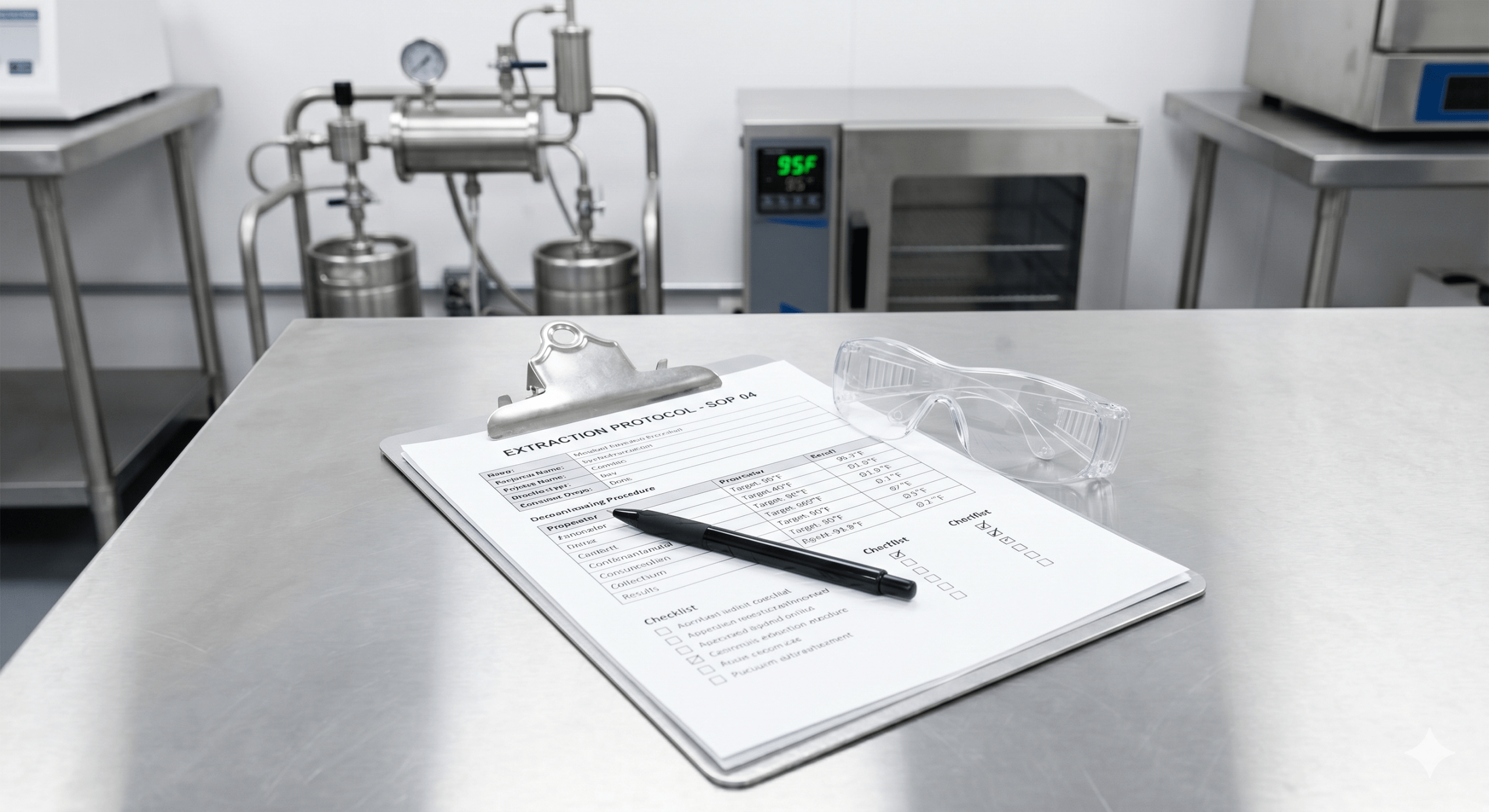
What Is a Cannabis Extraction SOP?
A cannabis extraction SOP is a written document that defines every variable in your extraction process with a target value, an acceptable range, and a defined action when you fall outside that range. It covers material inputs (solvent grade, starting material specs), process parameters (temperatures, pressures, hold times, solvent ratios), safety controls (PPE, gas detection, emergency procedures), and quality checkpoints (in-process tests, acceptance criteria, deviation protocols). A properly written extraction SOP eliminates operator judgment calls and gives inspectors a document they can verify against your actual batch records. The seven sections required by most state regulators are: header identification, material specifications, process parameters, safety protocols, quality control checkpoints, deviation documentation (CAPA), and batch release criteria.
What does a cannabis extraction SOP actually need to contain?
A cannabis extraction standard operating procedure needs seven sections that inspectors verify during every audit: header identification (operator, date, method, batch), material specifications (input weight, cannabinoid profile, moisture content), process parameters (temperatures, pressures, hold times, solvent ratios), safety protocols (PPE, gas detection thresholds, emergency procedures), quality control checkpoints (in-process tests, acceptance criteria, out-of-spec actions), deviation documentation (what went wrong, root cause, corrective action), and batch release criteria (testing requirements, hold times, label reconciliation). Most templates online give you the section headers. None of them tell you what numbers to put in each field. That is the difference between a template and an SOP.
An SOP that says “heat the solvent to the appropriate temperature” will fail an audit. An SOP that says “heat ethanol to 78.4C (173F) using a jacketed vessel with PID control, verify with calibrated K-type thermocouple, acceptable range 76-80C” will pass. Inspectors check specificity because specificity is what prevents accidents. Vague SOPs create operator judgment calls. Operator judgment calls create inconsistent batches. Inconsistent batches create failed testing. The SOP is the document that prevents all of it. The same specificity rule applies to your sampling and release-testing SOP; the potency cross-test audit guide lays out the increment sampling plan, the unit RSD limit and the off-target investigation record a regulator asks for first.
The Seven Sections Every Extraction SOP Must Include
1. Header and Document Control
Every SOP starts with a header block that proves the document is current, authorized, and traceable. Inspectors check this FIRST. If the header is incomplete, they flag the entire SOP before reading the process.
Required fields: SOP number (unique identifier tied to your document management system), revision number and date, effective date, author name and title, reviewer name and title, approver name and signature, next review date (most states require annual review at minimum), distribution list (who has a copy), and superseded SOP number if this replaces a prior version.
The mistake operators make: skipping revision control. An SOP with no revision number tells the inspector this document has never been reviewed since it was written. That is a finding. Every change, even minor wording updates, gets a new revision number with a changelog entry.
2. Material Specifications and Input Criteria
Before extraction starts, the SOP must define exactly what goes in. Inspectors verify that your input criteria match your actual batch records.
| Parameter | What to Specify | Example (BHO) | Example (Ethanol) | Why Inspectors Check This |
|---|---|---|---|---|
| Input material type | Fresh frozen, dried flower, trim, biomass | Dried flower, 8-12% moisture | Dried trim, 10-15% moisture | Material type determines extraction parameters |
| Maximum batch size | Weight in grams or pounds per run | 5 lbs per column | 20 lbs per wash cycle | Overloading equipment is a safety violation |
| Input testing requirements | Potency, pesticides, moisture, foreign matter | COA required: cannabinoid profile, pesticide screen | COA required: cannabinoid profile, moisture <15% | Garbage in, garbage out. Testing proves input quality. |
| Solvent specification | Grade, purity, supplier, CAS number | n-Butane, instrument grade 99.5%+, CAS 106-97-8 | Ethanol, USP grade 200 proof, CAS 64-17-5 | Wrong solvent grade = contamination risk |
| Solvent ratio | Volume or weight of solvent per unit of material | 3:1 to 5:1 by weight (butane to material) | 10:1 by volume (ethanol to material) | Ratio affects yield, purity, and solvent residuals |
3. Process Parameters: The Numbers That Matter
This is where most SOPs fail audits. The process section must contain specific, measurable parameters for every step. Not “heat gently.” Not “cool to an appropriate temperature.” Exact numbers with acceptable ranges and what to do if you fall outside those ranges.
| Extraction Method | Critical Parameter | SOP Target | Acceptable Range | Failure Threshold |
|---|---|---|---|---|
| Closed-loop BHO | Column soak temperature | -40C (-40F) | -20C to -60C | Above 0C: excessive wax/chlorophyll co-extraction |
| Closed-loop BHO | Recovery tank temperature | 85-95F (29-35C) | 80-110F | Above 130F: terpene degradation, pressure hazard |
| Closed-loop BHO | System operating pressure | 0-30 PSI gauge | 0-50 PSI | Above 150 PSI: relief valve territory, evacuate |
| Cryo ethanol | Ethanol wash temperature | -40C (-40F) | -20C to -80C | Above -20C: chlorophyll co-extraction, dark crude |
| Cryo ethanol | Contact time | 3-5 minutes | 1-10 minutes | Above 15 min at warm temps: wax saturation |
| Vacuum purge | Oven temperature | 90-110F (32-43C) | 85-120F | Above 140F: decarboxylation onset, product change |
| Vacuum purge | Vacuum depth | -29.5 inHg (-100 kPa) | -28 to -29.9 inHg | Above -25 inHg: incomplete solvent removal |
| Winterization | Freezer hold temperature | -20C (-4F) minimum | -20C to -80C | Above -10C: waxes remain dissolved, filtration fails |
| Winterization | Hold time | 24 hours | 12-48 hours | Below 12 hours: incomplete lipid precipitation |
Every parameter in this table belongs in your SOP. Not as a range. As a target value with an acceptable range and a defined action when you exceed the failure threshold. That three-part structure (target, range, failure) is what separates a document that passes audit from one that gets flagged.
4. Safety Protocols: What Gets Labs Shut Down
Safety is not a section you bolt on at the end. Inspectors read the safety protocol alongside the process section, checking that every hazardous step has a corresponding control. If the process says “pressurize the system to 30 PSI” and the safety section does not mention pressure relief, leak detection, or maximum operating pressure, that is a finding.
Required safety elements by extraction type:
Hydrocarbon (BHO) labs: LEL monitoring with alarm set at 10% LEL (not 25%, which is the IDLH threshold). Continuous air monitoring placement diagram. Ventilation rate documentation (12+ air changes per hour for extraction rooms, verified by anemometer readings). Emergency shutdown procedure with numbered steps. Solvent storage limits per NFPA 30 (60 gallons max in a single room for Class I flammable liquids). Blast-rated enclosure specifications if applicable.
Ethanol labs: Ignition source control documentation. Static grounding and bonding procedures for every transfer point. Ethanol vapor density reminder (1.59 relative to air: it pools at floor level). Spill containment volume calculation (must contain 110% of largest single container). Emergency eyewash and shower locations with weekly inspection log.
All extraction labs: PPE requirements by step (not just “wear PPE”): nitrile gloves minimum 8 mil for solvent handling, safety glasses with side shields for any pressurized operation, full face respirator with organic vapor cartridge when breaking open systems. First aid procedures specific to solvent exposure. Emergency contact numbers posted within line of sight of every workstation.
5. Quality Control Checkpoints
Quality control in an SOP is not “test the final product.” It is a series of in-process checks that catch problems before they become failed batches. Inspectors look for these because in-process testing proves you are controlling the process, not just testing the output.
In-process checkpoints every extraction SOP should include: pre-extraction equipment verification (leak test, calibration check, clean confirmation), mid-process temperature verification (logged, not just observed), post-extraction weight reconciliation (input vs output, expected yield range), visual inspection criteria at each stage (color, clarity, viscosity with defined acceptance criteria), and solvent residual testing trigger (when to send for GC analysis vs when to continue purging).
The out-of-spec action is the part most SOPs miss entirely. If your in-process test shows the temperature drifted outside the acceptable range, what do you do? Stop the run? Continue and note the deviation? Scrap the batch? The SOP must answer this for every checkpoint. “Use best judgment” is not an answer. It is an audit finding.
6. Deviation and CAPA Documentation
When something goes wrong, the SOP must define how to document it. This is the Corrective and Preventive Action (CAPA) framework that most small cannabis operators skip entirely and that inspectors specifically ask about.
Minimum deviation documentation: date and time of deviation, step number where the deviation occurred, description of what happened vs what should have happened, immediate action taken (stop, continue, adjust), root cause analysis (not “operator error” but specific: “thermocouple reading lagged due to probe placement outside the fluid stream”), corrective action (what was done to fix this specific batch), preventive action (what SOP change prevents this from happening again), and sign-off by both operator and quality manager.
If you want to learn this entire framework hands-on with real batch documentation and SOPs you can actually hand to your team, that is exactly what we built extractiontraining.com for.
7. Batch Release Criteria
The final section defines what must happen before a batch leaves the production area. Inspectors check this against your actual batch records to verify you follow your own rules.
Release criteria include: all in-process checks completed and within specification, all deviations documented and resolved, final product testing submitted (potency, residual solvents, pesticides, heavy metals, microbial as required by state), COA received and reviewed against acceptance criteria, label reconciliation complete (labels issued vs labels used vs labels destroyed), yield within expected range (flag batches with yield deviation greater than 15% from the SOP target for investigation), and authorized release signature from someone other than the operator who ran the batch.
Common SOP Audit Failures and How to Prevent Them
| Audit Finding | What Inspectors See | Root Cause | Fix |
|---|---|---|---|
| Vague process parameters | “Heat to appropriate temperature” | SOP written by management, not operators | Add target + range + failure threshold for every parameter |
| No revision control | SOP has no version number or last review date | Document was written once and never touched | Implement version numbering, annual review schedule |
| Safety gaps | Process describes pressurization but safety section omits pressure relief | Safety section written separately from process section | Cross-reference every hazardous step with its safety control |
| Missing out-of-spec procedures | QC checkpoints exist but no action defined when they fail | SOP focuses on the happy path only | Define stop/continue/scrap decision for every checkpoint |
| Batch records don’t match SOP | SOP says -40C ethanol wash, batch records show -20C | SOP was written ideally, not practically | Write the SOP to match your actual capability, not your aspirational capability |
| No CAPA framework | Deviations logged as “operator error” with no corrective action | Operators blame people instead of systems | Require root cause + corrective action + preventive action for every deviation |
State-by-State SOP Requirements: What Varies
Every state with an extraction licensing program requires SOPs. The specifics vary, but the core structure above covers 90% of what any state inspector will look for. Here is what varies:
California (DCC): SOPs must be submitted with the license application. DCC inspectors conduct unannounced inspections and verify that actual operations match submitted SOPs. Extraction-specific SOP requirements are defined in CCR Title 4, Division 19, Section 17217. SOPs must include cleaning and sanitation procedures for all equipment.
Colorado (MED): SOPs required for every licensed activity. Colorado is unique in requiring that extraction SOPs specifically address solvent recovery rates and waste disposal procedures. Inspectors check that vacuum oven purge times in SOPs match batch log entries.
Oregon (OLCC/ODA): Oregon provides actual SOP templates on the state website (the “Processor SOPs and Mix Logs” PDF from the SERP). These templates are a good starting framework but lack the parameter specificity described above. Inspectors check that operators have been trained on SOPs and can explain the process during audits.
Michigan (CRA): Michigan requires SOPs to include material safety data sheets (SDS) for all solvents as appendices. Inspection frequency increased in 2025, and SOP compliance is a primary focus area.
For the full licensing requirements by state, including SOP submission requirements, see our Cannabis Extraction License Requirements by State guide.
Frequently Asked Questions
How many SOPs does a cannabis extraction lab need?
A minimum of 8 to 12 SOPs covering: each extraction method you operate, post-processing procedures (winterization, distillation, purging), equipment cleaning and sanitation, waste disposal, sample collection and chain of custody, emergency procedures, quality control and testing protocols, and receiving and inventory management. Larger operations add SOPs for each product type (shatter, distillate, edible oil) because the process parameters differ enough that one generic SOP creates confusion on the production floor.
Can I use a template SOP from the internet for my extraction lab?
You can use a template as a starting framework, but submitting a generic template as your SOP will likely fail an audit. Inspectors check that your SOP matches your actual equipment, your actual capabilities, and your actual operations. A template that lists -80C ethanol wash temperature is useless if your freezer only reaches -20C. Your SOP must reflect what you actually do, not what the template says you should do.
How often do cannabis extraction SOPs need to be reviewed?
Most states require annual review at minimum. Best practice is to review after every significant deviation, after any equipment change, after any regulatory update, and at least every 12 months even if nothing changed. Each review gets a new revision number and a dated signature from the reviewer. California DCC and Colorado MED inspectors specifically check revision dates during unannounced inspections.
What happens if an inspector finds my SOP doesn’t match my actual process?
This is one of the most common and most serious findings. It means either your SOP is wrong (you wrote an aspirational document) or your process is wrong (you are deviating from your own procedures). Either way, it is a finding that can result in a corrective action plan, increased inspection frequency, or in severe cases, license suspension. The fix is simple: write your SOP to describe what you actually do. If what you actually do is not compliant, fix the process first, then update the SOP.
Do I need separate SOPs for BHO extraction and ethanol extraction?
Yes. Each extraction method has different safety hazards, different equipment, different process parameters, and different regulatory requirements. BHO extraction operates in a C1D1 classified space with hydrocarbon gas detection. Ethanol extraction has different ventilation requirements and ignition source controls. Combining them into one SOP creates confusion and audit risk. Each method gets its own SOP. Post-processing steps that apply to both (winterization, purging) can share an SOP if the parameters are identical regardless of the upstream extraction method.
What residual solvent limits should my SOP specify?
Your SOP should reference your state’s specific limits, which vary. California follows USP 467 with modifications: butane and propane at 5,000 ppm each, ethanol at 5,000 ppm, heptane at 5,000 ppm. Colorado sets tighter limits for some solvents. Oregon follows similar USP 467 guidelines. Your SOP should specify both the testing method (headspace GC-FID or GC-MS) and the pass/fail threshold. Best practice: set your internal SOP limit at 80% of the state limit to provide a safety margin. If the state allows 5,000 ppm butane, set your SOP target at 4,000 ppm with an action limit at 3,500 ppm.
Ready to level up your extraction game? Contact WKU Consulting for personalized guidance on building your extraction lab.
For more deep dives into cannabis chemistry, extraction SOPs, and lab design, subscribe to the WKU Consulting YouTube channel.
Watch a related video:
