
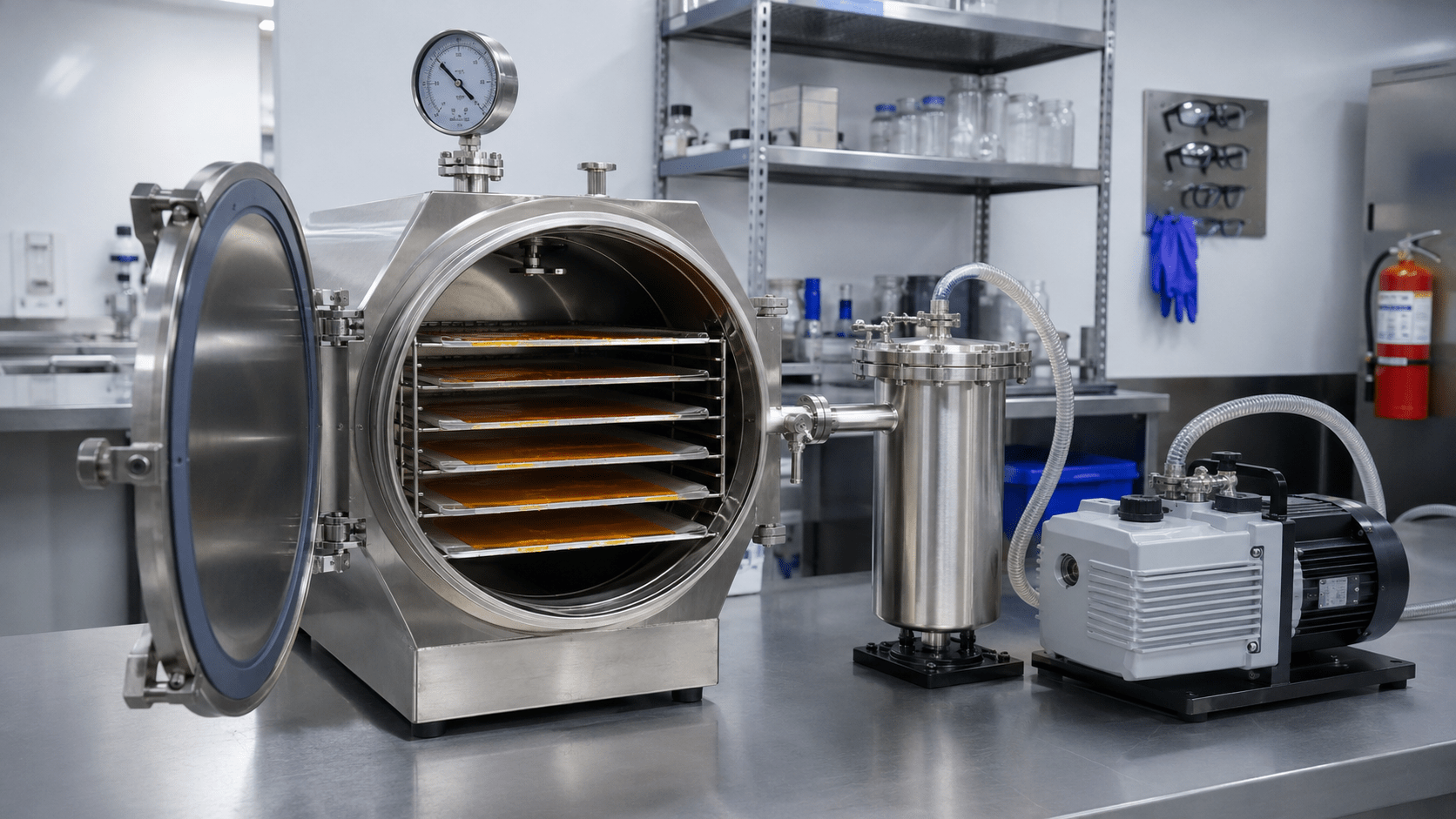
How to Purge Residual Solvents from Cannabis Concentrates: Solvent-Specific SOPs, State Limits, and Diagnostic Protocol
Residual solvent purging for cannabis concentrates requires solvent-specific parameters: butane purges at 29-38C (85-100F) under 29+ inHg vacuum for 24-72 hours to reach sub-500 ppm. Ethanol purges at 40-50C (104-122F) under 28+ inHg for 8-24 hours. Propane purges faster than butane (lower boiling point: -42C vs -1C at atmospheric pressure) but demands identical vacuum depth. CO2 extracts rarely need vacuum purging since supercritical CO2 flashes off at ambient pressure, but subcritical runs can trap 200-800 ppm requiring 2-4 hours at 35C under vacuum. State limits range from 500 ppm total hydrocarbons (Oregon) to 5,000 ppm residual butane (Colorado). Getting below your state’s threshold is not a guess: it is a process with measurable parameters at every step.
What Is Residual Solvent Purging?
Residual solvent purging is the removal of the extraction solvent left in a cannabis concentrate after collection, down to the limit the product’s market allows: commonly 5,000 ppm total butane and propane, 5,000 ppm ethanol, and tighter limits for inhalables in several states. It is done by vacuum, heat, surface area, and time: a slab poured at 3 mm and held at 90 to 100F under -29 inHg loses solvent faster than a 10 mm slab at the same conditions, and mass-loss tracking to a plateau is the only bench check that predicts the GC result. The solvent-specific SOPs, the state limits table, and the failure diagnostics follow.
Most operators treat purging as “put it in the oven and wait.” That approach fails compliance testing 15-20% of the time. The difference between passing and failing is not patience. It is understanding what you are actually trying to do: lower the partial pressure of dissolved solvent below the solubility threshold at your chosen temperature and vacuum depth. Every parameter in this SOP exists to manipulate that relationship.
Why Solvent Type Changes Everything About Purging
Butane, propane, ethanol, and CO2 are not interchangeable when it comes to purging. Each solvent has a different boiling point, different solubility in cannabis lipid matrices, and different behavior under vacuum. A purge protocol that works perfectly for butane can leave 3,000 ppm of ethanol in the same product.
The core physics: a solvent evaporates from concentrate when its vapor pressure exceeds the ambient pressure above the surface. Vacuum lowers the ambient pressure. Heat increases the vapor pressure. Thin-film spreading increases the surface area. All three variables work together. But the rate-limiting step changes by solvent:
- Butane (BP -1C / 31F at 1 atm): Highly volatile. Leaves the surface quickly once vacuum pulls the headspace below butane’s vapor pressure. The rate-limiting step is diffusion from the interior of thick slabs, not surface evaporation. Thin spreading is everything.
- Propane (BP -42C / -44F at 1 atm): Even more volatile than butane. Purges faster from surfaces but can get trapped in dense crystalline matrices. Same thin-film rules apply.
- Ethanol (BP 78C / 173F at 1 atm): Much higher boiling point. Dissolves into the lipid matrix more deeply and has stronger hydrogen bonding with cannabinoid hydroxyl groups. Requires higher temperatures and longer times. Vacuum alone is not enough; heat is the primary driver.
- CO2 (sublimation at -78C at 1 atm): Supercritical CO2 extracts degas almost completely during depressurization. Subcritical runs can trap CO2 in viscous wax matrices. Short, mild purge usually sufficient.
Butane and Propane (Hydrocarbon) Purge SOP
This is the most common purge in commercial cannabis processing. The goal: reduce total hydrocarbons below your state’s limit (typically 500-5,000 ppm depending on jurisdiction) without destroying terpenes, degrading cannabinoids, or nucleating the extract into an unintended texture.
Equipment
- Vacuum oven with shelf-to-shelf temperature uniformity within 2C (check with IR thermometer across all shelves before loading)
- Vacuum pump capable of pulling 29.5+ inHg (deep vacuum). Oil-sealed rotary vane preferred for sustained deep vacuum. Diaphragm pumps plateau at 28-29 inHg and may not be sufficient.
- Cold trap between oven and pump (prevents solvent vapor from contaminating pump oil and degrading vacuum depth over time)
- Parchment-lined silicone mats or PTFE sheets for tray loading
- IR thermometer for surface temp verification
- Analytical balance (0.01g resolution) for mass-loss tracking
Step-by-Step Protocol
Step 1: Thin-Film Spread. Spread the extract to 2-3mm maximum thickness on parchment. Thicker slabs trap butane in the interior where diffusion, not evaporation, is the rate-limiting step. A 10mm slab can take 3-5x longer to purge than a 2mm film. If the extract is too viscous to spread thin at room temperature, warm it briefly to 35-40C on a hot plate until workable, then spread immediately.
Step 2: Initial Vacuum Pull. Load trays into the preheated oven. Set temperature to 29C (85F) for terpene-sensitive products (live resin, sauce) or 35-38C (95-100F) for standard shatter/wax. Pull vacuum to 29+ inHg. Do not rush this step: pull vacuum slowly over 5-10 minutes to prevent “muffining” (rapid outgassing that expands the slab into a puffy, aerated structure that can overflow trays and is harder to handle).
Step 3: First Purge Cycle (0-8 hours). Maintain temperature and vacuum. During the first 2-4 hours, the majority of free butane evaporates. You will see active bubbling if you have a window. Bubbling intensity decreases over hours 4-8. Do not break vacuum during this phase unless checking mass loss at the 4-hour mark.
Step 4: Flip and Redistribute (8-hour mark). Break vacuum slowly (crack the valve, do not release all at once). Remove trays. If the extract has muffined or puffed, press it flat and re-spread to 2-3mm. Flip any solid slabs. Re-load, re-pull vacuum over 5-10 minutes, and continue.
Step 5: Extended Purge (8-72 hours). Continue at the same temperature and vacuum. Total purge time depends on starting material:
| Extract Type | Starting Solvent Load | Temp (C/F) | Vacuum (inHg) | Time (hours) | Target (ppm) | Failure Threshold |
|---|---|---|---|---|---|---|
| BHO Shatter | 3-8% residual | 35-38 / 95-100 | 29.5+ | 48-72 | <500 | >1,000 ppm at 48h = restart with thinner spread |
| BHO Budder/Wax | 2-5% residual | 35-38 / 95-100 | 29.5+ | 24-48 | <500 | >800 ppm at 24h = check vacuum depth |
| Live Resin / Sauce | 5-12% residual | 29-32 / 85-90 | 29.5+ | 48-96 | <500 | >1,500 ppm at 48h = terpene fraction trapping solvent |
| Propane Extract | 1-4% residual | 29-35 / 85-95 | 29.5+ | 16-36 | <500 | >600 ppm at 16h = check cold trap and pump oil |
Step 6: Mass-Loss Tracking. Weigh the tray assembly (tray + parchment + extract) before loading and at each flip interval. When consecutive 8-hour weigh-ins show less than 0.05% mass change, the purge is functionally complete. This is more reliable than visual assessment because the last 200-500 ppm of butane is invisible.
Step 7: Confirmation Pull. After mass stabilization, pull a small sample (0.5-1g) from the thickest section of the slab. This is where residual solvent concentrates. Send for GC-MS or GC-FID residual solvent testing. Do not pull from edges or thin areas: they purge first and will give falsely low readings.
Ethanol Purge SOP
Ethanol is a fundamentally different purge challenge. Its boiling point (78C at atmospheric pressure) means vacuum alone does not create the pressure differential that drives butane purging. You need both heat and vacuum, and the temperatures required are high enough to decarboxylate THCa if you are not careful.
The Ethanol Purge Dilemma
At 29 inHg vacuum, ethanol’s effective boiling point drops to approximately 34C (93F). This means you can purge ethanol at temperatures below the decarboxylation threshold (105C onset, significant at 110C+). But 34C ethanol evaporation is slow. The practical approach: purge at 40-50C under deep vacuum, which gives a 6-16C cushion above ethanol’s reduced boiling point and stays well below decarboxylation.
Protocol
Step 1: Rotovap First (if available). A rotary evaporator at 40C and 120-150 mbar removes 90-95% of ethanol in 30-60 minutes. This is the most efficient first pass. If you do not have a rotovap, skip to Step 2 but expect 2-3x longer oven time.
Step 2: Vacuum Oven Finish. Spread the rotovap-concentrated crude to 3-5mm on parchment (ethanol crude is typically more viscous than BHO, so thicker spreads are acceptable). Load into a preheated oven at 40-50C (104-122F). Pull vacuum to 28+ inHg.
Step 3: Extended Purge (8-24 hours). Ethanol purges slower than butane even under identical conditions because of hydrogen bonding with cannabinoid hydroxyl groups. The ethanol molecules are literally stuck to the cannabinoids. Heat is what breaks these bonds. Monitor mass loss every 4-6 hours.
Step 4: Confirmation. Same mass-loss tracking protocol. Ethanol target: below 500 ppm in most states (California: 5,000 ppm for Class 2 solvents including ethanol, but many operators target sub-500 for product quality). Pull confirmation sample from the thickest section.
CO2 Extract Purge Protocol
Supercritical CO2 extraction operates at 1,100-7,500 PSI. When the system depressurizes, CO2 transitions from supercritical fluid to gas and escapes the extract matrix almost completely. Most supercritical CO2 extracts test at 0 ppm residual CO2 without any purging.
Subcritical CO2 runs (lower pressure, 300-800 PSI) produce waxier, more viscous extracts that can physically trap CO2 bubbles. These extracts may contain 200-800 ppm residual CO2. A brief vacuum oven treatment (35C, 28+ inHg, 2-4 hours) resolves this. CO2 is non-toxic and most state regulations either exempt it or set generous limits (10,000+ ppm), so purging is primarily for product quality, not compliance.
State-by-State Residual Solvent Limits
Every state sets its own residual solvent thresholds. The numbers below are the limits your product must test below to pass compliance testing. These are maximums, not targets. Professional operators target 50-80% below the state limit to build in a margin of error.
Those state lists were written around butane, propane, and ethanol. A methylene chloride or toluene result is a different problem from an under-purged slab: it is the signature of a CBD-to-THC conversion, and the converted THC detection guide covers what to do when one shows up.
| State | Butane Limit (ppm) | Propane Limit (ppm) | Ethanol Limit (ppm) | Total Hydrocarbons | Standard Referenced |
|---|---|---|---|---|---|
| California | 5,000 | 5,000 | 5,000 | N/A (individual) | 16 CCR 5723 |
| Colorado | 5,000 | 5,000 | 5,000 | N/A (individual) | 1 CCR 212-3 |
| Oregon | 500 | 500 | 5,000 | 500 total Class 1 | OAR 845-025-1230 |
| Washington | 500 | 500 | 5,000 | 500 total Class 2 | WAC 314-55-1025 |
| Michigan | 500 | 500 | 5,000 | 500 total Class 1 | LARA R 420.206 |
| Massachusetts | 500 | 500 | 5,000 | 500 total Class 1 | 935 CMR 500.160 |
| Illinois | 500 | 500 | 5,000 | 500 total Class 1 | 68 IAC 1290.420 |
| Oklahoma | 5,000 | 5,000 | 5,000 | N/A (individual) | OAC 442:10-9-8 |
Notice the pattern: states that adopted USP 467 or ICH Q3C guidelines (Oregon, Washington, Michigan, Massachusetts, Illinois) set 500 ppm limits for Class 2 solvents like butane and propane. States with their own frameworks (California, Colorado, Oklahoma) allow up to 5,000 ppm. If you operate in a 500 ppm state and your oven is calibrated for Colorado’s 5,000 ppm tolerance, you will fail every test.
Thin-Film Spreading: The Most Underrated Purge Variable
Spreading thickness determines purge time more than temperature or vacuum depth. The physics is straightforward: butane molecules at the surface of a thin film evaporate within minutes under vacuum. Butane molecules trapped 10mm deep inside a slab must diffuse through the lipid matrix before they can reach the surface. That diffusion is the slow step.
A 2mm spread purges to sub-500 ppm in 24-48 hours under standard conditions. A 10mm slab of the same material under the same conditions may take 72-120 hours and still test above 1,000 ppm because the interior never fully outgasses. Spreading to 2-3mm is not optional. It is the single most effective variable you control.
For viscous extracts that resist thin spreading: warm to 35-40C on a heated surface until the viscosity drops enough to spread with a silicone spatula. Do this in a well-ventilated area or under a fume hood. The extract still contains 3-12% residual solvent at this point, and warming it releases flammable vapors. Do not heat above 50C during spreading. No open flames or ignition sources within 10 feet. The goal is workable viscosity, not decarboxylation.
Mass-Loss Tracking: The Diagnostic Protocol That Replaces Guessing
Visual assessment (watching for bubbles, checking clarity, poking the slab) is how operators who fail compliance testing decide when purging is done. Mass-loss tracking is how operators who pass every time know when to stop.
The protocol:
- Record initial mass of tray assembly (tray + parchment + extract) to 0.01g before loading into the oven.
- Record mass at each flip interval (every 8 hours for BHO, every 4-6 hours for ethanol).
- Calculate percentage mass loss per interval. Example: if a 150g tray assembly loses 0.08g in 8 hours, that is 0.053% mass loss.
- Purge is complete when two consecutive intervals show less than 0.05% mass change. At this point, the remaining solvent is below the detection threshold for most GC-FID methods (<50 ppm).
- If mass loss plateaus above 0.1% per interval but the extract still tests above limit: the vacuum is not deep enough, the temperature is too low, or the spread is too thick. Troubleshoot before continuing.
This protocol turns purging from a time-based guess into a measurable process with a defined endpoint. It also creates a written record that supports GMP documentation requirements.
Common Purge Failures and How to Diagnose Them
Every purge failure traces back to one of five root causes. If your product keeps failing residual solvent testing, the answer is in this table.
| Symptom | Root Cause | Diagnostic Test | Corrective Action | Prevention |
|---|---|---|---|---|
| Passes at edges, fails at center | Spread too thick. Interior butane trapped by diffusion barrier. | Measure slab thickness with calipers. If >5mm at center, this is the cause. | Re-spread to 2mm, restart purge. | Always spread to 2-3mm max. Verify with ruler before loading. |
| Mass loss stalls above 0.1%/interval | Vacuum leak. Ambient air leaking into oven reduces pressure differential. | Close oven valve, pump down to 29.5+ inHg, watch gauge for 15 min. If pressure rises >0.5 inHg, there is a leak. | Check door gasket, hose fittings, valve seals. Replace degraded gasket. Use vacuum grease on connections. | Leak-check the oven weekly. Replace gaskets every 6-12 months. |
| Extract muffins/expands violently | Vacuum pulled too fast. Rapid pressure drop causes dissolved butane to nucleate as large bubbles. | Observe rate of vacuum pull. If reaching 29 inHg in <2 minutes, too fast. | Flatten the muffined extract, re-spread thin, restart. Next time, pull vacuum slowly over 5-10 minutes. | Use a needle valve to control pump-down rate. Target 5-10 min to full vacuum. |
| Cold spots: center shelves purge, top/bottom fail | Oven temperature not uniform. Top and bottom shelves 3-5C colder than center. | IR thermometer on each shelf surface after 1 hour at setpoint. Compare readings. | Rotate trays every flip interval. Set oven 3-5C higher to compensate for cold shelves. | Buy an oven with forced-convection heating. Radiant-only ovens have the worst uniformity. |
| Ethanol extract tests high despite 24+ hours | Temperature too low. Ethanol’s hydrogen bonding keeps it dissolved in the lipid matrix below 35C even under vacuum. | Verify actual surface temp with IR thermometer. If <38C, heat is insufficient. | Increase to 45-50C. If decarboxylation is a concern, pre-purge with rotovap to remove 90-95% of ethanol before oven finishing. | Always rotovap ethanol crude before vacuum oven. The oven is a polishing step, not a primary removal step. |
Equipment Selection: When to Use What
A vacuum oven is the default for solvent purging. But it is not the only tool, and for ethanol it is not even the best primary tool.
- Vacuum oven: Primary purge tool for all hydrocarbon extracts. Finishing tool for ethanol crude post-rotovap. Batch process. Throughput limited by shelf space. Cost: $2,000-$15,000 depending on size (0.9 cu ft to 7.5 cu ft).
- Rotary evaporator: Primary ethanol removal (90-95% in one pass). Not effective for hydrocarbon purging. Throughput: 1-5L per hour depending on flask size and bath temperature. Cost: $5,000-$25,000.
- Falling film evaporator: High-throughput ethanol removal for commercial scale. Processes 10-50L per hour of crude. Removes 95-99% of ethanol in a single pass. Overkill for operations under 100 lbs/day. Cost: $30,000-$150,000.
- Thin-film evaporator / wiped film: Used in distillation, not primary purging. Can remove trace solvents during the distillation pass itself, but this is a secondary benefit. For dedicated solvent purging at a post-processing scale, see our wiped film distillation guide.
If you want to learn the full extraction-to-finished-product workflow including purge station design, SOP development, and compliance documentation, that is exactly what we built extractiontraining.com for.
Sampling for GC-MS: How to Pull a Representative Sample
The sample you send to the testing lab determines whether you pass or fail. A poorly pulled sample will give you either a false pass (dangerous: product goes to shelves with residual solvent) or a false fail (expensive: batch gets rejected, re-purged, re-tested).
Rules for representative sampling:
- Sample from the thickest section. The center of the slab or the bottom of a jar is where residual solvent concentrates. Edges and thin sections purge first and will give falsely optimistic readings.
- Use a clean tool. Isopropanol-cleaned stainless steel dabber or spatula. Contamination from a dirty tool can introduce solvents that were not in the product.
- Sample at room temperature. Do not sample from a hot extract straight out of the oven. Residual solvent is more volatile at elevated temps and will off-gas during sample collection, giving a falsely low reading.
- Collect 0.5-1.0g. More is better for analytical precision, but most labs specify a minimum. Check with your testing lab.
- Seal immediately. Place in a glass vial with a PTFE-lined cap. Every second the sample sits exposed, solvent evaporates. Cap the vial within 10 seconds of pulling the sample.
- Maintain chain of custody. Label with batch ID, date, time, sample location (center/edge/top/bottom), and sampler initials. This is not optional in regulated markets.
How to Rescue a Failed Residual Solvent Batch
A failed COA is a geometry and vacuum problem before it is a heat problem. Cooking the batch hotter darkens it and strips the light terpene fraction, and it still leaves the solvent that is sitting under a skinned-over surface. Rescue in this order:
- Read the COA, not the slab. Know which solvent failed and by how much. Butane high with propane in range points at slab thickness. Propane high with butane in range points at a purge that stopped early: propane is the last hydrocarbon out. Ethanol high after an oven finish points upstream, at rotovap recovery that never reached 90 to 95 percent.
- Inspect the matrix. Warm the slab to 40C. If it flows and re-spreads, rescue it. If it has greased out, nucleated, or browned, you are choosing between a compliant downgrade and a rework, and those are not the same product.
- Increase area before anything else. Re-spread to 2 to 3 mm, measured, on a fresh tray. This single step fixes more failed batches than the next five combined.
- Leak-check the oven before you restart it. Isolate the oven at 29.5 inHg and watch the gauge for 15 minutes. A rise over 0.5 inHg means a rescue purge on this oven is wasted time until the gasket or a fitting is replaced.
- Use the SOP setpoint, not a higher one. The same shelf temperature that the solvent-specific SOP above calls for, verified with an IR thermometer on the shelf surface, not the controller display.
- Hold until the mass-loss curve flattens. Weigh at every interval. When loss drops under 0.1 percent per interval for two consecutive intervals, the diffusion-limited tail is finished. Calm bubbles are not the endpoint; the scale is.
- Retest. Pull the GC-MS sample from the center of the thickest tray, per the sampling section below. A rescued batch that passes at the edge and fails in the middle is not rescued.
- Write down the real parameters. Actual shelf temperature, vacuum depth, tray load in grams, film thickness in millimeters, and total hold. Nominal setpoints cannot be troubleshot.
Sub-Limit Solvent Still Costs You: Quality Above the Compliance Floor
A batch at half the state limit is legal and can still be a bad product. Residual butane at a few hundred ppm flattens terpene expression and adds a chemical top note on the first pull; trapped volatiles keep a shatter mobile so it sugars or slumps in the jar; and the pop and expansion on a nail that consumers read as “wet” is dissolved gas leaving the matrix on heating. A jar that changes after packaging was not finished, whatever the COA says. The operators whose product holds up at 90 days purge to the mass-loss endpoint, not to the legal line.
Operator Checklist Before You Blame the Recipe
Most recurring residual solvent failures live inside these eight questions:
- Did the extraction system recover as much solvent as it should have before the pour, or is the oven being asked to do the recovery pump’s job?
- Is the tray loaded as a thin, even film (2 to 3 mm) rather than a thick central pool?
- Was the oven fully preheated and the shelf surface verified before the product went in?
- Does the oven hold vacuum when isolated (under 0.5 inHg rise in 15 minutes)?
- Has the pump been maintained and its ultimate vacuum verified recently, and is the gauge believable?
- Was the crude winterized or cleaned well enough upstream for the product path you are asking it to take?
- Did you hold through the late, diffusion-limited phase, or only through the early fast boil-off?
- Are the recorded parameters the actual shelf temperature, vacuum depth, load, and thickness, or the nominal setpoints?
Frequently Asked Questions
How long does it take to purge butane from BHO?
At 35-38C under 29.5+ inHg vacuum with a 2-3mm thin film spread: 24-72 hours depending on extract type. Shatter takes 48-72 hours. Budder and wax take 24-48 hours. Live resin and sauce take 48-96 hours because the terpene fraction traps butane. The single biggest factor is spread thickness, not time. A 2mm film purges to sub-500 ppm in 48 hours under standard conditions. A 10mm slab of the same material may take 120+ hours.
Can you purge ethanol the same way as butane?
No. Ethanol has a boiling point of 78C versus butane’s -1C. Even under deep vacuum (29 inHg), ethanol’s reduced boiling point is approximately 34C, meaning you need both heat and vacuum. The correct approach: remove 90-95% of ethanol via rotary evaporator at 40C and 120-150 mbar first, then finish in a vacuum oven at 40-50C for 8-24 hours. Skipping the rotovap step and going straight to the oven works, but expect 2-3x longer purge times and higher energy costs.
What happens if residual solvent is too high in the finished product?
The product fails state compliance testing and cannot be sold. In most markets, a failed residual solvent test triggers a mandatory remediation or destruction protocol. The batch must be re-purged and re-tested (additional $150-300 per test in most states) or destroyed with documented chain of custody. Repeated failures can trigger audits of your processing SOP. Beyond compliance: residual butane above 1,000 ppm produces a chemical taste, throat irritation, and headaches in consumers.
How do I know when purging is done without sending a sample?
Mass-loss tracking. Weigh the tray assembly (tray + parchment + extract) before loading and at every 8-hour flip interval. When two consecutive 8-hour intervals show less than 0.05% mass change, the purge is functionally complete. This protocol is more reliable than visual assessment (watching for bubbles) because the last 200-500 ppm of residual solvent produces no visible off-gassing. Always confirm with a GC-MS test before selling the batch.
What is the difference between USP 467 and state-specific solvent limits?
USP 467 is the pharmaceutical reference standard for residual solvents. It classifies butane and propane as Class 2 solvents with a 5,000 ppm limit, and ethanol as a Class 3 solvent with a 5,000 ppm limit. States like Oregon, Washington, and Michigan adopted the USP classification system but set tighter limits: 500 ppm for Class 2 hydrocarbons. States like California and Colorado reference USP 467 directly and accept the full 5,000 ppm threshold. Always check your specific state’s regulations, not the federal standard.
Does vacuum purging destroy terpenes?
It can. The most volatile terpenes (myrcene BP 167C, limonene BP 176C, pinene BP 155C) begin evaporating at temperatures well below their atmospheric boiling points when vacuum reduces the headspace pressure. At 29.5 inHg vacuum (approximately 14 mmHg absolute), these compounds evaporate significantly faster: myrcene’s effective boiling point drops below 60C, and even at 30-35C there is measurable evaporation. Keeping purge temperature at 29-32C minimizes terpene loss but does not eliminate it. Above 38C under deep vacuum, you will lose 15-30% of monoterpene content over a 48-hour purge. This is the tradeoff: lower temperature preserves terpenes but extends purge time.
Why does my shatter keep nucleating during purging?
Nucleation (shatter turning to sugar/budder) during purging usually means the extract has a THCa concentration above 60% and the combination of heat and agitation (from bubbling) provides enough energy for THCa molecules to begin crystallizing. This is a thermodynamic inevitability at high THCa concentrations, not a purge failure. To maintain shatter consistency: keep temperature below 32C, minimize vacuum breaks (each break causes a burst of bubbling that agitates the matrix), and use starting material with lower THCa content (below 55%). For a deeper dive into crystallization kinetics and how to control texture, see our jar tech guide.
Can I purge in a regular oven without vacuum?
Technically, yes, but it requires temperatures of 70-90C to drive butane off at atmospheric pressure, which decarboxylates THCa (onset at 105C, significant loss at 90C+ for extended periods), destroys monoterpenes (50%+ loss above 60C), and changes the extract texture irreversibly. A vacuum oven at 35C under 29.5 inHg achieves the same or better solvent removal as a convection oven at 80C, with dramatically less damage to the product. There is no professional scenario where purging without vacuum is the right choice for saleable cannabis concentrates.
Ready to level up your extraction game? Contact WKU Consulting for personalized guidance on building your extraction lab.
For more deep dives into cannabis chemistry, extraction SOPs, and lab design, subscribe to the WKU Consulting YouTube channel.
For a comprehensive walkthrough of vacuum oven fundamentals and parameter theory, see our vacuum oven purging guide.
