
What Happens When You Press Rosin: The 30-Second Sequence
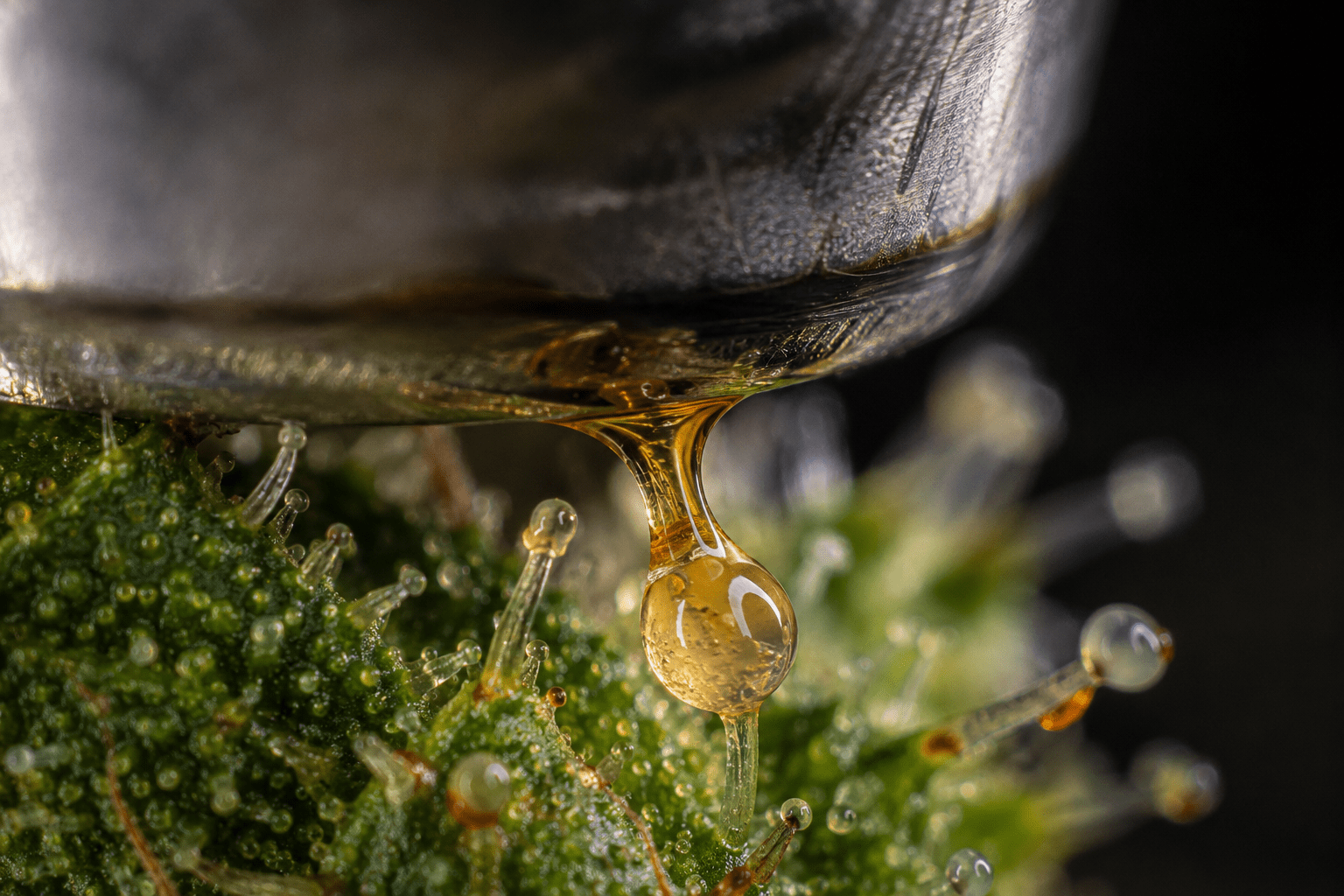
Rosin pressing extracts cannabinoids and terpenes from cannabis by rupturing trichome gland heads at 150-220°F (65-104°C) under 300-1,000 PSI of material pressure, forcing a lipid-cannabinoid-terpene matrix through plant tissue and a filter medium in a process that takes 45-180 seconds. Capitate stalked trichome heads (50-100μm diameter) contain a resin mixture that is roughly 50-70% cannabinoids by dry weight, 10-25% terpenes, 5-15% lipids and waxes, and the remainder flavonoids and other phenolics. At room temperature, this resin has a viscosity exceeding 10,000 cP. Heat drops that viscosity below 500 cP, and mechanical pressure provides the driving force to push the now-mobile resin out of the gland, through the surrounding plant matrix, through the filter bag, and onto the collection surface. No solvent. No chemical reaction. Just thermomechanical phase mobilization.
The reason rosin pressing works at all comes down to three simultaneous mechanisms happening at the plate: trichome gland rupture, lipid phase transition, and viscous flow through a porous medium. Get any one of these wrong and you either leave cannabinoids in the puck, contaminate the extract with chlorophyll and plant lipids, or thermally degrade the terpene profile. Understanding the mechanism behind each one is what separates pressing with intention from pressing with hope.
Trichome Anatomy: What You Are Actually Extracting
Cannabis produces three types of trichomes. Only one matters for rosin.
Capitate stalked trichomes are the extraction target. They stand 150-500μm tall on a multicellular stalk, topped by a secretory gland head 50-100μm in diameter. The gland head is where the plant biosynthesizes and stores cannabinoids, terpenes, and phenolic compounds inside a subcuticular cavity. Think of it as a pressurized oil droplet sitting on a stick. The “oil” is a concentrated resin matrix. The “stick” is a cellulose-lignin stalk that connects the gland to the plant epidermis.
Two other trichome types exist but contribute almost nothing to rosin yield. Capitate sessile trichomes sit flush against the leaf surface with heads only 20-30μm across. They contain resin, but their small size and low density make them negligible contributors. Bulbous trichomes are 10-15μm and contain trace amounts of cannabinoids at best.
The capitate stalked gland head has a specific structure that determines how rosin pressing works. The outermost layer is a waxy cuticle. Beneath that sits a subcuticular cavity where resin accumulates as the secretory disc cells at the base of the head synthesize cannabinoids via the polyketide (olivetolic acid) and MEP (GPP) pathways. The cavity fills with resin over the plant’s flowering cycle. By harvest, the cavity is taut with accumulated product.
Here is the critical detail: the gland head’s cell wall is designed for secretion, not structural support. It has a tensile strength roughly 5-10x lower than the surrounding leaf epidermal cells. When you apply heat and pressure simultaneously, the resin inside the gland expands thermally, the waxy cuticle softens, and the gland ruptures preferentially before the surrounding plant tissue is damaged. This differential is the entire basis of selective solventless extraction. If trichome heads had the same wall strength as leaf cells, pressing would extract a green slurry of chlorophyll, cellulose fragments, and resin. The fact that gland heads fail first is why rosin can be clean.
The Three-Phase Extraction Mechanism
Rosin pressing is not a single event. It is a three-phase sequence that occurs over 45-180 seconds at the plate. Each phase is governed by different physics, and each has failure modes that produce different problems in the final product.
Phase 1: Thermal Softening (0-15 seconds)
When the heated platens contact the cannabis puck, heat conducts from steel (thermal conductivity ~50 W/m·K) through the filter bag material (~0.2 W/m·K for nylon) into the plant material (~0.1-0.2 W/m·K for compressed dry flower). This creates a steep temperature gradient. The outer layer of trichomes reaches platen temperature within 3-5 seconds. The center of a 1-inch thick puck takes 30-60 seconds to equilibrate, depending on moisture content and packing density.
During this phase, three thermal transitions occur simultaneously:
- Cuticular wax softening: Cannabis cuticular waxes melt between 60-70°C (140-158°F). This softens the gland head’s outer barrier.
- Resin viscosity drop: The cannabinoid-terpene resin inside the gland drops from >10,000 cP at room temperature to <500 cP at pressing temperature. Terpenes (particularly monoterpenes like myrcene and limonene with boiling points of 167°C and 176°C respectively) act as natural solvents within the resin, and their viscosity drops exponentially with temperature.
- Thermal expansion: The resin volume increases by approximately 5-8% as it heats from 20°C to 90°C. Inside the sealed gland head, this expansion pressurizes the cavity from the inside.
Phase 1 is why preheat matters. If you apply full pressure before the trichomes have thermally softened, you mechanically crush them rather than rupturing them cleanly. Crushed trichomes release resin mixed with cell wall fragments. Thermally softened trichomes rupture at the cuticle and release clean resin. The difference shows up as color: dark, green-tinted rosin (mechanical crush) versus golden, translucent rosin (thermal rupture).
Phase 2: Gland Rupture and Resin Mobilization (5-30 seconds)
Once the gland heads are thermally softened and internally pressurized, external mechanical pressure causes rupture. The combination of internal thermal expansion and external compressive force exceeds the softened cuticle’s tensile strength, and the gland opens.
Rupture does not happen uniformly across the puck. Trichomes on the surface (closest to the platen) rupture first because they reach temperature first. Trichomes in the center rupture later. This is why slow, ramping pressure outperforms sudden full-pressure application. Ramping pressure allows the thermal wave to propagate inward so that glands rupture in sequence rather than having surface glands crushed while center glands remain cool and intact.
Once ruptured, the mobilized resin faces a transport challenge. It needs to travel from the gland location, through the surrounding plant matrix (a porous medium of leaf tissue, stems, and other plant cells), through the filter bag, and onto the collection surface. This transport is governed by Darcy’s law for flow through porous media:
Q = (k × A × ΔP) / (μ × L)
Where Q is flow rate, k is permeability of the medium, A is cross-sectional area, ΔP is the pressure differential driving flow, μ is resin viscosity, and L is the path length through the medium. Every variable in this equation explains a pressing decision:
- k (permeability): This is why bag micron size matters. A 25μm bag has lower permeability than a 160μm bag. Lower k means lower flow rate at the same pressure.
- A (area): This is why bag size relative to material amount matters. A 2×4 inch bag with 3.5g gives more area per gram than a 2×4 bag with 7g. More area means more flow paths.
- ΔP (pressure): This is the hydraulic force divided by platen area. More pressure drives faster flow, but excessive pressure also drives non-resin material (chlorophyll, plant lipids) through the filter.
- μ (viscosity): This is why temperature matters. Higher temperature means lower viscosity means faster flow. But excessive temperature degrades terpenes and accelerates decarboxylation.
- L (path length): This is why thin, evenly packed pucks outperform thick, loose pucks. Shorter path length means less resistance to flow.
Phase 3: Sustained Flow and Collection (15-180 seconds)
After initial rupture, the press enters a sustained flow phase where resin migrates through the plant matrix under constant pressure. Flow rate declines exponentially over time because the easiest flow paths (largest pores, shortest distances) are exhausted first. The resin that emerges in the first 30 seconds is typically the highest quality: lowest wax content, highest terpene concentration, lightest color. Later flow brings more waxes, some plant lipids, and darker color compounds.
This is why some pressers collect first-press and second-press separately. The first press at lower temperature (160-180°F) captures the most volatile terpenes and least wax. The second press at higher temperature (200-220°F) mobilizes remaining resin that was too viscous to flow at the lower temperature, but it comes with more wax and less terpene content. The chemistry behind this split is viscosity-selective extraction: you are using temperature to control which fraction of the resin is mobile enough to flow at a given pressure.
Heat Transfer Through a Cannabis Puck: Why Temperature Is Not What Your Gauge Reads
The temperature your press displays is the platen surface temperature. The temperature at the trichome head is lower, and it varies by position within the puck. This thermal gradient is the most underappreciated variable in rosin pressing.
| Material | Thermal Conductivity (W/m·K) | Implication for Rosin Pressing |
|---|---|---|
| Steel platen | ~50 | Heat reservoir; maintains surface temp under load |
| Aluminum platen | ~205 | Faster heat delivery but less thermal mass; temp drops on contact |
| Nylon filter bag | ~0.25 | Insulating layer between platen and material; adds thermal lag |
| Parchment paper | ~0.15 | Additional insulating layer; two sheets = measurable temp loss |
| Dry cannabis (compressed) | 0.10-0.20 | Poor conductor; center heats slowly; puck thickness matters |
| Cannabis at 62% RH | 0.15-0.30 | Moisture increases conductivity 50-100%; faster equilibration |
| Water | ~0.60 | 3-6x more conductive than dry plant material |
The practical consequence: if your platens read 190°F and you are pressing a 1-inch thick puck of dry flower, the center of that puck may only be at 150-160°F after 30 seconds. The trichomes in the center are not reaching the temperature you think they are. This is why thin pucks (0.5-0.75 inches) yield better than thick pucks at the same temperature and pressure. It is not about pressure distribution. It is about thermal equilibration time.
Moisture content is the single biggest lever for improving heat transfer without changing press settings. Flower at 62% relative humidity (maintained with humidity packs) has 50-100% higher thermal conductivity than bone-dry flower. The water content acts as a thermal bridge between plant cells, conducting heat deeper into the puck faster. This is the thermodynamic reason why properly humidified flower yields more than dry flower, even at identical temperature and pressure settings. It is not about “steaming” the material. It is about reducing the thermal resistance of the puck so more trichomes reach rupture temperature during the press window.
Pressure Science: What the Gauge Is Actually Telling You
Most hydraulic rosin presses display pressure in tons of force at the ram. This number is nearly useless without knowing your platen area and bag footprint. The variable that governs extraction is material PSI: the pressure experienced by the cannabis inside the bag.
Material PSI = (Ram Force in lbs) / (Bag Footprint in square inches)
A 10-ton press (20,000 lbs of force) with 3×5 inch platens and a 2×4 inch bag footprint:
Material PSI = 20,000 / (2 × 4) = 2,500 PSI
That same 10-ton press with a 3×6 inch bag footprint:
Material PSI = 20,000 / (3 × 6) = 1,111 PSI
Same press. Same gauge reading. Completely different extraction physics.
| Material PSI Range | What Happens | Quality Effect | Best For |
|---|---|---|---|
| Under 300 PSI | Incomplete trichome rupture; resin left in puck | High quality but low yield (3-8%) | Not recommended; wasted starting material |
| 300-600 PSI | Trichome heads rupture; plant cells mostly intact | Highest quality; cleanest color; best terpene retention | Hash rosin; premium flower rosin (first press) |
| 600-1,000 PSI | Complete trichome rupture; some epidermal cell damage | Good quality; higher yield; slightly darker color | Flower rosin (standard press); second press |
| 1,000-1,500 PSI | Plant cell walls compromised; chloroplast contents released | Dark color; green tint; lipid contamination; reduced terpenes | Not recommended unless maximizing yield from low-grade material |
| Over 1,500 PSI | Structural plant tissue destruction; bag blowouts | Contaminated extract; plant material in rosin; bag failure | Never |
The sweet spot exists because of the differential wall strength discussed in the trichome anatomy section. Trichome gland heads fail at lower pressures than plant epidermal cells. The 300-1,000 PSI window exploits this differential: enough force to rupture glands, not enough to crush leaf cells. Go above 1,000 PSI on flower and you start breaking open the cells you want to leave intact, releasing chlorophyll (green color), phospholipids (haze), and cuticular waxes (waxy texture) into your extract.
For hash rosin, the pressure window shifts lower (300-600 PSI) because the starting material is already isolated trichome heads. There are minimal plant cells to worry about. The pressure only needs to rupture the gland cuticle and drive resin flow through the filter bag.
Filter Bag Permeability: Why Micron Size Controls More Than Filtration
Filter bag micron ratings are treated as a filtration spec. They are actually a flow restriction that controls extraction rate, yield, and quality simultaneously. The micron number refers to the mesh opening size, but the variable that governs pressing performance is permeability: how easily resin can flow through the bag under pressure.
| Bag Micron | Relative Permeability | Yield Impact | Quality Impact | Recommended Use |
|---|---|---|---|---|
| 25μm | Low (1x baseline) | 10-15% reduction vs 90μm | Cleanest; minimal lipids; lightest color | Hash rosin (90-120μm bubble hash) |
| 37μm | Low-medium (1.5x) | 5-10% reduction vs 90μm | Very clean; slight yield improvement over 25μm | Hash rosin (full-spectrum hash); premium flower |
| 90μm | Medium (3x) | Baseline | Balanced; some plant lipids pass; good color | Flower rosin (general purpose) |
| 120μm | Medium-high (4x) | 5-10% increase vs 90μm | More lipids; slightly darker; less filtration | Flower rosin (yield-focused); dry sift |
| 160μm | High (6x) | 10-15% increase vs 90μm | Noticeable lipid content; darker; more plant material | Low-grade flower; trim; maximum yield extraction |
| No bag | Unrestricted | Highest raw yield | Plant matter contamination; requires post-press cleanup | Quick tests; personal use with quality tolerance |
The permeability difference between 25μm and 160μm bags is roughly 6x under the same pressure. That means at identical press settings, resin flows 6x faster through a 160μm bag. Faster flow means more material passes through before the press window closes, but it also means larger particles (plant lipids, wax fragments, trichome stalk pieces) pass through.
For hash rosin, the starting material is already isolated trichome heads with minimal plant matter. The bag’s job is to contain the hash while allowing resin to flow. A 25-37μm bag does this while catching any trichome stalk fragments or contaminants. For flower rosin, the starting material contains significant plant tissue, and the bag must filter that while still allowing resin flow. That requires larger openings (90-160μm) because the resin must travel through more plant matrix before reaching the bag, arriving with higher viscosity and more entrained particulates.
Decarboxylation at the Plate: How Much THCa Converts During Pressing
Every rosin press decarboxylates some THCa to THC. The question is how much, and whether it matters.
Decarboxylation follows first-order Arrhenius kinetics. The rate constant increases exponentially with temperature. At rosin pressing temperatures:
| Press Temp | Approximate Decarb Rate | Total Decarb in 90-sec Press | Practical Impact |
|---|---|---|---|
| 160°F (71°C) | ~0.02%/min | <0.1% | Negligible; rosin is essentially all THCa |
| 180°F (82°C) | ~0.08%/min | ~0.1% | Negligible; no measurable effect on potency or consistency |
| 200°F (93°C) | ~0.3%/min | ~0.5% | Minimal; slight THC increase; terpene degradation begins |
| 220°F (104°C) | ~1.0%/min | ~1.5% | Measurable; rosin may test 2-3% THC alongside 60%+ THCa |
| 240°F (116°C) | ~3.5%/min | ~5% | Significant; changes consistency; reduces terpene content 20-40% |
At standard pressing temperatures (170-210°F), decarboxylation during the press is negligible. Less than 1% of THCa converts to THC during a typical 60-120 second press. This is why fresh rosin tests overwhelmingly as THCa, not THC. The press is not hot enough or long enough to drive significant decarboxylation.
The practical concern is not decarboxylation of cannabinoids but degradation of terpenes. Monoterpenes (myrcene, limonene, pinene, terpinolene) have boiling points between 155-185°C (311-365°F) at atmospheric pressure, but they begin volatilizing well below their boiling points. At 220°F (104°C), monoterpene loss during a 90-second press can reach 15-25% of total monoterpene content. At 180°F (82°C), losses stay under 5%. This is the real temperature tradeoff in rosin pressing: higher temps mobilize more resin (higher yield) but volatilize more terpenes (lower quality).
Why Some Cultivars Press Better: Trichome Density, Head Size, and Lipid Composition
Rosin yield varies from 8% to 30%+ depending on cultivar, even when press settings are identical. The mechanism behind this variation comes down to four biological variables that determine how much extractable resin is available and how easily it flows.
The same head-maturity ratio decides the wash before it decides the press: the head maturity vs return table in the bubble hash guide gives the expected 73 to 90 micron return and melt grade for clear, cloudy and amber ratios at harvest.
Trichome density is the most obvious factor. More trichomes per square centimeter means more resin per gram of flower. High-density cultivars (GMO, Papaya, Ice Cream Cake, many Zkittlez crosses) pack 80-120 capitate stalked trichomes per mm² on calyx surfaces. Low-density cultivars may have 30-50 per mm². That 2-3x difference in trichome density maps directly to a 2-3x difference in available resin.
Head-to-stalk ratio matters because the stalk contributes mass but not extractable resin. A trichome with a 100μm head on a 200μm stalk has a different resin-to-mass ratio than one with a 60μm head on a 300μm stalk. Cultivars with large, bulbous gland heads relative to their stalk length (the “mushroom cap” look under magnification) tend to yield better because more of the trichome mass is extractable resin rather than structural cellulose.
Lipid and wax content of the resin affects flow behavior. Cultivars with higher proportions of cuticular waxes in their trichome heads produce resin with higher viscosity at a given temperature. This resin requires higher temperatures to mobilize, and it tends to produce a waxier, more opaque rosin. Cultivars with lower wax content and higher terpene-to-wax ratios produce resin that flows more easily and yields a more translucent, sappier product.
Terpene profile composition directly affects resin viscosity because terpenes act as the solvent component of the resin matrix. Cultivars high in monoterpenes (lower molecular weight, lower viscosity) produce more fluid resin than cultivars dominated by sesquiterpenes (higher molecular weight, higher viscosity). This is why strains with strong lemon or pine profiles (high limonene or pinene, both monoterpenes) often press with a wet, sappy texture, while strains with earthy, spicy profiles (high caryophyllene or humulene, both sesquiterpenes) tend to press drier and require higher temperatures for equivalent flow.
Moisture as a Heat Transfer Medium: The 62% RH Standard Explained
The recommendation to store flower at 55-62% relative humidity before pressing is not about keeping the flower “fresh.” It is about heat transfer physics.
Water has a thermal conductivity of 0.60 W/m·K. Dry cannabis plant tissue has a thermal conductivity of 0.10-0.15 W/m·K. When flower is maintained at 62% RH, the intercellular spaces and cell walls contain enough moisture to increase the bulk thermal conductivity of the puck by 50-100%. This means the center of the puck reaches pressing temperature significantly faster.
There is a second mechanism. When water in the puck reaches approximately 100°C (212°F) at atmospheric pressure (or lower under the compressed conditions inside the bag), it begins to vaporize. This phase change absorbs energy (2,260 kJ/kg latent heat of vaporization), which creates a brief plateau in temperature rise. But the steam generated acts as a heat transfer medium, carrying thermal energy deeper into the puck via convection rather than relying solely on the slow conduction through dry plant matter. This is micro-scale steam-assisted heat transfer, and it is the thermodynamic reason why properly humidified flower presses faster and more completely than overdried material.
The water activity (Aw) target for storage stability is 0.55-0.65 (corresponding to 55-65% RH in equilibrium). Below 0.55 Aw, the flower is too dry for efficient heat transfer and trichome heads become brittle, shattering rather than rupturing cleanly. Above 0.65 Aw, microbial growth risk increases (fungi and mold activate above 0.65 Aw), and excessive moisture can produce steam pockets that cause bag blowouts or sizzling at the plate. The 62% RH target balances heat transfer efficiency against storage safety and pressing behavior. For a deeper dive into water activity science and its role across all extraction methods, see our guide on cannabis starting material moisture and water activity.
The Temperature-Pressure Tradeoff: Why You Cannot Maximize Both
Temperature and pressure both increase resin flow rate (lower viscosity and higher driving force respectively), but they have competing effects on quality. This creates a fundamental tradeoff that governs every pressing decision.
| Goal | Temperature | Material PSI | Press Time | Expected Yield | Quality Profile |
|---|---|---|---|---|---|
| Maximum terpene retention | 160-175°F | 400-600 | 120-180 sec | 10-15% (flower) | Lightest color; highest terp %; sappiest texture |
| Balanced yield/quality | 180-200°F | 600-800 | 90-120 sec | 15-22% (flower) | Gold to light amber; good terp retention; versatile consistency |
| Maximum yield | 200-220°F | 800-1,000 | 60-90 sec | 20-28% (flower) | Amber to dark gold; lower terp %; more wax; stable/budder texture |
| Hash rosin (premium) | 160-180°F | 300-500 | 60-90 sec | 50-80% (of hash input) | Near-white to light gold; highest purity; full terpene spectrum |
The reason you cannot simply maximize both temperature and pressure is contamination threshold. Higher temperature softens not just trichome cuticles but also plant epidermal cell walls. Higher pressure compresses those weakened cells closer to their failure point. The combination of high temperature AND high pressure drops the effective contamination threshold: the point at which plant cells rupture and release chlorophyll, phospholipids, and structural waxes into the extract. Pressing at 220°F and 1,200 PSI produces contamination that neither 220°F at 600 PSI nor 180°F at 1,200 PSI would individually cause. The interaction is multiplicative, not additive.
For a complete step-by-step SOP with specific parameters for every press scenario, read our flower rosin pressing guide. For hash rosin specifically, see the hash rosin SOP. If you are interested in post-press crystallization, our rosin diamonds guide covers solventless THCa crystallization from pressed rosin.
Common Failures and How to Diagnose Them
Every rosin pressing failure maps to a specific mechanism. Diagnosing by mechanism rather than symptom is the difference between solving the problem and chasing it in circles.
Dark or Green Rosin
Symptom: Rosin is dark amber, brown, or has a green tint instead of gold or light amber.
Root cause: Plant cell rupture releasing chlorophyll (green tint) and/or oxidized phenolic compounds (dark amber/brown). Caused by excessive pressure (>1,000 PSI material), excessive temperature (>220°F), or old starting material with oxidized trichomes.
Diagnostic test: Press a small test amount at 180°F / 500 PSI. If color improves, the original settings were too aggressive. If color remains dark, the starting material is degraded (oxidized trichome heads).
Fix: Reduce material PSI below 800. Reduce temperature to 180-190°F. If starting material is the issue, no press parameter change will produce light rosin from oxidized flower.
Low Yield from High-Quality Flower
Symptom: Flower tests 25%+ THC and has visible trichome coverage, but yield is under 12%.
Root cause: Incomplete trichome rupture due to: (a) puck too thick (center not reaching temperature), (b) flower too dry (poor heat transfer, brittle trichomes shattering instead of rupturing), or (c) pressure too low for the bag micron used.
Diagnostic test: After pressing, break open the puck. If flattened trichome heads are still visible under magnification (20-60x), rupture was incomplete. If the center of the puck appears lighter/less compressed than the edges, thermal equilibration was the issue.
Fix: Rehydrate flower to 58-62% RH. Reduce puck thickness to 0.5-0.75 inches. Add 5-10 second preheat at light pressure before full pressure application. Increase material PSI by 200 increments until yield improves without color degradation.
Bag Blowouts
Symptom: Filter bag ruptures during pressing, releasing plant material onto collection surface.
Root cause: Internal pressure exceeding bag tensile strength. Caused by: excessive material PSI (>1,200 on flower), overpacking the bag (resin has nowhere to flow and pressure builds), or bag folded improperly (stress concentration at fold creases).
Diagnostic test: Check bag after blowout. If failure is at a seam or fold, it is a packing problem. If failure is in the mesh face, it is a pressure problem.
Fix: Reduce material load by 20-30%. Reduce maximum pressure. Pack bag with even distribution and proper fold technique (bottle tech or flat pack, no air pockets). Consider stepping up to a bag with reinforced seams for high-pressure applications.
Sizzling or Popping at the Plate
Symptom: Audible sizzling when pressing. Steam or vapor visible at plate edges.
Root cause: Excess moisture in starting material vaporizing at the plate. Water at atmospheric pressure boils at 100°C (212°F), and even below boiling point, moisture near the platen surface vaporizes rapidly when compressed.
Diagnostic test: Check starting material humidity. If above 65% RH, excessive moisture is the cause.
Fix: Dry material to 58-62% RH using humidity control packs. Allow material to equilibrate for 24-48 hours before pressing. If sizzling persists, reduce temperature below 200°F to stay below the vaporization threshold at compressed conditions.
Rosin Won’t Stabilize (Stays Tacky/Gooey)
Symptom: Rosin remains sticky and amorphous at room temperature. Cannot be collected or handled easily.
Root cause: High monoterpene content acting as a solvent, keeping the cannabinoid matrix in a liquid/semi-liquid state. High-terpene cultivars (>4% terpene content in flower) often produce rosin that stays sappy because the terpene fraction prevents THCa crystal nucleation.
Diagnostic test: Place a small amount in a sealed jar at room temperature for 24-48 hours. If it begins to butter up (nucleation starts), the terpene content is borderline. If it stays liquid, the terpene fraction is too high to self-stabilize.
Fix: Cold cure at 40-50°F for 3-7 days in a sealed jar to encourage THCa nucleation. The same nucleation run for weeks instead of days, on freeze-dried heads rather than pressed rosin, is the piatella cold cure. If the goal is stable rosin, press at slightly higher temperature (10°F increase) to volatilize some monoterpenes before collection. Alternatively, accept the sappy consistency as a feature of the cultivar’s terpene profile.
Ready to go beyond pressing science into hands-on extraction training? Extraction Training covers rosin, BHO, ethanol, and distillation with the same depth you just read, delivered as structured courses with real SOPs and equipment guides.
Frequently Asked Questions
What actually happens to trichomes during rosin pressing?
Heat softens the waxy cuticle of capitate stalked trichome gland heads (50-100μm diameter) while simultaneously reducing the viscosity of the internal resin from over 10,000 cP to under 500 cP. Mechanical pressure then ruptures the softened gland head, and the mobilized resin flows through the surrounding plant matrix, through the filter bag, and onto the collection surface. The process exploits the fact that trichome gland heads have 5-10x lower wall strength than surrounding plant epidermal cells, allowing selective extraction at 300-1,000 PSI.
Why does rosin yield vary so much between strains?
Four biological variables control yield independently of press settings: trichome density (30-120 capitate stalked trichomes per mm² depending on cultivar), head-to-stalk ratio (larger heads relative to stalk = more extractable resin per trichome), lipid composition (high-wax cultivars produce more viscous resin that flows slower), and terpene profile (monoterpene-dominant strains produce lower-viscosity resin that flows more easily at a given temperature). A cultivar with 100 trichomes/mm², large heads, low wax, and high limonene can yield 25%+ while a cultivar with 40 trichomes/mm² and high wax content may barely reach 12% under identical press conditions.
How much THCa converts to THC during pressing?
At standard pressing temperatures (170-210°F / 77-99°C) and press times (60-120 seconds), decarboxylation converts less than 1% of THCa to THC. At 220°F, a 90-second press converts approximately 1.5%. Decarboxylation follows Arrhenius kinetics and requires either higher temperatures (240°F+) or longer exposure times (30+ minutes) for significant conversion. Fresh rosin tests overwhelmingly as THCa, not THC.
Why does properly humidified flower yield more than dry flower?
Water has a thermal conductivity of 0.60 W/m·K compared to 0.10-0.15 W/m·K for dry plant tissue. Flower maintained at 62% relative humidity has 50-100% higher bulk thermal conductivity, meaning the center of the puck reaches pressing temperature faster. More trichomes reach rupture temperature during the press window, and the resin flows more consistently. Additionally, moisture prevents trichome heads from becoming brittle and shattering (releasing cell wall fragments) rather than rupturing cleanly at the cuticle.
What is material PSI and why does it matter more than the gauge reading?
Material PSI is the actual pressure experienced by the cannabis inside the bag, calculated as ram force (in pounds) divided by bag footprint area (in square inches). A 10-ton press reads the same on the gauge whether you use a 2×4 inch bag (2,500 PSI material) or a 3×6 inch bag (1,111 PSI material). The extraction physics, contamination threshold, and yield are all governed by material PSI, not gauge pressure. The optimal range is 300-600 PSI for hash rosin and 600-1,000 PSI for flower rosin.
Does micron bag size affect anything besides filtration?
Bag micron size controls flow rate through the permeability of the filter medium (governed by Darcy’s law). A 160μm bag has roughly 6x the permeability of a 25μm bag, meaning resin flows 6x faster at identical pressure. This affects yield (higher permeability = more resin collected in the same press window), quality (higher permeability = more plant lipids pass through), and pressing behavior (lower permeability bags require longer press times or higher pressure to achieve equivalent yield). Micron selection is a flow engineering decision, not just a filtration decision.
Why does first-press rosin look and taste different from second-press?
First press at lower temperature (160-180°F) extracts the lowest-viscosity fraction of the resin: highest terpene content, lowest wax content, lightest color. Second press at higher temperature (200-220°F) mobilizes the remaining higher-viscosity fraction that was too thick to flow at the lower temperature. This second fraction contains more cuticular waxes, less volatile terpenes, and more oxidized compounds. The separation is viscosity-selective: each temperature window extracts a different fraction of the resin based on what is mobile enough to flow at that temperature.
Ready to level up your extraction game? Contact WKU Consulting for personalized guidance on building your extraction lab.
For more deep dives into cannabis chemistry, extraction SOPs, and lab design, subscribe to the WKU Consulting YouTube channel.
Watch a related video:
