
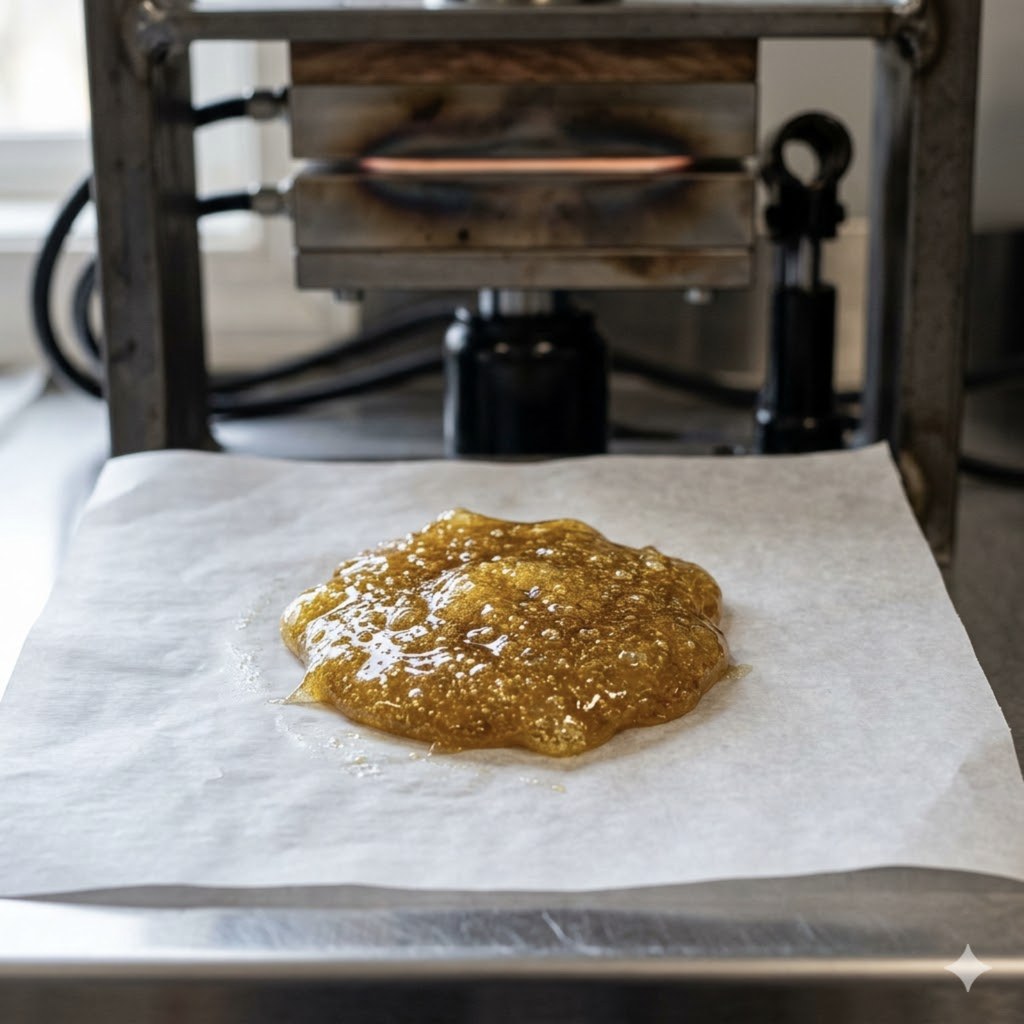
Hash rosin is the highest-yielding, highest-purity rosin you can press, and the reason has nothing to do with the press itself. It is the starting material. When you press flower, you are squeezing maybe 5 to 15 percent trichome heads against 85 to 95 percent plant fiber. When you press bubble hash, you are squeezing 60 to 90 percent trichome heads against almost nothing. The yield difference is not subtle. The quality difference is not subtle. And the rookie mistakes that destroy a flower rosin press will destroy a hash rosin press twice as fast because you no longer have plant fiber acting as a thermal buffer.
This is the SOP. Bubble hash quality first, moisture second, temperature third, pressure fourth, and a strict ban on improvising any of them. Hash rosin is a forgiving product to make if you respect the inputs and an unforgiving product if you do not.
What Hash Rosin Actually Is
Hash rosin is solventless concentrate produced by applying heat and pressure to ice water hash (also called bubble hash). The bubble hash itself is already a solventless concentrate. It is produced by agitating fresh frozen or properly dried cannabis in ice water, which freezes and shears the trichome heads off the plant. Those trichome heads are then sieved through a stack of micron bags (typically 220, 160, 120, 90, 73, 45, and 25 micron) to separate the resin from the plant matter and to grade the heads by size.
The grade of bubble hash you start with determines almost everything about the final rosin. Five-star or full-melt hash is the goal. That means the hash will fully liquefy and dome on a quartz banger with no residue. Anything less than full melt will produce hash rosin that contains plant matter, lipids, or contamination, and your press will reflect that.
The chemistry hook is straightforward. Trichome heads are membrane-bound resin glands. The membrane is lipid and protein. Inside is the cannabinoid and terpene payload. Heat softens the membrane. Pressure ruptures it. The resin flows out through the micron screen of your press bag. The full trichome mechanics, the three-phase rupture, heat transfer through the puck, and material PSI, are in the rosin press science guide. That is the entire mechanism. Everything else is variable control. We compare solventless terpene preservation against every other method in our terpene extraction method comparison.
The Bubble Hash Has to Be Right
You cannot polish a bad input. If your bubble hash is contaminated, wet, overworked, or low grade, no press technique will save it. Before any rosin pressing, the bubble hash needs to pass three checks.
Before you commit a lot to the press, run the 25 gram test wash on it: the dry percentage it returns tells you whether the hash will be full melt press feedstock or 120u-grade material before a single bag is pulled.
Quality Grade
Aim for 5-star (full melt) hash from the 90, 73, and 45 micron bags. These are the bags that capture the cleanest, most intact trichome heads. The 25 micron bag often catches broken heads and small contamination. The 120 and 160 bags catch larger heads but also more plant fragments. For premium hash rosin, blend the 90, 73, and 45 micron bags. Skip the rest unless you are pressing for personal use.
Moisture Content
This is where most operators fail. Bubble hash that comes out of the ice water wash is wet. If you press it wet, the steam pressure inside the bag will blow out the bag, contaminate the rosin with water, and produce a milky, cloudy product that is impossible to consolidate. The hash needs to dry to between 25 and 35 percent residual moisture before pressing. The freeze dryer is the gold standard tool for this. Air drying in a 60 degree Fahrenheit dehumidified room works but takes 48 to 72 hours and risks mold. Freeze drying takes 18 to 24 hours and locks in terpenes.
Microplaning
Once the hash is dried, it needs to be broken up to a uniform, fine-grain texture before going into the rosin bag. A microplane (the kind used for citrus zest in a kitchen) is the industry tool. Microplaning breaks up clumps so heat distributes evenly through the hash bed during the press. Skipping microplane is a rookie mistake that produces uneven yields and inconsistent texture.
Press Variables: What Actually Matters
There are exactly four variables that decide what your hash rosin looks like, and they are not weighted equally.
Temperature: The Most Important Variable
Hash rosin presses cold. Cold meaning 160 to 200 degrees Fahrenheit. Flower rosin presses hotter, typically 190 to 220 degrees, because the plant fiber acts as a thermal mass and slows heat transfer to the trichomes. Hash has no plant fiber. The heat hits the trichomes directly and instantly. Pressing hash rosin at 220 degrees will scorch terpenes, produce a dark, runny product, and destroy the volatile aromatics that justify the price tag of premium hash rosin.
The general temperature targets:
- 160-170 degrees F: Cold press. Produces badder or jam consistency. Maximum terpene preservation. Best flavor. Lower yield by weight.
- 175-185 degrees F: Standard press. Balanced between yield and flavor. The default for most commercial hash rosin operations.
- 190-200 degrees F: Warmer press. Higher yield. Slightly degraded terpene profile. Produces flatter, more shatter-like consistency.
Target the lowest temperature your hash will release at. Premium full-melt hash will release at 160 to 170 degrees. Lower-grade hash needs more heat. If you have to push above 200 degrees to get any release, your bubble hash is the problem, not your press.
Pressure
Hash rosin needs less pressure than flower rosin. The trichome heads are already concentrated, so you do not need brute force to expel resin from a fiber matrix. Target 600 to 1000 PSI on the actual hash, not the gauge reading on your press. The distinction matters: a 20 ton press applied to a 2×4 inch bag area produces wildly different real PSI than the same press on a 6×6 inch bag. Calculate the actual pressure on the material. Too much pressure on hash rosin blows out the bag, forces wax and lipids through the screen, and contaminates the product. Less is more.
Time
Press time for hash rosin is short. 60 to 180 seconds is the typical range. The product flows fast because there is no plant fiber to slow it down. Watch the rosin flow on the parchment. When the flow stops, you are done. Holding pressure longer will not extract more rosin. It will only push wax and contaminants through the bag.
Bag Micron
Hash rosin presses through tighter micron bags than flower rosin because the input is already cleaned. Use 25 to 37 micron bags for hash rosin. Flower rosin typically uses 90 micron because the input has plant material that needs to be filtered. With hash, you want the tightest screen that still allows resin flow. Tighter screens produce cleaner rosin with less lipid and wax contamination.
The Press Sequence
- Confirm the bubble hash is dried to 25 to 35 percent residual moisture and microplaned to a uniform texture.
- Pre-heat the press plates to your target temperature. Verify the actual plate temperature with a thermocouple, not the press display, which often reads 5 to 15 degrees off.
- Load the hash into a 25 or 37 micron bag. Distribute evenly across the bag. Avoid clumps.
- Fold the bag into a flat puck. Pre-press the puck cold (no heat, light pressure) to consolidate the hash and remove air pockets.
- Place the cold-pressed puck between two sheets of parchment paper on the heated plates.
- Apply gradual pressure over 15 to 30 seconds. Do not slam the press shut. Gradual pressure prevents bag blowouts.
- Hold pressure until rosin flow stops on the parchment. Typical hold time: 60 to 180 seconds.
- Release pressure, remove the parchment with the rosin, and immediately transfer the parchment to a cold surface (refrigerated metal plate) to halt further degradation.
- Collect the rosin with a dab tool. Discard the spent puck.
If you want to run this sequence hands-on, with the hash prep, the press settings and the SOPs we actually use, that is what we built extractiontraining.com for.
Yield Expectations
Premium full-melt hash rosin yields between 60 and 80 percent by weight from input bubble hash. That means 1 gram of 5-star hash should produce 0.6 to 0.8 grams of rosin. Compare that to flower rosin, which yields between 15 and 25 percent by weight. The math is brutal in hash rosin’s favor. The catch: the bubble hash itself yielded only 1 to 5 percent from the original flower input. So the total flower-to-rosin yield is similar to direct flower pressing, but the rosin quality is dramatically higher.
If your hash rosin yield drops below 50 percent, the bubble hash is wrong. Either the moisture is off, the grade is too low, or the press temperature is too cold for that particular hash. Troubleshoot the inputs first, the press second.
Texture Manipulation
Hash rosin texture is determined by post-press handling. Fresh rosin from a cold press is typically a wet, oily badder consistency. To consolidate to jam, place the rosin in a sealed jar at room temperature for 24 to 72 hours. Terpenes will redistribute and the rosin will firm up. To produce live hash rosin badder with the high-terpene mouthfeel that premium markets demand, whip the rosin gently with a dab tool while the terpenes are equilibrating. To produce hash rosin diamonds, see our complete guide on rosin diamonds and solventless THCa crystallization. The crystallization process for hash rosin is identical to the process for flower rosin diamonds, but the starting purity is higher, so the diamonds form faster and cleaner.
Common Failure Modes
Cloudy or Milky Rosin
The hash was too wet. Steam pressure built inside the bag during the press, and water emulsified into the rosin. Dry the next batch to under 35 percent moisture and the cloudiness disappears. There is no rescue for cloudy rosin once it has been pressed. It can be redistilled or reprocessed but the premium pricing is gone.
Bag Blowouts
Two causes. Either pressure was applied too fast (slamming the press shut instead of ramping up gradually), or the hash had clumps that created uneven pressure points. Fix: pre-press cold to consolidate, microplane more aggressively, ramp pressure over 30 seconds.
Dark, Amber Rosin from Light Hash
Temperature too high. You scorched the terpenes and degraded the cannabinoids. Drop the press temperature 15 to 20 degrees on the next press. Hash rosin from premium full-melt should come out almost colorless to pale yellow. Anything darker than honey is a process failure.
Low Yield from Premium Hash
If the bubble hash is genuinely 5-star but yield is below 60 percent, the temperature is too cold for that particular hash. Different cultivars and different wash techniques produce hash that releases at slightly different temperatures. Run a temperature ladder: press 1 gram at 165, 175, and 185 degrees. The temperature that gives the highest yield without darkening the rosin is your target for that batch.
Why Hash Rosin Commands Premium Pricing
Hash rosin retails at $60 to $120 per gram in mature markets like California, Michigan, and Massachusetts. Flower rosin retails at $30 to $60 per gram. Distillate retails at $15 to $30 per gram. The price difference reflects three things: the labor intensity of producing premium bubble hash, the input cost (premium fresh frozen flower runs $1500 to $3500 per pound), and the pharmacological completeness of the final product. Hash rosin retains the full terpene profile, the minor cannabinoids (CBG, CBC, THCV), and the flavonoids that distillate strips out entirely. For consumers chasing the entourage effect rather than pure THC potency, hash rosin is the gold standard.
From a process economics standpoint, hash rosin is the rare cannabis product where a small operator with good technique can compete head-to-head with large extraction labs. The equipment cost is low (a quality rosin press runs $1500 to $5000, a freeze dryer adds $3000 to $5000, ice water wash equipment another $2000). The barrier is the technique and the quality of starting material, not the capital investment. For operators looking at total cannabis extraction lab cost, hash rosin is one of the few high-margin entry points that does not require a $200K closed loop hydrocarbon system.
Hash Rosin vs Flower Rosin: When to Use Which
Flower rosin is the right choice for: rapid throughput, lower input cost, broader market price points, and operators without ice water wash equipment. See the complete SOP for pressing rosin from flower for the flower-specific variables.
Hash rosin is the right choice for: premium product positioning, maximum terpene preservation, low-volume high-margin operations, and any product line targeting the connoisseur segment of the market. The two processes share the same press but everything else (input prep, temperature, pressure, time, bag micron) is different.
Frequently Asked Questions
What is the difference between hash rosin and flower rosin?
Hash rosin is pressed from ice water bubble hash. Flower rosin is pressed from dried, cured cannabis flower. Hash rosin yields 60 to 80 percent by weight (vs 15 to 25 percent for flower rosin), produces a cleaner, more terpene-rich final product, and presses at lower temperatures (160 to 200 F vs 190 to 220 F). The trade-off is that producing the bubble hash itself is labor intensive and requires ice water wash equipment plus a freeze dryer.
What temperature should I press hash rosin at?
Press hash rosin between 160 and 200 degrees Fahrenheit. Premium full-melt hash releases at 160 to 170 F and produces the best flavor and terpene retention. Lower-grade hash needs 175 to 200 F to release. Pressing above 200 F scorches terpenes and produces dark, degraded rosin. If you cannot get release below 200 F, the bubble hash quality is the problem, not the press temperature.
Why is my hash rosin cloudy and milky?
The bubble hash was too wet when pressed. Water in the hash flashed to steam under pressure and emulsified into the rosin. Dry bubble hash to 25 to 35 percent residual moisture before pressing, ideally with a freeze dryer. There is no fix for already-pressed cloudy rosin. The premium positioning is gone and the product can only be reprocessed or sold at distillate-tier pricing.
How much bubble hash do I need to produce one gram of hash rosin?
You need 1.25 to 1.7 grams of premium full-melt bubble hash to produce one gram of hash rosin, assuming a 60 to 80 percent yield. Lower-grade hash will require more (closer to 2 grams of input per gram of rosin). The yield is determined almost entirely by the quality of the bubble hash, not by press technique.
What micron rosin bag should I use for hash rosin?
Use 25 to 37 micron bags for hash rosin. The input material is already filtered through ice water sieving, so you can run a tighter screen than flower rosin (which typically uses 90 micron bags). Tighter screens produce cleaner rosin with less wax and lipid contamination. Going below 25 micron is not recommended because flow rates drop and you risk excess heat exposure to the trichomes.
Can I make hash rosin diamonds?
Yes. Hash rosin diamonds form through the same THCa crystallization process as flower rosin diamonds. The starting purity of hash rosin makes the crystallization faster and cleaner. Place fresh hash rosin in a sealed jar in a controlled-temperature environment (70 to 75 F), allow the THCa to nucleate over 2 to 6 weeks, then separate the crystallized THCa from the terpene-rich sauce. The complete process is covered in our guide to rosin diamonds and solventless THCa crystallization.
Why does hash rosin cost so much more than flower rosin?
Three reasons: premium fresh frozen input flower costs $1500 to $3500 per pound, the bubble hash production process is labor intensive (4 to 8 hours of wash, plus 18 to 24 hours of freeze drying), and the final yield from raw flower is comparable to direct flower pressing despite all the additional steps. The premium pricing reflects the labor and the dramatically higher quality of the final product, not just the rarity.
Bottom Line
Hash rosin is a process discipline product. The press itself is the easy part. The hard part is upstream: selecting the right cultivar, executing a clean ice water wash, freeze drying to the right moisture, and microplaning before the press. Operators who treat hash rosin as a flower rosin variant with a different starting material will produce mediocre product. Operators who treat the entire workflow as a precision process from frozen flower to finished badder will produce the highest-value cannabis concentrate on the market. The math is in the inputs, not the press.
Want to know if hash rosin production actually pencils out at your scale? Our live rosin production economics guide breaks down cost per gram from hobby to 1kg/day commercial, with real yield numbers and equipment ROI timelines.
Ready to level up your extraction game? Contact WKU Consulting for personalized guidance on building your extraction lab.
For more deep dives into cannabis chemistry, extraction SOPs, and lab design, subscribe to the WKU Consulting YouTube channel.
Watch a related video:
