
The Real Number Nobody Wants to Tell You
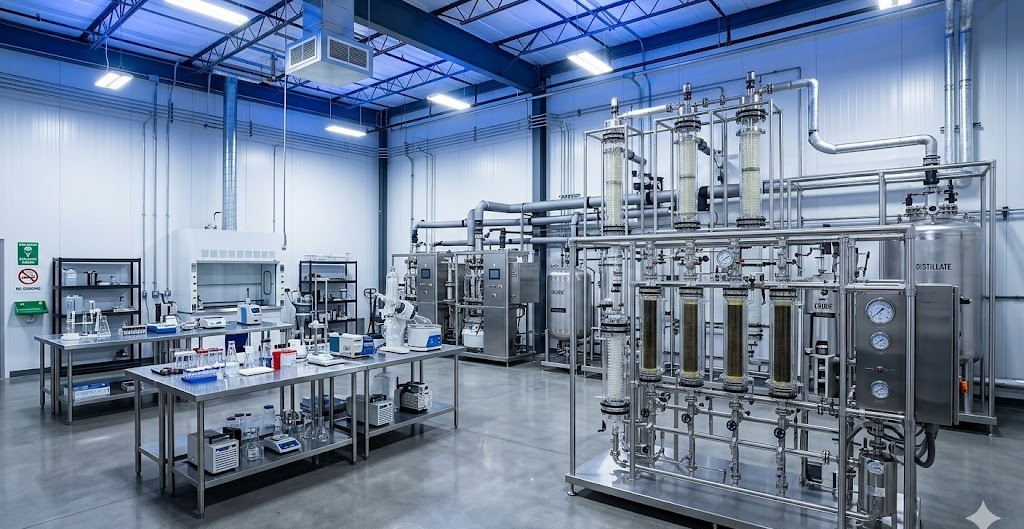
A licensed cannabis extraction lab costs between $250,000 and $2 million to build. The recent Schedule III reclassification changes the tax landscape significantly for cannabis labs. That range is useless without context, and most guides stop right there. The number that matters is cost per pound of throughput capacity. A $500,000 lab that processes 50 pounds per day and a $1.2 million lab that processes 200 pounds per day are not the same investment. The second one costs less per pound, produces revenue faster, and typically reaches breakeven 6 to 12 months sooner.
The operators who overspend do it in predictable ways: oversized equipment for their license capacity, redundant safety systems because they didn’t understand the code requirements, and post-processing gear they won’t need for 18 months. The operators who underspend do it in equally predictable ways: skipping C1D1 compliance, buying residential-grade vacuum pumps, and pretending they won’t need a solvent recovery system.
Here is what extraction lab costs actually look like when you break them down by what drives the number.
Extraction Equipment: The Core Capital Expense
Your extraction method determines your floor cost. Everything else scales from this decision.
Hydrocarbon (BHO) Extraction
A closed loop BHO system rated for commercial throughput runs $40,000 to $189,000 depending on column size and recovery tank capacity. A 5-pound passive system for small batch artisan work starts around $15,000. A 20-pound active system with an integrated recovery pump and jacketed columns for temperature control lands in the $80,000 to $120,000 range. The high end ($150,000+) gets you automated solvent injection, programmable temperature ramping, and built-in data logging for compliance.
The hidden cost with BHO is not the extractor. It is the C1D1 classified room you need to put it in. That room alone runs $50,000 to $200,000 depending on square footage, ventilation requirements, and whether you are retrofitting an existing space or building from scratch. A BHO extractor without a C1D1 room is a paperweight in every regulated market. For a complete walkthrough of closed loop system configuration, see our BHO extraction setup guide.
Ethanol Extraction
Ethanol systems scale more linearly with throughput. A small centrifugal extraction unit for 10 to 20 pounds per day costs $30,000 to $80,000. A full cryo-ethanol line capable of 100+ pounds per day (centrifuge, chiller, rotary evaporator, falling film evaporator for solvent recovery) runs $200,000 to $500,000. High-throughput ethanol operations processing 500+ pounds per day can push past $1 million in equipment alone.
Ethanol’s advantage is simpler facility requirements. No C1D1 room needed for most ethanol setups since ethanol’s flash point allows Class I, Division 2 classification in many jurisdictions. That saves $50,000 to $150,000 on the facility side. The tradeoff: ethanol systems pull more chlorophyll and waxes, which means you need downstream winterization and filtration equipment ($15,000 to $40,000) that a BHO lab might not need.
CO2 Extraction
Supercritical CO2 systems are the most expensive upfront. A production-scale unit from Apeks, Waters, or Vitalis runs $150,000 to $450,000. Smaller tabletop or benchtop CO2 systems exist for $40,000 to $80,000, but their throughput is too low for most commercial operations.
CO2’s operating costs are lower (the solvent is cheap and non-flammable), and facility requirements are the simplest of any solvent-based method. No C1D1 room, no explosion-proof electrical. The capital cost is front-loaded, but the total cost of ownership over 5 years can be competitive with hydrocarbon if your throughput targets match the system’s capacity.
Solventless (Rosin Press)
A commercial rosin press runs $5,000 to $30,000. Add a freeze dryer for bubble hash production ($10,000 to $50,000), wash vessels, and drying racks, and a full solventless line comes in at $30,000 to $100,000. Facility requirements are minimal: no solvent storage, no C1D1, no explosion-proof anything.
Solventless is the cheapest entry point by a wide margin. The constraint is throughput. A rosin press produces ounces per hour, not pounds. Scaling solventless means buying more presses, not bigger presses, and labor costs climb fast.
Post-Processing Equipment: Where Budgets Quietly Double
Extraction gets the headline. Post-processing is where the real cost lives for most labs.
- Wiped film or short path distillation: $20,000 to $150,000. Required for any operation producing distillate. A wiped film evaporator handles higher throughput and produces more consistent output, but costs 3 to 5x more than a short path setup.
- Rotary evaporator (solvent recovery): $5,000 to $25,000. Essential for ethanol operations. Undersizing your rotovap creates a bottleneck that throttles your entire line.
- Vacuum ovens (purging): $3,000 to $15,000 per oven. Most labs need 2 to 4 ovens running in rotation. Buy lab-grade, not Amazon-grade. Inconsistent temperature control means inconsistent residual solvent tests.
- Winterization and filtration: $5,000 to $40,000. Includes jacketed vessels, Buchner funnels, filter media, and a chest freezer or cryogenic chiller. Required for ethanol and CO2 operations; optional for BHO depending on your product targets.
- Analytical testing (in-house): $15,000 to $80,000. An HPLC for potency testing runs $30,000 to $60,000 used. A basic terpene analyzer adds $15,000. Not every lab needs in-house analytics, but the ones that do catch batch failures before they become $50,000 problems.
Facility Build-Out: The Cost Most Operators Underestimate
The building is not just a room with equipment in it. It is a controlled environment designed around your process. Our step-by-step lab build guide covers the full construction sequence.
Two line items in that build-out get their own breakdowns: the CO2 extraction room, which is cheaper than a C1D1 room but not free, and the safety equipment package, where the gas detection and exhaust interlock budget lives.
- C1D1 classified room (BHO operations): $50,000 to $200,000. Includes explosion-proof electrical, 12+ air changes per hour ventilation, gas detection systems, emergency shutdown controls, and fire suppression. This is non-negotiable in every state with hydrocarbon extraction licensing.
- HVAC and environmental controls: $20,000 to $80,000. Temperature and humidity control affect extraction efficiency, solvent recovery rates, and product consistency. A lab running at 80°F with no humidity control is a lab producing inconsistent product.
- Electrical upgrades: $10,000 to $50,000. Most extraction equipment runs on 208V or 480V three-phase power. If your building doesn’t have it, running new service from the transformer is a five-figure cost before you mount a single piece of equipment.
- Plumbing and drainage: $5,000 to $20,000. Floor drains, chemical-resistant piping, eye wash stations, emergency showers. Required by OSHA and most state cannabis regulations.
- Security and compliance: $10,000 to $30,000. Camera systems, access control, alarm monitoring, seed-to-track integration. Every regulated market requires this. Budget for it or your license application stalls.
The Hidden Costs Nobody Lists on Equipment Websites
The invoice from your equipment vendor is not your total cost. These line items show up after the purchase order is signed.
- Freight and rigging: $2,000 to $15,000. A CO2 extractor weighs 2,000+ pounds. Getting it off a truck, through a door, and into position requires a crane or forklift and people who know how to use them.
- Installation and commissioning: $5,000 to $25,000. Connecting gas lines, plumbing chilled water loops, calibrating pressure gauges, and running test batches. Some vendors include this. Most charge extra.
- Licensing and permitting: $5,000 to $50,000+. Application fees, architect and engineer stamps on your facility plans, fire marshal inspections, and the 3 to 12 months of carrying cost while you wait for approval.
- Insurance: $10,000 to $40,000 per year. Cannabis extraction carries elevated premiums. Expect 2 to 4% of your total insured value annually. Solventless operations pay less than BHO operations.
- Training: $2,000 to $10,000. Your equipment is only as safe as the person operating it. Manufacturer training, SOP development, and safety certification are not optional line items.
- Working capital (consumables and raw material): $25,000 to $100,000. Solvents, filter media, packaging, testing fees, and your first 30 to 90 days of biomass purchases. If you spend everything on equipment and have nothing left for inputs, your lab sits idle.
Total Cost Ranges by Lab Type
Here is what a realistic all-in budget looks like for each extraction method at commercial scale:
- Solventless lab (rosin + hash): $80,000 to $250,000. Lowest entry point. Best for artisan brands focused on premium product. Limited by throughput.
- BHO lab (closed loop hydrocarbon): $250,000 to $800,000. The C1D1 room is the single biggest variable. Equipment costs are moderate, but facility compliance is expensive.
- Ethanol lab (cryo-ethanol): $300,000 to $1.2 million. Scales well for high throughput. Lower facility costs than BHO. Higher post-processing equipment costs.
- CO2 lab (supercritical): $400,000 to $1.5 million. Highest equipment cost, lowest facility cost. Best total cost of ownership for labs running consistent, high-volume production.
- Multi-method lab (BHO + ethanol + post-processing): $600,000 to $2 million+. Most large commercial operations end up here because different products require different extraction methods.
Itemized Capital Budget: Where Every Dollar Actually Goes
The ranges above give you the all-in number. This table shows where that money actually goes, line by line, across three representative lab archetypes. Every figure is one-time capital expense in USD. It excludes real estate purchase, working capital, and the first year of labor and inventory. The columns reconcile to the all-in ranges listed above: the entry column tops out near $250,000, the C1D1 commercial column near $800,000, and the multi-method column past $2 million.
| Capital Line Item | Solventless / Entry ($80K–$250K all-in) |
Hydrocarbon C1D1 Commercial ($250K–$800K all-in) |
Multi-Method Large ($600K–$2M+ all-in) |
|---|---|---|---|
| Primary extraction system | $15,000–$50,000 | $50,000–$150,000 | $150,000–$500,000 |
| Post-processing (winterization, distillation, decarb, crystallization) | $8,000–$30,000 | $40,000–$150,000 | $100,000–$400,000 |
| Room classification + facility build-out (C1D1/C1D2) | $20,000–$70,000 | $80,000–$250,000 | $150,000–$500,000 |
| HVAC, ventilation, and gas detection | $8,000–$25,000 | $25,000–$90,000 | $60,000–$200,000 |
| Electrical, plumbing, and fire suppression | $6,000–$20,000 | $20,000–$70,000 | $50,000–$150,000 |
| Analytical / QC and environmental monitoring | $5,000–$20,000 | $15,000–$50,000 | $40,000–$150,000 |
| Licensing, permits, and PE-stamped engineering | $5,000–$15,000 | $10,000–$40,000 | $30,000–$100,000 |
| Contingency + startup (SOPs, training, first solvent fill) | $8,000–$20,000 | $10,000–$30,000 | $30,000–$100,000 |
| All-in capital total | ~$80,000–$250,000 | ~$250,000–$800,000 | ~$600,000–$2,000,000+ |
The line operators underestimate most is room classification and facility build-out. On a hydrocarbon lab it can equal the extraction system itself, because a compliant C1D1 room carries its own electrical classification, gas detection, and negative-pressure requirements before a single gram of biomass moves through it. If you want that room right-sized before you commit capital, our cannabis extraction consultant team scopes the classification and CFM against your actual throughput, so you are not paying for a C1D2 buffer or an oversized air handler you never needed.
How to Cut Costs Without Cutting Corners
The goal is not to spend the least amount of money. It is to spend money where it generates the most throughput per dollar.
Buy used post-processing equipment. Short path distillation heads, rotary evaporators, and vacuum ovens lose 40 to 60% of their value the moment they ship. The glass and the heating mantle work the same whether they are new or three years old. Extraction equipment is harder to buy used because warranty and compliance documentation matter more.
Right-size your C1D1 room. Build it for the equipment you have, not the equipment you hope to have in two years. Expanding a C1D1 room later costs $30,000 to $50,000. Building one twice as large as you need costs $80,000+ that generates zero return while your throughput catches up.
Lease your building, don’t buy. Cannabis zoning restrictions change. Regulations shift. A 5-year lease with expansion options gives you flexibility that a mortgage does not.
Phase your equipment purchases. Start with extraction and basic purging. Add distillation when your crude output justifies it. Add analytical instruments when your batch volume makes outsourced testing more expensive than in-house. Every piece of equipment should earn its space in the lab within 12 months of installation.
Lab Layout and Room Design: The Blueprint Nobody Publishes
Equipment costs are what everybody asks about. Room design is what actually determines whether a lab runs efficiently or bleeds money through workflow bottlenecks, contamination risks, and compliance failures. A $500,000 extraction lab in a poorly designed facility will underperform a $300,000 lab with intelligent room layout. The layout is the multiplier.
Every extraction lab needs at minimum five distinct zones. The sequence matters: biomass enters from one side and finished product exits from the other. Unidirectional flow prevents cross-contamination, satisfies GMP requirements, and keeps your operators from walking through contamination zones carrying finished product.
| Room | Classification | Min Air Changes/Hr | Pressure | Gas Detection | Min Size (sq ft) | Key Requirements |
|---|---|---|---|---|---|---|
| Extraction Room (BHO) | C1D1 | 12+ | Negative | LEL at 12″ and 36″, alarm at 25% LEL | 200-400 | Explosion-proof electrical, emergency shutoff, no ignition sources |
| Extraction Room (Ethanol) | C1D2 | 6-8 | Negative | LEL at 12″, alarm at 25% LEL | 300-600 | Spark-resistant outlets, ethanol storage cabinet rated for volume |
| Extraction Room (CO2) | General | 4-6 | Negative | CO2 sensor at 12″, alarm at 5,000 ppm (TWA) | 400-800 | CO2 asphyxiation risk, O2 monitor, emergency ventilation |
| Post-Processing | C1D2 or General | 6-8 | Negative or Neutral | Depends on solvents used | 250-500 | Rotovap, short path, vacuum oven, winterization freezer |
| Solvent Storage | C1D1 or C1D2 | 12+ | Negative | LEL at 12″, continuous monitoring | 60-150 | FM-rated cabinet, secondary containment, fire suppression |
| Intake/Biomass Prep | General | 4 | Positive | None required | 150-300 | Weigh station, grinder, material log, positive pressure to prevent contamination inflow |
| Packaging/Finished Goods | General (clean room preferred) | 4-6 | Positive | None required | 150-250 | Label printer, scale, compliance packaging, positive pressure to prevent contamination |
The pressure differentials matter more than most operators realize. Extraction rooms run negative pressure so any solvent vapor gets pulled OUT of the room, not into adjacent spaces. Intake and packaging rooms run positive pressure so particulates and contaminants from other zones cannot flow IN. Get this backward and you have solvent vapor migrating into your packaging room or plant dust contaminating your finished distillate.
Ventilation Design: The CFM Calculations That Keep Labs Legal
Ventilation is not a line item you hand to your HVAC contractor and walk away. It is the single most common point of failure in lab design. Over half the labs that fail their first fire marshal inspection fail on ventilation. The calculations are straightforward, but the inputs are specific to cannabis extraction and most general HVAC contractors have never worked with them. The other budget-breaker at that inspection is the equipment approval path: an unlisted extractor needs a registered design professional’s technical report under IFC Chapter 39 before it can even be placed in the room.
For the full hazardous-location compliance spec behind those ventilation and gas-detection numbers, see our C1D1 room requirements guide, including the air-exchange math and the inspection checklist.
Air Change Rate Calculation
The formula: CFM = (Room Volume in cubic feet x Air Changes per Hour) / 60
For a 300 sq ft extraction room with 10-foot ceilings requiring 12 air changes per hour:
CFM = (300 x 10 x 12) / 60 = 600 CFM
That 600 CFM is the exhaust rate. Your supply air must be 10-15% less than exhaust to maintain negative pressure. So supply air is 510-540 CFM, with the deficit made up by transfer air from adjacent zones through engineered gaps (not open doors).
Makeup Air and Temperature Control
At 600 CFM exhaust, you are dumping the entire room volume every 5 minutes. In Portland in January, that incoming air is 35F. In Phoenix in July, it is 115F. Without proper makeup air units (MAU) with heating and cooling capacity, your lab temperature swings 20-30F throughout the day, destroying process control. A rotovap set to 40C in a room that swings between 60F and 85F produces different product every hour.
The MAU must be sized to the CFM load AND the delta-T. A 600 CFM MAU heating from 35F to 70F needs approximately 12,600 BTU. The same MAU cooling from 115F to 72F needs approximately 16,200 BTU. Your HVAC contractor needs both numbers.
Gas Detection Placement
LEL (Lower Explosive Limit) monitors must be placed at two heights: 12 inches from floor level (where heavier-than-air butane and propane settle) and 36 inches (breathing zone). Ethanol vapor is slightly denser than air at room temperature but disperses more readily, so a single monitor at 12 inches is typically sufficient for C1D2 ethanol rooms. CO2 extraction rooms need CO2-specific sensors (not LEL monitors) at 12 inches, with alarm at 5,000 ppm (the 8-hour TWA exposure limit) and emergency ventilation activation at 30,000 ppm (IDLH).
Every gas detection system must tie into the building management system (BMS) with automatic response: alarm at 10% LEL, ventilation boost at 20% LEL, emergency shutdown of extraction equipment and activation of emergency exhaust at 25% LEL. If your gas detection system only triggers an audible alarm with no automatic response, it is a decoration, not a safety system.
Workflow Design: Biomass In, Product Out, No Backtracking
Unidirectional flow is not optional. It is the foundation of both GMP compliance and operational efficiency. The principle: raw material enters from one end of the facility, moves through each processing stage in sequence, and exits as finished product from the other end. No operator carrying finished distillate should walk through the biomass prep area. No raw plant material should pass through the packaging zone.
The ideal flow sequence: Receiving/Intake, Biomass Prep (grinding, weighing), Extraction, Post-Processing (winterization, CRC, distillation), Purging/Devolatilization, Formulation/Packaging, QC/Testing (if in-house), Finished Goods Storage, Shipping. Each transition should be a pass-through, not a U-turn.
The most common layout mistake: placing the extraction room in the center of the building with post-processing on one side and intake on the other. This forces product to pass through the extraction room twice (once as raw material, once as crude extract returning for post-processing). Every time product crosses through an active extraction zone, you increase contamination risk and create a compliance liability.
Common Lab Design Failures and How to Avoid Them
Every one of these failures has cost a real operator $10,000 to $200,000 in rework, fines, or lost production. They are all avoidable with proper design.
| Failure | Root Cause | Consequence | Fix Cost | Prevention |
|---|---|---|---|---|
| Failed fire marshal inspection | HVAC contractor unfamiliar with C1D1; installed residential-grade ductwork | 3-6 month delay, $30,000-80,000 ductwork replacement | $30K-80K | Specify C1D1-rated ductwork in bid package; verify contractor has cannabis/chemical lab experience |
| Reversed pressure differentials | HVAC balanced for comfort, not containment; extraction room at positive pressure | Solvent vapor migrates to adjacent rooms; failed air quality test; potential ignition risk | $15K-40K | Specify negative pressure in extraction room, positive in packaging; commission with smoke test verification |
| Insufficient electrical capacity | Designed for extraction equipment only; forgot post-processing, HVAC, and vacuum pump loads | Tripped breakers during peak operation; equipment damage; production shutdown | $20K-60K | Calculate total connected load including 125% NEC safety factor; size panel for 150% of initial equipment |
| No makeup air unit | Exhaust installed without supply air compensation | Room goes excessively negative; doors won’t close; exhaust fan can’t move rated CFM | $10K-25K | Always pair exhaust with MAU; supply air = 85-90% of exhaust CFM |
| Undersized solvent storage | Designed for day-one volume; no capacity for scaling or regulatory changes | Solvent stored outside rated cabinets; fire code violation; license jeopardy | $5K-15K | Size solvent storage at 200% of current max volume; plan for the scale you want, not the scale you have |
| Wrong floor finish | Standard concrete or tile instead of chemical-resistant epoxy with cove base | Ethanol dissolves floor coating within months; solvent seeps into concrete; remediation required | $8K-20K | Chemical-resistant epoxy (minimum 20 mil DFT) with 4″ cove base; specify solvent compatibility with your primary solvent |
The pattern across these failures: operators hire general contractors and HVAC companies that build restaurants, retail spaces, or residential projects. Those contractors know building codes but have never worked with flammable solvents, negative pressure containment, or Class I Division 1 electrical classifications. The cheapest contractor is almost always the most expensive decision.
If you want to learn the complete design-to-operation workflow with room-by-room SOPs, equipment placement guides, and compliance checklists, that is exactly what we built extractiontraining.com for.
Lab Design Decision Matrix: Choosing Your Configuration
The right lab configuration depends on three variables: your primary extraction method, your daily throughput target, and your state’s regulatory framework. This matrix gives you the starting point for each combination.
| Configuration | Method | Throughput | Min Total Space | Facility Cost | Build Time | Critical Design Factor |
|---|---|---|---|---|---|---|
| Small BHO | Hydrocarbon | 5-10 lbs/day | 800-1,200 sq ft | $100K-250K | 3-6 months | C1D1 room is 40-60% of facility cost; don’t underbuild it |
| Large BHO | Hydrocarbon | 20-50 lbs/day | 2,000-4,000 sq ft | $300K-600K | 4-8 months | Separate solvent storage room; dual extraction bays for continuous operation |
| Ethanol | Ethanol | 50-200 lbs/day | 2,500-5,000 sq ft | $200K-450K | 3-5 months | Ethanol recovery space (rotovap or falling film) often larger than extraction space |
| CO2 | Supercritical CO2 | 10-30 lbs/day | 1,500-3,000 sq ft | $150K-350K | 3-5 months | Three-phase power for CO2 pumps; CO2 asphyxiation ventilation; no C1D1 needed |
| Solventless | Rosin/Ice Water | 5-20 lbs/day | 600-1,500 sq ft | $50K-150K | 1-3 months | Cold room or walk-in cooler for ice water hash; drainage and waterproofing |
| Multi-Method | BHO + Ethanol + Rosin | 30-100 lbs/day | 4,000-8,000 sq ft | $500K-1.2M | 6-12 months | Separate classified rooms per method; shared post-processing; fire marshal wants one unified AHJ plan |
Every configuration in this table assumes the facility is a purpose-built or retrofitted commercial space. Residential conversions face additional zoning, electrical, and structural challenges that can add 30-50% to facility costs and 3-6 months to timeline. If your lease says “light industrial” but the space was previously a retail store, budget for a full electrical panel upgrade, HVAC replacement, and structural assessment for equipment weight loads.
The cheapest line item in a build is usually the cannabis extraction consultant who keeps the expensive ones from doubling.
If you are budgeting a real build and not just ballparking it, this is where the expensive mistakes live: a misclassified space, a ventilation design that fails inspection, a six-figure redesign after the AHJ walks through. Designing extraction facilities so that does not happen is what WKU does. If you want that on your project before the concrete is poured, here is how to work with us.
Frequently Asked Questions
How much does a basic cannabis extraction lab cost to set up?
A basic cannabis extraction lab costs $80,000 to $300,000 depending on your extraction method. Solventless rosin operations are the cheapest entry point at $80,000 to $150,000. A BHO lab with C1D1 compliance starts around $250,000. These figures include equipment, facility build-out, safety infrastructure, and initial working capital.
What is the most expensive part of building a cannabis extraction lab?
For hydrocarbon labs, the C1D1 classified room is typically the single largest cost at $50,000 to $200,000. For ethanol and CO2 labs, the extraction equipment itself is the biggest line item. Across all methods, facility build-out (HVAC, electrical, plumbing, compliance) often exceeds the extraction equipment cost by 20 to 40%.
Is CO2 extraction more expensive than BHO?
CO2 extraction equipment costs 2 to 3x more than equivalent BHO equipment ($150,000 to $450,000 vs $40,000 to $189,000). However, CO2 labs save $50,000 to $200,000 on facility costs because they don’t require C1D1 classification. Over a 5-year period, total cost of ownership for CO2 and BHO labs at similar throughput levels is often within 15% of each other.
Do I need a C1D1 room for cannabis extraction?
You need a C1D1 classified room if you are using flammable solvents like butane, propane, or pentane for extraction. Ethanol operations typically require Class I, Division 2 classification, which is less expensive. CO2 and solventless operations do not require C1D1 rooms. Check your state’s specific regulations because some jurisdictions require C1D1 even for ethanol above certain volumes.
What hidden costs do most cannabis extraction lab budgets miss?
The most commonly missed costs are freight and rigging ($2,000 to $15,000), electrical upgrades for three-phase power ($10,000 to $50,000), licensing delays that create 3 to 12 months of carrying costs on your lease, and working capital for the first 90 days of operation ($25,000 to $100,000 for solvents, biomass, testing, and consumables).
How long does it take for a cannabis extraction lab to break even?
Most cannabis extraction labs reach breakeven in 12 to 24 months of active production. The timeline depends on throughput capacity, product margins, and utilization rate. A lab processing 50 pounds per day at 70% utilization with a $500,000 build-out typically breaks even faster than a $1 million lab processing the same volume because fixed costs are lower relative to output.
Can I start a cannabis extraction lab for under $100,000?
Only with a solventless operation (rosin press and bubble hash). A basic commercial rosin setup with a press, freeze dryer, wash vessels, and minimal facility work can come in at $80,000 to $100,000. Any solvent-based method (BHO, ethanol, CO2) will exceed $100,000 once you factor in facility compliance, safety infrastructure, and working capital.
Hash rosin is one of the few high-margin entry points that does not require a $200K closed loop hydrocarbon system. See our hash rosin SOP from bubble hash for the workflow and equipment costs.
What room classification do I need for BHO extraction?
BHO extraction requires a Class I, Division 1 (C1D1) classified room because butane and propane are heavier-than-air flammable gases. This means explosion-proof electrical fixtures, no ignition sources, LEL gas detection at 12 inches and 36 inches from floor level with automatic emergency shutoff at 25% LEL, and a minimum of 12 air changes per hour with negative pressure relative to adjacent rooms. The C1D1 room alone typically costs $50,000 to $200,000 depending on size and local fire marshal requirements.
How many air changes per hour does a cannabis extraction room need?
A BHO extraction room requires a minimum of 12 air changes per hour. Ethanol extraction rooms need 6 to 8 air changes per hour under C1D2 classification. CO2 extraction rooms need 4 to 6 air changes per hour. To calculate the required CFM: multiply room volume in cubic feet by air changes per hour, then divide by 60. A 300 sq ft room with 10-foot ceilings needing 12 air changes requires 600 CFM of exhaust.
What is the most common lab design mistake?
The most common and most expensive mistake is hiring a general HVAC contractor without cannabis lab experience. Over half the labs that fail their first fire marshal inspection fail on ventilation: residential-grade ductwork in C1D1 spaces, reversed pressure differentials (extraction room at positive instead of negative pressure), or exhaust systems installed without makeup air units. The fix costs $30,000 to $80,000 in ductwork replacement and adds 3 to 6 months to the build timeline.
How much space do I need for a cannabis extraction lab?
A small BHO lab processing 5 to 10 pounds per day needs 800 to 1,200 square feet minimum. A mid-size ethanol lab processing 50 to 200 pounds per day needs 2,500 to 5,000 square feet. A multi-method facility running BHO, ethanol, and solventless needs 4,000 to 8,000 square feet. These figures include extraction, post-processing, solvent storage, intake, packaging, and required buffer zones between classified areas.
Ready to level up your extraction game? Contact WKU Consulting for personalized guidance on building your extraction lab.
For more deep dives into cannabis chemistry, extraction SOPs, and lab design, subscribe to the WKU Consulting YouTube channel.
Watch a related video:
If you are budgeting a hydrocarbon room, do not treat the extractor as an isolated line item. The solvent path, recovery logic, and room safety burden all scale together. For a deeper breakdown, read Closed-Loop Extraction Systems for Cannabis: How They Work, What Matters, and What Fails.
If you are still pricing a build, do not stop at budget ranges and equipment quotes. A lab only works when layout, utilities, process flow, and safety systems agree with the chemistry. This cannabis extraction lab design guide breaks down how to structure the facility so the capital you spend actually turns into throughput.
If you are budgeting a hydrocarbon or ethanol room, do not treat safety infrastructure like background overhead. Gas detection, ventilation, relief logic, shutdowns, and emergency hardware are part of the production system. This cannabis extraction lab safety equipment guide breaks down what actually has to work before the room is worth paying for.
