
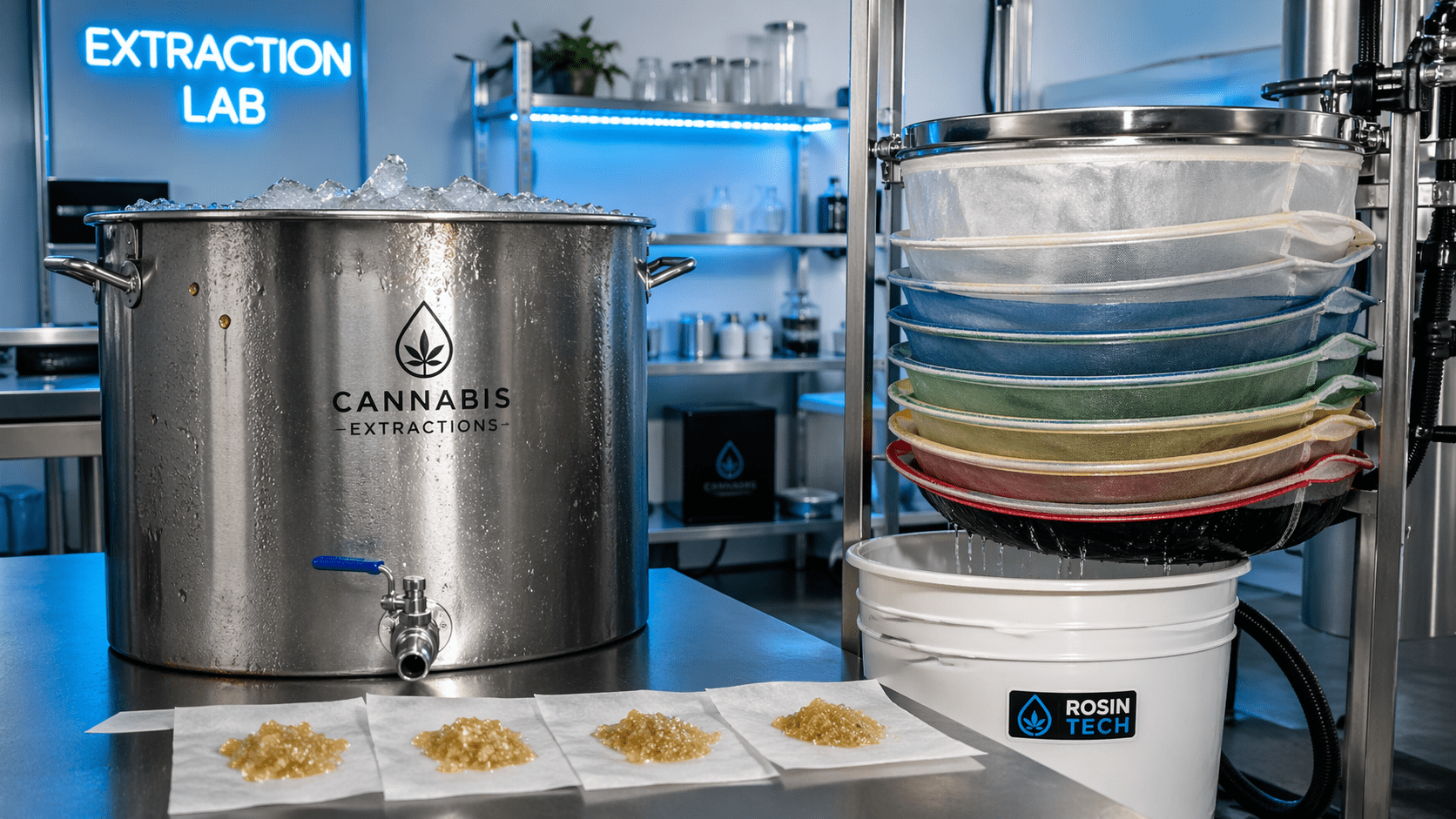
Bubble hash is the simplest extraction method in cannabis. No solvents, no closed loops, no C1D1 rooms. Just ice, water, agitation, and gravity. Trichome heads are denser than water, and cold makes them brittle enough to snap off the plant material. Everything else is technique. If you run into flavor problems downstream, our concentrate troubleshooting guide covers the root causes.
What Is Bubble Hash?
Bubble hash is a solventless cannabis concentrate made by agitating trichome-covered plant material in ice water, then filtering the dislodged trichome heads through progressively finer mesh bags (typically 220 to 25 microns). The cold makes trichome stalks brittle at 0 to 4C, causing them to snap cleanly. Full-melt bubble hash (73 to 120 micron collection) tests at 60 to 80% THC and melts completely when dabbed, leaving zero residue. Yield from quality flower runs 3 to 8% by weight; trim runs 1 to 3%.
The difference between 6-star full melt and brown food-grade hash is not the equipment. It is water temperature, agitation intensity, and how fast you dry it.
Equipment You Need
The startup cost for bubble hash is the lowest of any extraction method. A full production setup runs $2,000-5,000. Here is what you actually need.
Wash vessel: A 5-gallon or 20-gallon bucket for small batches. A commercial washing machine (like the PurePressure Bruteless) for production. The vessel needs to hold ice, water, and biomass with room for agitation.
Micron bag set: Standard stack runs 220, 160, 120, 90, 73, 45, and 25 micron. The 73-120 micron range captures the highest quality trichome heads. Below 45 catches stalks and debris. Above 160 catches plant material. You need the full stack because each grade gets collected separately.
Ice: Plan for a 1:1 ratio of ice to water by volume. The goal is keeping water temperature below 40F (4C) throughout the wash. More ice is always better than less.
RO or distilled water: Tap water contains chlorine and minerals that contaminate the final product. Use reverse osmosis or distilled water only.
Collection tools: Spoon, 25-micron pressing screen, parchment paper, cold plate or tray.
Freeze dryer: This is the one piece of equipment that separates amateur from professional results. A Harvest Right or similar pharmaceutical freeze dryer removes moisture without heat, preserving terpenes and preventing oxidation. If you do not have a freeze dryer, you can air dry in a cold, dehumidified room, but the quality ceiling drops significantly.
The Wash: Where Quality Is Won or Lost
Step 1: Prepare the Biomass
Use fresh frozen material for the highest quality hash. Freeze the cannabis immediately after harvest at -10F or below. Never dry and cure material you plan to wash. Dried material produces darker hash with lower melt quality because the trichome heads have already begun oxidizing and the stalks become more brittle, contaminating the resin.
If using dried trim or flower, rehydrate by soaking in ice water for 15 minutes before the first wash.
Step 2: Load and Soak
Fill the wash vessel with ice and RO water. Submerge the biomass (loose or in a 220-micron work bag). Let it soak for 15-20 minutes before agitating. This cold soak makes the trichome stalks brittle so they snap cleanly during agitation. Skipping the soak means you are pulling trichomes with stalks attached, which means contamination in your collection bags.
Water temperature must stay below 40F. Check with a thermometer. If the water hits 45F, add more ice before proceeding.
Step 3: Agitation
This is where most hash makers destroy their product. The goal is to snap trichome heads off stalks and wash them through the bag stack. Aggressive agitation breaks plant material into the water, turning your hash green.
First wash: 90 seconds of gentle agitation. Hand stir or use the machine on its lowest setting. This pull captures the loosest, highest-quality trichome heads. It will be your best grade.
Second wash: 2-3 minutes of moderate agitation. Slightly more intensity to capture trichomes that are more firmly attached. Quality drops slightly.
Third wash (and beyond): 3-5 minutes of moderate agitation. Each subsequent wash produces lower quality hash. Most producers run 3-4 washes total before the returns diminish to the point where it is not worth continuing.
The critical variable is TIME, not force. Longer gentle agitation produces cleaner hash than short violent agitation. If your hash is green, you agitated too hard. If your yield is low, you did not soak long enough or your water was too warm.
Step 4: Drain and Collect
Pull the work bag (with the biomass) out of the wash vessel. Let it drain completely. Now pull the bag stack one at a time, starting from the largest micron and working down.
Each bag contains a different grade of trichomes:
- 160-220 micron: Plant material and debris. Discard or use for edibles.
- 120 micron: Mixed quality. Some trichome heads, some plant contamination.
- 90 micron: High quality. Mostly intact trichome heads.
- 73 micron: Premium quality. The cleanest trichome heads with the least contamination. This is where 6-star full melt lives.
- 45 micron: Good quality but smaller heads. May have more stalk contamination.
- 25 micron: Smallest trichome heads and fragments. Often used for edibles or pressed into lower-grade rosin.
Spoon the collected resin from each bag onto a 25-micron pressing screen over parchment paper. Press gently to remove excess water. Keep each grade separate. They have different melt qualities and should be stored and processed independently.
Drying: The Step That Ruins the Most Hash
Wet bubble hash oxidizes rapidly. Within hours of collection, it will start darkening and losing terpenes if left at room temperature. You have two options.
Freeze Drying (Preferred)
Microplane the wet hash onto parchment-lined freeze dryer trays. The finer you grate it, the more surface area is exposed and the faster and more completely it dries. Run the freeze dryer at a shelf temperature of 50F or below. Standard cycle is 24-36 hours depending on the batch size and moisture content.
Freeze drying preserves terpenes because it removes water by sublimation (ice directly to vapor) without passing through a liquid phase. No heat means no terpene volatilization. The result is a light-colored, crumbly hash that melts clean.
Air Drying (Fallback)
If you do not have a freeze dryer, microplane the hash onto parchment and place it in a cold room (35-45F) with a dehumidifier running. Aim for 35-45% relative humidity. This takes 5-7 days. The hash will oxidize more than freeze-dried product and the terpene profile will be diminished, but it is functional.
Never dry hash at room temperature. Never use a food dehydrator or any heat source. Heat destroys the terpene profile and melts the resin glands, producing a dark, sticky product with poor melt quality.
Grading Your Hash
After drying, test each micron grade for melt quality. Place a small amount on a piece of quartz or parchment and apply gentle heat (a hair dryer on low from 12 inches works). Watch how it melts.
- 6-star (full melt): Melts completely into a clear, golden puddle with no residue. This is the top grade and can be dabbed as-is.
- 5-star: Melts mostly clean with minimal residue. Excellent for pressing into rosin.
- 3-4 star (half melt): Partial melt with visible residue. Best used for rosin pressing or edibles.
- 1-2 star (cooking grade): Does not melt clean. Use for edibles, topicals, or discard.
The 73 and 90 micron bags from your first wash will typically produce the highest grade. Every subsequent wash and every increase in agitation intensity moves the quality downward.
Common Mistakes
Too warm: Water above 45F produces greasy, dark hash because the trichome heads are too pliable to snap clean. Add more ice. Check temperature between washes.
Too aggressive: Over-agitation breaks plant material into microscopic pieces that pass through the micron bags and contaminate every grade. If your 73-micron is green, you agitated too hard.
Drying too slow: Hash sitting wet for more than a few hours begins oxidizing. Get it into the freeze dryer or cold room immediately after collection.
Mixing grades: Each micron bag produces a different quality. Combining them produces a uniform mediocre product instead of a premium top grade and a functional lower grade.
Using tap water: Chlorine and dissolved minerals end up in the final product. Always use RO or distilled water.
What Comes Next
High-grade bubble hash is the starting material for hash rosin. If you are producing 5-star or 6-star hash, pressing it into rosin with a rosin press at 160-190F yields a solventless concentrate that commands premium pricing. The quality of the rosin is directly limited by the quality of the input hash. No amount of pressing technique fixes poor wash technique.
For producers interested in solventless diamonds, 6-star hash rosin can be cold-cured into rosin diamonds through controlled nucleation. The entire solventless product line starts here, at the wash.
Fresh Frozen vs Dried Material: The Quality Gap in Numbers
The starting material question comes up in every hash washing conversation, and the data is not ambiguous. Fresh frozen cannabis produces measurably superior bubble hash across every quality metric. The reason is trichome integrity.
When cannabis is harvested and immediately frozen at -10F (-23C) or below, the trichome gland heads remain fully intact. The resin inside stays viscous. The outer membrane holds. Monoterpenes like myrcene (BP 167C), limonene (BP 176C), and linalool (BP 198C) that would volatilize during a standard 10-14 day dry and cure are preserved because they never encounter temps above freezing.
Dried and cured material has already lost 30-50% of its monoterpene content before you even start washing. The trichome stalks become more brittle after drying, which sounds helpful until you realize those broken stalks contaminate every micron grade. You get more plant material passing through the bags, darker color, and lower melt quality.
| Variable | Fresh Frozen | Dried/Cured | Why It Matters |
|---|---|---|---|
| Trichome head integrity | 90-95% intact | 60-75% intact | Intact heads = clean melt. Broken heads = contamination in every bag. |
| Monoterpene retention | 85-95% | 40-60% | Myrcene, limonene, linalool volatilize during drying. They do not come back. |
| Typical yield (high-resin cultivar) | 4-8% | 2-5% | Fresh frozen preserves more collectible resin. |
| 6-star (full melt) potential | High (73-90u first wash) | Rare (most grades 3-4 star) | Full melt requires clean gland heads with minimal stalk contamination. |
| Color | Blonde to light gold | Gold to dark brown | Oxidation darkens the resin. Frozen material has not oxidized. |
| Rehydration step needed | No | Yes (15 min ice water soak) | Dried material must rehydrate to prevent excessive stalk breakage. |
Bottom line: if you are washing for quality (full melt, rosin press feedstock, or premium retail hash), use fresh frozen. If you are washing trim for edibles or lower-grade products where melt quality does not matter, dried material works fine and is cheaper to store.
Yield Expectations by Material and Method
Yield in ice water extraction depends on three variables: trichome density of the cultivar, material freshness, and wash technique. Here are realistic numbers based on production data, not the marketing claims on equipment manufacturer websites.
| Starting Material | Typical Yield (% wet weight) | High-Resin Cultivar | 6-Star % | Notes |
|---|---|---|---|---|
| Fresh frozen whole plant | 3-6% | 6-8% | 10-25% of total yield | Best quality. GMO, Papaya, Wedding Cake consistently 6%+. |
| Fresh frozen buds only | 4-8% | 8-12% | 15-30% of total yield | Higher trichome density per gram. Premium feedstock. |
| Dried trim | 1-3% | 3-5% | 0-5% of total yield | Low quality ceiling. Useful for edibles or rosin press feedstock. |
| Dried flower | 2-5% | 4-7% | 0-10% of total yield | Rehydration required. Color and terpenes diminished. |
When someone tells you they are getting 10% yields on whole plant fresh frozen, they are either measuring wet (before freeze drying removes 10-15% moisture) or running an unusually resinous pheno. Realistic production yields after drying are 3-6% for most material. That is normal. That is not a problem with your technique.
Troubleshooting: Diagnosing Hash Quality Problems
Every hash washing failure traces back to one of five root causes. If your hash is not meeting quality targets, work through this diagnostic table before changing your equipment or technique wholesale.
| Symptom | Root Cause | Diagnostic Test | Fix |
|---|---|---|---|
| Hash is green/dark | Plant material contamination from over-agitation or warm water | Check water temp (above 45F?). Reduce agitation time by 50% on next wash. | Lower agitation intensity. Add more ice. First wash: 60-90 seconds max. |
| Low yield (<2%) | Insufficient soak time, water too warm, or low-trichome cultivar | Measure water temp. Verify 15-20 min cold soak before agitation. | Extend soak to 20 min. Ensure water below 40F. Consider cultivar change. |
| Hash does not melt (3-star or below) | Stalk contamination, plant lipids, or chlorophyll co-extraction | Examine under 10x loupe. Stalks visible? Green tint in 73u bag? | Gentle first wash only. Collect 73u separately. Use work bag to contain biomass. |
| Hash darkens rapidly after drying | Oxidation from slow drying or exposure to heat and light | Time from collection to freeze dryer >2 hours? Air drying above 50F? | Get hash into freeze dryer within 1 hour of collection. Air dry at 35-45F only. |
| Greasy, wet texture (won’t dry) | Lipid content too high (water too warm) or freeze dryer temp too high | Check freeze dryer shelf temp (above 50F?). Check water temp during wash. | Lower shelf temp to 40-50F. Ensure water stays below 40F. Microplane finer. |
| Inconsistent quality between batches | Variable water temp, inconsistent agitation timing, or mixed cultivars | Log water temp at start and end of each wash. Time agitation precisely. | Standardize: thermometer check every wash, timer for agitation, wash single cultivars. |
The single biggest diagnostic shortcut: examine your 73-micron collection under a 10x loupe or digital microscope. If you see intact spherical gland heads with minimal stalk material, your process is clean. If you see broken pieces, green debris, or waxy film, something upstream needs to change.
Water Temperature and Trichome Physics
The 40F (4C) threshold is not arbitrary. It comes from the physical properties of trichome resin at different temperatures.
Cannabis trichome gland heads contain a complex mixture of cannabinoids, terpenes, flavonoids, and lipids. At room temperature (68-72F), this mixture is viscous but pliable. The gland head deforms rather than snapping off the stalk. You get incomplete separation and smeared resin that passes through multiple bag grades.
At 40F and below, the resin becomes brittle. The stalk-to-head connection point fractures cleanly under agitation because the head is rigid enough to snap rather than stretch. This is the same principle behind cryogenic grinding in other industries: cold makes organic polymers brittle.
At 32F (0C), you hit the freezing point of your wash water. Ice crystals begin forming on the trichome surface, which can damage the outer membrane. This is why you want cold, not frozen. The sweet spot is 33-40F: cold enough for brittleness, warm enough to avoid ice crystal damage.
Above 45F, lipid co-extraction increases dramatically. The waxy cuticle on the plant surface softens, releasing lipids that contaminate your hash. This is why hash washed in warm water looks greasy and dark. The lipids pass through every micron grade and reduce melt quality across the board.
If you want to learn the full science behind solventless extraction and how temperature, pressure, and time interact across every hash and rosin process, that is exactly what we built extractiontraining.com for.
Micron Grade Reference
Every micron bag in your stack captures a specific fraction of the trichome anatomy. Understanding what each bag collects helps you grade accurately and decide what to do with each fraction.
| Micron Range | What It Captures | Typical Quality | Best Use |
|---|---|---|---|
| 160-220u | Plant debris, leaf fragments, large contaminants | Waste / 1-star | Discard or edibles only |
| 120u | Large trichome heads + some plant material | 3-4 star | Rosin press feedstock or edibles |
| 90u | Premium trichome heads, minimal contamination | 4-6 star | Dabbable hash or premium rosin press |
| 73u | Cleanest trichome heads, ideal size fraction | 5-6 star (full melt potential) | Full melt hash, premium rosin |
| 45u | Smaller trichome heads + stalk fragments | 3-5 star | Rosin press feedstock |
| 25u | Smallest heads, fragments, trichome debris | 1-3 star | Edibles or discard |
The 73-micron bag is the money bag for most cultivars. But this varies by genetics. Some strains produce larger trichome heads that concentrate in the 90-120u range. The only way to know your cultivar’s sweet spot is to grade each bag separately and test melt quality across batches.
Frequently Asked Questions
How much bubble hash does a pound of cannabis yield?
Expect 3-8% yield by weight from quality fresh frozen material, depending on the cultivar and trichome density. High-resin strains like GMO or Papaya can yield 6-8%. Low-trichome material may yield under 3%. Dried trim yields even less.
How cold does the water need to be for bubble hash?
Below 40F (4C) throughout the entire wash. Check with a thermometer between washes and add ice as needed. Water above 45F produces significantly lower quality hash.
How many washes should I do?
3-4 washes is standard. The first wash produces the best quality. Each subsequent wash yields lower-grade hash. After the fourth wash, most of the accessible trichome heads have been collected and further washes produce diminishing returns with increasing plant contamination.
Can I make bubble hash from dried flower?
Yes, but the quality ceiling is lower. Dried and cured flower produces darker hash with less terpene content because oxidation has already begun. Fresh frozen material always produces superior results. If using dried material, rehydrate in ice water for 15 minutes before the first wash.
What micron bag has the best hash?
The 73 and 90 micron bags typically capture the highest quality trichome heads with the least contamination. The 73 micron bag from the first wash is usually where 6-star full melt lives. However, this varies by cultivar. Some strains produce their best heads in the 90 or 120 micron range.
Do I need a freeze dryer for bubble hash?
Not strictly, but it makes a significant difference in quality. Freeze drying preserves terpenes and prevents oxidation by removing moisture through sublimation at low temperatures. Air drying in a cold room works as a fallback but produces a darker product with a diminished terpene profile. For commercial production, a freeze dryer is considered essential.
What is the difference between bubble hash and dry sift?
Both separate trichomes from plant material, but they use different physics. Bubble hash uses ice water and agitation to snap trichome heads in a cold liquid medium, then gravity separates them through micron bags. Dry sift uses mechanical agitation over mesh screens at low temperatures, relying on the size difference between trichome heads and plant material in a dry environment. Bubble hash typically produces cleaner separation with less plant contamination because the water acts as a secondary filter. Dry sift is faster but requires more skill to avoid pushing plant material through the screens.
How do I store bubble hash long term?
Fully dried bubble hash should be stored in an airtight glass container at -10F (-23C) or below. Vacuum sealing inside the glass container removes oxygen and prevents oxidation. Light degrades THC to CBN over time, so use an opaque container or store in complete darkness. Properly stored freeze-dried hash maintains quality for 12-18 months. Air-dried hash degrades faster and should be used within 6 months.
Why does my bubble hash taste harsh when dabbed?
Harsh taste when dabbing bubble hash points to one of three problems: plant material contamination (green hash from over-agitation), lipid contamination (greasy hash from warm water above 45F), or residual moisture (hash was not fully dried before storage). The fix depends on the symptom. Green taste = reduce agitation. Waxy mouthfeel = lower water temperature. Sizzle or pop on the nail = extend freeze drying time by 6-12 hours.
Can I press bubble hash into rosin?
Yes, and this is one of the most common uses for 3-5 star bubble hash. The hash needs to be fully dried (less than 5% moisture by weight). Press at 150-190F (see our complete flower rosin SOP) for 60-120 seconds in a 25-37 micron rosin bag. Lower temperatures (150-170F) preserve more terpenes but yield less. Higher temperatures (180-190F) yield more but sacrifice some volatile terpenes. The quality of the rosin is directly determined by the quality of the input hash. 5-6 star hash produces full melt rosin. 3-4 star hash produces good rosin with some residue.
Batch Sizing Protocol: Water, Ice, and Material Ratios
Every failed wash starts with wrong ratios. Too much material relative to water means inadequate agitation space. Too little ice means the water warms past 45F before the first wash finishes. These ratios are based on production data, not equipment manufacturer recommendations that assume you bought their biggest washing machine.
| Batch Size | Vessel | Water (gal) | Ice (lbs) | RO Water (gal) | Work Bag | Expected Yield (FF) |
|---|---|---|---|---|---|---|
| 100g (hobby) | 5-gal bucket | 2.5 | 8-10 | 2.5 | 220u, 5-gal | 3-6g |
| 500g (personal) | 20-gal bucket | 10 | 30-40 | 10 | 220u, 20-gal | 15-30g |
| 1 lb (454g) | 20-gal machine | 10-12 | 30-40 | 10-12 | 220u, machine | 14-36g |
| 5 lbs (2.3kg) | 44-gal machine | 30-35 | 100-120 | 30-35 | 220u, machine | 70-180g |
| 20 lbs (9.1kg) | 65-gal+ machine | 50-55 | 300-350 | 50-55 | 220u, machine | 280-720g |
The 1:1 ice-to-water ratio by volume is the floor, not the ceiling. In production, we run closer to 1.5:1 in warm environments because ice melt during a 4-wash cycle can push water temps past 45F by the third wash. If your facility ambient temperature exceeds 72F, increase ice by 25% and pre-chill your wash water to 34F.
Production Economics: What Bubble Hash Actually Costs Per Gram
Equipment manufacturers never publish this data because the numbers would scare hobbyists and force commercial operators to run the math before buying a machine. Here is what bubble hash actually costs to produce at each scale.
| Scale | Equipment Cost | Input Cost/lb | Labor/lb | Yield (FF, 4%) | Cost/g Hash | Retail Value/g |
|---|---|---|---|---|---|---|
| Hobby (bucket) | -400 | /bin/zsh (home grow) | /bin/zsh (own time) | ~18g | /bin/zsh.50-1.00* | -80 |
| Small (20-gal machine) | ,000-5,000 | -600 | -80 (2-4 hrs) | ~18g | -40 | -80 |
| Mid (44-gal, freeze dryer) | ,000-15,000 | -400 | -120 (3-6 hrs) | ~90g (5 lbs) | -7 | -80 |
| Commercial (65-gal+, pharma FD) | ,000-40,000 | -250 | -160 (4-8 hrs) | ~360g (20 lbs) | -3 | -60 |
*Hobby cost per gram reflects consumables only (ice, bags, parchment). Home growers absorb input cost in the cultivation budget.
The margin inflection point is at the 5-pound batch level with a dedicated freeze dryer. Below that, you are paying -40 per gram for hash you could buy retail for -80. At 5 pounds with a freeze dryer, production cost drops to -7 per gram, and margin opens up. At 20 pounds with a commercial setup, cost per gram hits -3 and the operation becomes viable as a standalone product line.
The freeze dryer is the single largest equipment investment, but it is also the single largest quality differentiator. Without it, your hash oxidizes during air drying, the terpene profile degrades, and your melt quality drops. The cost of not freeze drying is invisible: you produce a /g product instead of a /g product, and the lost revenue compounds with every batch.
