
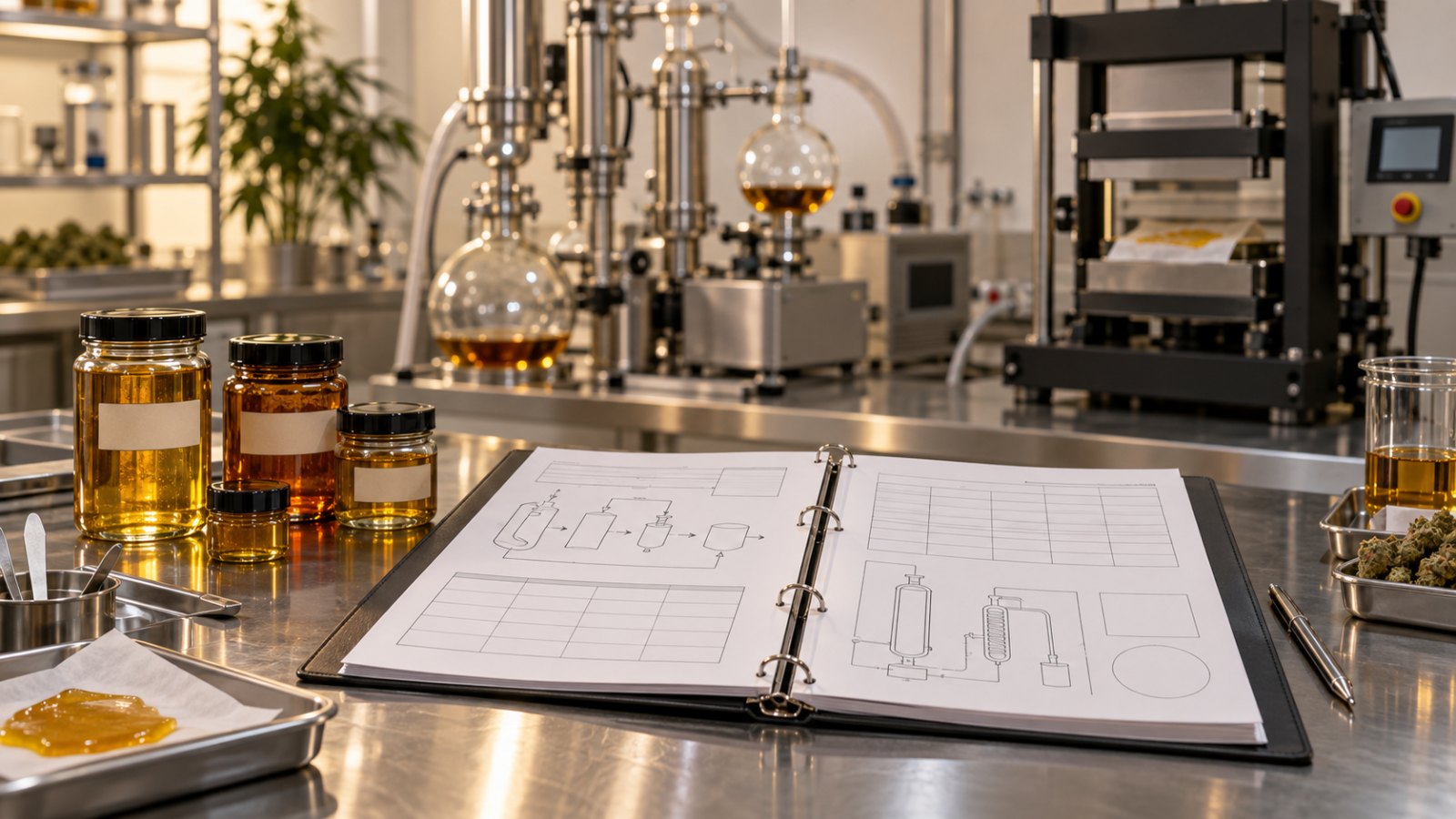
Tools: the Cannabis Extraction Licensing Lookup shows the agency, license type, fees, residency rules, allowed extraction methods, and facility requirements behind the terms below for 37 states; the THC Dosing Calculator and the SOP templates cover dosing and procedures.
The C1D1 Ventilation Calculator sizes the exhaust, air changes, and LEL alarm point for an extraction room.
What is This Glossary?
Every extraction, distillation, and processing term that matters, defined by operators who run these systems daily. No textbook fluff. Each entry gives you the definition, why it matters to your operation, and the key numbers you need to know. Where we have written the full guide, you will find the link.
Extraction Methods
BHO (Butane Hash Oil) Extraction
What it is: Hydrocarbon extraction using n-butane (or butane/propane blends) in a closed-loop system to dissolve cannabinoids and terpenes from plant material.
Why it matters: BHO produces the widest range of concentrate textures (shatter, wax, budder, live resin, diamonds) and preserves terpene profiles better than ethanol. Get the solvent recovery wrong and you are left with residual butane above the 5,000 ppm action level.
Key numbers: Extraction temp: -40F to -80F for best selectivity. Recovery rate: 95-98% solvent. Target residual solvent: below 500 ppm (most states), below 50 ppm (Oregon).
→ Full guide: How to Set Up and Operate a Closed Loop BHO Extraction System
→ Full guide: How to Make BHO Wax: Butane Extraction SOP for Every Texture
CO2 Extraction (Supercritical/Subcritical)
What it is: Extraction using carbon dioxide at elevated temperature and pressure to reach supercritical or subcritical states, selectively dissolving cannabinoids and terpenes.
Why it matters: CO2 is tunable. Supercritical (above 31.1C, 1,071 psi) acts like a nonpolar solvent for bulk cannabinoid extraction. Subcritical (lower pressure) targets terpenes and lighter compounds. The downside is throughput: CO2 runs slower than hydrocarbon and produces crude that still needs winterization.
Key numbers: Supercritical: 35-60C, 1,200-5,000 psi. Subcritical: 15-25C, 800-1,200 psi. Typical yield: 8-12% by weight on dry flower.
→ Full guide: CO2 Extraction for Cannabis: Supercritical vs Subcritical
Ethanol Extraction
What it is: Using food-grade ethanol (190 proof minimum) as a polar solvent to strip cannabinoids from plant material, typically at cryogenic temperatures (-40F to -80F).
Why it matters: Ethanol is the workhorse for high-throughput operations. It extracts fast and scales well. The tradeoff is selectivity: warm ethanol pulls everything, including chlorophyll, waxes, and fats. That is why cryogenic temperatures and post-extraction winterization are non-negotiable for quality output.
Key numbers: Soak time: 3-10 minutes at cryo temps. Ethanol ratio: 10:1 solvent-to-biomass. Evaporation temp: below 40C to preserve terpenes.
→ Full guide: How to Make Ethanol Shatter
Rosin Press Extraction
What it is: Solventless extraction using heat and pressure to squeeze cannabinoid-rich resin from flower, hash, or kief. No solvents. No residual solvent testing required.
Why it matters: Rosin is the cleanest path to a dabbable concentrate. No C1D1 room. No solvent recovery. No residual solvent COA. The constraint is yield: flower rosin returns 15-25%, and you lose terpene fractions above 220F.
Key numbers: Flower rosin: 180-220F, 600-1,200 psi, 60-120 seconds. Hash rosin: 150-190F, 300-800 psi. Micron bags: 25u-90u depending on input.
→ Full guide: How to Press Rosin from Flower
→ Full guide: Hash Rosin: How to Press Premium Rosin from Bubble Hash
Ice Water Hash (Bubble Hash)
What it is: Mechanical separation of trichome heads from cannabis using ice water agitation and progressively finer filter bags (25u-220u).
Why it matters: Ice water hash is the starting material for premium hash rosin and solventless diamonds. The 73u-90u collection is where the full-melt heads live. Everything else goes to edibles or second-press rosin. Water quality matters: use RO or distilled. Chlorinated tap water degrades terpenes on contact.
Key numbers: Water temp: 32-38F. Agitation: 5-15 minutes depending on freshness. Full-melt collection: 73u-120u bags. Drying: freeze dryer at -40F, 24-48h.
RSO (Rick Simpson Oil)
What it is: Full-spectrum whole-plant extract made by soaking cannabis in ethanol or isopropanol, then evaporating the solvent to leave a thick, dark oil containing the full cannabinoid and terpene profile.
Why it matters: RSO retains more plant compounds than any other extraction method: cannabinoids, terpenes, flavonoids, and plant waxes. The entourage effect is maximized. The downside is taste and purity. RSO is crude by design. It is not meant to be dabbed.
Key numbers: Soak time: 3-5 minutes (quick wash) to 20+ minutes (full extraction). Decarboxylation: 240F for 40-60 minutes. Typical potency: 50-70% total cannabinoids.
→ Full guide: How to Make RSO (Rick Simpson Oil)
Live Resin Extraction
What it is: Hydrocarbon extraction of fresh-frozen cannabis (harvested and immediately frozen, never dried or cured) to preserve the volatile terpene profile that drying destroys.
Why it matters: Drying cannabis at ambient temperature evaporates 30-50% of monoterpenes before extraction even begins. Fresh-frozen material retains the full terpene fingerprint. The result is a concentrate that actually smells and tastes like the living plant.
Key numbers: Freeze within 1 hour of harvest. Storage: -20F or colder. Extraction: -60F to -80F butane/propane blend. Monoterpene retention: 2-5x higher than dried material.
→ Full guide: How to Make Live Resin
Steam Distillation
What it is: Passing steam through cannabis biomass to volatilize and carry terpenes into a condenser, where they separate from the water layer as an essential oil.
Why it matters: Steam distillation isolates terpenes without any solvent. It produces cannabis essential oil for reintroduction into distillate or formulation products. The limitation: it only captures volatile terpenes. Cannabinoids stay behind in the biomass.
Key numbers: Steam temp: 100C. Run time: 2-4 hours per batch. Yield: 1-3% by weight of terpene-rich essential oil.
→ Full guide: Terpene Extraction from Cannabis
Post-Processing
Winterization (Dewaxing)
What it is: Dissolving crude extract in cold ethanol (-40F to -80F) and filtering to remove fats, lipids, and waxes that co-extracted with the cannabinoids.
Why it matters: Fats and waxes cause cloudiness, harsh taste, and clogged vape cartridges. Skip winterization and your distillate will haze within days on the shelf. The ethanol must be cold enough to precipitate waxes while keeping cannabinoids in solution.
Key numbers: Ethanol ratio: 10:1 to 15:1. Temp: -40F minimum, -80F ideal. Soak time: 24-48 hours. Filter: 0.45um or Buchner with Whatman #1.
→ Full guide: Cannabis Winterization: The Complete Guide to Dewaxing Extracts
Degumming
What it is: Removing phospholipids from crude oil before distillation using water, citric acid, or phosphoric acid to hydrate and precipitate the gums.
Why it matters: Phospholipids cause foaming in the distillation flask, erratic boiling, and reduced throughput. They also degrade at distillation temperatures and contribute off-flavors to the final product.
Key numbers: Citric acid concentration: 0.1-0.5% by weight. Water addition: 1-3% by volume. Temp: 60-80C. Centrifuge or filter after 30-60 minutes of mixing.
→ Full guide: Degumming Cannabis Crude Oil
Decarboxylation
What it is: Heat-driven removal of the carboxyl group from THCA to produce THC (or CBDA to CBD). The reaction that converts non-psychoactive acid forms into their active counterparts.
Why it matters: Raw cannabis contains THCA, not THC. Without decarboxylation, edibles will not produce psychoactive effects. Smoking and vaping decarb on contact. Edible and tincture production requires controlled decarb before infusion.
Key numbers: THCA to THC: 220-240F for 30-60 minutes. CBDA to CBD: 240-280F for 60-90 minutes. Above 300F: degradation to CBN accelerates.
→ Full guide: Devolatilization and Decarboxylation Explained
CRC (Color Remediation Chromatography)
What it is: Filtering crude extract through a packed column of adsorbent media (activated alumina, silica, bentonite, T5 clay, or Magnesol) to remove pigments, chlorophyll, and oxidation byproducts.
Why it matters: CRC turns dark crude into light, golden extract. It is standard practice for BHO producers who need consistent color. The risk: over-packing or using the wrong media strips terpenes alongside the color. A CRC column that is too aggressive produces clean-looking product with no nose.
Key numbers: Media ratio: 5-15g per pound of oil depending on darkness. Flow rate: gravity or 5-10 psi. Typical terpene loss: 5-20% depending on media selection.
→ Full guide: Color Remediation Chromatography (CRC): The Complete Guide
Remediation
What it is: Post-extraction correction of failed batches, including removal of residual solvents, pesticides, heavy metals, or microbial contamination from concentrate that did not pass testing.
Why it matters: A failed COA does not always mean the batch is scrap. Residual solvent remediation via extended vacuum purging, pesticide remediation via activated carbon filtration, and microbial remediation via extraction or gamma irradiation each have specific protocols. For the complete extraction-based microbial remediation SOP, see our microbial remediation through extraction guide. Extraction kills 99.9% of vegetative cells and 0.2 micron filtration catches surviving spores. Knowing when to remediate versus when to scrap saves thousands per failed batch. For solvent-specific purge protocols, see our residual solvent purging SOP.
Key numbers: Residual solvent limit (most states): butane below 5,000 ppm, propane below 5,000 ppm. Pesticide action levels vary by state. Microbial: total yeast and mold below 10,000 CFU/g (most states).
→ Full guide: Cannabis Remediation Decision Matrix
Devolatilization
What it is: Controlled vacuum oven purging to remove residual solvents and volatile impurities from crude extract before distillation or final product packaging.
Why it matters: Devolatilization is the step between extraction and distillation that most operators rush. Incomplete purging leaves residual solvent in the crude, which causes bumping during distillation and contaminates the final product. Proper vacuum oven protocol is the difference between passing and failing residual solvent testing.
Key numbers: Vacuum: -29 inHg minimum. Temperature: 90-130F (depends on target). Time: 24-72 hours depending on slab thickness. Flip slabs every 8-12 hours.
→ Full guide: Cannabis Devolatilization: Vacuum Oven Purging Guide
Distillation
Short Path Distillation
What it is: Vacuum distillation where the condenser sits centimeters from the evaporating surface, minimizing the distance cannabinoid vapor must travel before condensing. Used to purify crude into 85-95% THC or CBD distillate.
Why it matters: Short path is the entry-level distillation system for cannabis labs. It is slower than wiped film but cheaper to set up and simpler to operate. The short vapor path reduces thermal degradation, which matters because THC starts converting to CBN above 157C.
Key numbers: Mantle temp: 160-200C. Vacuum: 50-500 millitorr. Throughput: 1-4L per hour. Typical purity: 85-95% cannabinoid content.
→ Full guide: Short Path Distillation Cannabis: Complete Setup and SOP Guide
Wiped Film Distillation
What it is: Continuous-feed distillation where a rotating wiper blade spreads crude oil into a thin film on a heated cylinder wall, and cannabinoid vapor condenses on an internal condenser. Operates under deep vacuum.
Why it matters: Wiped film runs continuously (not batch), processes 5-20L per hour, and produces more consistent purity than short path. The thin film means shorter residence time on the heated surface, which reduces thermal degradation. This is the production-scale workhorse for distillate manufacturing.
Key numbers: Evaporator temp: 150-185C. Vacuum: 50-200 millitorr. Throughput: 5-20L/hr. Film thickness: 0.5-1.5mm. Wiper speed: 200-400 RPM.
→ Full guide: What is Wiped Film Distillation?
Fractional Distillation
What it is: Multi-stage distillation using a fractionating column to separate compounds by boiling point. Each theoretical plate in the column provides additional separation resolution.
Why it matters: Fractional distillation achieves higher purity than single-pass short path. It is used when you need to isolate specific cannabinoid fractions or separate closely-boiling terpene groups. The tradeoff is speed: more theoretical plates means slower throughput.
Key numbers: THC boiling point: 157C at 1 atm (much lower under vacuum). CBD: 160-180C. Terpenes: 100-180C depending on compound. Each theoretical plate adds ~10C of separation resolution.
→ Full guide: Cannabis Distillation Theory
Wiped Film Feed Preparation
What it is: The crude quality control that happens before oil enters a wiped film evaporator: water and residual solvent driven below 0.5 percent, decarboxylation complete, winterization thorough, color and viscosity inside the spec the feed pump and wiper were sized for.
Why it matters: First-pass potency, foaming, brown distillate, and wiper fouling almost always trace back to the feed, not the still. Prepared crude distills to spec on the first pass; unprepared crude turns the evaporator into a very expensive degasser.
Key numbers: First-pass cannabinoids 87 to 92 percent from prepared crude. Water and residual solvent below 0.5 percent at the feed. Jacket 130 to 165 C depending on crude type and vacuum. Feed rate, wiper speed and vacuum depth set as a matrix by crude type, not one fixed setpoint.
→ Full guide: Wiped Film Evaporator Feed Preparation: How Crude Quality Determines Distillation Output
Concentrates and Products
Shatter
What it is: Translucent, glass-like cannabis concentrate produced by BHO or ethanol extraction followed by vacuum purging at low temperatures to maintain a stable, amorphous molecular structure.
Why it matters: Shatter is the benchmark for visual purity in BHO. The clarity comes from avoiding nucleation: if you agitate, heat too high, or introduce moisture during purging, the shatter will butter out. Consistent shatter production is a direct test of your vacuum oven protocol.
Key numbers: Purge temp: 90-110F. Vacuum: -29 inHg. Time: 48-72 hours. Flip every 8-12h. Target residual solvent: below 500 ppm.
→ Full guide: How to Make Ethanol Shatter
Live Resin
What it is: Hydrocarbon concentrate made from fresh-frozen cannabis that was never dried or cured. Retains the full volatile terpene profile of the living plant.
Why it matters: Live resin is what consumers mean when they say a concentrate “tastes like the strain.” Drying cannabis at room temperature evaporates monoterpenes (myrcene, limonene, pinene) that define the aroma. Fresh-frozen extraction captures what drying destroys.
Key numbers: Monoterpene content: 5-15% (vs 1-5% in cured resin). Freeze within 1 hour of harvest. Storage: -20F or colder until extraction.
→ Full guide: How to Make Live Resin
THCa Diamonds
What it is: Crystalline THCa structures grown by controlled nucleation and crystallization from a supersaturated cannabinoid solution, either via solvent-based jar tech or solventless mechanical separation.
Why it matters: Diamonds are the purest non-isolate cannabinoid product on the market (95-99% THCa). They form when conditions are right: slow cooling, minimal agitation, and enough time for crystal lattice growth. Rush it and you get microcrystals instead of faceted stones.
Key numbers: Jar tech: sealed at room temp, 2-4 weeks. Solventless: rosin tech cold cure at 50-70F, 1-3 weeks. Purity: 95-99% THCa crystalline.
→ Full guide: How to Make THCa Diamonds: Jar Tech Method
→ Full guide: Rosin Diamonds: Solventless THCa Crystallization
Liquid Diamonds
What it is: THCa diamonds decarboxylated into delta-9 THC oil and recombined with the high-terpene extract (HTE) they crystallized out of. Sold as cartridge oil and as dab jars; the cartridge version has to be decarbed or it recrystallizes.
Why it matters: THC is an amorphous resin and stays liquid; THCa is a crystal and comes back out of a cooling cart as sugar. A “liquid diamond” cart that sugars in a month was filled with a melt, not a decarb, and the complaints land on the brand, not the chemistry.
Key numbers: Decarb at 110 to 120C until gas evolution stops (THCa under 1% on the COA); 12.3% of the diamond mass leaves as CO2 (358.5 to 314.5 g/mol). Blend 10 to 20% HTE by weight for 85 to 93% THC; fill ceramic-core carts at about 60C.
→ Full guide: How to Make Liquid Diamonds
Distillate
What it is: Purified cannabis oil produced by vacuum distillation, typically 85-95% total cannabinoids with most terpenes, fats, and plant compounds removed.
Why it matters: Distillate is the most versatile base product in cannabis manufacturing. It goes into vape cartridges, edibles, tinctures, and topicals. The tradeoff is that distillation strips the terpene profile, so the final product needs terpene reintroduction for flavor and entourage effect.
Key numbers: Typical purity: 85-95% cannabinoids. Color: light gold to amber. Viscosity: highly viscous at room temp. Terpene content: below 1% (most removed during distillation).
→ Full guide: Full Spectrum vs Distillate
Full Spectrum Extract
What it is: Cannabis extract that retains the complete cannabinoid, terpene, and flavonoid profile of the source plant, without isolating or removing individual compounds.
Why it matters: Full spectrum maximizes the entourage effect. THC, CBD, minor cannabinoids, and terpenes work together through multiple receptor pathways (CB1, CB2, TRPV1, 5-HT1A) in ways that isolated compounds cannot replicate. The challenge is producing full spectrum at scale without losing volatile terpenes during processing.
Key numbers: Terpene retention target: above 5% for premium full spectrum. Cannabinoid diversity: 6+ detectable cannabinoids. Processing temp: never above 40C during ethanol removal.
→ Full guide: 6 Reasons Full Spectrum Outperforms Distillate
Piatella
What it is: A solventless concentrate made by pressing and folding bubble hash or rosin at controlled temperatures until it reaches a smooth, butter-like consistency. Originated in the European hash scene.
Why it matters: Piatella represents the highest expression of mechanical processing without solvents. The folding and pressing technique aligns trichome structures and releases terpenes evenly through the matrix. The result is a full-melt product with better flavor distribution than standard hash rosin.
Key numbers: Starting material: 73u-90u full-melt bubble hash. Press temp: 130-160F. Folding cycles: 5-15 depending on consistency target.
→ Full guide: How to Make Piatella
Nano Emulsion
What it is: Cannabis oil broken into droplets smaller than 100 nanometers and stabilized in water using surfactants and high-energy mixing (ultrasonication or high-pressure homogenization).
Why it matters: Standard cannabis oil is lipophilic and has oral bioavailability of 6-20%. Nano emulsification increases surface area by orders of magnitude, driving onset time from 60-90 minutes down to 10-20 minutes. But most commercial nano products fail because the emulsion is unstable, the droplet size is too large, or the surfactant system is wrong.
Key numbers: Target droplet size: below 100nm (ideally 20-50nm). Surfactant HLB: 12-16 for oil-in-water. Onset: 10-20 minutes vs 60-90 for standard edibles. Bioavailability: 2-4x improvement over standard oil.
→ Full guide: How to Make a Nano Emulsion
→ Full guide: Nano Emulsified Distillate: What It Actually Is and Why Most Products Fail
Key Cannabinoids
THC (Delta-9-Tetrahydrocannabinol)
What it is: The primary psychoactive cannabinoid in cannabis. Produced by decarboxylation of THCa. Binds CB1 receptors in the brain and central nervous system.
Why it matters: THC is what regulators measure, what consumers chase, and what determines whether your product is legal hemp (below 0.3% total THC) or marijuana. The total THC calculation (THCa x 0.877 + THC) catches every hemp-derived product that contains THCa.
Key numbers: Boiling point: 157C. Legal threshold: 0.3% total THC (dry weight). Decarb: THCa converts to THC at 220-240F over 30-60 minutes. Degradation to CBN accelerates above 300F.
→ Full guide: How to Convert CBD to THC
THCa (Tetrahydrocannabinolic Acid)
What it is: The non-psychoactive acid precursor to THC, found in raw cannabis. Converts to THC when heated above 220F.
Why it matters: THCa is the legal loophole driving the hemp-derived THCa flower market. Hemp can contain high THCa as long as delta-9 THC is below 0.3% at the time of testing. But once the consumer lights it, the THCa converts to THC. This regulatory gap is closing.
Key numbers: Molecular weight: 358.47 g/mol. THCa x 0.877 = equivalent THC (the 0.877 accounts for the lost carboxyl group). Crystalline purity: 95-99% in diamond form.
→ Full guide: How to Make THCa Flower from Hemp
CBD (Cannabidiol)
What it is: Non-psychoactive cannabinoid that modulates CB1 (negative allosteric modulator), activates 5-HT1A serotonin receptors, and inhibits FAAH enzyme (which breaks down anandamide).
Why it matters: CBD is the most commercially significant non-psychoactive cannabinoid. It is also the starting material for isomerization to delta-8, delta-9, and delta-10 THC. Understanding CBD chemistry is essential for both the wellness market and the synthetic cannabinoid conversion industry.
Key numbers: Boiling point: 160-180C. Oral bioavailability: 13-19%. Isomerization to delta-9: requires acid catalyst (p-TSA, BF3, Lewis acids) at 100-140C.
→ Full guide: CBD to THC Isomerization
Delta-8 THC
What it is: A positional isomer of delta-9 THC with the double bond at the 8th carbon instead of the 9th. Produced commercially by acid-catalyzed isomerization of CBD.
Why it matters: Delta-8 is not found in significant quantities in natural cannabis. Virtually all commercial delta-8 is synthesized from CBD isolate. The conversion process requires acid catalysis, reflux, and careful neutralization. Incomplete reactions produce byproducts that must be removed by distillation.
Key numbers: Isomerization: p-TSA catalyst, toluene solvent, 100-140C, 3-8 hours. Typical crude purity: 50-70% delta-8 before distillation. Final purity after distillation: 90-98%.
→ Full guide: How to Make Delta 8 THC from CBD
CBN (Cannabinol)
What it is: Oxidation product of THC. Forms when THC is exposed to heat, light, or air over time. Mildly psychoactive with reported sedative properties.
Why it matters: CBN is both an indicator of degradation and a marketable product. High CBN in your distillate means your crude was overheated or your starting material was old. Low CBN means your processing preserved the THC. The sleep/sedation market for CBN products is growing, but the mechanism is poorly understood and may be attributable to accompanying terpenes rather than CBN itself.
Key numbers: Forms at temperatures above 300F or with prolonged UV exposure. CBN content above 2% in distillate indicates thermal degradation during processing.
Key Terpenes
Myrcene
What it is: Monoterpene. The most abundant terpene in cannabis, often 20-50% of the total terpene fraction. Earthy, musky, herbal aroma.
Why it matters: Myrcene is a TRPV1 receptor agonist and potentiates THC transport across the blood-brain barrier. It is also the most volatile major terpene, which means it is the first thing you lose during drying, extraction, or post-processing at elevated temperatures.
Key numbers: Boiling point: 167C (334F). Flash point: 39C. Evaporation begins well below boiling point. Preserve by processing below 40C when possible.
→ Full guide: Terpene Extraction from Cannabis
Limonene
What it is: Monoterpene with a citrus aroma. Second or third most abundant terpene in many cannabis cultivars.
Why it matters: Limonene modulates serotonin and dopamine signaling and has demonstrated anxiolytic effects in clinical settings. From a processing standpoint, limonene is a good indicator of extraction quality: if your concentrate smells flat, you probably lost the limonene fraction during processing.
Key numbers: Boiling point: 176C (349F). Highly volatile. Soluble in ethanol and hydrocarbon solvents.
Beta-Caryophyllene
What it is: Sesquiterpene with a spicy, peppery aroma. The only terpene known to directly bind CB2 receptors, making it functionally a dietary cannabinoid.
Why it matters: Caryophyllene survives processing better than monoterpenes because it has a higher boiling point (119C vs 167C for myrcene). It is often the dominant terpene in distillate simply because the lighter terpenes were lost. CB2 activation provides anti-inflammatory effects without psychoactivity.
Key numbers: Boiling point: 119C (246F). CB2 binding affinity: Ki = 155 nM. More thermally stable than monoterpenes.
Chemistry and Processes
pH (Extract Acid-Base Environment)
What it is: The acid-base character of the protic phase an extract contacts. Cannabinoids are weak acids: neutral forms (THC, CBD) carry a phenolic hydroxyl with a pKa near 9 to 10, and acid forms (THCA, CBDA) carry a carboxylic acid with a pKa near 3 to 4.
Why it matters: pH is the degradation lever operators forget. Below roughly pH 4, acid drives isomerization and delta-9 THC migrates to delta-8. Above roughly pH 8, the deprotonated phenolate oxidizes to CBN faster. An alkaline CRC clay or an over-neutralized batch can shift the extract out of the safe band and change your COA with no extra heat.
Key numbers: Stable handling window pH 4 to 7. Acidic media (acid-washed silica) push toward delta-8; alkaline clays (bentonite, magnesium silicate) run a slurry pH of 7.5 to 9.5 and push toward CBN.
→ Full guide: Cannabis Extract pH Management
Hazardous Materials Inventory Statement (HMIS)
The IFC Section 5001.5.2 table that lists every hazardous material on site by control area with hazard class, physical state, maximum quantity in storage and in use, storage condition, and location; the fire code official checks it against the Table 5003.1.1(1) maximum allowable quantities (120 gal Class IB liquids, 1,000 ft³ flammable gas per control area) with the extraction permit. Built line by line in the HMIS and HMMP guide.
Isomerization
What it is: Rearranging the molecular structure of a cannabinoid without changing its molecular formula. Most commonly: converting CBD to delta-8 or delta-9 THC using an acid catalyst.
Why it matters: Isomerization is what turned cheap CBD isolate into the delta-8 market. The chemistry is straightforward (acid catalyst + heat + time), but the cleanup is where most operators fail. Incomplete reactions and unknown byproducts require distillation, chromatography, or both to reach sellable purity.
Key numbers: CBD to delta-9: Lewis acid catalyst, 100-140C, 1-6 hours depending on catalyst. CBD to delta-8: p-TSA in toluene, 100-140C, 3-8 hours. Reaction monitoring: HPLC every hour.
→ Full guide: How to Convert CBD to THC
→ Full guide: Lewis Acids for Cannabinoid Isomerization
→ Full guide: The Amberlyst 15 Method
Preparative Chromatography
What it is: Column separation that isolates one cannabinoid from decarboxylated distillate by loading the feed at 1 to 10 percent of the stationary-phase mass and eluting it with an alcohol and water mobile phase, on flash cartridges or preparative HPLC.
Why it matters: It is the route to a THC-free broad-spectrum fraction and to CBG or CBN at isolate purity when crystallization will not get there. The cost is solvent: every run burns mobile phase by the tens of liters per kilogram, so cost per gram is a solvent-recovery number before it is a column number.
Key numbers: C18 elution order CBG, then CBD, then THC. Isocratic 75 to 85 percent ethanol cuts broad spectrum at non-detect THC with 85 to 95 percent CBD recovery. Preparative HPLC loads at 1 to 3 percent and a 10 micron column returns CBG or CBN at 98 percent purity with 90 percent recovery. Mobile phase 20 to 50 liters per kilogram of feed.
Equipment
Closed-Loop Extraction System
What it is: A sealed hydrocarbon extraction system where solvent is recovered, condensed, and recycled without ever being exposed to the atmosphere. Required by law for commercial BHO extraction.
Why it matters: Open blasting kills people. Closed-loop systems contain the butane within a sealed circuit, recover 95-98% of the solvent, and operate within C1D1 classified rooms. Every commercial hydrocarbon lab runs closed-loop. There is no legal alternative.
Key numbers: Working pressure: 150-300 PSI. Solvent recovery: 95-98%. Column sizes: 1 lb to 20+ lb material capacity. Recovery tank temp: 80-100F for passive, chilled coil for active.
→ Full guide: Closed Loop BHO Extraction Setup Guide
Vacuum Oven
What it is: A heated chamber that operates under vacuum (-29 inHg) to lower the boiling point of residual solvents, allowing them to evaporate at temperatures that do not degrade cannabinoids or terpenes.
Rotary Evaporator (Rotovap)
What it is: A batch solvent recovery device that spins a flask in a heated bath under vacuum, creating a thin film for rapid evaporation. The workhorse of small to mid-scale ethanol recovery.
Why it matters: A rotovap strips ethanol down to less than 100 ppm residual in a single pass, which means your downstream purge step is shorter or unnecessary. But at 4 to 6 liters per hour, it becomes the bottleneck at any scale above 50 liters per day.
Key numbers: 4 to 6 L/hr throughput (20L unit). Bath temp 40 to 60C. Vacuum 50 to 100 mbar. Recovery rate 95 to 99%. Cost per liter recovered: $0.60 to $1.20.
→ Full guide: Solvent Recovery Systems Compared
Falling Film Evaporator
What it is: A continuous-flow solvent recovery system where liquid feeds from the top and flows down heated vertical tubes under vacuum. Gravity does the work. Built for high-throughput ethanol recovery at commercial scale.
Why it matters: A falling film processes 30 to 120 liters of ethanol per hour, which is 6 to 24 times faster than a rotovap. The catch: it leaves 10 to 20% residual ethanol, so you still need a finishing device. Budget for both from day one or you are writing a check for a surprise rotovap two weeks after installation.
Key numbers: 30 to 120 L/hr throughput. Residual ethanol 10 to 20% (requires finishing). Capital cost $25,000 to $80,000. Cost per liter recovered: $0.08 to $0.15.
→ Full guide: Solvent Recovery Systems Compared
Centrifugal Evaporator
What it is: A solvent recovery system that uses centrifugal force to spread solution across a heated surface as an ultra-thin film. Sits between rotovap and falling film in both throughput and cost.
Why it matters: Centrifugal evaporators achieve near-complete solvent stripping (below 1% residual) in a single pass, which means no finishing device required. The sweet spot for labs processing 80 to 200 liters of ethanol per day.
Key numbers: 10 to 50 L/hr throughput. Residual ethanol less than 1% (single pass). Capital cost $40,000 to $120,000. Cost per liter recovered: $0.15 to $0.35.
→ Full guide: Solvent Recovery Systems Compared
Why it matters: The vacuum oven is where BHO goes from crude extract to finished product. Temperature and vacuum depth control the texture (shatter vs budder vs crumble) and determine whether you pass residual solvent testing. Most failed solvent tests trace back to rushed vacuum oven protocols.
Key numbers: Temp range: 90-130F for purging. Vacuum: -29 to -29.9 inHg. Time: 24-72 hours minimum for shatter. Slab thickness: 0.25-0.5 inches for even purging.
→ Full guide: Vacuum Oven Purging Guide
Extraction Lab Design
What it is: The complete facility plan for a cannabis extraction laboratory including room classification (C1D1/C1D2), HVAC, gas detection, fire suppression, electrical, and equipment layout.
Why it matters: A poorly designed lab fails inspection before it processes a single gram. C1D1 classification alone requires explosion-proof electrical, 12+ air changes per hour, negative pressure zoning, LEL monitoring, and emergency ventilation. Getting this wrong costs six figures to retrofit.
Key numbers: C1D1 air changes: 12+ per hour. LEL low alarm: 10% of butane LEL (1,800 ppm); shutdown at 25% (4,500 ppm). Emergency ventilation: full room volume in under 1 minute. Typical build cost: $150K-$500K+ depending on scale.
→ Full guide: How to Build an Extraction Laboratory
→ Full guide: How Much Does a Cannabis Extraction Lab Cost?
Oxime Ether Cannabinoid (EPN, Euphorinol)
What it is: A cannabinoid skeleton carrying a carbon-nitrogen double bond with an oxygen-linked side chain, formed by condensing a hydroxylamine reagent with a ketone on the finished ring system. Cannabis has no biosynthetic pathway to that bond.
Why it matters: No reference standard exists, so a standard potency panel reports the compound as absent or as an unidentified peak rather than quantifying it. See how Euphorinol is made for the full seven-step route and the analytical consequences.
Regulatory and Compliance
Sterile Filtration
What it is: Filtration through a 0.2 micron membrane that removes all bacteria, mold spores, and yeast cells from a liquid extract. The pharmaceutical standard for bioburden reduction in fluid processing.
Why it matters: This is the critical step in extraction-based microbial remediation. Ethanol kills vegetative cells, but spores survive. A 0.2 micron membrane catches everything cellular (smallest pathogenic bacteria: 0.3 microns, mold spores: 2-10 microns). Skip this step and your remediated extract will fail retesting.
Key numbers: 0.2 micron pore size standard. PTFE or PVDF membranes for solvent compatibility. 10-15 PSI nitrogen pressure for throughput. Change filter at 50% flow rate drop. Nylon membranes degrade in butane.
→ Full guide: Microbial Remediation Through Extraction
COA (Certificate of Analysis)
What it is: Third-party lab report verifying the cannabinoid potency, terpene profile, residual solvents, pesticides, heavy metals, microbial contaminants, and mycotoxins in a cannabis product.
Why it matters: The COA is the document that determines if your product can legally be sold. A failed COA on any category can require remediation, relabeling, or disposal. Understanding what each panel tests and at what action levels lets you design your process to pass consistently.
Key numbers: Panels vary by state. Typical: potency (cannabinoids), terpenes, residual solvents (butane below 5,000 ppm), pesticides (66-70 analytes), heavy metals (As, Cd, Hg, Pb), microbial (TYM, bile-tolerant gram-negative), mycotoxins (aflatoxin, ochratoxin).
Total THC Calculation
What it is: The formula regulators use to determine the true THC content of a product: Total THC = (THCa x 0.877) + delta-9 THC.
Why it matters: This is the calculation that makes or breaks every hemp-derived product. The 0.877 conversion factor accounts for the mass lost when the carboxyl group leaves during decarboxylation. A flower testing at 20% THCa and 0.2% THC has a total THC of 17.74% under this formula, which means it exceeds the 0.3% hemp threshold by a factor of 59.
Key numbers: Hemp threshold: 0.3% total THC (dry weight). Conversion factor: 0.877. Any product with THCa above 0.34% exceeds the hemp limit even with 0% delta-9 THC.
C1D1 (Class 1, Division 1)
What it is: NEC electrical classification for rooms where ignitable concentrations of flammable gases or vapors exist under normal operating conditions. Required for any room where hydrocarbon solvents are used.
Why it matters: If you run BHO, your extraction room is C1D1. That means every electrical component (lights, outlets, switches, fans, heaters) must be explosion-proof rated. Standard electrical equipment in a C1D1 room is a code violation that will shut down your operation and void your insurance.
Key numbers: Explosion-proof electrical rated Class I Division 1 Group D; seal-off fittings within 18 inches of arcing enclosures. Ventilation: minimum 1 CFM per square foot of floor (about 6 air changes per hour at a 10 ft ceiling), with many AHJs and booth specs targeting 12+ ACH. LEL gas detection: warning at 10 to 20% LEL, alarm and shutdown at 25% LEL. Butane LEL 1.86% by volume.
→ Full guide: C1D1 Room Requirements
MAQ (Maximum Allowable Quantity)
What it is: The most flammable liquid or gas a control area may hold before the space stops being a normal occupancy and becomes a hazardous (H) occupancy under the International Fire Code, Table 5003.1.1(1). A control area is a space bounded by fire-rated construction; each one gets its own full MAQ.
Why it matters: Operators read “60 gallons” off a cabinet spec and think it is their limit. It is the limit for one cabinet. The MAQ is the number that decides whether your solvent room needs H-occupancy construction, and it is the number the plan reviewer checks first.
Key numbers: Class IB/IC liquids (ethanol, isopropanol, heptane, acetone): 120 gallons base per control area, 240 with sprinklers, 480 with sprinklers plus listed cabinets. Class IA (pentane): 30 / 60 / 120 gallons. Single cabinet: 60 gallons of Class I or II liquid, no more than 3 cabinets per fire area unless separated by 100 feet (IFC 5704.3.2). OSHA 1910.106 caps flammable liquid in containers outside a cabinet at 25 gallons per room.
→ Full guide: Solvent Storage Room Design Under NFPA 30
LEL (Lower Explosive Limit)
What it is: The lowest concentration of a flammable vapor in air that will ignite. Fixed gas detectors in extraction rooms report percent of LEL, not percent of gas, so 100 percent LEL for butane is 1.8 percent butane by volume.
Hemp inversion (converted THC). Selling hemp-derived cannabinoids, usually CBD isolate chemically converted to THC with an acid catalyst, as if they were state-licensed cannabis. A converted product leaves three kinds of evidence: a Class 2 workup solvent (methylene chloride, toluene, chloroform) that extraction never uses, an isomer profile the plant does not make (delta-8 above 1 percent, any delta-10 or iso-THC, olivetol), and in the zinc-catalyzed routes a metal the standard four-metal panel does not screen. The Colorado StayCon recall (September 2026, 49 vape products, methylene chloride found on a pesticide screen) is the reference case. Full detection key: how to detect converted THC.
Residual solvent classes (USP 467). USP General Chapter 467 sorts solvents by toxicity: Class 1 (avoid; benzene 2 ppm), Class 2 (limited by permitted daily exposure; methylene chloride 600 ppm, toluene 890, hexane 290, chloroform 60, methanol 3,000), Class 3 (low risk, 5,000 ppm; ethanol, heptane, isopropanol, acetone, ethyl acetate, pentane). Butane and propane are not in USP 467 and are limited by state rule, commonly 5,000 ppm total. State cannabis panels usually copy the numbers without the full list, which is why a Class 2 conversion solvent can pass a “compliant” residual solvent test. Purge procedures by solvent: residual solvent purge SOPs.
Why it matters: Every fire code alarm point, interlock, and evacuation rule in a hydrocarbon or ethanol lab hangs on this number. A sensor mounted at head height, a catalytic bead poisoned by silicone spray, or a panel that operators reset without finding the cause all turn a working alarm into a decorative one.
Key numbers: LEL by volume in air: n-butane 1.8%, propane 2.1%, ethanol 3.3%, heptane 1.1%. Low alarm 10% LEL (1,800 ppm butane): exhaust to high, stop introducing solvent. High alarm 25% LEL (4,500 ppm butane), the NFPA 1 Chapter 38 and IFC Chapter 39 trip point: interlock shuts the system down, evacuate. Sensor height for butane and propane: 6 to 12 inches above the floor. Fixed monitors: bump test monthly, calibrate every 6 months on 50% LEL span gas of the solvent in use.
→ Full guide: What a High LEL Reading Actually Means (Safety Equipment Checklist)
RCRA Hazardous Waste (Solvent Disposal)
What it is: The federal framework (Resource Conservation and Recovery Act) that governs how spent extraction solvent is classified and disposed. Spent ethanol, butane, propane, and hexane are D001 ignitable waste; methanol and acetone are additionally F-listed.
Why it matters: Complying with your state cannabis waste rules (render the plant material unusable) does nothing for the EPA. Ignitable solvent needs a manifest and a permitted disposal facility. Pouring it down a drain is both an illegal disposal and a fire hazard.
Key numbers: Ignitability threshold is a flashpoint below 60C (140F). Generator tiers: VSQG under 100 kg per month (about 33 gallons of ethanol), SQG 100 to 1,000 kg, LQG 1,000 kg and up. Satellite accumulation cap: 55 gallons.
→ Full guide: Cannabis Extraction Waste Disposal (RCRA)
Sprinkler Design Density
What it is: The water an NFPA 13 sprinkler system is designed to deliver, in gallons per minute per square foot, over the most remote design area of a room, set by that room’s hazard classification rather than by the building’s occupancy label.
Why it matters: It sizes the water supply, the pipe, and the fire pump, and it is the condition behind the 100 percent increase in maximum allowable quantity an extraction lab claims in its hazardous materials inventory statement. An Ordinary Hazard design in a room the reviewer reads as Extra Hazard is a repipe, not a paperwork fix.
Key numbers: Ordinary Hazard Group 2: 0.20 gpm per square foot over 1,500 square feet (300 gpm), 250 gpm hose stream, 60 to 90 minutes. Extra Hazard Group 2: 0.40 over 2,500 square feet (1,000 gpm), 500 gpm hose stream, 90 to 120 minutes. The sprinklered control area holds 240 gallons of Class IB liquid instead of 120 and 2,000 cubic feet of flammable gas instead of 1,000.
Extra Hazard Occupancy (NFPA 13)
What it is: The NFPA 13 hazard classification for spaces where flammable or combustible liquids are present in quantity and a fire would develop fast: Group 1 for moderate amounts in closed systems, Group 2 for moderate to substantial amounts in the open, the class the annex examples (solvent cleaning, flammable liquid spraying, dip tanks) describe.
Why it matters: An ethanol extraction room with open centrifuges and 55-gallon totes reads as Extra Hazard Group 2; a hydrocarbon room with listed closed-loop skids is argued between Group 1 and Group 2 on stored spares and open purging. The classification is set by the room with the most open flammable liquid, and piping sized for Ordinary Hazard cannot be talked up to Extra Hazard at inspection.
Key numbers: Group 1: 0.30 gpm per square foot over 2,500 square feet (750 gpm). Group 2: 0.40 over 2,500 (1,000 gpm). Hose stream 500 gpm, duration 90 to 120 minutes for both. The quick-response design-area reduction allowed in Light and Ordinary Hazard is not available in Extra Hazard.
Potency Cross-Test Audit
What it is: A regulator-run re-test of finished product bought or pulled from retail, analyzed by a reference lab or independent labs that are not the lab on the producer’s COA, and scored against the label (Massachusetts: 75 to 125 percent of labeled total THC; 13 of 63 flower products failed in August 2026).
Why it matters: The state tests one unit, not a batch average, so homogenization and unit-level release testing decide the outcome. Full guide: potency cross-test audits.
Lab Shopping
What it is: Submitting the same batch to several labs and keeping the highest potency or cleanest contaminant result, or moving to a lab known to report high. Detected statistically by a lab’s mean sitting above the market mean, results clustering just above commercial thresholds, near-zero contaminant detection, and client migration after a fail.
Why it matters: New Jersey is buying a twice-yearly statistical scan of every lab’s data and Maryland is running the same flower through five labs; a producer whose COAs come from the flagged lab inherits the doubt. See lab testing fraud and the cross-test audit guide.
Relative Percent Difference (RPD) and RSD
What it is: RPD is the absolute difference between two results divided by their mean, times 100 (two gummies at 8.6 and 11.3 mg: 27 percent). RSD is the standard deviation of three or more results divided by the mean, times 100. Both measure homogeneity, the spread between units of the same batch.
Why it matters: Oregon’s proposed rule fails 10 to 50 mg CBD concentrates, extracts and inhalables when RPD or RSD exceeds 50 percent, and a single unit over the maximum fails the batch regardless of the average. An internal unit limit of 10 to 15 percent is what survives a single-unit state draw.
Formulation
Bioavailability
What it is: The fraction of administered cannabinoid that reaches systemic circulation. Varies dramatically by route of administration.
Why it matters: A 10mg THC edible delivers 0.6-2mg to the bloodstream. The same 10mg vaped delivers 3-5mg. This is why dosing between product categories is not interchangeable. Formulation scientists focus on improving oral bioavailability through nano emulsification, lipid-based carriers, or self-emulsifying drug delivery systems (SEDDS).
Key numbers: Inhalation: 30-50%. Sublingual: 15-35%. Oral: 6-20%. Transdermal: 5-10%. Nano emulsion oral: 15-40% (estimated, varies by formulation quality).
Terpene Reintroduction
What it is: Adding terpenes back into distillate or isolate after processing has stripped the original terpene profile. Uses cannabis-derived terpenes (CDT), botanically-derived terpenes (BDT), or a blend.
Why it matters: Distillate without terpenes is a flavorless, odorless oil. Terpene reintroduction restores the strain-specific flavor and may restore entourage effect benefits. CDT is preferred for quality products but costs 5-20x more than BDT. The target concentration is 5-10% by weight for vape cartridges.
Key numbers: Vape cartridge: 5-10% terpene by weight. Edible: 0.5-2%. Mix temp: below 40C to prevent terpene volatilization. CDT cost: $50-$200 per gram. BDT cost: $1-$10 per gram.
Isomerization Troubleshooting
What it is: Systematic diagnosis and correction of process failures during acid-catalyzed CBD-to-THC conversion reactions.
Why it matters: The eight most common isomerization failures (incomplete conversion, wrong isomer ratio, dark product, unknown byproducts, crystallization, poor reproducibility, residual acid, THC degradation to CBN) each have specific root causes and specific fixes. Diagnosing wrong costs time and money.
Key numbers: Catalyst loading 1-3 mol%, reaction temp 100-120C for p-TsOH, delta-9 peak window 2.5-4 hours, starting material purity 85%+ CBD, water content below 500 ppm.
→ Full guide: CBD Isomerization Troubleshooting: 8 Failures and How to Fix Them
Kinetic vs Thermodynamic Product
What it is: In isomerization chemistry, the kinetic product (delta-9 THC) forms first and faster. The thermodynamic product (delta-8 THC) is more stable and accumulates with extended reaction time.
Why it matters: The product you get from isomerization is determined by when you stop the reaction, not by what catalyst you use. Running past the delta-9 peak shifts the ratio toward delta-8. Operators who do not run time-course HPLC cannot control which isomer dominates.
Key numbers: Delta-9 peak at 2.5-4 hours (p-TsOH/toluene, 100-110C). Delta-8 dominance at 6-12 hours same conditions.
Water Activity (Aw)
What it is: A thermodynamic measurement (0 to 1 scale) of how much water in plant material is available for chemical reactions and microbial growth. Not the same as moisture content.
Why it matters: Every extraction method has a different target Aw. BHO at 0.55-0.60, ethanol at 0.50-0.55, CO2 at 0.45-0.50, rosin at 0.55-0.62. Too high causes emulsions and chlorophyll co-extraction. Too low causes trichome brittleness and 15-20% yield loss from static. The single most common root cause of extraction failures that operators blame on equipment.
Key numbers: Microbial growth threshold: Aw > 0.65. Aspergillus minimum: Aw 0.65. Static loss onset: Aw < 0.50. Instrument: chilled mirror hygrometer (+/- 0.003 Aw, 3-5 min read, $3,500-5,000).
→ Full guide: Cannabis Starting Material Moisture and Water Activity
Moisture Content
What it is: A gravimetric measurement of total water present in plant material by weight, expressed as a percentage. Measured by loss on drying (105C, 2-4 hours) or Karl Fischer titration.
Why it matters: Tells you how much water is present, but not whether that water is free to cause problems during extraction. Two samples at 10% moisture can have very different water activities (0.50 vs 0.62) depending on how tightly the water is bound. Moisture content is the cheap screening tool. Water activity is the quality control measurement that predicts extraction performance.
Key numbers: Dried flower target: 8-15% by weight. Fresh frozen (ice water hash): 70-80%. Drying temp: 60-65F / 55-60% RH. Karl Fischer instrument: $4,000-10,000.
→ Full guide: Cannabis Starting Material Moisture and Water Activity
THCP (Tetrahydrocannabiphorol)
What it is: A naturally occurring phytocannabinoid with a seven-carbon (heptyl) alkyl side chain, compared to THC’s five-carbon (pentyl) chain. First isolated from the FM2 cultivar in 2019 by Italian researchers.
Why it matters: THCP binds CB1 at approximately 1.2 nM (Ki), which is 33x the binding affinity of delta-9 THC (~40 nM). A 1mg oral dose of THCP produces subjective effects comparable to 15-30mg of THC. Most commercial THCP is semi-synthesized from CBD via acid-catalyzed isomerization followed by Grignard side-chain homologation.
Key numbers: CB1 Ki ~1.2 nM; C7 heptyl chain; synthesis yield 40-65% (homologation step); triggers THC-COOH metabolite on standard drug panels.
→ Full guide: Novel Cannabinoid Synthesis from CBD
HHC (Hexahydrocannabinol)
What it is: THC with the double bond at C9 removed via catalytic hydrogenation. The saturated ring makes HHC more oxidatively stable than THC, with no C9=C10 double bond available for degradation to CBN.
Why it matters: HHC exists in a regulatory gray zone because it is technically not “tetrahydrocannabinol” by most statutory definitions. Pharmacologically, it is 50-80% as potent as THC depending on the 9R:9S diastereomer ratio. Standard Pd/C hydrogenation produces 60:40 to 70:30 (9R:9S), where 9R is the active form.
Key numbers: Hydrogenation at 30-60 PSI H2, Pd/C 3-5% w/w, 20-25C, 2-8 hours; 9R-HHC ~80% THC potency; 9S-HHC ~10% THC potency; shelf life advantage: <5% degradation at 40C/75% RH over 90 days vs 15-25% for THC.
→ Full guide: Novel Cannabinoid Synthesis from CBD
THCV (Tetrahydrocannabivarin)
What it is: The C3 (propyl) homolog of THC. Pharmacologically unique: acts as a CB1 antagonist below 10mg and flips to a partial agonist above 20mg. Found naturally in certain African sativa cultivars at 3-5%.
Why it matters: The dose-dependent reversal means THCV suppresses appetite at low doses (CB1 antagonism) and may stimulate it at high doses. Shorter duration of action (45-90 min inhaled vs 2-4 hours for THC). Commercial synthesis from CBDV via isomerization or de novo from olivetol.
Key numbers: CB1 Ki ~75 nM; antagonist <10mg, partial agonist >20mg; oral Tmax 30-60 min (vs 60-120 for THC); CBDV isolate cost $5,000-12,000/kg.
→ Full guide: Novel Cannabinoid Synthesis from CBD
Supersaturation
What it is: A solution state where the dissolved cannabinoid concentration exceeds the thermodynamic solubility limit at a given temperature. The driving force behind THCa crystallization (diamond growing) in both reactor and jar tech methods.
Why it matters: Without supersaturation, crystals do not nucleate. The degree of supersaturation controls crystal size, growth rate, and morphology. Too little supersaturation: no crystallization. Too much: rapid nucleation produces many small crystals (sugar) instead of fewer large diamonds.
Key numbers: Optimal supersaturation ratio 1.2-1.5x for large diamonds; temperature ramp 0.5-1C/day; starting THCa concentration >70% for viable crystallization.
→ Full guide: THCa Crystallization Technique
Sugaring (Extract Instability)
What it is: Spontaneous crystallization of THCa in cannabis concentrates (especially shatter), converting a clear, glassy texture into an opaque, granular “sugar” consistency. Driven by nucleation kinetics when THCa concentration exceeds the solubility limit in the terpene/cannabinoid matrix.
Why it matters: Sugaring is not a defect in every context (sauce and sugar wax are intentional), but in shatter it represents product instability. The trigger is residual solvent evaporation, mechanical agitation, temperature cycling, or terpene loss reducing the solvent capacity of the matrix.
Key numbers: Shatter stability threshold: THCa <65% with terpene content >5% resists sugaring; nucleation accelerates above 25C; cold storage (2-8C) slows nucleation 10-50x.
→ Full guide: Cannabis Extract Stability Science
Extract Stability
What it is: The resistance of a cannabis concentrate to chemical degradation (oxidation, isomerization) and physical change (crystallization, phase separation, viscosity shift) over time. Governed by THC oxidation to CBN, terpene volatilization, and nucleation kinetics.
Why it matters: Unstable extracts lose potency, change texture, develop off-flavors, and fail retesting. THC degrades to CBN at a rate dependent on oxygen exposure, UV light, and temperature. Terpene half-lives range from 30 days (myrcene, open container, RT) to 12+ months (beta-caryophyllene, sealed, 4C).
Key numbers: THC to CBN: ~2-5% per month at RT in air; terpene loss in open container: 30-60% over 30 days; optimal storage: 2-8C, N2 atmosphere, amber glass, <60% RH.
→ Full guide: Cannabis Extract Stability Science
Standard Operating Procedure (SOP)
What it is: A written document that defines every step of an extraction or post-processing operation with specific parameters, safety controls, and quality checkpoints. Not a suggestion list. A binding process definition.
Why it matters: Inspectors compare your SOP to your batch records. If they do not match, that is a finding. Vague SOPs (“heat to appropriate temperature”) create operator judgment calls that produce inconsistent batches and failed audits.
Key numbers: A complete extraction SOP needs 7 sections minimum: header/document control, material specifications, process parameters (with target + range + failure threshold for every variable), safety protocols, QC checkpoints, deviation documentation, and batch release criteria.
→ Full guide: Cannabis Extraction SOP Templates
Batch Record
What it is: The real-time log of every parameter, observation, and decision made during a single extraction or processing run. The batch record is the SOP’s proof of execution.
Why it matters: Inspectors cross-reference batch records against the SOP. If the SOP says -40C ethanol wash and the batch record shows -20C, you have a documented deviation. Without batch records, you have no traceability and no defense during an audit.
Key numbers: Each batch record captures: input weight, solvent volume, temperatures at each step (logged, not estimated), hold times, in-process test results, yield, and operator signatures.
→ Full guide: Cannabis Extraction SOP Templates
Deviation and CAPA
What it is: A deviation is any departure from the SOP during production. CAPA (Corrective and Preventive Action) is the framework for documenting what went wrong, why, and how to prevent it from recurring.
Why it matters: Most small cannabis labs log deviations as “operator error” with no root cause analysis. Inspectors see this as a systemic failure: you are not learning from mistakes. A proper CAPA identifies the specific cause (thermocouple placement, not the operator) and implements a structural fix.
Key numbers: Each CAPA requires 5 elements: deviation description, immediate action, root cause analysis, corrective action (this batch), and preventive action (all future batches).
→ Full guide: Cannabis Extraction SOP Templates
DEA Registration (Schedule III)
Federal registration required for state-licensed medical cannabis businesses to handle Schedule III marijuana under 21 CFR Part 1301. Uses DEA Form 225 with drug codes 7362 (marijuana extract), 7353 (tetrahydrocannabinols), or 7386 (marijuana). Annual fee: $3,699 for manufacturers. Not the same as state licensing. State C1D1 covers fire safety; DEA registration covers diversion controls, federal inventory, and facility access. A lab can pass every state inspection and still fail DEA pre-registration because the storage cabinet does not meet 21 CFR 1301.72 specifications. See our DEA Schedule III Registration Guide.
DEA Form 225
The application form for DEA registration as a manufacturer, distributor, or researcher of controlled substances. For cannabis extraction labs, Form 225 requires disclosure across seven sections: business info, ownership structure, state licenses, supplier identification, security infrastructure, criminal history, and activity-specific details including production methods and estimated annual quantities by drug code.
Nominal Price Crop Mechanism
A Single Convention treaty obligation that has no state-level analog. Manufacturers must establish a nominal price for harvested marijuana crop and store it in a DEA-accessible facility until a paper transaction is completed. This is new territory for cannabis operators and requires custom SOPs and accounting procedures that your state has never required.
Reverse Distributor (DEA)
A DEA-registered entity authorized to receive and destroy controlled substance waste. Under 21 CFR 1317, cannabis waste disposal must either go through a registered reverse distributor or follow an on-site two-witness destruction protocol with DEA Form 41. Most state-approved disposal methods (composting, rendering unusable) do not automatically satisfy federal requirements.
Extraction Yield
The mass of crude extract recovered per unit of input biomass, expressed as a percentage. BHO from premium flower: 15-25%. Cold ethanol: 10-18%. CO2 supercritical: 8-14%. Rosin from bubble hash: 15-25%. The number everyone chases and the number most operators measure wrong. Weight yield means nothing without potency data. Potency-corrected yield (cannabinoid mass out divided by cannabinoid mass in) tells you how efficient your process actually is. A 20% crude yield at 55% potency recovers less cannabinoid than a 15% crude yield at 75% potency. Full yield troubleshooting diagnostic framework here.
Synthetically Derived Cannabinoid
What it is: Any cannabinoid produced through chemical transformation rather than direct plant extraction. Delta-8 THC from acid-catalyzed CBD isomerization, HHC from catalytic hydrogenation, and THC-O from acetylation all qualify under most regulatory definitions.
Why it matters: The classification determines legality. The DEA and multiple states classify synthetically derived cannabinoids as Schedule I regardless of hemp origin. Texas reclassified all non-delta-9 THC isomers as controlled substances effective July 31, 2026. The term is legally loaded: a structural rearrangement of a legal molecule produces an illegal one depending on which regulator is interpreting the chemistry.
Key numbers: The 2026 Farm Bill caps finished products at 0.4mg total THC per container. Any conversion product exceeds this by orders of magnitude.
→ Full guide: Texas Delta-8 Ban Analysis
Gas Ballast
What it is: A valve on a rotary vane vacuum pump that bleeds a small volume of air into the compression stage so condensable vapors (solvent, water) leave through the exhaust instead of condensing into the oil.
Why it matters: A pump backing a purge oven or a short path ingests solvent and water every run. With the ballast closed those vapors condense in the oil, the oil turns milky or dark, ultimate vacuum drifts from the high 29s toward 28 inHg, and purges stall above the residual solvent limit. Running the ballast after each solvent-heavy job is the cheapest maintenance in the lab.
Key numbers: Run 20 to 30 minutes open after a solvent-heavy purge. Oil change at 500 to 1,000 hours or at the first color change; 3,000 hours is the Edwards RV ceiling in clean service. Capped-inlet ultimate vacuum under 29.5 inHg means the pump, not the oven.
→ Full guide: Cannabis Extraction Equipment Maintenance
Preventive Maintenance Interval
What it is: The scheduled service point for a component, stated in operating hours or cycles for parts that wear from motion (vanes, diaphragms, bearings, seals) and in calendar time for parts that age from exposure (gaskets, glycol, grease).
Why it matters: The manual interval assumes the duty the manufacturer tested; an extraction lab runs solvent vapor, water, and cold through the same parts. The published number is the ceiling, the lab sets the schedule from what the equipment actually breathes, and the cost of skipping an interval runs 20 to over 100 times the cost of keeping it.
Key numbers: Vacuum pump oil 500 to 1,000 h; closed-loop gasket set 6 months in propane service, 12 in butane; chiller coils and strainer monthly, glycol pH 7.0 to 8.5 checked quarterly; wiped film rate-of-rise test weekly (50 micron hold, over 10 micron per minute is a leak).
→ Full guide: Cannabis Extraction Equipment Maintenance
Intoxicating Hemp Product
What it is: Any hemp-derived product containing cannabinoids that produce psychoactive effects. Delta-8 vapes, THCA flower, HHC gummies, and high-dose CBD products with measurable THC all fall under this definition depending on the jurisdiction.
Why it matters: The 2026 federal hemp ban ends this product category on December 11, 2026 for plant-derived cannabinoids (Public Law 119-37, Section 781, as extended on September 3, 2026); synthesized cannabinoids such as THC-O and HHC lose hemp status on November 12, 2026. States like Texas moved ahead of the federal deadline. The definition is the battlefield: “intoxicating” has no pharmacological threshold in most statutes, which means regulators can interpret it broadly enough to cover CBD at therapeutic doses.
Key numbers: The federal cap is 0.4mg total THC per container. A single 10mg delta-8 gummy exceeds this by 25x. A standard 1g delta-8 vape cartridge exceeds it by 2,000x.
