
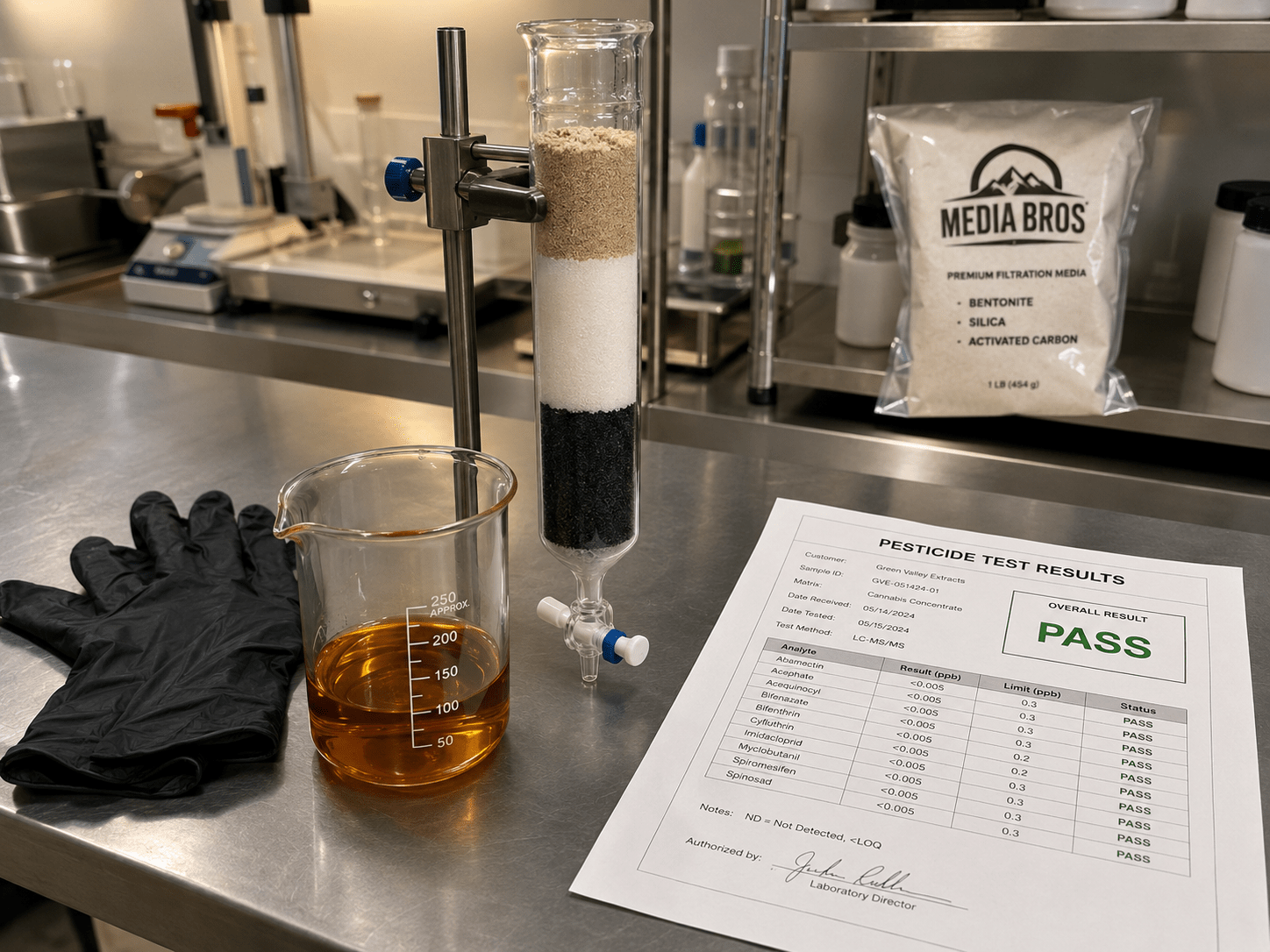
Cannabis pesticide remediation removes chemical residues from contaminated extracts using targeted adsorption: activated carbon grabs nonpolar organics like myclobutanil (log P 2.89) and bifenazate (log P 3.40) through van der Waals attraction in micropores sized 8-20 angstroms. Bentonite clay captures polar and cationic pesticides like daminozide (log P -0.29) through ion exchange at interlayer sites. Silica gel handles intermediate-polarity compounds like spiromesifen (log P 4.55) through hydrogen bonding on surface silanol groups. No single adsorbent removes all pesticide classes. A remediation media stack must match the contamination profile or the extract fails retesting. The most common failure: running the extract through activated carbon alone and missing polar pesticides entirely because carbon has near-zero capacity for water-soluble compounds.
For microbial contamination specifically, see our Microbial Remediation Through Extraction guide.
Pesticide Remediation by Adsorbent Class: Which Media Removes What and Why
| Pesticide | Class | log P (Polarity) | Molecular Weight | Primary Adsorbent | Mechanism | Secondary Adsorbent | Common Action Limit (ppm) |
|---|---|---|---|---|---|---|---|
| Myclobutanil | Triazole fungicide | 2.89 (moderate) | 288.8 | Activated carbon | Aromatic ring adsorption in micropores | Magnesium silicate | 0.1-9.0 |
| Bifenazate | Carbazate miticide | 3.40 (moderate-high) | 300.4 | Activated carbon | Hydrophobic attraction, pi-pi stacking | Silica gel | 0.1-5.0 |
| Pyrethrins | Natural insecticide | 3.56 (moderate-high) | 372.5 | Activated carbon | Nonpolar adsorption | Bentonite (adjunct) | 0.5-1.0 |
| Spiromesifen | Tetronic acid insecticide | 4.55 (high) | 370.5 | Silica gel | Hydrogen bonding at silanol groups | Activated carbon | 0.1-12.0 |
| Abamectin | Macrolide insecticide | 4.40 (high) | 873.1 | Activated carbon (macroporous) | Size-dependent: requires large pore carbon (>50 angstrom) | Florisil | 0.1-0.5 |
| Imidacloprid | Neonicotinoid | 0.57 (polar) | 255.7 | Bentonite clay | Ion exchange, interlayer adsorption | Alumina (basic) | 0.4-5.0 |
| Daminozide | Plant growth regulator | -0.29 (very polar) | 160.2 | Bentonite clay | Ion exchange (cationic in acidic solvent) | None effective standalone | 0.1-1.0 |
| Chlorfenapyr | Pyrrole insecticide | 4.83 (high) | 407.6 | Activated carbon | Strong hydrophobic adsorption | Silica gel | 0.05-1.0 |
| Paclobutrazol | Triazole PGR | 3.11 (moderate) | 293.8 | Activated carbon | Triazole ring adsorption | Magnesium silicate | 0.1-0.4 |
| Etoxazole | Oxazoline miticide | 5.59 (very high) | 359.4 | Activated carbon | Strong nonpolar adsorption | None typically needed | 0.1-1.5 |
| Metalaxyl | Phenylamide fungicide | 1.75 (low-moderate) | 279.3 | Activated carbon + bentonite | Dual mechanism: aromatic ring + amide group | Florisil | 0.1-2.0 |
| Carbaryl | Carbamate insecticide | 2.36 (moderate) | 201.2 | Activated carbon | Naphthyl ring adsorption in mesopores | Silica gel | 0.5-5.0 |
How to read this table: log P measures how much a compound prefers oil (high log P) versus water (low log P). Activated carbon excels at grabbing high log P compounds. Bentonite excels at low log P compounds. The gap in the middle (log P 1.5-3.0) is where single-adsorbent strategies fail. If your contamination profile includes both myclobutanil (log P 2.89) and imidacloprid (log P 0.57), a carbon-only column will pass the imidacloprid straight through.
Why Pesticide Remediation Is Not Just “Run It Through Carbon”
The most expensive mistake in pesticide remediation is treating it like color remediation. CRC removes chlorophyll and carotenoids. Those are all nonpolar organic pigments with similar chemistry. One media type (activated carbon) handles most of them. Pesticides are different. A contaminated extract can contain 5-15 different pesticide residues spanning the entire polarity spectrum, from etoxazole (log P 5.59, extremely hydrophobic) to daminozide (log P -0.29, water-soluble). No single adsorbent covers that range.
Activated carbon is the default because it works for the most common pesticides (myclobutanil, bifenazate, pyrethrins, chlorfenapyr). But carbon has a structural limitation: its adsorption mechanism is predominantly hydrophobic (van der Waals) and pi-pi stacking with aromatic rings. Compounds without aromatic character or with high water solubility pass through carbon with minimal interaction. Imidacloprid, daminozide, and acephate are the most common polar pesticides that carbon misses.
The second most expensive mistake is using the wrong type of activated carbon. Coconut shell carbon has a tight micropore distribution (8-20 angstroms) that is excellent for small molecules like myclobutanil (molecular diameter ~8 angstroms). But abamectin is a macrolide with a molecular diameter exceeding 15 angstroms. It physically cannot enter coconut shell micropores at sufficient rates. Wood-based or coal-based carbons with wider pore distributions (mesoporous, 20-500 angstroms) handle large molecules but have lower surface area per gram, meaning you need more media to achieve the same removal rate for small molecules.
The Remediation Process: Step by Step
Step 1: Identify the Contamination Profile
Send the failed extract to a lab for a full pesticide panel. Do not guess which pesticides are present. The panel tells you exactly which compounds exceeded action limits, at what concentration, and by how much. This determines your media stack. If myclobutanil is at 2.0 ppm (limit 0.1 ppm in Oregon) and nothing else failed, a simple carbon pass may be sufficient. If you have myclobutanil at 2.0 ppm AND imidacloprid at 1.5 ppm, you need carbon plus bentonite or you will pass the retest for one and fail for the other.
Step 2: Select the Media Stack
Match the contamination profile to the adsorbent table above. For each pesticide above the action limit, identify the primary adsorbent. If all pesticides are nonpolar (log P > 2.5), activated carbon alone may work. If the profile includes polar pesticides (log P < 2.0), add bentonite or basic alumina to the stack. If it includes large molecules (MW > 500), use macroporous carbon.
| Contamination Profile | Recommended Media Stack | Rationale |
|---|---|---|
| Nonpolar pesticides only (myclobutanil, bifenazate, pyrethrins) | Activated carbon (coconut shell, 20-40 mesh) | High surface area microporous carbon captures all aromatic/nonpolar residues |
| Mixed polarity (myclobutanil + imidacloprid) | Activated carbon + bentonite clay (layered) | Carbon handles nonpolar; bentonite ion exchange captures polar neonicotinoids |
| Large molecule pesticides (abamectin, spinosad) | Macroporous activated carbon (wood-based, 20-60 mesh) + Florisil | Wide pore distribution accommodates MW > 500 molecules |
| PGR contamination (paclobutrazol, daminozide) | Activated carbon + bentonite + basic alumina | Triple stack needed: paclobutrazol on carbon, daminozide on bentonite, residual on alumina |
| Unknown or broad-spectrum contamination | Activated carbon + bentonite + silica gel + Florisil (full stack) | Maximum coverage across all polarity ranges. Higher cannabinoid loss (10-15%) is the tradeoff. |
Step 3: Dissolve the Extract
Dissolve the contaminated extract in solvent at a 10:1 to 15:1 ratio (solvent to extract by mass). For BHO extracts, use butane or a butane/propane blend at -40C to -20C. For ethanol extracts, use 190-proof ethanol at -40C to -60C. Cold temperatures improve selectivity: pesticides remain dissolved while fats and waxes precipitate, reducing competition for adsorption sites on the media. If the extract is crude oil (not already winterized), winterize first. Running dirty crude through remediation media wastes capacity on fats instead of pesticides.
Step 4: Run the Column
Pack the media into a chromatography column or CRC column in layers. Bottom to top: filter paper (1 micron), coarse support media (celite or sand, 1 cm), primary adsorbent (activated carbon, 2-4 cm), secondary adsorbent (bentonite or silica, 1-2 cm), top filter paper. Flow rate matters: 2-5 mL/min per cm2 of column cross-section is the target. Faster flow reduces contact time and decreases removal efficiency. Slower flow increases contact time but also increases cannabinoid loss to the media.
Contact time target: 30-60 seconds of contact between the dissolved extract and the media bed. Calculate this from bed volume and flow rate. If your bed volume is 50 mL and your flow rate is 2 mL/min, contact time is 25 minutes. That is too long and will strip terpenes and cannabinoids. Adjust bed volume or flow rate to hit the 30-60 second window.
Step 5: Recover and Retest
Collect the eluent, recover the solvent (rotary evaporator for ethanol, passive or active recovery for hydrocarbons), and send the remediated extract for retesting on the same pesticide panel. Do not assume remediation worked based on visual appearance. A clear, golden extract can still contain pesticides above action limits. Only lab results confirm compliance.
Common Failures in Pesticide Remediation and How to Diagnose Them
| Failure | Symptom | Root Cause | Diagnostic Test | Fix |
|---|---|---|---|---|
| Polar pesticide pass-through | Retest fails for imidacloprid or daminozide despite passing for myclobutanil | Carbon-only stack has no capacity for polar compounds (log P < 2.0) | Check contamination profile log P values. Any pesticide below 2.0 requires non-carbon adsorbent. | Add bentonite clay layer (1-2 cm) below the carbon layer. Re-run. |
| Large molecule pass-through | Retest fails for abamectin or spinosad despite passing for smaller pesticides | Coconut shell carbon micropores too small (<20 angstrom) for MW > 500 molecules | Check molecular weight of failing pesticide. If MW > 500, pore size is the problem. | Replace coconut shell carbon with wood-based macroporous carbon. Or add Florisil layer. |
| Media capacity exceeded | First fraction passes, later fractions fail. Pesticide concentration rises through the run. | Not enough media for the contamination load. Adsorbent sites saturated mid-run. | Test fractions separately (first 25%, middle 50%, last 25%). Rising concentration confirms breakthrough. | Double the media bed depth. Or reduce the extract-to-media ratio (run less extract per column). |
| Cannabinoid loss exceeding 15% | Remediated extract tests significantly lower potency than pre-remediation | Too much activated carbon or too slow flow rate. Cannabinoids adsorb competitively with pesticides. | Compare pre and post potency panel. Calculate % loss. Above 15% = excessive. | Reduce carbon bed depth by 25%. Increase flow rate (shorter contact time). Use higher quality carbon with better selectivity. |
| Pesticide rebound (desorption) | Extract passes retest immediately but fails again after 48-72 hours | Weakly adsorbed pesticides desorb from media during solvent recovery or storage. Common with low log P compounds on carbon. | Retest at 24h and 72h post-remediation. Rising levels confirm desorption. | Use a stronger adsorbent for the target pesticide (chemisorption > physisorption). Or run a second remediation pass. |
| Terpene destruction | Remediated extract is potent but flat, no aroma or flavor | Activated carbon adsorbs terpenes as effectively as it adsorbs pesticides. Monoterpenes especially (small, nonpolar). | Compare pre and post terpene panel. Monoterpene loss > 50% confirms. | Accept terpene loss as a cost of remediation. Or collect a terpene fraction before remediation (steam distill or cryo-trap) and reintroduce post-remediation. |
| Heavy metal contamination from media | Extract passes pesticide retest but fails heavy metals panel (lead, arsenic, mercury) | Unqualified adsorbent media containing heavy metal impurities. No COA verification before use. | Test the media itself for heavy metals before running any extract through it. Require batch-specific COAs. | Source pharmaceutical-grade media with batch COAs showing heavy metals below detection limits. Never use industrial-grade adsorbents. |
State-by-State Action Limits: Why “Passing” Depends on Where You Are
There is no federal standard for pesticide limits in cannabis. Each state sets its own action limits, and they vary dramatically. Myclobutanil passes at 9.0 ppm in some states and fails at 0.1 ppm in others. If you process in Oregon and sell in California, you need to pass California’s limits, not Oregon’s. Always remediate to the strictest limit in your supply chain.
| Pesticide | California (ppm) | Colorado (ppm) | Oregon (ppm) | Michigan (ppm) | Massachusetts (ppm) | Most Restrictive |
|---|---|---|---|---|---|---|
| Myclobutanil | 0.1 | 0.1 | 0.1 | 9.0 | 0.1 | 0.1 (CA/CO/OR/MA) |
| Bifenazate | 0.1 | 0.1 | 0.2 | 5.0 | 0.1 | 0.1 (CA/CO/MA) |
| Imidacloprid | 5.0 | 0.4 | 0.5 | 3.0 | 0.4 | 0.4 (CO/MA) |
| Abamectin | 0.1 | 0.1 | 0.5 | 0.5 | 0.1 | 0.1 (CA/CO/MA) |
| Paclobutrazol | 0.1 | 0.1 | 0.4 | 0.1 | 0.1 | 0.1 (CA/CO/MI/MA) |
| Pyrethrins | 0.5 | 1.0 | 1.0 | 1.0 | 0.5 | 0.5 (CA/MA) |
| Chlorfenapyr | 0.1 | 0.05 | 0.1 | 1.0 | 0.1 | 0.05 (CO) |
| Spiromesifen | 0.1 | 0.1 | 0.2 | 12.0 | 0.1 | 0.1 (CA/CO/MA) |
| Daminozide | 0.1 | 0.1 | 1.0 | 1.0 | 0.1 | 0.1 (CA/CO/MA) |
| Etoxazole | 0.1 | 0.1 | 0.2 | 1.5 | 0.1 | 0.1 (CA/CO/MA) |
Notice the pattern: California, Colorado, and Massachusetts consistently set the tightest limits. Michigan is significantly more permissive. If your business model involves multi-state distribution, remediate to California standards and you pass everywhere.
Activated Carbon Is Not All the Same: Choosing the Right Type
Activated carbon comes in three commercially relevant forms for cannabis remediation, and they are not interchangeable.
| Carbon Type | Source | Pore Size Distribution | Surface Area (m2/g) | Best For | Limitation |
|---|---|---|---|---|---|
| Coconut shell | Coconut husks, steam activated | Predominantly microporous (8-20 angstrom) | 1,000-1,200 | Small nonpolar pesticides (myclobutanil, bifenazate, carbaryl). Highest surface area per gram. | Poor for large molecules (abamectin, spinosad). Tight pores exclude MW > 500. |
| Wood-based | Hardwood or softwood, chemically activated | Mesoporous (20-500 angstrom) | 600-900 | Large molecule pesticides, broad-spectrum removal, decolorization | Lower surface area means more media per run. Higher cannabinoid co-adsorption. |
| Coal-based | Bituminous coal, steam activated | Mixed micro/mesoporous | 800-1,100 | General purpose. Good balance of small and large molecule removal. | Variable quality between suppliers. Heavy metal contamination risk if not pharmaceutical grade. |
When Remediation Is Not the Answer
Remediation has limits. If the contamination level is 10x or more above the action limit, the media capacity required to bring it into compliance will also strip 20-30% of your cannabinoids. At that point the economics flip: the potency loss costs more than the extract is worth. The decision framework is simple: if remediation costs (media, labor, potency loss, retesting) exceed 60% of the extract’s market value, destroy the batch and address the upstream contamination source. If total pesticide load exceeds 50 ppm across all analytes combined, remediation is almost never economically viable. For our complete batch remediation decision framework, see our remediation decision matrix.
The upstream fix is always cheaper than downstream remediation. Integrated pest management (IPM), clean room protocols, and supplier qualification for biomass purchases prevent pesticide contamination at 1/10th the cost of post-extraction remediation. Remediation exists as a salvage operation for failed batches, not as a standard processing step. If you are remediating every batch, the problem is in the grow room, not the extraction lab.
Frequently Asked Questions
Which adsorbent removes the most pesticides from cannabis extracts?
Activated carbon removes the widest range of pesticides because most common cannabis pesticides are nonpolar organic compounds (log P above 2.5). However, carbon fails to remove polar pesticides like imidacloprid (log P 0.57) and daminozide (log P -0.29). A carbon-only remediation strategy will pass for approximately 70-80% of the standard pesticide panel and fail for the polar 20-30%. Full-spectrum remediation requires at minimum carbon plus bentonite to cover both polarity ranges.
Does pesticide remediation remove cannabinoids?
Yes. Cannabinoids are nonpolar organic compounds (THC log P 6.97, CBD log P 6.33) that compete with pesticides for adsorption sites on activated carbon. Typical cannabinoid loss during pesticide remediation is 5-15% depending on media type, bed depth, and contact time. This is an unavoidable tradeoff. The goal is to minimize cannabinoid loss while maximizing pesticide removal, which requires matching the media stack to the specific contamination profile rather than running a generic column.
Can CRC (color remediation) remove pesticides?
A standard CRC column using activated carbon will incidentally remove some pesticides, particularly nonpolar ones like myclobutanil and bifenazate. However, CRC is not designed for pesticide remediation and should not be relied upon for compliance. CRC media stacks are optimized for chlorophyll and carotenoid removal (color), not pesticide binding. The contact times, media ratios, and adsorbent types may not match the contamination profile. If you have a pesticide failure, run a dedicated remediation column with media selected for the specific pesticides in your panel results. For column sizing, the media stack and how to spot a stripped product, see the CRC complete guide.
How do I know if remediation worked without retesting?
You do not. There is no visual, smell, or taste indicator of pesticide levels in cannabis extracts. A clear, golden, great-tasting extract can contain 10x the action limit for myclobutanil. The only way to confirm remediation success is a full pesticide panel from an accredited testing lab. Budget $150-300 per retest. If you cannot afford the retest, you cannot afford to sell the product.
Why does my extract fail for different pesticides after remediation?
This happens when the remediation media removes some pesticides but concentrates others. If you remove 50% of the extract mass (lost to the media) but only remove 30% of a specific pesticide, the concentration of that pesticide in the remaining extract actually increases. This is most common with polar pesticides on activated carbon: the carbon removes cannabinoids and nonpolar pesticides effectively, reducing total extract mass, while the polar pesticide passes through untouched at a higher concentration per gram. The fix is adding a polar-specific adsorbent (bentonite, alumina) to the stack.
What is the maximum contamination level that can be remediated?
As a practical rule, remediation is economically viable when total pesticide load is below 50 ppm across all analytes and no single pesticide exceeds 10x its action limit. Above that threshold, the media volume required strips too many cannabinoids (20-30% loss) and the retesting costs stack up. At 100x the action limit or above, remediation is not viable. Destroy the batch and investigate the contamination source. For the full remediation vs destruction decision framework, see our batch remediation decision matrix.
Is pesticide remediation legal in all states?
No. Some states allow remediation of failed batches and retesting. Others require destruction of any batch that fails pesticide testing with no remediation pathway. California, Oregon, and Colorado allow remediation with retest. Check your state’s regulations before investing in remediation equipment. Our state licensing guide covers remediation rules by state where available.
Ready to level up your extraction game? Contact WKU Consulting for personalized guidance on building your extraction lab.
For more deep dives into cannabis chemistry, extraction SOPs, and lab design, subscribe to the WKU Consulting YouTube channel.
