
What Is Remediation in Cannabis Processing?
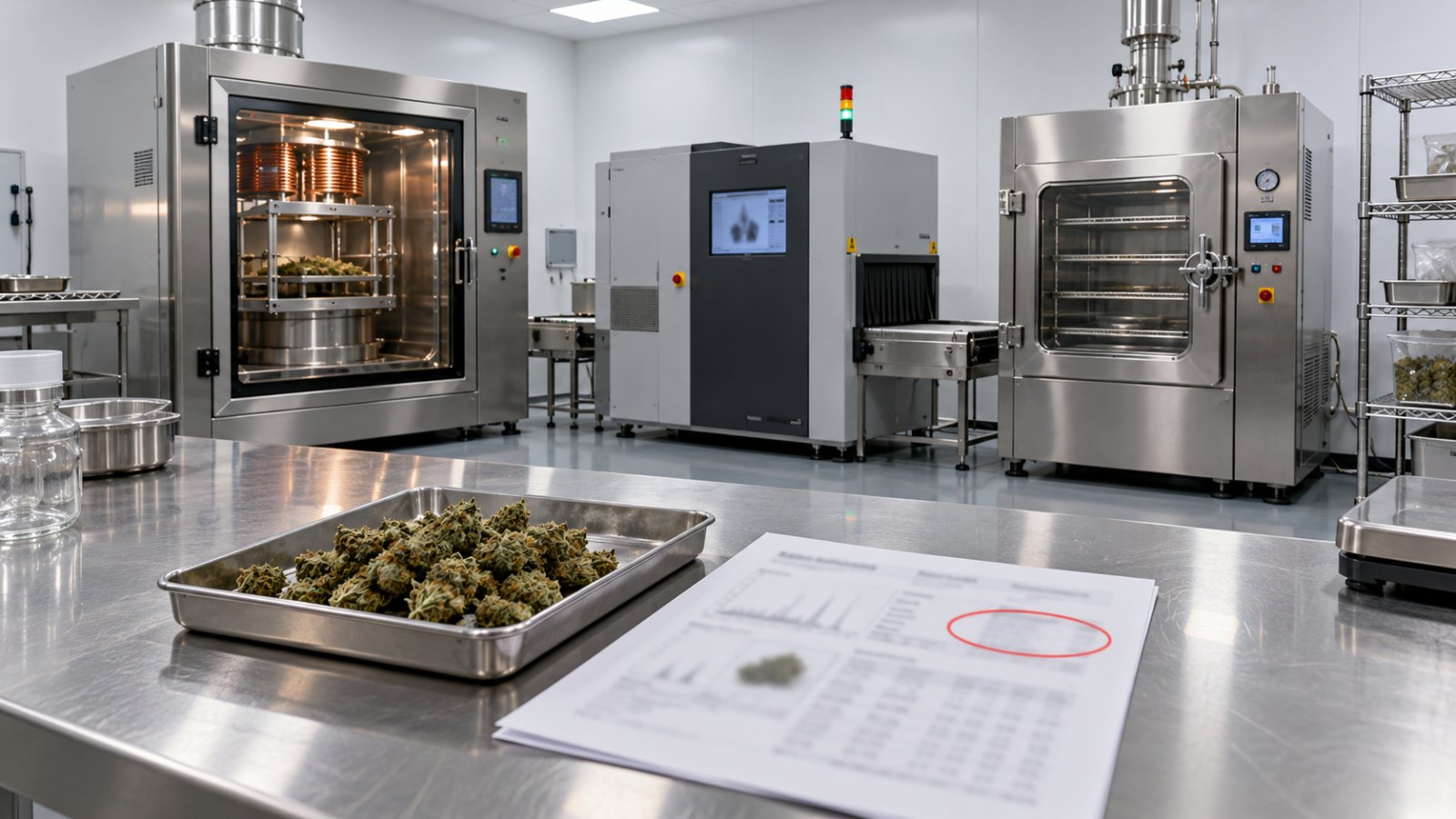
Cannabis remediation is the processing step that takes a batch that failed state testing back under the limit and through a retest: a kill step on flower for microbial failures (ozone, radio frequency heating, X-ray, electron beam, or heat), distillation on extract for the same failure, an extended thin-film vacuum purge at 100 to 115F for residual solvent, blending or a second distillation pass for potency, and reversed-phase chromatography for THC in hemp extract. The numbers that pick the method: a flower lot that failed total yeast and mold at 500,000 CFU/g needs a 2-log (99 percent) reduction to clear a 10,000 CFU/g limit, and a kill step gets validated at 3 log so the retest passes with margin. Ionizing methods (X-ray, e-beam, gamma) get there with no meaningful temperature rise in the flower; heat-based methods pay for the same kill in monoterpenes, and ozone only reaches the surface of a dense bud. No method on the list removes heavy metals, and no validated method clears a multi-pesticide failure. The full comparison is in the methods and systems table below.
When a cannabis batch fails testing, should you remediate it or destroy it? This is one of the most expensive decisions an extraction operator faces, and most people make it based on gut feeling rather than chemistry.
Remediation is the process of bringing a non-compliant cannabis product back into regulatory compliance through additional processing steps. When a batch fails mandatory testing for potency, residual solvents, pesticides, heavy metals, or microbial contamination, the operator faces a binary decision: remediate or destroy.
For detailed vacuum oven purge protocols and residual solvent troubleshooting, see our complete cannabis devolatilization guide.
This decision has significant financial consequences. A single failed batch of concentrate can represent $10,000 to $100,000+ in raw material, labor, and processing costs depending on scale. Destroying compliant-adjacent product when remediation is viable wastes money. Attempting to remediate product that cannot be saved wastes even more.
The purpose of this guide is to provide a systematic decision framework based on the type of failure, the magnitude of the exceedance, your available processing equipment, and your state’s regulatory position on remediated product.
The Four Categories of Batch Failure
1. Residual Solvent Failure
What it means: Your concentrate contains more residual extraction solvent than the regulatory limit allows. Common culprits include butane, propane, ethanol, isopropanol, or heptane above the permitted ppm threshold.
Remediation viability: HIGH
Residual solvent failures are the most straightforward to remediate because the solution is purely physical: additional purging. The solvent molecules need more time, heat, and/or vacuum to escape the concentrate matrix. This is fundamentally a mass transfer problem. The solvent is trapped within the viscous concentrate, and you need to provide sufficient energy and low enough pressure to drive it to the surface and into the gas phase.
Remediation protocol:
- Return the batch to the vacuum oven
- Spread as thin film (1-2 mm) to maximize surface area and minimize diffusion path length
- Run at 100-115°F under full vacuum (-29.5 inHg) for an additional 24-48 hours
- Flip the material at the halfway point to expose the bottom surface
- Retest with a state-accredited lab before releasing
The thin-film technique is critical here. A 1 cm thick slab of concentrate takes exponentially longer to purge than a 1 mm thin film because the solvent molecules trapped in the center must diffuse through the entire matrix to reach the surface. Doubling the thickness more than doubles the purge time required.
When to scrap instead:
- If you have already purged for 72+ hours at proper parameters and still fail, the solvent may be chemically bound or trapped in a crystalline matrix that standard vacuum purging cannot reach
- If the failure is for an unexpected solvent (one you did not use in extraction), this indicates cross-contamination and the source must be identified before any remediation
- If the material has undergone multiple remediation attempts with diminishing returns on solvent reduction
2. Potency/Cannabinoid Compliance Failure
What it means: The product’s THC, CBD, or total cannabinoid content does not match the labeled claim within the allowed variance (typically ±10-15%), or the product exceeds the legal THC limit for hemp-derived products (0.3% delta-9 THC on a dry weight basis).
If the failure is a hemp extract over the 0.3% total THC line rather than a label mismatch, the fix is a separation step, not a reformulation. The THC remediation guide compares crystallization, chromatography, and degradation on THC floor, CBD recovery, and cost per kilogram.
Remediation viability: MODERATE
Potency failures are addressed through dilution (blending with compliant material) or further processing (distillation to concentrate or isolate specific cannabinoids).
For over-potency (THC too high):
- Blend with lower-potency material from a compliant batch
- Recalculate and retest the blended product
- Ensure homogeneous mixing to avoid hot spots in the blend
- Document the blending ratios and source batch numbers for traceability
For under-potency:
- Further concentrate through distillation
- Blend with higher-potency compliant material
- Reformulate the product at a different target concentration
For hemp THC exceedance (hot hemp):
- This is the most difficult potency failure to remediate
- Options include chromatographic separation of THC from CBD (expensive, requires specialized equipment), conversion to isolate, or destruction
- Many states do NOT allow remediation of hot hemp and require destruction
- Check your state’s position before investing in remediation attempts
When to scrap instead:
- When the cost of remediation (additional distillation passes, blending material, retesting) exceeds the value of the remediated product
- When your state prohibits remediation of the specific failure type
- When the exceedance is so large that dilution would reduce the product below commercially viable potency
3. Microbial Contamination Failure
What it means: The batch exceeds allowable limits for total yeast and mold (TYM), total aerobic count (TAC), or tests positive for specific pathogens (E. coli, Salmonella, Aspergillus).
For the complete extraction-based remediation SOP with contaminant survival tables, mycotoxin concentration risk analysis, and state-by-state rules, see our Microbial Remediation Through Extraction guide.
The steps before this matrix on a partial-lot microbial fail (quarantine, the reanalysis-versus-retest distinction, lot segregation rules that vary by state) are laid out in Willow Industries’ partial lot microbial failure compliance playbook, which is the regulator-facing sequence to run before you cost out remediation versus destruction here.
Remediation viability: MODERATE to LOW
Microbial remediation is possible but requires careful consideration of the contamination type, the target product format, and your available technology. The distinction between non-pathogenic organisms and specific pathogens is critical.
For elevated TYM/TAC (non-pathogenic):
- Distillation effectively sterilizes concentrate through thermal processing, as the temperatures involved (150-200°C) far exceed the thermal death point of any organism
- Autoclave/pressure treatment for flower is controversial and significantly affects quality, terpene profile, and appearance
- Gamma or e-beam irradiation is available in some markets but requires third-party processing facilities
- Ozone treatment has limited efficacy for heavy contamination and inconsistent penetration into dense flower material
For pathogenic organisms (E. coli, Salmonella, Aspergillus):
- Distillation can eliminate live organisms but may not destroy mycotoxins produced by Aspergillus
- Mycotoxins (aflatoxins, ochratoxin) are heat-stable and survive distillation temperatures
- If Aspergillus is detected, test specifically for mycotoxins before deciding to remediate
When to scrap instead:
- Pathogen-positive flower intended for inhalation: destroy. The risk to immunocompromised consumers is too high, and most states prohibit sale of remediated pathogen-positive flower for smoking/vaping
- Any product with confirmed mycotoxin contamination: destroy. Mycotoxins cannot be removed through standard cannabis processing methods
- When microbial contamination indicates a systemic facility issue (contaminated water, HVAC, improperly stored biomass): fix the root cause before processing any more material
4. Pesticide and Heavy Metal Failure
What it means: The batch contains pesticide residues or heavy metals (lead, arsenic, cadmium, mercury) above the regulatory action limit.
Remediation viability: VERY LOW
This is where most operators should default to destruction.
Pesticides:
- Some pesticides can be partially removed through activated carbon treatment or distillation, but removal is inconsistent and compound-dependent
- Myclobutanil (Eagle 20) converts to hydrogen cyanide when heated. Distillation makes it MORE dangerous, not less. This is not theoretical; it is a documented chemical reaction that produces a lethal gas
- No reliable, validated remediation protocol exists for multi-pesticide contamination in cannabis
- Several states explicitly prohibit the sale of pesticide-remediated cannabis products
Heavy metals:
- Heavy metals cannot be removed through any standard cannabis processing method
- They are elemental contaminants that persist through distillation, filtration, and all thermal processes
- Heavy metal contamination is a raw material issue (contaminated soil, fertilizer, or water) that must be addressed at the cultivation level
- Some heavy metals actually concentrate during distillation, meaning the remediated product may test worse than the original
When to scrap instead: Almost always. Pesticide and heavy metal failures should default to destruction unless you have validated, compound-specific remediation data AND your state explicitly permits it. The liability risk of selling remediated pesticide or heavy metal contaminated product far exceeds the value of the batch.
The Remediation Decision Matrix
Use this systematic framework for any failed batch:
| Failure Type | Remediation Viability | Primary Method | Default Action |
|---|---|---|---|
| Residual Solvent | HIGH | Extended vacuum purge (thin film) | Remediate |
| Potency (over/under) | MODERATE | Blending or distillation | Remediate (cost-dependent) |
| Hot Hemp (THC exceedance) | LOW | Chromatography or isolation | Check state law first |
| Microbial (TYM/TAC) | MODERATE | Distillation or irradiation | Remediate for concentrates |
| Microbial (Pathogens) | LOW | Distillation (with caveats) | Destroy for inhalation products |
| Pesticides | VERY LOW | No reliable method | Destroy |
| Heavy Metals | NONE | None available | Destroy |
Decision Flowchart
Step 1: Identify the failure type
- Residual solvent → Go to Step 2
- Potency → Go to Step 3
- Microbial → Go to Step 4
- Pesticide or heavy metal → Default to DESTROY
Step 2: Residual Solvent Assessment
- Is the exceedance less than 2x the limit? → Remediate with extended purge
- Is the exceedance greater than 2x after proper purge protocol? → Investigate root cause, then remediate or destroy
- Is the failing solvent one you did not use? → STOP. Investigate cross-contamination. Do not remediate until the source is identified.
Step 3: Potency Assessment
- Over-potency? → Blend with compliant material
- Under-potency? → Distill further or blend up
- Hot hemp THC exceedance? → Check state law. Many require destruction.
- Remediation cost greater than batch value? → Destroy
Step 4: Microbial Assessment
- TYM/TAC only (no pathogens)? → Remediate via distillation or approved method
- Pathogen-positive? → If product is for inhalation, strongly consider destruction
- Aspergillus detected? → Test for mycotoxins. If positive, DESTROY.
- First failure or recurring pattern? → If pattern, stop production and audit facility before any remediation
Cannabis Remediation Methods and Systems Compared: Ozone, Radio Frequency, X-Ray, E-Beam, Heat, and Extraction
Every remediation system on the market is sold by a company that makes one of them, so every vendor comparison stops at the method they sell. This table puts the kill steps for flower next to the reprocessing routes for extract, with the contaminant each one actually addresses, the reduction you can validate, and what it costs you in terpenes and product form.
| Method or system | Failure it addresses | Mechanism | Reduction you can validate | Terpene and cannabinoid cost | Product form after | Where it fits, where it fails |
|---|---|---|---|---|---|---|
| Ozone gas (chamber) | Microbial on flower, surface counts | Oxidation of microbial cell membranes by ozone at parts-per-million concentrations over hours | 1 to 2 log on surface counts; little effect inside a dense bud | Ozone attacks the double bonds in myrcene and limonene, so terpene loss climbs with dose and exposure time | Flower, form preserved | Light surface failures (total yeast and mold in the tens of thousands of CFU/g). Fails on interior mold and on Aspergillus in the bud core, and counts rebound if the room stays humid |
| Radio frequency (RF) heating | Microbial on flower, interior included | Dielectric heating warms the whole bud volumetrically to a pasteurization setpoint in minutes | Up to 3 log in vendor data; validate on your own lot | Vendor data shows under 10 percent terpene loss; the run also drives off moisture, which shows up as weight on the invoice | Flower, form preserved | Programs that want a validated in-house kill step. Fails when the run over-dries the flower (brittle, harsh smoke) |
| X-ray (cabinet unit, in-house) | Microbial on flower, interior included, through packaging | Ionizing radiation breaks microbial DNA with no thermal load | 3 log and higher at commercial doses; qualify the dose on your lot | No meaningful temperature rise, cannabinoids unchanged, terpene loss minimal | Flower, form preserved, can be treated already packaged | Hard microbial failures and pre-packaged product. The capital cost is the barrier, not the chemistry |
| Electron beam or gamma (contract irradiation) | Microbial on flower, interior included | Ionizing radiation at 5 to 10 kGy | 5 log or more at 10 kGy | Cannabinoids unchanged; individual terpenes dropped 10 to 38 percent at 10 kGy in the 2016 gamma study on medicinal cannabis (Hazekamp) | Flower, form preserved | Bulk lots where a one to two week round trip is acceptable. Fails on chain of custody where off-site treatment is not allowed, and on consumer perception where irradiation must be disclosed |
| Heat, steam, or vapor pasteurization | Microbial on flower | Thermal kill at 60 to 75C held for minutes to an hour | 2 to 3 log with time at temperature | Monoterpenes volatilize: 10 to 30 percent loss depending on time at temperature. Keep the flower under 100C or THCA starts decarboxylating | Flower, form preserved but drier and harsher | Budget in-house option. Fails for terpene-forward flower and for lots sold on a moisture spec |
| Hydrogen peroxide vapor, chlorine dioxide, UV-C | Microbial, surface only | Oxidation or UV DNA damage on exposed surfaces | Under 1 to 2 log; UV cannot reach shaded surfaces | Low on cannabinoids; oxidizers touch terpenes at the surface | Flower | Room and packaging sanitation more than remediation. Fails as a primary kill step on dense flower |
| Extraction plus distillation | Microbial on flower headed to concentrate; potency | Solvent extraction leaves the cells behind, and the 150 to 200C distillation pass kills anything that came through | Complete for living organisms | Terpenes are largely lost on the distillate path. Mycotoxins are heat-stable and can carry into crude, so test for them before choosing this route | Flower becomes distillate at 15 to 20 percent of flower mass | Failed flower that was always going to the extractor. Fails when the buyer wanted flower, and it concentrates pesticides and metals instead of removing them |
| Extended vacuum purge (thin film) | Residual solvent in concentrate | Diffusion out of a 1 to 2 mm film at 100 to 115F under -29.5 inHg for 24 to 48 hours | Brings exceedances under 2x the limit into spec | Some monoterpene loss with every additional day in the oven | Concentrate, form preserved | Any hydrocarbon lab already owns the oven. Fails past 72 hours of total purge, which points to trapped solvent or cross-contamination, not retention |
| Blending or a second distillation pass | Potency over or under label | Dilution with compliant material, or concentration by distillation | Sets potency to target | Distillation strips terpenes; blending does not | Concentrate, form may change | Cost-dependent. Fails when the blend partner is worth more than the batch it rescues |
| Reversed-phase flash chromatography | THC over 0.3 percent in hemp extract | C18 separation with an alcohol and water mobile phase; CBD elutes before THC | Non-detect at a 0.01 percent LOQ in one pass | 85 to 95 percent CBD recovery; the loss is the overlap cut you throw away | Distillate, form preserved | Hemp processors making broad-spectrum or T-free oil. The solvent bill runs 20 to 50 liters per kilogram of feed, so it fails on cost without solvent recovery |
| Activated carbon or CRC media | Color; partial, unvalidated pesticide reduction | Adsorption on carbon or clay | Compound-dependent, not validated for compliance | 8 to 15 percent cannabinoid co-adsorption per pass | Extract | Supporting step only. Fails as a compliance remediation for pesticides |
| Heavy metals (lead, cadmium, arsenic, mercury) | Metals failure | None | None | Metals persist through distillation and concentrate in the cannabinoid fraction | Destroy | Fix it at the grow (soil, water, inputs). No processing step removes an element |
When a label or a seed-to-sale entry says remediated, it means the lot failed a compliance test, went through one of the steps above, and passed a full retest afterward; the retest is what makes it sellable, not the treatment. Some programs require the remediation to be disclosed on the label or in the tracking record, others allow one remediation attempt per lot before it goes to destruction, and none of them accept a remediated result for heavy metals or a multi-residue pesticide failure. Dead organisms and their heat-stable metabolites do not leave with the kill step: a lot that failed for Aspergillus can pass the microbial retest and still carry mycotoxins, which is why the retest panel after any microbial remediation should include mycotoxins whether the state asks for it or not. For flower that was always headed to the extractor, the microbial remediation through extraction guide covers the solvent selection, the mycotoxin carry-through, and the cost math for that route.
Different remediation scenarios require different equipment. Here is what each method demands and where each one excels.
Vacuum Oven (Residual Solvent Remediation): The workhorse of solvent remediation. Any operation running hydrocarbon extraction already owns one. Key specs: digital temperature control accurate to ±1°F, vacuum pump capable of -29.5 inHg or deeper, and adequate shelf space for thin-film spreading. Cost: $2,000-15,000 depending on size. This is your first line of defense for residual solvent failures.
Short Path / Wiped Film Distillation (Potency and Microbial Remediation): Distillation addresses both potency adjustment and microbial sterilization simultaneously. The thermal processing (150-200°C) kills all microorganisms while concentrating cannabinoids. Trade-off: you lose the original product format. Shatter becomes distillate. Live resin becomes distillate. If maintaining the original product type matters, distillation may not be the right remediation path. For a deeper understanding of distillation principles, see our cannabis distillation theory guide.
Activated Carbon / CRC (Partial Pesticide Removal): Activated carbon adsorption can reduce certain pesticide residues, but efficacy varies wildly by compound. Non-polar pesticides adsorb more readily than polar ones. Carbon treatment also strips color and some terpenes. This is not a validated, reliable remediation method for regulatory compliance. Use it as a supporting technique, not a primary remediation strategy.
Irradiation (Microbial Remediation for Flower): Gamma irradiation and electron beam (e-beam) processing effectively reduce microbial counts in flower without thermal processing. The product maintains its original form, terpene profile (mostly), and appearance. Drawbacks: requires sending product to a licensed irradiation facility, adds cost and time, and carries a consumer perception issue in some markets. Not all states permit irradiation as a remediation method.
Cost-Benefit Analysis Framework
Before committing to remediation, calculate both sides of the equation honestly. Operators consistently overestimate the value of remediated product and underestimate the true cost of remediation.
Cost of remediation:
- Additional processing time (labor, energy, equipment depreciation)
- Retesting fees ($200-500 per panel, and you may need multiple rounds if the first retest still fails)
- Yield loss from additional processing (distillation typically loses 10-15% per pass)
- Opportunity cost (equipment tied up reprocessing instead of running new, higher-margin batches)
- Administrative burden of documentation and regulatory reporting
Value of remediated product:
- Market value of the finished product if remediation succeeds
- Probability of passing retest (be honest with yourself about this number)
- Potential discount if the product must be reclassified or relabeled post-remediation
- Shelf life considerations: how much market value remains after the time remediation takes?
The 60% rule: If the cost of remediation exceeds 60-70% of the remediated product value, destruction is usually the more economical choice. Factor in the intangible cost of releasing a remediated product that may have compromised quality characteristics. Your brand reputation has a dollar value too.
Regulatory Compliance by Failure Type
Residual solvent limits vary significantly by jurisdiction. Common standards include:
- California (DCC): Follows USP <467> Category 2 limits. Butane and propane max 5,000 ppm each. Total residual solvents must not exceed Category 2 thresholds. Remediation permitted with documentation.
- Colorado (MED): Follows USP <467> Class 3 limits (5,000 ppm for butane). Requires remediation plan documentation.
- Oregon (OLCC): Total hydrocarbons below 1,000 ppm. This is significantly stricter than most states and makes Oregon batches the most likely to need residual solvent remediation.
- Washington (WSLCB): 500 ppm per individual solvent. Another strict state that demands precise purge protocols.
Always verify current limits with your state regulatory body. Limits change, and some states differentiate between inhaled products and oral/topical products with different thresholds for each category.
Documentation and Regulatory Requirements
Every remediation event must be documented thoroughly. Most state regulatory programs require:
- Original test results showing the failure, including the specific analyte and measured value
- Detailed description of the remediation process applied, with equipment parameters and duration
- Chain of custody records throughout remediation
- Post-remediation test results from a state-accredited laboratory
- Updated product labeling reflecting any changes to cannabinoid content or product classification
Some states require pre-approval from the regulatory body before remediation can begin. Others allow operators to remediate at their discretion but require documentation. A few states have mandatory waiting periods between the failed test and remediation. Know your state’s requirements before you have a failure, not after.
Preventing Failures: Root Cause Analysis
The best remediation strategy is prevention. Every batch failure should trigger a root cause investigation, not just a remediation attempt.
Residual solvent failures: Review purge protocol parameters. Is the vacuum pump maintaining adequate depth? Are oven temperatures accurate (calibrate quarterly)? Is the product being spread thin enough? Is purge time adequate for the batch size? For a detailed walkthrough of proper purge protocols, see our guide on devolatilization and decarboxylation before distillation.
Potency failures: Review extraction parameters, starting material potency, and blending/formulation calculations. Are you accounting for the decarboxylation conversion factor (0.877) when calculating total THC from THCa? A small error in this calculation compounds across every batch.
Microbial failures: Audit facility sanitation, HVAC filtration, water quality, and biomass storage conditions. Microbial contamination is almost always an environmental or storage issue. Proper lab safety and facility design can prevent most microbial issues before they start.
Pesticide/heavy metal failures: These are cultivation-level problems. Review your supply chain qualification process. Are you testing incoming biomass before committing processing resources? A $200 incoming material test can save you $50,000 in wasted processing on contaminated feedstock.
Frequently Asked Questions
Can you remediate cannabis that failed pesticide testing?
In most cases, no. There is no reliable, validated remediation protocol for multi-pesticide contamination in cannabis. Some pesticides can be partially removed through activated carbon treatment or distillation, but results are inconsistent and compound-dependent. Myclobutanil (Eagle 20) is particularly dangerous because it converts to hydrogen cyanide when heated. Several states explicitly prohibit sale of pesticide-remediated cannabis. Default to destruction for pesticide failures.
How long does residual solvent remediation take?
An additional 24-48 hours of vacuum purging at 100-115°F under full vacuum (-29.5 inHg) typically brings marginally failing batches into compliance. The key is spreading the concentrate as a thin film (1-2 mm) to maximize surface area and reduce diffusion path length. If the batch still fails after 72+ hours of total purge time, the issue is likely more complex than simple solvent retention.
What is the cheapest way to remediate a failed cannabis batch?
For residual solvent failures, extended vacuum purging is the lowest-cost option since you already own the equipment. For potency failures, blending with compliant material is typically cheaper than additional distillation passes. For microbial contamination in concentrates, running the material through distillation serves double duty by both sterilizing the product and concentrating cannabinoids. Always calculate total remediation cost (labor + retesting + yield loss) against the value of the saved product before proceeding.
Can you remove heavy metals from cannabis extract?
No. Heavy metals are elemental contaminants that cannot be removed through any standard cannabis processing method. They persist through distillation, filtration, and all thermal processes. In some cases, heavy metals actually concentrate during distillation because the cannabinoid fraction carries the metals while the terpene/volatile fraction does not. Heavy metal contamination must be addressed at the cultivation level through soil testing, water quality management, and fertilizer sourcing.
What happens if you sell remediated cannabis without proper documentation?
Most state regulatory programs require complete documentation of every remediation event, including original test results, process descriptions, chain of custody records, and post-remediation lab results. Selling remediated product without proper documentation can result in fines, license suspension, or revocation. Some states require pre-approval before remediation begins. Know your state’s requirements proactively.
Is it safe to smoke cannabis that has been remediated for microbial contamination?
It depends on the contamination type and remediation method. Distillation effectively eliminates live organisms, making remediated distillate safe for vaporization. Remediated flower is more controversial. Irradiation (gamma or e-beam) kills microbes but may affect terpene profile and consumer perception. Most critically, if Aspergillus was detected, mycotoxins may remain even after the organism is killed. These toxins are heat-stable and survive both remediation and consumption temperatures. Always test for mycotoxins specifically when Aspergillus is the contaminant.
How many times can you remediate the same batch?
There is no universal legal limit on remediation attempts, but practical and economic limits exist. Each remediation cycle degrades product quality: terpenes are lost, color darkens, and yields drop. After two failed remediation attempts on the same batch, the probability of the third attempt succeeding drops significantly while costs continue to accumulate. Most experienced operators set an internal policy of two remediation attempts maximum before defaulting to destruction. Your state may also have specific rules on the number of permitted remediation cycles.
Should I test incoming biomass before processing?
Yes. A $200 incoming material test for pesticides and heavy metals can save you tens of thousands of dollars in wasted processing costs. If your feedstock is contaminated with pesticides or heavy metals, no amount of post-processing remediation will fix it. Establish a supply chain qualification process that requires COAs from your biomass suppliers and verify with independent testing on a sample basis.
What does remediated cannabis mean?
Remediated cannabis is a lot that failed a state compliance test, was processed with a kill step or a reprocessing route (ozone, radio frequency, X-ray, electron beam, heat, extended vacuum purge, distillation, or chromatography), and then passed a full retest. A microbial remediation is qualified as a 2 to 3 log reduction, meaning a lot at 500,000 CFU/g comes back under a 10,000 CFU/g limit with margin. The retest is what makes the product legal to sell; some programs also require the word remediated on the label or in the tracking record.
Does remediation lower THC potency?
Ionizing methods (X-ray, electron beam, gamma at 5 to 10 kGy) leave THC and CBD unchanged. Heat-based methods stay under 100C, below the point where THCA decarboxylates at a meaningful rate, so potency holds while terpenes do not: expect 10 to 30 percent monoterpene loss from heat, under 10 percent from radio frequency or X-ray in vendor data. Distillation raises potency because it concentrates cannabinoids into the distillate fraction and strips the terpenes. The measurable cost of every flower remediation is terpenes, not THC.
Summary
Not every failed batch deserves remediation, and not every failed batch deserves destruction. The decision depends on the failure type, the magnitude of exceedance, your processing capabilities, your state’s regulatory framework, and a clear-eyed cost-benefit analysis.
Residual solvent failures are almost always remediable. Potency issues are usually fixable through blending or further processing. Microbial contamination depends heavily on the organism and product type. Pesticide and heavy metal failures should default to destruction.
Build your remediation SOPs before you need them. When a batch fails at 4 PM on a Friday, you do not want to be making these decisions under pressure without a documented protocol.
For more on the processing techniques referenced in this guide, check out our complete guide to CRC and our breakdown of safe ethanol handling at scale.
For operators building quality management systems, remediation SOPs, or root cause analysis frameworks, WKU Consulting provides process development and regulatory compliance consulting.
Join the WKU community:
- Subscribe to our newsletter: https://forms.gle/BpFA9MmDdMRPa5Bq9
- Join our Discord: https://discord.gg/wku
Before remediation gets blamed for every dark or dirty fraction, it is worth checking whether phospholipids were carried into the hot steps in the first place. This guide on cannabis crude oil degumming walks through the mechanism and the practical SOP.
