
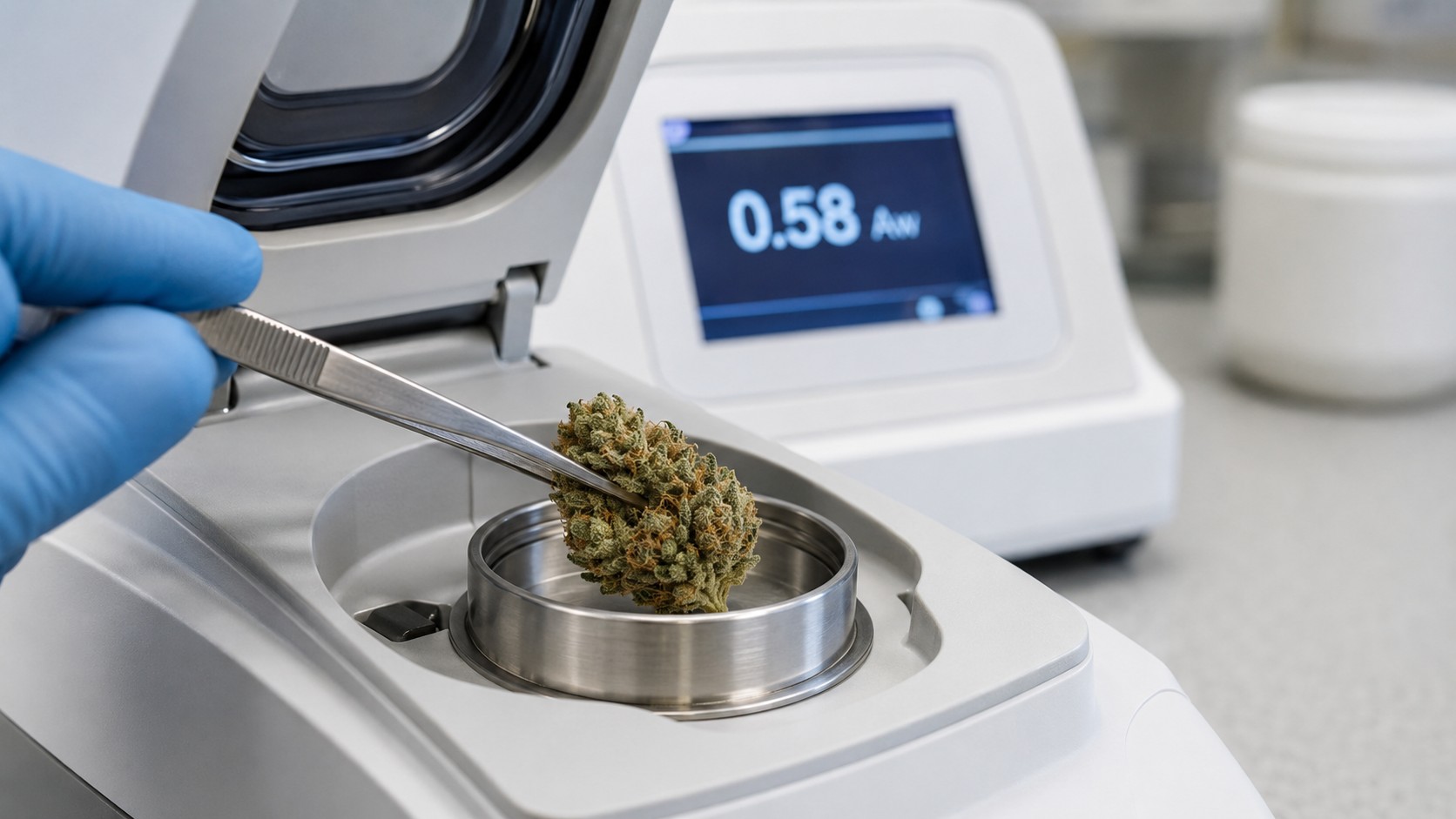
Why Water Activity Is the Variable You Are Ignoring
Cannabis starting material at 0.65 Aw will co-extract chlorophyll, form emulsions in hydrocarbon runs, and grow Aspergillus before your crude hits the rotovap. Material at 0.40 Aw will shatter trichome heads on contact, lose 15-20% yield to static cling, and starve your solvent of the moisture bridge it needs to penetrate cell walls efficiently. The window between “too wet” and “too dry” is narrow, method-specific, and the single most common root cause behind extraction failures that operators blame on equipment, technique, or genetics.
Water activity (Aw) measures the thermodynamic availability of water in plant tissue on a 0 to 1 scale, where 0 is bone dry and 1.0 is pure water. It is not the same as moisture content. A flower sample at 10% moisture content by weight can have an Aw of 0.55 or 0.65 depending on how tightly that water is bound to cellular structures. Moisture content tells you how much water is present. Water activity tells you how much of that water is free to participate in chemical reactions, support microbial growth, and interact with your extraction solvent. The distinction matters because extraction outcomes depend on water availability, not water quantity. Potency is reported as a mass fraction, so flower that keeps drying in the package reads higher on a state re-test than it did on your COA, and flower that rehydrates reads lower; the potency cross-test audit guide shows how to label for the shelf-state moisture rather than the test-day number.
Water Activity vs Moisture Content: Why You Need Both Measurements
Moisture content is a gravimetric measurement: weigh a sample, dry it in an oven at 105C for 2-4 hours, weigh it again. The difference is water lost, expressed as a percentage. A flower sample at 12% moisture content has 12 grams of water per 100 grams of material. This number tells you nothing about whether that water is free to cause problems.
Water activity is a thermodynamic measurement: the ratio of vapor pressure above your sample to the vapor pressure above pure water at the same temperature. An Aw of 0.60 means the sample is in equilibrium with a relative humidity of 60%. This tells you whether the water present is available to drive microbial growth (most cannabis pathogens need Aw > 0.65), participate in hydrolysis reactions that degrade cannabinoids, or interact with extraction solvents during processing.
Two flower samples can have identical moisture content (10%) but very different water activities (0.50 vs 0.62) because the physical structure of the plant tissue and the ratio of bound to unbound water varies by strain, curing method, and storage conditions. Running extraction on these two samples without measuring Aw produces different crude quality, different yields, and different downstream processing challenges.
| Measurement | What It Tells You | Method | Typical Range (Dried Flower) | Instrument Cost |
|---|---|---|---|---|
| Moisture Content (%) | Total water present by weight | Loss on drying (105C, 2-4h) or Karl Fischer titration | 8-15% | $200-500 (moisture analyzer) / $3,000-8,000 (Karl Fischer) |
| Water Activity (Aw) | How much water is available for reactions and microbial growth | Chilled mirror hygrometer (dew point sensor) | 0.45-0.65 | $2,500-5,000 (Aqualab, Rotronic) |
Bottom line: moisture content is the cheap, fast screening tool. Water activity is the quality control measurement that actually predicts extraction performance. Run both. If you can only afford one instrument, buy the Aw meter.
Target Water Activity by Extraction Method
Every extraction method has a different relationship with water. Hydrocarbon solvents (butane, propane) are non-polar and immiscible with water. Any free moisture in the biomass creates emulsions, traps water-soluble contaminants like chlorophyll, and produces crude that separates into layers during post-processing. Ethanol is polar and hygroscopic. It absorbs available water from the plant material, which dilutes the solvent, shifts its polarity toward water, and increases co-extraction of sugars, amino acids, and chlorophyll. CO2 extraction under supercritical conditions is less sensitive to moisture but still affected by water’s impact on solubility parameters. Rosin pressing requires enough moisture to create steam that helps terpene and cannabinoid migration but not so much that the press plates generate water-contaminated rosin.
| Extraction Method | Target Aw | Target Moisture % | Too High (Aw > X) | Too Low (Aw < X) | Why This Range |
|---|---|---|---|---|---|
| BHO (Closed Loop) | 0.55-0.60 | 8-12% | > 0.62: emulsion formation, chlorophyll co-extraction, cloudy crude | < 0.50: trichome brittleness, static losses 15-20%, poor solvent contact | Butane/propane immiscible with water. Free moisture creates water pockets that trap chlorophyll and sugars. |
| Ethanol (Cold) | 0.50-0.55 | 8-10% | > 0.58: ethanol absorbs water, polarity shifts, chlorophyll/sugar co-extraction increases 30-50% | < 0.45: cell wall collapse, reduced cannabinoid accessibility, yield drops 10-15% | Ethanol is hygroscopic. Available water dilutes solvent and shifts extraction selectivity toward undesirables. |
| CO2 (Supercritical) | 0.45-0.50 | 6-10% | > 0.55: water acts as co-solvent, shifts selectivity, increases wax co-extraction | < 0.40: reduced diffusion, longer run times, lower throughput | Supercritical CO2 is tunable. Water at high Aw acts as uncontrolled co-solvent, undermining parameter control. |
| Rosin Press | 0.55-0.62 | 10-14% | > 0.65: sizzling on plates, water contamination in rosin, reduced clarity | < 0.50: dry, brittle material, poor flow, blowouts, yield drops 20-30% | Steam generation at press temps (170-220F) aids cannabinoid/terpene migration. Too much = water in product. |
| Ice Water Hash | N/A (fresh frozen) | 70-80% (fresh) | N/A: material is submerged. More moisture = easier trichome separation. | Dried material: trichome heads fragment, contamination increases, yields drop | Rules reverse for ice water. Fresh frozen preserves trichome integrity. Dried material produces inferior hash. |
Notice ice water hash breaks every rule. For solvent and mechanical extraction from dried flower, you want Aw as low as practical without losing yield to brittleness. For ice water hash, you want the material as fresh and wet as possible because the water IS the extraction medium, and frozen trichomes snap cleanly from intact cell walls rather than shattering into contaminant-laden fragments.
What Goes Wrong When Water Activity Is Too High
Running extraction on material above the target Aw range for your method creates a cascade of problems, most of which operators diagnose as equipment failures or poor genetics rather than starting material issues.
BHO with Aw > 0.62: The Emulsion Trap
Butane is non-polar. Water is polar. They do not mix. When free moisture is present in cannabis biomass above Aw 0.62, the butane flows around the water pockets during extraction. Those water pockets contain dissolved chlorophyll, water-soluble sugars, amino acids, and mineral salts. The crude that comes out of the collection pot separates into layers: a cannabinoid-rich upper phase and a water-contaminated lower phase. Some operators see this as “dark crude” and blame genetics or column packing. The real cause is 3 points of Aw above target.
The chlorophyll co-extraction is the visible symptom. The less visible problem is that water trapped in the crude interferes with downstream winterization. Water in ethanol used for winterization creates ice crystals that look like precipitated waxes, giving false positives on the clarity test. Operators think they have clean oil when they actually have water-contaminated oil that will fail residual solvent testing because the water evaporates at a different rate than the ethanol during purging.
Ethanol with Aw > 0.58: Polarity Shift
Cold ethanol extraction relies on the solvent staying at approximately 95% ethanol / 5% water (190 proof). This polarity is selective for cannabinoids and terpenes while leaving behind chlorophyll, waxes, and sugars. When plant material has Aw above 0.58, the available water is absorbed into the ethanol during contact. A 10:1 solvent ratio with 200 lbs of biomass at Aw 0.60 vs 0.55 can shift ethanol concentration from 95% to 88-90% during extraction. That 5-7% polarity shift increases chlorophyll co-extraction by 30-50% and sugar co-extraction by 40-60%. The crude comes out dark green instead of golden amber, and the operator blames contact time when the real problem was starting material moisture.
Rosin Press with Aw > 0.65: Sizzle and Contamination
Rosin pressing works at 170-220F plate temperatures (77-104C). Water boils at 212F (100C) at atmospheric pressure. Material with Aw above 0.65 releases enough steam during pressing to create audible sizzling, visible steam venting from the bag, and water droplets in the collected rosin. The water contamination makes the rosin cloudy instead of translucent and introduces off-flavors (grassy, vegetal) from water-soluble compounds that should never have been in the press output.
What Goes Wrong When Water Activity Is Too Low
Over-dried material causes a different set of problems that are equally damaging but harder to diagnose because they manifest as low yields rather than visible contamination.
Trichome Brittleness Below Aw 0.45
Cannabis trichome stalks are cellular structures that require some internal moisture to maintain flexibility. Below Aw 0.45, the stalks become brittle and the trichome heads detach during handling, packing, and extraction prep. In BHO extraction, these detached heads create fines that clog screen filters and produce cloudy crude. In ethanol, the shattered cell walls release more plant pigments. The visible result is lower yield with darker crude, and the invisible result is trichome heads left behind in the biomass or clinging to container walls via static charge. The press-side consequence of brittle heads, shatter instead of flow and no moisture bridge for heat transfer, is worked through in the rosin press science guide.
Static Charge Losses: 15-20% Yield Reduction
Dry cannabis below Aw 0.50 generates significant static charge during grinding, packing, and material transfer. Trichome heads and kief adhere to plastic containers, metal column walls, bags, and gloves. Operators who grind dry material in a plastic container and then pack a BHO column lose 15-20% of their trichome heads to static before the solvent ever touches the biomass. This is invisible yield loss. The operator sees normal-looking biomass in the column but gets 14% yield instead of the 18-22% they expected.
Mitigation: if material is below target Aw, use stainless steel containers for grinding and transfer, ground yourself and the equipment, and consider a brief rehydration step (see Controlled Rehydration Protocol below). Anti-static spray is not an option for food/pharmaceutical grade products. Starting material issues like this are consistently the most underdiagnosed yield problem across all extraction methods—the full diagnostic, covering BHO, ethanol, CO2, and rosin, is in the cannabis extraction yield troubleshooting guide.
Poor Solvent Penetration Below Aw 0.40
Plant cell walls in cannabis flower rely on turgor pressure from internal moisture to maintain their structure. Below Aw 0.40, cell walls collapse and the intracellular spaces that allow solvent to penetrate the trichome-bearing tissue close down. The solvent flows around the compacted biomass rather than through it. In BHO, this means longer soak times to achieve the same yield, which increases wax co-extraction. In ethanol, it means the solvent contacts surface trichomes efficiently but cannot access the 30-40% of trichomes embedded in collapsed tissue below the surface.
How to Measure Water Activity
There are three approaches, each with different cost, speed, and accuracy profiles.
| Instrument | Accuracy | Read Time | Cost | Best For | Calibration |
|---|---|---|---|---|---|
| Chilled Mirror Hygrometer (Aqualab 4TE, Aqualab TDL) | +/- 0.003 Aw | 3-5 minutes | $3,500-5,000 | Production labs needing compliance-grade data | Salt standards every 30 days (NaCl 0.753, MgCl2 0.328) |
| Capacitive Sensor (Rotronic HC2-AW, Hygropalm) | +/- 0.01-0.02 Aw | 5-15 minutes | $2,000-3,500 | Smaller operations, incoming material screening | Salt standards every 90 days |
| Karl Fischer Titration (Metrohm, Mettler Toledo) | +/- 0.1% moisture (not Aw directly) | 5-10 minutes | $4,000-10,000 | Moisture content measurement (pair with Aw meter for complete picture) | Standard solution verification weekly |
For cannabis extraction labs, the Aqualab 4TE or TDL is the industry standard. It reads in under 5 minutes, holds compliance-grade accuracy at +/- 0.003 Aw, and requires minimal training. The chilled mirror method measures the dew point of air in equilibrium with the sample. No consumables beyond calibration salt standards. The investment pays for itself the first time it catches a batch of over-dried or under-cured material before it enters a $50,000 BHO system.
Sampling Protocol
Water activity varies within a single batch of flower. The top of a turkey bag will be drier than the center. Buds near the outside of a cure jar equilibrate faster than dense colas packed in the middle. To get a representative reading:
- Pull 3-5 sub-samples from different positions in the container (top, middle, bottom, edges)
- Grind each to a coarse consistency (not fine powder, which increases surface area and accelerates moisture loss during measurement)
- Fill the Aw meter cup to the line (typically 5-7 grams). Do not pack it.
- Seal and read. The instrument measures equilibrium vapor pressure above the sample.
- Average the readings. If any sub-sample is more than 0.05 Aw from the average, the batch is not uniformly dried. Re-cure or blend before extracting.
Controlled Drying Protocol for Extraction
Most cannabis is dried and cured for the flower market, not for extraction. Flower-market drying targets Aw 0.55-0.62 for optimal smoking quality and terpene preservation. Extraction drying targets are method-specific and often 0.03-0.10 Aw lower than flower market targets (especially for ethanol and CO2).
Standard Extraction Drying Protocol
- Initial dry: Hang whole plants or individual branches in a controlled environment at 60-65F (15-18C), 55-60% relative humidity, with 0.5-1.0 air changes per minute. Duration: 7-14 days depending on density and ambient humidity. Target: stems snap but do not break cleanly.
- Buck and assess: Remove flowers from stems. Immediately take an Aw reading from 3-5 sub-samples across the batch.
- Adjustment (if needed):
- If Aw > target: continue drying at 60F / 50% RH in paper bags or breathable containers. Recheck every 24 hours. Do not use heat above 70F. Heat above 70F degrades terpenes and accelerates decarboxylation.
- If Aw < target: see Controlled Rehydration Protocol below.
- If Aw in range: proceed to packaging and cold storage until extraction.
- Cold storage for extraction: Vacuum-sealed bags at 35-40F (2-4C). Aw remains stable in sealed containers. Verify Aw on extraction day before loading columns.
Controlled Rehydration Protocol (When Material Is Too Dry)
Over-dried material is not ruined. It can be rehydrated to target Aw using humidity packs or controlled environment chambers. The goal is to raise Aw without creating surface moisture that promotes microbial growth.
- Place material in sealed containers with 62% RH humidity packs (Boveda or Integra Boost). Ratio: 1 pack per 30 grams of flower. For bulk rehydration: 4-8 packs per pound.
- Seal and hold at 60-65F for 24-72 hours. Check Aw every 24 hours.
- Target: Aw 0.55-0.60 for BHO/rosin, 0.50-0.55 for ethanol, 0.45-0.50 for CO2.
- Do not over-rehydrate. Humidity packs are bidirectional (they absorb or release moisture to maintain target RH), but if you add too many packs or use a higher RH rating (72%), you will push Aw above target and create the problems described above.
- After rehydration, vacuum-seal and process within 48 hours. Rehydrated material is more susceptible to microbial growth than properly cured material.
If you want to learn how to dial in every variable from starting material through finished product, that is exactly what we built extractiontraining.com for. The course walks through parameter control at every stage of extraction, including the pre-processing steps that most operators skip.
The Fresh Frozen Exception: Why Ice Water Hash Breaks Every Rule
Everything above applies to extraction from dried and cured cannabis. Ice water hash (bubble hash) reverses the entire framework. For ice water extraction, you want material at 70-80% moisture content because:
- Trichome preservation: Fresh frozen material preserves the full terpene profile locked inside intact trichome heads. Drying causes terpene volatilization and oxidation before extraction even begins.
- Clean separation: Frozen trichome stalks snap cleanly from the plant surface when agitated in ice water. Dried stalks tear and fragment, releasing contaminant plant material into the hash.
- No static: Frozen material with high moisture content generates zero static charge. All of the static-related yield losses from dry material are eliminated.
- Water IS the extraction medium: Ice water hash does not use a separate solvent. The water itself agitates, separates, and transports trichome heads through filter bags. More available water means more efficient separation.
The critical variable for fresh frozen is not Aw but freeze speed. Material must be frozen within 2-4 hours of harvest to below -10F (-23C). Slow freezing creates large ice crystals that rupture cell walls and release chlorophyll into the wash water. Fast freezing creates small ice crystals that preserve cell structure.
Common Failures and How to Diagnose Them
| Symptom | Root Cause | Diagnostic Test | Corrective Action | Prevention |
|---|---|---|---|---|
| Dark green BHO crude, layers separating | Aw > 0.62 caused water pocket formation and chlorophyll co-extraction | Measure Aw of remaining starting material. If > 0.60, moisture is the cause. | Extended winterization at -40C (24h, not 8h). Double filtration. Accept lower yield. | Screen all incoming material. Reject or dry batches above 0.62 Aw. |
| BHO yield 30%+ below expected | Aw < 0.50 caused trichome brittleness and static losses | Check container walls for kief/trichome residue. Measure Aw. Static test: rub material on plastic, observe adhesion. | Rehydrate next batch to 0.55-0.60 Aw using Boveda 62% packs (24-72h). Use stainless steel for handling. | Aw reading before every extraction run. Stainless steel grinding and transfer containers. |
| Ethanol crude dark green despite cold extraction (-40C or colder) | Aw > 0.58 diluted ethanol from 95% to 88-90%, shifting polarity | Measure ethanol proof after extraction with hydrometer. If below 190 proof, water dilution is confirmed. | CRC filtration with activated carbon + T5 to remove chlorophyll post-extraction. Molecular sieve to recover ethanol proof. | Target Aw 0.50-0.55 for ethanol. Use molecular sieves (3A) to maintain ethanol at 200 proof. |
| Rosin sizzles on plates, water droplets in collection | Aw > 0.65, excess free water flashes to steam at press temperatures (170-220F) | Visual: steam visible at bag edges. Audible: sizzling sound. Rosin is cloudy, not translucent. | Dry material in paper bags at 60F / 50% RH for 24-48h. Recheck Aw before pressing. | Screen all material before pressing. Target 0.55-0.62 Aw. |
| Rosin yield consistently 10-15% below strain averages | Aw < 0.50, material too dry for efficient heat-driven cannabinoid migration | Puck is light, dry, and crumbles easily after press. Minimal oil visible at bag edges during press. | Rehydrate with Boveda 62% (24-48h). Verify 0.55-0.62 Aw before re-pressing. | Cure specifically for pressing: 62% RH jars, 14-21 day minimum before pressing. |
| Microbial contamination (Aspergillus, yeast, mold) in pre-extraction material | Aw > 0.65 supports microbial growth. Most cannabis pathogens require Aw > 0.65-0.70. | Visual: white or gray fuzz on inner buds. Lab test: total yeast and mold count > 10,000 CFU/g. | Route to remediation extraction (extraction-based remediation SOP). Do NOT extract as normal batch. | Aw < 0.60 during storage. Vacuum-seal after drying. Cold storage at 35-40F. |
| Bubble hash is dark, contaminated, low quality despite good genetics | Used dried material instead of fresh frozen. Trichomes fragmented, released plant contaminants into wash. | Visual: hash is green-brown instead of golden-blonde. Under microscope: trichome heads mixed with plant debris. | Cannot be corrected after processing. Next batch: fresh freeze within 2-4h of harvest to < -10F. | Fresh frozen is the only input for premium ice water hash. Do not attempt to “save” dried trim for hash washing. |
State Compliance: Water Activity Testing Requirements
Multiple states now mandate water activity testing as part of compliance testing for cannabis flower and concentrates. The regulatory threshold varies but most converge around 0.65 Aw as the maximum for saleable flower:
- California: Aw < 0.65 required for all cannabis flower entering the market (BCC regulations, Section 5307)
- Colorado: Aw testing required under METRC. Microbial limits triggered above 0.65
- Michigan: Aw < 0.65 for flower. Testing guidance updated September 2024 (see SERP: Michigan .gov PDF)
- Oregon: Aw testing part of compliance panel. Threshold 0.65
- Oklahoma: Aw testing required since 2023 rule updates
The compliance threshold (0.65) is set for microbial safety, not for extraction quality. Material that passes compliance testing at 0.63 Aw is too wet for BHO extraction (target: 0.55-0.60) and far too wet for ethanol extraction (target: 0.50-0.55). Passing the compliance test does not mean the material is ready for extraction. Always measure Aw against your extraction method’s target, not just the state threshold.
Frequently Asked Questions
What water activity level is ideal for cannabis extraction?
It depends on your extraction method. BHO targets 0.55-0.60 Aw, ethanol targets 0.50-0.55, CO2 targets 0.45-0.50, and rosin press targets 0.55-0.62. Ice water hash is the exception: it uses fresh frozen material at 70-80% moisture content. There is no single “ideal” Aw for extraction because each solvent interacts with water differently.
How does water activity affect BHO extraction quality?
Above 0.62 Aw, free moisture in the biomass creates water pockets that trap chlorophyll, sugars, and mineral salts. The crude separates into layers and comes out dark green instead of golden. Below 0.50 Aw, trichomes become brittle, shed during handling, and stick to container walls via static charge, reducing yield by 15-20%. The target window of 0.55-0.60 Aw minimizes both problems.
Is water activity the same as moisture content?
No. Moisture content measures total water by weight (typically 8-15% for dried flower). Water activity measures how much of that water is thermodynamically available for reactions and microbial growth (typically 0.45-0.65 for dried flower). Two samples with identical moisture content can have different water activities depending on how tightly water is bound to the plant matrix. Aw is the better predictor of extraction performance.
Can over-dried cannabis be rehydrated for extraction?
Yes. Place material in sealed containers with 62% RH humidity packs (Boveda or Integra Boost) at a ratio of 1 pack per 30 grams. Seal and hold at 60-65F for 24-72 hours, checking Aw every 24 hours. Target your extraction method’s Aw range. Rehydrated material should be processed within 48 hours because it is more susceptible to microbial growth than properly cured material.
Why does fresh frozen cannabis work differently for ice water hash?
Ice water hash uses water as the extraction medium, not a separate solvent. Frozen trichome stalks snap cleanly from intact, hydrated cell walls when agitated in ice water. Dried material has collapsed cell walls and brittle trichomes that fragment into contaminant-laden particles instead of separating cleanly. The high moisture content (70-80%) of fresh frozen material preserves the full terpene profile inside intact trichome heads, which is why live rosin made from fresh frozen hash commands 2-3x the price of hash from dried material.
What instrument should I buy to measure water activity?
For production labs, the Aqualab 4TE or TDL (chilled mirror hygrometer) is the standard: +/- 0.003 Aw accuracy, 3-5 minute read time, $3,500-5,000. For smaller operations, a capacitive sensor like the Rotronic HC2-AW ($2,000-3,500) is sufficient for incoming material screening at +/- 0.01-0.02 Aw accuracy. Karl Fischer titration measures moisture content, not water activity, so it is a complement to an Aw meter, not a replacement.
At what water activity level does mold grow on cannabis?
Most cannabis-relevant pathogens require Aw above 0.65-0.70 to grow. Aspergillus species (the most common cannabis contaminant) can grow at Aw as low as 0.65. Penicillium requires Aw above 0.80. Keeping stored cannabis below 0.60 Aw effectively prevents all microbial growth without chemical treatment. This is why the compliance threshold in California, Colorado, Michigan, and Oregon is set at 0.65 Aw.
How often should I measure water activity before extraction?
Every batch, every time. Aw changes with storage conditions, temperature, container integrity (vacuum seals fail), and time. Material that tested at 0.55 Aw three months ago may be at 0.45 or 0.65 today depending on storage. A 5-minute Aw reading before loading your extraction column costs nothing compared to a failed extraction run. Make it part of your pre-extraction SOP.
Ready to level up your extraction game? Contact WKU Consulting for personalized guidance on building your extraction lab.
For more deep dives into cannabis chemistry, extraction SOPs, and lab design, subscribe to the WKU Consulting YouTube channel.
