
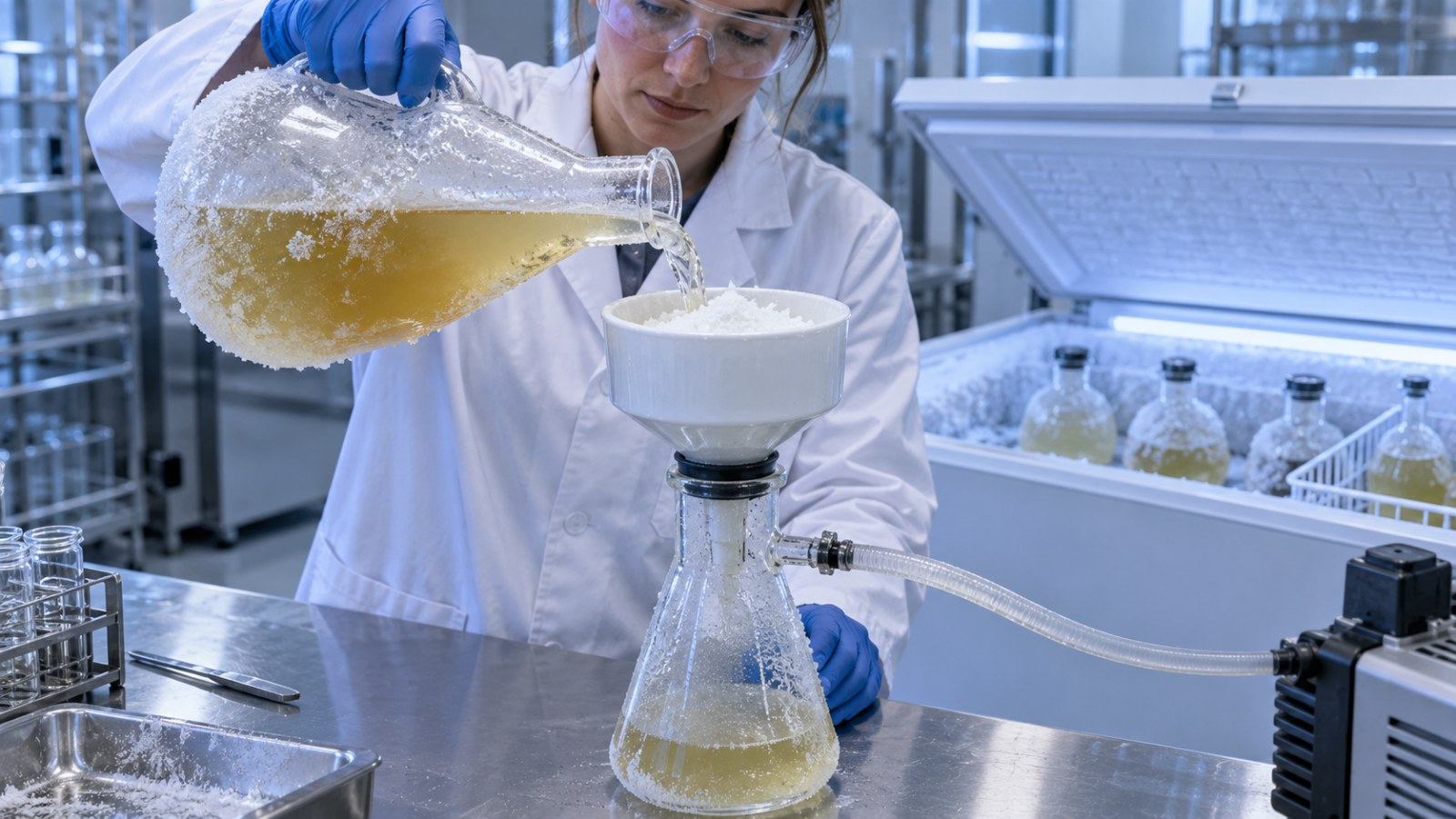
Cannabis winterization is the cold-ethanol step that strips fats, waxes, and phospholipids out of crude extract before distillation. The process in four numbers: dissolve the crude in 190-proof ethanol at 10 parts ethanol to 1 part crude by mass, chill to -20°C for ethanol crude or -40°C for hydrocarbon crude, hold 12 to 24 hours, then filter cold through 25 micron paper with a 5 micron polish. Done right it removes 85 to 95% of the lipid load, raises cannabinoid purity by roughly the lipid fraction removed, and keeps waxes out of the wiped film evaporator, where they coat the wiper, drag the vacuum, and darken the first pass.
What Is Winterization and Why Does It Matter?
Cannabis winterization is the cold-ethanol purification step that removes fats, waxes, and lipids from crude extract. Standard protocol: dissolve crude in 190-proof ethanol at a 10:1 solvent ratio (minimum), chill to -20°C minimum (-40°C to -80°C for high-wax BHO crude), hold 12 to 24 hours, then vacuum-filter through 5 to 25 micron media. Executed correctly, winterization removes 85 to 95% of lipid content, improves cannabinoid purity from 55 to 65% (crude) to 80 to 90% (winterized), and prevents wax fouling in downstream distillation equipment. The critical variables are temperature (every 10°C above -20°C leaves measurably more wax in solution), solvent ratio (below 8:1 risks cannabinoid co-precipitation), and hold time (under 8 hours produces incomplete wax dropout regardless of temperature).
Winterization and purge performance are directly linked. If you want the next downstream step broken out in detail, read Residual Solvent Purging in Cannabis for a full guide to removing butane, propane, and ethanol without cooking the batch.
Winterization Temperature vs. Lipid Removal: Quick Reference
| Temperature | Lipid Removal | Hold Time | Best For | What Stays Behind |
|---|---|---|---|---|
| -20°C (-4°F) | 80–85% | 24 hours | Ethanol and CO₂ crude | Phospholipids, some polar waxes |
| -40°C (-40°F) | 88–92% | 16–24 hours | Standard BHO crude | Trace phospholipids |
| -80°C (-112°F) | 93–97% | 12–16 hours | High-wax BHO, precision distillate | Minimal residual lipids |
Why temperature matters more than time: Every 10°C above -20°C leaves measurably more wax in solution because lipid solubility in ethanol increases with temperature. Running at 0°C instead of -40°C can leave 30 to 40% of plant waxes undissolved, resulting in cloudy distillate, shortened wiped film run times, and accelerated filter fouling in downstream CRC steps.
Cannabis winterization in practice: what happens when you dissolve crude extract in cold ethanol and let it sit overnight? The fats, waxes, and lipids that made it through your initial extraction crash out of solution. You filter them off. What remains is a cleaner, more refined extract with higher cannabinoid concentration and better flavor.
That is winterization in its simplest form. It is the single most important purification step between crude extraction and distillation, and getting it wrong will cascade failures through every downstream process in your lab.
If you skip winterization or do it poorly, your wiped film distillator will foul faster. Your short path heads will carry waxy residues that tank potency and clarity. Your vape cartridges will clog. Your edibles will have off-flavors. Every product format in your catalog is affected by the quality of this one step.
This guide covers the chemistry, the SOPs, the equipment, and the troubleshooting that separates professional winterization from the amateur version.
Need a printable SOP for this process? We built a free Winterization SOP Template with step-by-step procedures, QC checkpoints, batch records, and a troubleshooting table you can print or save as PDF.
The Chemistry of Winterization: Why Cold Ethanol Works
Winterization exploits a fundamental principle of solubility: most compounds become less soluble in a given solvent as temperature drops. Cannabinoids and terpenes remain soluble in ethanol at temperatures as low as -40°C. Fats, waxes, and phospholipids do not.
Here is what is actually happening at the molecular level:
Waxes (long-chain esters of fatty acids and fatty alcohols, typically C40-C60) have high melting points relative to cannabinoids. At room temperature, they dissolve readily in ethanol because the kinetic energy of the solvent molecules keeps them dispersed. Drop the temperature to -20°C or below, and the wax molecules lose enough thermal energy that intermolecular van der Waals forces dominate. They aggregate, nucleate, and precipitate as visible white or yellowish flocs.
Phospholipids behave similarly but form different structures. These amphiphilic molecules (with both polar head groups and nonpolar fatty acid tails) aggregate into micelles and lamellar sheets at low temperatures. They often appear as cloudy suspensions rather than discrete particles.
Chlorophyll and plant pigments are partially removed during winterization, though this is a secondary benefit. True color remediation requires chromatographic techniques like CRC (which we cover in our complete CRC guide).
Cannabinoids (THC, CBD, CBG, CBN, and their acid forms) remain dissolved because their molecular weights are much lower (typically 300-360 g/mol versus 500-900 g/mol for waxes), and their hydroxyl and carboxyl groups maintain favorable hydrogen bonding interactions with ethanol even at extreme cold.
The Solvent Ratio Question
The ratio of ethanol to crude extract is one of the most debated parameters in winterization. Here is what the chemistry dictates:
| Ratio (Ethanol:Crude) | Pros | Cons | Best For |
|---|---|---|---|
| 5:1 | Lower solvent cost, faster evaporation | Incomplete wax removal, higher cannabinoid losses to co-precipitation | Low-wax inputs (CO2 crude, ethanol crude) |
| 10:1 | Industry standard, good balance of removal and recovery | Higher solvent volume, longer evaporation | BHO crude, mixed inputs |
| 15:1 | Maximum wax removal, minimal cannabinoid loss | Expensive, very long evaporation, diminishing returns | High-wax biomass, trim runs, outdoor material |
The practical answer: 10:1 with 190-proof ethanol handles 90% of commercial scenarios. If you are processing fresh-frozen material that went through a properly run closed-loop BHO system (like we describe in our BHO extraction setup guide), your wax load is already lower and you can sometimes get away with 7:1 or 8:1.
Why 190-Proof, Not 200-Proof?
This is one of those details that separates operators who understand chemistry from those who just follow recipes. 190-proof ethanol (95% ethanol, 5% water) works well for winterization and is more commonly available than anhydrous 200-proof for winterization. The small amount of water increases the polarity of the solvent slightly, which helps keep cannabinoids in solution while making the nonpolar waxes even less soluble. You get cleaner separation.
200-proof ethanol costs more and performs worse for this specific application. Save it for processes where water is genuinely problematic, like certain isomerization reactions.
Step-by-Step Cannabis Winterization Process (SOP)
Cannabis Winterization Equipment Required
- Deep freezer capable of reaching -20°C to -40°C (chest freezers work; laboratory freezers are better)
- Glass or stainless steel mixing vessel (NEVER plastic; ethanol will leach plasticizers)
- 190-proof food-grade ethanol (non-denatured)
- Buchner funnel with vacuum flask, or a commercial filter press
- Filter papers: 20-25 micron for initial pass, 1-5 micron for polishing
- Vacuum pump (diaphragm type preferred for solvent resistance)
- Rotary evaporator or falling film evaporator for solvent recovery
- Digital thermometer
- PPE: nitrile gloves, safety glasses, lab coat
Phase 1: Dissolution (30 minutes active, 12-24 hours passive)
1. Warm your crude extract to 40-50°C in a warm water bath. This makes it pourable and ensures complete dissolution. Do not exceed 60°C; you will start degrading cannabinoids.
2. Add pre-chilled ethanol at your target ratio (10:1 recommended). The ethanol should be at room temperature or slightly cool, not frozen yet. You need the crude to dissolve completely before chilling.
3. Stir thoroughly for 10-15 minutes. The solution should be homogeneous with no visible globules of undissolved crude. If using very viscous crude (like cold-extracted BHO that has been sitting), you may need to warm the ethanol to 30°C to get complete dissolution.
4. Transfer to your freezer and hold at -20°C minimum for 12-24 hours. For the best results, use -40°C for 24 hours. During this hold time, the waxes and lipids slowly nucleate and precipitate. Faster chilling (like dry ice baths) can work but tends to produce finer precipitates that are harder to filter.
Critical note: Do not skip the hold time. Four hours at -20°C removes maybe 60-70% of waxes. A full 24 hours at -40°C gets you above 95%. This is not a step where shortcuts pay off.
Phase 2: Filtration (30-60 minutes)
5. Set up your Buchner funnel with a 20-25 micron filter paper. Pre-chill the funnel and flask if possible. Warm glassware will melt fats back into solution as the liquid passes through.
6. Pour the cold solution through the filter under vacuum. Work quickly. Every minute the solution warms, some precipitated wax redissolves. Some operators keep the Buchner funnel inside a freezer or cold room for this reason.
7. Collect the filtrate (this is your winterized miscella, containing cannabinoids in ethanol).
8. Optional polishing pass: Run the filtrate through a 1-5 micron filter for maximum clarity. This second pass catches fine particulates that slipped through the coarser filter.
9. Inspect the filter cake. It should be a white to light yellow waxy mass. If it is dark green or brown, you are losing cannabinoids to the filter cake, likely because your ethanol ratio was too low or dissolution was incomplete.
Phase 3: Solvent Recovery
10. Recover your ethanol using a rotary evaporator (preferred) or falling film evaporator (for larger volumes). Target bath temperature of 40-45°C under vacuum. You want to remove ethanol without degrading cannabinoids or volatilizing terpenes.
11. Final purge: Once the bulk ethanol is removed, transfer the concentrate to a vacuum oven for final devolatilization. We cover this process in detail in our complete devolatilization guide.
12. Test residual solvent levels. Most state regulations require less than 5,000 ppm total residual solvents, but best practice is below 500 ppm for any inhalable product.
Winterization Batch Math: 5 kg of BHO Crude at 10:1, Start to Finish
Every parameter in this guide is a ratio, a temperature, or a time. Operators get hurt on the arithmetic that turns those into freezer volume, filter area, and hours on the rotovap. Here is one batch worked end to end, with the assumption behind every number, so you can substitute your own crude and equipment.
| Line item | Number | How it is calculated |
|---|---|---|
| Crude in | 5.0 kg BHO crude at 12% total lipids and 60% total cannabinoids | Mid-range of the 8-15% wax load and 60-80% cannabinoid content typical of indoor hydrocarbon crude (tables below) |
| Ethanol required at 10:1 by mass | 50 kg = 62 L of 190-proof | 190-proof ethanol is 0.81 kg per liter at 20°C, so 50 kg ÷ 0.81 = 62 L |
| Solution to chill | About 67 L | 62 L ethanol + about 5 L of crude (crude runs close to 1.0 kg/L warm); volumes are not perfectly additive, so plan on 67 L and a vessel with 80 L or more of working volume |
| Heat to remove, 20°C to -40°C | About 7,900 kJ (2.2 kWh of cooling) | 55 kg of solution × 2.4 kJ per kg per °C (ethanol specific heat) × 60°C. The crude contributes little; ethanol dominates the mass |
| Time to reach -40°C before the hold starts | About 15 hours in a chest freezer, about 2 hours in a jacketed vessel | 7,900 kJ ÷ 150 W of usable cooling (a -40°C chest freezer at its floor) = 14.6 h. 7,900 kJ ÷ 1,000 W (a glycol chiller delivering 1 kW net at -40°C to a jacketed vessel) = 2.2 h. The 24-hour hold starts when the liquid, not the air, reads -40°C |
| Dry wax cake | About 550 g | 5.0 kg × 12% lipids × 92% removal at -40°C (temperature table above) |
| Wet cake as it comes off the filter | About 1.2 to 1.6 kg | A wax cake holds 1 to 2 times its own mass in ethanol; that trapped ethanol is where cannabinoids leave the batch |
| Cannabinoids trapped in the cake | About 45 g (1.5% of the batch) before a rinse | 3.0 kg cannabinoids ÷ 62 L = 48 g per liter of miscella; about 0.9 L of miscella stays in a 1.5 kg wet cake. A 2 L rinse with -40°C ethanol pulled through the cake recovers most of it. Paper, transfer, and rotovap holdup push total loss toward the 5 to 10% the recovery targets in the tables allow for |
| Filter papers on a 24 cm Büchner | About 13 changes of 25 micron paper | On 12% wax crude a 24 cm Büchner blinds after roughly 5 L per paper; 67 L ÷ 5 L = 13 changes. This is the batch size where a filter press stops being optional |
| Ethanol recovery time | 62 L: about 12 hours on a 20 L rotovap, 6 hours on a 50 L rotovap, 75 minutes on a falling film | 20 L rotovap at 5 L per hour, 50 L rotovap at 10 L per hour, falling film at 50 L per hour (bath 40-45°C under vacuum) |
| Ethanol lost per cycle | About 1.9 L, roughly $40 | 3% of 62 L at $20 per liter (2-5% loss is normal with recovery running) |
| Winterized crude out | About 4.3 kg | 5.0 kg − 0.55 kg wax cake − about 0.15 kg of cake retention, paper, and transfer losses |
Two things fall out of the table that the parameter list hides. First, the freezer is the bottleneck, not the filter: a chest freezer spends most of a day just pulling 67 L down to -40°C, which is why the 24-hour hold on a chest freezer is really a 40-hour cycle, and why a jacketed vessel on a glycol chiller pays for itself on the second batch. Second, the cake rinse is the cheapest cannabinoid recovery in the building. Two liters of cold ethanol pulled through the cake returns about 40 g of cannabinoids for the price of a few minutes of extra rotovap time.
The Winterization Cycle at a Glance
How to perform winterization, step by step: dissolve the crude in cold-ready ethanol at 10:1, chill it to the target for the crude type, hold it still for 12 to 24 hours, filter it cold in two stages, and recover the ethanol. The table carries the number that controls each step and the way each step fails when it is rushed.
| Step | Setting | Time | How it fails when rushed |
|---|---|---|---|
| Dissolve | Warm the crude to 40 to 50C so it pours, add 190-proof ethanol at 10:1 by mass (8:1 for ethanol crude, 12:1 for high-wax trim runs), stir until there is no visible crude at the bottom | 5 to 15 minutes per batch; a 5 kg batch is 62 L of solution | Chilling an incompletely dissolved batch traps cannabinoids inside the wax that drops out first |
| Chill | Jacketed vessel with glycol, or a chest freezer at the target: -20C for ethanol and CO2 crude, -40C for BHO crude, -80C for precision distillate feed | Jacketed: about 2 hours to -40C on a 1 kW net chiller; chest freezer: about 15 hours for the same 67 L | The hold clock does not start until the center of the vessel reads the target; a probe in the liquid, not the jacket |
| Hold | Keep the solution still at temperature; no stirring once the wax starts to come out | 24 h for BHO crude at -40C, 12 to 16 h for ethanol crude at -20C, 16 to 24 h for CO2 crude, 12 to 16 h at -80C | Cutting the hold to 6 h leaves the slow-nucleating waxes in solution and the distillate feed clouds on the first pass |
| Filter | Pre-chilled Buchner or filter press: 25 micron coarse pass over a celite bed, then 5 micron polish; keep the whole path under -10C | 5 L per 24 cm paper before it blinds on 12% wax crude, so about 13 papers on a 5 kg batch; a filter press runs the batch in one pass | Letting the filtrate warm redissolves wax and the polish pass goes cloudy; a 2 L cold rinse through the cake recovers the trapped cannabinoids |
| Recover | Rotovap or falling film at 40 to 45C bath under vacuum; collect the ethanol for the next batch | 62 L: 12 h on a 20 L rotovap, 6 h on a 50 L, 75 minutes on a falling film; 2 to 5% ethanol loss per cycle | Running the bath hot to save time decarboxylates THCA in the flask and darkens the oil before it ever sees the still |
Winterization by Extraction Method: What Changes?
Not all crude extracts are created equal. The extraction method used upstream determines how much work winterization has to do.
BHO (Butane/Propane) Crude
Hydrocarbon extracts typically carry the highest wax load because butane and propane are excellent wax solvents. Fresh-frozen BHO is better than dry trim BHO because the trichome heads are mechanically harvested before the waxes have time to dissolve from leaf cuticles.
Winterization parameters for BHO crude:
- Ratio: 10:1 ethanol to crude
- Temperature: -40°C minimum
- Hold time: 24 hours
- Expected yield loss: 10-20% (this is wax being removed, not cannabinoid loss)
- Filter: 20 micron initial, 5 micron polish
Ethanol Crude
If you extracted with ethanol in the first place, winterization is simpler because your crude is already dissolved in the right solvent. The challenge is that warm ethanol extraction (above 0°C) pulls significantly more waxes and chlorophyll than cold ethanol extraction.
Winterization parameters for ethanol crude:
- Ratio: Already dissolved; dilute to approximately 10:1 if the crude-to-ethanol ratio is higher
- Temperature: -40°C preferred
- Hold time: 24 hours
- Expected yield loss: 5-15%
- Filter: 20 micron initial, 1 micron polish (ethanol crude tends to have finer particulates)
CO2 Crude
Supercritical CO2 extraction can be tuned to minimize wax co-extraction by adjusting pressure and temperature parameters. Subcritical CO2 pulls even fewer waxes. However, most commercial CO2 operations run at conditions that favor throughput over selectivity, so winterization is still necessary.
Winterization parameters for CO2 crude:
- Ratio: 5:1 to 8:1 (lower wax load)
- Temperature: -20°C often sufficient
- Hold time: 12-16 hours
- Expected yield loss: 3-8%
- Filter: 10-20 micron usually sufficient
The differences in winterization protocol by extraction method trace back to how each solvent interacts with plant waxes during extraction. For a full breakdown of how BHO, ethanol, CO2, and rosin compare on cost, yield, throughput, and facility requirements, see our extraction method selection decision framework.
Winterization Parameters by Extract Type
| Parameter | BHO Crude | Ethanol Crude | CO2 Crude |
|---|---|---|---|
| Wax Content (typical) | 8-15% | 3-8% | 5-12% |
| Target Temp | -40°C to -80°C | -20°C to -40°C | -30°C to -60°C |
| Solvent Ratio | 10:1 to 15:1 | 8:1 to 10:1 (already in ethanol) | 10:1 to 12:1 |
| Hold Time | 24h (high wax load) | 12-16h | 16-24h |
| Filter Micron | 25μm coarse, 5μm polish | 10-25μm (less wax cake) | 10-25μm coarse, 5μm polish |
| Expected Wax Removal | 90-95% | 85-92% | 88-94% |
| Common Failure Mode | Filter blinding from fine wax particles | Chlorophyll co-extraction masking wax signals | Incomplete dissolution before chilling |
| Cannabinoid Recovery | 92-96% | 94-98% | 93-97% |
These parameters are starting points. BHO crude from fresh frozen material carries more waxes than trim runs. Ethanol crude from warm extraction carries more than cold extraction. CO2 crude from subcritical runs carries less than supercritical. Adjust temperature and hold time based on your input material, and verify with the QC protocol in the section below.
Common Winterization Failures and How to Fix Them
Quick Diagnostic Reference
| Symptom | Root Cause | Fix | Prevention |
|---|---|---|---|
| Cloudy filtrate | Filtrate warmed during filtration, redissolving waxes | Pre-chill all glassware; filter in cold room or ice bath | Keep entire filtration path below -10°C |
| Slow/blinded filters | Fine wax particles clogging filter; too-rapid chilling | Coarse pre-filter (25μm) then polish (5μm); add DE/celite bed | Slow-cool (no dry ice shock); use two-stage filtration |
| Dark green filter cake | Cannabinoids co-precipitating; ethanol ratio too low | Increase ratio to 12:1 or 15:1; ensure full dissolution before chilling | Never chill below 8:1 ratio; warm-dissolve first |
| Waxy final product | Incomplete winterization; temp too warm or hold too short | Re-winterize at -40°C for 24h with fresh ethanol | Hold minimum 12h at -20°C; 24h for BHO crude |
| Low cannabinoid recovery (<90%) | Excessive co-precipitation; too cold for too long; low ratio | Warm ethanol wash of filter cake to recover trapped cannabinoids | Monitor ratio; do not exceed -80°C; keep at 10:1+ |
Problem: Cloudy Filtrate After Filtering
Root cause: The filtrate warmed up during filtration, redissolving precipitated waxes.
Fix: Pre-chill all glassware. Work in a cold room if possible. Filter in smaller batches so each pour spends less time at ambient temperature. If you are filtering in a warm lab, wrap your vacuum flask in insulation or keep it in an ice bath.
Problem: Slow Filtration / Blinded Filters
Root cause: Fine wax particles are clogging the filter paper. This is common with crude that was chilled too rapidly (dry ice bath without slow cooling first) or with very high-wax inputs.
Fix: Use a coarser initial filter (25-40 micron) to catch the bulk, then do a polishing pass at 5 micron. Adding a layer of diatomaceous earth (DE) or celite to the Buchner funnel before the filter paper creates a depth filter bed that prevents blinding. This is the same principle used in beer and wine filtration.
Problem: Dark Green Filter Cake
Root cause: Cannabinoids are precipitating along with the waxes, usually because the ethanol ratio is too low or the crude was not fully dissolved before freezing.
Fix: Increase your ethanol ratio to 12:1 or 15:1. Ensure complete dissolution at warm temperatures before any chilling begins. If you see a green filter cake, wash it with a small amount of cold ethanol to recover trapped cannabinoids. Do not discard high-cannabinoid filter cakes.
Problem: Final Product Still Has Waxy Texture
Root cause: Insufficient hold time, temperature not cold enough, or high-wax biomass that needs a second winterization pass.
Fix: Run a second winterization. Dissolve the winterized extract again at 10:1, freeze at -40°C for 24 hours, and filter again. Two passes at -40°C will remove virtually all fats and waxes from any starting material. For extremely waxy outdoor trim extracts, this double winterization is standard practice.
Problem: Low Cannabinoid Recovery After Winterization
Root cause: Ethanol ratio too high (cannabinoids diluted and lost in filter cake), temperature too cold for too long (some cannabinoids can slowly precipitate at extreme cold, especially CBD), or using denatured ethanol with additives that affect solubility.
Fix: Stick to 10:1 ratio. Use 190-proof food-grade, non-denatured ethanol only. If CBD recovery is a concern, limit hold time to 16 hours rather than 48. Always wash your filter cake with a small volume of cold ethanol to recover trapped cannabinoids. If low recovery persists after correcting these variables, the starting material itself may be the problem: water activity, harvest timing, and curing all affect how much cannabinoid is accessible to your solvent. See the yield troubleshooting guide for a full method-by-method breakdown.
We cover winterization alongside every other post-processing step, from crude to finished distillate, in our extraction training course at extractiontraining.com.
Winterization vs. Inline Dewaxing: When to Skip the Freezer
Some closed-loop hydrocarbon extraction systems feature inline dewaxing columns. These columns, packed with dry ice or chilled with a glycol jacket, crash out waxes during the extraction itself, before the solvent is recovered.
Inline dewaxing advantages:
- Eliminates the need for ethanol winterization entirely
- Reduces processing steps and labor
- No ethanol handling or recovery required
- Faster turnaround from biomass to refined extract
Inline dewaxing limitations:
- Removes less wax than a full ethanol winterization (typically 60-80% vs. 95%+)
- Requires properly designed extraction equipment with dewaxing capability
- Performance degrades as the dewaxing column saturates; requires regular cleaning
- Not applicable to ethanol or CO2 extraction methods
The practical recommendation: If your hydrocarbon system has inline dewaxing and you are making products where slight wax content is acceptable (live resin, sauce, budder), you can often skip winterization. If you are feeding distillation equipment or making vape cartridges, do a full winterization regardless of inline dewaxing. The fats that slip through will accumulate on your distillation equipment and degrade product quality over time, as we discuss in our wiped film distillation guide.
Solvent Recovery and Ethanol Economics
Winterization is one of the most solvent-intensive steps in cannabis processing. At a 10:1 ratio, processing 10 kg of crude requires 100 liters of ethanol. At $15-25 per liter for food-grade 190-proof, that is $1,500-2,500 in solvent cost per batch.
Ethanol that sits between runs is a stored flammable liquid whatever you call it, and the solvent storage room guide runs the NFPA 30 quantity math for it; if the recovery economics still do not close at your scale, that is the conversation an independent extraction consultant has with you before the second chiller gets ordered.
This is why solvent recovery is not optional. It is the difference between a profitable operation and one that bleeds money.
Rotary evaporation is the standard for small to medium operations (processing up to 50 kg crude per day). A properly sized rotovap recovers 95-98% of ethanol at bath temperatures of 40-45°C under vacuum.
Falling film evaporation is the industrial solution for operations processing 50+ kg crude daily. These continuous-flow systems recover ethanol at rates of 50-200 liters per hour with 98-99% recovery efficiency.
Key economics:
- Ethanol loss per cycle (with recovery): 2-5%
- Break-even on a quality rotovap: typically 2-3 months of daily operation
- Annual ethanol cost for a mid-size operation (with 97% recovery): $8,000-15,000
- Annual ethanol cost without recovery: $400,000+ (this is not a typo)
Solvent recovery equipment pays for itself almost immediately. If you are not recovering ethanol, you are not running a real business.
How Winterization Fits the Full Processing Workflow
Understanding where winterization sits in your overall process flow prevents bottlenecks and quality issues:
- Extraction (BHO, ethanol, or CO2) produces crude extract
- Winterization removes fats, waxes, lipids
- Solvent recovery reclaims ethanol
- Decarboxylation (if making distillate for edibles or if required before distillation)
- Distillation (short path or wiped film) refines cannabinoid concentration
- Post-distillation processing (CRC, crystallization, formulation)
Skipping step 2 or doing it poorly creates compounding problems at steps 5 and 6. Waxes foul distillation equipment. Lipids cause haziness in vape cartridges. Phospholipids create emulsion problems in edible formulations.
If you are working through this workflow and run into off-flavors or clarity issues, our off-flavors troubleshooting guide covers diagnosis and correction for each stage.
Scaling Winterization: Bench to Production
Winterization at 500 mL in a lab beaker is straightforward. Winterization at 200 liters in a production facility is an engineering problem. The chemistry does not change. Everything else does.
Bench Scale (1-5 Liters)
Most operators learn winterization here: dissolve crude in ethanol in a mason jar or Erlenmeyer flask, stick it in a chest freezer at -20°C overnight, filter through a Buchner funnel with Whatman #1 paper. This works. The variables are manageable because the thermal mass is small. A 2-liter jar reaches target temperature in 2-3 hours. Mixing is done by hand. Filtration takes 15-30 minutes.
The mistake operators make at this scale is assuming production will be this simple at 50x the volume. It will not.
Mid-Scale (10-50 Liters)
At this volume, three problems appear simultaneously. First, thermal transfer. A 50-liter vessel takes 8-12 hours to reach -40°C in a standard chest freezer because the ethanol in the center of the vessel is insulated by the ethanol around it. Without active mixing, you get a temperature gradient: -40°C at the walls, -15°C in the center. Waxes at the center stay dissolved while the edges precipitate. Result: inconsistent winterization and poor filtration.
Second, filtration throughput. A single 6-inch Buchner funnel cannot handle 50 liters of winterized solution in any reasonable timeframe. The filter blinds within the first 5 liters. You need a vacuum filtration manifold with multiple filter plates, or a pressurized filter system.
Third, ethanol vapor management. At 50 liters of ethanol in a room, vapor accumulation during filtration and solvent recovery becomes a genuine safety concern. Proper ventilation and explosion-proof equipment are not optional.
Solutions at this scale: Use a jacketed stainless steel vessel with glycol cooling for consistent temperature control. Install an overhead stirrer (explosion-proof motor) for mixing during the cold soak. Upgrade to a plate-and-frame filter or a pressurized Nutsche filter. Ensure your facility meets C1D1 ventilation requirements, which we cover in our extraction lab build guide.
Production Scale (100+ Liters)
At production scale, winterization becomes a unit operation with its own dedicated equipment train. Jacketed reactors with PID-controlled glycol systems maintain exact temperatures. Centrifugal filtration replaces vacuum filtration for throughput. Automated solvent recovery systems run continuously.
The critical variable at scale is batch consistency. Every batch must reach the same temperature, hold for the same duration, and filter through the same grade media. Deviation in any of these produces downstream quality variation that shows up as haze in distillate, fouled wiped film equipment, or inconsistent vape cartridge performance.
Production facilities should establish SOPs with specific temperature, time, ratio, and filtration parameters for each crude type they process, and deviation from those SOPs should require documented justification.
Quality Control: Verifying Your Winterization
You finished winterizing. The filtrate looks clear. The filter cake is white. But how do you actually confirm it worked? Relying on visual inspection alone is a rookie mistake that will cost you in downstream processing.
Four-Point Verification Protocol
1. Turbidity Check (Immediate). Pour a sample of filtered winterized solution into a clear glass container at room temperature. Hold it against a white background. If it is perfectly transparent with no haze, cloudiness, or floating particles, your wax removal is complete. If you see any haze when the solution warms to room temperature, waxes are still dissolved and your winterization temperature was not cold enough or your hold time was too short.
2. Filter Cake Gravimetric Analysis (Same Day). Weigh your filter cake after drying. Compare it to the weight of crude input. For ethanol crude from cold biomass extraction, typical wax removal is 3-8% of crude weight. For BHO crude, which carries the heaviest wax load of the three methods, 8-15% is normal. If your filter cake weight is below 2%, you either had very clean starting material or your winterization was incomplete. If it exceeds 20%, your extraction is pulling excessive plant material and you have an upstream problem.
3. Solvent-Free Residue Test (Post-Evaporation). After recovering your ethanol, inspect the winterized extract at room temperature. It should be smooth, glossy, and uniform in texture. Any grittiness, waxy film, or white specks indicate waxes that survived winterization. These will cause problems during distillation.
4. Analytical Testing (If Available). If you have access to third-party or in-house analytical testing, request a lipid content assay on your winterized extract. Professional winterization should reduce lipid content to below 2% of total extract weight. If lipids remain above 5%, your winterization process needs adjustment: colder temperatures, longer hold times, or better filtration.
When to Re-Winterize
If your turbidity check fails or your filter cake is suspiciously light, do not proceed to distillation. Re-dissolve the extract in fresh cold ethanol at 10:1, drop the temperature 10°C below your previous attempt, extend the hold time by 8 hours, and re-filter through a tighter grade paper (from Whatman #1 to Whatman #4, or from 20-micron to 5-micron). The cost of re-winterizing is a few hours and some ethanol. The cost of feeding waxy crude into a wiped film distillation system is fouled equipment, lost product, and a maintenance shutdown.
Hemp Winterization: Why Hemp Crude Needs a Different Approach
Hemp biomass produces crude with 2 to 5 times the wax load of indoor cannabis flower. Outdoor-grown hemp accumulates heavier epicuticular waxes from UV exposure, wind stress, and temperature swings. That means the standard winterization parameters built for indoor BHO crude will leave waxes in your hemp extract if you do not adjust.
The core problem is concentration. Hemp crude typically runs 30 to 50% total cannabinoids versus 60 to 80% from quality indoor cannabis crude. Lower cannabinoid density means more plant matrix per gram of extract, which means more waxes, lipids, and phospholipids competing for space in your ethanol solution.
Adjusting Ratios for Hemp Crude
Standard cannabis winterization uses a 10:1 ethanol to crude ratio (by volume). Hemp crude needs 15:1 to 20:1. The extra solvent volume is not optional. At 10:1, hemp waxes saturate the solution before they can fully precipitate, and you end up pushing waxy ethanol through your filters instead of clear solution with a wax cake on top.
Temperature matters more with hemp. Drop to -40C (-40F) instead of the standard -20C (-4F). The higher wax load requires colder temperatures to force complete precipitation. At -20C, about 60 to 70% of hemp waxes precipitate. At -40C, you capture 90%+. The energy cost of running a chest freezer or cold room at -40C is the price of processing hemp correctly.
Filtration Challenges With Hemp
Hemp crude clogs filters faster because the wax cake is thicker and stickier. Pre-filter at 10 to 20 microns before your final Buchner filtration at 1 to 5 microns. Without the pre-filter step, your Buchner funnel blinds within minutes on a 5-liter batch. Change filter papers twice as often as you would with cannabis crude.
Yield loss from hemp winterization runs 15 to 25% of starting crude weight. That is higher than the 8 to 15% typical for indoor cannabis crude. The extra loss is waxes you are removing, not cannabinoids. Verify with post-winterization potency testing: if your cannabinoid recovery is below 85%, your ethanol ratio was too low or your soak time was too short.
CBD Oil Winterization: Cleaning Up Low-Potency Extract
Consumer-grade CBD crude oil often arrives at 20 to 40% total cannabinoids with visible wax contamination. Cloudiness at room temperature, waxy deposits in the bottle after refrigeration, and shortened shelf life are all signs that winterization was skipped or poorly executed upstream.
Winterizing CBD oil follows the same chemistry as any other extract, but the low cannabinoid concentration changes the economics. You are using a lot of ethanol to clean up a relatively dilute product. The math only works if the cleaned product commands a price premium (clear, stable, longer shelf life) or if you are feeding the winterized crude into a downstream distillation step where waxes would foul your equipment.
When CBD Oil Winterization Makes Sense
Winterize CBD crude when it is headed for distillation. Waxes in the boiling flask polymerize onto your glassware, reduce vacuum efficiency, and contaminate your distillate fraction. One batch of un-winterized hemp crude through a short path system creates cleanup work that costs more than the winterization would have.
Winterize when your crude is being sold as a tincture base or topical ingredient. Consumers notice cloudiness. Formulators reject waxy crude because it destabilizes emulsions and causes separation in finished products. The winterization step adds $2 to $5 per unit in processing cost and eliminates the quality complaints.
Skip winterization when working with CBD isolate or broad-spectrum distillate that has already been processed. These products are post-wax by definition. Re-winterizing clean distillate wastes ethanol and processing time for zero quality improvement.
CBD Oil Winterization Parameters
| Parameter | Indoor Cannabis Crude | Hemp Crude | CBD Oil (Low Potency) |
|---|---|---|---|
| Typical cannabinoid content | 60-80% | 30-50% | 20-40% |
| Ethanol:crude ratio | 10:1 | 15:1 to 20:1 | 15:1 to 20:1 |
| Target temperature | -20C (-4F) | -40C (-40F) | -30C to -40C (-22F to -40F) |
| Soak time | 12-24 hours | 24-48 hours | 24-48 hours |
| Typical wax yield | 8-15% of crude weight | 15-25% of crude weight | 10-20% of crude weight |
| Cannabinoid recovery target | 90%+ | 85%+ | 85%+ |
Winterization Decision Matrix
Not every product needs winterization, and not every extraction method produces crude that requires the same level of dewaxing. This matrix eliminates the guesswork.
| Extraction Method | End Product | Winterization Required? | Recommended Protocol |
|---|---|---|---|
| BHO (closed loop) | Distillate / Vape carts | Yes (full) | -40°C, 24h hold, 10:1 ratio |
| BHO (closed loop) | Live resin / Sauce | Optional (light) | -20°C, 4-6h hold, 7:1 ratio |
| BHO (closed loop) | Shatter / Slab | Yes (standard) | -30°C, 12-16h hold, 10:1 ratio |
| Ethanol extraction | Distillate | Yes (full, often 2x) | -40°C, 24h hold, 10:1. Re-winterize if turbid. |
| Ethanol extraction | RSO / Full-spectrum | Optional | Some wax content is acceptable in RSO. Light winterize at -20°C if clarity matters for capsule fill. |
| CO2 (supercritical) | Distillate | Yes (standard) | -30°C, 12h hold, 7:1 ratio (CO2 pulls less wax) |
| CO2 (subcritical) | Any | Rarely needed | Subcritical CO2 is selective enough that wax content is minimal. |
| Rosin press | Any | No | Solventless. No lipid co-extraction. If rosin has wax issues, the problem is press temp or input quality. |
| Bubble hash / Dry sift | Any | No | Mechanical separation. No solvents, no lipid co-extraction. |
The pattern is clear: any process that uses a polar or semi-polar solvent (ethanol, butane, CO2) will co-extract fats and waxes to some degree. The more aggressive the extraction (higher temperatures, longer contact times, more polar solvents), the more winterization work follows. Solventless processes skip winterization entirely because the mechanism of separation never contacts the cellular lipids in the first place.
For a complete walkthrough of color remediation as the next purification step after winterization, see our CRC chemistry and media stack guide.
Frequently Asked Questions
Can I use isopropyl alcohol instead of ethanol for winterization?
Technically yes, but only for non-ingestible products. Isopropyl alcohol (IPA) works chemically for precipitating waxes, but it is toxic and cannot be fully removed to safe levels for inhalable or edible products. Use food-grade ethanol for anything that will be consumed.
How many times can I reuse winterization ethanol?
Recovered ethanol can be reused 3-5 times before wax contamination reduces its effectiveness. Test recovered ethanol periodically by chilling a sample to -40°C. If it turns cloudy, it is carrying dissolved waxes and should be redistilled or replaced.
Does winterization remove pesticides or heavy metals?
No. Winterization is a physical separation based on solubility differences. Pesticides and heavy metals require different remediation approaches entirely. See our remediation decision matrix for guidance on failed batch recovery.
What is the difference between winterization and degumming?
Winterization targets waxes and lipids through cold precipitation. Degumming specifically targets phospholipids using water or acid treatment. Some operators combine both: degum first with a small amount of water at warm temperature, then winterize the degummed extract. This two-step approach produces the cleanest input for distillation.
Can I winterize with other solvents besides ethanol?
Methanol works but is highly toxic. Acetone works but is harder to fully remove and can degrade certain terpenes. Ethanol is the industry standard because it is effective, relatively safe, food-grade options exist, and it is easily recovered. There is no practical reason to use anything else for commercial cannabis processing.
How do I know if my winterization was successful?
Three checks: (1) The filtrate should be clear, not cloudy, when held at room temperature. (2) The filter cake should be white to light yellow, not green or brown. (3) After solvent removal, the winterized extract should be smooth and glossy, not gritty or waxy in texture. If you have access to analytical testing, lipid content below 2% in the winterized extract confirms good winterization.
Is winterization necessary for making live resin?
Generally no. Live resin is valued for its full terpene and cannabinoid profile, and the slight wax content contributes to its characteristic texture. However, if your live resin has clarity issues or is clogging cartridges, a light winterization at -20°C for 4-6 hours can clean it up without destroying the terpene profile.
What temperature is cold enough for winterization?
Minimum -20°C for acceptable results. -40°C for professional results. Below -60°C offers negligible improvement and risks precipitating some cannabinoids (especially CBD). The sweet spot for most operations is -35°C to -40°C.
What is the cannabis winterization process, step by step?
Four steps. One: warm the crude to 40-50°C and dissolve it in 190-proof ethanol at 10 parts ethanol to 1 part crude by mass, stirring 10 to 15 minutes until there are no undissolved globules. Two: chill the solution to -20°C for ethanol crude or -40°C for hydrocarbon crude and hold it 12 to 24 hours so the waxes nucleate and settle. Three: filter cold, under vacuum, through 25 micron paper, then polish through 5 micron, with the funnel and flask pre-chilled so nothing redissolves on the way through. Four: recover the ethanol on a rotovap or falling film at a 40-45°C bath under vacuum, then finish the last solvent in a vacuum oven.
How do you winterize CBD oil?
The same chemistry with a wider ratio and a longer hold, because low-potency CBD crude carries more wax per gram of cannabinoid. Dissolve 1 part CBD crude in 15 to 20 parts 190-proof ethanol, chill to -30°C to -40°C, hold 24 to 48 hours, then filter through 25 micron paper and polish at 5 micron. Expect 10 to 20% of the crude weight to come off as wax cake and plan on 85% or better cannabinoid recovery. At 20 to 40% cannabinoids the ethanol cost per gram of cannabinoid is three to four times what it is on indoor cannabis crude, so winterize CBD oil when it is headed for distillation or being sold as a clear tincture base, and skip it for isolate or distillate that is already wax-free.
What equipment do you need to winterize cannabis extract?
Under 20 L per batch: a chest freezer that reaches -40°C, a glass or stainless mixing vessel (never plastic), 190-proof non-denatured ethanol, a Büchner funnel with a vacuum flask and a diaphragm vacuum pump, 25 micron and 5 micron filter papers, a rotary evaporator for ethanol recovery, a vacuum oven for the final purge, and a digital thermometer that reads the liquid, not the freezer air. Above 20 L: a jacketed stainless vessel on a glycol chiller replaces the freezer, a plate filter press replaces the Büchner, and a falling film evaporator replaces the rotovap once you pass 50 kg of crude per day.
What temperature destroys cannabinoids during winterization?
Nothing in a correctly run winterization gets hot enough to destroy them. Dissolution happens at 40-50°C and never above 60°C, and ethanol recovery runs at a 40-45°C bath under vacuum. THCA only decarboxylates at a meaningful rate above about 105°C held for the better part of an hour, and THC oxidizes to CBN with heat, light, and air over days, not minutes. The damage operators actually see comes from the recovery step run too hot or too long: a rotovap bath pushed past 60°C to speed things up strips terpenes first and starts converting THC to CBN, which is why the last of the ethanol comes off in a vacuum oven at low heat and not on a hot plate.
What Winterization Decides Downstream
Winterization is not glamorous. It does not get the attention that distillation or crystallization receives. But it is the foundation that every downstream process depends on. Get it right, and your distillation runs cleaner, your products look better, and your equipment lasts longer. Get it wrong, and you chase quality problems through your entire operation, never quite understanding why your distillate is hazy or your cartridges clog after two days on the shelf.
The chemistry is straightforward. Cold ethanol, proper ratios, sufficient hold time, clean filtration. No shortcuts. That is the entire secret. For the full science of what happens to your extract after winterization (nucleation, oxidation, terpene loss, and how to prevent each), see our extract stability guide.
Want to go deeper on extraction processing? Join our Discord community for direct Q&A, or subscribe to our newsletter for weekly technical content.
About the Author: Grim is the founder of WKU Consulting, a global consultancy specializing in cannabis and hemp extraction engineering, lab design, and SOP development. WKU Consulting has designed and built some of the largest extraction laboratories in the world.
Solventless workflows skip the winterization step entirely because no lipids are pulled from the trichomes. For an example of a fully solventless workflow, see our SOP for pressing hash rosin from bubble hash.
Winterization handles waxes. It does not always solve the phospholipid fraction that can still darken oil and foul the still. For that next cleanup step, read Cannabis Crude Oil Degumming: The Complete Guide to Removing Phospholipids Before Distillation.
Winterization quality starts upstream. If the closed-loop extraction run is too warm, too waxy, or poorly recovered, the freezer ends up doing cleanup for problems that should have been controlled earlier. For that upstream view, read Closed-Loop Extraction Systems for Cannabis: How They Work, What Matters, and What Fails.
