
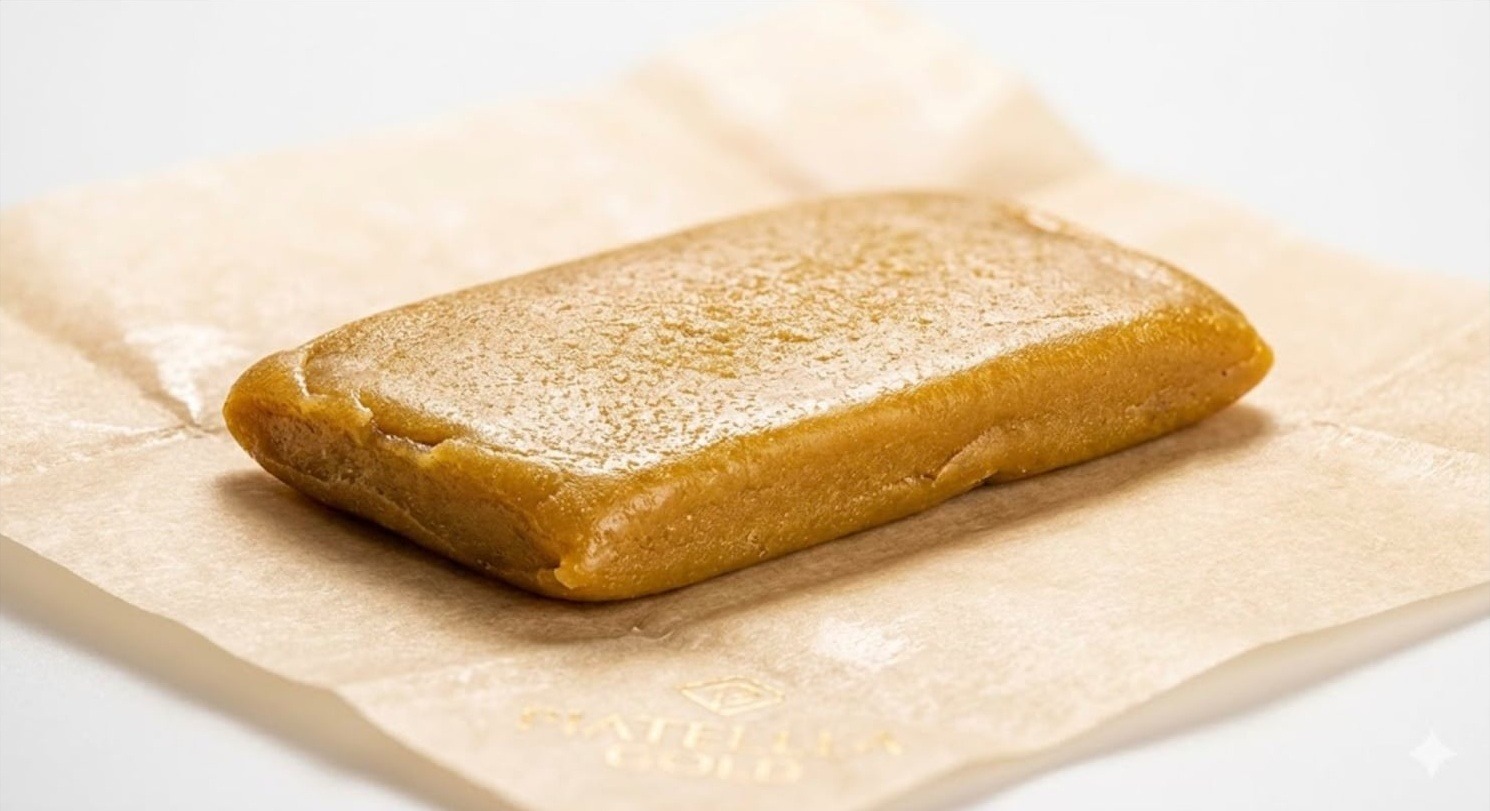
A comprehensive technical guide to authentic solventless piatella production and the CBD-derived alternative pathway, from first principles of trichome chemistry through finished product.
Introduction
Piatella has become one of the most talked-about cannabis concentrates in the world, and for good reason. It represents the pinnacle of solventless processing: a golden, butter-like slab that melts cleanly, delivers exceptional terpene complexity, and commands prices between 50 and 120 euros per gram at retail in legal markets. It is, by any measure, a masterclass in post-harvest trichome science.
But there is a second pathway to piatella that has nothing to do with fresh-frozen cannabis flower or ice water hash. This pathway starts with CBD isolate, a white crystalline powder that ships internationally with zero legal restriction, and transforms it through acid-catalyzed isomerization, distillation, color remediation, and matrix engineering into a product that is visually, texturally, and aromatically indistinguishable from the authentic version.
This guide covers both pathways in full technical detail. Part One walks through authentic piatella production from harvest through cold cure, explaining the chemistry and physics behind each step. Part Two breaks down the CBD-derived pathway with complete procedural parameters, reaction mechanisms, and the material science that makes the final product physically convincing.
This is written for scientists, extractors, and serious students of cannabis chemistry. The goal is comprehension at a level where you understand not just what happens at each stage, but why it happens.
Part One: Authentic Piatella Production
Origins and Definition
Piatella was developed by a producer known as Zio at Uncle’s Farm Cannabis Social Club in Barcelona around 2018. The technique won third place at the Ego Clash competition in 2020, putting it on the global map. The name derives from the Italian word piatto, meaning flat, a reference to the vacuum-sealed flat slab format of the finished product.
Piatella is not a strain. It is not a product category in the way that shatter or badder are product categories. It is a specific post-processing and curing technique applied to the highest grade of solventless hash. The distinction matters because the technique is what creates the signature characteristics: the buttery consistency, the exceptional terpene retention, and the clean melt behavior.
Step 1: Starting Material Selection
The foundation of authentic piatella is fresh-frozen cannabis flower harvested at peak trichome maturity. This is non-negotiable. The entire downstream process depends on preserving the volatile terpene fraction and preventing oxidation of the cannabinoid-terpene matrix.
Why fresh-frozen? Cannabis trichomes are living biological structures. The moment the plant is cut, enzymatic degradation begins. Monoterpenes like myrcene (boiling point 167°C), limonene (176°C), and linalool (198°C) begin volatilizing at ambient temperature, particularly in the presence of oxygen and light. Sesquiterpenes like beta-caryophyllene (119°C at 17.5 mmHg) are more thermally stable but still degrade through oxidation pathways.
By freezing the plant immediately after harvest, typically within 15 to 30 minutes, you arrest enzymatic activity and lock the terpene profile in place. The target temperature is negative 40°C or below, achievable with commercial blast freezers or dry ice. Standard chest freezers at negative 18°C are a compromise; they slow degradation but do not fully halt it. At negative 40°C, the rate of terpene volatilization drops to near zero, and the phospholipid membranes of the trichome heads become rigid, which is critical for the mechanical separation that follows.
Trichome maturity assessment: Optimal harvest timing is determined by trichome head color under 60x to 100x magnification. The target is a mixture of clear to milky capitate-stalked trichomes with minimal amber coloration. Milky heads indicate peak THCA concentration. Amber heads indicate oxidative degradation of THCA to CBN. For piatella production specifically, you want to err toward the milky side, because the cold curing process will contribute additional aging.
Step 2: Ice Water Extraction
Ice water hash extraction is a mechanical separation process, not a chemical one. No solvents are used. The principle is simple: trichome heads are denser than water and more brittle than plant tissue when cold. Agitation in ice water snaps the trichome stalks, and the freed heads are collected by filtration through graduated micron screens.
The physics of separation: At near-freezing temperatures (0 to 4°C), the waxy cuticle of trichome heads becomes rigid and brittle. The glandular heads, which contain the cannabinoid and terpene payload, are spherical structures typically 60 to 120 microns in diameter. The cellulosic plant matrix (leaf tissue, stems, cell wall fragments) tends to be either much larger or much smaller than this range. By filtering through a series of decreasing micron bags (typically 220, 190, 160, 120, 90, 73, 45, and 25 microns), you isolate the trichome head fraction from both larger plant debris and smaller contaminants.
Target fraction: For piatella-grade hash, the 73 to 120 micron collection is the primary target. This range captures the majority of intact capitate-stalked trichome heads while excluding broken cell wall fragments (sub-45 micron) and larger plant material. The 73 to 120 micron fraction is often referred to as “full-melt” or “6-star” hash, meaning it vaporizes completely with zero residue when subjected to flame or a heated surface.
Process parameters:
- Water temperature: 0 to 4°C, maintained with a 1:1 ratio of ice to water by volume
- Agitation: gentle to moderate. Over-agitation breaks trichome heads and releases chlorophyll, lipids, and cell wall fragments into the wash. Hand stirring or a low-RPM washing machine at 3 to 5 minute cycles
- Number of washes: 3 to 6, depending on starting material quality. Each successive wash yields lower quality, with increasing plant contamination
- Filtration: gravity drain through stacked micron bags. Do not squeeze or compress the bags, as this forces sub-micron contaminants through the mesh
Quality assessment: The wet trichome patty collected on each screen is assessed visually and by the “grease test.” A small sample is pressed between the thumb and forefinger. Full-melt material will become translucent and greasy without visible plant specks. The color should be light blonde to pale gold. Green tint indicates chlorophyll contamination. Dark color indicates oxidation or excessive plant lipid content.
Step 3: Freeze Drying (Lyophilization)
The wet trichome mass must be dried without thermal degradation. Conventional air drying or even cold-room drying at 4°C introduces oxidation and partial terpene loss. Lyophilization, freeze drying under vacuum, is the gold standard because it removes water through sublimation rather than evaporation.
The thermodynamics of sublimation: Water exists in three phases: solid, liquid, and gas. At pressures below 6.1 mbar (the triple point of water), liquid water cannot exist. Ice transitions directly to vapor without passing through the liquid phase. This is sublimation, and it is the principle behind lyophilization.
In a freeze dryer, the wet hash is frozen to negative 40°C or below, then placed under vacuum at 50 to 200 millitorr (0.067 to 0.267 mbar). At these conditions, the ice within the trichome matrix sublimates directly to vapor, which is captured on a cold condenser surface. The critical advantage is that the trichome structure never passes through a wet, warm state where terpene volatilization and oxidative degradation would accelerate.
Process parameters:
- Shelf temperature: negative 40°C during primary drying, gradually ramping to negative 10°C during secondary drying
- Chamber pressure: 50 to 200 millitorr
- Condenser temperature: negative 50°C or below (must be colder than the shelf to create the vapor pressure gradient that drives sublimation)
- Duration: 24 to 48 hours depending on batch size and initial moisture content
- Endpoint determination: weight stabilization. When consecutive hourly weight measurements show less than 0.1% change, drying is complete
The freeze-dried trichome mass emerges as a light-colored, loose powder with minimal oxidation. The monoterpene fraction is largely preserved because the temperatures never exceeded the sublimation range. This terpene-rich, minimally oxidized starting material is what makes the subsequent cold cure possible. If you start with degraded, oxidized hash, the cold cure cannot rescue it.
Step 4: Cold Curing (The Transformation)
This is the step that makes piatella what it is. Cold curing transforms dry, powdery trichome heads into a cohesive, buttery, sliceable mass. It is also the least understood step, so let’s break down the chemistry.
The freeze-dried hash is sealed in an airtight vessel and stored at 4 to 15°C for a minimum of four to six weeks. Three distinct processes occur simultaneously:
1. Terpene mobilization and redistribution. At cold but above-freezing temperatures, the monoterpene and sesquiterpene fractions within the trichome heads exist as viscous liquids. Over weeks, these terpenes slowly migrate through the cannabinoid matrix via molecular diffusion. The driving force is the concentration gradient between the terpene-rich core of the trichome head and the surface. This redistribution homogenizes the terpene profile throughout the mass and creates the intense, complex aroma that characterizes piatella.
The rate of diffusion follows Fick’s first law: J = -D(dC/dx), where J is the flux, D is the diffusion coefficient, and dC/dx is the concentration gradient. At 4 to 15°C, the diffusion coefficient of monoterpenes through a cannabinoid wax matrix is extremely low, which is why the process takes weeks rather than hours. But the slow diffusion is actually beneficial: it allows for thorough, uniform redistribution rather than rapid surface depletion.
2. Partial THCA nucleation. THCA is a crystalline compound at room temperature. In the amorphous matrix of a trichome head, THCA exists in a supersaturated state, dissolved in the terpene and lipid fraction. During cold storage, THCA molecules slowly organize into micro-crystalline domains through nucleation. This partial crystallization contributes to the firm, fudge-like texture of piatella. The crystalline THCA domains act as structural crosslinks within the amorphous terpene-wax matrix, much like the cocoa butter crystals that give chocolate its snap.
The nucleation rate is temperature-dependent. At 4°C, nucleation proceeds slowly, producing many small crystal domains rather than a few large ones. This creates a uniform, fine-grained texture. At higher temperatures (15°C+), nucleation is faster but produces larger, fewer crystal domains, which can create a grainy or sandy texture. The optimal temperature range for piatella curing is 4 to 10°C.
3. Lipid reorganization. Trichome heads contain complex lipids including fatty acids, wax esters, and sterols. During cold storage, these lipids undergo slow reorganization from their initial amorphous state toward more ordered configurations. This contributes to the cohesive, plasticine-like consistency. The lipid fraction acts as a plasticizer within the THCA crystalline network, preventing the mass from becoming dry and crumbly.
Process parameters:
- Container: glass mason jar or vacuum-sealed food-grade cellophane
- Fill level: 75 to 90% full to minimize headspace oxygen
- Temperature: 4 to 10°C (standard refrigerator range)
- Duration: 4 to 8 weeks minimum. Some producers cure for 3 to 6 months.
- Inspection: checked weekly. Early stages show the powder beginning to clump and darken slightly toward gold. Mid-cure, the mass becomes cohesive and pliable. Late cure produces the final buttery consistency.
Step 5: Vacuum Sealing and Final Format
The cured mass is transferred to food-safe cellophane or specialized foils and vacuum-sealed flat. The vacuum compression serves two purposes:
Oxygen exclusion: Removing residual air halts oxidative degradation, preserving the golden color and terpene integrity indefinitely under proper storage.
Mechanical consolidation: The vacuum pressure (approximately 1 atm differential, or 14.7 psi, across the surface of the slab) compresses the cured mass into a dense, uniform slab. This continued compression allows the product to continue sweating terpenes internally, further developing flavor complexity over time.
The final product is a golden to amber-colored slab that can be sliced with a knife like soft fudge. It melts fully when vaporized at 160 to 200°C, leaving minimal residue. When assessed under a refractometer, authentic piatella typically reads between 1.50 and 1.54 refractive index, consistent with a cannabinoid-terpene matrix rather than a pure isolate.
Part Two: CBD-Derived Piatella
The Precursor Supply Chain
CBD isolate is the starting material. It is legal, unscheduled in most jurisdictions, and commercially available from Chinese, Eastern European, and North American suppliers at 1 to 5 USD per gram in bulk. It arrives as a white crystalline powder (melting point 66°C, molecular formula C₂₁H₃₀O₂, molecular weight 314.47 g/mol) through normal commercial freight.
The structural relationship between CBD and delta-9-THC is the chemical foundation of this entire pathway. Both molecules share the same molecular formula (C₂₁H₃₀O₂) and the same monoterpenoid backbone. The sole structural difference is the arrangement of a single ring: CBD has an open terpene ring with a free hydroxyl group, while delta-9-THC has a closed pyran ring formed by intramolecular cyclization. This means the conversion from CBD to THC is an isomerization, not a synthesis. No atoms are added or removed. A single bond is formed.
Stage 1: Acid-Catalyzed Isomerization of CBD to THC
The isomerization of CBD to THC under acidic conditions has been documented since the pioneering work of Roger Adams at the University of Illinois in 1941 (Adams, R., et al., Journal of the American Chemical Society, 63, 1971-1973). Raphael Mechoulam and Yechiel Gaoni at the Weizmann Institute expanded the mechanistic understanding in the 1960s. The chemistry is well-established and has been patented multiple times.
For a detailed walkthrough of the CBD to THC conversion process, including alternative catalyst systems and safety considerations, see our complete guide: How to Convert CBD to THC.
Reaction mechanism: The conversion proceeds through acid-catalyzed intramolecular electrophilic cyclization:
- Protonation. The acid catalyst donates a proton to the hydroxyl group on the resorcinol ring (position C-1) of CBD, or alternatively to the isopropenyl double bond. This generates a carbocation intermediate.
- Electrophilic cyclization. The carbocation undergoes intramolecular attack by the free phenolic oxygen, forming the pyran ring characteristic of THC. The stereochemistry of this ring closure determines whether the product is delta-9-THC (thermodynamic product, double bond at C9-C10) or delta-8-THC (kinetically accessible product, double bond at C8-C9).
- Deprotonation. Loss of a proton restores aromaticity and yields the neutral THC product.
Catalyst systems and selectivity:
Para-toluenesulfonic acid (p-TSA): A strong organic acid used at 1 to 4% by weight of CBD. In toluene at reflux (110°C), p-TSA provides vigorous catalysis that favors the thermodynamic product, delta-9-THC. Typical yields after 3 hours: 65 to 75% delta-9-THC, 5 to 10% delta-8-THC, with the remainder being unreacted CBD and minor byproducts.
Sulfuric acid in glacial acetic acid: H₂SO₄ at 0.005 M concentration in acetic acid provides a milder, more controllable reaction environment. At room temperature over 3 hours, the literature reports approximately 52% delta-9-THC and 2% delta-8-THC (Webster, G.R.B., et al.). Extended reaction times of 72 hours shift the product ratio toward delta-8 (approximately 54% delta-8-THC, 15% delta-9-THC, and 10% delta-8-iso-THC), because delta-8 is the thermodynamic sink under prolonged acid exposure at lower temperatures.
Boron trifluoride diethyl etherate (BF₃·OEt₂): A Lewis acid catalyst used in dichloromethane at 0 to 25°C. BF₃ coordinates with the hydroxyl oxygen, activating the cyclization without the aqueous workup complications of mineral acids. Reported selectivities favor delta-9-THC at short reaction times (1 to 2 hours).
Why selectivity shifts with time and temperature: This is fundamentally about thermodynamic versus kinetic control. The delta-9 isomer forms faster initially because the transition state for C9-C10 bond rotation is more accessible. But the delta-9 double bond position is slightly less thermodynamically stable than delta-8 under prolonged acid exposure, because the delta-8 position places the double bond in greater conjugation with the aromatic ring. Given enough time and acid, the equilibrium shifts toward delta-8. If you want delta-9-THC, run the reaction hot and fast, then quench. If delta-8 is the target, run it cool and long.
Side reactions and impurity profile:
- Delta-8-iso-THC: A constitutional isomer with the double bond at C8-C9 and inverted stereochemistry at C10. Present at 5 to 15% depending on conditions. Pharmacologically active but poorly characterized.
- Olivetol: A degradation product formed by retro-Diels-Alder fragmentation of the terpene ring under harsh conditions. Its presence indicates over-reaction.
- CBN: Formed by oxidative aromatization of THC. Presence increases with oxygen exposure during the reaction.
- Abnormal cannabinoids: Including 4(8)-iso-THC variants, formed through alternative cyclization pathways when protonation occurs at non-preferred sites.
These byproducts are the analytical fingerprint that distinguishes isomerized THC from naturally derived THC. A GC-MS analysis of isomerized distillate will show trace peaks for delta-8-iso-THC and abnormal cannabinoids that are absent in plant-derived extracts.
Process parameters for delta-9-THC target:
- Dissolve CBD isolate in anhydrous toluene at 3:1 solvent:CBD ratio by mass
- Add p-TSA at 3% by weight of CBD
- Heat to reflux (110°C) under nitrogen atmosphere with magnetic stirring
- React for 2 to 3 hours, monitoring by TLC using 9:1 hexane:ethyl acetate eluent
- Quench by pouring into 3 volumes of cold water (0 to 5°C)
Stage 2: Workup and Purification
After the reaction is quenched, the crude product must be cleaned of residual acid, solvent, and water-soluble impurities.
Aqueous workup:
- Phase separation. The quenched mixture separates into an organic layer (toluene containing the cannabinoid products) and an aqueous layer (water containing dissolved acid). Separate using a separatory funnel.
- Acid neutralization. Wash the organic phase with saturated aqueous sodium bicarbonate (NaHCO₃) solution, 3 washes of equal volume. Each wash neutralizes residual acid. Vent the separatory funnel frequently, because the acid-base reaction evolves CO₂ gas.
- Brine wash. Wash once with saturated sodium chloride solution. This removes residual water from the organic phase through the salting-out effect.
- Drying. Pass the organic phase through anhydrous magnesium sulfate (MgSO₄) or sodium sulfate (Na₂SO₄) to adsorb trace water. Filter through a Buchner funnel.
- Solvent recovery. Remove toluene by rotary evaporation at 50°C under reduced pressure (50 to 100 mbar). The bath temperature must stay below 70°C to minimize thermal degradation of cannabinoids.
Distillation: The crude cannabinoid fraction is a dark amber oil containing the target cannabinoid, unreacted CBD, isomeric byproducts, and residual non-volatile impurities. Short-path distillation or wiped-film evaporation under high vacuum isolates the cannabinoid fraction.
- Vacuum: 0.1 to 1 millitorr (measured at the distillation head, not the pump)
- Vapor temperature for the main cannabinoid fraction: 157 to 180°C
- Feed rate (wiped-film): 100 to 500 mL/hour depending on equipment scale
- Expected purity of the main fraction: 85 to 95% total cannabinoids
The distillation step also serves as the decarboxylation step. At the temperatures involved (157°C+), any remaining THCA or CBDA is fully decarboxylated. This is important for the texture engineering that follows: the absence of THCA means there is no crystalline cannabinoid available for nucleation. The distillate is a fully decarboxylated, amorphous liquid.
Stage 3: Color Remediation Chromatography (CRC)
The distillate at this point is functional but visually wrong. Isomerized CBD distillate is typically deep amber to reddish-brown due to oxidation products, residual pigments, and Maillard-type reaction products formed during the acid-catalyzed reaction. To achieve the pale golden appearance of authentic piatella, the distillate undergoes CRC.
For a complete deep dive into CRC theory, media selection, and column design, see our full guide: Color Remediation Chromatography (CRC): The Complete Guide.
Principle: CRC is an adsorption chromatography process. Colored impurities (carotenoids, chlorophylls, oxidation products, porphyrins) are selectively adsorbed onto high-surface-area media while the target cannabinoids pass through with minimal retention. The selectivity comes from the difference in polarity between the nonpolar cannabinoid fraction and the more polar pigment molecules.
Media stack design (bottom to top):
- Sintered metal frit (5 micron): Mechanical support and particle retention. Prevents media blowthrough into the collection vessel.
- Activated carbon (1 to 3% by weight of crude): High surface area (800 to 1200 m²/g) carbonaceous adsorbent. Adsorbs the darkest pigments through pi-pi stacking interactions and van der Waals forces. Too much activated carbon strips terpenes and cannabinoids non-selectively.
- Bentonite or T41 bleaching clay (5 to 10% by weight): Montmorillonite-based layered silicate with high cation exchange capacity. Adsorbs polar pigments through ion exchange and surface complexation. T41 (acid-activated bleaching earth) has enhanced adsorptive capacity because acid activation increases specific surface area from approximately 50 m²/g to over 200 m²/g.
- Silica gel 60 (10 to 20% by weight): Amorphous silicon dioxide with 60-angstrom pore diameter. Acts as a polishing layer, removing residual polar contaminants through hydrogen bonding and dipole-dipole interactions. Specific surface area approximately 500 m²/g.
- Sintered metal frit (5 micron): Top cap to contain the media stack.
Process: The crude distillate is dissolved in a hydrocarbon solvent (typically butane or pentane at 3:1 to 5:1 solvent:crude ratio) and pushed through the packed column under 5 to 15 PSI nitrogen pressure. The solvent is recovered by rotary evaporation or controlled purging, leaving a pale, visually clean distillate.
The hidden risk: CRC is not a purification for safety. It is a purification for appearance. Labs do not routinely test for silica particulates, residual clay, or aluminum migration from activated alumina if it is used in the stack. The absence of this testing means the consumer has no assurance that visual clarity corresponds to actual purity.
Stage 4: Terpene Reintroduction
The CRC process strips native terpene content along with the pigments. Activated carbon in particular adsorbs terpenes aggressively due to the hydrophobic interaction between the nonpolar terpene molecules and the carbon surface.
To restore aroma and flavor, commercially available terpene blends are added at 3 to 8% by weight. These blends are purchased from bulk suppliers who profile them to match the terpene ratios of popular strains. The operator selects a blend corresponding to a trending cultivar name: Runtz, Gelato, Zkittlez, or whatever commands the highest price in their target market.
The chemistry of why this works: Botanical terpenes (sourced from citrus, hops, lavender, or other plant sources) are chemically identical to cannabis-derived terpenes at the molecular level. Limonene is limonene regardless of its biological origin. The same is true for myrcene, linalool, beta-caryophyllene, and alpha-pinene. An analytical lab running GC-FID terpene profiling cannot distinguish between cannabis-derived limonene and orange-peel-derived limonene because they are the same molecule. The subtle difference is in the ratio: commercial botanical blends approximate the major terpenes but typically miss the trace components that contribute to the nuanced character of whole-plant extracts.
Process:
- Warm the distillate to 50 to 60°C to reduce viscosity
- Add the terpene blend by weight (3 to 8% depending on desired intensity)
- Homogenize on a magnetic stir plate at low RPM for 15 to 30 minutes
- Avoid vigorous stirring, which introduces air and accelerates oxidation
Stage 5: Solid-Phase Matrix Formation
This is the most critical step in creating a physically convincing piatella from CBD-derived distillate, and it is the step that most people outside the extraction community do not understand.
The problem: THC distillate is a viscous, honey-like liquid at room temperature. Piatella is a firm, sliceable solid. You cannot simply cool distillate and expect it to solidify. And you cannot rely on THCA crystallization to form a solid matrix, because the distillation process has already decarboxylated all THCA to THC. The nucleation pathway that creates the firmness in authentic piatella is chemically unavailable. There is no THCA left to crystallize.
The solution: The solid phase is provided by hemp kief, legally sourced CBD-rich trichomes from EU-licensed industrial hemp cultivars like Futura 75 or Kompolti, dry-sifted through 90 to 150 micron mesh screens. The kief provides the structural matrix. The distillate provides the psychoactive payload and the binding agent. The trichome cell walls, composed of cellulose, hemicellulose, and cutin wax, form a particulate scaffold. The distillate fills the interstitial spaces between trichome fragments, creating a cohesive mass through capillary adhesion and van der Waals forces.
Method A: Direct Warm Incorporation
The terpene-loaded distillate at 50 to 60°C is added incrementally to the kief in a stainless steel mixing vessel. The ratio of distillate to kief determines the final consistency:
- 4 to 10% distillate by weight: Firm, traditional hash-like product. The kief matrix dominates.
- 40 to 60% distillate by weight: Softer, more pliable, butter-like consistency that mimics piatella. The distillate fills nearly all interstitial space in the kief matrix.
The mixture is folded and kneaded manually with a stainless steel spatula or palette knife. Kneading incorporates the liquid phase into the solid phase through shear mixing, similar to how butter is worked into flour in pastry-making. The distillate fills the spaces between trichome fragments and wax structures, forming a cohesive mass as it cools to room temperature.
Method B: Freeze-Crush Technique
This method produces a more homogeneous result at high distillate ratios by converting both components to the same physical state before mixing:
- Freeze the distillate to negative 20°C or below until it solidifies into a brittle glass. THC distillate is an amorphous material; when cooled below its glass transition temperature (approximately negative 15 to negative 25°C depending on terpene content), it transforms from a viscous liquid to a rigid, brittle solid.
- Fracture the frozen distillate into a fine powder while still at sub-zero temperature, using a mortar and pestle or mechanical grinder.
- Combine with hemp kief, also chilled to sub-zero temperature. Both components are now in particulate form at the same temperature, allowing intimate mixing without the viscosity mismatch.
- Compress the blended powder in a rectangular stainless steel or aluminum mold under hydraulic press at 3 to 12 tonnes of force for 5 to 15 minutes while still at sub-ambient temperature.
- Equilibrate to room temperature. As the distillate fraction warms past its glass transition temperature, it transitions back to a viscous fluid within the kief matrix, producing the signature soft, sliceable, butter-like consistency.
The material science: The system is analogous to a composite material: the kief is the fiber reinforcement, and the distillate is the matrix resin. The mechanical properties of the composite (firmness, sliceability, pliability) depend on the ratio of reinforcement to matrix, exactly as in fiberglass or carbon fiber composites. Without the kief scaffold, the distillate has no structural integrity at room temperature.
If you want to understand the full conversion and post-processing workflow from CBD isolate to finished concentrate, we cover every step with lab walkthroughs and batch records at extractiontraining.com.
Final Formatting
The finished slab is portioned, wrapped in food-grade cellophane or parchment paper, and vacuum-sealed flat. The vacuum compression further consolidates the matrix and gives it the flat bar format associated with authentic piatella. The visual, tactile, and thermal behavior of this product is nearly indistinguishable from genuine cold-cured piatella.
Alternative Pathways
Imported CRC-Processed BHO
Butane hash oil extracted from failed or contaminated cannabis crops in jurisdictions with tolerance policies (Spain, the Netherlands) is processed through CRC to strip visual evidence of poor starting material. The product is reintroduced with terpene blends and exported as concentrate bars. CRC makes the output look clean, but it cannot remove mycotoxins, pesticide metabolites, or heavy metals. It only removes color.
Semi-Synthetic Cannabinoids
Compounds like HHC (hexahydrocannabinol) and longer side-chain variants like HHCP (reported to be significantly more potent than delta-9-THC) have been documented in products marketed as piatella. The UK Advisory Council on the Misuse of Drugs has flagged this pathway. Products containing CBN-P and CBD-P have been documented, sold at prices as low as 4 euros per gram. The chemical composition and safety profile of these products is entirely uncharacterized.
How to Identify CBD-Derived Piatella vs. Authentic
Understanding the production chemistry enables you to recognize the telltale differences:
- Price below 30 per gram. The production economics of authentic piatella cannot support that price point.
- Perfect visual homogeneity. Authentic piatella exhibits natural variation in color and texture because it derives from a complex biological matrix. Industrial uniformity indicates a manufactured product.
- Minimal tack or stickiness. Authentic piatella is terpene-rich and adhesive to the touch. A dry, barely tacky bar suggests an isolated cannabinoid with limited chemical complexity.
- Zero combustion residue. Full-spectrum solventless hash leaves trace residue because it contains plant waxes, lipids, and flavonoids. Distillate-based products burn completely clean. Paradoxically, the cleaner burn is the red flag.
- Strain-branded packaging. Artisan hash producers do not release product in branded Mylar bags with strain-cross names.
- Unverifiable COA. If the certificate of analysis cannot be traced to a named, accredited laboratory with verifiable contact information, it provides no assurance of product identity or purity.
Definitive analytical methods: The only methods that conclusively distinguish CBD-derived piatella from authentic are chiral HPLC or GC-MS impurity profiling (detection of delta-8-iso-THC and abnormal cannabinoids absent in plant-derived extracts) and radiocarbon accelerator mass spectrometry (AMS), which can determine whether the carbon in the cannabinoid fraction is consistent with recent biological origin. These methods require specialized instrumentation and cost hundreds of dollars per sample.
Safety and Legal Disclaimer
This content is produced for educational and harm reduction purposes by WKU Consulting. It is intended to inform the scientific and cannabis research community about product chemistry, production methodologies, and adulteration risks. WKU Consulting does not condone the production, distribution, or consumption of controlled substances in any jurisdiction where such activities are prohibited.
The chemical procedures described in this article involve hazardous reagents, flammable solvents, and reactions that require proper laboratory equipment, ventilation, and safety training. Do not attempt these procedures without appropriate education, equipment, and legal authorization.
Have questions about extraction chemistry, lab design, or process optimization? WKU Consulting provides expert guidance for cannabis and hemp operations worldwide.
