
What Is Color Remediation Chromatography?
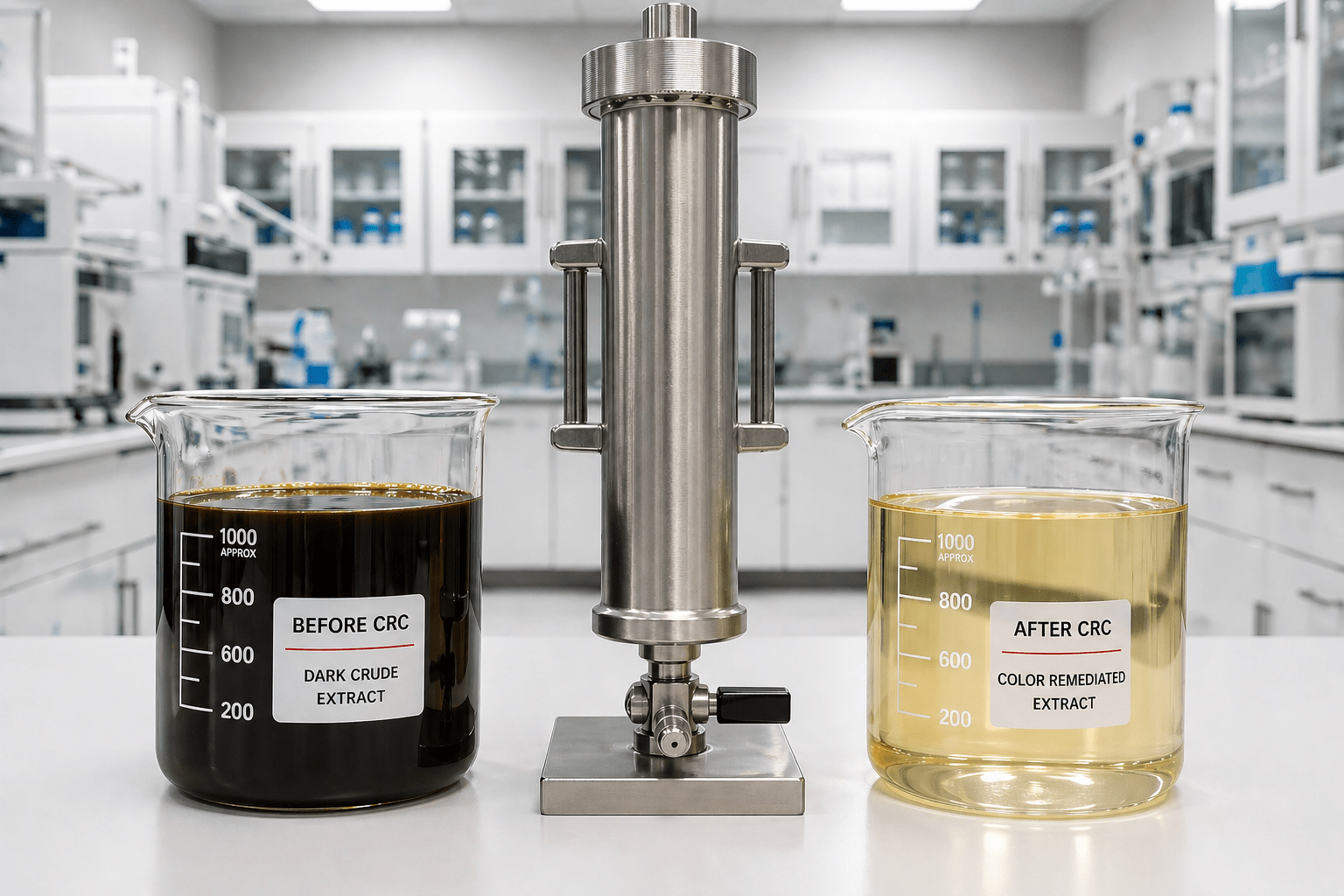
A color remediation column is a 3 to 6 inch stainless column packed with 0.8 to 3.2 kg of layered adsorbent, in the WKU stack 75 percent T5 bleaching clay, 12 percent magnesium silicate and 12 percent silica gel over a 5 micron sintered disk, run inline at 1 to 3 mL per minute per square centimeter of cross-section with the solvent at 20 to 35C. One pass turns dark BHO crude gold at a cannabinoid yield cost of 3 to 8 percent, and a media charge is spent after 1 to 3 runs. The sizing table below converts those numbers to each column diameter.
Color remediation chromatography (CRC) is a post-extraction purification technique that uses layered adsorbent media in a pressurized column to selectively remove pigments, chlorophyll, carotenoids, and other color-causing impurities from cannabis extracts. Originally adapted from the edible oil refining industry: where magnesium silicate and activated carbon have been used for decades to decolorize frying oils: CRC has become one of the most widely adopted post-processing steps in butane hash oil (BHO) extraction since its popularization around 2016. To understand what each color shade tells you about your process before deciding on CRC, see our distillate color diagnostics guide.
A properly configured CRC column can transform dark, amber-to-green crude extract into a light gold or nearly water-white concentrate in a single inline pass: without the need for distillation. The technique relies on the same adsorption chromatography principles used in analytical and preparative chemistry: CRC is an adsorption clean-up, not a separation of cannabinoids from each other; for isolating a single cannabinoid by preparative flash or HPLC on C18, see the preparative chromatography for cannabinoid isolation guide. polar adsorbent media selectively bind polar impurity molecules (pigments, oxidation products, and certain lipids) while allowing less-polar cannabinoids and terpenes to pass through.
CRC is not a substitute for quality starting material. It is a refinement tool: and understanding its chemistry is the difference between producing clean, safe concentrates and creating products contaminated with media fines or stripped of desirable terpene profiles.
The Chemistry Behind CRC: How Adsorption Works
To understand CRC, you need to understand adsorption: the process by which molecules in a fluid phase adhere to the surface of a solid material.
Every adsorbent medium used in CRC has a surface covered in active sites: hydroxyl groups on silica gel, exchangeable cations on bentonite clay, or microporosity in activated carbon. When a cannabis extract dissolved in a hydrocarbon solvent (typically butane or a butane/propane blend) flows through the packed media bed, impurity molecules compete for these active sites based on their polarity, molecular size, and functional group chemistry.
Why Pigments Get Trapped and Cannabinoids Don’t
The key to CRC selectivity lies in polarity differences:
- Chlorophyll a and b (the primary green pigments) are highly polar molecules with magnesium-coordinated porphyrin ring structures. They bind strongly to polar adsorbents like magnesium silicate and silica gel.
- Carotenoids (β-carotene, lycopene) and xanthophylls (lutein, zeaxanthin) are moderately polar polyene pigments that adsorb readily onto activated clays and carbon.
- Pheophytins (chlorophyll degradation products that cause brown/dark coloring) are moderately polar and bind to activated carbon and magnesium silicate.
- Cannabinoids (THC, CBD, CBG, etc.) are relatively nonpolar phenolic terpenoids. In a hydrocarbon solvent system, they have low affinity for the polar adsorbent surfaces and pass through the column largely unretained.
- Terpenes are nonpolar to slightly polar and also pass through: but with an important caveat: activated carbon is non-selective at high loading ratios and will adsorb terpenes, particularly oxygenated monoterpenes like linalool and terpineol.
This differential adsorption is the entire basis of CRC. It works because the impurities you want to remove are more polar than the cannabinoids you want to keep.
CRC Media: Types, Functions, and Selection
The performance of any CRC column depends entirely on the media you pack it with. Each adsorbent has different selectivity, capacity, and risk profiles.
Activated Bleaching Clay (T5 / Bentonite)
- Chemical composition: Calcium montmorillonite or bentonite clay, acid-activated to increase surface area and porosity
- Surface area: 150–300 m²/g
- Primary targets: Chlorophyll, carotenoids, xanthophylls, oxidation products
- Mechanism: Cation exchange and surface adsorption; the acid-activated lattice exposes aluminum and silicon sites that bind polar molecules
- Typical loading: The workhorse medium: often 70–80% of total media weight in a CRC column
- Sourcing: Available from filtration supply companies; “T5” refers to a specific grade of acid-activated bentonite widely used in the cannabis industry
T5 clay does the heavy lifting in most CRC configurations. It is effective, inexpensive, and has good capacity for chlorophyll and carotenoid removal without significant cannabinoid retention.
Magnesium Silicate (Magnesol / MagSil)
- Chemical composition: MgSiO₃ (synthetic amorphous magnesium silicate)
- Surface area: 300–600 m²/g
- Primary targets: Polar impurities, free fatty acids, phospholipids, soap residues, dark color bodies
- Mechanism: Highly polar surface with silanol (Si-OH) and magnesia (Mg-OH) groups that strongly adsorb polar contaminants via hydrogen bonding and dipole interactions
- Typical loading: 10–15% of total media weight
- Sourcing: The Dallas Group of America manufactures Magnesol: an FDA GRAS product originally designed for frying oil filtration. Available in bulk (~$70/10 kg)
Magnesol is the precision tool in the CRC stack. Its extremely high surface area and polar surface chemistry make it exceptionally effective at removing the darkest color bodies and polar degradation products that T5 alone leaves behind. However, because of its strong polarity, excessive Magnesol loading will strip desirable compounds: including terpenes and even some cannabinoids.
Silica Gel (SiO₂)
- Chemical composition: Amorphous silicon dioxide, typically 60 Å pore size
- Surface area: 400–800 m²/g
- Primary targets: Polar impurities, serves as a polishing layer and chromatographic separator
- Mechanism: Silanol groups (Si-OH) on the surface act as hydrogen bond donors/acceptors; functions as a normal-phase chromatographic stationary phase
- Typical loading: 10–15% of total media weight
- Note: Silica 60 is the standard grade; mesh size matters: finer mesh (230–400) gives better separation but higher backpressure
Silica gel acts as the top polishing layer in many CRC configurations, providing a final chromatographic separation stage before the extract exits the column.
Activated Carbon (Charcoal)
- Chemical composition: Carbon with high microporosity, activated via steam or chemical treatment
- Surface area: 800–1,500 m²/g
- Primary targets: Dark pigments, off-flavors, certain pesticides, and residual solvents
- Mechanism: Non-selective physical adsorption into micropores; van der Waals forces dominate
- Typical loading: 1–5% of total media weight: use sparingly
- Critical warning: Activated carbon is the most non-selective adsorbent in the CRC toolkit. At high loading ratios, it will strip terpenes, flavonoids, and even cannabinoids. It should be used as a targeted intervention for specific contamination issues, not as a default bulk medium.
Diatomaceous Earth (DE / Celite)
- Chemical composition: Biogenic amorphous silica from fossilized diatom exoskeletons
- Surface area: Low (1–5 m²/g): not a significant adsorbent
- Function: Flow aid and filter bed support; DE is used at the bottom of the column to prevent compaction of fine media particles and to maintain uniform flow distribution
- Typical loading: Thin layer (0.5–1 cm) at the bottom of the column, above the sintered filter disk
WKU CRC Media Selection Matrix
| Medium | Surface Area (m²/g) | Primary Targets | Selectivity | Cannabinoid Risk | Cost | Typical % in Column |
|---|---|---|---|---|---|---|
| T5 Clay (Bentonite) | 150–300 | Chlorophyll, carotenoids | Good | Low | Low | 70–80% |
| Magnesol (MgSiO₃) | 300–600 | Polar impurities, dark color bodies | Very good | Moderate | Medium | 10–15% |
| Silica Gel 60 | 400–800 | Polar compounds, polishing | Good | Low–moderate | Medium | 10–15% |
| Activated Carbon | 800–1,500 | Dark pigments, off-flavors, pesticides | Poor (non-selective) | High | Low | 1–5% |
| Diatomaceous Earth | 1–5 | None (flow aid only) | N/A | None | Very low | Bottom layer only |
How to Pack a CRC Column: Step-by-Step
Column packing is the single most critical variable in CRC performance. A poorly packed column with channeling will produce inconsistent results, media breakthrough, and potential product contamination. A well-packed column with the same media will produce water-white extract.
For a complete guide to batch AC remediation outside of inline CRC (grade comparison, contact time benchmarks, and failure diagnostics for ethanol and CO2 extracts), see our activated carbon grade selection guide.
Equipment Required
- CRC column: Stainless steel, typically 4″ or 6″ diameter, rated for your system pressure (150–300 PSI typical for closed-loop BHO systems)
- Sintered stainless steel filter disk: 5 μm pore size at the outlet: this is your critical safety barrier preventing media fines from entering the final product
- Hydraulic press or column ram: 20-ton hydraulic press recommended for compacting media to eliminate void spaces
- Scale: For weighing media to precise ratios
- PPE: N95 mask, nitrile gloves, safety glasses: fine silica and clay particles are respiratory hazards
WKU Recommended Packing Configuration (6″ Column)
This is a proven configuration based on the 75/12/12 ratio:
Layer 1 (Bottom): Diatomaceous Earth
- Thin layer (0.5–1 cm) directly above the 5 μm sintered disk
- Purpose: Flow distribution and protection of sintered disk from fine clay particles
Layer 2: T5 Activated Bleaching Clay (75% of media weight)
- The bulk adsorbent layer; this does the majority of color removal
- Pack firmly and evenly: no gaps, no air pockets
Layer 3: Magnesium Silicate / Magnesol (12% of media weight)
- Targets the most stubborn polar impurities that T5 alone misses
- Even layer, consistent thickness across the column diameter
Layer 4 (Top): Silica Gel 60 (12% of media weight)
- Final polishing layer; provides chromatographic refinement
- Also acts as a pre-filter to prevent top-loading contamination from reaching the primary media
Packing Procedure
- Place the sintered disk at the column outlet. Verify it seats properly with no gaps around the edges.
- Add diatomaceous earth: level it by gently tapping the column sides.
- Weigh and add T5 clay: pour in increments, tapping the column sides to settle each addition. Do not rush this step.
- Compress with hydraulic press: apply 5–10 tons of force evenly across the column face. The media bed should be rock-solid with no visible gaps along the column wall.
- Add Magnesol: level and compress lightly.
- Add Silica Gel 60: level and compress lightly.
- Final compression: apply full pressure one more time across all layers.
- Verify bed integrity: the media bed should not shift when the column is tilted slightly. If it moves, repack.
Why Compaction Matters
In packed-bed chromatography, channeling: the formation of preferential flow paths through the media bed: is the primary failure mode. When solvent finds a low-resistance channel, it bypasses most of the adsorbent media, resulting in:
- Poor color removal despite adequate media loading
- Inconsistent batch-to-batch results
- Media fines carried into the product (if channels form near the sintered disk)
- Wasted media capacity (most of the bed never contacts the extract)
The 20-ton hydraulic press compaction eliminates void spaces that cause channeling. This is not optional: it is the single most important step in CRC column preparation.
Column Setup: Dimensions and Packing
Your column needs a minimum of 6 inches of packed media height to provide adequate residence time for adsorption. For a standard closed loop BHO system processing 1 to 5 pounds per run, a 3 inch diameter by 12 inch column handles the flow volume. Scale up diameter for larger runs, not length. A taller, narrower column creates excessive back pressure and uneven flow distribution.
For a deeper dive into media selectivity ratios, cannabinoid loss percentages, and cost-per-gram analysis across every CRC adsorbent type, see our independent filtration media comparison guide.
WKU CRC Column Sizing Table
Cross-section sets everything else. Media mass assumes a 25 cm packed bed at 0.7 g per cubic centimeter after compaction; flow is the page rule of 1 to 3 mL per minute per square centimeter; biomass per charge comes from the 80 to 120 g of media per pound of starting material rule below. A charge is spent after 1 to 3 runs, so the biomass column is the material one media load can see before the clay saturates.
| Column | Cross-section | Media per charge (25 cm bed) | Solvent flow window | Biomass per charge (80 to 120 g media per lb) | Compaction |
|---|---|---|---|---|---|
| 3 inch (7.6 cm ID) | 46 cm² | 0.8 kg | 46 to 137 mL/min | 7 to 10 lb | 5 tons, verify bed does not shift |
| 4 inch (10.2 cm ID) | 81 cm² | 1.4 kg | 81 to 243 mL/min | 12 to 18 lb | 5 to 8 tons |
| 6 inch (15.2 cm ID) | 182 cm² | 3.2 kg | 182 to 547 mL/min | 27 to 40 lb | 8 to 10 tons, full-face platen |
Media Ratios (Standard Starting Point)
- Bottom: 0.5 inch DE bed on filter screen
- Layer 1: Silica gel, 40% of total media weight
- Layer 2: Bentonite (T5), 40% of total media weight
- Layer 3: Activated alumina, 10% of total media weight
- Top: 10% silica gel cap to distribute incoming flow
- Total media weight: 80 to 120 grams per pound of starting material
These ratios are starting points. Adjust based on crude color. Dark, oxidized crude from old trim needs more bentonite and possibly a small amount of carbon. Light crude from fresh frozen material may only need silica and a thin bentonite layer.
Operating Parameters and Best Practices
Flow Rate
- Recommended: 1–3 mL/min per cm² of column cross-sectional area
- Too fast: Extract bypasses media, poor color removal, potential for pressure spikes
- Too slow: Excessive contact time increases cannabinoid and terpene adsorption; diminishing returns on color removal
- Flow rate is controlled by the pressure differential across your closed-loop system; adjust recovery pot temperature and vacuum to dial in flow
Temperature
- Solvent temperature: Room temperature to slightly warm (20–35°C / 68–95°F). Cold solvent increases viscosity and reduces flow rate. Excessively warm solvent can desorb compounds you want to keep trapped.
- Column temperature: Ambient. Do not heat the CRC column externally.
Single-Pass vs. Recirculation
- Single pass (inline): Extract flows through the CRC column once on its way to the collection vessel. Simpler, faster, and sufficient for most applications.
- Recirculation: Extract is looped back through the CRC column multiple times. Provides more thorough remediation for heavily contaminated material, but increases terpene loss and processing time.
- Recommendation: Start with single-pass. If color removal is insufficient, increase media loading or adjust ratios rather than recirculating: this gives you more control over selectivity.
Media-to-Extract Ratio
- Starting point: 1 to 1.5 g of total media per gram of crude extract for moderately dark material. That is the same rule as 80 to 120 g of media per pound of biomass at a 15 to 20 percent extraction yield (68 to 91 g of crude per pound).
- Light material (live resin grade): 0.5 to 0.8 g media per gram of extract, and you may not need CRC at all
- Very dark material (trim runs, aged material): 1.5 to 2.5 g media per gram of extract
- Caution: Higher ratios improve color removal but increase the risk of stripping terpenes and reducing yield. Always test with a small batch before scaling up.
Common Mistakes and How to Fix Them
1. “My CRC extract has no flavor”
Cause: Excessive activated carbon loading, or overall media ratio too high. Activated carbon adsorbs terpenes non-selectively.
Fix: Reduce or eliminate activated carbon from your media stack. Drop overall media ratio. Consider whether CRC is even necessary for your starting material.
2. “I see white particles in my final product”
Cause: Media breakthrough: fine silica, clay, or Magnesol particles passing through the sintered disk.
Fix: Check the sintered disk for damage or improper seating. Ensure you’re using 5 μm (not 10 or 25 μm). Add a DE layer above the sintered disk. Verify compaction eliminated all channels along the column walls.
3. “CRC works great on the first run but poorly by the third”
Cause: Media saturation: the adsorbent sites are fully occupied. CRC media is single-use; it cannot be regenerated effectively for cannabis applications.
Fix: Replace the media after every 1–3 runs depending on the color/contamination level of your starting material. Never reuse saturated media.
4. “Color removal is uneven: some batches come out gold, others amber”
Cause: Inconsistent packing between batches, or variable starting material quality.
Fix: Standardize your packing procedure with measured weights, consistent press force, and documented SOPs. Track starting material quality (harvest date, trim vs. nug, storage conditions) as variables.
5. “My yields dropped after adding CRC”
Cause: Media ratio too high, or Magnesol/silica loading excessive relative to T5 clay.
Fix: CRC yield loss of 3–8% is normal (adsorbed impurities had weight). If yield loss exceeds 10–12%, reduce Magnesol percentage or overall media loading. Run a test batch with T5 only (no Magnesol, no carbon) to establish a baseline.
6. “CRC extract fails residual solvent testing”
Cause: Insufficient purging post-CRC, not a CRC issue per se. Media beds can trap solvent that releases slowly during collection.
Fix: Extend your purge protocol after CRC processing. Ensure full vacuum purge at appropriate temperatures (typically 90–110°F for BHO) for adequate duration.
7. Channeling (preferential flow paths through the column)
Cause: Uneven packing density creates gaps along the column wall or through the media bed. Solvent follows the path of least resistance, bypassing media entirely. Most common with loose hand-packing and poorly sized columns.
Diagnostic: Run a visual test: pour clean solvent through the packed column and watch for uneven flow at the drain. If one side drains faster, channeling is present. Also check: if color removal varies from run to run with identical starting material, channeling is the likely cause.
Fix: Repack with measured weights and consistent tamping force (15-20 firm tamps per layer). Use a packing rod that fits the column ID with less than 2mm clearance. Fill each layer to 1cm depth before tamping. Replace columns with inner diameter under 2 inches if running production volumes: narrow columns channel more easily.
8. Color rebound (product turns amber/dark after initial clear result)
Cause: CRC removed chlorophyll and carotenoids but did not remove oxidation precursors (peroxides, free radicals) or residual acids from bleaching clay. These precursors react with oxygen and light post-processing, regenerating color compounds within 24-72 hours.
Diagnostic: Process a test batch through CRC. Store half under nitrogen in amber glass (control) and half in a clear container exposed to ambient light. If the exposed sample darkens within 48 hours, oxidation precursors are present.
Fix: Add a 5-10% magnesium silicate (MagSil) layer to your stack specifically for peroxide adsorption. MagSil adsorbs polar oxidation products that T5 clay does not target. Also: store CRC-processed material under nitrogen or vacuum immediately after processing. Light and oxygen are the triggers.
9. Heavy metal leaching from media
Cause: Low-grade activated carbon or uncharacterized clay sources can release aluminum, lead, arsenic, or cadmium into the extract. Carbon from coconut shell sources is generally cleaner than coal-based carbon. Unbuffered silica gel below pH 4 can leach silicates.
Diagnostic: Send CRC-processed distillate to a third-party lab for ICP-MS heavy metals panel. Compare against pre-CRC crude heavy metals. If post-CRC levels are HIGHER than pre-CRC, the media is the source. Test each media component individually by running clean solvent through each layer separately.
Fix: Source food-grade or pharmaceutical-grade media exclusively. Request certificates of analysis (COA) for heavy metals content from media suppliers. Pre-wash activated carbon with deionized water before packing. If using clay, verify the mine source and processing method. Acid-activated clays carry more risk than neutral clays.
10. Pesticide pass-through (CRC does not remove pesticides)
Cause: CRC media adsorbs based on polarity and molecular size. Most regulated pesticides (myclobutanil, bifenthrin, spiromesifen) have molecular structures that do not interact strongly with standard CRC media. CRC is a color remediation tool, not a pesticide remediation tool.
Diagnostic: Run pre-CRC and post-CRC samples through a full pesticide panel. If pesticide concentrations are unchanged (within 10% variance), CRC is not removing them. This is expected behavior, not a CRC failure.
Fix: CRC cannot reliably remediate pesticide contamination. For pesticide-contaminated material, see our dedicated pesticide remediation guide, which covers adsorbent selection by pesticide class. Different pesticides require different adsorbents (activated carbon for myclobutanil, alumina for organophosphates, silica for pyrethroids). Do not rely on CRC for compliance testing.
CRC Failure Mode Quick-Reference Table
| Failure | Root Cause | First Check | Fix | Yield Impact |
|---|---|---|---|---|
| No flavor/flat terpene profile | Excessive activated carbon | Remove carbon from stack, test | Reduce or eliminate AC; use T5 only | Recoverable |
| White particles in product | Media breakthrough (fines) | Inspect sintered disk (5µm) | Replace disk; add DE layer; repack | None |
| Declining performance run-to-run | Media saturation | Check run count on current pack | Replace media every 1-3 runs | None |
| Inconsistent color batch-to-batch | Channeling or variable feedstock | Visual flow test with clean solvent | Standardize packing SOP; track input quality | None |
| Yield loss over 10% | Media ratio too high | Test T5-only at lower ratio | Reduce MagSil; lower total media loading | Direct |
| Residual solvent failure | Solvent trapped in media bed | Extend vacuum purge time | Full purge at 90-110°F post-CRC | None |
| Channeling | Uneven packing density | Visual flow test | Repack with measured weights, 15-20 tamps | Indirect (poor separation) |
| Color rebound (24-72hr) | Oxidation precursors not removed | Light exposure test vs nitrogen control | Add 5-10% MagSil; store under N2 | None |
| Heavy metal contamination | Low-grade media leaching | ICP-MS panel pre/post CRC | Source pharma-grade media with COA | None |
| Pesticide pass-through | CRC does not target pesticides | Pre/post pesticide panel | Use dedicated pesticide remediation | N/A |
If you want to run a column start to finish with the media stack, flow rate, and QC checks written as SOPs a tech can follow, that is exactly what we built extractiontraining.com for. CRC is one module in the post-processing chain the course walks from crude to finished product.
Safety Considerations
CRC adds specific safety risks to the extraction workflow that operators must address:
The room those columns sit in is covered by the extraction lab safety equipment checklist, and the drums of fresh and spent solvent feeding them by the solvent storage room guide.
Media Particulate Inhalation
Silica gel, bentonite clay, and Magnesol are all fine particulates that pose respiratory hazards. Crystalline silica exposure is an OSHA-regulated hazard (PEL: 50 μg/m³). Always wear an N95 or better respirator when handling dry media, and work in a well-ventilated area or fume hood.
Media Contamination in Final Product
The 5 μm sintered stainless steel filter disk at the column outlet is the last line of defense. If this disk is damaged, improperly seated, or the wrong pore size, media fines will enter the final product. This is a product safety issue: consumers should not be inhaling silica or bentonite particles.
Quality check: After every CRC run, inspect your collection vessel for any cloudiness or particulate. If visible, the run must be re-filtered through a 0.45 μm inline filter before further processing.
Pressure Safety
CRC columns add backpressure to closed-loop extraction systems. Ensure your system is rated for the additional pressure and that all tri-clamp connections are properly secured and inspected before each run.
Regulatory Considerations
Some state cannabis regulatory programs have specific rules regarding post-processing adsorbents and filtration media. Verify that your media choices (particularly activated carbon grades and bleaching earth sources) are compliant with your state’s manufacturing regulations and that any media used is food-grade or pharmaceutical-grade.
CRC vs. Other Remediation Methods
| Method | Color Removal | Terpene Preservation | Throughput | Cost | Complexity |
|---|---|---|---|---|---|
| CRC (Inline) | Good–Excellent | Moderate–Good | High | Low | Low |
| Winterization + Filtration | Moderate | Poor (cold strips terpenes) | Medium | Low | Low |
| Short Path Distillation | Excellent | Poor (terpenes boil off) | Low | High | High |
| Wiped Film Distillation | Excellent | Poor–Moderate | Medium | Very high | High |
| Liquid-Liquid Partitioning | Moderate | Variable | Low | Medium | High |
| Centrifugal Partition Chromatography | Excellent | Good | Low | Very high | Very high |
CRC’s advantage is its simplicity and cost-effectiveness. For BHO operations that need to improve product appearance without investing in distillation equipment, CRC is the most practical solution. However, it is not a substitute for distillation when full purification is required: it is a complementary step.
How to Tell If Wax Is CRC
No single sign proves it, and a clean CRC run on food-grade media behind a 5 micron disk is not a defect. Three of the five together on a product sold as top shelf tells you the gold came from the column, not the flower.
| Sign | What it means | Caveat |
|---|---|---|
| Pale gold to near-white extract from trim, outdoor or aged material | Pigments and chlorophyll pulled by clay, not by clean starting material | Fresh-frozen nug runs are naturally light without any column |
| Flat flavor or a perfume note that does not match the strain | Activated carbon and heavy media ratios adsorb terpenes non-selectively; botanical terpenes get added back | An over-purged extract loses terpenes the same way |
| Sugars or crystallizes within days at room temperature | Lipids and waxes that slow THCA nucleation left with the pigments | Diamond and sauce products are crystallized on purpose |
| Terpene total under 2 percent on a product labeled live resin | Fresh-frozen live resin tests 4 to 10 percent total terpenes; a stripped profile points to carbon or recirculation | Cultivar and harvest timing move the number too |
| White specks or a haze that settles in a warm jar | Media breakthrough: silica, clay or magnesium silicate fines past a damaged or oversized disk | This one is a hard sign and a product-safety failure, not a style choice |
Lab reports settle it faster than your eyes: a CRC product shows a lower total terpene line and a near-zero chlorophyll signature against the same cultivar run without the column. Pesticide results do not change, because the column does not remove them.
When NOT to Use CRC
CRC is not always the right answer:
- If your starting material is already high quality (fresh frozen, nug-only runs), CRC may strip more value than it adds. Light, golden extracts from quality material don’t need color remediation.
- If you’re making distillate anyway, the distillation process removes color bodies thermally. CRC before distillation is redundant in most cases.
- If you’re prioritizing full-spectrum terpene profiles, even a light CRC pass will remove some terpene content. Solventless and live resin producers typically avoid CRC entirely for this reason.
- If you’re trying to “fix” contaminated or failed material, CRC can mask visual indicators of poor quality without actually making the product safe. CRC does not remove pesticides reliably (despite some claims), and it does not reduce residual solvent levels. Never use CRC as a remediation shortcut for compliance failures.
Frequently Asked Questions
What does CRC stand for in cannabis extraction?
CRC stands for Color Remediation Chromatography (also called Color Remediation Column). It refers to both the physical column hardware and the adsorption chromatography process used to remove pigments and color-causing impurities from cannabis extracts. The term was coined by the Future4200 extraction community around 2016.
Is CRC wax safe to smoke?
CRC-processed concentrates are safe when the column is properly packed with food-grade media and filtered through a 5 μm or finer sintered disk to prevent particulate contamination. The risk comes from poorly packed columns that allow media fines (silica, clay particles) to enter the final product. Always inspect for clarity and, in regulated markets, verify clean lab results.
Does CRC remove terpenes?
CRC can reduce terpene content, particularly when activated carbon is included in the media stack or when overall media ratios are too high. Oxygenated terpenes (linalool, terpineol, geraniol) are most susceptible to adsorption. To minimize terpene loss, limit activated carbon use, keep media ratios conservative (10–15 g/g), and favor T5 clay as your primary medium.
What is the best CRC media for BHO?
A proven starting configuration is 75% T5 activated bleaching clay, 12% magnesium silicate (Magnesol), and 12% silica gel 60 by weight. This ratio balances effective color removal with cannabinoid and terpene preservation. Adjust based on your specific starting material: darker crude may need more T5, while lighter material may not need Magnesol at all.
Can CRC remove pesticides from cannabis extract?
Activated carbon can adsorb some pesticide compounds, but CRC should never be relied upon as a pesticide remediation strategy. Pesticide contamination is a starting material quality issue that must be addressed at the cultivation level. Some states explicitly prohibit the sale of remediated pesticide-contaminated product regardless of the method used.
How often should CRC media be replaced?
CRC media is single-use. Replace the entire media bed after every 1–3 extraction runs depending on starting material quality and column size. Saturated media provides no additional purification and can actually release previously adsorbed compounds back into the extract (desorption) if overloaded.
What is the difference between CRC and winterization?
CRC and winterization target different impurities. Winterization uses cold ethanol to precipitate and remove waxes, lipids, and fats from cannabis extract. CRC uses adsorbent chromatography to remove pigments and color bodies. In a full processing workflow, winterization typically occurs before CRC. For BHO specifically, inline dewaxing columns can partially replace winterization, and CRC handles the remaining color issues.
Can CRC be used with ethanol extracts?
Yes, but with important differences. Ethanol is more polar than butane, which means it will compete with impurity molecules for adsorption sites on the media. CRC is less effective with ethanol extracts compared to hydrocarbon extracts, and you may need higher media ratios or multiple passes. The technique was originally developed for and is most effective with BHO processing.
How do you know if your wax is CRC?
Look for three of five signs together: near-white color from trim-grade material, a flat or perfumed flavor, fast sugaring at room temperature, a terpene total under 2 percent on a product sold as live resin, and white fines that settle in a warm jar. The last one is media breakthrough and is the only sign that is a defect on its own.
What size CRC column do I need?
Size by biomass per run. A 3 inch column holds about 0.8 kg of media and remediates 7 to 10 pounds of material per charge; a 4 inch column holds about 1.4 kg for 12 to 18 pounds; a 6 inch column holds about 3.2 kg for 27 to 40 pounds. Flow scales with cross-section at 1 to 3 mL per minute per square centimeter, so a 6 inch column runs 182 to 547 mL per minute.
How much CRC media do you use per gram of extract?
1 to 1.5 g of total media per gram of crude for moderately dark material, which is the same rule as 80 to 120 g of media per pound of biomass at a 15 to 20 percent yield. Light live-resin-grade material needs 0.5 to 0.8 g per gram or no column at all; dark trim runs need 1.5 to 2.5 g per gram.
Summary
Color remediation chromatography is a powerful, cost-effective post-processing tool for cannabis extractors: when it’s done right. The technique is rooted in well-established adsorption chemistry from the edible oil industry, applied to the unique challenges of cannabis extract purification. Success depends on understanding your media, packing your columns properly, and respecting the limitations of the technique.
CRC is not a magic fix for bad material, and it’s not a substitute for distillation. It is a precision refinement step that, when integrated into a well-designed extraction workflow, produces consistently clean, visually appealing concentrates that meet both consumer expectations and regulatory standards.
For operators looking to implement or optimize CRC in their facilities, WKU Consulting offers process development, SOP creation, and hands-on training for extraction labs of all scales.
Join the WKU community:
- 📬 Subscribe to our newsletter for weekly extraction science
- 💬 Join our Discord community for real-time Q&A with extraction professionals
Written by Grim, WKU Consulting. 14-year chemical engineer specializing in cannabis and hemp extraction process development, laboratory design, and SOP implementation.
Related Articles from WKU Consulting
- BHO Extraction vs Ethanol: Understanding Solvent Polarity
- Devolatilization and Decarboxylation Before Distillation
- THCA Diamonds and Jar Tech
- Cannabis Extraction Lab Safety
Join the WKU Community
📬 Subscribe to our newsletter for weekly extraction science
💬 Join our Discord community for real-time Q&A with extraction professionals
Related reading: CRC is one tool in the remediation toolbox. For a complete framework on handling failed cannabis batches, see our Cannabis Remediation Decision Matrix.
