
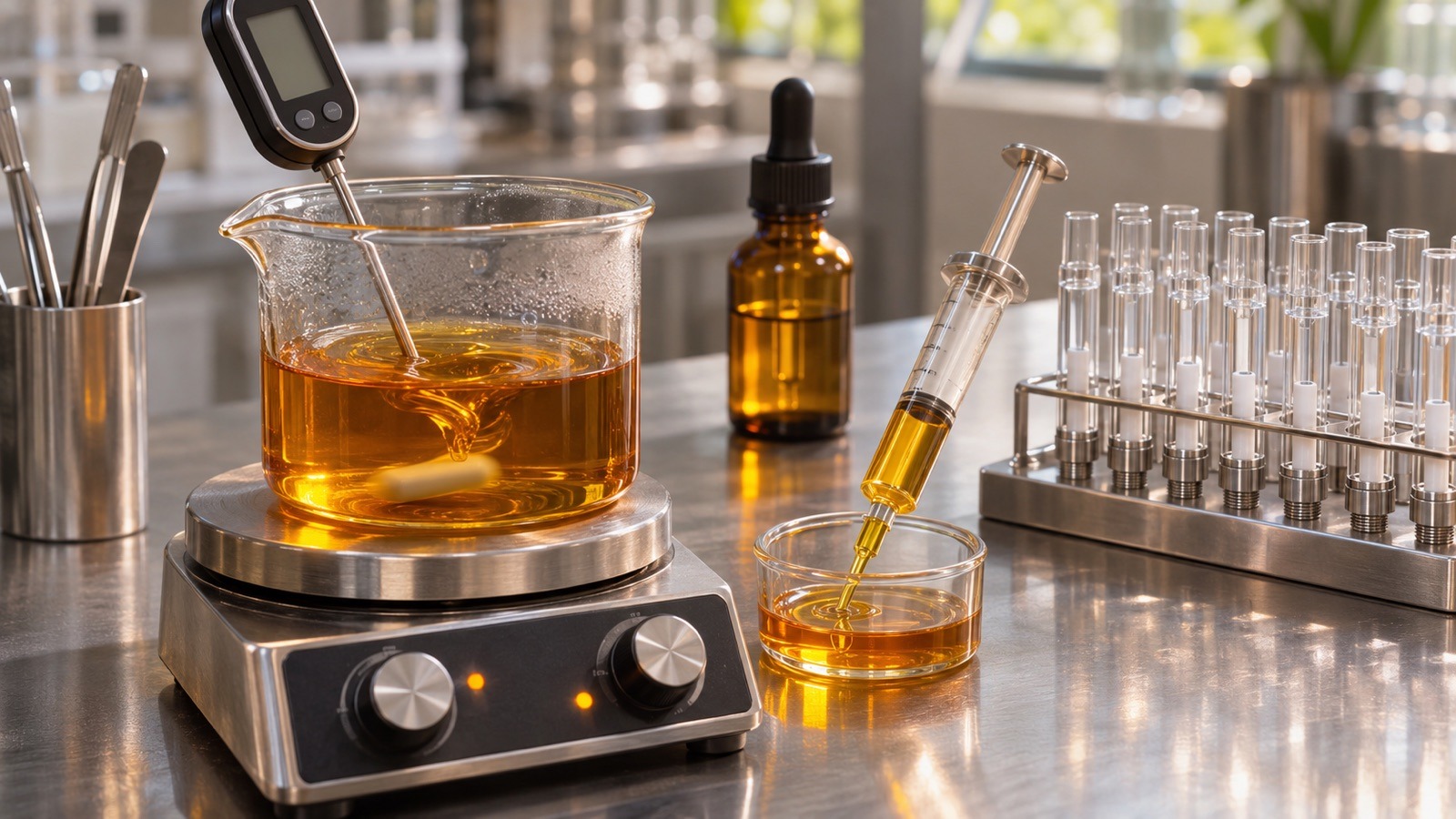
How to thin distillate for cartridges: warm it to 45 to 60C (113 to 140F) in a closed, stirred vessel and blend in 5 to 10% cannabis-derived terpenes by weight, then fill warm and check the cooled oil against the viscosity window your cartridge maker rates the hardware for. Ceramic 510 cores are rated from about 10,000 cP up to 700,000 cP (CCELL SE) or 2,000,000 cP (CCELL EVOMAX), and two commercial cart oils measured about 4,100 and 10,100 cP at 30C, falling to about 65 and 90 cP at 70C. Heat changes viscosity far more than any additive does: every 10C step cut those oils 2 to 5 times. Vitamin E acetate, PEG, MCT and propylene glycol also thin oil, and Colorado and Oregon ban them from inhaled cannabis, and PEG 400 heated to 230C made the most formaldehyde of four thinners tested.
Most thinning problems are a thick oil in a cartridge built for a different oil, discovered after 2,000 units are filled. The fix starts with a viscosity reading at a stated temperature.
What Thinning Actually Changes
THC distillate is an amorphous resin. Its molecules are large, sticky and packed tight, so at room temperature it flows like cold honey. A ceramic cartridge feeds the coil by capillary action: oil soaks through the porous ceramic and replaces what each puff vaporizes. If the oil is too thick, the wick cannot refill between puffs and the coil runs partly dry. If it is too thin, the same pores that feed the coil let oil through the intake holes and out the mouthpiece.
You have exactly two levers on viscosity. Temperature is the big one and it is temporary: heat the oil and it flows, cool it and it locks up again. Composition is the permanent one: terpenes are small, low-viscosity molecules that sit between the cannabinoid molecules and let them slide. Anything sold as a “thinner” that is not a terpene is a non-cannabis liquid you are asking a customer to inhale.
Density is a separate number and does not track viscosity. A terpene-rich oil is both thinner and lighter, so the gram you fill by volume changes when you change the recipe. Our extract density reference has the g/mL figures and the temperature correction for filling by volume.
Measured Viscosity of Cart Oils by Temperature
Published, method-stated viscosity data on cannabis oil is thin. The best public set is a RheoSense application note (APP34, 2020) that ran three commercial products on a VROC Initium viscometer from 70C down to 30C, three readings per point. The values below are read from the published plot and rounded.
| Oil temperature | Cart oil A (79.5% THC, whole-flower terpenes) | Cart oil B (82.9% THC, cannabis oil) | Dab oil (91.8% THC, natural terpenes) |
|---|---|---|---|
| 30C (86F) | About 10,100 cP | About 4,100 cP | Too thick for the run (fitted curve: about 70,000 cP) |
| 40C (104F) | About 2,100 cP | About 1,050 cP | Not measured (fitted curve: about 12,000 cP) |
| 50C (122F) | About 600 cP | About 350 cP | About 2,500 cP |
| 60C (140F) | About 220 cP | About 140 cP | About 700 cP |
| 70C (158F) | About 90 cP | About 65 cP | About 250 cP |
The drop between 30 and 70C is two orders of magnitude, and each 10C step cuts viscosity 2 to 5 times, steepest at the cool end. At 50C the dab oil, carrying 9 to 12 more points of THC, was 4 to 7 times thicker than the cart oils. And the cart oils were already near or under the 10,000 cP floor of common ceramic cores at 30C, which means those brands thinned to the hardware rating and stopped there.
A widely shared curve puts an 86% THC distillate at 5,000,000 cP at 20C and 1,000 cP at 60C. It traces to a single anonymous forum post from January 2020 that names no instrument and no method. Treat it as a rough shape at best, including where it appears in our own liquid diamonds guide, which now labels it that way. The only number that counts is your oil on your viscometer at a stated temperature.
Match the Oil to the Hardware, Not to a Feeling
Cartridge makers publish the viscosity range each core is built for. That range is the target. CCELL’s distributor lists these ratings; the temperature behind the ratings is not stated, so measure your oil at 25C and confirm the basis with your supplier before you lock a recipe.
| Ceramic core | Rated oil viscosity | Element | Intake holes | What it means for thinning |
|---|---|---|---|---|
| CCELL SE (TH2-SE, M6T-SE) | 10,000 to 700,000 cP | 1.4 ohm | 4 x 2 mm | Straight high-purity distillate can sit inside this window; thinning is for flavor and fill speed, not flow |
| CCELL EVOMAX (TH2, M6T, Ceramic) | 10,000 to 2,000,000 cP | 1.7 ohm | 4 x 2 mm | Built for thick oil; over-thinning it is the more common mistake |
| CCELL EVOMAX HV (enlarged airway) | 700,000 to 5,000,000 cP; recommended above 2,000,000 | Not stated | Enlarged airway | Liquid diamonds and other oils too thick for standard cores |
| Any core, oil below its rated floor | Under the low end | n/a | n/a | Leak and flood risk, worst in warm storage |
Read Table 1 against Table 2 and the rookie mistake is obvious. An oil at 4,000 cP at 30C is already near the floor of a core rated from 10,000 cP. Add more terpenes “because it looks thick” and you push it under the floor, and the first warm day turns into leaking carts. The intake hole size matters too: CCELL sells inlets from 1.2 to 2.0 mm, and the thicker the oil, the larger the hole it needs.
How Much Terpene to Add
Most brands land between 5 and 10% cannabis-derived terpenes by weight. Below 5%, terpenes mostly add flavor. Above about 10%, the oil gets harsh, flavor turns solventy, and the potency number drops faster than the flow improves. Every point of terpene you add takes almost a point of THC off the label, because terpenes dilute the cannabinoid fraction one for one by mass.
| Terpenes added (w/w) | THC from a 92% distillate | Flow change | Flavor and safety note |
|---|---|---|---|
| 0% | 92.0% | None; flows only when warm | No flavor; fine on thick-oil cores |
| 3% | 89.2% | Small | Flavor-first dose |
| 5% | 87.4% | Noticeable at room temperature | Common floor for flavored distillate carts |
| 8% | 84.6% | Large | Common sweet spot on standard ceramic cores |
| 10% | 82.8% | Very large | Upper end before harshness complaints climb |
| 15% | 78.2% | Near live-resin flow | Live-resin territory; check against the hardware floor |
Terpenes also change what happens at the coil, in both directions. In a 2021 study on a CCELL TH2 cartridge at 10 W (Meehan-Atrash et al., RSC Advances), adding 14% myrcene to THC raised the THC delivered per puff from 1.6 to 4 mg and cut methacrolein from 41 to 16 ng per puff, because the thinner oil kept the wick wet. The same group showed terpenes break down into methacrolein once the heating surface passes about 400C, and into benzene at the hottest setting, above 500C. Thinning that keeps the coil wet is a safety gain; terpene load on a high-voltage battery is a safety cost. Our THC heat map has the coil temperatures by device.
Cannabis-derived terpenes keep the label honest and the profile close to the plant. Botanical terpenes are legal in many markets, but they are a supplier you are vouching for; screen every lot for chlorinated solvents before it touches a cart, as our terpene supplier COA guide lays out. If you are lowering potency to meet a state cap rather than to improve flow, the blend math is different; see formulating under a THC cap.
Step-by-Step: Thinning and Filling Distillate
- Measure the starting oil. Pull the COA (total THC, residual solvents, terpenes if present) and, if you own a viscometer, read the oil at 25C. Record the hardware model and its rated window.
- Warm it closed. Bring the distillate to 45 to 60C (113 to 140F) in a lidded, stirred vessel on a hot plate or jacketed reservoir. Vape-Jet, a filling-machine maker, quotes 45 to 65C as the working range. Do not chase speed with heat; there is no flow problem at 60C that 80C solves.
- Weigh, do not count drops. Weigh the terpene charge to 0.01 g against the oil mass. A 1,000 g batch at 8% takes 87 g of terpenes for an 8% final blend (87 / 1,087 = 8.0%).
- Add terpenes into the warm oil under the lid and stir 20 minutes until the blend is uniform with no streaks. Monoterpenes such as myrcene and limonene evaporate off an open beaker; every minute the lid is off is flavor and label accuracy leaving the batch.
- Cool a sample and check it. Pull 10 g, let it reach 25C, and read viscosity or fill three test carts. Hold one test cart upright at 40C (104F) for 24 hours to stand in for a hot car. A leak here is a leak in the market.
- Fill warm, by mass. Fill at 50 to 60C so the filler meters cleanly, and set fill weight by mass, not volume, because warm oil is less dense.
- Cap fast and rest upright. Cap within minutes of filling and let carts sit upright for 24 hours before boxing so the ceramic saturates.
- Release-test the finished blend. Potency and terpene percent on the finished blend; residual solvents on any new terpene lot; heavy metals per your state. Massachusetts also screens finished vaporizer products for vitamin E acetate.
This is one of the formulation modules in our extraction training program, from reading a viscosity number to setting fill weights on real hardware. If you want the SOPs and the walkthroughs, that is what we built extractiontraining.com for.
Cutting Agents: What Thins and What It Costs You
Every non-terpene thinner on the market thins oil, which is why they spread. None of them belong in an inhaled product, and the states that regulate vapes have said so in rule text.
| Agent | Why people used it | What the evidence shows | Where it is banned (examples) |
|---|---|---|---|
| Vitamin E acetate | Thickens cut oil so it looks like pure distillate | Found in lung-fluid samples of 48 of 51 EVALI patients (94%) in 16 states and none of 99 controls (Blount et al., NEJM 2020); heating can release ketene, a lung irritant (Wu and O’Shea, PNAS 2020) | Colorado Rule 3-335(K)(1); Oregon OAR 845-025-3265; California HSC 111929.2 (inhalable hemp products); Washington WAC 246-80-021 |
| PEG 400 | Cheap, clear, thins well | Heated to 230C, made significantly more formaldehyde and acetaldehyde than PG, MCT or VG; one puff equaled 1.12% of the daily formaldehyde exposure limit (Troutt and DiDonato, 2017) | Colorado 3-335(K)(1); California HSC 111929.2 |
| Propylene glycol (PG) | E-liquid base, thins and carries flavor | More formaldehyde than MCT or VG at 230C in the same study | Oregon OAR 845-025-3265 (except metered-dose inhalers) |
| MCT oil | Food-grade, mixes with distillate | A lipid with no established inhalation safety basis; in vitro cytotoxicity and animal lung findings reported | Colorado 3-335(K)(1); Oregon OAR 845-025-3265 (triglycerides); California HSC 111929.2 |
| Vegetable glycerin (VG) | E-liquid base | Polar; does not dissolve in cannabinoid oil and separates in the cart | Not a workable thinner regardless of rules |
| Squalane / squalene | Cosmetic oil, thins | No inhalation safety basis | Oregon OAR 845-025-3265; California HSC 111929.2 |
Colorado also limits any inactive ingredient in a vaporizer product to what the FDA Inactive Ingredient Database lists for inhalation, at or below the listed level, with cannabis-derived and botanically derived terpenes exempt (Rule 3-335(H) and (I)). Oregon requires a full ingredient list with CAS numbers for every non-cannabis additive. Check your state’s current rule before any additive other than cannabis terpenes enters a formulation.
Common Failures and How to Diagnose Them
1. Carts leak or flood, worst after warm storage
Root cause: Oil viscosity below the core’s rated floor once it warms. The measured oils above lost 4 to 5 times their viscosity between 30 and 40C, so a cart that holds on a 22C shelf can drain in a 40C car.
Diagnostic test: Read the blend at 25C against the hardware rating; repeat the 24-hour, 40C upright hold on retained units.
Fix: Cut terpenes 2 to 3 points, or move to a core and inlet size rated for the thinner oil. Never add a thickener.
2. Dry, weak hits or clogging on the first few puffs
Root cause: Oil above what the wick can pull at room temperature, or a cold stockroom. The wick cannot refill between puffs.
Diagnostic test: Warm one cart to 30C and retest. If it hits normally warm, viscosity is the cause.
Fix: Add 1 to 2 points of terpene, or switch to a core rated for thick oil (EVOMAX family) instead of thinning past the flavor limit.
3. Burnt taste partway through the cart
Root cause: A starved wick heats a partly dry coil; coil temperature climbs into the range where terpenes and THC break down.
Diagnostic test: Fill two carts from one lot; run one at 2.4 V and one at 4.0 V. If only the high-voltage cart burns, the device setting is the failure; if both burn, the oil is too thick for the core.
Fix: Bring viscosity into the core’s window and print a voltage ceiling on the pack.
4. Label potency drifts up between blend sheet and COA
Root cause: Terpenes evaporated during warm mixing or filling with the lid off, which concentrates THC.
Diagnostic test: Compare terpene percent on the blend sheet to the COA; a one-point terpene loss explains about a one-point potency rise.
Fix: Mix closed, cap fast, and blend to the COA terpene number, not the recipe number.
5. Oil separates or clouds in the cart
Root cause: An immiscible diluent (VG, water-based flavor) or a high-THCA fraction recrystallizing.
Diagnostic test: Spin a sample or let it sit 48 hours; a clear layer is a diluent, grit is THCA.
Fix: Remove the diluent; decarb fully before blending (THCA under about 1% of total).
For the crystallization case in liquid diamond carts, the full decarb and HTE ratio fix is in our liquid diamonds guide; for live resin oils, see how to make live resin vape carts.
Frequently Asked Questions
How do you thin distillate for cartridges?
Warm the distillate to 45 to 60C in a closed, stirred vessel, add 5 to 10% cannabis-derived terpenes by weight, stir for 20 minutes, then fill warm by mass. Check the cooled oil against the viscosity window your cartridge maker rates the core for, for example 10,000 to 700,000 cP on a CCELL SE core.
How much terpene should I add per gram of distillate?
50 to 100 mg per gram (5 to 10% by weight) for most ceramic 510 cartridges. Weigh it rather than counting drops: drop size changes with temperature and terpene blend, and each percentage point of terpene lowers label THC by almost a point, so a 92% distillate at 8% terpenes reads about 84.6%.
What temperature should distillate be when filling carts?
About 50 to 60C (122 to 140F). Vape-Jet, a filling-machine maker, quotes 45 to 65C as the working range. Measured cart oils drop from about 4,000 to 10,000 cP at 30C to under 250 cP at 60C, so a warm oil meters cleanly, while hotter oil only costs terpenes.
Can you thin distillate with MCT, PG, PEG or vitamin E acetate?
No. Colorado bans PEG, vitamin E acetate and MCT from inhaled cannabis concentrate, and Oregon bans vitamin E acetate, triglycerides including MCT, squalane and propylene glycol. Vitamin E acetate was found in 94% of tested EVALI patients, and PEG 400 heated to 230C produced the most formaldehyde of four thinners tested.
Do I need to thin distillate at all?
Often not for modern ceramic hardware. CCELL rates its SE core for 10,000 to 700,000 cP and its EVOMAX core for 10,000 to 2,000,000 cP, which covers most high-purity distillate. Thinning is then a flavor choice, and over-thinning below the core’s rated floor is the more common cause of leaking carts.
Why is my distillate cart leaking?
The oil is thinner than the core’s rated floor once it warms. Measured cart oils lost 4 to 5 times their viscosity between 30 and 40C, so carts that hold on a shelf leak in a hot car. Cut terpenes by 2 to 3 points or move to a core rated for thinner oil, and test retained units at 40C for 24 hours.
Can you use vegetable glycerin to thin THC oil?
No. Vegetable glycerin is polar and does not dissolve in cannabinoid oil, so it separates into a layer in the cartridge and the coil sees two different liquids. Only terpenes blend into distillate as a true solution.
Sources: RheoSense, “Differentiating cannabis products with viscosity measurements,” APP34 (2020); Hamilton Devices CCELL SE and EVOMAX heating technology pages (2026); CCELL inlet guide; Meehan-Atrash et al., RSC Advances 11 (2021) 11714; Meehan-Atrash, Luo and Strongin, ACS Omega 2 (2017) 6112; Blount et al., NEJM 382 (2020) 697; Wu and O’Shea, PNAS 117 (2020) 6349; Troutt and DiDonato, J Altern Complement Med 23 (2017) 879; Colorado 1 CCR 212-3 Rule 3-335; Oregon OAR 845-025-3265; California HSC 111929.2; 935 CMR 500.160; Vape-Jet filling guidance (45 to 65C).
Ready to level up your extraction game? Contact WKU Consulting for personalized guidance on building your extraction lab.
For more deep dives into cannabis chemistry, extraction SOPs, and lab design, subscribe to the WKU Consulting YouTube channel.
Watch a related video:
