
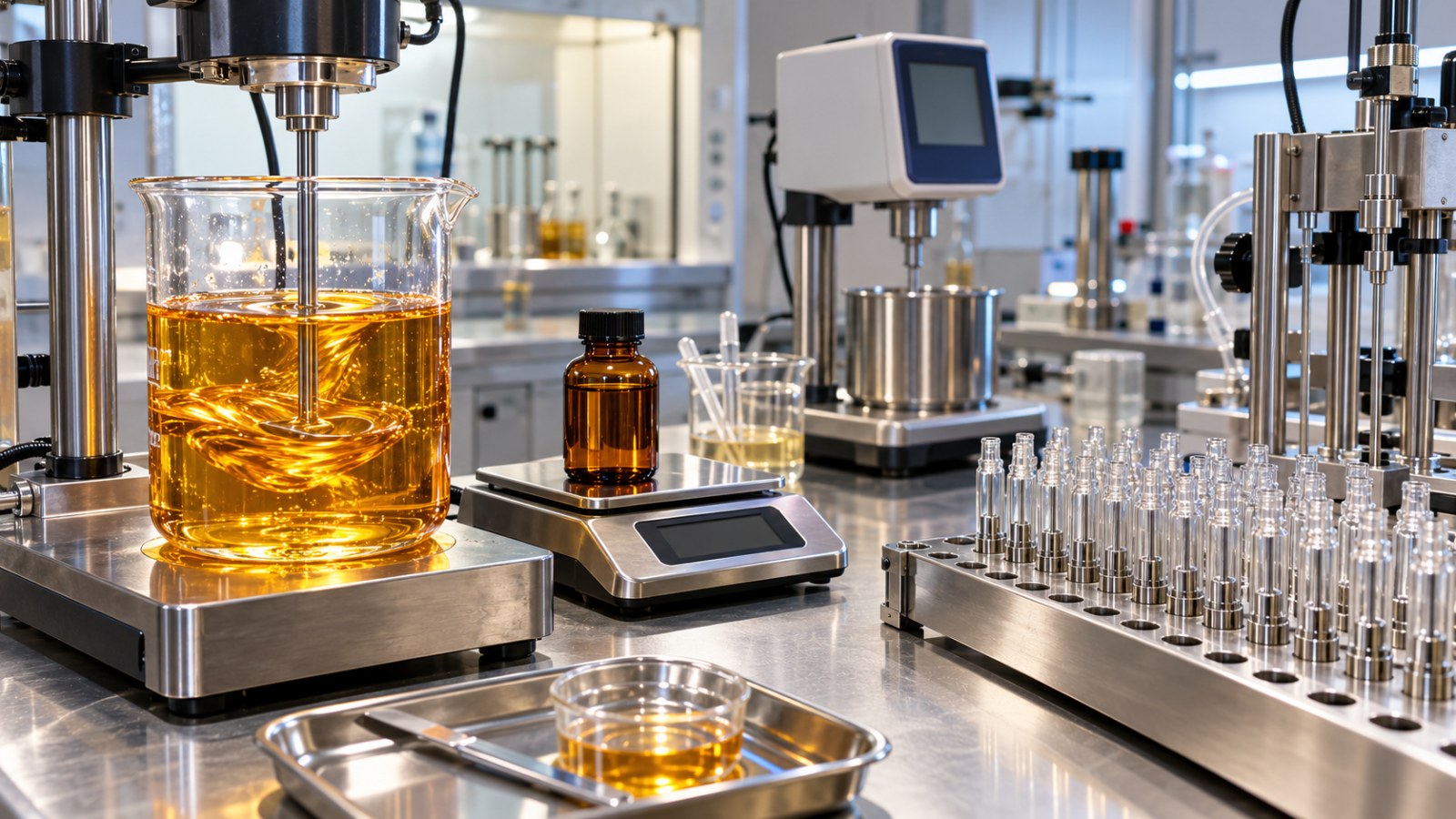
A 90 percent THC cap is a blend-math problem, not an extraction problem: to bring 95 percent distillate down to an 85 percent release target you add 10.5 percent non-THC material by weight, and the reason the target is 85 and not 89 is lab variance. A product released at 88 percent reads 90.6 percent at a plus 3 percent relative lab bias and fails. Ohio made this concrete: Ohio Administrative Code 1301:18-4-06, effective October 5, 2026, caps vapes and concentrates at 90 percent THC, limits each device to 2 grams and each package to 3 devices, and products shipped to dispensaries from that date have to comply. The molecular math also cuts the other way: a THCA diamond at 99 percent THCA reports 86.8 percent total THC (THCA times 0.877), so raw diamonds clear a total-THC cap that the same diamonds fail once they are decarbed into liquid diamonds.
Most operators meet a cap the rookie way: they cut until the COA reads 89.9 and ship. Then a second lab reads the same batch at 91, or the state’s reference lab does, and the batch is a recall instead of a product. Every number below is built to keep that from happening.
What the Ohio Rule Actually Sets
| Item | Ohio requirement (OAC 1301:18-4-06, effective October 5, 2026) | What it means on the floor |
|---|---|---|
| THC concentration, vapes and concentrates | Capped at 90 percent | Your release target sits below 90 by your lab’s variance, not at 89.9 |
| Device size | No more than 2 grams net per vape device or cartridge | 2.5 g and 3 g all-in-ones are out; fill specs and hardware orders change |
| Package | No more than 3 devices, cartridges or containers per package | Multipacks above 3 are out |
| Transition | Products transferred to dispensaries from October 5, 2026 must comply; inventory received through October 4 could be sold only through October 4 | Non-compliant stock in the channel had a one-day tail, then became unsellable |
| History | Senate Bill 56 had cut the cap to 70 percent in March 2026; the Division then raised it back to 90 percent by rule | Read the current rule text before every release; the number has moved twice this year |
Two things the rule text does not settle for a formulator: whether “THC” means delta-9 alone or total THC, and which lab’s number governs when two labs disagree. Formulate to total THC (delta-9 plus 0.877 times THCA) and to the worse of two labs, and neither question can hurt you. Statewide rules for every program are in our licensing requirements by state guide.
Where Common Products Land Against a 90 Percent Cap
| Product | Typical total THC | Against a 90 percent total-THC cap | Why |
|---|---|---|---|
| Distillate (cart grade) | 90 to 97 percent | Most batches fail as made | A wiped film or short path pass concentrates THC; the terpenes that diluted it were stripped |
| Liquid diamonds (decarbed diamonds plus HTE) | 85 to 93 percent at 10 to 20 percent HTE | Blend-dependent | The HTE fraction sets the potency; a 90:10 blend lands near 92 percent |
| Raw THCA diamonds | About 86 to 87 percent total THC at 98 to 99 percent THCA | Pass on a total-THC basis | THCA loses 12.3 percent of its mass as CO2 on decarboxylation; 99 times 0.877 is 86.8 |
| Live resin, badder, sauce | Roughly 60 to 80 percent | Pass | Terpenes and minor cannabinoids already dilute the THC |
| Shatter and wax | Roughly 70 to 85 percent | Pass in most cases | Terpene and lipid content keeps them under |
The diamond row is the one that surprises people, and it only holds if the cap is read on total THC. If a regulator reads it on delta-9 alone, raw diamonds read almost nothing and distillate reads everything, which is why the formulation target below is set on total THC: it is the conservative reading for every product that matters. The decarb chemistry and the blend table for liquid diamonds are in our liquid diamonds guide.
The Blend Math: How Much Diluent to Add
The fraction of non-THC material you need is (starting THC minus target THC) divided by (starting THC minus the diluent’s THC). For a diluent with no THC (terpenes, CBD distillate, CBG), the denominator is just the starting potency.
| Starting distillate THC | Diluent needed to reach 85 percent | Diluent per 1,000 g batch | Diluent needed to reach 87 percent |
|---|---|---|---|
| 92 percent | 7.6 percent | 76.1 g | 5.4 percent |
| 94 percent | 9.6 percent | 95.7 g | 7.4 percent |
| 95 percent | 10.5 percent | 105.3 g | 8.4 percent |
| 96 percent | 11.5 percent | 114.6 g | 9.4 percent |
| 98 percent | 13.3 percent | 132.7 g | 11.2 percent |
Two corrections apply in practice. First, if the diluent carries THC (an HTE at 50 percent total cannabinoids does), subtract its contribution: the denominator becomes starting THC minus the diluent’s THC, and you need more of it. Second, terpenes are volatile: if the oil is filled hot and loses a point of terpene to evaporation, potency rises by the same proportion, so weigh the diluent in after the last heated step, not before it.
The Margin: Why the Target Is 85, Not 89
| Release target (total THC) | Reading at +3 percent relative lab bias | Reading at +5 percent | Reading at +8 percent |
|---|---|---|---|
| 89 percent | 91.7 percent (fails) | 93.5 percent (fails) | 96.1 percent (fails) |
| 88 percent | 90.6 percent (fails) | 92.4 percent (fails) | 95.0 percent (fails) |
| 87 percent | 89.6 percent | 91.4 percent (fails) | 94.0 percent (fails) |
| 86 percent | 88.6 percent | 90.3 percent (fails) | 92.9 percent (fails) |
| 85 percent | 87.5 percent | 89.2 percent | 91.8 percent (fails) |
Potency results are not exact. Two accredited labs testing the same oil routinely disagree by a few percent of the value, and a state reference lab is a third opinion you do not get to choose. At an 85 percent target, a lab reading 5 percent high still lands at 89.3; at 88, a lab reading 3 percent high fails you. Pick the target from your own data: send the same homogenized batch to your usual lab and one other, take the larger reading, and set the release limit so that reading plus your observed spread stays under 90. The sampling and homogeneity side of the same problem, including how states test one unit rather than your batch average, is in our state potency audit guide.
Diluent Options, Ranked by What They Cost You
| Diluent | What it adds | Practical ceiling | The catch |
|---|---|---|---|
| Cannabis-derived terpenes (CDT) | Flavor, aroma, thinner oil | About 5 to 10 percent before most 510 hardware starts leaking (target 3,000 to 5,000 cP at room temperature) | Terpene alone rarely covers a 10-point cut without making the cart thin and harsh |
| High-terpene extract (HTE, live resin sauce) | Terpenes plus lower-potency cannabinoids; the live resin flavor | 10 to 20 percent of the blend | It carries its own THC, so you need more of it than the simple math says |
| CBD or CBG distillate | Non-intoxicating cannabinoid mass that holds viscosity | Several points of the blend; run a cold hold to check stability | High CBD shares can crystallize out of the oil; test a two-week cold hold before scale |
| CBN or minor cannabinoid distillate | Mass, a different effect profile | A few points | Changes the effect and the label; consumers notice |
| Botanical terpenes | Cheap flavor and thinning | Same viscosity ceiling as CDT | A supplier you are vouching for: a 1 ppm chlorinated-solvent panel is mandatory; see our terpene supplier COA guide |
| Cutting agents (vitamin E acetate, MCT, PEG, PG) | Volume and thinning | Zero | Vitamin E acetate is the additive behind the 2019 EVALI outbreak; check your state’s prohibited-additive list, and use none of them in an inhalable |
The cleanest 10-point cut is usually a combination: 5 to 7 percent cannabis terpene for flavor and flow, the rest as CBD or CBG distillate or HTE to hold viscosity. That keeps the cart in the 3,000 to 5,000 centipoise window most 510 hardware is built for and avoids leaning on any one diluent past its ceiling.
We walk through cart formulation, blend math and the COA strategy that goes with it in our extraction training course at extractiontraining.com.
A Release Protocol for Capped Products
- Qualify your margin once. Homogenize one batch, split it, and send it to your regular lab and a second accredited lab. Record the gap as a percent of value. Repeat on two more batches; the largest gap is your working margin.
- Set the release limit. Release limit = 90 divided by (1 plus your margin). A 5 percent margin gives 85.7 percent; round down to 85.
- Blend on paper first. Use the fraction formula with the diluent’s real THC content from its own COA, not an assumed zero.
- Mix warm and long enough to be uniform. Sample the top, middle and bottom of the vessel; a spread over 2 points means keep mixing.
- Weigh terpenes in last. After the last heated or vacuum step, so evaporation cannot push the potency up.
- Test the filled product, not the tank. Pull finished units across the fill run for the release COA; that is what the state will pull.
- Keep retains. One sealed retain per batch through the shelf life, so a state result can be answered with your own second test.
Concentrates Under the Cap: What Changes When It Is Not a Cart
Dab products face the same 90 percent number with a different set of levers. Badder, sauce and live resin carry their own terpenes and usually land well under the cap as made. Decarbed THC products (distillate sold in syringes, liquid diamonds sold in jars) are the ones that need the blend math. Raw THCA diamonds are the special case: on a total-THC basis they report about 86.8 percent at 99 percent THCA, but a diamond sold with a little sauce clinging to it reports lower still, and a regulator reading delta-9 alone would see almost none. RSO, the full-plant oil, sits far below any 90 percent line because chlorophyll, waxes and minor cannabinoids dilute it.
The package rule bites concentrates too: no more than 3 containers per package and no more than 2 grams in each. A 3.5 gram jar is no longer a compliant SKU in Ohio, whatever its potency.
Common Failures and How to Diagnose Them
Batch released at 89 percent, state sample reads 91.
Root cause: No margin for lab variance; released at the cap instead of under it.
Diagnostic test: Send a retain to a second accredited lab; a reading 2 to 3 percent of value higher than your lab confirms a between-lab bias, not a formulation error.
Fix: Re-blend to an 85 to 86 percent target and write the release limit from the larger of two labs’ readings.
Potency climbs between blending and the COA.
Root cause: Terpenes evaporated during hot filling or a vacuum degas, concentrating THC.
Diagnostic test: Compare terpene percent on the blend sheet with terpene percent on the COA; a one-point terpene drop explains about a one-point potency rise at these levels.
Fix: Weigh terpenes in after the last heated step, fill at the lowest temperature the hardware allows, and cap the fill time.
Units from the same batch test 87, 90 and 92.
Root cause: Incomplete mixing: viscous distillate and thin terpene stratify if not mixed warm and long enough.
Diagnostic test: Pull top, middle and bottom samples from the mixing vessel before filling; a spread over 2 points is a mixing problem.
Fix: Mix warm (above the oil’s flow point) with overhead stirring for a validated time, and sample the vessel before every fill run.
Carts leak or flood after the cut.
Root cause: Viscosity dropped below what the hardware intake holds: too much terpene used as the only diluent.
Diagnostic test: Viscometer at 25C; under about 3,000 cP on standard 510 hardware confirms it.
Fix: Move part of the cut from terpene to CBD, CBG or HTE to bring viscosity back into 3,000 to 5,000 cP.
Cloudy or grainy oil weeks after release.
Root cause: A high CBD share crystallizing out of the blend, or THCA left in an undecarbed fraction.
Diagnostic test: Microscope or a warm-and-clear test; a COA showing THCA above 1 percent points to an incomplete decarb.
Fix: Lower the CBD share or pair it with minor cannabinoids; finish the decarb to under 1 percent THCA before blending.
Frequently Asked Questions
What is the THC cap on vapes in Ohio?
90 percent THC for vapes and concentrates under Ohio Administrative Code 1301:18-4-06, effective October 5, 2026, with no more than 2 grams per device and 3 devices per package. Senate Bill 56 had set 70 percent in March 2026 before the Division of Cannabis Control restored 90 percent by rule, so check the current text before release.
How do you lower the THC percentage in distillate for a vape?
Add non-THC material by weight using fraction = (starting THC minus target) divided by starting THC. Taking 95 percent distillate to an 85 percent target takes 10.5 percent diluent, usually 5 to 7 percent cannabis terpenes plus CBD, CBG distillate or high-terpene extract for the rest. Never use cutting agents such as vitamin E acetate, MCT or PEG.
What THC percentage should I target under a 90 percent cap?
About 85 percent total THC, set from your own two-lab data. A product released at 88 percent reads 90.6 percent at a plus 3 percent relative lab bias and fails; at 85 percent, even a plus 5 percent bias reads 89.3.
Do THCA diamonds exceed a 90 percent THC cap?
Not on a total-THC basis. Total THC counts THCA at 0.877 of its weight because decarboxylation removes 12.3 percent of the mass as CO2, so 99 percent THCA diamonds report about 86.8 percent total THC. Once decarbed into liquid diamonds, the same material is about 97 percent THC and has to be blended down.
Does adding terpenes lower THC percentage?
Yes, by dilution, but most 510 hardware tolerates only about 5 to 10 percent terpene before the oil drops under 3,000 centipoise and leaks. For cuts larger than about 5 points, combine terpenes with CBD, CBG or high-terpene extract to hold viscosity.
Why did my cart test over 90 percent when I formulated it at 89?
Lab variance and terpene loss. Two accredited labs commonly differ by a few percent of the value, and terpenes lost during hot filling concentrate the THC. Formulate to about 85 percent and weigh terpenes in after the last heated step.
Ready to level up your extraction game? Contact WKU Consulting for personalized guidance on building your extraction lab.
For more deep dives into cannabis chemistry, extraction SOPs, and lab design, subscribe to the WKU Consulting YouTube channel.
Watch a related video:
