
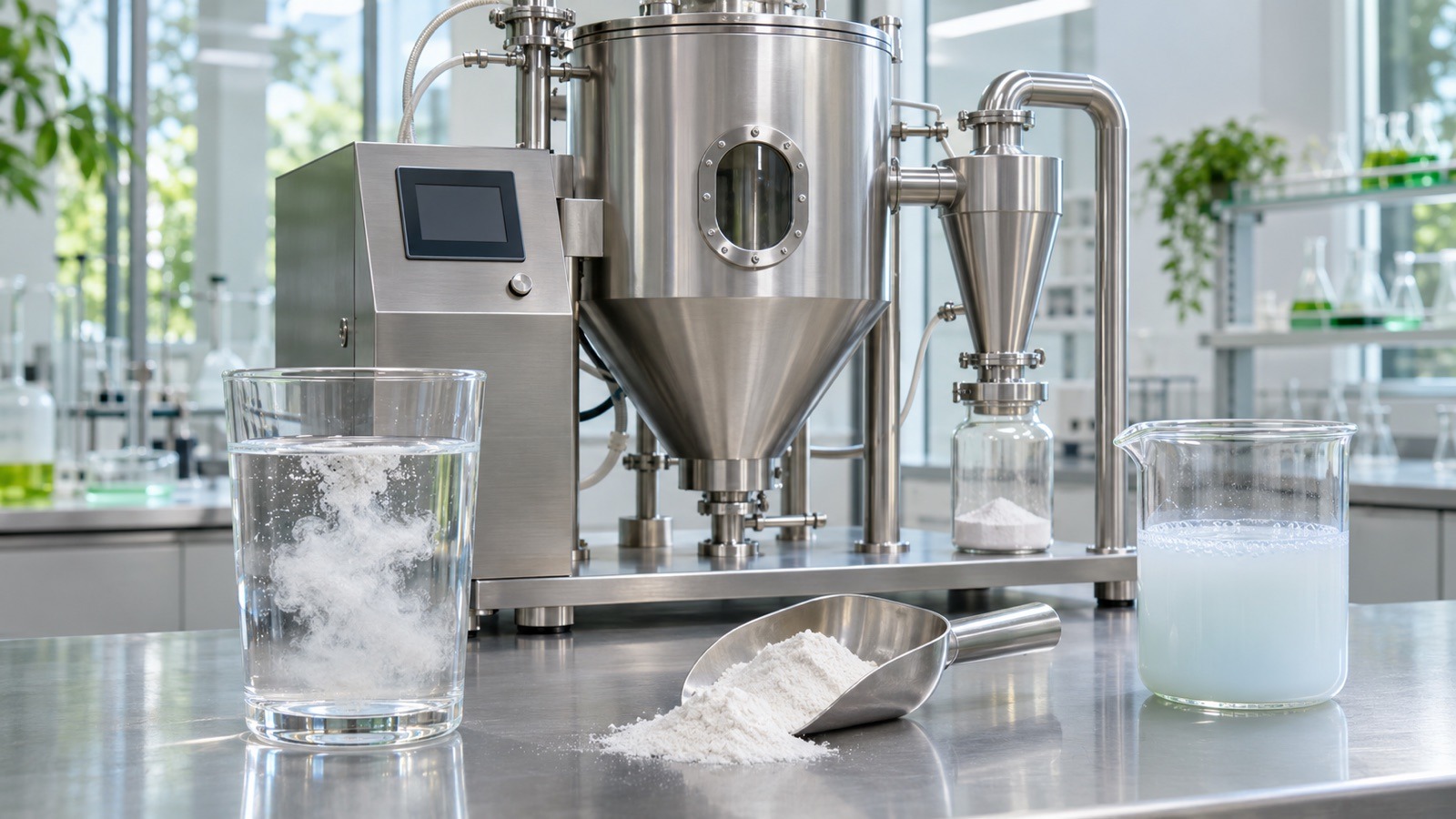
Water soluble THC powder is a THC nanoemulsion dried onto a water-soluble carrier, so each oil droplet sits locked inside a particle of sugar glass until water dissolves the shell. The THC itself never dissolves. A published reference run on MCT oil (San et al., Pharmaceutics 2022) sprayed a feed at 40 percent solids with a 2:1 wall-to-oil ratio, 150°C inlet air and about 95°C outlet air, and reached 98 percent encapsulation efficiency with OSA starch plus maltodextrin; moisture across its formulas ran 3.7 to 5.2 percent. On cannabis oil (Lajoie et al., Food & Function 2022), protein walls encapsulated more than 95 percent of the oil while Tween 80 held about 16 percent, and the Tween droplets grew from 95 to 210 nm when the powder went back into water. Those two numbers, encapsulation efficiency and droplet size after redispersion, decide whether a powder works.
What Water Soluble THC Powder Actually Is
THC and CBD are oils. CBD’s intrinsic water solubility is about 0.2 micromolar, roughly 0.06 mg per liter (Hatziagapiou et al., Pharmaceutics 2022), so dissolving one 10 mg dose would take about 160 liters of water. Every “water soluble” cannabinoid product on the market is a dispersion: the cannabinoid stays in oil, and the oil is broken into droplets small enough, and coated well enough, that they stay suspended in water instead of floating to the top.
The powder form adds one step. The liquid nanoemulsion gets a dissolved carrier, usually a starch derivative, gum or protein, and the whole mixture is sprayed into hot air. Water flashes off, the carrier solidifies into a glassy shell around the droplets, and what falls out of the cyclone is a free-flowing powder. Stir it into water and the shell dissolves first, releasing droplets that should match the size they had before drying. The powder is a storage format for an emulsion. If the emulsion was bad, drying it does not fix it; if the drying was bad, a good emulsion comes back broken.
This is a different product from the cannabinoid powder for infused flower, which is a solvent co-deposition powder built to coat flower, not to disperse in a drink. For the droplet-size, surfactant and stability side of the liquid, our 1 L nanoemulsion tutorial and beverage formulation guide carry the full numbers. This page covers what happens after the emulsion exists.
How Water Soluble THC Powder Is Made: The Four Stages
| Stage | What happens | Published number | What goes wrong here |
|---|---|---|---|
| 1. Nanoemulsion | THC distillate in a carrier oil is emulsified with a surfactant or protein and sheared down to nanometer droplets | Release target for the liquid: Z-average 20 to 50 nm, PDI under 0.20 (our canonical spec) | Droplets too large or too broad; everything downstream inherits it |
| 2. Wall material | A dissolved carrier (maltodextrin with OSA starch, gum arabic or protein) is added to the emulsion | 40% total feed solids; wall:oil 2:1 gave 98.38% encapsulation with OSA starch + maltodextrin (San et al., Pharmaceutics 2022) | Maltodextrin alone is a poor emulsifier; free oil ends up on the particle surface |
| 3. Spray drying | The feed is atomized into hot air; water evaporates in seconds and the wall sets into a glass | Inlet 150°C, outlet 95 ± 5°C, lab yield up to 88.57% on MCT oil (San et al., Pharmaceutics 2022) | Sticky wall deposits, low yield, surface oil left exposed to air |
| 4. Powder | Collected, sieved, packed against moisture and light | Moisture 3.68 to 5.23%; 4 to 6% described as appropriate for food powders (San et al., Pharmaceutics 2022) | Caking in the bag, oxidation of surface oil, droplet growth on redispersion |
The spray dryer does not cook the THC the way the inlet number suggests. While a droplet still has water to lose, evaporation holds it near the wet-bulb temperature of the air, well below the inlet setting, and the dry particle leaves at about the outlet temperature within seconds. On cannabis oil, Lajoie et al., Food & Function 2022 measured CBD, THC and CBN in the powders by UPLC and found no significant difference from the bulk oil, with one exception, the formulation with the least Tween 80. The heat risk lives in the outlet setting and in what happens to the surface oil afterward, not in the inlet number on the panel.
Wall Material: Where Most Powders Are Won or Lost
Maltodextrin is cheap, dissolves clean and forms a good glass, which is why it shows up in so many formulas. It is also a weak emulsifier. San et al., Pharmaceutics 2022 put it directly: the poor emulsifying property of maltodextrin “decreases its tendency to be used as a wall material alone.” Run maltodextrin by itself and the oil that was not trapped during atomization stays on the particle surface, where air reaches it and where it smears into an oil slick on the drink.
| Wall system | Encapsulation efficiency | Droplets before drying | After redispersion | Trade-off | Source |
|---|---|---|---|---|---|
| OSA starch + maltodextrin (1:1), wall:oil 2:1 | 98.38% | 177 nm | not reported | Best-performing MCT system in the study | San 2022 |
| Maltodextrin + whey protein isolate (cannabis oil) | above 95% | 170 nm | 176 nm | In vitro bioaccessibility about 7% | Lajoie 2022 |
| Maltodextrin + soy protein isolate (cannabis oil) | above 95% | 259 nm | 346 nm | Bioaccessibility about 10%; droplets grew a third | Lajoie 2022 |
| Maltodextrin + Tween 80 (cannabis oil) | about 16% | 95 nm | 210 nm | Bioaccessibility about 53%; most oil left on the surface | Lajoie 2022 |
| All MCT formulations tested | 12.22% to 98.87% | The wall system moves efficiency by a factor of eight | San 2022 |
Read the cannabis rows twice. The protein walls locked in nearly all of the oil and released little of it in a simulated digestion; the Tween 80 powder released the most and protected the least. Surface oil also oxidized: the powders’ peroxide values ran about four times the 5.2 mEq of the starting oil. A formulator chasing fast onset with a high-surfactant powder is buying bioaccessibility with shelf life, and the only way to know where a formula sits is to measure both encapsulation efficiency and droplet size after redispersion on every lot.
Dextrose equivalent (DE), the degree of starch breakdown in the maltodextrin, is the second lever. Higher DE packs a denser glass that blocks oxygen better. In carrot carotene powders, a 36.5 DE carrier beat 4, 15 and 25 DE, with a predicted half-life of 450 days at 21°C against 2 days for juice dried with no carrier (Wagner and Warthesen, 1995). The price is stickiness: a DE 18 maltodextrin with caseinate improved fish-oil stability but browned and agglomerated (Kagami et al., 2003). Lower DE dries cleaner; higher DE protects better. A blend of the two is the usual compromise.
If you want to run this sequence on real equipment, from the emulsion premix to a powder you can reconstitute and measure, that is the formulation side of what we teach at extractiontraining.com.
Spray Dryer Settings and the Glass Transition
A spray-dried carrier is an amorphous glass, not a crystal. Below its glass transition temperature (Tg) it is hard and free-flowing; above it, it turns rubbery and sticks to the chamber wall, to itself and to the inside of the bag. Water is a plasticizer: every bit of moisture the powder holds lowers its Tg (Roos and Karel, Biotechnology Progress 1991, measured the drop across water activities of 0.11 to 0.85). Anhydrous DE 10 maltodextrin is reported with a Tg anywhere from about 154°C to 180°C depending on the study, and a widely used drying rule of thumb puts the sticky point about 10 to 20°C above Tg. Treat that rule as a starting point; it was derived on static powders.
| Setting | Reference value | Why it matters | Failure if you miss it |
|---|---|---|---|
| Feed total solids | 40% (San 2022) | More solids means faster crust formation and less oil escaping to the surface | Low solids: more surface oil, more water to evaporate per gram of powder |
| Wall:oil ratio | 2:1 to 3:1 tested; 2:1 best with OSA + maltodextrin | Sets the oil load of the powder and how much wall covers each droplet | 1:1 leaves oil exposed; 3:1 dilutes potency |
| Inlet air | 150°C on a lab dryer | Drives evaporation rate | Too low: wet product, wall deposits |
| Outlet air | 95 ± 5°C | Approximates the dry particle temperature and sets final moisture | Too high: the particle passes its sticky point; too low: moisture above target |
| Final moisture | 3.7 to 5.2% measured; 4 to 6% target band | Moisture lowers Tg; water activity governs caking and microbial stability | Above band: caking and collapse in storage |
| Water activity | Dry food powders in recent studies: below 0.32 | A low water activity keeps the glass below its sticky point at room temperature | Humid packing room: the powder picks up water before the bag is sealed |
Yield is the number buyers ask about and vendors argue over. The MCT reference run peaked at 88.57 percent on a lab dryer. Le Herbe’s white paper puts a standard Büchi B-290 at 50 to 60 percent against more than 90 percent on the pulse-combustion dryer it promotes, so read that comparison as a vendor claim. On a small dryer, most of the loss is powder stuck to the chamber and fines that miss the cyclone, which is cannabinoid you paid for and will not sell.
Cyclodextrin Powders: The Mass Penalty
The other route to a water-dispersible cannabinoid skips the emulsion. A cyclodextrin is a ring of glucose units with an oily cavity that can hold one cannabinoid molecule. The complex dissolves in water, and with the right cyclodextrin it works: THC reached about 14 mg per mL in a 24 percent solution of randomly methylated beta-cyclodextrin (RAMEB), about four orders of magnitude above its water solubility (Hazekamp and Verpoorte, 2006). In rabbits, sublingual THC in a methylated beta-cyclodextrin reached 12.1 percent bioavailability against 1.3 percent for an oral ethanol solution (Mannila et al., 2005); that is animal data, not a human dose guide.
The catch is weight. Cyclodextrins are heavy, cannabinoids bind them weakly, and you need a large excess to push a meaningful amount into solution.
| Cyclodextrin system | Binding constant (CBD, 25°C) | Carrier per 10 mg cannabinoid | What it means |
|---|---|---|---|
| Beta-cyclodextrin, 1:1 | 58.7 per M | 36 mg (1:1 minimum) | Weakest binder; complexation efficiency 1.2% |
| HP-beta-cyclodextrin, 1:1 | 146.7 per M | 45 to 48 mg at 1:1; CBD tops out near 17 to 18% w/w | Complexation efficiency 2.9% |
| HP-beta-cyclodextrin at the 1:37 molar ratio needed for 4 mg/mL CBD | 146.7 per M | about 1.65 to 1.77 g | The dose rides on 165 to 177 times its own weight in carrier |
| Randomly methylated beta-cyclodextrin, 1:5 molar for 4 mg/mL CBD | 1,503.6 per M | about 5 molar equivalents | Complexation efficiency 30%; the strongest binder |
| RAMEB with THC (14 mg/mL in 24% RAMEB) | 2 THC : 1 cyclodextrin binding | about 171 mg per 10 mg THC | Roughly 17 times the THC mass in carrier |
Binding constants, efficiencies and the 1:5 and 1:37 ratios are from Hatziagapiou et al., Pharmaceutics 2022; the THC row is computed from Hazekamp and Verpoorte, 2006; the carrier masses are computed from molecular weights (CBD 314.46, beta-cyclodextrin 1,135, HP-beta-cyclodextrin about 1,400 to 1,500 g per mol). For a 10 mg drink packet the extra gram of carrier is not a problem. For a tablet, a capsule or a dose that has to fit in a small sachet, it pushes those formats toward emulsion-based powders.
The Home Method: Oil Plated on Maltodextrin
Most “how to make THC powder at home” recipes stir cannabis oil, sometimes with lecithin, into tapioca maltodextrin and sieve it. That is plating: the oil coats the surface of the carrier particles. Ordinary maltodextrin plates about 10 to 15 percent oil before it turns greasy; specialty starches are marketed at up to 40 percent. Nothing about the process makes droplets. Drop a plated powder into water and the maltodextrin dissolves in seconds, the oil it was carrying floats, and the dose ends up in a ring at the waterline and on the cup wall. With lecithin in the mix you get a cloudy, coarse emulsion with droplets in the micron range, closer to salad dressing than to a nanoemulsion.
Plated powder is a fine way to get oil into a dry baking mix, where fat is supposed to be. It is the wrong product for a drink, and it is the wrong product to label “water soluble.”
Dosing a Powder: Potency Math and Uniformity
Powder potency is fixed by two numbers: how much of the dry solids is oil phase, and how much of the oil phase is THC. Milligrams of THC per gram of powder = 1,000 × oil fraction of the solids × THC fraction of the oil phase. The table ignores the 4 to 6 percent moisture and assumes full encapsulation, so real numbers run slightly lower.
| Wall:oil ratio (oil share of solids) | THC in the oil phase | THC per gram of powder | Powder per 10 mg dose |
|---|---|---|---|
| 2:1 (33%) | 5% | 16.7 mg/g | 0.60 g |
| 2:1 (33%) | 10% | 33.3 mg/g | 0.30 g |
| 2:1 (33%) | 20% | 66.7 mg/g | 0.15 g |
| 3:1 (25%) | 5% | 12.5 mg/g | 0.80 g |
| 3:1 (25%) | 10% | 25.0 mg/g | 0.40 g |
| 3:1 (25%) | 20% | 50.0 mg/g | 0.20 g |
Commercial drink mixes usually blend that active powder into several grams of sugar, acid and flavor, and that is where uniformity breaks. A few hundred milligrams of fine active powder in a coarse sugar blend segregates in the hopper and the filler, the same way small particles settle to the bottom of a cereal box. The pharmaceutical benchmark is USP <905> Uniformity of Dosage Units: an acceptance value of 15 or less on 10 units, and no single unit outside 75 to 125 percent of the reference value (normally the label claim) in the second stage. Test stick packs from the start, middle and end of the fill run, not a composite.
Hemp-derived drink powders have a date to watch. Under the federal hemp rule, from December 11, 2026 a finished hemp product is capped at 0.4 mg total THC per container. A 10 mg hemp THC stick pack is 25 times that cap; the per-container cap counts the whole package, not the serving.
Common Failures and How to Diagnose Them
- Symptom: An oil slick or ring forms on the drink within minutes Root cause: Low encapsulation efficiency or a plated powder: oil sits on the particle surface instead of inside it. Diagnostic test: Wash a weighed sample with hexane and weigh the surface oil, or reconstitute in clear water and look for the ring after 10 minutes. Fix: Add OSA starch or protein to the wall, run 2:1 wall:oil, raise feed solids toward 40%.
- Symptom: The powder cakes or turns into a hard brick in the bag Root cause: Moisture lowered the glass transition below room temperature; the particles fused. Diagnostic test: Moisture and water activity on the caked lot against a retained sample. Fix: Barrier film and a desiccant, pack in a dry room, dry to the low end of the 4 to 6% band; consider a lower-DE carrier.
- Symptom: The reconstituted drink is cloudier than the liquid emulsion was Root cause: Droplets grew on drying and redispersion (Tween 80 went from 95 to 210 nm in Lajoie 2022). Diagnostic test: DLS of the liquid feed against DLS of the powder redispersed in water at use concentration. Fix: Change the emulsifier or wall system; make redispersed droplet size a release test.
- Symptom: Potency falls or the powder smells like old crayons Root cause: Surface oil oxidizing; light exposure. Diagnostic test: Peroxide value and potency over time, light-exposed versus dark-stored samples. Fix: Raise encapsulation efficiency, use opaque packaging, nitrogen-flush; light was “the greatest single factor” in cannabinoid loss (Fairbairn, Liebmann and Rowan, 1976).
- Symptom: Low yield and a crust on the chamber wall Root cause: Outlet temperature above the sticky point for that carrier at that moisture. Diagnostic test: Collected mass against solids fed; inspect the chamber after the run. Fix: Lower the outlet temperature, shift to a lower-DE or higher-Tg wall, adjust feed solids.
- Symptom: Stick packs test far apart within one lot Root cause: Segregation of fine active powder in a coarse blend. Diagnostic test: 10 units across the fill run, USP <905> acceptance value. Fix: Match particle sizes, pre-blend the active with a portion of the base, shorten the hopper run.
Unprotected cannabinoid powder does not keep. Kožák et al., Journal of Cannabis Research 2026 found that THC, CBD, THCA and CBDA in a pure dried extract were almost entirely degraded after 6 months at 40°C, while particles built with polymer carriers held up significantly better. The wall is the shelf life.
Safety: A Spray Dryer Is a Dust Hazard
Maltodextrin dust burns. A trade review quoting a process-safety lab gave a maximum explosion pressure of 7.5 to 8.5 bar, a deflagration index (Kst) up to about 135 bar·m/s, and a minimum ignition energy that can fall below 10 mJ, low enough for a static discharge from a person to ignite a cloud. Spray dryers, cyclones, dust collectors and the sieving station all handle that powder airborne. NFPA 652 requires a dust hazard analysis, and NFPA 660 (2025) now consolidates the combustible dust standards, including NFPA 61 for food and starch powders. Ground the equipment, bond the transfers, keep housekeeping ahead of accumulation, and put the dust hazard analysis on the list before the dryer arrives, the same way a hydrocarbon room starts with the fire code.
Frequently Asked Questions
How is water soluble THC powder made?
THC distillate in a carrier oil is made into a nanoemulsion, mixed with a dissolved wall material such as OSA starch plus maltodextrin, and spray dried. A published reference run used 40 percent feed solids, a 2:1 wall-to-oil ratio, 150°C inlet and about 95°C outlet air, and reached 98 percent encapsulation efficiency; moisture across the formulas ran 3.7 to 5.2 percent.
Is water soluble THC actually soluble in water?
No. CBD’s water solubility is about 0.06 mg per liter, so a 10 mg dose would need about 160 liters to dissolve. Water soluble THC is a dispersion of nanometer oil droplets, held in suspension by a surfactant or protein, and in powder form protected by a dried carrier shell.
Does water soluble THC work faster?
A powder that redisperses to its original nanometer droplets behaves like the liquid nanoemulsion: onset is roughly 15 to 30 minutes against 45 to 90 for oil edibles. It is still swallowed and still passes through the liver before reaching circulation; nothing about a powder sends THC directly into the bloodstream. Droplets that grow on redispersion, as Tween 80 droplets did from 95 to 210 nm in one cannabis study, lose part of that advantage.
Does spray drying destroy THC?
Not by itself. Evaporating water holds the droplet near the wet-bulb temperature, the dry particle leaves at about the outlet temperature within seconds, and one cannabis study found no significant change in CBD, THC or CBN after spray drying except in the formulation with the least Tween 80. The bigger losses come later, from oxidation of unencapsulated surface oil and from light.
Can you make water soluble THC powder at home?
Not a true one. Stirring oil into tapioca maltodextrin plates the oil on the surface (about 10 to 15 percent oil before it turns greasy); in water the carrier dissolves and the oil floats as a ring. A water-dispersible powder needs a real emulsion with nanometer droplets and a spray or freeze dryer to lock them in a carrier.
What is the difference between a nanoemulsion powder and a cyclodextrin powder?
A nanoemulsion powder holds oil droplets inside a dried carrier; a cyclodextrin powder binds single cannabinoid molecules inside ring-shaped sugar molecules. Cyclodextrins carry a heavy mass penalty: HP-beta-cyclodextrin at a 1:1 ratio adds 45 to 48 mg per 10 mg CBD, and reaching 4 mg per mL in solution took a 1:37 molar ratio, about 1.7 g of carrier per 10 mg.
Why does my THC powder leave an oil ring in my drink?
The oil is on the outside of the particles. Either the powder was plated rather than emulsified, or encapsulation efficiency is low, which happens with maltodextrin alone or surfactant-heavy walls (Tween 80 encapsulated about 16 percent of cannabis oil in one study, against more than 95 percent for protein walls).
How should water soluble THC powder be stored?
Dry, dark and sealed. Keep moisture in the 4 to 6 percent band the powder left the dryer at, use a barrier bag with a desiccant, and block light, which was the single largest factor in cannabinoid loss in a classic storage study. A powder that cakes has absorbed enough water to pass its glass transition.
Sources: San et al., Pharmaceutics 14:1281 (2022), doi:10.3390/pharmaceutics14061281; Lajoie et al., Food & Function (2022), doi:10.1039/d2fo01591a; Hatziagapiou et al., Pharmaceutics 14:706 (2022), doi:10.3390/pharmaceutics14040706; Hazekamp and Verpoorte, European Journal of Pharmaceutical Sciences (2006), doi:10.1016/j.ejps.2006.07.001; Mannila et al., European Journal of Pharmaceutical Sciences (2005), doi:10.1016/j.ejps.2005.04.020; Wagner and Warthesen, Journal of Food Science (1995), doi:10.1111/j.1365-2621.1995.tb06290.x; Kagami et al., Journal of Food Science (2003), doi:10.1111/j.1365-2621.2003.tb05755.x; Roos and Karel, Biotechnology Progress 7:49 (1991), doi:10.1021/bp00007a008; Fairbairn, Liebmann and Rowan, Journal of Pharmacy and Pharmacology (1976), doi:10.1111/j.2042-7158.1976.tb04014.x; Kožák et al., Journal of Cannabis Research (2026), doi:10.1186/s42238-025-00381-w; Le Herbe, “The Art and Science of Cannabis Powder” (2022 white paper); O’Halloran, Food Engineering (November 2013); USP <905> Uniformity of Dosage Units; NFPA 652 and NFPA 660; CRS LSB11496 (October 28, 2026).
Ready to level up your extraction game? Contact WKU Consulting for personalized guidance on building your extraction lab.
For more deep dives into cannabis chemistry, extraction SOPs, and lab design, subscribe to the WKU Consulting YouTube channel.
Watch a related video:
