
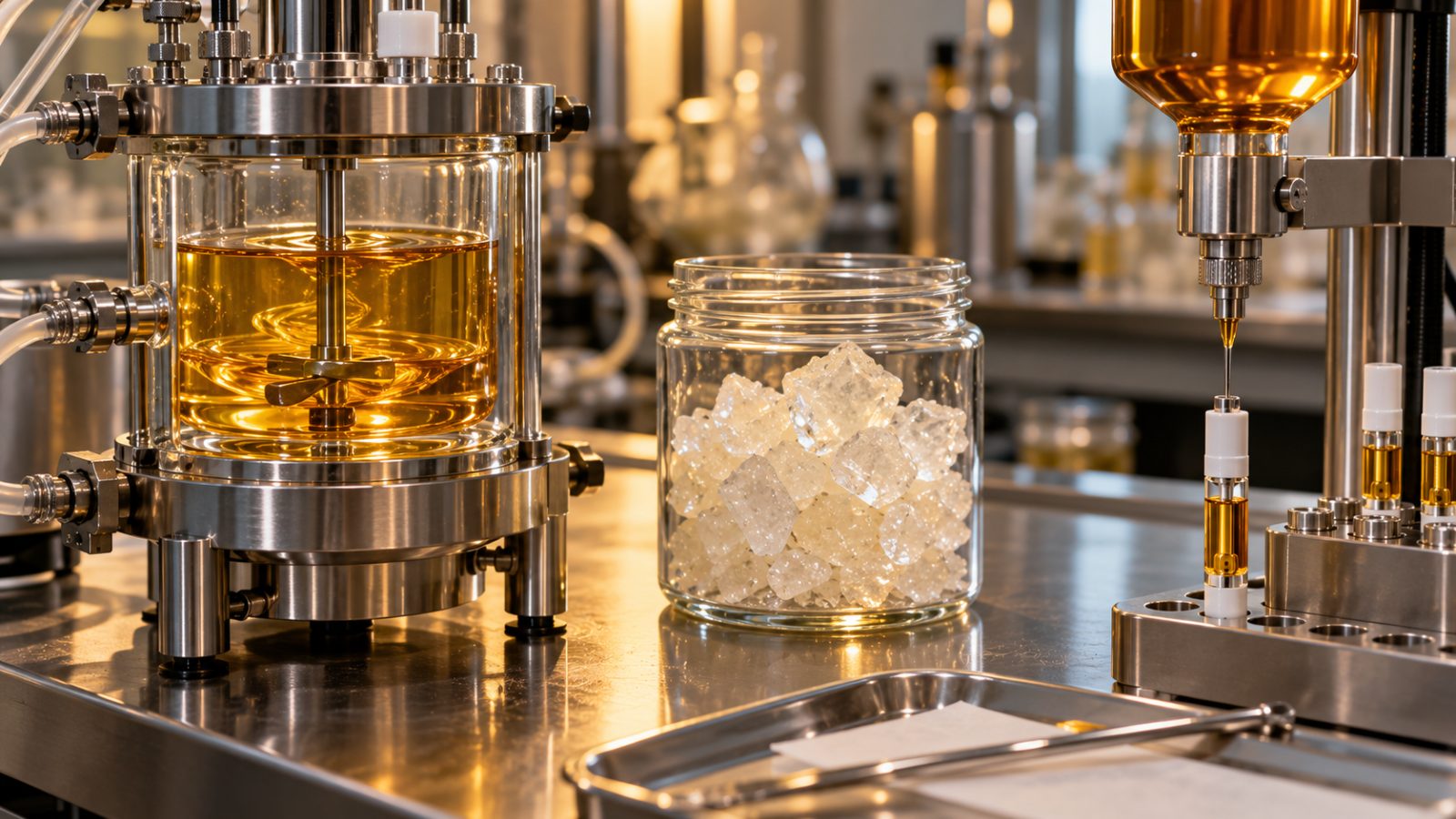
Liquid diamonds are THCA diamonds that have been decarboxylated into delta-9 THC and recombined with the high-terpene extract (HTE) they crystallized out of. The decarb runs at 110 to 120C, loses exactly 12.3% of the diamond mass as carbon dioxide (358.5 g/mol THCA becomes 314.5 g/mol THC), and is finished when the melt stops bubbling and the COA shows THCA under 1%. The decarbed oil is then blended with 10 to 20% HTE by weight, which lands the finished product at 85 to 93% THC and 3 to 7% terpenes, and it is filled into ceramic-core cartridges at about 60C where its viscosity drops from well over 100,000 centipoise at room temperature to roughly 1,000. Every “liquid diamond” cart that turned to sugar in a month skipped the decarb and sold a melt. That is the whole article in one paragraph. The rest is how to get each number right.
There is no home version of this. The diamonds come from a closed-loop hydrocarbon extraction and a crystallization step, and the recombination only works if you can measure THCA, terpene content, and residual solvent. If you cannot test, you are guessing with a product that goes into a lung.
What Liquid Diamonds Are, and What a Melt Is
A THCA diamond is a crystal, and a crystal is a solid because its molecules pack into a lattice. Delta-9 THC does not do that. It is a viscous, amorphous resin at every temperature you will ever store it at. So “liquid diamonds” is a chemical statement before it is a marketing one: the only way to make a diamond permanently liquid is to turn the THCA into THC, which means removing the carboxylic acid group as CO2. Heat does that, nothing else in a licensed lab does.
The other product sold under the same name is a melt. Warm THCA diamonds in sauce to 80 or 90C and they dissolve, because THCA is more soluble in a terpene-rich matrix at that temperature than at 20C. Cool the jar back down and the solubility falls with it. Nothing has changed chemically, so over days to weeks the THCA comes back out as sugar, first on the glass, then through the whole mass. That is a fine dab product. It is a terrible cart product, because a 510 cartridge sits at room temperature, loses monoterpenes through the mouthpiece every day, and gives the THCA a steadily worse solvent to stay dissolved in.
The label tells you which one you have. A decarbed product tests as THC with THCA under 1%. A melt tests as THCA with THC in the single digits. Both can honestly say “liquid diamonds.” Only one of them stays liquid.
Where the Diamonds and the Sauce Come From
This guide starts at the point where you are holding two jars: THCA diamonds and the high-terpene extract they separated from. If you are not there yet, the crystallization itself is covered in three separate guides, because the method depends on the input: jar tech from a hydrocarbon extract, diamonds from BHO at production scale, and rosin diamonds from solventless input. The fresh-frozen extraction that feeds all of them is in the live resin cart guide, which also covers the sauce-cart path that skips crystallization entirely.
Two input specifications decide whether the recombination works.
Diamond purity at or above 95% THCA. Below that, the remaining 5% or more is a mixture of minor cannabinoids, waxes, and whatever co-crystallized. The decarb still works, but the oil darkens faster and the potency math in the blend table below stops being predictable. Rinse-washed diamonds (cold pentane or a cold butane rinse) routinely test 97 to 99%.
HTE residual solvent under 500 ppm. The HTE is the part of the cart that carries the flavor and the part that never gets heated above 60C again, so whatever solvent is in it stays in it. Most states allow 5,000 ppm butane in an inhalable, and 500 ppm is already detectable by taste. Purge the HTE as its own product before it goes anywhere near the decarbed oil. The residual solvent purging SOPs cover the vacuum oven parameters for a thin terpene-heavy fraction.
Measure the HTE’s terpene content before you plan the blend. A fresh-frozen HTE from a terpene-rich cultivar can carry 25 to 45% total terpenes with the balance mostly THCA and THC. A dry-cure HTE may be half that. The blend ratio that gives you a 6% terpene cart from the first HTE gives you a 3% cart from the second, and a 3% cart will not wick.
Step 1: Decarboxylate the Diamonds
The reaction is simple. THCA carries a carboxylic acid on the aromatic ring next to the phenol. Above about 90C that group leaves as carbon dioxide and a proton takes its place, which gives you delta-9 THC. It is first order in THCA with an activation energy near 88 kJ/mol (Wang et al., 2016, Cannabis and Cannabinoid Research), which means every 10C of extra temperature roughly doubles the rate and the reaction never truly stops at a timer, it stops when the THCA is gone.
The mass balance is fixed by the molecular weights. THCA is 358.5 g/mol, THC is 314.5 g/mol, and the difference, 44.0 g/mol, is CO2. Put 1,000 g of diamonds into the reactor and you take 877 g of THC out. The other 123 g leaves as gas, about 68 liters of it at room temperature. That volume matters for two reasons: it foams, and it has to go somewhere.
| Decarb variable | Recommended | Acceptable | Failure threshold |
|---|---|---|---|
| Oil temperature (measured in the melt, not the jacket) | 115C | 105 to 120C | Above 125C: CBN and delta-8 climb, color goes amber; at 145C the literature shows total THC falling by half within 40 minutes from evaporation and degradation |
| Time | Until gas evolution stops, then 15 minutes more (typically 60 to 90 minutes for a 1 to 3 kg melt) | 30 minutes for a thin film at 110C (Wang 2016: near-complete conversion) | Stopping while the melt still bubbles: THCA above 3% on the COA and crystals in the cart within weeks |
| Vessel fill | 40% of volume | Up to 50% | Above 50%: CO2 foam reaches the lid or the vacuum port and carries oil into the line |
| Atmosphere | Nitrogen blanket at atmospheric pressure, vented | Vacuum at 100 to 200 torr once foaming subsides (pulls residual solvent and CO2) | Deep vacuum from the start: foam-over; open to air for the full run: measurable CBN gain |
| Agitation | Overhead or magnetic stir, 100 to 200 rpm | Periodic manual stir on sub-500 g batches | No agitation: a 10 to 20C gradient between jacket wall and center, scorching at the wall while the center is still THCA |
| Endpoint check | HPLC: THCA under 1% of total cannabinoids | Under 2% for dab-only product | Above 3%: the oil will seed crystals in storage |
Two practical notes. First, diamonds do not need to be ground. They melt in the 70 to 100C range depending on purity and crystal form, and the melt is already decarboxylating by the time it is a liquid, so load the crystals, bring the jacket up slowly, and let the melt form under stir. Second, measure the oil, not the jacket. A jacket set to 120C with a cold 2 kg charge will run the oil at 95C for the first half hour, and an operator watching the jacket will pull the batch early. The foam is your thermometer: it starts when the center of the melt crosses about 100C and it stops when there is nothing left to decarboxylate.
What comes out is a clear to pale gold oil at 115C that will look like glass at room temperature. It is 97 to 99% THC if the diamonds were 97 to 99% THCA, and it has no terpenes, which is why it tastes like nothing and why the next step exists.
Step 2: Prepare the HTE
The HTE sat in a jar for two to four weeks while the diamonds grew, which means it also sat on dissolved solvent for two to four weeks. Purge it as a separate product: a thin layer, 29 inHg, 32 to 38C, until a headspace GC reads under 500 ppm. Do not purge it hotter to go faster. Monoterpenes evaporate at every temperature, and the rate roughly doubles for every 10C, so a 48 hour purge at 45C costs you more limonene and myrcene than a 72 hour purge at 35C.
Then test it for three numbers: total terpenes, total cannabinoids, and water. Total terpenes sets the blend ratio in Step 3. Total cannabinoids tells you how much the HTE will raise or lower the finished potency. Water above 0.5% shows up later as cloudiness and as popping in the coil, and it comes from fresh-frozen material that was extracted with a wet column; the fix is a short 40C vacuum hold before the blend, not an additive.
Some labs cold-trap a pure terpene fraction off the HTE and hold it separately. If you do, you have a third blending ingredient and more control, because you can raise terpene content without raising the HTE’s cannabinoid contribution. Cannabis-derived terpenes from another cultivar are a legitimate fourth ingredient. Botanical terpenes are not: at the 8 to 12% addition rates needed to thin a decarbed-diamond base they taste like a cleaning product and they are the single most common reason a liquid diamond cart is harsh. The terpene extraction guide ranks what each capture method actually keeps.
Step 3: The Blend Ratio
The ratio is set backwards from two targets: the terpene content the cart needs in order to wick, and the potency you want on the label. Decarbed diamonds are the potency. HTE is the terpene content and the flavor. The table assumes 97% THC decarbed oil and an HTE at 50% total cannabinoids and 35% total terpenes, which is a typical fresh-frozen hydrocarbon sauce. Substitute your own HTE numbers; the arithmetic is linear.
| Blend (decarbed diamonds : HTE, by weight) | Finished THC | Finished terpenes | Viscosity class at 25C | Where it works |
|---|---|---|---|---|
| 95 : 5 | 94.7% | 1.7% | Glass; no flow below 40C | Dab jar only. Will not wick in any cartridge |
| 90 : 10 | 92.3% | 3.5% | Very thick, above 20,000 cP | Dab product; cart only with an added CDT fraction |
| 85 : 15 | 90.0% | 5.2% | Thick, roughly 8,000 to 15,000 cP | Ceramic-core carts rated for thick oil, 1.6 to 2.0 mm intake ports; the most common commercial liquid diamond cart |
| 80 : 20 | 87.6% | 7.0% | Moderate, roughly 5,000 to 9,000 cP | Standard ceramic 510 hardware; the best balance of flavor, wicking, and a label above 85% |
| 80 : 15 : 5 (diamonds : HTE : cold-trapped CDT) | 85.1% | 10.2% | Standard cart window, roughly 3,000 to 6,000 cP | Any ceramic 510; flavor-forward SKU |
| 70 : 30 | 82.9% | 10.5% | Standard cart window | Reads as a live resin sauce cart on the label; the diamonds stop paying for themselves |
Read the table from the right. If the hardware is a standard ceramic 510, you need the finished oil somewhere in the 3,000 to 6,000 centipoise range at room temperature, and with a 35% terpene HTE that means at least 20% HTE, or 15% HTE plus a few percent of cold-trapped terpenes. If the hardware is built for thick oil, 15% HTE works and the label reads 90%. If the product is a dab jar, ratio is a flavor decision and 90 : 10 is typical. What never works is the 95 : 5 “mostly diamonds” blend in a cartridge, and it is sold anyway because 94.7% looks good on a label right up until the first dry hit.
The viscosity classes are deliberately broad because viscosity is dominated by terpene content and temperature, not by the exact THC number, and two HTEs with the same terpene total can differ by a factor of two if one is myrcene-heavy and the other is caryophyllene-heavy. Measure the finished blend on a viscometer at 25C once, record it against the HTE lot, and the next batch from the same lot is predictable.
Step 4: Mixing, Temperature, and Viscosity
Combine the decarbed oil and the HTE in a closed, jacketed vessel at 55 to 60C under magnetic or overhead stir for 20 to 30 minutes. Closed matters: at 60C an open beaker loses a measurable fraction of its monoterpenes to the room every hour, and limonene and pinene leave first, which shifts the flavor toward the heavier sesquiterpenes before the first cart is filled. Do not mix above 70C. There is no chemistry you need above 70C and there is a lot of terpene you lose.
The reason the temperature window is so narrow is the viscosity curve. Published measurements on THC distillate put an 86% THC oil at roughly 5,000,000 cP at 20C, 200,000 at 30C, 20,000 at 40C, 4,000 at 50C, and 1,000 at 60C. Decarbed diamonds at 97% THC sit above that curve at every temperature. Blending in 15% terpenes drops the room-temperature number by two to three orders of magnitude, to the high thousands, and the 60C number to a few hundred. So the same oil that will not pour at 25C fills like water at 60C, and the fill temperature is not a convenience, it is the only point on the curve where a filling machine can meter it.
| Oil temperature | Decarbed diamonds, no terpenes (approx.) | Finished blend, about 7% terpenes (approx.) | What that means on the bench |
|---|---|---|---|
| 25C | Above 1,000,000 cP | 5,000 to 9,000 cP | Base oil is a solid glass; blend is honey that barely moves. This is the number the wick lives with |
| 40C | About 50,000 cP | About 1,500 cP | Blend stirs; base oil still will not |
| 50C | About 8,000 cP | About 800 cP | Lower limit for a gravity or syringe fill |
| 60C | About 2,000 cP | 300 to 500 cP | Fill temperature. Semi-automatic fillers meter cleanly here |
| 70C | Under 1,000 cP | Under 300 cP | Ceiling. Faster fills, but monoterpene loss per hour doubles against 60C |
The figures are rounded from published distillate curves and from the terpene-dilution behavior those same measurements show; they are the shape of the curve, not a substitute for your own viscometer reading. The point is the slope: a 10C change moves viscosity by a factor of three to five anywhere on this curve, which is why a cart that fills perfectly at 60C clogs at 20C in a cold warehouse and leaks at 35C on a dashboard.
Step 5: Filling and Hardware
Fill at 60C from a stirred, jacketed reservoir into ceramic-core cartridges. Cotton and silica wicks are not an option at these viscosities. Intake ports should be 1.6 to 2.0 mm for a 15 to 20% HTE blend, against 1.2 to 1.6 mm for a standard live resin sauce oil. Coil resistance of 1.2 to 1.4 ohm keeps the activation temperature low enough to vaporize terpenes without pyrolyzing them. Fill weight target 1.0 g for a 1.0 mL cartridge; decarbed-diamond blends run close to 1.0 g/mL at room temperature (the extract density reference has the numbers by type), so volume and mass agree within a few percent.
Cap within ten minutes of filling. The oil is at 60C, the headspace above it is saturated with monoterpenes, and every minute the mouthpiece is off is terpene leaving the product. Let the capped carts cool upright at room temperature for 24 hours before they are boxed; the oil is settling into the wick during that time, and a cart boxed hot and laid on its side is a cart that arrives at the dispensary with oil in the airway.
Hold three carts from every batch for a 14 day room-temperature check and one for a 14 day check at 4C. If any of them shows crystal on the glass at 14 days, the decarb endpoint in Step 1 was not reached and the batch will sugar in the field.
If you want to learn this process hands-on, with the lab walkthroughs and the SOPs you can actually run, that is exactly what we built extractiontraining.com for.
The Dab-Jar Version: Dissolved Diamonds That Stay THCA
A second product carries the same name and is made without the decarb. Diamonds and sauce go into a closed jar, the jar goes into a 80 to 90C bath for 10 to 15 minutes with occasional stirring, and the diamonds dissolve into the sauce. Decarboxylation at that temperature and time is a few percent at most, because the reaction only becomes fast above about 105C, so the product is still a THCA product and tests like one.
It is a legitimate dab format and it should be sold as a THCA product with a short shelf life. Stored cold it recrystallizes, because THCA solubility in the terpene matrix falls as the temperature falls; stored warm it slowly decarboxylates and the terpenes slowly leave. Neither is a defect, both are chemistry, and the honest label is “may recrystallize, warm gently before use.” Putting this product into a cartridge is where the complaints come from: it is a supersaturated solution the moment it cools, and the cartridge gives it weeks to prove it.
Mass Balance and What a Cart Actually Costs in Diamonds
Run the numbers for a 100 g charge of 98% diamonds. The decarb returns 87.7 g of THC oil. Blending at 85 : 15 adds 15.5 g of HTE for 103.2 g of finished oil, which at roughly 1.0 g/mL fills about 100 one-gram cartridges. So every 1.0 g cart carries about 0.97 g of diamonds’ worth of THCA and 0.15 g of HTE, and the 12.3% that left as CO2 is a cost line that never appears on any invoice. At 80 : 20 the same 100 g of diamonds makes about 110 carts, each with 0.80 g of decarbed oil and 0.20 g of HTE.
That ratio is also why the economics tilt toward the 80 : 20 blend for most brands: the HTE is cheaper per gram than diamonds, the cart wicks better, the flavor is better, and the label still says 87%. The only thing the 90 : 10 blend buys is a bigger number on the box, paid for with clogged hardware and returns. The live rosin economics guide walks the same cost-per-gram logic for the solventless side.
Common Failures and How to Diagnose Them
Symptom: Crystals on the glass or a cloudy, grainy oil two to six weeks after filling.
Root cause: THCA left in the blend. Either the decarb was pulled while the melt was still bubbling, or the HTE carried a high THCA load that was never decarboxylated because the HTE is deliberately kept cool. THC itself cannot crystallize; every crystal in a liquid diamond cart is THCA.
Diagnostic test: HPLC on the finished oil. THCA above 3% of total cannabinoids confirms it. Check the HTE separately; a 50% cannabinoid HTE that is mostly THCA contributes 7 to 10% THCA to a 20% blend on its own.
Fix: Decarb to the endpoint (THCA under 1%) and, if the HTE is THCA-heavy, give the finished blend a short 100 to 105C hold under nitrogen until it stops bubbling, accepting a few percent terpene loss, or cold-trap the terpenes off the HTE and decarb the HTE’s cannabinoid fraction with the diamonds.
Symptom: Dry hits and burnt-coil taste from day one; the oil column does not drop as the cart is used.
Root cause: Viscosity above what the wick can pull at room temperature. Usually a 90 : 10 or 95 : 5 blend, or a correct ratio built on a low-terpene HTE.
Diagnostic test: Viscometer at 25C; anything above about 10,000 cP on standard ceramic hardware will show this. Terpene panel on the finished oil under 4% confirms the cause.
Fix: Raise HTE to 20% or add 3 to 5% cold-trapped cannabis terpenes; or move to hardware rated for thick oil with 2.0 mm ports.
Symptom: Oil in the airway or leaking from the intake ports, especially in warm shipping.
Root cause: Viscosity too low. Terpene content above about 12%, botanical terpenes used as a thinner, or any diluent.
Diagnostic test: Viscometer under about 2,000 cP at 25C; terpene panel over 12%.
Fix: Pull the ratio back toward 80 : 20 and remove any added thinner. There is no legitimate diluent in a liquid diamond cart, and if the oil needs one the formulation is wrong, not the hardware.
Symptom: Oil darkens from gold to amber during the decarb or within weeks of filling; CBN rising on the COA.
Root cause: Oxidation and over-temperature. Decarb open to air, a jacket above 125C, or a long hold after gas evolution stopped. CBN above 1% in a product that started under 0.2% is the fingerprint.
Diagnostic test: HPLC CBN and delta-8 lines against the diamond COA; both should be near zero in a clean decarb.
Fix: Nitrogen blanket, oil-temperature control at 115C, stop 15 minutes after the bubbling stops. Diamonds are the one THC source that never saw a wiped film; a decarb that puts CBN into them throws that advantage away.
Symptom: Harsh, chemical, or cleaning-product taste in an oil that tested clean for solvents.
Root cause: Botanical terpenes at thinner-level dosing (8 to 12%), or residual solvent in the HTE that was never purged as its own product. The full taste-to-cause map is in the off-flavor troubleshooting guide.
Diagnostic test: Terpene panel showing a profile that does not match the cultivar (botanicals), or headspace GC on the HTE above 500 ppm.
Fix: Cannabis-derived terpenes only; purge the HTE to under 500 ppm before blending.
Symptom: Finished potency 5 to 10 points below the blend calculation.
Root cause: The HTE was assumed to be 50% cannabinoids and was 30%, or the diamonds were weighed with rinse solvent still on them, or the decarb lost THC to evaporation at a jacket temperature well above 125C.
Diagnostic test: Re-run the blend arithmetic with the measured HTE cannabinoid number; weigh diamonds only after a vacuum dry.
Fix: Test every HTE lot before planning the ratio; dry the diamonds; keep the decarb at 115C measured in the oil.
Symptom: A terpene-rich layer on top of a thicker layer in the reservoir or the cart.
Root cause: Incomplete mixing. Decarbed oil at 60C and HTE at room temperature were combined and filled before the stir finished, or the vessel was not stirred at all.
Diagnostic test: Pull a top and a bottom sample from the reservoir; potency differs by more than 2 points.
Fix: 20 to 30 minutes under stir at 55 to 60C in a closed vessel, fill from the stirred vessel, never from a settled one.
A Note on Hemp-Derived THCA Diamonds
Liquid diamonds made from hemp-derived THCA diamonds exist because, until the current rule change, hemp was defined by delta-9 THC alone. The decarb arithmetic in this guide is the same arithmetic the regulators now use: total THC is delta-9 THC plus 0.877 times THCA, and 0.877 is 314.5 divided by 358.5. A diamond that is 98% THCA is 86% total THC before anyone heats it. What that rule means for processors and the dates it takes effect are in the 2026 hemp ban guide for extraction operators. The chemistry does not care which plant the THCA came from, and as of the total-THC rule, neither does the definition.
Frequently Asked Questions
How are liquid diamonds made?
THCA diamonds are decarboxylated at 110 to 120C until the melt stops releasing CO2 (THCA under 1% on the COA), which converts them to delta-9 THC oil and costs 12.3% of the mass as gas. That oil is blended with 10 to 20% high-terpene extract by weight at 55 to 60C in a closed, stirred vessel and filled into ceramic-core cartridges at about 60C. The finished oil tests 85 to 93% THC with 3 to 10% terpenes depending on the ratio.
Do liquid diamonds have to be decarbed?
For a cartridge, yes. THC is an amorphous resin and stays liquid; THCA is a crystal and comes back out of solution as the cart cools and loses terpenes. A product made by dissolving diamonds in warm sauce without decarbing is a THCA product and will recrystallize in weeks. It is fine as a dab jar labeled that way. It is the reason liquid diamond carts get returned.
Why do liquid diamond carts crystallize or turn to sugar?
Because THCA was left in the oil. Either the decarb was stopped while the melt was still bubbling, or the HTE carried a large THCA fraction that was never heated. Every crystal in a liquid diamond cart is THCA, since THC cannot crystallize. The test is HPLC on the finished oil: THCA above 3% of total cannabinoids predicts sugar within a month at room temperature.
What is the difference between liquid diamonds and live resin?
Live resin is the whole extract with its native terpene content, typically 65 to 80% THC and 5 to 15% terpenes. Liquid diamonds separate that extract into THCA crystals and HTE, decarb the crystals, and recombine at a chosen ratio, which gives 85 to 93% THC with 3 to 10% terpenes. Same starting material, different potency, and a cart that is thicker and needs hardware built for it.
What ratio of diamonds to sauce should I use?
By weight, 80 : 20 decarbed diamonds to HTE for standard ceramic 510 hardware (about 87% THC, 7% terpenes with a 35% terpene HTE), 85 : 15 for hardware rated for thick oil (about 90% THC), and 90 : 10 for a dab jar. A 95 : 5 blend will not wick in any cartridge. Adjust for your HTE’s measured terpene content; the ratio is a terpene target, not a fixed recipe.
What temperature do you fill liquid diamond carts at?
About 60C (140F), from a stirred, jacketed reservoir. At 60C a 7% terpene blend sits in the low hundreds of centipoise and meters cleanly; at 25C the same oil is 5,000 to 9,000 cP and will not move. Do not go above 70C, because monoterpene loss per hour roughly doubles for every 10C and there is no benefit above the fill window.
Are liquid diamonds stronger than distillate?
On a label, slightly: 85 to 93% THC against 85 to 90% for most distillate carts. The real difference is what else is in the oil. Distillate has been through a wiped film at 150C or more and carries the CBN and delta-8 that heat makes; decarbed diamonds come from a crystallization step and arrive with neither. Distillate carts usually get botanical terpenes back; liquid diamonds get the plant’s own HTE.
Can you make liquid diamonds at home?
No. The diamonds come from a closed-loop hydrocarbon extraction and a pressure-controlled crystallization, the decarb needs oil-temperature control and venting for the CO2, and the blend needs HPLC and residual solvent testing to be safe to inhale. Open blasting is illegal in every legal market and cannot reach the temperatures the process needs.
Ready to level up your extraction game? Contact WKU Consulting for personalized guidance on building your extraction lab.
For more deep dives into cannabis chemistry, extraction SOPs, and lab design, subscribe to the WKU Consulting YouTube channel.
Watch a related video:
