
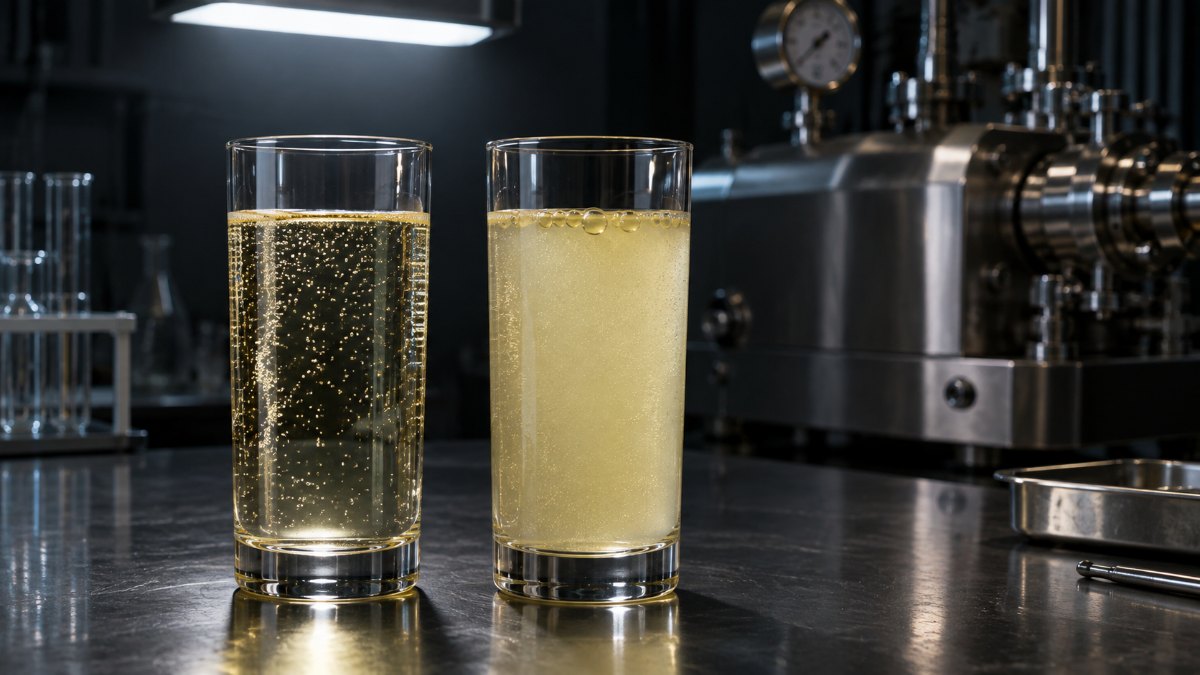
Why Most Cannabis Beverages Fail Within 6 Months
Cannabis nano emulsion for beverages requires droplet sizes between 20-100nm (PDI below 0.3) using high-pressure homogenization at 15,000-30,000 PSI or ultrasonication at 20-25 kHz. At 50nm average droplet size, THC bioavailability jumps from 6-10% (standard edible) to 50-85%, with onset dropping from 45-90 minutes to 10-20 minutes. Stability window at proper surfactant ratios (HLB 12-16): 6-12 months at room temperature. Most cannabis beverages on the market fail the 90-day stability test because their emulsions exceed 200nm and use single-surfactant systems that cannot survive temperature cycling during distribution.
That number, 6 months, is generous. Walk through any dispensary cooler and pull the oldest cannabis seltzer you can find. Hold it up to the light. If you see clouding, rings at the meniscus, or oil beading on the surface, the emulsion failed. The cannabinoids separated (see our nano emulsion troubleshooting guide for diagnostics). The dose printed on the label no longer matches what is in the liquid. This is the central problem in cannabis beverage formulation, and most companies solve it badly because they treat emulsion as a checkbox instead of the engineering problem it actually is.
The Oil-in-Water Problem: Why Cannabinoids Hate Water
THC and CBD are hydrophobic molecules with log P values of 6.97 and 6.33 respectively. For context, a log P above 5 means the compound is essentially insoluble in water. Ethanol has a log P of -0.31. Caffeine is 0.16. Cannabinoids are 35-45x more hydrophobic than caffeine on a logarithmic scale. Dissolving THC in water is like dissolving cooking oil in water. It does not happen without force.
Standard cannabis edibles avoid this problem entirely. They dissolve cannabinoids in fats (MCT oil, butter, coconut oil) and let the digestive system handle absorption. The trade-off: oral bioavailability of 6-10% because THC passes through the liver (first-pass metabolism) before reaching systemic circulation. CYP3A4 and CYP2C9 enzymes convert most of the THC to 11-OH-THC before it ever hits CB1 receptors. Onset: 45-90 minutes. Peak: 2-4 hours. Duration: 6-8 hours.
A beverage cannot deliver a fat glob floating on top of a drink and call it a product. The cannabinoid must be dispersed uniformly throughout the water phase in particles small enough that they do not separate under gravity, do not scatter light visibly, and absorb through the GI lining fast enough to produce onset times competitive with alcohol (10-20 minutes). That requires nano emulsion.
Nano Emulsion Fundamentals for Beverage Applications
A nano emulsion is a kinetically stable dispersion of oil droplets in water, with droplet diameters between 20-200nm. Below 100nm, the emulsion is optically transparent. Between 100-200nm, it is translucent. Above 200nm, it turns cloudy and will eventually separate. For cannabis beverages, the target is 20-100nm average droplet diameter with a polydispersity index (PDI) below 0.3.
Three parameters determine whether a cannabis nano emulsion works in a beverage:
- Droplet size. Smaller droplets absorb faster through intestinal epithelium via transcellular transport. At 50nm, absorption bypasses lymphatic routing entirely and enters the portal vein within minutes. At 200nm, absorption follows the same slow lymphatic pathway as standard edibles. The difference in onset is 10 minutes vs 60 minutes from the same dose.
- PDI. A PDI below 0.3 means the droplet size distribution is narrow. A PDI above 0.5 means you have a mix of 30nm and 300nm droplets. The small ones absorb fast, the large ones absorb slowly, and the consumer gets an unpredictable onset with a long tail. Consistency requires narrow distribution.
- Zeta potential. The surface charge on the droplets determines whether they repel each other or clump together over time. Target: more negative than -30mV. Below -30mV, electrostatic repulsion keeps droplets separated. Above -20mV, droplets aggregate within weeks, and the emulsion breaks.
| Parameter | Target Range | Acceptable | Failure Threshold | What Happens at Failure |
|---|---|---|---|---|
| Droplet Size (nm) | 20-50 | 50-100 | >200 | Visible clouding, slow onset (45+ min), separation within weeks |
| PDI | <0.2 | 0.2-0.3 | >0.5 | Inconsistent onset, unpredictable dosing, biphasic absorption curve |
| Zeta Potential (mV) | -40 to -50 | -30 to -40 | >-20 | Droplet aggregation, Ostwald ripening, emulsion breaks in 2-4 weeks |
| Surfactant HLB | 13-15 | 12-16 | <10 or >18 | Phase inversion (HLB too low) or excessive foaming and off-taste (HLB too high) |
| Oil Phase Loading (%) | 5-10 | 10-15 | >20 | Emulsion overloaded, droplet coalescence, visible oil layer |
Surfactant Selection: The Decision That Makes or Breaks Stability
The surfactant is the molecule that sits at the oil-water interface, with one end dissolved in the oil phase and the other in the water phase. It prevents droplets from merging back together after homogenization. Pick the wrong surfactant and your emulsion will look perfect on day one and be a separated mess by day thirty.
Every surfactant has a Hydrophilic-Lipophilic Balance (HLB) number. Low HLB (1-8) means the molecule is more oil-soluble. High HLB (12-18) means more water-soluble. For oil-in-water nano emulsions, you need HLB 12-16. Below 12, the surfactant cannot adequately stabilize oil droplets in water. Above 16, it foams excessively and imparts bitter, soapy off-flavors.
| Surfactant | HLB | Type | Best For | Limitations | Typical Loading (%) |
|---|---|---|---|---|---|
| Polysorbate 80 (Tween 80) | 15.0 | Synthetic nonionic | Smallest droplets (20-40nm), highest stability | Synthetic label concern, bitter at >2%, potential allergenic | 0.5-2.0 |
| Quillaja Saponin | ~13 | Natural (tree bark) | Clean-label products, moderate stability | Larger droplets (80-150nm), bitter at high concentration, foaming | 0.3-1.0 |
| Sucrose Esters (SE-15) | 15.0 | Natural-derived | Clean-label, neutral taste, good pH stability | Higher loading required, moderate droplet sizes (60-120nm) | 1.0-3.0 |
| Modified Starch (OSA) | ~12 | Natural-derived | Large-scale production, cost-effective | Large droplets (150-300nm), limited nano range, cloudy product | 5-15 |
| Lecithin (Soy/Sunflower) | 4-7 | Natural phospholipid | Co-surfactant only (paired with Tween 80 or Quillaja) | HLB too low for primary O/W emulsifier, oxidation-prone, soy allergen | 0.1-0.5 (as co-surfactant) |
| Polysorbate 20 (Tween 20) | 16.7 | Synthetic nonionic | High clarity, citrus-flavored beverages | Slightly less stable than Tween 80 for cannabinoids, synthetic label | 0.5-2.0 |
The industry trend is toward clean-label (Quillaja, sucrose esters, modified starch) and away from synthetic polysorbates. The trade-off is real: Tween 80 produces the smallest, most stable droplets. Quillaja produces larger droplets with a shorter stability window. Sucrose esters split the difference. Most successful commercial beverages use a blend: Quillaja or sucrose ester as the primary emulsifier with a small amount of lecithin as a co-surfactant to improve interfacial film flexibility.
Equipment and Processing Methods
Three mechanical methods produce cannabis nano emulsions at commercial scale. Each has a different throughput ceiling, droplet size floor, and capital cost.
High-Pressure Homogenization (HPH)
Pressures of 15,000-30,000 PSI force the coarse emulsion through a narrow valve gap. Shear, cavitation, and turbulence fragment droplets to 20-80nm in 1-3 passes. This is the gold standard for cannabis beverage production above 100 liters per day. Capital cost: $50,000-$200,000 for a production unit (GEA, Microfluidics, BEE International). The limitation is heat generation. Each pass through the homogenizer raises the emulsion temperature by 15-25C. Without inline cooling (jacketed heat exchanger on the outlet), you will thermally degrade cannabinoids and terpenes. THC begins to decarboxylate above 104C, and monoterpenes like myrcene begin to volatilize above 167C (their boiling point, not the emulsion temperature, but headspace loss starts well below that).
Ultrasonication
A titanium horn vibrating at 20-25 kHz creates cavitation bubbles that collapse with localized pressures exceeding 1,000 atm. Droplet sizes of 30-100nm are achievable. This is the most common method for small-batch cannabis emulsion (1-10 liters). Capital cost: $5,000-$30,000 (Qsonica, Hielscher, Sonics). The limitation is scale. Probe sonicators process 0.5-5 liters per batch. Flow-through sonicators push this to 10-50 liters per hour, but droplet uniformity degrades at higher flow rates because residence time in the cavitation zone decreases. At production volumes above 100 liters per day, high-pressure homogenization is more consistent and cost-effective per liter.
Microfluidization
A specialized form of high-pressure processing that forces the emulsion through fixed-geometry interaction chambers with precisely defined channel dimensions. Produces the most uniform droplet distribution (PDI consistently below 0.15) at 20-60nm. Capital cost: $100,000-$500,000 (Microfluidics Corp). This is the premium method used by beverage companies that need pharmaceutical-grade consistency for products sold through mainstream retail (dispensary to Target shelf). The limitation is throughput for the investment. A microfluidizer running at 10,000 PSI processes 5-20 liters per minute depending on the interaction chamber, but the chambers wear and need replacement every 500-1,000 hours of operation ($2,000-$5,000 each).
| Method | Droplet Size | PDI | Scale | Capital Cost | Cost/Liter | Best For |
|---|---|---|---|---|---|---|
| Ultrasonication | 30-100nm | 0.15-0.30 | 1-50 L/hr | $5K-$30K | $2-8 | R&D, small batch, startups |
| High-Pressure Homogenization | 20-80nm | 0.10-0.25 | 50-500 L/hr | $50K-$200K | $0.50-2 | Commercial production, dispensary brands |
| Microfluidization | 20-60nm | 0.05-0.15 | 300-1200 L/hr | $100K-$500K | $0.20-1 | Mass retail, pharmaceutical-grade consistency |
Flavor Masking: Why Cannabis Drinks Taste Bad and How to Fix It
THC tastes bitter. Not mildly bitter. Aggressively bitter. The bitterness comes from cannabinoid interaction with TAS2R bitter taste receptors on the tongue. THC activates TAS2R14 and TAS2R1 specifically. CBD activates TAS2R14 at even lower thresholds. Terpenes compound the problem: myrcene, limonene, and pinene are all hydrophobic and create a lingering earthy, piney, or citrus off-note that clashes with most beverage flavor profiles.
Nano emulsion makes the flavor problem worse, not better. Smaller droplets have more surface area per unit volume, which means more cannabinoid contact with taste receptors per sip. A 50nm emulsion puts more bitterness in your mouth than a 200nm emulsion at the same dose because the cannabinoids are more bioavailable in the oral cavity, not just the gut.
Five strategies that work:
- Flavor encapsulation. Encapsulate the cannabis oil phase inside a secondary wall material (cyclodextrin, modified starch, or protein-polysaccharide complex) before emulsification. This creates a physical barrier between cannabinoids and taste receptors. The barrier dissolves in the stomach (pH 1.5-3.5) but holds at oral pH (6.5-7.0). The beverage tastes clean in the mouth; the cannabinoid releases in the gut.
- Citric acid and malic acid co-formulation. Sour taste suppresses bitter perception through peripheral taste receptor cross-modulation. Citric acid at 0.3-0.8% w/v masks THC bitterness effectively in citrus, berry, and tropical flavor profiles. Malic acid (0.2-0.5% w/v) works better in apple and stone fruit profiles. The mechanism is competition at the taste bud level, not chemical interaction with THC.
- Sweetener systems. Sucralose at 50-100 ppm or stevia (Reb A) at 200-400 ppm suppresses bitterness through TAS2R competitive inhibition. Sugar (sucrose) at 6-10% w/v works but adds calories. Most commercial cannabis beverages use a blend: erythritol base (2-4% for mouthfeel) plus sucralose or stevia for sweetness. Avoid monk fruit alone. It has its own bitter undertone that compounds with cannabinoid bitterness.
- Cooling agents. Menthol or WS-23 (synthetic cooling compound) at 50-200 ppm activates TRPM8 cold receptors, which distracts from bitter perception. Common in cannabis seltzers. WS-23 is preferred over menthol because it provides cooling without the mint flavor that limits beverage style options.
- Carbonation. CO2 dissolved at 3.5-4.5 volumes activates TRPA1 receptors (the same ones that detect wasabi and mustard), creating a sharp, clean mouthfeel that cuts through bitterness. This is why cannabis seltzers are the dominant format. The carbonation burn, combined with citric acid and cooling agents, creates enough sensory complexity that the brain deprioritizes bitterness. Flat cannabis waters consistently score lower on taste panels.
Onset Pharmacokinetics: Why Nano Beverages Hit Faster
The onset difference between a cannabis beverage and a cannabis brownie is not marketing. It is pharmacokinetics driven by particle size and absorption pathway.
| Delivery Format | Droplet/Particle Size | Tmax (Time to Peak) | Bioavailability | Duration | Primary Absorption Route |
|---|---|---|---|---|---|
| Standard Edible (brownie, gummy) | Macro (>1000nm) | 60-120 min | 6-10% | 6-8 hrs | Lymphatic (slow, first-pass metabolism) |
| Nano Beverage (<100nm) | 20-100nm | 10-20 min | 50-85% | 2-4 hrs | Transcellular (fast, partial first-pass bypass) |
| Sublingual Tincture | Oil-based (bulk) | 15-45 min | 12-35% | 4-6 hrs | Buccal mucosa (bypasses GI, variable hold time) |
| Smoked/Vaped | Vapor/aerosol | 2-5 min | 30-50% | 1-3 hrs | Pulmonary (fastest, direct to blood) |
The 10-20 minute onset of nano beverages comes from the transcellular absorption pathway. At droplet sizes below 100nm, cannabinoid particles can pass directly through intestinal epithelial cells via transcytosis, entering the portal vein and reaching the liver within minutes rather than routing through the lymphatic system. Some fraction of sub-50nm droplets may even absorb through buccal and esophageal mucosa before reaching the stomach, further shortening onset.
The shorter duration (2-4 hours vs 6-8 hours) is the trade-off. Higher bioavailability means more of the dose reaches systemic circulation at once, producing a sharper peak and faster clearance. This matters for dosing: a consumer accustomed to 10mg edibles may feel 10mg in a nano beverage as equivalent to 30-50mg in a standard edible because 5-8x more THC reaches the bloodstream.
Stability Testing: The Protocol That Separates Real Products From Science Projects
A cannabis nano emulsion that looks perfect after 24 hours means nothing. The industry has a shelf life problem that most companies discover after product is on shelves, not before. Stability testing must happen before production scale-up, and it must simulate real-world conditions: temperature cycling during shipping, UV exposure on dispensary shelves, and the 90-day minimum retailers demand.
Five core tests cover the mechanisms that destroy cannabis nano emulsions: accelerated aging (chemical degradation and Ostwald ripening), temperature cycling (distribution chain stress), freeze-thaw cycling (ice crystal damage), centrifugation (gravitational instability), and pH drift monitoring (buffer failure and cannabinoid conversion). Skipping any one of them means you shipped a product you do not actually know will survive the supply chain.
Accelerated Aging Protocol (ICH Q1A Adapted)
Accelerated aging is the backbone of stability testing. The ICH Q1A guideline, adapted from pharmaceutical emulsion testing, uses elevated temperature and humidity to compress months of shelf life into weeks. The math follows the Arrhenius equation: every 10C increase roughly doubles the rate of chemical degradation. A 40C stress condition accelerates degradation approximately 4x compared to 25C storage, meaning 90 days at 40C approximates 12-18 months at room temperature.
Protocol:
- Prepare 12-16 identical samples from the same batch (3-4 per time point).
- Measure baseline parameters: particle size (Z-average by DLS), polydispersity index (PDI), zeta potential, pH, cannabinoid potency (HPLC), and visual appearance.
- Place samples in a stability chamber set to 40C +/- 2C and 75% +/- 5% RH.
- Pull 3-4 samples at T30, T60, and T90 days. Do not return opened samples to the chamber.
- Measure the same parameters at each time point. Compare to T0 baseline.
Pass/fail at each time point:
- Droplet size (DLS): Must remain within +/-20% of T0 value. If T0 = 60nm, the acceptable range at T90 is 48-72nm. Growth beyond 100nm indicates Ostwald ripening. The emulsion is unstable.
- PDI: Must remain below 0.3. A PDI above 0.3 means the distribution is broadening, which is the first visible sign of destabilization before phase separation occurs.
- Zeta potential: Must remain more negative than -25mV. Drift toward zero indicates loss of electrostatic stabilization. Below -30mV is ideal.
- Cannabinoid content (HPLC): Must remain within +/-10% of label claim at T90. THC oxidizes to CBN (see our extract stability science guide for degradation kinetics). CBD oxidizes to cannabinoid quinones. If CBN/THC ratio exceeds 5%, oxidation is the primary degradation pathway.
- pH: Must remain within +/-0.5 units of T0 value. Drift exceeding 0.5 units indicates buffer failure.
- Visual: No creaming, sedimentation, phase separation, ring formation at meniscus, or color change (amber/brown = oxidation).
Temperature Cycling Protocol
Cycle between 4C and 40C every 12 hours for 14 days (28 cycles). This simulates distribution chain stress: refrigerated warehouse to hot delivery truck to dispensary cooler to consumer fridge. Emulsions that survive 28 cycles without visible separation or droplet growth above 20% are distribution-stable. Most single-surfactant cannabis emulsions fail by cycle 10-15. Dual-surfactant systems with co-surfactant (Quillaja + lecithin, or Tween 80 + lecithin) consistently survive all 28 cycles.
Freeze-Thaw Cycling
Freeze-thaw tests whether the emulsion survives temperature extremes during winter shipping and cold warehouse storage. This is a different stress than temperature cycling: freezing causes ice crystal formation, and water expands approximately 9% when it freezes. The growing ice crystals mechanically rupture the surfactant monolayer around each oil droplet. When the ice melts, exposed oil droplets coalesce into larger droplets. A nano emulsion that creams after one freeze-thaw cycle has a distribution problem, not a formulation problem.
Protocol:
- Prepare 6 identical samples from the same batch (2 test, 2 control at 25C, 2 backup).
- Place test samples at -20C +/- 2C for 24 hours.
- Transfer to 25C +/- 2C for 24 hours. This is one cycle.
- Repeat for 5 complete cycles (10 days total).
- After cycle 5, bring samples to 25C and equilibrate for 2 hours.
- Measure: particle size, PDI, zeta potential, visual appearance. Compare to control samples.
Pass/fail criteria:
- Particle size (Z-average): within +/-25% of control after 5 cycles. Freeze-thaw is more aggressive than accelerated aging, so a wider tolerance is standard.
- PDI: below 0.35 (slightly relaxed from the 0.3 accelerated aging threshold).
- No visible creaming, sedimentation, or phase separation.
- Any oil droplets visible on surface = fail. This indicates coalescence from ice crystal damage to the surfactant layer.
Cryoprotectants reduce freeze-thaw failure: glycerol at 5-10% w/w reduces ice crystal size by increasing solution viscosity, and trehalose at 3-5% w/w forms a protective glass matrix around the droplets. Both change the flavor profile and must be formulated accordingly.
Centrifugation Stress Test
Centrifugation compresses months of gravitational settling into minutes. Spin the emulsion at 3,000g for 30 minutes at 25C. For beverages with lower viscosity, increase to 5,000g. A properly formulated nano emulsion with sub-100nm droplets and adequate surfactant coverage should resist centrifugal force without phase separation. If it separates under centrifugation, it will separate on the shelf.
Protocol:
- Fill centrifuge tubes with 10-15mL of sample. Balance tubes by mass (+/-0.1g).
- Centrifuge at 3,000g for 30 minutes at 25C. For beverages, increase to 5,000g.
- Remove tubes without disturbing the contents. Photograph immediately.
- Inspect for: cream layer on top, sediment on bottom, clear serum layer, or oil ring.
- If no visible separation, measure particle size and PDI of the supernatant. Compare to pre-centrifugation values.
Pass/fail criteria:
- No visible phase separation, creaming, or sedimentation after 30 minutes at 3,000g.
- Post-centrifugation particle size within +/-15% of pre-centrifugation value.
- Post-centrifugation PDI below 0.3.
- Any visible separation = immediate fail. Do not ship this batch.
A fail at 3,000g does not necessarily mean the emulsion is worthless. It means the surfactant system needs adjustment: either higher surfactant concentration (try increasing by 0.5% w/w increments), a different HLB value (shift +/-1 unit from current), or additional co-surfactant (0.1-0.5% w/w lecithin or polysorbate 80 as a secondary stabilizer).
pH Stability and Drift Monitoring
Cannabinoid stability is pH-dependent. THC degrades faster above pH 7 (alkaline hydrolysis). CBD isomerizes to delta-9-THC under acidic conditions below pH 2. The sweet spot for cannabis nano emulsions is pH 4.0-6.5, depending on the surfactant system.
Protocol:
- Calibrate pH meter with fresh buffer solutions (pH 4.0 and 7.0, two-point calibration).
- Measure pH of each sample at T0. Record to two decimal places.
- Measure pH at every time point during accelerated aging (T30, T60, T90).
- Also measure pH before and after each freeze-thaw cycle to track drift.
Pass/fail criteria:
- pH must remain within +/-0.5 units of T0 throughout the study.
- Drift exceeding 0.5 units indicates buffer failure. Increase buffer concentration or switch buffer type.
- If pH drops below 3.5 at any point, test for CBD-to-THC conversion (HPLC). This is a regulatory compliance issue.
- If pH rises above 7.0, test for THC degradation to CBN (HPLC).
Buffer systems for cannabis emulsions: Citric acid/sodium citrate (pH 3.0-6.2, most common for beverages), phosphate buffer (pH 5.8-8.0, less common due to taste), and acetate buffer (pH 3.6-5.6, alternative for low-pH products). Buffer concentration typically 10-50mM.
Stability Pass/Fail Thresholds: Summary
| Parameter | Ideal (T0) | Acceptable (T90) | Fail Threshold | Failure Mechanism |
|---|---|---|---|---|
| Z-Average (nm) | 20-80 | Within +/-20% of T0 | >100nm or >20% growth | Ostwald ripening or coalescence |
| PDI | <0.2 | <0.3 | >0.3 (accelerated) / >0.35 (freeze-thaw) | Distribution broadening |
| Zeta Potential (mV) | <-30 | <-25 | >-20 | Electrostatic stabilization loss |
| pH | 4.0-6.5 | Within +/-0.5 of T0 | <3.5 or >7.0 | Buffer failure, CBD isomerization or THC hydrolysis |
| Cannabinoid Potency | 100% of label | Within +/-10% | >10% loss from T0 | Oxidation, hydrolysis, or light degradation |
| Centrifugation (3,000g/30min) | No separation | Particle size +/-15% | Any visible phase separation | Insufficient surfactant coverage |
| Freeze-Thaw (5 cycles) | No separation | Particle size +/-25% | Any oil droplets or creaming | Ice crystal damage to surfactant layer |
Equipment for In-House Stability Testing
| Equipment | Purpose | Price Range | Can Outsource? |
|---|---|---|---|
| DLS Instrument (Malvern Zetasizer, Anton Paar Litesizer) | Particle size, PDI, zeta potential | $30,000-$80,000 | Yes ($50-150/sample) |
| Stability Chamber (Binder, Memmert) | 40C/75% RH accelerated aging | $3,000-$8,000 | No (need continuous access) |
| Centrifuge (benchtop, 5,000g+) | Centrifugation stress test | $1,500-$5,000 | No |
| pH Meter (Mettler Toledo, Hanna) | pH monitoring | $200-$1,000 | No |
| HPLC System | Cannabinoid potency, degradation products | $50,000-$150,000 | Yes ($50-100/test) |
| Freezer (-20C) | Freeze-thaw cycling | $500-$2,000 | No |
The minimum in-house setup: a stability chamber, centrifuge, pH meter, and freezer. Approximately $5,000-$15,000 in equipment. The DLS and HPLC can be outsourced to a contract lab at $100-250 per time point. A full 90-day stability study with outsourced particle size and potency runs approximately $1,500-$3,000 per batch. That cost is negligible compared to a product recall.
Interpreting Results: Ship, Shorten Shelf Life, or Reformulate
Ship if: All parameters are within spec at T90 under accelerated conditions. Centrifugation and freeze-thaw passed. pH stable. Potency within 10%. This product has a validated 12-18 month shelf life.
Ship with shortened shelf life if: Parameters drift outside spec between T60 and T90 but remain in spec at T60. This product is stable for 6-12 months under room temperature storage. Label accordingly.
Reformulate if: Parameters drift outside spec before T30 under accelerated conditions, or centrifugation/freeze-thaw fail. This emulsion will separate within 3-6 months under real conditions. Common fixes: adjust surfactant concentration (try 1-3% w/w Tween 80 or 0.5-2% w/w Span 80 in combination), add ripening inhibitor, increase processing intensity, or reformulate the oil phase.
Kill the formulation if: Multiple parameters fail simultaneously at T30 (particle size >200nm, PDI >0.5, visible separation). The surfactant system is fundamentally mismatched to the oil phase. Start over with a different surfactant/co-surfactant system at a different HLB range.
Building a Stability Testing Schedule Into Production
Stability testing is not a one-time validation exercise. Every significant formulation change, every new raw material lot, and every scale change triggers a new stability study. The practical approach:
- Full stability study (90-day accelerated): Run on the initial formulation, after any formulation change, after any scale-up (1L to 10L to 100L), and annually as a shelf-life reconfirmation.
- Abbreviated stability check (centrifugation + 30-day accelerated): Run on every production batch. Takes 30 days but catches most instabilities. If abbreviated check passes, the batch ships. If it fails, pull and reformulate.
- Incoming material check (centrifugation only): Run on every batch before it enters finished goods inventory. Takes 30 minutes. Catches catastrophic instabilities from raw material lot variation.
A stability chamber costs $3,000-$8,000. A product recall costs $50,000+. The math is not complicated. If you want to learn the full emulsion production and testing process hands-on with SOPs you can actually deploy, that is exactly what we built extractiontraining.com for.
Seven Failure Modes That Kill Cannabis Beverages
| Failure Mode | Root Cause | Visual Symptom | Diagnostic Test | Fix |
|---|---|---|---|---|
| Creaming (oil ring at top) | Droplets >200nm, insufficient surfactant, or density mismatch | Visible oil layer or ring at meniscus | DLS shows mean >200nm or PDI >0.5 | Increase homogenization pressure or passes; add weighting agent (ester gum, SAIB) |
| Ostwald Ripening | Small droplets dissolve and redeposit on large ones (driven by Laplace pressure) | Gradual clouding over weeks, mean size increase | DLS at baseline vs 30 days: >20% size increase | Add ripening inhibitor (long-chain triglyceride or mineral oil in oil phase); narrow PDI |
| Coalescence | Surfactant film too thin or too rigid; insufficient zeta potential | Rapid separation, oil globules visible within days | Zeta potential >-20mV; surfactant loading below CMC | Increase surfactant to above CMC; add co-surfactant for film flexibility |
| pH-Induced Destabilization | Acidic beverage (pH <3.5) degrades surfactant or neutralizes surface charge | Flocculation after adding to acidic base, cloudiness | Measure zeta at beverage pH; if >-15mV, charge neutralized | Use pH-stable surfactants (sucrose esters stable pH 3-8); coat droplets with protein-polysaccharide complex |
| Cannabinoid Degradation | UV light, dissolved oxygen, or heat oxidize THC to CBN and CBD to quinones | Color change (clear to amber/brown), potency below label claim | HPLC potency test: >10% loss from label, CBN increase | Nitrogen sparging (remove dissolved O2); amber or opaque packaging; add antioxidant (ascorbic acid 0.05-0.1%) |
| Flavor Fade | Terpene volatilization or surfactant-flavor interaction (Tween absorbs flavor compounds) | Product tastes different after 30-60 days; flavor intensity drops | GC-MS headspace analysis: terpene and flavor compound loss >30% | Nitrogen blanket headspace; encapsulate flavor separately; select surfactants with low flavor binding |
| Inconsistent Dosing | Non-uniform emulsion (high PDI), settlement in filling line, or poor mixing before fill | No visual symptom; discovered in QC testing (can-to-can variance >15%) | Test 10 cans from same batch: CV >15% on THC content | Inline homogenization before filler; PDI below 0.25; recirculation during filling |
Regulatory Considerations by State
Cannabis beverage regulations vary wildly. The THC limit per serving, per package, and the definition of “serving” differ by state. Fast-onset nano beverages create additional regulatory complexity because traditional edible dosing guidance (5-10mg, wait 2 hours) does not apply when onset is 10-20 minutes.
Key regulatory variables to check before formulating for any state market:
- Per-serving THC limit: Colorado, California, and most rec states cap at 10mg THC per serving. Some markets allow 100mg per package (10 servings). Illinois caps at 100mg per package for rec. Medical programs often allow higher (100mg+ per serving in some states).
- Nano-specific rules: As of 2026, no state explicitly regulates nano emulsion as a separate category, but some (Colorado, California) require onset time or enhanced bioavailability disclosure on labels. Colorado’s HB 21-1317 requires labeling that accounts for “fast-acting” products. This is evolving rapidly.
- Homogeneity testing: Several states (Colorado, Oregon) require homogeneity testing proving that every serving in the package contains within 10-15% of the labeled THC dose. This is where inconsistent emulsions (failure mode #7) create compliance failures.
- Water-soluble vs oil-based labeling: Some states require products to specify whether the cannabinoid is “water-soluble” or “oil-based” because the effective dose differs. A 5mg nano beverage may produce effects equivalent to a 15-25mg traditional edible.
If you want to learn this entire process hands-on, from emulsification to stability testing to filling line optimization, that is exactly what we built extractiontraining.com for.
Scale-Up Decision Framework
The path from R&D bench (1 liter) to commercial production (1,000+ liters per day) is where most cannabis beverage companies fail. What works at bench scale does not scale linearly. The physics change.
- 1-10 liters (R&D): Probe sonicator. Manual mixing. Bench-top DLS for QC. Total investment: $10K-$30K. At this scale, you can achieve 30-60nm droplets with 5-10 minutes of sonication per liter. Good for formula development and stability testing. Not viable for production.
- 10-100 liters (Pilot): Flow-through sonicator or small HPH. Semi-automated. You need a jacketed mixing vessel with temperature control because bulk volumes retain heat from processing. Expect droplet sizes 50-100nm (larger than bench due to reduced cavitation intensity per unit volume). Investment: $30K-$80K.
- 100-1,000+ liters (Production): High-pressure homogenizer or microfluidizer with inline cooling, nitrogen sparging, and automated filling line. CIP (clean-in-place) capability is non-negotiable at this scale. Droplet size targets must be validated at production throughput, not extrapolated from bench. Investment: $200K-$1M+.
The mistake most startups make: they develop a formula on a probe sonicator, scale up to a different piece of equipment (HPH), and find that the formula does not produce the same droplet size, PDI, or stability at scale. The equipment change is a formula change. Revalidate everything when you change the energy input method.
Frequently Asked Questions
What is the minimum droplet size needed for a cannabis beverage to be clear?
Below 100nm, the emulsion is optically transparent because the droplets are smaller than the wavelength of visible light (400-700nm). Between 100-200nm, the product appears slightly translucent or hazy. Above 200nm, it is cloudy. Most commercial cannabis seltzers target 30-80nm for clarity.
Can I use MCT oil as the carrier oil in a nano emulsion?
MCT oil (medium-chain triglycerides, C8-C10) is the most common carrier oil for cannabis nano emulsion. It has low viscosity, good cannabinoid solubility (dissolves THC and CBD readily at 100+ mg/mL), and produces smaller droplets than long-chain triglycerides because the shorter chain length reduces interfacial tension. The one limitation: MCT oil contributes a slight coconut/oil flavor note that can be detected in light-flavored beverages like unflavored seltzer. Hemp seed oil is an alternative but produces larger droplets and has a stronger flavor.
How long does a cannabis nano emulsion last on the shelf?
A properly formulated nano emulsion (sub-80nm, PDI below 0.25, dual-surfactant system, nitrogen-sparged, amber or opaque packaging) lasts 9-12 months at room temperature without significant droplet growth or potency loss. A poorly formulated one (200nm+, single surfactant, high PDI) may separate within 2-4 weeks. The accelerated stability protocol above predicts real-world shelf life before you commit to production.
Why do some cannabis drinks hit harder than the label says?
Bioavailability. A 5mg nano beverage at 50-85% bioavailability delivers 2.5-4.25mg of THC to systemic circulation. A 10mg standard gummy at 6-10% bioavailability delivers 0.6-1.0mg. The nano beverage at half the labeled dose delivers 2.5-7x more THC to the bloodstream. Consumers who dose nano beverages the same as gummies often overconsume. Responsible brands are starting to lower per-serving doses to 2.5mg to account for this.
What is the best surfactant for clean-label cannabis beverages?
Quillaja saponin paired with sunflower lecithin as co-surfactant. Quillaja is plant-derived (South American soapbark tree), GRAS-listed, and produces droplets in the 80-120nm range at 0.3-0.8% loading. The lecithin co-surfactant (0.1-0.3%) improves interfacial film flexibility and extends shelf life. The trade-off vs synthetic Tween 80: larger droplets (80-120nm vs 20-40nm) and slightly longer onset (15-25 min vs 10-15 min). For most beverage brands, this trade-off is acceptable for the “clean label” positioning.
Does carbonation affect emulsion stability?
Carbonation itself does not destabilize a well-formulated nano emulsion. CO2 dissolved in water forms carbonic acid, which lowers pH to approximately 3.5-4.0 at 4 volumes of carbonation. The pH drop can destabilize emulsions that rely on pH-sensitive surfactants or protein-based emulsifiers. Polysorbate 80 and sucrose esters are stable at pH 3-8 and work well in carbonated applications. Protein-based emulsifiers (whey, pea protein) aggregate below pH 4.5 and should not be used as primary emulsifiers in carbonated beverages.
What testing equipment do I need for cannabis beverage QC?
Minimum: dynamic light scattering (DLS) instrument for droplet size and PDI ($15,000-$40,000 for a Malvern Zetasizer or equivalent), zeta potential measurement (often integrated in the DLS unit), HPLC for cannabinoid potency ($30,000-$80,000), and pH meter. For production QC, add: turbidimeter ($2,000-$5,000) for rapid inline clarity checks, and refractometer for Brix verification if using sweeteners.
Can I skip centrifugation testing if accelerated aging passes?
No. Accelerated aging and centrifugation test different failure mechanisms. Accelerated aging primarily catches Ostwald ripening and chemical degradation. Centrifugation catches gravitational instability from density mismatch between oil and water phases. An emulsion can pass accelerated aging (no ripening) but fail centrifugation (density-driven separation) if the surfactant coverage is marginal. Run both.
What is the difference between PDI and particle size for predicting shelf life?
Particle size (Z-average) tells you how big the droplets are on average. PDI tells you how uniform the distribution is. A Z-average of 60nm with PDI of 0.1 is a tight, monodisperse emulsion that will ripen slowly. A Z-average of 60nm with PDI of 0.4 is a broad, polydisperse emulsion where small droplets will dissolve and feed large droplets rapidly. PDI is often the better predictor of shelf life because it captures the distribution heterogeneity that drives Ostwald ripening. Track both, but if you can only measure one, PDI is more informative for stability prediction.
