
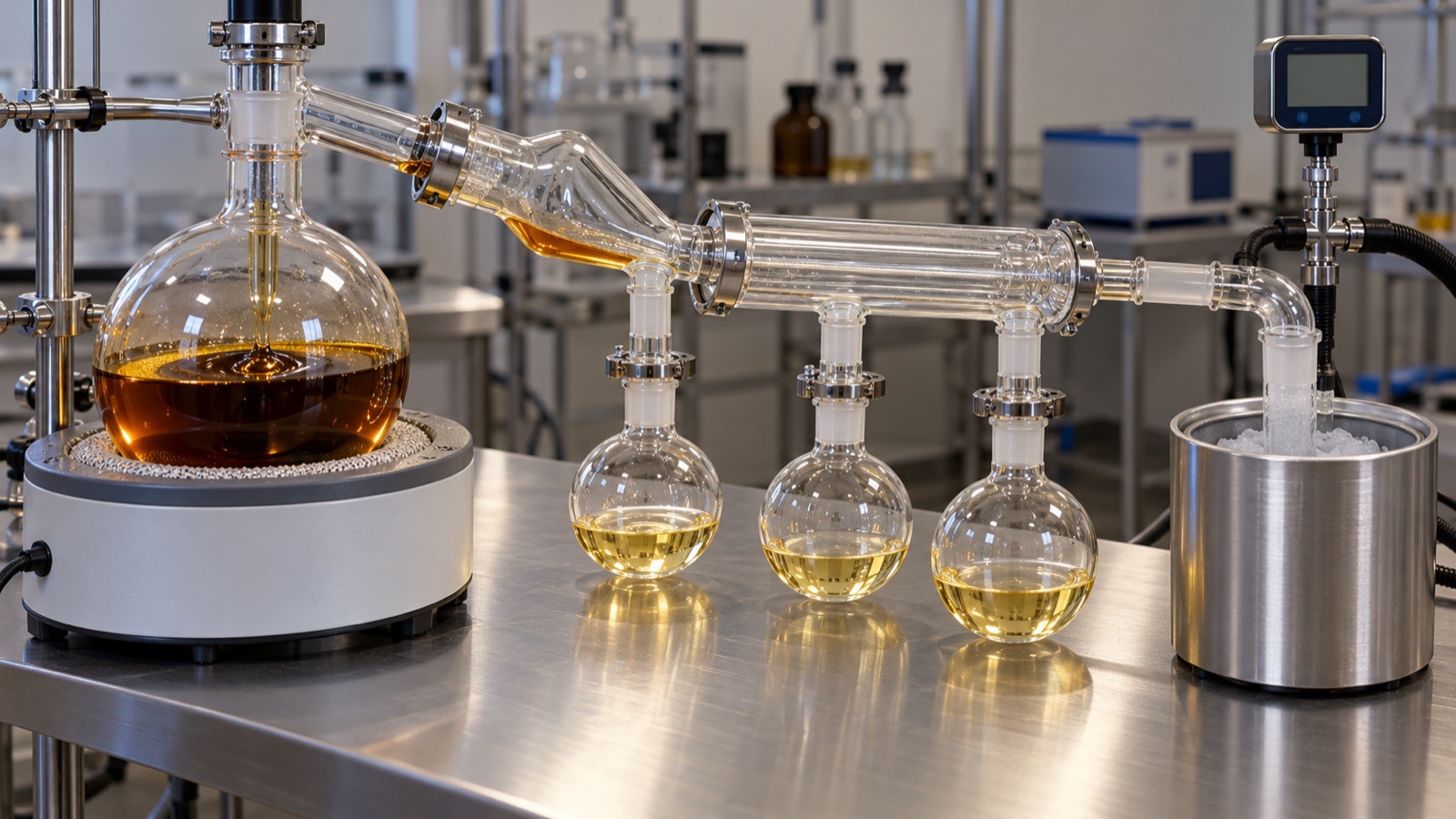
Cannabis distillation is a boiling-point separation run under deep vacuum. Every compound in your crude, the terpenes, the cannabinoids, and the residual solvents, carries a different vapor pressure, and vacuum is the lever that lets you exploit those differences without cooking the product. At atmospheric pressure THC will not distill cleanly because it starts to decompose before it ever evaporates. Drop the pressure into the micron range, below 0.1 Torr, and the temperature needed to push THC into vapor falls low enough to collect it intact. That is the entire mechanism: lower the pressure, lower the working temperature, lower the thermal damage. Get the vacuum wrong and you are not distilling, you are degrading.
Theory only takes you as far as your feed allows. The practical companion to this is wiped film evaporator feed preparation, which maps each out-of-spec crude variable to the distillation failure it causes.
📺 Watch the full video: “Why Distillation Is The Key To Every Lab! 3-C”
What Is Cannabis Distillation, Really?
At its core, cannabis distillation is the purification of a liquid mixture through selective evaporation and recondensation. You’re taking a crude extract, a complex soup of cannabinoids, terpenes, lipids, and other compounds, and using heat and vacuum to separate what you want from what you don’t.
This isn’t magic. It’s thermodynamics. Every compound in your crude has a specific boiling point, and by carefully controlling temperature, you can evaporate them one at a time, collect them separately, and end up with cannabis distillate at 90% purity or higher. For solvent recovery applications, you’re looking at 98–99% purity. That’s the power of understanding the distillation process for cannabis extraction.
Vapor Pressure: The Driving Force Behind Distillation
Here’s something a lot of operators get wrong: vapor pressure is determined by temperature alone. Not the volume of your flask, not the surface area of your oil, not how hard you’re wishing. Temperature. That’s it.
Every liquid exerts a vapor pressure, molecules at the surface are constantly escaping into the gas phase. When vapor pressure equals atmospheric pressure, you’ve hit the boiling point and the liquid begins to evaporate freely. This is the fundamental principle that makes botanical extract purification through distillation possible.
Think of it this way: your crude contains dozens of compounds, each with its own vapor pressure curve. As you raise the temperature, compounds hit their boiling points in sequence, lighter, more volatile compounds first, heavier ones later. This predictable order is what allows you to collect specific fractions during THC distillation and other cannabinoid purification runs.
Why Vacuum Distillation Is Non-Negotiable
Here’s the problem with distilling cannabis extracts at normal atmospheric pressure: the boiling points of cannabinoids are high enough that the heat required would degrade them. You’d be destroying your product in the process of purifying it. That’s where vacuum distillation comes in.
A vacuum pump reduces the atmospheric pressure inside your system. Lower pressure means lower boiling points, which means you need less heat to evaporate your target compounds. This is critical for cannabis distillation because cannabinoids are thermally sensitive. Hit them with too much heat and you’ll convert, degrade, or destroy the very compounds you’re trying to isolate.
Vacuum is measured in inches of mercury (inHg), with a theoretical maximum around 29.9 inHg at sea level. One thing worth noting: if your lab is at a higher elevation, you’re actually starting with less atmospheric pressure, which means pulling a deep vacuum is slightly easier. It’s a small advantage, but it matters when you’re dialing in precise parameters for your distillation process.
The Three Fractions: Heads, Main Body, and Tails
During any cannabis distillation run, you’re collecting three distinct fractions, and understanding them is essential:
Heads, These come off first. They contain the lighter, more volatile compounds: residual solvents, terpenes, and other low-boiling-point substances. Heads are everything that evaporates before your target cannabinoids. You collect these separately and set them aside.
Main Body, This is what you’re after. The main body fraction contains your target cannabinoids, the compounds that make cannabis distillate valuable. This is where your THC, CBD, and other desired cannabinoids concentrate. Proper collection of the main body is where operator skill and understanding of the distillation process really show.
Tails, These come off last and contain heavier compounds with higher boiling points. Collecting tails means you’ve pushed past your target fraction. Running too far into tails contaminates your main body and drops your purity.
The art of distillation is knowing exactly when to switch between fractions. Too early and you leave product behind. Too late and you contaminate what you’ve collected.
The CBD and Delta-8 Myth: What Distillation Can’t Do
Let’s set the record straight on something: you cannot separate CBD from delta-8 or delta-9 THC using distillation alone. Their boiling points are too close together. Anyone telling you otherwise is, and I’ll be direct here, a rookie.
This is a common misconception in cannabis distillation, and it leads operators down dead ends. Short path distillation and wiped film distillation are incredibly powerful tools for purification, but they work by separating compounds with meaningfully different boiling points. When compounds are thermally similar, like the major cannabinoids, you need other techniques (chromatography, for example) to achieve separation.
Understanding this limitation is just as important as understanding what distillation can do. It saves you time, money, and frustration.
Condensation: The Other Half of the Equation
Evaporation gets all the attention, but condensation is equally critical to a successful cannabis distillation run. Once your target compounds are in the vapor phase, they need to be cooled and recollected as liquid, that’s where your condenser comes in.
The key principle here is the dew point: the temperature at which vapor begins to condense back into liquid. Your condenser needs to be cold enough to efficiently recondense your target vapors, but here’s the catch, it can’t be too cold.
Cannabis distillate is viscous. If your condenser is excessively cold, the oil condenses but becomes too thick to flow down into your collection flask. It just sits there, coating the glass, reducing your yield, and creating a mess. The general rule of thumb is to keep your condenser temperature roughly 40°C colder than your evaporation temperature. This gives you efficient condensation while keeping the oil fluid enough to flow.
This is one of those details that separates experienced operators from beginners. It’s not just about getting compounds into the gas phase, it’s about getting them back into liquid form and into the right flask.
Vacuum Depth: What Each Pressure Regime Actually Buys You
Distillation theory only becomes useful when you tie a target vacuum to a real outcome. Not all vacuum is equal. The gap between a rotary vane pump limping along at 500 microns and a fresh two-stage pump holding 20 microns is the gap between a hot, dark, terpene-stripped run and a clean single pass. Here is what each pressure regime actually lets you do.
| Vacuum Level | Typical Source | What It Buys You | Reality Check |
|---|---|---|---|
| 1 to 5 Torr (1,000 to 5,000 micron) | Rotary vane at end of service life, or a worn diaphragm pump | Terpene and residual solvent stripping only | Main-body cannabinoids need mantle temps high enough to darken and isomerize. You will chase color all day. |
| 100 to 500 micron (0.1 to 0.5 Torr) | Healthy two-stage rotary vane, clean oil, good seals | Workable single-pass distillate | Vapor temp runs hot at the top of this range. A vapor temp that keeps climbing while the mantle holds steady means a vacuum leak, not a hotter run. |
| 5 to 50 micron (0.005 to 0.05 Torr) | Diffusion pump, or a two-stage pump backed by a deep cold trap | Low-temperature main body, best clarity, lowest thermal load | Your cold trap and gasket quality now set the floor, not the pump rating. One bad KF fitting can cap you at 200 micron. |
The pump you choose to hit these numbers is a separate decision, covered in the pump table below. The vacuum you can actually hold also depends on upstream work: crude that still carries light solvents or water will outgas and spike your pressure, which is why proper winterization and dewaxing before distillation directly set the vacuum floor you can reach. If you are still dialing in the hardware and first-pass workflow, the full build is in our short path distillation setup and SOP guide.
Vacuum System Selection: Which Pump for Which Lab
The vacuum pump is the single most expensive consumable decision in your distillation setup. Pick wrong and you are either leaving product behind (insufficient vacuum) or spending $3,000 a year in oil changes you did not budget for.
| Pump Type | Ultimate Vacuum | Flow Rate (CFM) | Maintenance | Cost Range | Best For |
|---|---|---|---|---|---|
| Rotary Vane (oil-sealed) | 0.001 mbar (deep) | 3-12 CFM | Oil change every 20-40 hours | $400-$2,500 | Short path setups, bench scale. Workhorse of small labs. |
| Diaphragm (oil-free) | 1-10 mbar (moderate) | 0.5-3 CFM | Diaphragm swap every 5,000-10,000 hrs | $1,200-$4,000 | Solvent recovery, rotovap. Not deep enough for final distillation passes. |
| Scroll (oil-free) | 0.01-0.1 mbar | 5-15 CFM | Tip seal every 15,000-30,000 hrs | $3,000-$10,000 | Production scale. No oil changes. Higher upfront, lower operating cost. |
| Diffusion (with roughing pump) | 0.0001 mbar (ultra-deep) | N/A (conductance-limited) | Fluid replacement every 1-2 years | $2,000-$8,000 | Wiped film evaporators. Required for molecular distillation. |
The rookie mistake is buying a diaphragm pump for distillation and wondering why the heads fraction never fully clears. Diaphragm pumps top out around 1-10 mbar. First-pass cannabis distillation typically needs 0.1 mbar or deeper to hit the 160-180C mantle range without thermal degradation. If your pump cannot pull deep enough, you compensate with more heat, and more heat means more degradation, more color, more CBN in your main body.
For most short path setups under 5 liters, a quality rotary vane pump with regular oil changes is the right answer. Budget $100-200 per year for pump oil and plan to change it every 20-40 run hours. Contaminated oil means reduced ultimate vacuum, which means higher operating temperatures, which means lower purity. The $30 oil change you skipped costs you $300 in lost product quality.
Fraction Collection Reference: What to Collect and When
Fraction collection is where distillation goes from theory to skill. The transition points between heads, main body, and tails are not sharp lines. They are gradients.
| Fraction | Mantle Temp | Vapor Temp | Vacuum | Visual Cues | What You Are Collecting |
|---|---|---|---|---|---|
| Heads | 100-160C | 50-120C | 0.01-0.1 mbar | Clear to pale yellow. Fast drip. Strong terpene smell at cold trap. | Residual solvents, monoterpenes (myrcene BP 167C, limonene 176C), water, light volatiles. |
| Transition | 160-175C | 120-155C | 0.01-0.05 mbar | Color shifts clear to light gold. Drip rate slows then accelerates. Terpene smell fades. | Mixed fraction. Collect separately for reprocessing. |
| Main Body | 175-220C | 155-185C | 0.01-0.05 mbar | Golden to light amber. Consistent drip rate. Condenser coats evenly. | THC, CBD, minor cannabinoids. Target: 85-95% total cannabinoids. |
| Tails | 220C+ | 185C+ | 0.01-0.05 mbar | Dark amber to brown. Drip rate drops sharply. Smoke or off-gas from flask. | Sesquiterpenes, CBN (from THC thermal isomerization), residual waxes, chlorophyll. |
These temperature ranges assume properly winterized BHO or ethanol crude at 0.01-0.05 mbar vacuum. If your vacuum is shallower, every temperature shifts upward. If your crude was not winterized, wax fouling will disrupt fraction transitions regardless of temperature control.
The single most important number on this table is your vapor temperature, not your mantle temperature. Mantle temp tells you what heat you are applying. Vapor temp tells you what is actually evaporating. If your mantle is at 200C but your vapor reads 130C, you have a heat transfer problem: insufficient stirring, oil too thick, or cold spots in your flask. Trust the vapor thermometer.
Temperature Ramp Optimization
Temperature ramp rate is the variable most operators get wrong and never realize it. Too fast and you co-distill compounds that should have separated. Too slow and you spend 12 hours on a run that should take 4.
Heads ramp: 2-3C per minute. Move through quickly. These are volatile compounds that come off easily. Get through it, collect the terpenes and residual solvents, move on.
Transition zone: 0.5-1C per minute. Slow down here. The transition between heads and main body determines separation quality. A fast ramp drags terpenes into your main body, reducing purity and adding flavor compounds you do not want in distillate.
Main body: 1-2C per minute. Steady, controlled increase. The goal is a consistent drip rate. If you see stall-surge patterns (drip stops, then floods), you ramped too fast. Compounds are co-distilling in batches rather than separating cleanly.
End of main body: WATCH THE COLOR. When distillate darkens from golden to amber, you are entering tails. Experienced operators stop collection 5-10 minutes before the color shift becomes obvious, because the compounds causing that shift are already in the vapor path before they show up in the receiver.
If you want to learn temperature programming, fraction management, and the full distillation workflow hands-on, that is exactly what we built extractiontraining.com for. The course walks through every step from crude to finished distillate.
Distillation Troubleshooting: Diagnosis and Fixes
Every distillation problem traces back to one of five root causes: vacuum leak, heat control failure, crude quality, condenser temperature, or operator timing.
| Symptom | Likely Cause | Verify | Fix |
|---|---|---|---|
| Dark main body (amber/brown) | Mantle temp too high, pushing into tails. OR crude not properly winterized. | Check vacuum gauge. If shallow (>0.1 mbar), pump is forcing heat compensation. If deep and still dark, crude quality. | Reduce mantle 10C. Verify vacuum depth. Re-winterize at -40C before next run. |
| Low yield (30-40% vs expected 60-70%) | Condenser too cold (oil coating glass, not flowing). OR switched to tails receiver too early. | Inspect condenser after run. Thick oil film = too cold. Clean glass = stopped too soon. | Raise condenser 10-15C. Extend main body until drip rate drops below 1 per 10 seconds. |
| Vacuum fluctuates / cannot reach depth | Vacuum leak. Most common: joint connections, stopcocks, thermometer adapter seals. | Isolate sections, close stopcocks, test each segment. Vacuum grease all joints. | Replace O-rings. Re-grease with high-vacuum silicone. Replace cracked glass. Check pump oil. |
| Bumping (violent boiling) | Ramp too fast. Dissolved gases/solvents releasing suddenly. No stirring. | If early in run = residual solvent. If later = aggressive ramp rate. | Add stir bar. Reduce ramp to 1C/min. Ensure full solvent recovery (rotovap) before loading. |
| Off-flavor / terpene taste in distillate | Heads not fully collected. Monoterpenes co-distilling into main body. | Smell cold trap. Strong terpene = heads adequate. Weak = terpenes went to main body. | Extend heads collection. Wait for vapor temp plateau (2+ min stable) before switching. |
| Second pass lower purity than first | Thermal degradation on first pass created CBN/delta-8 isomers that co-distill on second. | HPLC: compare CBN/delta-8 between first and second pass. If increased, thermal degradation confirmed. | Lower first-pass mantle temp. Max vacuum depth. Evaluate whether second pass is needed (often not if first >90%). |
| Pump oil turns dark/milky after one run | Solvent/terpene vapor reaching pump. Cold trap not functioning. | Check cold trap temp (-40C minimum). If dry ice depleted or trap undersized, vapors bypass. | Replenish cold trap (dry ice/IPA slurry at -78C). Change pump oil immediately. Contaminated oil = reduced vacuum. |
The pattern across all these problems is the same: measure, do not guess. A $50 thermocouple on your vapor path and a $100 vacuum gauge on your system tell you more about your run quality than any amount of experience alone.
Bringing It All Together
Cannabis distillation is fundamentally about controlling three things: evaporation, condensation, and timing. The vacuum system determines your operating floor. The fraction collection protocol determines your ceiling. And the troubleshooting framework keeps you from losing product to mistakes you could have diagnosed in 30 seconds. You use heat and vacuum to selectively evaporate compounds based on their vapor pressure and boiling points. You use a properly tempered condenser to recollect them as purified liquid. And you use your knowledge of fraction collection to separate heads, main body, and tails into distinct cuts.
The result? Cannabis distillate at 90%+ purity, a clean, potent product that serves as the backbone of countless downstream applications.
This is the theory. The foundation. Whether you’re running a short path distillation setup or operating a wiped film distillation system, these principles don’t change. The apparatus is different, the throughput is different, but the thermodynamics are the same.
This post is based on the WKU Consultants video series on laboratory buildout. Watch the full video on YouTube for Grim’s complete breakdown of distillation theory.
Need help building out your distillation process or optimizing your lab? WKU Consultants provides expert virtual consulting for cannabis laboratories, from SOPs to equipment selection to operator training. Get in touch today.
For more deep dives into cannabis chemistry, extraction SOPs, and lab design, subscribe to the WKU Consulting YouTube channel. New videos every week covering everything from distillation theory to advanced cannabinoid conversions.

[…] Solvent-based extraction is a common method of cannabis extraction that involves the use of a solvent (such as ethanol or butane) to dissolve the active compounds from the plant material. The solvent is then evaporated, leaving behind a concentrated extract that can be further processed and purified through distillation. […]