
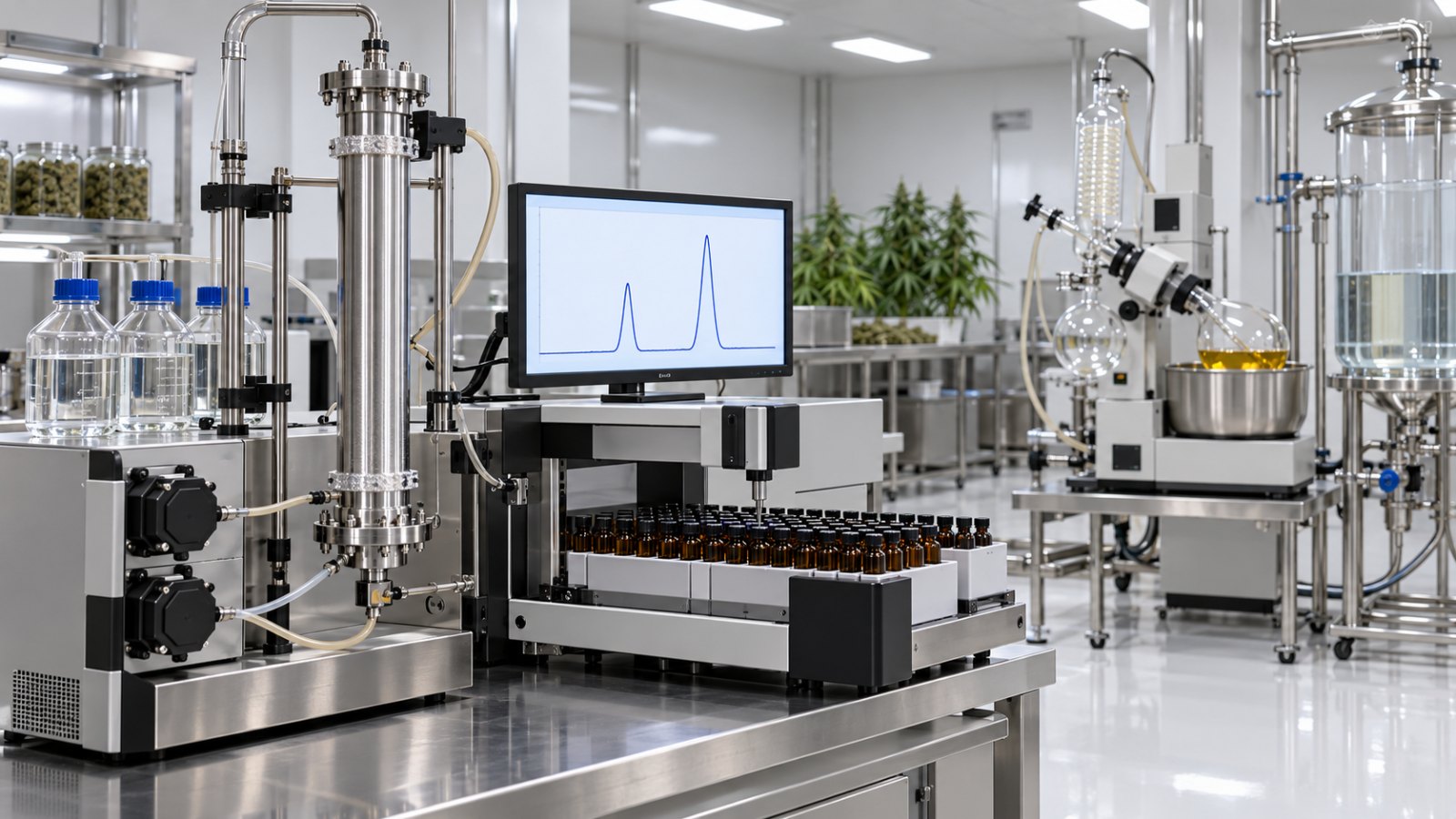
Preparative chromatography isolates one cannabinoid from a hemp or cannabis extract by loading decarboxylated distillate onto a column at 1 to 10 percent of the stationary-phase mass and eluting it with an alcohol and water mobile phase. On a C18 reversed-phase column, CBG comes off first, CBD right behind it, and THC last, so a single pass with an isocratic 75 to 85 percent ethanol mobile phase cuts a broad-spectrum fraction at non-detect THC with 85 to 95 percent CBD recovery, while on preparative HPLC cannabinoids load at 1 to 3 percent and a 10 micron column returns CBG or CBN at 98 percent purity with 90 percent recovery. Every run burns 20 to 50 liters of mobile phase per kilogram of feed, which is why the cost per gram is a solvent-recovery number before it is a column number: on a 5 kg flash cartridge at 8 percent loading with 92 percent ethanol recovery, broad-spectrum distillate costs about 46 cents per gram to make and a CBG isolate from a 5 percent feed costs about 10 dollars per gram. The rest of this guide is how to pick the column, build the gradient, size the load, cut the fraction, and run that math for your own feed.
What Preparative Chromatography Actually Separates
Distillation separates cannabinoids from everything that is not a cannabinoid. It cannot separate cannabinoids from each other, because CBD boils within a few degrees of THC and CBG sits inside the same window. Crystallization pulls CBD out as a solid and leaves the rest in the mother liquor, which works when CBD is 70 percent or more of the extract and fails when the target is a 5 percent minor. Chromatography is the only unit operation that separates molecules by how they interact with a surface rather than by how they boil or how they pack into a crystal, and that is the whole reason a hemp processor buys one.
On a reversed-phase column, the stationary phase is silica with an 18-carbon chain bonded to it (C18), and the mobile phase is water with an organic modifier. The more hydrophobic a molecule is, the longer it spends on the C18 chains and the later it elutes. CBD carries two free hydroxyl groups and an open ring; THC has one hydroxyl and a closed pyran ring. That closed ring makes THC more hydrophobic, so THC is retained longer and CBD elutes first. CBG has two hydroxyls plus a flexible geranyl chain, which lands it just ahead of CBD. Every separation on this page is a consequence of that one ranking.
Three numbers describe whether a separation will work at scale. The retention factor, k prime, is how many column volumes past the void a peak elutes; you want your target between k prime 2 and 10, because below 2 it runs with the junk in the void and above 10 you are pumping solvent for nothing. Selectivity, alpha, is the ratio of the two k prime values for the pair you are cutting; CBD and THC on C18 with ethanol and water sit at an alpha of roughly 1.3 to 1.5, which is comfortable, while CBG and CBD sit closer to 1.1 to 1.2, which is the tightest pair on the column. Resolution is what you get when selectivity meets column efficiency, and it is the number that collapses when you overload. At analytical loads (micrograms) you see baseline separation. At preparative loads (grams to hundreds of grams) the peaks widen into bands that touch, and the operator’s job becomes deciding where to cut a band that is 95 percent one thing on the front and 95 percent the other thing on the back.
Elution Order on C18: Where Every Cannabinoid Sits
This is the reversed-phase order with an acidified mobile phase (0.1 percent formic acid keeps the acid cannabinoids protonated so they behave). Neutrals dominate any decarboxylated distillate feed; the acid forms matter only if you are running crude or a cold-processed extract.
| Position | Cannabinoid | What it is | Neighbor that gives you trouble |
|---|---|---|---|
| 1 | CBDV | Propyl CBD homolog, trace in most feeds | None; it leaves with the solvent front region |
| 2 | CBDA | Acid form of CBD, present in undecarboxylated feed | CBGA close behind it |
| 3 | CBGA | Acid form of CBG | CBG |
| 4 | CBG | Cannabigerol, the first neutral of interest | CBD directly behind it: the tightest neutral pair on C18 |
| 5 | CBD | Cannabidiol, the bulk of a hemp feed | CBG in front, THCV behind |
| 6 | THCV | Propyl THC homolog, 0.5 to 2 percent in enriched fractions | CBN |
| 7 | CBN | Cannabinol, the oxidation product of THC | THCV in front, delta-9 THC behind |
| 8 | Delta-9 THC | The one hemp processors are cutting out | CBN in front; on a short gradient it can merge into the CBD tail |
| 9 | Delta-8 THC | Isomerization product, appears in converted feeds | Delta-9 in front, CBC behind; the pair resolves only on a shallow gradient |
| 10 | CBC | Cannabichromene, 1 to 3 percent of many hemp distillates | Delta-8 THC |
| 11 | THCA | Acid form of THC, present only in undecarboxylated feed | Elutes last; without acid in the mobile phase it ionizes, moves earlier, and tails across the THC region |
Normal phase flips the ranking. On bare silica with heptane and a few percent ethyl acetate, the more polar molecule is held longer, so THC elutes first and CBD comes off later; CBG, with its extra polarity, comes off later still. That is why normal phase is the format people reach for when CBG and CBD refuse to separate on C18, and it is also the format where an acidic silica surface plus heat plus residence time starts isomerizing CBD into THC on the column. If you run normal phase for a THC-free spec, you are using the one stationary phase that can manufacture the molecule you are trying to remove.
Column Selection: Flash, Preparative HPLC, Normal Phase, CPC, and SMB
The column decides your resolution, your loading, your backpressure, and your consumable bill, in that order. Nobody sells one that wins all four.
| Format | Stationary phase | Particle size | Operating pressure | Loading (percent of phase mass) | Resolution | Where it earns its place |
|---|---|---|---|---|---|---|
| Reversed-phase flash | C18 bonded silica, irregular | 40 to 63 microns | 2 to 20 bar (medium pressure) | 5 to 10 percent | Moderate: baseline CBD from THC, CBG partially resolved | The workhorse for broad-spectrum and T-free distillate at 1 to 20 kg of feed per day |
| Reversed-phase flash, spherical | C18 bonded silica, spherical | 20 to 40 microns | 5 to 30 bar | 3 to 8 percent | Better: CBG from CBD with a shallow gradient | Minor-cannabinoid enrichment before a polishing pass |
| Preparative HPLC | C18 or C8 bonded silica, spherical | 5 to 10 microns | 50 to 150 bar | 1 to 3 percent | High: 98 percent-plus isolates in one pass from an enriched feed | CBG, CBN, CBC, THCV isolation at 100 g to 1 kg per week |
| Normal-phase flash | Bare silica or alumina | 40 to 63 microns | 2 to 20 bar | 2 to 5 percent | Good for CBG from CBD; THC elutes first | Legacy setups and CBG polishing; watch for on-column isomerization |
| Centrifugal partition (CPC) | None; two immiscible liquids in a spinning rotor | Not applicable | 10 to 60 bar | 5 to 15 percent of rotor volume | High, with method development measured in weeks | Multi-tonne annual volumes where cartridge consumption is the dominant cost |
| Simulated moving bed (SMB) | C18 in 4 to 8 columns run continuously | 10 to 20 microns | 20 to 60 bar | Continuous feed, not batch | High for a binary cut (CBG from everything else) | Continuous production of one product spec at industrial scale |
Particle size is the trade you feel every day. Halving the particle diameter roughly doubles the plate count and quadruples the backpressure at the same flow, which is why a 10 micron prep column runs at 100 bar on a pump that costs more than the flash system it replaces. Irregular 40 to 63 micron C18 is cheap, loads high, and resolves CBD from THC without effort; it does not resolve CBG from CBD cleanly in one pass. Spherical 20 to 40 micron material is the middle ground most minor-cannabinoid shops end up on: enough resolution to enrich CBG to 80 percent in the first pass, low enough pressure to run on a medium-pressure flash pump, and a cartridge that survives 100 runs instead of 30.
Mobile Phase: Ethanol, Methanol, or Acetonitrile
Acetonitrile gives the sharpest peaks and the lowest backpressure, and almost nobody in hemp uses it at preparative scale because a fraction that will be sold as an ingestible ingredient has to be stripped of a solvent with a 410 ppm limit under USP 467 and a name that consumers google. Ethanol is the industry mobile phase because it is food grade, recoverable, and already on site. It costs you viscosity.
| Mobile phase | Organic percent where CBD elutes (C18, isocratic) | Organic percent where THC elutes | Viscosity at the working composition | Backpressure relative to acetonitrile-water | Solvent cost and recovery | Residual-solvent status in the product |
|---|---|---|---|---|---|---|
| Ethanol and water | 75 to 80 percent | 80 to 85 percent | About 2 mPa s at 20 to 25 C (the 40 to 60 percent region is the viscosity peak near 2.8) | 2 to 3 times higher | Lowest cost per liter at 190 proof; recoverable by rotovap or falling film at 92 to 96 percent | Class 3 solvent, 5,000 ppm limit; the target market already accepts it |
| Methanol and water | 65 to 70 percent | 75 to 80 percent | About 1.5 mPa s | 1.5 to 2 times higher | Cheap, recoverable, sharper peaks than ethanol | Class 2, 3,000 ppm limit; toxicity makes it a hard sell for ingestibles |
| Acetonitrile and water | 60 to 65 percent | 70 to 75 percent | About 0.8 mPa s | 1 (reference) | Expensive, recovery is a distillation with an azeotrope to manage | Class 2, 410 ppm limit; used for analytical and pharmaceutical prep, not hemp ingredient production |
A starting gradient for a CBD and THC cut on a C18 flash cartridge, in column volumes (CV): equilibrate 3 CV at 65 percent ethanol, load the sample dissolved in 65 percent ethanol, hold 2 CV at 65 percent to let the polar junk and any CBGA through, ramp from 65 to 80 percent over 6 CV (CBG and CBD elute in the ramp), hold 2 CV at 80 percent (THC elutes here), flush 3 CV at 100 percent ethanol for CBC and anything hydrophobic that stuck, then re-equilibrate. That is 16 CV per run. An isocratic run at 78 percent ethanol does the CBD and THC cut in about 8 CV with a wider overlap zone, which is the choice when throughput matters more than the last 3 percent of recovery. For the CBG and CBD pair, flatten the ramp to half a percent organic per column volume across the region where they elute; a fast gradient merges them into one band and no amount of fraction collecting gets them back.
Water quality changes retention. Recovered ethanol comes back at 190 proof or below, and a 5 percent shift in the organic fraction of your mobile phase moves the CBD peak by a full column volume on an isocratic method. Karl Fischer the recovered solvent, blend it to a fixed water content before it goes back into the mobile-phase tank, and log the number on the batch record. Retention drift between runs is almost always a solvent-composition problem, not a column problem.
Loading: How Much Feed per Run
Loading is expressed as grams of feed per gram of stationary phase, and the right number depends entirely on what you are trying to make. The rule: the harder the cut, the lighter the load. Broad-spectrum distillate at non-detect THC tolerates a heavy load because CBD and THC are well separated and the cut is at the valley. A 98 percent CBG isolate from a feed that is 5 percent CBG needs light loading and a two-pass strategy: enrich first, polish second.
| Target product | Feed | Format | Loading (percent of phase mass) | Grams of feed on a 5 kg cartridge or column | Passes | Expected purity and recovery |
|---|---|---|---|---|---|---|
| Broad-spectrum distillate, THC non-detect at 0.01 percent LOQ | Hemp distillate, 3 percent THC, 80 percent CBD | C18 flash, 40 to 63 microns | 8 to 10 percent | 400 to 500 g | 1 | THC non-detect; CBD recovery 85 to 95 percent depending on cut width |
| T-free distillate at under 0.3 percent THC (not non-detect) | Same feed | C18 flash, isocratic | 10 percent | 500 g | 1 | Under 0.3 percent THC with 95 percent CBD recovery; wider cut, cheaper run |
| CBG-enriched fraction, 80 percent CBG | CBG-rich distillate, 40 to 60 percent CBG | Spherical C18 flash, 20 to 40 microns | 4 to 5 percent | 200 to 250 g | 1 | 80 to 85 percent CBG at 85 percent recovery |
| CBG isolate, 98 percent | The 80 percent enriched fraction above | Prep HPLC, 10 micron C18 | 1.5 to 2 percent | 75 to 100 g | 2 (enrich then polish) | 98 percent-plus CBG at 90 percent recovery on the polishing pass |
| CBN isolate, 98 percent | Converted THC distillate, 60 to 70 percent CBN | Prep HPLC, 10 micron C18 | 1 to 2 percent | 50 to 100 g | 1 to 2 | 98 percent CBN; delta-9 THC to non-detect is the binding constraint for a hemp product |
| THCV or CBC enrichment | Minor-rich mother liquor from CBD crystallization | Spherical C18 flash | 3 to 5 percent | 150 to 250 g | 2 | 60 to 80 percent enrichment first pass; polish on prep HPLC |
Sample preparation decides whether the load you calculated actually reaches the column. Distillate dissolved in 200 proof ethanol crashes out the moment it meets a 65 percent ethanol mobile phase, and the precipitate lands on the frit. Dissolve the feed at 1 part distillate to 3 to 5 parts of the starting mobile-phase composition, warm to 40 C if it clouds, and filter through 0.45 micron for prep HPLC or 1 micron for flash. If the feed will not stay in solution at the starting composition, raise the starting organic to 70 percent and accept a slightly earlier CBG breakthrough; a plugged frit costs you the run and sometimes the cartridge.
The best mother liquor for minor-cannabinoid work is the one your crystallization tank already makes. When CBD crystallizes out of a pentane or heptane solution, the CBG, CBC, THCV, and THC stay behind and concentrate three to five times. That liquor is a better chromatography feed than distillate, and the crystallization SOP covers the solvent and the temperature ramp that produce it.
Fraction Cutting: Recovery Versus Purity
At preparative loading the CBD and THC bands overlap, and the overlap zone is where you choose between recovery and purity. Cut early and you protect the spec but throw away CBD; cut late and you keep the CBD and carry THC. The detector tells you where the bands are; the COA on the last run tells you where the cut has to be.
| Cut point on the CBD band | What you collect | CBD recovery | THC in the collected fraction | Where it fits |
|---|---|---|---|---|
| Valley cut, front 85 percent of the band | Clean CBD fraction, THC front excluded | 85 percent | Non-detect at 0.01 percent LOQ | Broad-spectrum or T-free at non-detect; the safe default |
| Front 92 percent of the band | Most of the CBD, small overlap zone included | 92 percent | Under 0.05 percent | T-free at a state limit of 0.1 percent; check the COA method LOQ |
| Front 97 percent of the band | Nearly all the CBD, overlap included | 97 percent | 0.2 to 0.3 percent | Under 0.3 percent total THC only; fails non-detect and fails any market that tests at 0.1 |
| Recycle: collect the overlap zone separately and re-inject it on the next run | The overlap comes back as feed | Adds 5 to 8 percentage points to net recovery over a campaign | Same as the primary cut | Any campaign longer than 10 runs; the overlap fraction is worth more than the solvent to rerun it |
Detection is where a lot of prep systems get set up wrong. Cannabinoids absorb strongly at 220 to 230 nm and weakly at 280 nm. At analytical loads you watch 228 nm. At preparative loads the 228 nm signal saturates before the band front arrives and the trace goes flat-topped, so the fraction collector is triggering on a plateau. Run the prep detector at 280 nm, where the weaker absorbance keeps the peak on scale, and use the 228 nm channel only for the tail where concentrations fall. Then measure the delay volume from the detector cell to the collector valve with a dye injection, because a 5 mL dead volume at 100 mL per minute is a 3 second lag, and 3 seconds at the cut point is the difference between non-detect and 0.02 percent.
Solvent Recovery Is the Process
At 20 to 50 liters of mobile phase per kilogram of feed, a system running 5 kg of distillate a day consumes 100 to 250 liters of ethanol a day. Without recovery that is the entire margin. With a falling-film or rotary evaporator sized for the daily volume, recovery runs 92 to 96 percent and the makeup ethanol becomes a rounding error. The evaporator also has to handle the water: the fractions come off the column at 65 to 85 percent ethanol, which means 15 to 35 percent water that has to be boiled off or separated before the cannabinoid fraction goes to the wiped film for its final residual-solvent purge. Size the evaporator for the total liquid volume of the fractions, not for the ethanol alone, and expect the ethanol to come back at 185 to 190 proof, which is the reason the Karl Fischer step in the mobile-phase section exists.
The energy bill is smaller than people expect. The latent heat of ethanol is roughly 0.66 megajoules per liter, so evaporating 12 liters of mobile phase from one flash run is about 2.2 kilowatt hours of pure latent load; with heating, condensing, and pump overhead call it 4 to 5 kilowatt hours per run. At 15 cents a kilowatt hour that is under a dollar. The solvent you lose, the cartridge you consume, and the person standing at the fraction collector are where the money goes.
Preparative HPLC Cannabinoids Cost per Gram: The Worked Example
Vendors publish loading and purity. They do not publish what a gram costs, because the answer depends on the target concentration in your feed, and for a minor cannabinoid that number is brutal. Here is the math with every input on the table so you can swap in your own.
| Input | Flash, broad-spectrum (1 kg per day) | Prep HPLC, CBG isolate (100 g per week) | Where the number comes from |
|---|---|---|---|
| Stationary phase | 5 kg C18, 40 to 63 microns, in a reusable cartridge | 1 kg spherical 10 micron C18 column | Typical commercial formats for each scale |
| Column cost and life | 4,000 dollars, 100 runs before resolution loss | 12,000 dollars, 300 runs | Amortize: 40 dollars per run in both cases |
| Loading | 8 percent: 400 g of feed per run | 2 percent: 20 g of enriched feed per run | From the loading table above |
| Mobile phase | 30 liters per kg of feed: 12 liters per run | 50 liters per kg: 1 liter per run | Consumption band from the format table |
| Ethanol cost and recovery | 6 dollars per liter at 190 proof, 92 percent recovered: 0.96 liter lost per run, 5.76 dollars | Same rate: 0.08 liter lost, 0.48 dollars | Bulk 190 proof pricing; falling-film recovery |
| Energy | 4.5 kWh at 15 cents: 0.68 dollars per run | 0.5 kWh: 0.08 dollars | Latent heat plus overhead |
| Labor | 4 hours per run at 30 dollars: 120 dollars | 2 hours per run: 60 dollars | One operator loading, collecting, and stripping fractions |
| Cost per run | 166 dollars | 101 dollars | Sum of the rows above |
| Feed cost per kilogram | 416 dollars per kg of feed | 5,028 dollars per kg of feed | Cost per run divided by feed per run |
| Product | Feed and recovery | Product per run | Processing cost per gram of product | What that means |
|---|---|---|---|---|
| Broad-spectrum distillate, THC non-detect | 400 g feed, 90 percent of mass collected | 360 g | 0.46 dollars per gram | Chromatography adds under 50 cents a gram to distillate that sells for 1 to 3 dollars a gram wholesale: the margin survives |
| CBG isolate, 98 percent, from a 5 percent CBG feed run directly on flash | 400 g feed, 5 percent CBG, 85 percent recovery | 17 g CBG | 9.79 dollars per gram | The feed concentration is the cost driver: 95 percent of the mass on the column was never the product |
| CBG isolate, 98 percent, polished on prep HPLC from an 80 percent enriched fraction | 20 g feed, 80 percent CBG, 90 percent recovery | 14.4 g CBG | 6.98 dollars per gram for the polishing pass alone | Enrichment on flash first, then polish: the two-pass route costs less per gram of isolate than running dilute feed on the expensive column |
| CBG isolate, 98 percent, prep HPLC only, from the 5 percent feed | 20 g feed, 5 percent CBG, 85 percent recovery | 0.85 g CBG | 118 dollars per gram | This is what happens when a minor cannabinoid is run on the polishing column without an enrichment step |
Two decisions fall out of that table. First, never run dilute feed on the expensive column: enrich on flash or in the crystallization mother liquor, then polish. Second, the buy-versus-toll question has a threshold. A flash system with solvent recovery pays for itself when the plant runs more than roughly 200 kg of feed a month at a 50 cent per gram toll rate, because the toll processor is charging you for the same 416 dollars a kilogram plus margin plus the freight and the chain-of-custody risk of shipping hot distillate across a state line. Below that volume, toll the work and spend the capital on the evaporator you will need either way. If you are sizing this decision for a real facility, a chromatography skid specification and method-development scope is the kind of engagement where the feed COA decides the column before anyone quotes a price.
The method development itself, from the first analytical gradient to a validated prep cut with a fraction map and a solvent-recovery balance, is a module in our extraction training program, with the real chromatograms and the loading studies behind these tables. extractiontraining.com
Common Failures and How to Diagnose Them
CBD and THC co-elute into one band
Symptom: CBD and THC co-elute into one band.
Root cause: The gradient is too steep or the isocratic organic fraction is too high; at 85 percent ethanol both compounds have k prime under 2 and leave together.
Diagnostic test: Run the same feed at analytical load on the same column: if the pair resolves at low load, the problem is overload plus gradient slope, not the column.
Fix: Drop the isocratic composition to 76 to 78 percent, or flatten the ramp to 1 percent per column volume across 72 to 82 percent; reduce loading by 30 percent for the next run.
Breakthrough: target appears in the void volume
Symptom: Breakthrough: target appears in the void volume.
Root cause: Loading above the capacity of the phase for this feed, or the sample was injected in a solvent stronger than the mobile phase and rode through the bed.
Diagnostic test: Collect the first 1.5 column volumes separately and test them; if the target is there at more than 2 percent of the load, it is breakthrough.
Fix: Cut loading to 5 percent; dissolve the feed in the starting mobile-phase composition rather than neat ethanol; check the frit for channeling.
Backpressure climbs run over run
Symptom: Backpressure climbs run over run.
Root cause: Precipitated feed on the inlet frit, or fines from an irregular C18 packing migrating to the outlet frit.
Diagnostic test: Reverse-flush the cartridge at half flow: pressure that drops by more than 30 percent was frit fouling; pressure that stays high is compressed or collapsed packing.
Fix: Filter the feed at 1 micron, warm the sample solution to 40 C, run a 3 CV 100 percent ethanol flush at the end of every run; replace the cartridge when the reverse flush stops helping.
THC shows up in a CBD fraction that used to be clean on normal phase
Symptom: THC shows up in a CBD fraction that used to be clean on normal phase.
Root cause: On-column isomerization: acidic silanols, warm room, long residence time; CBD is being converted to delta-9 and delta-8 THC on the column.
Diagnostic test: Inject a CBD isolate standard with no THC in it and run the method; any THC in the output was made on the column.
Fix: Move the separation to reversed phase; if normal phase must stay, run cold, shorten residence time, and move to an end-capped diol or neutral alumina phase instead of bare silica; see the isomerization byproducts guide for the delta-8 and delta-9 signatures.
Ghost peaks and a THC tail in the next run
Symptom: Ghost peaks and a THC tail in the next run.
Root cause: Carryover: hydrophobic material (CBC, THC, waxes if the feed was not winterized) that did not elute at the final gradient composition.
Diagnostic test: Run a blank gradient with no injection; anything that elutes is carryover from the previous load.
Fix: Add a 3 CV flush at 100 percent ethanol, then 2 CV at 100 percent before re-equilibrating; winterize the feed properly before it sees the column, the feed-preparation spec applies here as much as it does to distillation.
Retention time drifts earlier every run
Symptom: Retention time drifts earlier every run.
Root cause: Recovered ethanol is coming back wetter than the specification; the mobile phase is getting weaker in water terms and the organic fraction is climbing.
Diagnostic test: Karl Fischer the mobile-phase tank; a shift from 5 to 10 percent water is a full column volume of retention.
Fix: Blend recovered ethanol to a fixed water content before it enters the mobile-phase tank; log the value on the batch record.
The cut looks right on the trace and the fraction fails the COA anyway
Symptom: The cut looks right on the trace and the fraction fails the COA anyway.
Root cause: Detector-to-collector delay volume was never measured, or the 228 nm channel was flat-topped at the cut point and the trigger fired on a plateau.
Diagnostic test: Inject a dye and time the collector valve against the detector; check whether the prep trace is saturated at the band front.
Fix: Measure the delay volume and program it into the collector; trigger on the 280 nm channel at prep loads.
Purity is fine, recovery is 60 percent
Symptom: Purity is fine, recovery is 60 percent.
Root cause: The cut is too conservative, or the overlap zone is going to waste instead of being recycled.
Diagnostic test: Mass-balance the run: feed in, primary fraction, overlap fraction, flush; the missing mass is in the overlap or the flush.
Fix: Collect the overlap separately and re-inject it; if the mass is in the flush, the gradient ended too early for the target.
Minor Cannabinoids: What Each One Needs
CBG. The pair to beat is CBG and CBD, alpha 1.1 to 1.2 on C18. Enrich on a spherical 20 to 40 micron flash cartridge with a half-percent-per-column-volume ramp through the 70 to 78 percent ethanol region, then polish on prep HPLC. Feeds that started as CBG-dominant hemp (40 to 60 percent CBG) skip the enrichment pass. Feeds that are CBD-dominant with 3 to 5 percent CBG should go through crystallization first: the mother liquor is the enrichment step, and it costs nothing extra.
CBN. CBN is made by oxidizing THC, so the feed is THC-rich by definition, and for a hemp product the binding constraint is not CBN purity but delta-9 THC at non-detect. CBN elutes ahead of delta-9 THC with a comfortable alpha, so a single prep HPLC pass gets both the purity and the THC spec. The conversion chemistry upstream decides how much delta-8 and CBC you have to cut around; the catalyst comparison covers what each acid leaves behind.
CBC. CBC elutes after delta-8 THC and the pair is tight. In a feed that never saw a catalyst, delta-8 is absent and CBC comes off clean after delta-9. In a converted feed, plan on a shallow gradient through the 82 to 88 percent region and accept a recycle fraction.
THCV and CBDV. Both propyl homologs are low abundance and elute earlier than their pentyl parents (CBDV first on the column, THCV between CBD and CBN). Enrichment from crystallization mother liquor is the only route that makes the economics work; direct chromatography of a 1 percent feed puts you in the 100 dollars per gram row of the cost table.
For THC removal as the primary goal rather than isolation of a target, the format comparison, the crystallization alternative, and the 100 kg cost model are in the THC remediation guide; the two pages are meant to be read together, that one for getting THC out and this one for getting a specific cannabinoid in hand. And for the regulatory side, the December 11 total-THC definition is the reason non-detect, not 0.3 percent, is the spec most of these methods are now being built to.
Frequently Asked Questions
What loading can a preparative C18 column handle for cannabinoids?
5 to 10 percent of the stationary-phase mass on 40 to 63 micron flash C18 for a CBD and THC cut, 3 to 8 percent on spherical 20 to 40 micron material for CBG enrichment, and 1 to 3 percent on 5 to 10 micron preparative HPLC for a 98 percent isolate. A 5 kg flash cartridge therefore takes 250 to 500 g of distillate per run; a 1 kg prep HPLC column takes 10 to 30 g.
Which mobile phase is best for preparative HPLC of cannabinoids: ethanol, methanol, or acetonitrile?
Ethanol and water for anything sold as an ingredient: CBD elutes at 75 to 80 percent ethanol and THC at 80 to 85 percent on C18, the solvent is food grade with a 5,000 ppm residual limit, and it recovers at 92 to 96 percent. Acetonitrile gives sharper peaks and one third the backpressure but carries a 410 ppm limit and a recovery azeotrope. Methanol sits between them and has a 3,000 ppm limit with a toxicity profile buyers do not want on a COA.
What is the elution order of cannabinoids on a C18 column?
With an acidified mobile phase: CBDV, CBDA, CBGA, CBG, CBD, THCV, CBN, delta-9 THC, delta-8 THC, CBC, THCA. The more hydrophobic the molecule, the later it elutes; THC is retained longer than CBD because its closed pyran ring makes it less polar. On normal-phase silica the order reverses and THC elutes before CBD.
How much does preparative chromatography cost per gram of cannabinoid?
With a 5 kg C18 flash cartridge at 8 percent loading, 30 liters of ethanol per kilogram of feed recovered at 92 percent, and 4 hours of labor per run, processing costs about 416 dollars per kilogram of feed: 46 cents per gram of broad-spectrum distillate, or about 10 dollars per gram of 98 percent CBG isolate when the feed is 5 percent CBG. Feed concentration drives the number; a minor cannabinoid at 1 percent in the feed costs over 100 dollars per gram to isolate without an enrichment step.
Can flash chromatography separate CBG from CBD?
Yes, with conditions. CBG elutes just ahead of CBD on C18 with a selectivity of about 1.1 to 1.2, the tightest neutral pair on the column. Irregular 40 to 63 micron C18 with a fast gradient merges them; spherical 20 to 40 micron C18 with a half-percent-per-column-volume ramp through 70 to 78 percent ethanol enriches CBG to 80 percent in one pass, and a preparative HPLC polishing pass takes that to 98 percent. Normal-phase silica separates the pair more easily but risks isomerizing CBD to THC on the column.
Why does my THC-free fraction fail the COA when the chromatogram looked clean?
Three causes account for nearly every case: the 228 nm detector channel was saturated at preparative load so the fraction collector triggered on a flat plateau instead of the true band front, the delay volume between the detector cell and the collector valve was never measured (5 mL at 100 mL per minute is a 3 second lag), or recovered ethanol came back wetter than specification and shifted retention earlier so the cut landed inside the THC front. Trigger on 280 nm at prep loads, measure the delay volume with a dye, and Karl Fischer the mobile phase.
Does chromatography remove residual solvent from cannabinoid distillate?
No, it adds it. Fractions come off the column at 65 to 85 percent ethanol and have to be evaporated, and the recovered cannabinoid fraction then needs a wiped-film or vacuum purge to bring ethanol under the 5,000 ppm Class 3 limit. Budget the evaporator for the total fraction volume, water included, not for the ethanol alone.
Ready to level up your extraction game? Contact WKU Consulting for personalized guidance on building your extraction lab.
For more deep dives into cannabis chemistry, extraction SOPs, and lab design, subscribe to the WKU Consulting YouTube channel.
Watch a related video:

[…] When compounds are thermally similar, like the major cannabinoids, you need other techniques (chromatography, for example) to achieve […]