
CO2 Does Not Care About Your Marketing Claims
Every equipment vendor selling CO2 extraction systems will tell you it produces “clean, solventless” extract. That framing is technically defensible and practically misleading. CO2 is a solvent. It dissolves target compounds under pressure and releases them when you drop that pressure. The fact that it evaporates completely does not change what it did while it was in the vessel. Understanding that distinction is the difference between running a CO2 system that produces quality oil and running one that produces expensive green sludge.
CO2 extraction works because carbon dioxide has a tunable critical point. Above 1,071 psi and 88°F (31.1°C), CO2 enters a supercritical state where it behaves simultaneously as a liquid and a gas. That dual behavior gives it adjustable solvating power. Change the pressure, change what it dissolves. Change the temperature, change the selectivity. This is the entire engineering advantage of CO2 over hydrocarbon or ethanol extraction: you can dial in what you pull from the plant material.
Supercritical vs. Subcritical: The Real Difference Is Selectivity
The industry talks about supercritical and subcritical CO2 extraction like they are two different methods. They are the same method at different operating parameters. The physics does not change. The phase behavior does.
Supercritical CO2 Extraction
Operating above the critical point (typically 2,000 to 5,000 psi, 95 to 150°F), supercritical CO2 acts as an aggressive, non-selective solvent. It pulls cannabinoids, terpenes, waxes, lipids, chlorophyll, and plant pigments in a single pass. Extraction times are fast: 2 to 4 hours per batch depending on vessel size and flow rate. Yields are high, often 18 to 25% by weight of dried biomass. For the full comparison of terpene yields across every extraction method, see our terpene extraction guide.
The tradeoff is post-processing. Supercritical crude requires winterization to remove waxes and lipids, followed by distillation to isolate cannabinoids. That additional processing adds equipment cost, labor, solvent handling (ethanol for winterization), and time. For high-volume operations making distillate or isolate, that overhead pencils out. For small-batch terpene-forward products, it destroys the compounds you wanted to preserve.
Subcritical CO2 Extraction
Operating below the critical point (typically 800 to 1,070 psi, 35 to 85°F), subcritical CO2 is a selective, gentle solvent. It preferentially dissolves terpenes and light cannabinoids while leaving waxes, lipids, and chlorophyll behind. The extract comes out cleaner, with a terpene profile closer to the original plant material.
The cost is throughput. Subcritical runs take 4 to 10 hours per batch. Yields drop to 8 to 14%. The CO2 is less dense, less aggressive, and slower at penetrating plant cell structures. For operations producing full-spectrum extracts where terpene preservation matters more than volume, that tradeoff makes sense. For operations chasing throughput, it does not.
The Pressure-Temperature Matrix: Where Operators Go Wrong
Most CO2 extraction failures come from treating pressure and temperature as independent variables. They are not. At 3,000 psi and 100°F, CO2 has a density of roughly 0.75 g/mL and dissolves cannabinoids efficiently. At 3,000 psi and 140°F, the density drops to 0.55 g/mL and selectivity shifts toward terpenes and lighter fractions. Same pressure, completely different extract profile.
This is why copying someone else’s parameters rarely works. Your biomass moisture content, grind size, vessel packing density, and flow rate all interact with the pressure-temperature window to determine what comes out of the separator. A 2% change in moisture can shift your cannabinoid extraction efficiency by 15 to 20%.
The Three Variables That Actually Control Your Output
1. CO2 density (controlled by pressure and temperature together). Higher density means more solvating power. Lower density means more selectivity. You are not “setting pressure.” You are setting density.
2. Flow rate. Too fast and the CO2 channels through the biomass without full contact. Too slow and you waste time and energy. The target is complete bed saturation per pass. Most systems run 15 to 30 liters per minute per liter of extraction vessel volume.
3. Separator conditions. The separator is where dissolved compounds precipitate out of the CO2 as pressure drops. If your separator pressure is too high, you leave cannabinoids in the CO2 stream and they recirculate. If it is too low, you get a non-selective dump of everything. Separator optimization is where most of the extract quality is actually determined, and most operators never touch it after initial setup.
What Cheap CO2 Systems Get Wrong
Entry-level CO2 extractors (the sub-$50K units marketed to small operators) share three consistent engineering failures:
Inadequate heat exchangers. CO2 extraction is thermodynamically demanding. The gas must be cooled to liquid for the pump, heated for the extractor, and cooled again for the separator. Undersized heat exchangers mean the system cannot maintain consistent temperatures, which means inconsistent density, which means inconsistent extracts. Batch-to-batch variation of 10 to 15% in cannabinoid content is a dead giveaway of thermal control problems.
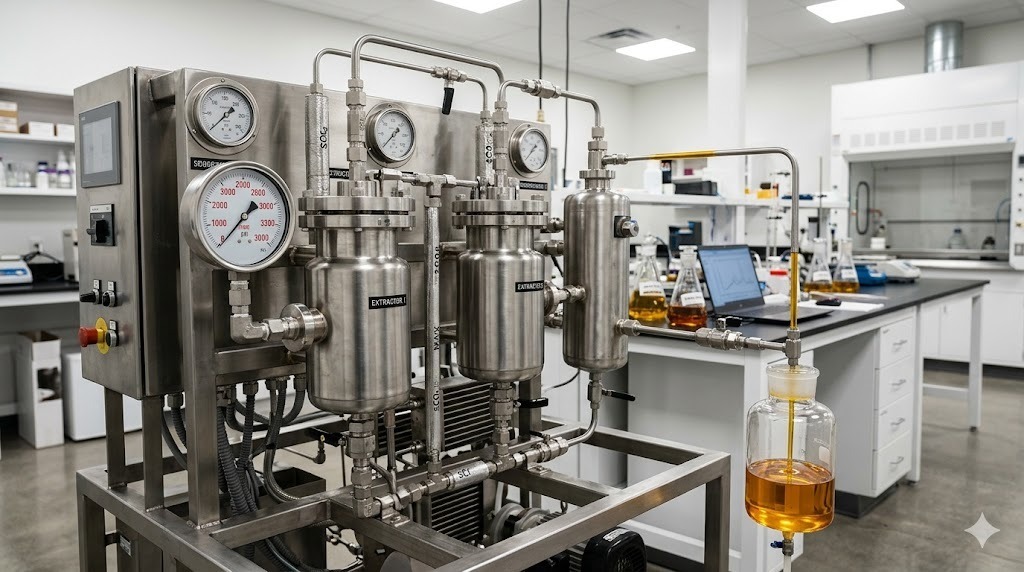
Single-separator designs. Professional systems use two or three separators in series, each at different pressures. The first separator drops heavy compounds (waxes, lipids), the second catches cannabinoids, and the third captures terpenes. Single-separator systems dump everything into one collection vessel. You get crude that requires more aggressive post-processing and terpenes contaminated with wax.
Pump limitations. The high-pressure pump is the heart of the system. Cheap systems use pneumatic pumps that cannot maintain consistent flow rates above 3,000 psi. Without consistent flow, you get channeling in the extraction vessel and incomplete extraction. The result is low yields and wasted biomass. Industrial systems run hydraulic or diaphragm pumps rated for continuous operation at 5,000+ psi.
When CO2 Makes Sense (and When It Does Not)
CO2 extraction occupies a specific niche in the extraction landscape. It is not the best method for every operation. Here is where it fits and where it does not.
CO2 wins when: You need a solvent-free label claim for retail products. You are processing more than 100 pounds per day and can justify the capital cost ($150K to $500K+ for production-scale systems). You need tunable selectivity for different product lines from the same biomass. You are in a regulatory environment that restricts hydrocarbon solvents.
CO2 loses when: You need terpene-forward live resin or sauce (hydrocarbon extraction preserves monoterpenes better at cryogenic temperatures). You are a small operation processing under 50 pounds per day (the capital cost per pound never pencils out). You need fast turnaround with minimal post-processing (closed-loop BHO produces a cleaner crude in less time at lower capital cost). You are making isolate and nothing else (ethanol extraction is cheaper and faster for bulk crude destined for distillation).
Frequently Asked Questions
Is CO2 extraction better than BHO for cannabis?
Neither method is universally better. CO2 extraction offers tunable selectivity and a solvent-free label claim, making it ideal for retail-facing products and operations above 100 lbs/day. BHO extraction preserves monoterpenes better at cryogenic temperatures (below -40°F) and produces cleaner crude with less post-processing. The right choice depends on your target product, daily throughput, and regulatory environment.
What pressure and temperature should I run my CO2 extractor at?
For supercritical cannabinoid extraction, start at 3,000 psi and 110°F, which gives a CO2 density around 0.7 g/mL. For subcritical terpene-focused extraction, run 900 psi at 60°F. These are starting points only. Your optimal parameters depend on biomass moisture content, grind size, and vessel packing density. Adjust in 200 psi increments and track cannabinoid yield per batch until you find your peak efficiency window.
Why does my CO2 extract come out green?
Green extract means chlorophyll co-extraction, which happens when supercritical conditions are too aggressive (typically above 4,500 psi and 130°F) or when biomass moisture exceeds 10%. Chlorophyll dissolves readily in high-density CO2. Fix this by reducing pressure to 3,000 to 3,500 psi, ensuring biomass is dried to 5 to 8% moisture, and adding a dewaxing separator stage before the main collection vessel.
How much cannabis can a CO2 extractor process per day?
A 5L extraction vessel processes roughly 2 to 4 lbs per run with a 3 to 4 hour supercritical cycle. That is 10 to 16 lbs per 12-hour shift. A 20L system handles 8 to 15 lbs per run, scaling to 30 to 60 lbs per shift. Production-scale systems with 40L+ vessels and dual extraction columns can exceed 200 lbs per day. The pump flow rate and heat exchanger capacity are the actual bottlenecks, not vessel size.
Does CO2 extraction destroy terpenes?
Supercritical CO2 extraction degrades heat-sensitive monoterpenes (myrcene, limonene, pinene) when operating above 120°F. Subcritical extraction at 60 to 85°F preserves terpenes effectively, but at lower yields and longer cycle times. The best commercial approach is a two-stage run: subcritical first pass to capture terpenes, followed by a supercritical pass for cannabinoids. The fractions are recombined at controlled ratios for a full-spectrum product.
Is CO2 extraction really solvent-free?
CO2 is classified as a GRAS (Generally Recognized as Safe) solvent by the FDA. It evaporates completely from the extract at ambient pressure, leaving zero residual solvent. The “solvent-free” label claim is technically accurate for the final product. But CO2 absolutely functions as a solvent during extraction. It dissolves compounds under pressure and releases them when pressure drops. The marketing distinction matters for retail packaging. The chemistry distinction matters for your SOP.
What does a CO2 extraction system cost?
Tabletop units for R&D start around $15,000 to $25,000. Small production systems (5L to 10L vessels) run $40,000 to $100,000. Mid-scale systems (20L vessels) cost $100,000 to $250,000. Production-scale systems (40L+ with dual columns) range from $250,000 to $500,000+. Factor in chiller units ($5,000 to $15,000), facility upgrades for high-pressure gas handling, and annual maintenance at 5 to 8% of system cost. The equipment is the smallest part of the total investment.
Ready to level up your extraction game? Contact WKU Consulting for personalized guidance on building your extraction lab.
For more deep dives into cannabis chemistry, extraction SOPs, and lab design, subscribe to the WKU Consulting YouTube channel.
Watch a related video:
