
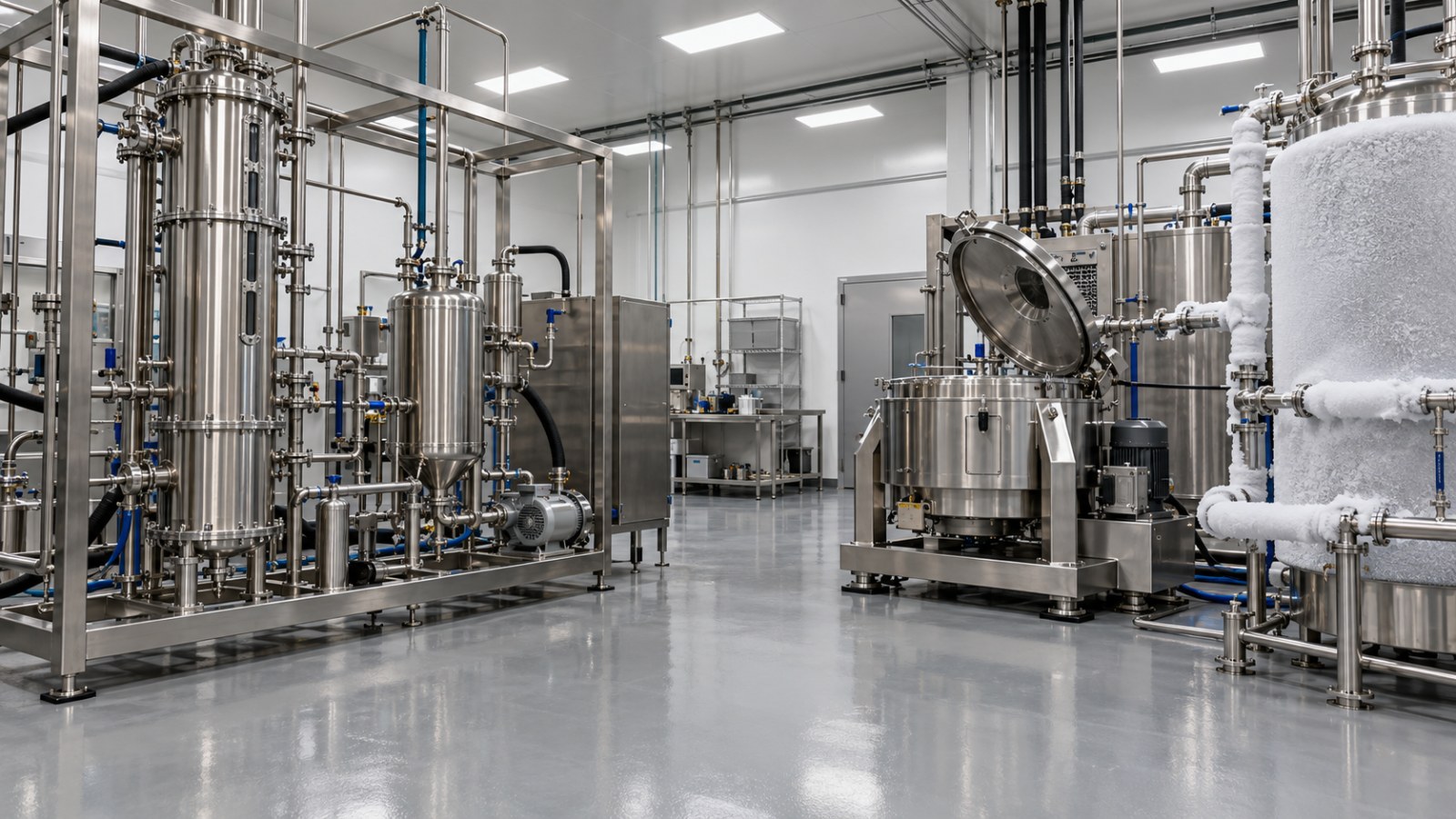
Four extraction methods dominate commercial cannabis processing: hydrocarbon (BHO), ethanol, supercritical CO2, and solventless (rosin press). At production scale, BHO delivers 18-24% yield from 24% THC flower at $0.15-0.30/gram processing cost, producing the widest product range (shatter, budder, live resin, diamonds). Ethanol processes 100-500 lbs/day at $0.08-0.15/gram but strips terpenes at rates above 30-40%, requiring downstream distillation. CO2 runs $0.25-0.50/gram with 8-12% typical yield, producing clean oil but limited textures. Rosin averages $0.50-1.00/gram with 15-25% yield, zero solvent risk, and premium pricing ($40-80/gram retail). Equipment costs range from $15,000 (rosin press) to $500,000+ (supercritical CO2 system). The right method depends on your target product, throughput requirement, facility classification, and state licensing constraints.
For the supercritical and subcritical CO2 details, including pressure, temperature, and density control, see our full CO2 extraction guide.
Extraction Method Comparison: Cost, Yield, Throughput, and Product Range
| Method | Processing Cost/gram | Typical Yield | Daily Throughput | Equipment Cost | Product Range | Facility Class Required | Terpene Retention |
|---|---|---|---|---|---|---|---|
| BHO (Closed Loop) | $0.15-0.30 | 18-24% | 10-50 lbs/day | $50K-200K | Shatter, budder, live resin, diamonds, sauce, vape oil | C1D1 (most states) | 85-95% (with cold extraction) |
| Ethanol | $0.08-0.15 | 12-18% | 100-500 lbs/day | $100K-400K | Crude oil, RSO/FECO, distillate (post-processing) | C1D1 or C1D2 (state-dependent) | 30-50% (cold ethanol improves to 60-70%) |
| Supercritical CO2 | $0.25-0.50 | 8-12% | 5-20 lbs/day | $200K-500K+ | Crude oil, winterized oil, terpene fractions (limited) | Standard commercial | 50-70% (tunable with subcritical phase) |
| Rosin Press | $0.50-1.00 | 15-25% (flower); 60-80% (hash) | 1-5 lbs/day (flower); 0.5-2 lbs (hash) | $15K-80K | Rosin, hash rosin, rosin diamonds, live rosin | Standard commercial | 70-90% (mechanical only) |
Introduction
Choosing the right extraction solvent is one of the most critical decisions in cannabis processing. Whether you’re building a new lab or optimizing an existing operation, understanding the science behind BHO extraction, ethanol extraction, and solvent polarity will directly impact your product quality, throughput, and bottom line.
In this guide — based on our in-depth extraction training series — we break down the fundamental chemistry that drives solvent selection, explain why butane honey oil (BHO) remains a favorite for high-quality concentrates, and help you determine which method fits your operation best.
What Is Solvent-Based Cannabis Extraction?
Solvent-based extraction uses organic solvents to dissolve target compounds — primarily cannabinoids and terpenes — from cannabis biomass to form a solution. This solution is then processed to recover the solvent and concentrate the desired compounds.
There are two dominant solvent-based methods in the cannabis industry today:
- Hydrocarbon extraction (butane, propane, or blends)
- Ethanol extraction (grain alcohol)
Both are highly efficient, but each comes with distinct advantages and trade-offs depending on your target product and facility capabilities.
Polarity: The Foundation of Solvent Selection
The single most important factor in choosing an extraction solvent is polarity. In chemistry, the rule is simple: like dissolves like.
Polar vs. Non-Polar Solvents
- Non-polar solvents (butane, propane) have an even distribution of electron density across their molecular structure. They excel at dissolving non-polar compounds like cannabinoids and terpenes found in trichomes.
- Polar solvents (water) have an uneven electron distribution, creating positive and negative ends. They dissolve polar compounds like sugars and salts.
A solvent’s polarity dictates which compounds it can pull from plant material. Since cannabinoids are predominantly non-polar, non-polar solvents like butane and propane are naturally selective for the compounds we want most.
Why This Matters for Your Extract
When you use a non-polar hydrocarbon solvent, it preferentially dissolves cannabinoids and terpenes while leaving behind many of the undesirable polar compounds like chlorophyll. This is why BHO extraction typically produces a cleaner, more potent crude oil straight out of the extractor compared to ethanol.
Solvent Polarity Reference: Dielectric Constants and What Each Solvent Dissolves
Polarity is not a vague label, it is a measurable property. Dielectric constant (relative permittivity, measured near 20-25C) is the single number that predicts what a solvent will and will not pull out of cannabis. Cannabinoids and terpenes are strongly lipophilic (THC has a logP near 6 to 7), so they partition into low-dielectric non-polar solvents and stay behind in high-dielectric polar ones. The table below is the selectivity map behind every method choice on this page.
| Solvent | Dielectric constant (approx, 20-25C) | Polarity class | Dissolves | Leaves behind | Extraction consequence |
|---|---|---|---|---|---|
| n-Butane | ~1.8 | Non-polar | Cannabinoids, terpenes, lipids and waxes | Water, sugars, salts, and most chlorophyll and pigments (especially when run cold) | Cleanest crude straight from the column; minimal winterization when kept below -20C |
| Propane | ~1.7 | Non-polar | Cannabinoids and terpenes (higher terpene pull, lighter oils) | Same water-soluble load as butane, plus more of the heavy waxes | Higher terpene retention and lower wax load; commonly blended with butane |
| Liquid / supercritical CO2 | ~1.4-1.6 (tunable with density) | Non-polar, tunable | Cannabinoids and terpenes; polarity tuned via pressure, density, and co-solvent | Chlorophyll and pigments at low density; more co-extraction as density climbs | Selectivity is adjustable, but pressure and co-solvent control add process complexity |
| Ethanol | ~24.3 | Polar, amphiphilic | Cannabinoids AND chlorophyll, plant pigments, and water-soluble sugars (especially above -20C) | Very little, which is precisely the problem | Broad-spectrum pull that forces mandatory winterization and filtration downstream |
| Water | ~80 | Highly polar | Sugars, salts, and water-solubles, but NOT cannabinoids | Cannabinoids and terpenes entirely | The reason ice-water hash is mechanical trichome separation, not solvent extraction |
The practical read: the wider the gap between your solvent dielectric and the near-zero polarity of a cannabinoid, the more selective the pull and the less you clean up afterward. Butane at ~1.8 pulls target compounds and leaves the polar junk in the biomass. Ethanol at ~24.3 pulls everything, which is why high-volume ethanol crude always routes through winterization before it is worth anything.
Ethanol’s Double-Edged Sword: Amphiphilic Nature
Ethanol is unique among extraction solvents because it is amphiphilic — it has both polar and non-polar properties. Its molecular structure features:
- A hydrophilic (polar) head that binds to water-soluble compounds
- A hydrophobic (non-polar) tail that dissolves oil-soluble compounds like cannabinoids
This dual nature makes ethanol excellent for full-spectrum extracts like RSO (Rick Simpson Oil), where capturing the broadest range of plant compounds is the goal. However, it also means ethanol co-extracts significantly more undesirable compounds — particularly plant waxes, fats, lipids, and chlorophyll — resulting in darker, less pure crude oil that requires more intensive post-processing.
The Cold Ethanol Dilemma
A common strategy to improve ethanol selectivity is chilling the solvent before extraction. Reducing ethanol temperature to -20°C to -60°C lowers the solubility of undesirable waxes and chlorophyll. However, there’s a critical trade-off:
Chilling ethanol also reduces the solubility of your target cannabinoids.
This means:
- Lower yields from each extraction pass
- More biomass left with unrecovered cannabinoids
- Reduced throughput for your processing facility
- Wasted time, electricity, and processing power
The sweet spot for most operations falls around -20°C to -30°C, balancing acceptable wax co-extraction against reasonable cannabinoid recovery. But if your end product is a high-potency vape cartridge or premium concentrate, this compromise may point you toward hydrocarbon extraction instead.
Boiling Points: Why Solvent Recovery Matters
Beyond polarity, the boiling point of your extraction solvent relative to your target compounds determines how easily you can recover that solvent from the final extract.
A compound’s boiling point is the temperature at which its vapor pressure equals atmospheric pressure, causing it to phase-change from liquid to vapor. For effective solvent recovery:
- The solvent’s boiling point should be significantly lower than the target compound’s boiling point
- This allows the solvent to evaporate without degrading or co-evaporating your cannabinoids
Butane (boiling point: -1°C) and propane (boiling point: -42°C) have extremely low boiling points compared to cannabinoids like CBD (boiling point: ~160-180°C). This massive gap makes solvent recovery straightforward and preserves product integrity.
Terpene Preservation
This is where hydrocarbon extraction truly shines. Because butane and propane have such low boiling points, they can be recovered at temperatures well below where terpenes begin to volatilize. This results in more aromatic, flavorful extracts — a key quality differentiator for live resin, sauce, and other premium concentrate products.
Ethanol’s higher boiling point (78°C) creates challenges when preserving heat-sensitive terpenes. Recovering ethanol from an extract risks co-evaporating volatile terpene compounds, making it a less ideal choice when terpene preservation is a priority.
Safety Considerations in Closed Loop Extraction
While hydrocarbon extraction offers superior selectivity and terpene preservation, it requires strict safety protocols. Butane and propane are highly volatile and combustible, requiring:
Both solvents put the room under the same documents: the safety equipment checklist for gas detection and ventilation, the IFC Chapter 39 requirements for the technical report and the two equipment paths, and, if you go the CO2 route covered below, the CO2 extraction room design guide, because a CO2 room is classified for asphyxiation rather than ignition.
- C1D1-rated extraction booths (Class 1, Division 1 hazardous locations)
- Proper ventilation and gas detection systems
- Appropriate personal protective equipment (PPE)
- Compliance with local fire marshal requirements and municipal zoning
The good news: with proper equipment and a correctly rated facility, closed loop extraction systems allow hydrocarbon extraction to be performed safely and compliantly. Modern closed-loop systems recapture and recycle solvent, minimizing both waste and exposure risk.
Startup Cost Advantage
One often-overlooked benefit of hydrocarbon extraction is its relatively low startup cost. A viable industrial-capacity closed loop extraction system can be assembled for around $30,000 — far less than the multiple pieces of equipment required for a comparable ethanol extraction facility. For entrepreneurs entering the cannabis processing space, this lower barrier to entry makes BHO extraction an attractive starting point.
BHO vs. Ethanol: Choosing the Right Method
| Factor | BHO / Hydrocarbon | Ethanol |
|---|---|---|
| Polarity | Non-polar (selective) | Amphiphilic (broad) |
| Best For | Vape carts, live resin, shatter, diamonds | RSO, full-spectrum, high-throughput crude |
| Crude Purity | Higher out of extractor | Requires more post-processing |
| Terpene Preservation | Excellent | Moderate to poor |
| Startup Cost | Lower (~$30K+) | Higher (multiple equipment pieces) |
| Safety Requirements | C1D1 booth required | Lower flammability risk |
| Throughput | Moderate | High |
The bottom line: If your target product demands high potency, rich terpene profiles, and clean crude oil — BHO extraction using a closed loop system is the superior choice. If you need maximum throughput for full-spectrum products and have the post-processing infrastructure, ethanol extraction makes sense.
CO2 Extraction: The Third Method
Any honest comparison of BHO and ethanol has to include supercritical CO2. It is the third leg of the solvent triangle and the method most large-scale operators evaluate before committing capital.
Supercritical CO2 operates above its critical point (31.1 degrees C, 1,071 psi), where it behaves as both liquid and gas simultaneously. At this state, CO2 becomes a tunable solvent. Adjust pressure and temperature, and you shift its solvating power from nonpolar (targeting cannabinoids) to moderately polar (pulling waxes and chlorophyll).
The advantage: no residual solvent in the final product. The disadvantage: equipment costs start at $150,000 for a production-scale system, extraction times run 4 to 8 hours per batch versus 20 to 45 minutes for BHO, and terpene preservation is poor without specialized fraction collection.
CO2 dominates in markets where solventless labeling carries a premium or where regulators restrict hydrocarbon use. But for most operations targeting high-terpene concentrates or fast throughput, BHO or ethanol will outperform CO2 on both cost per gram and product quality.
Rosin Press: The Solventless Fourth Method
Extraction Method Comparison: Cost, Yield, Throughput, and Product Range
| Method | Processing Cost/gram | Typical Yield | Daily Throughput | Equipment Cost | Product Range | Facility Class Required | Terpene Retention |
|---|---|---|---|---|---|---|---|
| BHO (Closed Loop) | $0.15-0.30 | 18-24% | 10-50 lbs/day | $50K-200K | Shatter, budder, live resin, diamonds, sauce, vape oil | C1D1 (most states) | 85-95% (with cold extraction) |
| Ethanol | $0.08-0.15 | 12-18% | 100-500 lbs/day | $100K-400K | Crude oil, RSO/FECO, distillate (post-processing) | C1D1 or C1D2 (state-dependent) | 30-50% (cold ethanol improves to 60-70%) |
| Supercritical CO2 | $0.25-0.50 | 8-12% | 5-20 lbs/day | $200K-500K+ | Crude oil, winterized oil, terpene fractions (limited) | Standard commercial | 50-70% (tunable with subcritical phase) |
| Rosin Press | $0.50-1.00 | 15-25% (flower); 60-80% (hash) | 1-5 lbs/day (flower); 0.5-2 lbs (hash) | $15K-80K | Rosin, hash rosin, rosin diamonds, live rosin | Standard commercial | 90-98% (mechanical only) |
When to Use Each Method: Decision Framework by Business Scenario
Every equipment manufacturer will tell you their method is best. They are not lying, but they are selling. Here is what nobody with equipment to move will tell you: the right extraction method depends on five variables that have nothing to do with the equipment itself.
Scenario 1: Maximum Product Diversity on a Mid-Range Budget
Choose BHO. No other method produces shatter, live resin, diamonds, sauce, budder, and vape cartridge oil from a single extraction platform. A $75K closed-loop BHO system with a $25K vacuum oven setup gives you access to every texture the market demands. The tradeoff is regulatory: most states require a C1D1-classified room (explosion-proof electrical, dedicated ventilation, gas detection, emergency shutoffs). C1D1 buildout adds $50K-150K to your facility cost depending on room size and local code requirements. If your state allows hydrocarbon extraction and you can absorb the facility buildout, BHO gives you the most product flexibility per dollar invested. For a full room-by-room breakdown of extraction lab design, ventilation requirements, and common buildout failures, see our lab design and cost guide.
Scenario 2: High-Volume Crude for Distillate or Edibles
Choose ethanol. Ethanol extraction scales linearly in a way BHO and CO2 cannot match. A centrifugal ethanol system processes 200+ lbs/day with 2 operators. At $0.08-0.15/gram, your cost basis is the lowest of any solvent method. The limitation is product range: warm ethanol strips chlorophyll, waxes, and terpenes indiscriminately, producing dark crude that requires winterization, carbon scrubbing, and distillation before it becomes a sellable product. Cold ethanol (-40C to -80C) improves selectivity dramatically but requires cryogenic equipment ($30K-80K additional). If your business model is white-label distillate, edible oil, or RSO, ethanol is the workhorse. If your customers expect strain-specific live resin, ethanol is the wrong tool.
Scenario 3: Clean Label, Solvent-Free Marketing
Choose CO2 or rosin, depending on scale. Supercritical CO2 leaves zero solvent residue (CO2 is a gas at room temperature, so it self-purges from the extract). This matters for brands targeting health-conscious consumers, medical markets, or jurisdictions with strict residual solvent testing. CO2 equipment is the most expensive ($200K-500K+) and the slowest throughput (5-20 lbs/day), but operational costs are moderate because CO2 is cheap and recyclable. The limitation: CO2 extraction produces a narrow product range (crude oil, winterized oil) and cannot produce the textures BHO creates. For small-batch premium products, rosin presses offer true solventless extraction at a fraction of CO2’s capital cost. Rosin commands premium retail pricing ($40-80/gram) that offsets the lower throughput.
Scenario 4: Startup with Limited Capital ($50K-100K Total Budget)
Choose rosin press or cold ethanol (not BHO or CO2). A commercial rosin press runs $15K-50K. No C1D1 room required. No solvent recovery system. No explosion-proof electrical. Your facility buildout is a standard commercial kitchen or processing room. Alternatively, a benchtop ethanol system with a rotary evaporator processes 10-20 lbs/day for under $40K in equipment. Neither achieves the throughput of a full BHO or CO2 line, but both get product to market while you build revenue to fund the next phase.
Scenario 5: State Licensing Constraints
Check your state’s extraction license categories before buying equipment. Some states (Washington) have closed applications to new extractors entirely. Others (Illinois) do not issue standalone extraction licenses. Several states prohibit or heavily restrict hydrocarbon use (some require PE-stamped C1D1 engineering drawings before approval). CO2 and ethanol generally face fewer regulatory hurdles. Rosin press operations sometimes qualify under lower-tier manufacturing licenses because no solvents are involved. See our state-by-state licensing guide for specific requirements in your market.
Decision Framework: Which Method for Which Product
The right extraction method is the one that matches your target product. Operators who pick their solvent before defining their product line waste capital on equipment that fights against what they are trying to make.
| Target Product | Best Method | Why |
|---|---|---|
| Live resin / sauce | BHO (butane/propane blend) | Low boiling point preserves volatile terpenes. Propane blend improves terpene capture at sub-zero temps. |
| Shatter / wax | BHO (butane) | Nonpolar selectivity produces clean crude requiring minimal post-processing. Ethanol shatter is possible but requires additional winterization steps. |
| THCa diamonds | BHO | High-purity crude from BHO crystallizes more readily. Fewer contaminants means faster nucleation and larger crystal formation. |
| Distillate (vape carts) | Either BHO or ethanol | Both feed distillation effectively. Ethanol crude needs more winterization before the wiped film but produces equivalent distillate purity. |
| RSO / full spectrum oil | Ethanol | Amphiphilic nature captures the full compound profile. This is the point, not a limitation. |
| Edibles / nano emulsion | Ethanol or CO2 | Terpene preservation matters less for edibles. Ethanol throughput wins. Distillate from either method feeds nano emulsion formulation equally well. |
| Topicals / tinctures | Ethanol | Broad compound extraction creates a richer therapeutic profile. Ethanol is also food-grade and residual traces are non-toxic. |
The most profitable labs run two methods. BHO for premium concentrates where terpene content drives wholesale price, and ethanol for high-volume crude destined for distillation or edibles. If capital is limited, start with BHO. The startup cost is lower, the product commands higher margins, and you can add ethanol throughput later.
Real Costs: Equipment, Facility, and Operating (2026)
Cost comparisons that only list equipment prices are misleading. The facility requirements for each method change the total capital expenditure dramatically.
| Cost Category | BHO / Hydrocarbon | Ethanol | CO2 |
|---|---|---|---|
| Extraction equipment | $25,000 to $80,000 | $50,000 to $200,000 | $150,000 to $500,000+ |
| Facility (C1D1 booth or rated room) | $15,000 to $50,000 (C1D1 required) | $5,000 to $15,000 (standard ventilation) | $5,000 to $15,000 (standard ventilation) |
| Solvent recovery equipment | Included in closed loop | $15,000 to $60,000 (rotovap or falling film) | Included in system |
| Post-processing equipment | Minimal (vacuum oven: $3,000 to $8,000) | Winterization + filtration: $10,000 to $25,000 | Minimal |
| Total startup estimate | $45,000 to $140,000 | $80,000 to $300,000 | $160,000 to $530,000+ |
| Operating cost per lb biomass | $8 to $15 (solvent + energy) | $12 to $25 (solvent loss + energy + winterization) | $5 to $10 (energy only, no solvent cost) |
The hidden cost in ethanol extraction is solvent loss. Even with efficient recovery systems, expect 3 to 8 percent ethanol loss per run. At current food-grade ethanol prices, that loss adds $3 to $8 per pound of biomass processed. Over a year of production, solvent replacement alone can exceed the cost difference in equipment.
Throughput and Processing Speed
If your business model depends on volume, throughput per shift matters more than product quality per batch.
| Metric | BHO (10 lb system) | Ethanol (centrifuge) | CO2 (10L vessel) |
|---|---|---|---|
| Batch time | 20 to 45 minutes | 15 to 30 minutes (extraction only) | 4 to 8 hours |
| Biomass per batch | 10 lbs | 50 to 100 lbs | 5 to 10 lbs |
| Batches per 8-hour shift | 8 to 12 | 10 to 16 (extraction) + recovery time | 1 to 2 |
| Total biomass per shift | 80 to 120 lbs | 500 to 1,600 lbs | 5 to 20 lbs |
Ethanol wins on raw volume. A centrifuge-based ethanol system processes 10 to 20 times more biomass per shift than a comparable BHO system. This is why large-scale crude oil producers, toll processors, and RSO manufacturers choose ethanol. The math changes when you price per gram of finished product instead of per pound of biomass. BHO’s cleaner crude requires fewer downstream processing steps, so the effective throughput gap narrows when you factor in winterization, CRC filtration, and distillation time for ethanol crude.
Post-Processing Requirements by Method
The extraction method you choose determines your downstream processing requirements. This is where hidden costs accumulate. A $50K BHO system requires a $25K vacuum oven. A $100K ethanol system requires a $40K rotary evaporator, $20K winterization setup, and $30K short-path distillation system to produce a finished product.
| Method | Winterization Needed? | Devolatilization Needed? | Distillation Needed? | CRC/Carbon Scrub? | Additional Equipment Cost |
|---|---|---|---|---|---|
| BHO (cold) | Rarely (cold extraction minimizes wax) | Yes (vacuum oven, 24-72 hours) | Only for distillate/vape | Optional (for color remediation) | $25K-50K |
| BHO (warm) | Yes | Yes | Often (crude quality lower) | Often needed | $50K-100K |
| Ethanol (cold) | Sometimes (depends on temp) | Yes (rotovap + oven) | Almost always | Often (chlorophyll removal) | $60K-120K |
| Ethanol (warm) | Yes (mandatory) | Yes | Yes | Yes (mandatory for dark crude) | $80K-150K |
| CO2 (supercritical) | Yes (supercritical pulls waxes) | No (CO2 self-purges) | Often | Sometimes | $40K-80K |
| CO2 (subcritical) | Rarely | No | Sometimes | Rarely | $20K-40K |
| Rosin | No | No | No | No | $0-5K (presses, bags, parchment) |
Here is the detailed breakdown by method:
BHO Post-Processing
- Vacuum purging: Remove residual butane/propane below 500 ppm (most states require below 5,000 ppm, but premium brands target sub-500). Takes 24 to 72 hours in a vacuum oven at 90 to 110 degrees F.
- CRC (optional): Color remediation chromatography removes pigments and oxidized compounds. Adds 15 to 30 minutes per batch. Required for light-colored shatter and distillate-grade crude.
- Winterization (sometimes): Only needed if running warm extraction. Cold BHO extraction at minus 40 to minus 60 degrees F already precipitates most waxes.
Ethanol Post-Processing
- Winterization (mandatory): Ethanol crude contains significant fats, waxes, and lipids. Cold filtration at minus 20 to minus 40 degrees C removes them. Skip this step and your distillate will be cloudy, off-flavor, and fail potency testing.
- Solvent recovery: Rotary evaporator or falling film evaporator to reclaim ethanol. This is the bottleneck in most ethanol operations. Undersized recovery equipment creates a backlog that limits total throughput.
- Decarboxylation (if needed): For edibles and tinctures. THCA to THC conversion at 110 to 120 degrees C for 30 to 45 minutes.
- Distillation: Most ethanol crude requires at least one pass through a wiped film distillation system to reach 85 to 95 percent cannabinoid purity.
CO2 Post-Processing
- Minimal winterization: Supercritical CO2 at optimized parameters pulls fewer waxes than ethanol.
- Fraction collection and blending: Different pressure/temperature runs capture different compound profiles. Blending fractions to hit target ratios is an art.
- No residual solvent removal: CO2 evaporates completely at atmospheric pressure. This is the cleanest extraction method from a solvent residue perspective.
Five Mistakes That Cost Operators Thousands
1. Choosing ethanol for premium concentrates. Ethanol co-extracts chlorophyll and waxes at any temperature above minus 40 degrees C. If your product line is live resin, sauce, or diamonds, ethanol is the wrong tool. The post-processing cost to clean up ethanol crude for premium products often exceeds what you would have spent on a BHO system.
2. Undersizing the solvent recovery system. The extraction vessel is not the bottleneck. The rotovap or falling film is. Operators who buy a 100-pound ethanol extractor paired with a 5-liter rotovap spend more time waiting for recovery than running extractions. Size recovery equipment to match or exceed extraction throughput.
3. Running BHO warm to save on chiller costs. Warm butane extraction (above 0 degrees C) pulls waxes just like ethanol does. Now you need winterization AND a C1D1 booth. The entire selectivity advantage of BHO disappears when you skip the chiller. Invest in proper cooling or switch to ethanol.
4. Ignoring facility costs when comparing equipment prices. A $30,000 BHO system needs a $25,000 to $50,000 C1D1 booth. A $50,000 ethanol system needs basic ventilation. The total installed cost gap is smaller than equipment prices suggest. Factor in everything before committing.
5. Not testing residual solvents on every batch. Both BHO and ethanol leave residual solvents that require removal. The threshold varies by state (500 ppm to 5,000 ppm for butane, varies for ethanol). Operators who skip residual solvent testing on routine batches are one failed compliance test away from a product recall.
Common Failures by Extraction Method and How to Diagnose Them
Every extraction method has characteristic failure modes. Equipment manufacturers do not publish these because admitting that their equipment can produce bad product undermines sales. Here is what you will learn from operational experience that no product brochure contains.
| Method | Failure Mode | Root Cause | Diagnostic Sign | Fix |
|---|---|---|---|---|
| BHO | Dark extract despite fresh material | Solvent contact time too long or extraction temp too warm | Extract is amber/brown instead of gold/clear. Wax content high on lab test. | Reduce soak time to 3-5 min. Drop extraction temp to -40C or below. Check chiller function. |
| BHO | Residual solvent fails testing | Inadequate vacuum oven purge (temp, time, or vacuum depth) | Lab reports >5,000 ppm total hydrocarbons. | Spread material to 1-2mm. Purge at 100-115F, -29.5 inHg, 24-72 hours. See our vacuum oven purging guide. |
| Ethanol | Green/dark crude extract | Ethanol too warm during extraction (chlorophyll co-extraction) | Extract is dark green/brown. High chlorophyll on lab panel. | Extract at -40C to -60C minimum. If already extracted warm, run carbon scrub with activated charcoal at 1:10 ratio. |
| Ethanol | Low potency distillate after processing | Excessive winterization removing cannabinoids with fats | Distillate tests below 80% total cannabinoids despite starting material testing 20%+ THC. | Use 10:1 ethanol ratio (not higher). Filter at 1 micron (not finer). Check for emulsion formation during winterization. See our winterization guide. |
| CO2 | Extremely low yield (<5%) | Pressure too low or extraction time too short | Spent material still contains visible trichomes. Collection vessel nearly empty after full run. | Increase pressure to 3,500-4,500 PSI. Extend run time to 6-8 hours. Verify CO2 flow rate matches vessel size. |
| CO2 | Waxy, dark extract | Pressure too high pulling waxes and lipids | Extract is thick, opaque, and dark. High lipid content on lab panel. | Reduce pressure to 2,000-2,500 PSI. Run subcritical terpene pass first (800-1,200 PSI at 15-20C). Plan for winterization of supercritical fraction. |
| Rosin | Low yield from flower (<15%) | Material too dry, wrong temperature, or insufficient pressure | Pucks are barely pressed, minimal rosin on parchment, material crumbles. | Rehydrate material to 62-65% RH (Boveda packs, 24-48 hours). Start at 190F, 1,000 PSI. Adjust down for terpenes, up for yield. |
| Rosin | Dark rosin from quality flower | Temperature too high or press time too long | Rosin is dark amber/brown despite fresh, light-colored starting material. | Drop temp to 170-180F. Reduce press time to 60-90 seconds. Pre-press at room temp for 10 seconds to set the puck. |
If you want to learn extraction method selection with hands-on walkthroughs of each system, real SOPs, and the failure modes that no equipment manual covers, that is exactly what we built extractiontraining.com for.
Total Cost of Ownership: Year 1 Comparison
Equipment cost is never the full picture. Facility buildout, licensing, consumables, labor, and post-processing equipment determine whether a method is actually profitable at your scale.
| Cost Category | BHO | Ethanol | CO2 | Rosin |
|---|---|---|---|---|
| Extraction equipment | $75K-200K | $100K-400K | $200K-500K | $15K-80K |
| Post-processing equipment | $25K-100K | $60K-150K | $40K-80K | $0-5K |
| Facility buildout (C1D1 if required) | $50K-150K | $20K-80K | $10K-30K | $5K-15K |
| Licensing and compliance | $5K-50K (state-dependent) | $5K-50K | $5K-50K | $2K-20K |
| Consumables (year 1) | $10K-30K (butane, propane) | $20K-60K (ethanol, filters) | $5K-15K (CO2, seals) | $2K-8K (bags, parchment) |
| Labor (2 operators, year 1) | $80K-120K | $80K-120K | $80K-120K | $40K-80K (1 operator) |
| Total Year 1 | $245K-620K | $285K-860K | $340K-795K | $64K-208K |
Frequently Asked Questions
Is ethanol extraction better than butane?
Neither is universally better. Ethanol processes more biomass per shift and produces full-spectrum crude ideal for RSO, edibles, and tinctures. Butane produces cleaner, higher-purity crude with superior terpene preservation for live resin, shatter, and diamonds. The answer depends entirely on your target product. If you are making premium concentrates for dispensary shelves, BHO wins. If you are running a toll processing operation cranking out crude for distillation, ethanol wins.
What is the healthiest cannabis extraction method?
From a residual solvent perspective, supercritical CO2 leaves zero solvent residue. BHO and ethanol both require post-extraction purging or evaporation. Properly purged BHO (below 500 ppm residual butane) and properly recovered ethanol extracts are both safe when processed correctly. The health risk comes from improper processing, not from the solvent choice itself. Every method is safe when SOPs are followed. Every method is dangerous when they are not.
What is the best alcohol for cannabis extraction?
190-proof (95%) food-grade ethanol (Everclear or equivalent). The 5% water content is unavoidable in distilled ethanol and contributes to chlorophyll co-extraction. Some operators use 200-proof absolute ethanol to reduce water content, but the cost premium rarely justifies the marginal improvement in selectivity. Never use denatured alcohol, isopropanol, or methanol for cannabis extraction intended for human consumption.
Can you use the same equipment for both BHO and ethanol?
No. BHO requires a closed loop extraction system rated for flammable gas (typically stainless steel vessels rated to 150+ psi) inside a C1D1 hazardous location booth. Ethanol extraction uses open or semi-closed vessels at atmospheric pressure with standard ventilation. The post-processing equipment is also different: BHO uses vacuum ovens while ethanol uses rotary evaporators or falling film evaporators. Some downstream equipment (wiped film distillation, vacuum ovens) can serve both product streams.
How much does it cost to start a BHO extraction lab?
Total installed cost for a production-ready BHO lab in 2026 ranges from $45,000 to $140,000. This includes the closed loop extraction system ($25,000 to $80,000), C1D1 booth or rated room ($15,000 to $50,000), vacuum oven ($3,000 to $8,000), and basic lab equipment. Compare this to $80,000 to $300,000 for an equivalent ethanol setup or $160,000+ for CO2.
What is the difference between BHO and PHO?
BHO uses butane as the primary solvent. PHO (propane hash oil) uses propane. Propane has a lower boiling point (minus 42 degrees C vs minus 1 degree C for butane) and slightly different selectivity, pulling more terpenes and fewer heavier waxes. Most operators run a butane/propane blend (typically 70/30 or 80/20) to get the best of both: butane’s cannabinoid selectivity with propane’s enhanced terpene extraction. The choice between pure butane, pure propane, or a blend depends on your target terpene profile.
Why do most large-scale processors use ethanol?
Throughput. A centrifuge-based ethanol system processes 500 to 1,600 pounds of biomass per 8-hour shift. A comparable BHO system handles 80 to 120 pounds. When the business model is high-volume crude oil production for distillation or edibles manufacturing, ethanol’s throughput advantage outweighs BHO’s quality advantage. The post-processing cost (winterization, solvent recovery, distillation) is offset by raw volume economics.
Is solventless extraction worth the lower throughput?
At current market pricing, yes, for small operations. Hash rosin retails at $40-80/gram in most legal markets, while BHO concentrates retail at $15-40/gram. Even with rosin’s lower throughput (1-5 lbs flower/day), the margin per gram is 2-4x higher. A single operator pressing 3 lbs of 24% THC flower per day at 20% yield produces approximately 270 grams of rosin. At $50/gram wholesale, that is $13,500/day in gross revenue from a $50K equipment investment. The math changes above 10 lbs/day target throughput, where BHO or ethanol become more efficient on a per-dollar basis.
Can I use multiple extraction methods in one facility?
Yes, and many large-scale operations do. A common configuration is BHO for premium concentrates (live resin, diamonds) plus ethanol for high-volume crude oil destined for distillation. This requires a C1D1 room for the BHO side and adequate ventilation for the ethanol side. Some states issue a single manufacturing license covering multiple extraction methods; others require separate endorsements. Check your state’s license structure before building. Our state licensing guide covers multi-method facility requirements.
Which cannabis extraction method produces the highest quality concentrate?
BHO with cold extraction (-40C to -80C) and rosin press produce the highest quality full-spectrum concentrates. BHO preserves 85-95% of the original terpene profile when extracted cold, while rosin retains 90-98% because no solvent interacts with the plant chemistry. CO2 preserves 50-70% of terpenes depending on pressure parameters. Ethanol preserves 30-50% at room temperature, improving to 60-70% at cryogenic temperatures. “Quality” depends on your definition: if it means full terpene retention, BHO and rosin win. If it means zero solvent risk, rosin and CO2 win.
What is the cheapest extraction method to start with?
Rosin pressing is the lowest capital investment at $15K-50K for a commercial press with no additional facility buildout required (no C1D1 room, no solvent recovery, no explosion-proof electrical). Cold ethanol extraction is the cheapest solvent method at $30K-60K in equipment, though you will need a rotary evaporator ($8K-15K) and winterization setup ($5K-10K) to produce a sellable product. BHO and CO2 both require $50K+ in equipment before facility costs.
Is CO2 extraction better than BHO?
“Better” depends entirely on your business model. CO2 produces a cleaner oil with zero residual solvent risk, requires less complex facility compliance, and appeals to health-conscious consumers. BHO produces a wider range of product textures (shatter, live resin, diamonds, sauce) at higher throughput and lower cost per gram. Most commercial operations that make concentrates for dispensary shelves use BHO because product diversity drives sales. Operations focused on oil for vape cartridges, capsules, or edibles often prefer ethanol or CO2 because they need crude oil as a distillation feedstock, not finished textures.
How do I choose between BHO and ethanol extraction?
Ask three questions. First: what product does your market demand? If dispensary customers want shatter, live resin, and diamonds, choose BHO. If your customers want distillate cartridges, edibles, and tinctures, choose ethanol. Second: what is your daily throughput target? Under 50 lbs/day, BHO is cost-effective. Over 100 lbs/day, ethanol scales more efficiently. Third: does your state allow hydrocarbon extraction? If not (or if C1D1 compliance is prohibitively expensive at your location), ethanol is the path of least regulatory resistance.
What extraction method is best for making distillate?
Ethanol extraction produces the most cost-effective distillate feedstock at scale. Ethanol crude oil, after winterization and carbon scrubbing, feeds directly into a short-path or wiped-film distillation system. At $0.08-0.15/gram extraction cost, your distillate production cost basis stays below $0.50/gram total (extraction + post-processing). BHO crude also makes excellent distillate but at a higher per-gram extraction cost. CO2 crude is often more difficult to distill cleanly because of wax co-extraction at supercritical pressures. For wiped-film distillation parameters, see our wiped film distillation guide.
Watch a related video:
Conclusion
Understanding solvent polarity, boiling points, and safety requirements isn’t just academic — it’s the foundation of every successful cannabis extraction operation. The science behind BHO extraction and hydrocarbon processing explains why it remains the go-to method for producing premium cannabis concentrates.
Whether you’re setting up your first extraction lab or looking to optimize your current process, selecting the right solvent for your target product is where profitability begins. This guide covers every variable: solvent chemistry, business scenarios, cost modeling, failure diagnostics, and post-processing requirements. Bookmark it and come back when you are ready to commit capital.
Need help designing your extraction workflow or selecting equipment for your facility? Contact WKU Consultants for expert cannabis lab consulting — from SOP development to full lab build-outs, we help you get it right from day one.
—
This post is based on Episode 2-A of our extraction training series. Watch the full lesson on YouTube and join our Discord for early access to new episodes every Wednesday at 10 AM PST.
For more deep dives into cannabis chemistry, extraction SOPs, and lab design — subscribe to the WKU Consulting YouTube channel. New videos every week covering everything from distillation theory to advanced cannabinoid conversions.

[…] Lab Safety: Preventing Explosions with Proper C1D1 Setup, LEL Monitoring & SOPs Previous […]
[…] Starting material quality matters. Diamonds and wax are only as good as the BHO you start with. Run clean material through a properly maintained closed-loop extraction system. […]