
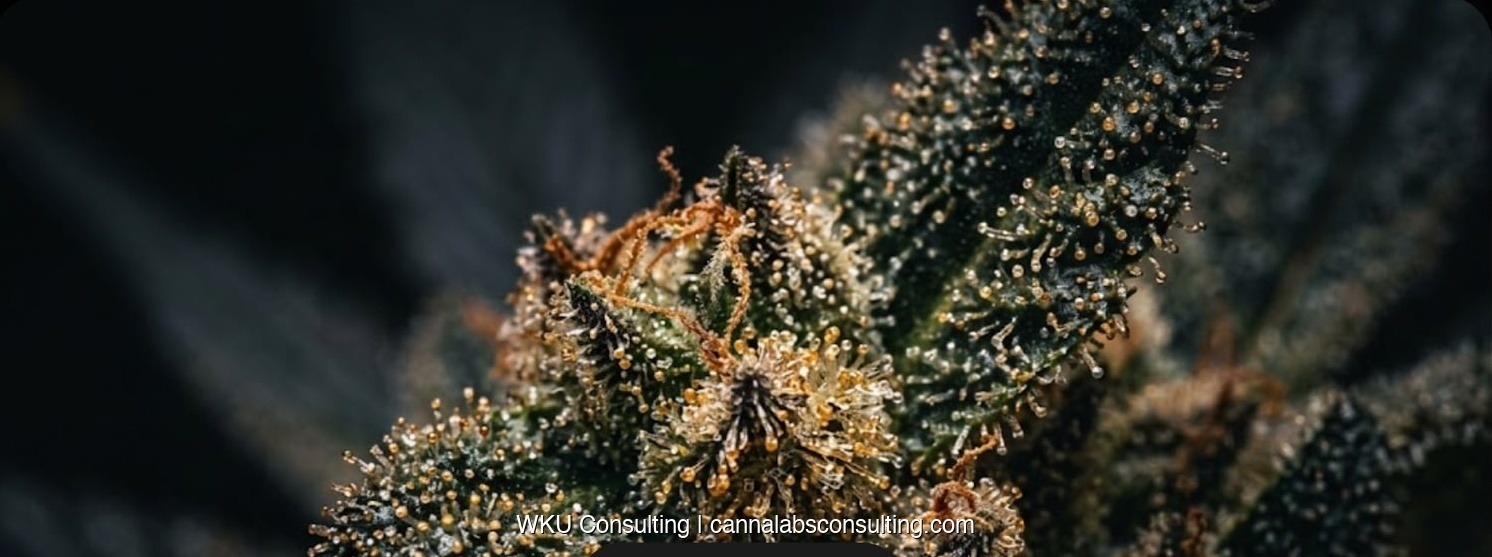
The conversation around THCA flower has been dominated by compliance anxiety for so long that the actual science barely gets airtime anymore. I find that frustrating. Not because compliance is unimportant, it is critically important right now, but because operators who do not understand the chemistry underneath the product are going to get crushed when the regulatory environment shifts. And it is shifting. The question is not whether you understand the law. The question is whether you understand the molecule, because the molecule does not care what the law says.
What THCA Actually Is
Tetrahydrocannabinolic acid is the acidic precursor form of THC. In living cannabis tissue and in carefully preserved plant material, cannabinoids exist predominantly in their carboxylated, acidic state. The plant does not synthesize THC directly. It synthesizes THCA. The “A” stands for acid, and that carboxylic acid group attached to the core ring structure is the reason the molecule behaves so differently from its decarboxylated counterpart.
THCA does not bind efficiently to CB1 receptors in the central nervous system. The molecular geometry created by that carboxylic group prevents the kind of receptor interaction required to produce psychoactive effects. So in its native state, THCA is not intoxicating. That changes the moment you apply heat. Decarboxylation removes the carboxyl group as carbon dioxide, converting THCA to THC. The reaction is: THCA yields THC plus CO2. It happens rapidly above 220 degrees Fahrenheit and is essentially complete at smoking or vaporizing temperatures.
The conversion factor everyone in this industry should have memorized is 0.877. One gram of THCA yields approximately 0.877 grams of THC upon decarboxylation. This is not an approximation born of imprecision. It is the stoichiometric result of losing the molecular weight of that carboxyl group. The math is straightforward. The reason it matters is that this exact number became the basis for how regulators decided to calculate total THC compliance. The science was already there. The agencies just eventually decided to use it.
Why This Product Exists
The 2018 Farm Bill defined hemp as cannabis with a delta-9 THC concentration of no more than 0.3 percent on a dry weight basis. That is the federal definition. THCA is not delta-9 THC. The two are chemically distinct compounds with different molecular structures, different receptor binding profiles, and different regulatory histories.
What that means in practical terms is that a hemp flower testing at 22 percent THCA and 0.24 percent delta-9 THC clears the federal compliance threshold. It ships across state lines legally. The moment someone applies a flame to it, decarboxylation converts that 22 percent THCA to roughly 19 percent THC. That is an objectively potent product. It is also, under the letter of the 2018 Farm Bill as written, legal hemp.
I have heard this described as a loophole so many times that the word has lost meaning. It was not a loophole. It was the direct, literal reading of a statutory definition. The people who built THCA flower businesses were not running a sophisticated regulatory arbitrage operation. They were reading the definition Congress wrote and growing a plant that met it. If the legislature intended to include THCA in the total THC calculation, it could have written that into the statute. It did not. That is a legislative choice, not an oversight that operators cleverly exploited.
Whether the policy intent behind the 0.3 percent threshold was to capture total THC potential is a separate question from what the law actually said. Operators who understood this distinction built a real industry around it. Operators who misread the political durability of that distinction are now watching it collapse in real time.
The Regulatory Clock
On March 31, 2026, the Texas Department of State Health Services finalizes a rule change that requires total THC calculations for hemp compliance in the state. The formula: THCA multiplied by 0.877, added to delta-9 THC. Apply that to the 22 percent THCA plant I described above, and you get roughly 19.5 percent total THC. The 0.3 percent threshold has not changed. The plant has not changed. The chemistry has not changed. The only thing that changed is the formula the agency chose to apply.
This is worth sitting with for a moment, because it is a significant exercise of administrative power. No legislative vote. No floor debate. No public referendum. A rulemaking process, public comment period included, resulting in a single formula change that effectively eliminates an entire product category in the second-largest state in the country overnight. Virtually every THCA flower product currently on the Texas market becomes non-compliant under this calculation. Not because anyone grew a different plant or changed their process. Because an agency changed a math formula.
I understand why regulators arrived here. The argument that THCA flower is functionally equivalent to high-THC marijuana when consumed is not wrong. It is. But there is a difference between acknowledging that fact and deciding the correct response is a unilateral administrative reclassification that bypasses the legislature entirely. If Texas wanted to ban high-THC-potential hemp products, the legislature could have done that through statute. That it happened through rulemaking instead tells you something about the political path of least resistance, and it tells you something about how other states will approach this in the months ahead.
Texas is not the last state. The DEA has been moving toward total THC calculations at the federal level for years. The compliance window for THCA flower, as the market has known it, is closing. Section 781 of Public Law 119-37 bans all intoxicating hemp products effective November 12, 2026, using a total THC definition that eliminates every THCA flower product on the market. What remains afterward depends on whether the next Farm Bill codifies total THC language, what the DEA’s final hemp rules look like, and whether any state legislators decide to push back through statute rather than letting agencies do the work for them.
Genetics and Starting Material
Not every hemp cultivar is suited for THCA flower production. The genetics are the foundation, and a poor choice in starting material creates COA problems that no amount of skilled processing will fix.
What you are looking for in a high-THCA cultivar is a strain with demonstrated high THCA expression in the mid-to-high twenties percent range, a consistently low delta-9 THC baseline (well below 0.3 percent even as the plant approaches harvest maturity), and stable cannabinoid ratios through the cure cycle. That last point is underappreciated. Some cultivars will maintain their cannabinoid profile beautifully through a four-week cure. Others will drift, showing delta-9 creep or THCA degradation that makes predictable compliance testing difficult. If you cannot predict what your COA will show at the distribution point, you do not have a viable product.
Certified seed or verified clone stock matters for COA predictability. Seed-grown plants carry genetic variability. Even within a well-bred line, individual phenotypes will express cannabinoid profiles differently. Running verified clones from a mother plant with a documented cannabinoid expression history gives you the most predictable outcomes at scale. That predictability is worth the additional cost and logistics, especially in a compliance environment where a failed test on a batch costs significantly more than the genetics would have.
Testing protocol for THCA flower production should include pre-harvest sampling at the predicted peak THCA window, harvest testing, and post-cure testing before any distribution. The pre-harvest panel is where you catch genetic drift and decide whether to harvest immediately or wait. The harvest and post-cure panels are your compliance documentation and your quality control record. What you want to see: THCA in the target range, delta-9 below your compliance threshold with enough margin to absorb inter-lab variability, CBG and terpene profiles consistent with the cultivar, and no flags on residuals or moisture.
Lab selection matters more than most operators acknowledge. Not all testing laboratories report total cannabinoids the same way, and the accuracy of THCA quantification in particular varies by methodology. Gas chromatography with flame ionization detection (GC-FID) decarboxylates the sample during analysis, so it reports total THC, not THCA. High-performance liquid chromatography (HPLC) preserves the acidic form. If your lab is using GC-FID without clearly noting that all THC values represent decarboxylated totals, you may be misreading your own COA. Know what method your lab uses and what the reported values actually represent.
How It Is Made
The production of high-THCA hemp flower starts in the grow environment, and controlled environment agriculture (CEA) has significant advantages over outdoor production for this specific product category. The reason is environmental stability. THCA is thermally labile. Exposure to heat and UV light accelerates decarboxylation, which means outdoor-grown flower in a hot climate is losing THCA to THC conversion in the field before it ever reaches your scale. A plant sitting in a 95-degree field in August is undergoing low-level decarboxylation continuously. Your harvest COA will show lower THCA and higher delta-9 than the same plant would produce in a controlled environment. That matters for compliance, and it matters for product quality.
Indoor or greenhouse production with temperature control in the 70-80 degree Fahrenheit range during the flowering phase preserves THCA more effectively. Light intensity and spectrum management reduces UV-induced degradation. The trade-off is cost per pound, which is why the highest-quality THCA flower is almost exclusively produced indoors. The compliance math simply works better when you are not fighting ambient heat and UV throughout the grow cycle.
Some operators in this space apply THCA isolate to hemp flower post-production to increase total THCA content. This is done through kief dusting, where THCA crystalline is ground and applied to the flower surface; rosin drizzle, where THCA-rich rosin is lightly applied; or isolate coating, where crystalline THCA is applied more uniformly via mechanical tumbling or hand application. The chemistry supports this: THCA crystallizes readily, the crystal structure adheres well to trichomes and plant matter, and the resulting product tests at significantly higher THCA concentrations than the base flower would alone.
This is legal. It is also a compliance liability that operators need to understand clearly. Enhanced flower must still pass the delta-9 threshold at the final test point. But in states applying total THC calculations like the Texas DSHS formula, enhanced product is especially vulnerable. If you are taking base flower testing at 18 percent THCA and coating it to reach 28 percent THCA, your total THC calculation under the 0.877 formula is approximately 24.7 percent plus your delta-9 baseline. That product has no path to compliance in a total-THC state. Operators who enhanced product to improve potency without thinking through the regulatory arithmetic built themselves a problem they cannot solve with better curing.
The cure cycle for THCA flower is not a passive rest period. It is an active biochemical process that requires controlled conditions. The target parameters are 55 to 62 percent relative humidity and 60 to 70 degrees Fahrenheit, in dark storage, for a minimum of two to four weeks. The relative humidity range is not arbitrary. Below 55 percent, the flower desiccates, terpenes volatilize rapidly, and the trichome structures become brittle and prone to mechanical loss. Above 62 percent, you are in the biological range for mold and pathogen growth. The temperature window matters because heat accelerates decarboxylation. Curing at 80 degrees instead of 65 degrees is measurably converting THCA to THC through the cure period.
Darkness is not optional. UV radiation breaks down cannabinoids, particularly THCA. Flower stored in light-exposed conditions during cure will show lower THCA concentrations on the post-cure COA than the same flower cured in dark storage. This is not a subtle effect. Light-exposed curing at scale can cost you meaningful THCA percentage points over a four-week cure period. Black-out storage is standard practice for a reason.
When cure parameters are violated, the COA tells the story. Delta-9 creep is the primary signal. If your post-cure panel shows meaningfully higher delta-9 than your harvest panel, something drove decarboxylation during storage. Check your temperature logs. Check whether light exposure occurred. If you are applying total THC calculations, even modest delta-9 creep that keeps you under the direct delta-9 threshold can push you over a total THC limit when the 0.877 factor is applied to your THCA.
Pre-distribution testing is your final quality gate and compliance checkpoint. The COA at this stage should show THCA in your target range, delta-9 below threshold with adequate margin, and no significant deviation from your post-cure panel. What flags a problem: delta-9 concentration higher than post-cure (indicates continued decarboxylation in storage or transit, often a temperature excursion), total THC calculation proximity to the applicable limit with insufficient margin for inter-lab variability, or terpene profiles inconsistent with the cultivar (indicates degradation or contamination).
When a batch is borderline, the decision framework is straightforward. If you are within inter-lab variability of the compliance limit, you do not ship it. Test at a second accredited laboratory. If both results cluster near the limit, the batch is not distribution-ready. Remediation options are limited: you can attempt to blend the borderline batch with compliant product to bring the average into range, but blending for compliance has its own regulatory considerations and is not a reliable long-term strategy. The cleaner path is tighter process control upstream so you are not making compliance decisions at the distribution gate.
The Compliance Tightrope
At the federal level, THCA flower exists in a framework defined by the 2018 Farm Bill’s delta-9 threshold. State law varies significantly. Some states have followed the federal definition. Others, like Texas as of March 31, 2026, have adopted total THC calculations. A handful of states have moved to ban THCA flower products outright regardless of the calculation method. The patchwork is a compliance challenge for multi-state operators and a geographic lottery for consumers.
Where this is headed: total THC calculation requirements are the direction of travel. The science supporting them is legitimate. THCA does convert to THC. A product that is functionally indistinguishable from high-THC cannabis when consumed is not obviously consistent with what Congress intended when it defined hemp. The argument that the law should have been written differently is correct and also irrelevant to operators who need to move product today.
My read on this is that the science never justified treating THCA as fully equivalent to THC for all regulatory purposes at all stages of the supply chain. THCA in raw flower is genuinely distinct from THC. But the enforcement window for THCA flower was always time-limited. Anyone who built a business solely on the regulatory arbitrage of the delta-9-only threshold without investing in understanding the product, the chemistry, and the compliance trajectory was not building a business. They were timing a trade.
Texas is not the last state. Operators who understand the molecule, who know their COAs, who built production processes on real chemistry rather than regulatory convenience, those operators will adapt. They can pivot to product categories with clearer compliance paths. They understand their starting material well enough to shift genetics. They know what a total THC calculation means for their specific product lines. The operators who treated THCA flower as a compliance trick without developing genuine product knowledge are going to find the exit narrowing faster than they expected.
This product category was built on a technicality and genuine chemistry at the same time. Those are not contradictions. The 2018 Farm Bill definition created the compliance framework that made THCA flower viable, but the underlying science, the decarboxylation thermodynamics, the cannabinoid biosynthesis pathways, the crystallization behavior of THCA, that is all real. Knowing the molecule does not become less important as the legal framework changes. It becomes more important. The compliance window is narrowing. Know the molecule, know the math, and know your state’s regulatory posture before the next rule change lands on a Thursday afternoon with a Monday enforcement date.
