
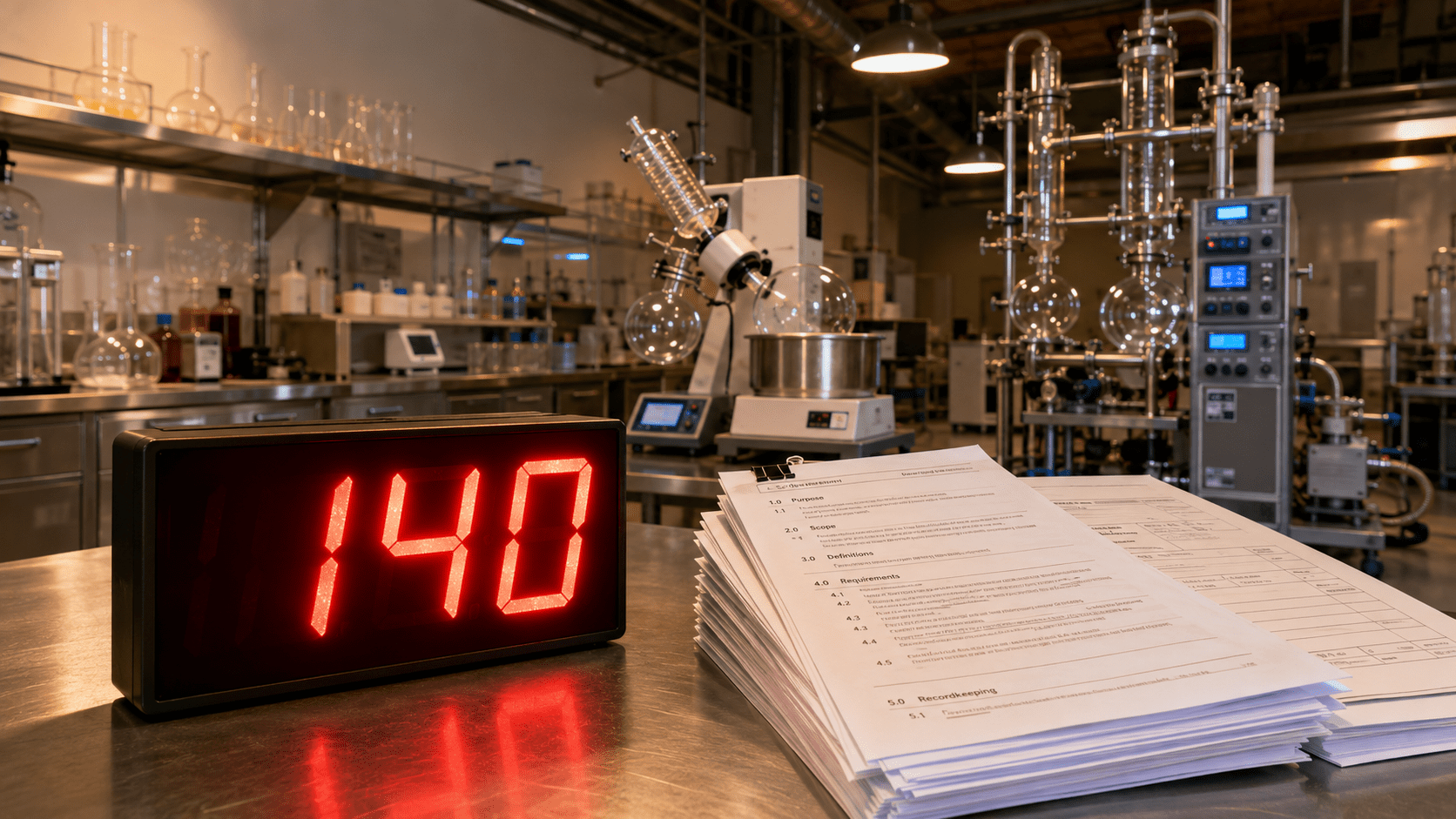
The Ban Nobody Prepared For
On December 11, 2026, a $28 billion industry becomes illegal, and the synthetic corner of it goes a month earlier, on November 12. Not shut down by the DEA. Not raided by state police. Killed by Section 781 of Public Law 119-37, signed on November 12, 2025 as part of a continuing resolution to avoid a government shutdown, and pushed back exactly 29 days by a second continuing resolution (H.R. 6500) signed on September 3, 2026. That single section reclassifies every hemp-derived THC product, every delta-8 conversion, every HHC synthesis, and every THCA flower operation as a controlled substance.
The ban caps finished products at 0.4 milligrams of total THC per container. Not per serving. Per container. A single 10-count gummy pack with 10mg per gummy contains 100mg total THC. That is 250 times over the new limit. Every delta-8 vape cartridge, every THC-infused beverage, every THCA pre-roll on the market today fails this threshold by orders of magnitude. The same math reaches finished extracts: a hemp RSO syringe concentrates the flower 6 to 10 times, so 0.3 percent flower comes out near 2 percent total THC and a 10 g syringe carries 200 mg, 500 times the container cap, unless the THC is remediated first.
If you are running a hemp-derived cannabinoid business with extraction equipment, conversion reactors, or formulation lines, you have 88 days to restructure, pivot, or shut down, and 59 days if the molecule you make is one the plant cannot. Law firms are telling you what the statute says. News outlets are covering the politics. Nobody is telling you what to actually do with your equipment, your inventory, your staff, and your business plan. That is what this guide covers.
What Exactly Gets Banned, and on Which Date
Section 781 redefines “hemp” as Cannabis sativa L. with a total THC concentration (including THCA) of not more than 0.3% on a dry weight basis. That one word, “total,” changes everything. The operative changes hit extraction and conversion operators in three ways.
The Total THC Redefinition
The old Farm Bill defined compliant hemp as containing less than 0.3% delta-9 THC by dry weight. That loophole is what built the entire hemp-derived cannabinoid industry. THCA flower tested at 25% THCA and 0.28% delta-9 was technically legal because the test only measured delta-9, not total THC. When you lit it on fire, the THCA decarboxylated to delta-9 THC and you got high. The new definition closes that gap by measuring total THC: delta-9 + (THCA x 0.877). That same 25% THCA flower now measures at 21.9% total THC. It fails the 0.3% threshold by a factor of 73.
Synthetic and Semisynthetic Cannabinoids
Delta-8 THC produced via acid-catalyzed isomerization of CBD is classified as a synthetically derived cannabinoid under the new definition. The same applies to HHC (hydrogenated THC), THC-O (acetylated THC), THCP (homologated THC), and any cannabinoid not naturally present in the plant at significant concentrations. Euphorinol, the EPN cannabinoid, is the clearest case in the category: THC butanenitrile oxime is built from an industrial ketone and was never in the plant, so it loses hemp status on the November 12 date. We documented what Euphorinol actually is and why its supplier name is not a chemical name. The chemistry does not matter to the statute. Whether you used BF3 etherate, p-toluenesulfonic acid, Amberlyst-15, or sulfuric acid to isomerize CBD to delta-8, the product is banned. For the chemistry behind every synthesis pathway the ban targets, see our guide to novel cannabinoid synthesis.
The September 3 delay split this category in two. H.R. 6500 moved the effective date of the Section 781 hemp definitions to December 11, 2026 for everything the plant can make. It did not move the date for cannabinoids the plant cannot naturally produce: those lose hemp status on November 12, 2026 exactly as originally scheduled. That is the first time federal law has drawn the line at the synthesis step instead of the molecule, and it means every operator now runs two clocks.
Two Clocks: Which Products Lose Hemp Status on Which Date
| Product | Can the plant make this molecule? | Date it leaves the hemp definition | What that means for an extraction operator |
|---|---|---|---|
| THCA flower and pre-rolls | Yes | December 11, 2026 | Total THC = delta-9 + (THCA x 0.877). Flower fails the 0.3% line once THCA alone passes 0.34%. No cultivar sold as THCA flower survives the math. |
| Delta-9 edibles, beverages, tinctures above 0.4 mg total THC per container | Yes | December 11, 2026 | The container cap is unchanged by the delay. A 10-pack of 5 mg gummies is still 125 times over. Reformulate to non-detect isolate or move the SKU to a state license. |
| Intermediate crude or distillate above 0.3% total THC | Yes | December 11, 2026 | A field at 0.3% THC and 8% CBD is a 27:1 ratio, and distillation keeps the ratio: 80% CBD distillate tests at 3% THC. It has to be remediated below the line (crystallization or flash chromatography), not distilled harder. |
| Delta-8 THC made from CBD | The plant makes trace delta-8; the converted product is treated as synthetically derived under Section 781 | Plan to November 12, 2026 | It fails on both clocks: as a synthetically derived cannabinoid on November 12, and as a total-THC product on December 11. Operate to the earlier date. |
| HHC (hydrogenated THC) | No | November 12, 2026 | Made by catalytic hydrogenation over Pd/C. The delay does not apply. Inventory needs a home before November 12. |
| THC-O acetate | No | November 12, 2026 | An acetate ester no trichome has ever produced. Same November 12 date, same inventory problem, plus the ketene hazard when vaped. |
| THCP, THCB and other homologs made by synthesis | Trace at most; commercial product is synthesized | November 12, 2026 | Treated as synthetically derived. Do not assume a trace natural occurrence buys the extra 29 days. |
| CBD, CBG, CBN, CBC products below 0.4 mg total THC per container | Yes | Not banned | Still hemp on both dates. The risk is trace THC in large-format products; verify by full potency panel per container. |
The 0.4mg Per Container Cap
Any finished product containing more than 0.4mg of total THC per container is classified as an intoxicating hemp product. This threshold eliminates every edible, beverage, tincture, and topical currently sold at psychoactive doses. For context:
| Product Type | Typical THC Per Container | Over Limit By | Status After Dec 11 (Nov 12 for synthetics) |
|---|---|---|---|
| Delta-8 vape cartridge (1g) | 800-950mg | 2,000x | Illegal |
| THC gummy pack (10x10mg) | 100mg | 250x | Illegal |
| THCA pre-roll (1g, 25% THCA) | 219mg total THC | 548x | Illegal |
| THC beverage (12oz, 5mg) | 5mg | 12.5x | Illegal |
| CBD tincture (1000mg CBD, <0.3% THC) | ~3mg | 7.5x | Illegal (borderline) |
| CBD isolate topical | <0.1mg | Below | Legal |
The 0.4mg threshold is not a serving limit. It is a container limit. Reformulating to lower-dose servings does not help if the total container exceeds 0.4mg. The only compliant path is products with essentially zero THC.
What Is NOT Banned
Not everything dies on December 11, or on November 12. Understanding what survives determines where your business pivots.
- Industrial hemp fiber and grain: Completely unaffected. The ban targets intoxicating cannabinoid products, not hemp agriculture for industrial use.
- CBD isolate (THC-free): CBD isolate with verified non-detectable THC remains compliant. The challenge is that most “THC-free” CBD isolate contains trace THC (0.01-0.05%) that may exceed 0.4mg in large-format products.
- Non-intoxicating minor cannabinoids: CBG, CBN (at non-intoxicating doses), CBC, and CBDV products below the THC threshold survive. This is a pivot path for extraction operators who can retool their post-processing for cannabinoid isolation.
- Topicals below threshold: Topical products with total THC below 0.4mg per container remain legal. Most CBD topicals already meet this threshold.
- State-licensed cannabis: The ban affects the federally regulated hemp market. State-licensed adult-use and medical cannabis programs operate under state authority and are unaffected by this definition change.
Impact by Business Type: Who Gets Hit and How Hard
| Business Type | Equipment at Risk | Impact Level | Primary Pivot Path |
|---|---|---|---|
| Delta-8 conversion lab | Reactors, rotovaps, short path, wiped film ($200K-$500K) | Total (100% revenue loss) | State license or international export |
| THCA flower producer | Growing, drying, trimming ($100K-$1M) | Total (product reclassified) | State license or pivot to CBG/CBD flower |
| Hemp beverage brand | Emulsification, bottling ($50K-$300K) | Total (0.4mg kills every SKU) | THC-free formulations or state license |
| CBD distillate producer | Extraction, distillation ($150K-$400K) | Moderate (isolate path survives) | Pivot to CBD/CBG isolate, minor cannabinoids |
| HHC/THCP manufacturer | Hydrogenation reactors, analytical ($300K-$700K) | Total (products explicitly banned) | State license, international, or new synthesis targets |
| Retail/dispensary (hemp) | Inventory ($10K-$100K) | Total (every intoxicating SKU) | Liquidate before Dec 11 (Nov 12 for synthetics) or pivot to CBD-only |
The Intermediate Product Trap
This is the detail most operators are missing. Section 781 excludes “intermediate hemp-derived products with more than 0.3% total THC concentration” from the definition of hemp. During extraction and refinement, CBD crude and distillate routinely exceed 0.3% total THC on a weight basis even when the final bottled product falls well below the limit. That means your extraction equipment could be treated as holding controlled substances after December 11, even if you are only producing compliant CBD isolate.
The other side of the hemp trade is the converted THC that leaks into licensed markets as “botanical” distillate; the converted THC detection guide covers the solvent and isomer tells that regulators and buyers are now screening for after the Colorado recall.
If you run ethanol extraction on CBD-dominant hemp and your crude oil tests at 2% total THC before distillation, that crude is not hemp under the new definition. It is a controlled substance. Your rotovap, your short path system, your wiped film unit, and every vessel that contacts that crude during processing holds a Schedule I substance until you purify it below 0.3%. The compliance implications are significant. Consult your attorney on how your state handles intermediate products.
Getting that intermediate back under the line is a chemistry problem with three answers. The THC remediation guide lays out crystallization, flash chromatography, and degradation with the recovery and cost numbers, and why distillation alone cannot do it. The method-development side (column selection, ethanol gradients, loading, and cost per gram) is in the preparative chromatography for cannabinoid isolation guide.
Where the Legislation Stands (September 2026)
On September 3, 2026, the President signed H.R. 6500, a continuing resolution that moved the effective date of the Section 781 hemp definitions from November 12 to December 11, 2026. That is the entire change. The total THC definition, the 0.4 mg per container cap, and the intermediate-product exclusion are all intact. The bill also carved out cannabinoids the plant cannot naturally produce, which keep the original November 12 date. Congress used the one easy lever it had, a 29-day delay attached to a must-pass spending bill, and left every definition alone.
The other 2026 signal came from the states and the courts. Texas made delta-8 and every other non-delta-9 THC isomer a controlled substance on July 31, 2026, and a federal judge in Galveston refused to pause that rule on August 10. On September 9 the D.C. Circuit denied a stay of the April 28 Schedule III order, so covered state medical operators stay in Schedule III and keep their 280E deductions. Read those two events together: the states are moving faster than the federal deadline, and the federal relief is flowing to state-licensed operators, not to hemp.
How the delay came about. Through the summer the White House was trying to fix what the White House signed. On June 24, 2026, OMB Director Russell Vought urged Congress to either pass a regulatory framework for intoxicating hemp products or delay the November implementation. Trump himself stated he wants Americans to “continue to access the full-spectrum CBD products they have come to rely on.”
Three competing legislative tracks are active:
- The Lawful Hemp Protection Act (Rep. Andy Barr, R-KY, introduced May 28): Age-21 requirement, serving-size limits for intoxicating content, mandatory testing and labeling, FDA recall authority. Barr withdrew the amendment from the 2026 Farm Bill but continues working with the White House on standalone language.
- Hemp Planting Predictability Act (H.R. 7024): Two-year extension pushing the deadline to November 2028. Not passed.
- Hemp Safety Enforcement Act (Sen. Rand Paul, R-KY, filed April 16): Lets states opt out of the federal ban and regulate hemp-derived products independently.
The House passed the 2026 Farm Bill (H.R. 7567) on a 224-200 vote, but without any provision to delay or alter the ban. None of the three tracks above has passed. As of September 14, 2026, the only change that has cleared both chambers is the 29-day delay in H.R. 6500. The December 11 deadline for plant-derived products and the November 12 deadline for synthetic cannabinoids stand as written.
The Compliance Timeline: What to Do and When
| Deadline | Action Item | Who |
|---|---|---|
| Now (88 days to December 11, 59 days to November 12) | Audit every SKU against 0.4mg total THC threshold. Identify which products die. | All operators |
| Now | Consult cannabis attorney on state license applications. Processing times are 90-180 days in most states. | Conversion labs, THCA producers |
| Already (July 2026 was the start line) | State license application should be filed. If it is not, file this week; 90-180 day processing means December 11 is already tight. Priority states: CO ($460 app), OK ($2,500), MI ($3,000), OR ($4,750). | Labs pursuing state-licensed pivot |
| August 2026 (underway) | Inventory liquidation for non-compliant products. Wholesale pricing started collapsing in August and the 29-day delay did not reverse it. | Retailers, wholesalers |
| September 2026 (now) | Reformulate any salvageable product lines to THC-free (CBD/CBG isolate base). Test reformulated products. | Beverage brands, edible manufacturers |
| October 1, 2026 | Last start date for any synthetic cannabinoid batch (HHC, THC-O, synthesized homologs). Six weeks for testing, packaging, and distribution lands before November 12. | HHC, THC-O, THCP manufacturers |
| October 30, 2026 | Last start date for any plant-derived intoxicating batch. Final clearance of THCA flower, delta-9 edibles, and beverages. Anything still in the pipeline on December 11 becomes contraband mid-process. | All other operators |
| November 12, 2026 | Cannabinoids the plant cannot naturally produce lose hemp status. HHC, THC-O, and synthesized homolog inventory is a controlled substance from this date. | Synthetic cannabinoid manufacturers, distributors, retailers |
| December 11, 2026 | Section 781 definitions take effect for everything else. Total THC above 0.3% or above 0.4 mg per container is no longer hemp. | Everyone |
Five Pivot Strategies for Extraction Operators
The ban eliminates a category of products. It does not eliminate the chemistry, the equipment, or the expertise that built them. Every extraction lab has options. Some are better than others depending on your equipment, location, and capital.
Every one of those pivots changes the process, and a changed process changes the permit; an extraction consultant re-maps the classification and the plan-review documents before the equipment moves.
1. Apply for a State Cannabis License
This is the most straightforward path if you are in a state with available licenses. Your extraction equipment, your SOPs, your facility build, your C1D1 compliance work transfers directly to state-licensed cannabis production. The product is the same molecule. The regulatory framework is different.
The challenge is timing. State license applications take 90-180 days to process. If you did not start this process by July 2026, you will not have a license by December 11. Priority states for extraction operators: Colorado ($460 application fee, no cap on processor licenses), Oklahoma ($2,500, no cap), Michigan ($3,000, 2-step process), and Oregon ($4,750). States like New York ($50,000+, CAURD priority) and New Jersey ($20,000+, social equity queue) are prohibitively expensive and slow for a pivot timeline this tight.
If you want to understand the full licensing landscape, we built a state-by-state extraction licensing guide covering every state’s fees, facility requirements, and application process.
2. Pivot to Non-Intoxicating Cannabinoids
CBG (cannabigerol), CBC (cannabichromene), CBDV (cannabidivarin), and CBD isolate remain legal under the new framework as long as the finished product contains less than 0.4mg total THC per container. If you are running ethanol extraction and short path distillation, the equipment transition is minimal. The biomass source changes (CBG-dominant hemp cultivars instead of CBD-dominant), and your post-processing targets a different cannabinoid fraction, but the underlying process is the same.
The economics are less favorable. CBG isolate wholesales at $600-$1,200/kg compared to delta-8 distillate at $1,500-$3,000/kg before the ban. But CBG is legal, the market is growing 15-20% annually, and you are not spending money on attorneys defending your legality every quarter.
3. Repurpose Equipment for Licensed Markets
Extraction equipment is not cannabinoid-specific. A closed-loop BHO system extracts essential oils from any aromatic plant material. A rotary evaporator concentrates any solution. A short path distillation unit purifies any thermally stable compound. If the cannabis pivot does not work, consider:
- Essential oil extraction: Lavender, peppermint, eucalyptus, tea tree. Same BHO or CO2 equipment, different biomass. Market is $12B and growing.
- Botanical extraction for supplements: Kratom, kava, ashwagandha, curcumin. Ethanol extraction transfers directly.
- Terpene isolation: The cannabis terpene market does not require intoxicating cannabinoids. Terpene extraction from hemp biomass remains legal. Isolate terpenes, sell to flavor and fragrance companies.
- Contract processing for state-licensed operators: White-label your facility’s extraction capacity to licensed cannabis companies that need processing overflow.
4. International Export
Several countries have medical cannabis programs that import cannabinoid products or raw materials. Germany, Australia, Thailand (before recent rollback), and Israel all import hemp-derived inputs. The challenge is regulatory compliance: EU GMP certification, international shipping logistics, import/export licenses, and the DEA export permit process if dealing with scheduled substances. This is a 6-12 month play, not an 88-day sprint. Start now if this is your target.
5. Wait for the Legal Challenge
Multiple industry groups and state attorneys general are preparing legal challenges to the ban. The Hemp Planting Predictability Act, introduced to extend the current hemp framework through 2028, could delay implementation if it passes; it has not moved since spring. The one delay that did arrive, H.R. 6500, came from a spending bill and bought 29 days. The courts have gone the other way so far: a federal judge in Galveston refused to block the Texas delta-8 rule on August 10, 2026.
This is the worst strategy to rely on alone. Legal challenges take months to years. Courts may or may not grant injunctive relief. If you wait for the courts and they do not intervene, you have zero days to pivot. A 29-day delay is not a signal that a longer one is coming; it is what a divided Congress could agree to in a shutdown deadline week. Use this as a parallel track, not a primary plan.
What Happens to Your Existing Inventory
On December 11 (November 12 for synthetic cannabinoids), any intoxicating hemp product in your possession, your warehouse, your distributor’s shelves, or your retail partners’ stores becomes a controlled substance. The enforcement mechanism has not been fully specified, but the reclassification itself creates legal liability for possession, distribution, and sale.
Three options for existing inventory:
- Liquidate before the date that applies to the molecule. Sell through existing channels at whatever price the market will bear. Wholesale prices for delta-8 distillate started collapsing in August as every operator tried to clear inventory simultaneously, and the September delay did not restore them. First movers got the better prices; late movers get the November 12 clock.
- Transfer to a state-licensed entity. If you partner with or become a state-licensed cannabis business, some inventory may transfer under that license depending on the state’s definition of cannabis vs hemp and their transfer protocols. Consult your state’s cannabis regulatory authority.
- Destroy and document. Proper destruction with documentation creates a compliance record that protects you from future enforcement actions. Do not simply throw it away. Work with a licensed waste disposal company and keep certificates of destruction.
The Chemistry Does Not Change. The Business Model Does.
CBD isomerizes to delta-9 THC with p-toluenesulfonic acid at 80C in toluene. That reaction happened before the Farm Bill existed and will happen after the ban takes effect. The molecules do not care about legislation. The ban does not eliminate the chemistry. It eliminates the federal loophole that allowed hemp-derived cannabinoid businesses to operate without state cannabis licenses. States are not waiting for December. Texas reclassified delta-8 as a felony effective July 31, 2026, months ahead of the federal deadline.
If you have built an extraction lab, learned the chemistry, and developed the SOPs, those assets transfer to any state-licensed market. The question is whether you start that transition now with 88 days of runway or wait until the deadline forces it under maximum pressure.
If you want to learn the extraction and post-processing chemistry that transfers across all of these pivot paths, that is exactly what we built extractiontraining.com for. The processes are the same whether you are extracting for hemp or state-licensed cannabis.
Common Failures and How to Diagnose Them
The ban creates operational failure modes that extraction businesses have never faced. These are not chemistry failures. They are business and compliance failures driven by the regulatory transition.
| Failure Mode | Root Cause | Diagnostic | Fix |
|---|---|---|---|
| “THC-free” reformulation still fails the 0.4mg threshold | CBD isolate contains trace THC (0.01-0.05%). In large-format products (1000mg CBD tinctures), trace THC can exceed 0.4mg per container. | Run full potency panel (not just CBD assay) on every reformulated product. Calculate total THC per container, not per serving. | Use certified ND (non-detect) CBD isolate with LOD below 0.001%. Or reduce product size to keep total THC below 0.4mg. |
| State license application rejected for facility non-compliance | Hemp facilities built without C1D1 classification, inadequate ventilation, missing gas detection. State cannabis licenses require higher facility standards. | Audit facility against target state’s cannabis processing requirements BEFORE applying. Compare HVAC air exchanges, electrical classification, and security. | Upgrade facility to state requirements. Budget $20K-$100K for C1D1 build, ventilation upgrade, and security systems. |
| Inventory stuck in pipeline past December 11 (November 12 for synthetics) | Extraction started before the deadline but post-processing, testing, or packaging extends past the date. Work-in-progress becomes contraband mid-process. | Map your full production timeline from biomass to finished product. Identify the latest date you can start a batch and complete it before the date that applies to that molecule. | Stop starting synthetic cannabinoid batches by October 1 and plant-derived intoxicating batches by October 30. Allow 6 weeks for testing, packaging, and distribution. |
| CBG pivot fails due to biomass sourcing | CBG-dominant hemp cultivars have shorter growing seasons and lower yields than CBD cultivars. The biomass supply chain for CBG is 10-15x smaller than CBD. | Contact CBG cultivators NOW. Verify they can deliver biomass at the volume and timeline you need. Do not assume CBD suppliers can switch to CBG. | Secure CBG biomass contracts by August 2026. Consider growing your own if you have cultivation capacity. White CBG (immature harvest) yields 10-15% CBG. |
| Legal challenge fails and you have no backup plan | Relying entirely on court injunctions or legislative delay without preparing a parallel operational pivot. | Ask yourself: if the ban takes effect as written on December 11, what does your business look like on December 12? | Run legal and operational tracks simultaneously. The best outcome is the ban gets delayed AND you are prepared. The worst outcome is it does not and you are not. |
| Treating the September delay as a repeal | An operator read “hemp ban delayed” on September 3, un-paused a conversion or THCA line, and is now building inventory that still fails total THC and the 0.4 mg cap on December 11, or fails on November 12 if the molecule is synthetic. | Run every SKU through two questions: can the plant make this molecule, and does the finished container pass 0.4 mg total THC? A “no” on the first is a November 12 problem; a “no” on the second is a December 11 problem. | Reinstate the pause. The delay moved a date, not a definition. Nothing produced since September 3 is safer than what was produced before it. |
Frequently Asked Questions
Will THCA flower be banned in 2026?
Yes. The 2026 Farm Bill redefines “hemp” using total THC (delta-9 + THCA x 0.877) instead of delta-9 only. A flower testing at 25% THCA calculates to 21.9% total THC, which exceeds the 0.3% threshold by 74x. THCA flower becomes a Schedule I controlled substance on December 11, 2026 unless you hold a state cannabis license. The September 3 delay moved that date from November 12; it did not change the math.
Is delta-8 THC banned under the 2026 Farm Bill?
Yes. Delta-8 THC produced via acid-catalyzed isomerization of CBD is classified as a synthetically derived cannabinoid. The synthesis method does not matter. Whether you used BF3 etherate, p-toluenesulfonic acid, Amberlyst-15, or hydrochloric acid, the resulting delta-8 product is banned at the federal level. Because it is treated as synthetically derived, plan to the November 12, 2026 date, not the December 11 delay.
What does 0.4mg total THC per container mean for my products?
The threshold applies to the entire container, not per serving. A 10-pack of 5mg gummies contains 50mg total THC per container, which is 125 times over the 0.4mg limit. Any product designed to produce psychoactive effects will fail this threshold by orders of magnitude. Only products with essentially zero THC (CBD isolate-based, verified ND) can comply.
Can I get a state cannabis license before December 2026?
It depends on the state. Colorado, Oklahoma, and Michigan can process applications in 60-120 days. Oregon takes 90-180 days. New York and New Jersey take 6-12 months and have social equity priority queues. If you applied in a fast-track state by July 2026, you may have a license by December 11. Do not count on states with long processing times, and do not count on the 29-day delay closing the gap.
What happens to my extraction equipment if I cannot get a state license?
Extraction equipment is not cannabinoid-specific. Closed-loop BHO systems extract essential oils from any aromatic plant. Rotovaps, short path distillation systems, and wiped film units process any thermally stable compound. Equipment repurposing for essential oils, botanical supplements, or terpene isolation are viable paths. Contract processing for state-licensed operators is another option if your facility meets their compliance requirements.
Could the Hemp Planting Predictability Act delay the ban?
The Hemp Planting Predictability Act would extend the current hemp framework (pre-ban definitions) through 2028, giving the industry additional time. As of September 2026 it has been introduced but not passed. The only delay enacted so far is the 29 days in H.R. 6500 (signed September 3, 2026), which moved the plant-derived deadline to December 11 and left synthetic cannabinoids on November 12. Relying on further legislation as your only plan is a high-risk bet. Prepare for December 11 while monitoring legislative developments as a parallel track.
Is HHC (hexahydrocannabinol) banned?
Yes. HHC is produced via catalytic hydrogenation of THC or CBD using palladium on carbon (Pd/C) or platinum catalysts under hydrogen pressure. It is classified as a synthetically derived cannabinoid under the new definition, and the September 3 delay does not apply to it: HHC loses hemp status on November 12, 2026. The same applies to THCP, THC-O, and all other cannabinoids not naturally present in the plant at significant concentrations.
What about CBD products with trace THC?
This is the critical edge case. A 1000mg CBD full-spectrum tincture at 0.3% THC contains approximately 3mg of THC per container, which is 7.5x over the 0.4mg limit. To comply, CBD product manufacturers must reformulate using CBD isolate with verified non-detectable THC (LOD below 0.001%) or broad-spectrum distillate with THC remediation verified by full potency panel testing.
Did the September 3 delay change the 0.4 mg per container rule or the total THC definition?
No. H.R. 6500 changed one thing: the effective date for plant-derived products moved from November 12 to December 11, 2026. Total THC is still delta-9 plus 0.877 times THCA, the 0.3% dry-weight line is still the definition of hemp, the 0.4 mg per container cap still applies to finished products, and intermediate extracts above 0.3% total THC are still excluded from hemp. A 10-pack of 5 mg gummies is 125 times over the cap on December 12 exactly as it would have been on November 13.
Which products lose hemp status on November 12 and which on December 11?
Sort by one question: can the cannabis plant make the molecule? HHC, THC-O acetate, and synthesized homologs such as THCP cannot come from a trichome, so they lose hemp status on November 12, 2026. THCA flower, delta-9 edibles and beverages, and intermediate extracts above 0.3% total THC are plant-made and lose hemp status on December 11, 2026. Delta-8 made from CBD is treated as synthetically derived and fails on both clocks, so operate it to November 12.
Ready to level up your extraction game? Contact WKU Consulting for personalized guidance on building your extraction lab.
For more deep dives into cannabis chemistry, extraction SOPs, and lab design, subscribe to the WKU Consulting YouTube channel.
Watch a related video:
