
Why the Traditional CBD to THC Conversion Method Falls Short
Converting CBD isolate into THC has become one of the most discussed processes in the cannabis and hemp processing industry. The traditional approach relies on dissolving CBD isolate in a solvent like heptane, adding a Lewis acid catalyst such as pTSA (para-toluenesulfonic acid) or hydrochloric acid, heating the mixture, and then running extensive liquid-liquid extractions to purify the product.
While effective, this method comes with real drawbacks. You need fume hoods, solvent handling protocols, acid neutralization steps, and significant post-processing to remove residual solvents and acid residues. The process is time-consuming, labor-intensive, and introduces safety risks that smaller operators may not be equipped to handle.
There is a better way. Heterogeneous acid catalysis using Amberlyst 15 resin beads eliminates the need for liquid solvents and dissolved acids entirely, delivering faster reaction times, easier cleanup, and dramatically lower operating costs.
What Is Amberlyst 15 and How Does It Work?
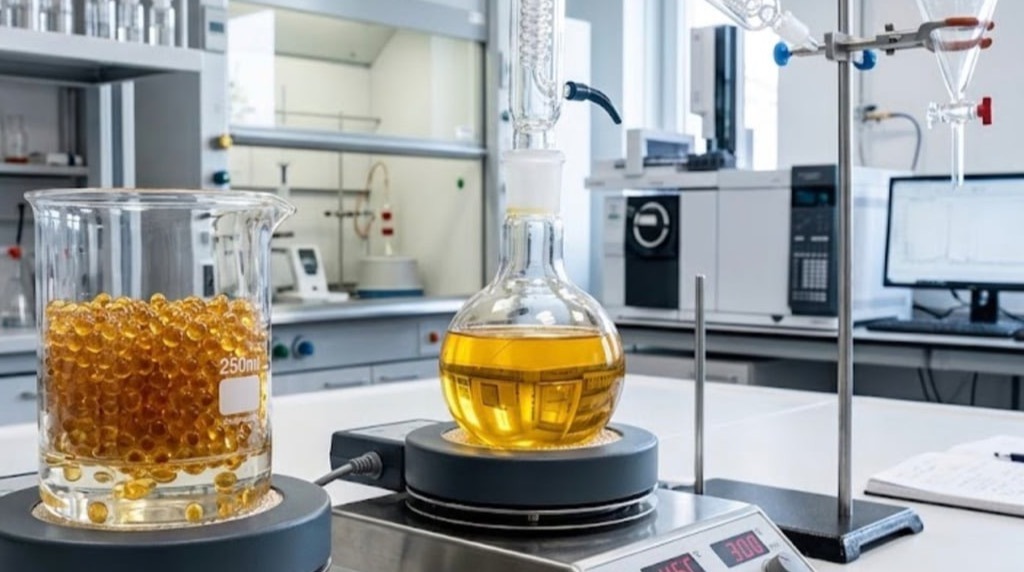
Amberlyst 15 is a macroreticular, strongly acidic ion-exchange resin manufactured by DuPont (formerly Rohm and Haas). It consists of sulfonated polystyrene beads that function as a solid-phase acid catalyst. Unlike dissolved Lewis acids that contaminate your product and require extensive washing to remove, Amberlyst 15 beads stay solid throughout the reaction. When the conversion is complete, you simply filter them out.
The mechanism is straightforward: the sulfonic acid groups on the bead surface provide the proton donation needed to catalyze the cyclization of CBD’s open ring structure into the closed ring of delta-9 THC. Because the catalyst is heterogeneous (solid in a liquid reaction), it never dissolves into your product. No acid residues. No solvent contamination. No liquid-liquid extraction needed.
Amberlyst 15 is widely available through chemical suppliers like Sigma-Aldrich and is commonly used in industrial organic chemistry for esterification, alkylation, and isomerization reactions. It is not exotic or hard to source.
Step-by-Step SOP: CBD to THC Using Amberlyst 15
This procedure converts CBD isolate into THC using only heat, mechanical stirring, and Amberlyst 15 beads. No solvents. No dissolved acids. Here is the complete standard operating procedure:
Materials Required
- 99%+ pure CBD isolate
- Amberlyst 15 catalytic beads (1:1 weight ratio to CBD)
- Glass reactor with mechanical stirring capability
- Temperature controller capable of maintaining 75°C
- Filtration apparatus (mesh or filter paper suitable for bead size)
- Short path or wiped film distillation system for final purification
Procedure
- Melt the CBD isolate. Place your CBD isolate into a glass reactor and heat to 75°C. CBD isolate melts into a clear liquid at this temperature. Ensure even heating to avoid hot spots.
- Add Amberlyst 15 beads. Once the CBD is fully melted and at temperature, add Amberlyst 15 beads at a 1:1 weight ratio. If you are processing 1 kg of CBD isolate, add 1 kg of beads.
- Stir at 500 RPM for 15 minutes. Engage mechanical stirring at approximately 500 RPM. The beads need consistent contact with the melted CBD to drive the conversion. At these parameters, you can expect approximately 80% total conversion of CBD to THC isomers (predominantly delta-8-THC, with delta-9 as a minor product) of CBD to THC in just 15 minutes.
- Filter while warm. Immediately after the reaction period, filter the mixture while it is still warm and fluid. The Amberlyst 15 beads are retained on the filter, and your crude THC oil passes through. Do not let the mixture cool before filtering, as the oil will solidify and make filtration difficult.
- Distill the crude oil. Run the filtered crude through wiped film distillation or short path distillation to purify the THC and remove any remaining CBD, byproducts, or color bodies.
Why This Method Is Superior to Traditional Acid Conversion
The advantages of Amberlyst 15 over traditional Lewis acid conversion are significant across every metric that matters to a processing operation:
Critical temperature limit: Amberlyst 15 has a maximum continuous operating temperature of 120C (standard grade). Above this temperature, the sulfonic acid functional groups begin leaching from the polymer matrix into the product. Even below 120C, prolonged contact (over 24 hours) at elevated temperatures can cause trace sulfonic acid leaching. Always test the final product for acidic residues.
Speed
Traditional acid-catalyzed conversion typically requires 1 to 4 hours of reaction time, followed by hours of liquid-liquid extraction and washing. The Amberlyst 15 method achieves 80% conversion in 15 minutes. At production scale, this means you can process 10 kg of CBD into THC every 15 minutes, limited only by your reactor size and filtration capacity.
Safety
No volatile solvents like heptane or DCM in the reaction vessel. No corrosive dissolved acids. No neutralization steps with sodium bicarbonate. The only materials in the reactor are melted CBD and inert polymer beads. This dramatically reduces fire risk, chemical exposure risk, and ventilation requirements.
Cost
Amberlyst 15 beads are reusable. After each batch, the beads can be regenerated by slowly passing a solution of 13% HCl in ethanol over them for approximately two hours. Once regenerated, they perform identically to fresh beads. Over dozens of cycles, the per-batch catalyst cost becomes negligible compared to purchasing fresh pTSA or other Lewis acids for every run.
Cleanup
The traditional method produces contaminated solvent waste, acidic aqueous waste from washing, and requires careful pH testing of the final product. The Amberlyst method produces no solvent waste and no acidic aqueous waste. You filter, distill, and you are done.
If you want to run through the full conversion workflow with lab walkthroughs and SOPs you can actually hand to your team, that is exactly what we built extractiontraining.com for.
How to Regenerate Amberlyst 15 Beads
Bead regeneration is simple and extends the useful life of your catalyst indefinitely:
- After filtering the beads from your reaction, rinse them with warm ethanol to remove residual cannabinoid oil.
- Prepare a regeneration solution of 13% hydrochloric acid in ethanol.
- Pass this solution slowly over the beads for approximately two hours. This restores the sulfonic acid active sites on the resin surface.
- Rinse the beads with clean ethanol to remove residual HCl.
- Dry the beads and store them for the next batch.
Regeneration is the only step in this entire process that involves an acid, and it happens offline, separate from your product. Your THC never contacts HCl.
Important Considerations Before You Start
While this method is simpler and safer than traditional approaches, a few critical points deserve attention:
- Starting material purity matters. Use 99%+ CBD isolate. Lower purity starting material will produce lower conversion rates and more byproducts that your distillation system must handle.
- Temperature control is essential. Maintaining a consistent 75°C ensures optimal conversion kinetics. Too low and the reaction slows. Too high and you risk thermal degradation and increased byproduct formation.
- Distillation is still required. The Amberlyst method produces crude THC oil that needs distillation for final purification, just like any other conversion method. The advantage is that you skip all the solvent removal and acid washing steps before distillation.
- Legal compliance is non-negotiable. CBD to THC conversion is regulated differently across jurisdictions. Ensure you have the appropriate licenses and are operating within your state and federal regulatory framework before attempting any cannabinoid conversion.
Frequently Asked Questions
Can you really convert CBD to THC without any solvents?
Yes. By melting CBD isolate at 75°C and using Amberlyst 15 catalytic beads as a solid-phase acid catalyst, the entire conversion happens in neat (solvent-free) conditions. The beads provide the acidic catalysis needed for cyclization without dissolving into the product. You filter the beads out after the reaction and proceed directly to distillation.
What conversion rate does the Amberlyst 15 method achieve?
At a 1:1 weight ratio of Amberlyst 15 to CBD isolate, stirred at 500 RPM and 75°C for 15 minutes, this method achieves approximately 80% total conversion of CBD, producing predominantly delta-8-THC (the thermodynamically favored product under these conditions). The remaining 20% consists of unconverted CBD and minor byproducts, which are separated during distillation.
How many times can Amberlyst 15 beads be reused?
With proper regeneration using 13% HCl in ethanol, Amberlyst 15 beads can be reused for dozens of cycles without significant loss of catalytic activity. The resin is designed for industrial reuse. Regeneration takes about two hours and restores the sulfonic acid active sites on the bead surface.
Is the Amberlyst 15 method faster than traditional Lewis acid conversion?
Dramatically faster. Traditional pTSA or HCl-catalyzed conversion requires 1 to 4 hours of reaction time, plus several additional hours for liquid-liquid extraction, acid washing, and solvent removal. The Amberlyst 15 method completes the reaction in 15 minutes, and cleanup is just filtration followed by distillation. At scale, this enables processing 10 kg of CBD every 15 minutes.
Does the THC produced need further purification?
Yes. The crude oil after filtration contains THC, residual CBD, and minor conversion byproducts. It must be run through short path distillation or wiped film distillation to produce a purified THC distillate. The key advantage is that you skip the solvent recovery and acid washing steps that traditional methods require before distillation.
What is the difference between Amberlyst 15 and traditional Lewis acids like pTSA?
pTSA is a homogeneous catalyst: it dissolves into your reaction mixture and must be washed out with extensive liquid-liquid extraction using aqueous sodium bicarbonate. Amberlyst 15 is a heterogeneous catalyst: it remains solid as polymer beads throughout the reaction. You filter it out mechanically. This eliminates solvent waste, acid waste, and the risk of acid contamination in your final product.
Is converting CBD to THC legal?
Legality varies by jurisdiction. Many U.S. states regulate cannabinoid conversion under their cannabis processing frameworks, requiring specific licenses. Some states prohibit it entirely. Federal law under the 2018 Farm Bill allows hemp-derived CBD but the DEA has stated that synthetically derived THC remains a Schedule I substance. Consult your state’s regulatory agency and a cannabis attorney before conducting any conversion work.
What equipment do I need to get started with this method?
The minimum equipment list includes a glass reactor with mechanical stirring and temperature control (capable of holding 75°C), a filtration setup appropriate for the bead particle size, and a distillation system (short path or wiped film) for final purification. If you are building a processing lab, this method integrates easily into existing distillation workflows.
Ready to level up your extraction game? Contact WKU Consulting for personalized guidance on cannabinoid conversion, lab design, and SOP development.
For more deep dives into cannabis chemistry, extraction SOPs, and lab design, subscribe to the WKU Consulting YouTube channel. New videos every week covering everything from distillation theory to advanced cannabinoid conversions.
Watch the full video walkthrough:
