
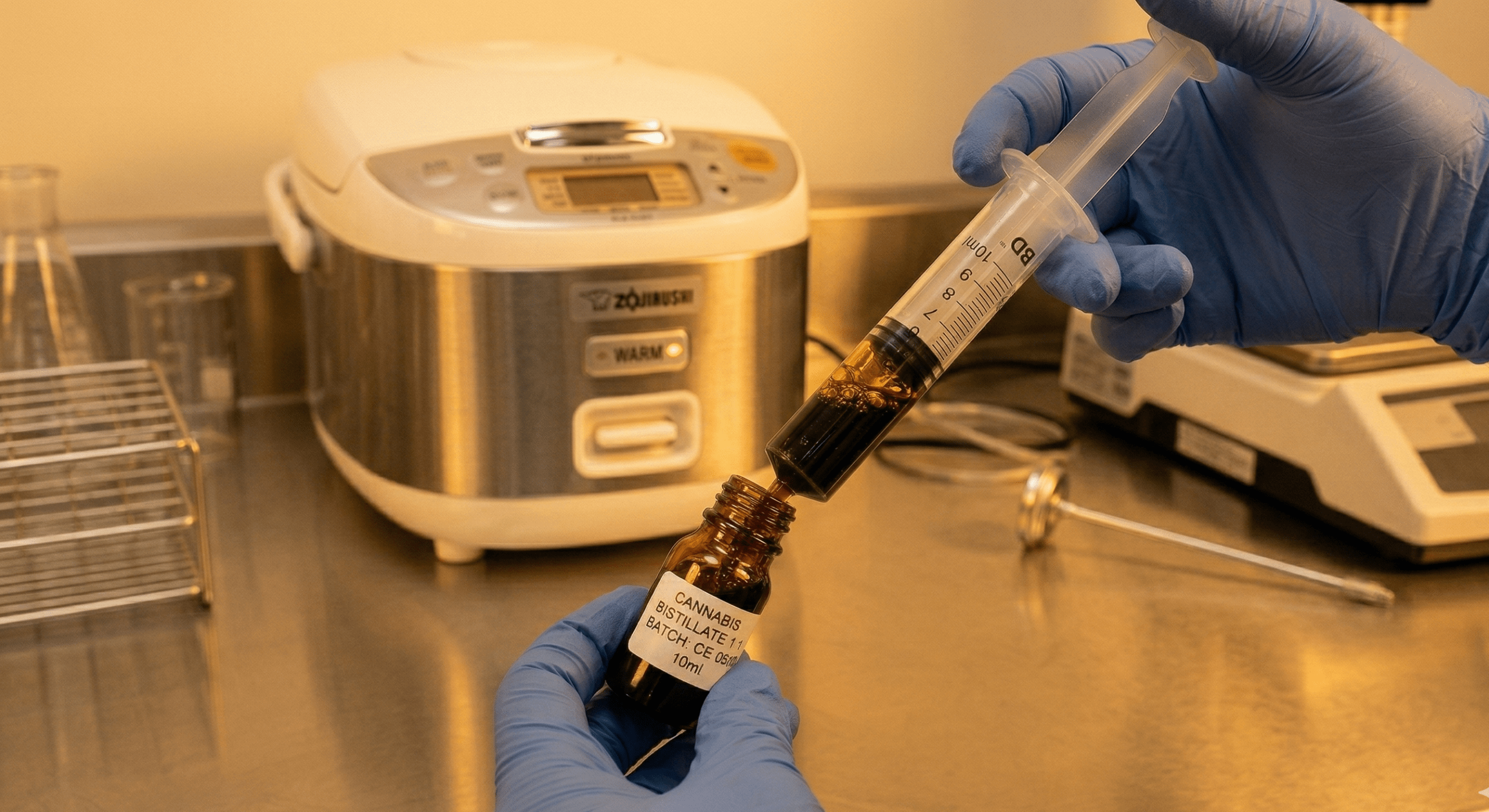
RSO oil, also known as Rick Simpson Oil, is a full-spectrum cannabis extract made by dissolving dried flower in 190-proof ethanol at a 750 mL per ounce ratio (roughly 3 cups per ounce of flower). The traditional Rick Simpson method used 1 gallon per ounce, but that volume of ethanol creates unnecessary fire risk during evaporation. 750 mL extracts just as effectively with half the solvent to purge, filtering the plant material, and evaporating the solvent at 140-160F until a thick, dark oil remains. Typical yield: 3-5 grams of RSO per ounce of flower at 20% THC input. Final potency ranges from 50-70% total cannabinoids with 2-8% terpene retention. The process takes 4-8 hours from start to finish. RSO differs from distillate because it retains the full chemical profile: cannabinoids, terpenes, flavonoids, chlorophyll, and plant waxes that contribute to the entourage effect.
What Is RSO (Rick Simpson Oil)?
RSO, or Rick Simpson Oil, is a full-spectrum cannabis extract made through ethanol extraction. Unlike concentrates that target isolated cannabinoids, RSO retains the full chemical profile of the plant: cannabinoids, terpenes, flavonoids, and other bioactive compounds. The result is a dark, viscous oil with a tar-like consistency that represents one of the most complete extractions you can produce from cannabis or hemp flower.
The process itself is straightforward, but the chemistry behind it matters. Ethanol is a polar solvent, meaning it pulls a broad range of compounds from plant material, including chlorophyll, waxes, and lipids. This is what gives RSO its characteristic dark color and full-bodied chemical profile. Understanding solvent polarity and its effect on extraction selectivity is critical to producing quality RSO consistently.
Equipment and Materials You Need
Before starting, gather the following:
- Cannabis or hemp flower: 1 ounce (28g) minimum. Higher quality input produces higher quality output.
- Food-grade ethanol (190 proof or higher): Everclear is the most accessible option. You need roughly 1 gallon per ounce of flower.
- Two large glass or ceramic mixing bowls
- Wooden spoon or silicone spatula for stirring
- Cheesecloth or fine mesh strainer
- Unbleached coffee filters for secondary filtration
- Rice cooker or double boiler for solvent evaporation
- Plastic syringes (no needle) for dosing and storage
- Ventilation: Work outdoors or in a well-ventilated area. Ethanol vapor is flammable.
Safety note: Never use an open flame near ethanol. Use electric heating elements only. Ethanol has a flash point of approximately 16.6°C (62°F), which means it can ignite at room temperature in the presence of a spark or open flame.
Step-by-Step RSO Extraction Process
Step 1: Decarboxylation (Optional Pre-Step)
If you want your RSO to be orally active without further heating, decarboxylation converts THCA to THC and CBDA to CBD. Spread your flower on a baking sheet lined with parchment paper and bake at 240°F (115°C) for 40 minutes. Some producers skip this step because the solvent evaporation phase generates enough heat to partially decarboxylate the extract. However, pre-decarbing ensures complete conversion and more predictable potency.
Step 2: First Ethanol Wash
Place your flower in a large glass bowl and pour enough ethanol to fully submerge the material, plus about an inch above. Stir gently for 3 to 5 minutes. This first wash extracts the majority of the cannabinoids and terpenes. Do not over-agitate or soak for extended periods. Longer contact time pulls more chlorophyll, waxes, and lipids, which darken the oil and reduce purity.
Step 3: Strain and Filter
Pour the ethanol solution through cheesecloth into a second clean bowl, squeezing gently to recover as much liquid as possible. For cleaner RSO, run the filtered liquid through an unbleached coffee filter. This removes fine plant particulate but does not remove dissolved chlorophyll or waxes.
Step 4: Second Wash (Optional)
You can perform a second wash on the same plant material to recover residual cannabinoids. Add fresh ethanol, stir for another 2 to 3 minutes, and strain again. Combine the first and second wash liquids. The second wash typically yields 15 to 20 percent additional cannabinoids but also extracts more undesirable compounds. Many producers keep the first and second wash separate, using the first wash for oral RSO and the second wash for topical applications.
Step 5: Solvent Evaporation
This is where most mistakes happen. Pour the filtered ethanol solution into a rice cooker and set it to the lowest heat setting. The rice cooker provides consistent, gentle heat that keeps temperatures below ethanol’s boiling point of 173°F (78.4°C) while still driving off the solvent efficiently. As the ethanol evaporates, the liquid volume decreases and the color darkens.
Never allow the temperature to exceed 290°F (143°C). Cannabinoid degradation accelerates above this threshold, converting THC to CBN and destroying terpenes. A rice cooker’s built-in thermal switch typically prevents overheating, which is why it is the preferred tool for this step.
The process takes 3 to 4 hours depending on the volume of ethanol. The oil is ready when it stops bubbling and becomes a thick, dark, viscous liquid. Small bubbles indicate residual solvent still evaporating. Wait until all bubbling stops completely.
Step 6: Collection and Storage
While the RSO is still warm and fluid, draw it into plastic oral syringes using the plunger. Once cooled, RSO becomes extremely thick and difficult to work with. Store filled syringes in a cool, dark place. RSO remains stable for months when kept away from heat, light, and oxygen. Refrigeration extends shelf life but makes the oil harder to dispense. Warming the syringe briefly under hot water restores workability.
Understanding RSO Potency and Composition
Well-made RSO from high-quality cannabis flower typically tests between 50 and 70 percent total cannabinoids. This is lower than ethanol shatter or distillate because RSO retains chlorophyll, lipids, and plant waxes that dilute the cannabinoid concentration. However, many users and patients prefer RSO specifically because of this full-spectrum profile.
The entourage effect, where cannabinoids and terpenes work synergistically, is maximized in full-spectrum extracts like RSO. This is the primary reason RSO has remained popular despite the availability of more refined concentrates. The trade-off is simple: higher purity concentrates isolate specific compounds, while RSO preserves the whole-plant chemistry.
Common Mistakes and How to Avoid Them
- Soaking too long: Extended ethanol contact (over 5 minutes) pulls excessive chlorophyll and waxes. Keep wash times short.
- Using isopropyl alcohol: Isopropyl (rubbing alcohol) contains denaturants and is not food-safe. Always use food-grade ethanol. If 190-proof Everclear is unavailable in your state, 151-proof works but yields a slightly less potent product due to water content.
- Overheating during evaporation: Temperatures above 290°F degrade cannabinoids. Use a rice cooker or double boiler with temperature monitoring.
- No ventilation: Ethanol vapor is heavier than air and accumulates at ground level. Always work in a well-ventilated area, preferably outdoors.
- Skipping filtration: Unfiltered RSO contains plant particulate that affects taste and consistency. Double-filter through cheesecloth and coffee filters.
If you want the full extraction-to-finished-oil workflow with SOPs you can hand to your team, that is exactly what we built extractiontraining.com for.
RSO vs. Other Cannabis Extracts
RSO occupies a unique position among cannabis extracts. Here is how it compares:
- RSO vs. Distillate: Distillate is a refined, high-potency extract (85 to 95 percent cannabinoids) produced through short path or wiped film distillation. RSO is unrefined and retains the full plant profile. Distillate is nearly flavorless; RSO has a strong, earthy, sometimes bitter taste.
- RSO vs. CO2 Oil: CO2 extraction produces a cleaner extract with better terpene preservation, but it requires expensive equipment ($50,000+). RSO can be made at home for under $50 in materials.
- RSO vs. BHO: Butane extracts target trichome heads and produce lighter-colored concentrates (shatter, wax, live resin). RSO extracts the whole plant, producing a darker, more complete extract.
- RSO vs. Tincture: Both use ethanol, but tinctures retain the solvent as the delivery vehicle. RSO evaporates the ethanol completely, leaving only the concentrated oil.
RSO Extraction Parameters by Method
| Parameter | 190-Proof Ethanol (Standard) | Everclear Method | Isopropyl (Not Recommended) | Naphtha (Original Simpson) |
|---|---|---|---|---|
| Solvent Ratio | 1 gallon per ounce | 750mL per ounce | 1 gallon per ounce | 500mL per ounce |
| Soak Time | 3-5 minutes (quick wash) | 3-5 minutes | 30 seconds max | 3-5 minutes |
| Evaporation Temp | 140-160F (60-71C) | 140-160F (60-71C) | 180F (82C) | 140-150F (60-65C) |
| Purge Time | 2-4 hours (rice cooker) | 2-4 hours | 4-6 hours | 3-5 hours |
| Expected Yield | 3-5g per ounce | 3-5g per ounce | 2-4g per ounce | 3-5g per ounce |
| Typical Potency | 50-70% total cannabinoids | 50-70% total cannabinoids | 40-60% (more impurities) | 55-70% total cannabinoids |
| Safety Risk | Low (food-grade solvent) | Low (food-grade) | HIGH (toxic residual) | HIGH (carcinogenic residual) |
| Residual Solvent Concern | Ethanol evaporates cleanly at 173F | Same as ethanol | ISO residual toxic above 500ppm | Naphtha residual carcinogenic at any level |
Bottom line: 190-proof ethanol or Everclear are the only solvents that should be used for RSO intended for human consumption. Isopropyl and naphtha leave toxic residuals that cannot be fully purged at home without analytical testing to confirm safety.
RSO vs Other Cannabis Extracts: What You Actually Get
| Extract Type | THC Range | Terpene Retention | Plant Waxes/Lipids | Onset (Oral) | Duration | Typical Use | Equipment Cost |
|---|---|---|---|---|---|---|---|
| RSO / FECO | 50-70% | 2-8% | High (5-15%) | 45-90 min | 4-8 hours | Medical protocols, oral dosing | Under $50 |
| Distillate | 85-95% | <1% (stripped) | None (removed) | 45-90 min | 3-6 hours | Vape carts, edibles, topicals | $5K-50K |
| Live Resin | 60-80% | 8-15% | Low (winterized) | N/A (dabbed) | 1-3 hours | Dabbing, flavor chasers | $50K-200K |
| Rosin | 60-80% | 5-12% | Moderate (3-8%) | N/A (dabbed) | 1-3 hours | Solventless dabbing | $300-15K |
| BHO Shatter | 70-85% | 3-8% | Low (winterized) | N/A (dabbed) | 1-3 hours | Dabbing, potency | $50K-200K |
| Tincture | 5-30% | 1-5% | Moderate | 15-45 min (sublingual) | 3-6 hours | Dosing precision, micro-dosing | Under $50 |
RSO’s advantage over distillate is the entourage effect. The retained terpenes, flavonoids (including cannflavins A and B, which showed 30x greater inhibition of prostaglandin E2 than aspirin in one specific in-vitro assay (Barrett et al., 1986, human rheumatoid synovial cells). This does not mean 30x more potent in the body, as in-vivo bioavailability and dose-response differ substantially), and minor cannabinoids (CBN, CBC, CBG) produce a broader therapeutic profile than isolated THC. RSO’s disadvantage is taste: the chlorophyll and plant waxes make it bitter and difficult to consume without capsules or food.
RSO Dosing Protocol: Standard Titration Schedule
For the complete pharmacokinetics guide including carrier oil bioavailability comparisons, sublingual vs oral absorption data, and dosing failure diagnostics, see our dedicated RSO Dosing Protocol and Carrier Oil Science article.
| Week | Dose Per Application | Frequency | Daily Total | Notes |
|---|---|---|---|---|
| Week 1 | Half a grain of rice (~5mg THC) | 3x daily | ~15mg | Start low. Assess tolerance. Take with fatty food for absorption. |
| Week 2-3 | Double previous dose every 4 days | 3x daily | 30-120mg | Doubling stops if side effects (drowsiness, anxiety) appear. Hold at current dose for 3 days. |
| Week 4-8 | Continue doubling to target | 3x daily | 120-500mg | Most patients plateau between 200-500mg daily. The Rick Simpson protocol targets 1g/day (600-700mg THC). |
| Week 8-12 | Full target dose | 3x daily | 500-1000mg | The full Simpson protocol is 60g total over 90 days. Not everyone reaches this. Dose to tolerance. |
| Maintenance | Reduced dose | 1-2x daily | 50-200mg | After completing protocol, maintenance dose is typically 1/4 to 1/3 of peak dose. |
RSO Extraction Failures: Diagnosis and Fixes
| Symptom | Root Cause | Diagnostic Test | Fix |
|---|---|---|---|
| Green/dark green oil instead of dark amber | Chlorophyll co-extraction from too-long soak time (>5 min) or warm solvent | Compare soak time to protocol. If solvent was above 40F during soak, chlorophyll dissolved. | Quick wash only: 3 minutes max. Chill solvent to -20F before contact. Cold ethanol is selective for cannabinoids over chlorophyll. |
| Low yield (<2g per ounce) | Insufficient solvent contact, poor-quality starting material, or incomplete evaporation leaving solvent-diluted oil | Weigh oil before and after extended purge at 160F. If weight drops significantly, solvent was still present. | Use full gallon per ounce. Ensure flower is fully dry and ground (not powder). Extend purge until no bubbles visible for 15+ minutes. |
| Harsh chemical taste in finished RSO | Residual solvent from incomplete evaporation, or contaminated solvent (denatured ethanol contains methanol or isopropanol additives) | Check solvent label: must be 190-proof USP or food-grade. Denatured alcohol is NOT safe for RSO. | Only use Everclear or equivalent 190-proof food-grade ethanol. Extend purge at 150-160F until oil stops bubbling entirely. Vacuum purge if available. |
| RSO is too runny/liquid at room temperature | Under-decarboxylation: THCa has not fully converted to THC. THCa-dominant oil is more viscous when hot but less viscous at room temp than fully decarbed oil. | Lab test for THCa vs THC ratio. If THCa > 15% of total, decarb is incomplete. | Return oil to heat at 240F for 30-45 minutes to complete decarboxylation. Oil will bubble (CO2 release) and thicken as THCa converts. |
| RSO causes extreme drowsiness at low doses | High CBN content from oxidized/aged starting material. CBN is commonly reported as sedating, though current peer-reviewed evidence is limited. A 2021 systematic review (Corroon) found insufficient evidence to confirm CBN as a standalone sedative. The sedation may require CBN + THC together (entourage effect). Anecdotal reports are consistent but clinical data is thin. | Check starting material: old, brown, or improperly stored flower oxidizes THC to CBN. If flower smells like hay instead of terpenes, CBN is elevated. | Use fresh, properly cured flower stored in airtight glass with no light exposure. CBN cannot be reversed once formed. |
| Finished RSO fails lab testing for residual solvents | Purge temperature too low or duration too short. Ethanol boils at 173F but trapped ethanol in thick oil needs sustained heat to fully escape. | If oil still bubbles at 170F, ethanol is present. Absence of visible bubbles at 175F for 15 minutes confirms clean purge. | Final purge at 175-180F for minimum 30 minutes after last visible bubble. Thin the oil layer in the vessel for faster solvent escape. Vacuum oven at 140F / -25inHg for 24h is the gold standard. |
RSO Tincture Recipe: Turning RSO into a Sublingual Oil
One of the most common questions from first-time RSO makers: can you dissolve RSO into a carrier oil to make a tincture? Yes. And there are good reasons to do it beyond convenience.
RSO straight from the syringe is thick, sticky, and difficult to dose precisely. Dissolving it into MCT oil (fractionated coconut oil) converts it into a sublingual tincture with two practical advantages: precise dosing with a graduated dropper, and faster onset. Sublingual absorption bypasses first-pass liver metabolism, meaning the cannabinoids reach systemic circulation in 15-30 minutes instead of the 60-90 minute window for oral ingestion. The tradeoff is lower total bioavailability for some compounds that benefit from hepatic conversion (specifically, THC converting to the more potent 11-hydroxy-THC in the liver).
Basic RSO Tincture Protocol
Start with 1 gram of RSO and 30 mL of MCT oil. That gives you roughly 20-25 mg of THC per mL (assuming your RSO tests at 60-70% total cannabinoids). Warm the MCT oil to 60C (140F) in a glass container, add the RSO, and stir until fully dissolved. Do not exceed 70C or you begin losing volatile terpenes. Transfer to an amber glass dropper bottle and store in a cool, dark place. Shelf life: 6-12 months when stored properly.
For lower-dose tinctures (5-10 mg/mL), use 60 mL of MCT oil per gram of RSO. For higher-concentration tinctures (40-50 mg/mL), reduce to 15 mL of MCT oil. The RSO dissolves more readily in warm oil, but do not microwave it. Use a water bath or low-heat plate.
MCT oil is the preferred carrier because its medium-chain fatty acids (C8 and C10 caprylic and capric acid) have higher lymphatic absorption than long-chain triglycerides found in olive oil or hemp seed oil. This means more cannabinoid reaches systemic circulation rather than being metabolized on first pass. If you want the hands-on walkthrough for dialing in carrier oil selection and dosing math, that is exactly what we built extractiontraining.com for.
Carrier Oil Comparison for RSO Tinctures
MCT is the default carrier for a reason, but it is not the only option. The carrier oil changes how the cannabinoids absorb, how fast they hit, and how long the tincture lasts on the shelf. Here is what actually matters.
| Carrier Oil | Dominant Fatty Acids | Absorption Route | Sublingual Onset (Tmax) | Relative Bioavailability | Shelf Life | Best Use Case |
|---|---|---|---|---|---|---|
| MCT Oil (C8/C10) | Caprylic (C8), Capric (C10) | Lymphatic (bypasses liver) | 15-25 min | Highest (3-5x vs olive oil) | 12-18 months | Sublingual tinctures, fast onset |
| Coconut Oil (Virgin) | Lauric (C12), Myristic (C14) | Mixed (partial lymphatic) | 25-40 min | Moderate (1.5-2.5x vs olive oil) | 12-24 months | Capsules, suppositories (solid at room temp) |
| Olive Oil (EVOO) | Oleic (C18:1) | Portal vein (liver first-pass) | 45-75 min | Baseline (1x) | 6-12 months | Cooking, oral dosing where onset speed does not matter |
| Hemp Seed Oil | Linoleic (C18:2), Alpha-linolenic (C18:3) | Portal vein | 50-80 min | 0.8-1.2x | 3-6 months (oxidizes fast) | Topicals, marketing appeal. Worst shelf life for tinctures. |
| Sunflower Lecithin | Phospholipids | Enhanced absorption via emulsification | 20-35 min | 2-3x (as additive to any carrier) | Additive only | Add 1-2% to any carrier to improve absorption |
The difference between MCT and olive oil is not subtle. MCT’s C8 and C10 chains are short enough to enter lymphatic circulation directly, bypassing hepatic first-pass metabolism. That means more THC reaches the bloodstream as THC rather than being converted to 11-hydroxy-THC in the liver. For patients who want the specific effects of delta-9 THC rather than its liver metabolite, MCT is the only carrier that makes pharmacological sense.
RSO Tincture Dosing Reference
Every RSO batch is different. These calculations assume 60-70% total cannabinoids in your RSO, which is typical for a well-made ethanol extraction from 20-25% THC flower. Adjust based on your actual potency if you have lab results.
| RSO Amount | MCT Oil Volume | Resulting mg/mL (at 65% cannabinoids) | Drops per 5mg Dose (0.05 mL/drop) | Best For |
|---|---|---|---|---|
| 1 gram | 60 mL | ~10.8 mg/mL | ~9 drops | Microdosing, beginners, titration |
| 1 gram | 30 mL | ~21.7 mg/mL | ~5 drops | Standard tincture, daily use |
| 1 gram | 15 mL | ~43.3 mg/mL | ~2 drops | High-dose patients, experienced users |
| 3 grams | 30 mL | ~65.0 mg/mL | ~1.5 drops | RSO protocol patients, concentrated dosing |
| 5 grams | 30 mL | ~108.3 mg/mL | <1 drop | Maximum concentration (viscosity may increase) |
At concentrations above 65 mg/mL, the RSO may not fully dissolve in MCT oil at room temperature. Warm the mixture to 60C and stir for 5 minutes. If the oil remains cloudy after cooling, reduce the RSO-to-oil ratio. Cloudy tincture means undissolved cannabinoids sitting at the bottom of the bottle, which means inconsistent dosing.
Flavoring and Shelf Life
RSO tinctures taste like concentrated cannabis. There is no avoiding it entirely. Food-grade peppermint oil (2-3 drops per 30 mL) is the most effective masking agent. Citrus oils work but oxidize faster. Vanilla extract adds sweetness without competing with the terpene profile. Add flavoring after the RSO dissolves completely, not during heating.
Shelf life depends on the carrier and storage. MCT tinctures stored in amber glass at room temperature last 12-18 months. Hemp seed oil tinctures degrade in 3-6 months due to polyunsaturated fat oxidation. Refrigeration extends all tinctures by 30-50%. The degradation you are watching for is not the carrier going rancid (you will smell that). It is the cannabinoids oxidizing: THC converts to CBN at a rate of approximately 5% per year at room temperature, faster with light or heat exposure.
THCA RSO: Making Non-Psychoactive Rick Simpson Oil
Standard RSO starts with decarboxylation, converting THCA to THC before extraction. THCA RSO skips that step entirely. The result is an oil where 40-70% of the cannabinoid content remains as THCA in its acid form: non-psychoactive, anti-inflammatory, and increasingly used by patients who need cannabinoid therapy without intoxication.
THCA decarboxylates to THC at approximately 105C (220F) with a half-life of about 30 minutes at that temperature. Below 80C (176F), the conversion rate drops to less than 2% per hour. That 25-degree window between 80C and 105C is everything. Every step of THCA RSO production is about staying below that line.
Some producers skip the flower entirely and start with full-melt bubble hash as the starting material. Ice water extraction pre-separates trichome heads from plant matter, so the resulting RSO has higher cannabinoid concentration and less chlorophyll. The tradeoff is lower total yield per pound of flower processed.
THCA RSO Extraction Protocol
The process is identical to standard RSO with three critical modifications: no decarboxylation, cold solvent contact, and low-temperature evaporation.
Step 1: Skip decarboxylation. Use raw, unheated cannabis flower. Do not oven-treat, microwave, or sous vide the material. The flower should be dried and cured normally (target water activity 0.55-0.60), but never exposed to temperatures above 80C during any pre-processing.
Step 2: Cold ethanol wash. Chill 190-proof ethanol to -20C (-4F) or colder before contact. Freezer temperature is acceptable; dry ice bath (-40C) is better. Cold ethanol is critical for two reasons: it minimizes chlorophyll and wax co-extraction (cleaner oil), and it prevents any thermal conversion of THCA during the wash. Contact time: 3 minutes maximum. One wash only. A second wash at cold temperature extracts diminishing cannabinoids but increasing undesirables.
Step 3: Filter at cold temperature. Strain through a 25-micron mesh, then through an unbleached coffee filter. Keep the solution cold during filtration. If it warms above 15C during filtering, you have not compromised the THCA, but you will pull more chlorophyll into the final product.
Step 4: Low-temperature evaporation. This is where most THCA RSO fails. A rice cooker runs at 100C, which is close enough to the 105C decarboxylation threshold to convert 15-30% of your THCA to THC during a 3-hour evaporation. Instead, use a vacuum oven or rotary evaporator. Target: evaporate ethanol at 40-50C under vacuum (25-29 inHg). At 45C and full vacuum, ethanol boils off efficiently while THCA conversion stays below 3%. If you do not have vacuum equipment, use a double boiler at 60C maximum, accept a longer evaporation time (6-10 hours), and accept 5-8% THCA-to-THC conversion.
Step 5: Nitrogen blanket and storage. Once the ethanol is evaporated, purge the headspace of your storage container with food-grade nitrogen gas before sealing. THCA oxidizes to CBNA (cannabinolic acid) when exposed to oxygen, degrading potency over weeks. Amber glass syringes or vials with nitrogen headspace, stored at 4C (refrigerator temperature), preserve THCA content for 6-12 months. Without nitrogen blanketing at room temperature, expect 10-15% THCA loss per month from oxidation alone.
THCA RSO vs Standard RSO
| Parameter | Standard RSO (Decarbed) | THCA RSO (Raw) |
|---|---|---|
| Primary cannabinoid | THC (delta-9) | THCA (tetrahydrocannabinolic acid) |
| Psychoactive | Yes (strongly) | No (unless heated above 105C) |
| Decarboxylation step | 240F/40 min before extraction | Skipped entirely |
| Ethanol temperature | Room temp or cold | Must be -20C or colder |
| Evaporation temperature | Rice cooker (100C) acceptable | Max 50C under vacuum, 60C without |
| Typical total cannabinoid % | 60-70% (mostly THC) | 40-70% (mostly THCA, <5% THC if done correctly) |
| Shelf life (room temp) | 12-18 months | 3-6 months (THCA oxidizes faster without nitrogen) |
| Shelf life (refrigerated + N2) | 18-24 months | 6-12 months |
| Common failure | Residual solvent, dark color | Accidental decarboxylation during evaporation |
| Lab test to verify | THC potency | THCA:THC ratio (target >90:10) |
If your lab results come back showing THCA:THC lower than 85:15, your evaporation temperature was too high. The fix is lower temperature, longer time, and ideally vacuum. There is no way to convert THC back to THCA once decarboxylation has occurred.
Is RSO Legal? Marijuana-Derived vs Hemp-Derived Rick Simpson Oil Under the Farm Bill and the December 11 Ban
The jar of ethanol does not care where the flower came from, and the law cares about nothing else. RSO made from dispensary flower and RSO made from a hemp field are the same procedure, the same solvent, and the same rice cooker, and they sit in two different legal categories decided by the plant that went into the jar, the state you are standing in, and, since the September 3, 2026 delay, the calendar.
Licensed processors clear that hazard with an NFPA 30 solvent storage room and the gas detection and ventilation package a home kitchen cannot replicate, which is the reason the home-extraction bans exist.
Hemp is cannabis at or below 0.3 percent total THC by dry weight, and total THC now counts the acid form: delta-9 THC plus 0.877 times THCA. That single multiplier is what killed the “THCA hemp flower” loophole, because 25 percent THCA flower is 21.9 percent total THC and fails the 0.3 percent line 73 times over. Section 781 of Public Law 119-37 rewrote the federal hemp definition around that math and added a cap of 0.4 mg total THC per container on finished products. H.R. 6500, signed September 3, 2026, moved the effective date to December 11, 2026 for anything the plant can make and left November 12, 2026 in place for cannabinoids it cannot, which is why delta-8 and HHC lose hemp status a month before THCA flower does. The full operator playbook for those two dates is in our intoxicating hemp ban guide.
The part nobody runs the numbers on is what RSO does to a legal hemp input. A 10 to 18 percent yield means the oil is 6 to 10 times more concentrated than the flower. Run hemp flower that tests exactly 0.3 percent total THC through a 15 percent yield and the syringe comes out near 2 percent total THC by weight. A 10 g syringe at 2 percent holds 200 mg of total THC, 500 times the container cap. Hemp went into the jar. Something that is not hemp came out. The only hemp RSO that survives December 11 is oil with the THC taken out first, by the same chromatography or crystallization steps a licensed CBD processor runs.
| Starting flower | What the finished oil is, federally | The total-THC math | After December 11, 2026 | What the maker actually needs |
|---|---|---|---|---|
| Dispensary or home-grown marijuana flower (15 to 30 percent THCA) | Marijuana. Your state program decides whether you can possess it, grow it, and extract it at home. Covered state-licensed operators sit in Schedule III under the April 28, 2026 order (stay denied September 9); home makers get nothing from that order. | 20 percent THCA flower is 17.5 percent total THC before you start. The oil concentrates it about 6 to 10 times. | No change. It was never hemp. | A state program that allows concentrate, and a state that does not bar home extraction with a flammable solvent. Check your state in the licensing hub. |
| Hemp flower at or below 0.3 percent total THC (CBD cultivars) | Hemp today. The finished oil is what gets tested, and RSO concentrates THC along with everything else. | 0.3 percent flower through a 15 percent yield lands near 2 percent total THC in the oil. A 10 g syringe at 2 percent carries 200 mg of total THC. | Section 781 caps finished hemp products at 0.4 mg total THC per container. That syringe is 500 times over. Only THC-remediated CBD RSO stays hemp. | Non-detect THC in the finished oil, which means chromatography or crystallization before the syringe, or a state license. |
| “THCA hemp flower” (15 to 25 percent THCA, under 0.3 percent delta-9) | Marijuana under the total-THC math, whatever the bag said. 25 percent THCA is 21.9 percent total THC; flower fails the line once THCA alone passes 0.34 percent. | Same 6 to 10x concentration. The oil is a marijuana concentrate. | December 11, 2026 is the date the federal hemp definition stops covering it. States like Texas moved earlier. | Treat it as row one. A THCA label does not change the extraction or the oil. |
| Delta-8, HHC, or THC-O oil made from CBD (sold as “RSO” by some brands) | Synthetically derived under Section 781. Not RSO in any chemical sense: RSO is a whole-flower ethanol wash, and these come out of a flask. | No flower, no concentration math. The THC was built, not extracted. | November 12, 2026. The plant cannot make these, so they lose hemp status a month earlier. | Nothing. If a syringe labeled RSO lists delta-8 or HHC, it is a conversion product, not an extraction. |
The state layer decides the rest, and it moves faster than the federal one. Most adult-use states allow possession of concentrate and many allow home cultivation, and a number of those same states separately prohibit extracting at home with a flammable solvent. Ethanol is a flammable solvent; that is the reason the rice cooker sits outside with the vent fan running and it is also the reason some states draw the line where they do. Texas started shelf-pull enforcement on THCA products in August 2026, ahead of the federal date. The state licensing hub tracks what each program allows a licensed processor to do; for home extraction, read your own state’s concentrate and manufacturing statutes before the first wash, because the extraction rules and the possession rules are written in different chapters.
Frequently Asked Questions
How long does it take to make RSO at home?
The full process takes approximately 4 to 6 hours from start to finish. The ethanol washes and filtration take about 30 minutes. Solvent evaporation in a rice cooker takes 3 to 4 hours depending on volume. If you include a decarboxylation pre-step, add another 40 minutes of oven time.
What is the best solvent for making RSO?
Food-grade ethanol at 190 proof (95% concentration) is the standard. Everclear is the most widely available option. Never use isopropyl alcohol, denatured alcohol, or methanol. These contain toxic additives that cannot be fully removed during evaporation and pose serious health risks.
How much RSO does one ounce of flower produce?
One ounce (28 grams) of quality cannabis flower typically yields 3 to 5 grams of RSO, depending on the starting material’s cannabinoid content and how thoroughly you wash. This represents roughly a 10 to 18 percent return by weight. Higher potency flower yields more concentrated RSO.
Does RSO need to be decarboxylated?
If you plan to consume RSO orally (under the tongue, in capsules, or mixed into food), decarboxylation is recommended. Raw THCA is not psychoactive; it must be converted to THC through heat. The solvent evaporation step provides some decarboxylation, but it is not complete or consistent. Pre-decarbing at 240°F for 40 minutes before extraction ensures full activation.
Can you make RSO from hemp flower?
Yes. Hemp-derived RSO follows the exact same process. The resulting oil will be high in CBD rather than THC, with total cannabinoid content typically between 40 and 60 percent. Under the 2018 Farm Bill the finished oil had to stay under 0.3% delta-9 THC. From December 11, 2026 the test becomes total THC (delta-9 plus 0.877 times THCA) with a 0.4 mg per container cap, which hemp RSO fails unless the THC is remediated out first. See the legality section above.
Is RSO the same as cannabis oil?
“Cannabis oil” is a broad term that can refer to any oil derived from cannabis, including distillate, CO2 oil, MCT-based tinctures, and RSO. RSO specifically refers to the full-spectrum ethanol extract made using the Rick Simpson method. The key difference is that RSO retains the complete chemical profile of the plant, while most commercial cannabis oils are refined to isolate specific cannabinoids.
How should RSO be stored for maximum shelf life?
Store RSO in airtight plastic syringes or glass containers in a cool, dark location. Exposure to heat, light, and oxygen degrades cannabinoids over time, converting THC to CBN and reducing potency. Properly stored RSO remains effective for 6 to 12 months. Refrigeration extends shelf life further but thickens the oil. Run the syringe under warm water for 30 seconds before dispensing refrigerated RSO.
Why is RSO so dark compared to other extracts?
RSO’s dark color comes from chlorophyll, lipids, and plant waxes that ethanol extracts along with cannabinoids and terpenes. These compounds are not present in more refined extracts like distillate or BHO shatter, which use either non-polar solvents or post-processing steps (winterization, filtration) to remove them. The dark color is not an indicator of quality; it simply reflects the full-spectrum nature of the extraction.
How is RSO made?
RSO is made by soaking dried cannabis flower in cold food-grade ethanol (190 proof), filtering the plant material out, and then slowly evaporating the solvent until only a thick, dark, full-spectrum oil remains. The standard process uses two 3-minute ethanol washes at -20C or colder to minimize chlorophyll and wax co-extraction. After filtering through a 25-micron mesh, the ethanol is evaporated in a rice cooker or hot plate at 70-80C until bubbling stops, then vacuum purged at 40-50C to remove the last 500-1,000 ppm of residual solvent. One ounce of flower typically yields 3 to 5 grams of finished RSO at 50 to 70 percent total cannabinoids.
Can you use Everclear to make RSO?
Everclear (190 proof, 95% ethanol) is the go-to solvent for RSO production. It is food-grade, widely available, and evaporates cleanly without leaving toxic residues. The 5% water content actually helps extract a broader range of polar compounds like flavonoids and phenolic acids that pure ethanol would miss. If Everclear is not available in your state, look for any food-grade ethanol at 190 proof or higher. Avoid 151-proof versions if possible. The lower ethanol concentration pulls more water-soluble chlorophyll and produces a harsher tasting oil with a heavier green color.
How many washes should you do when making RSO?
Two washes is the standard. The first wash (3 minutes, cold ethanol at -20C) pulls 70 to 80 percent of the available cannabinoids with minimal chlorophyll. The second wash (another 3 minutes) recovers most of the remaining 20 to 30 percent. A third wash is possible but the returns drop sharply. You are mostly pulling chlorophyll, lipids, and waxes at that point. The combined first and second wash extracts will have a different color profile. The first wash produces a golden amber oil. The second wash is darker and more plant-forward. Some producers keep them separate and use the first wash for oral dosing and the second wash for topicals.
Ready to level up your extraction game? Contact WKU Consulting for personalized guidance on building your extraction lab.
For more deep dives into cannabis chemistry, extraction SOPs, and lab design, subscribe to the WKU Consulting YouTube channel.
Watch a related video:
What is THCA RSO?
THCA RSO is Rick Simpson Oil extracted from raw, undecarboxylated cannabis, preserving 40-70% of the cannabinoid content as THCA rather than converting it to psychoactive THC. THCA decarboxylates to THC at 105C (220F) with a half-life of about 30 minutes. Making THCA RSO requires cold ethanol (-20C or colder), low-temperature evaporation (50C max under vacuum), and nitrogen-blanketed storage to prevent oxidation. See the full THCA RSO protocol above for the step-by-step SOP with temperature controls and failure diagnostics.
Can You Turn RSO into a Tincture?
Dissolve 1 gram of RSO in 10 to 30 mL of MCT oil depending on desired potency. Warm the carrier oil to 60C (140F) and stir until the RSO dissolves completely. MCT oil is the best carrier because medium-chain fatty acids (C8 and C10) bypass first-pass liver metabolism through lymphatic absorption, improving sublingual bioavailability by 3 to 5 times compared to long-chain carriers like olive oil. For a deeper breakdown of carrier oil pharmacokinetics, see our RSO dosing protocol guide. Store in amber glass dropper bottles at room temperature for 6 to 12 months shelf life.
What is the Difference Between RSO and FECO?
RSO and FECO (Full Extract Cannabis Oil) are the same product made by the same ethanol extraction process. FECO is the technically accurate name. RSO is named after Rick Simpson who popularized the method in the early 2000s. Some producers call grain alcohol extracts FECO and naphtha extracts RSO, but modern practice uses food-grade ethanol exclusively for both. The chemistry, cannabinoid profile, and therapeutic applications are identical.
Is RSO legal?
It depends on the flower, not the process. RSO made from marijuana flower is a marijuana concentrate and is legal only inside a state program that allows concentrate, and several states that allow home cultivation still bar home extraction with flammable solvents. RSO made from hemp flower at or below 0.3 percent total THC is a hemp product today, but the oil concentrates THC 6 to 10 times, so a 10 g syringe of hemp RSO can carry 200 mg of total THC, 500 times the 0.4 mg per container cap that takes effect December 11, 2026. After that date only THC-remediated CBD RSO stays hemp.
Can I make RSO from fresh flower, or does it need to be dried?
Dry it. Fresh flower is 75 to 80 percent water, so an ounce of fresh material is about 6 g of dry-equivalent flower and a 750 mL wash returns roughly a quarter of the oil you planned on. The water it carries stays behind after the ethanol boils off at 78C, so the oil sits at 100C while the last water leaves, and what does not leave turns the RSO cloudy and lets it mold in the syringe. Cure to 10 to 12 percent moisture (water activity 0.55 to 0.60) first. If the goal is a fresh-frozen terpene profile, freeze the flower and the ethanol to -20C, keep the wash under 3 minutes, and accept the lower yield.
Is the 2018 Farm Bill hemp loophole closed?
For THCA flower, yes, on December 11, 2026. The 2018 Farm Bill measured delta-9 THC only, so flower at 25 percent THCA passed as hemp. Section 781 of Public Law 119-37 redefines hemp by total THC (delta-9 plus 0.877 times THCA), which puts that same flower at 21.9 percent, and caps finished hemp products at 0.4 mg total THC per container. H.R. 6500 set the effective date at December 11, 2026 for cannabinoids the plant makes and November 12, 2026 for synthesized ones such as delta-8 and HHC.
