
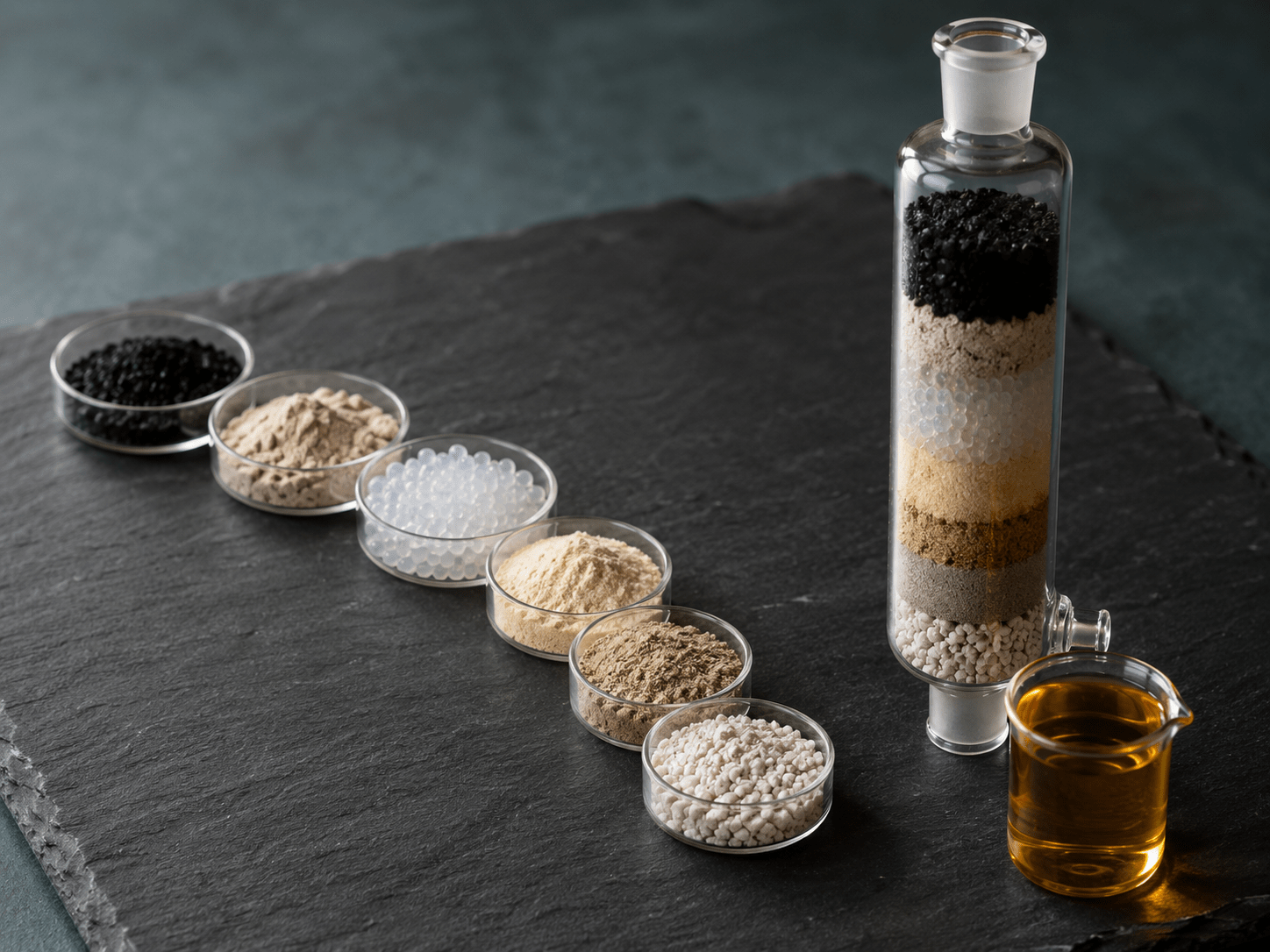
Cannabis filtration media splits into two functional classes: depth filtration (celite, perlite, filter paper) that removes particulates by size exclusion at 1-25 micron pore ratings, and adsorptive chromatography media (activated carbon, bentonite clay, silica gel, alumina, magnesium silicate) that removes contaminants by chemical interaction. Activated carbon adsorbs 85-95% of color bodies but strips 8-15% of cannabinoids at standard loading (10% w/w). Bentonite removes pesticides at 70-90% efficiency with only 2-5% cannabinoid loss. Silica gel (60A pore, 230-400 mesh) provides the most selective color remediation at 3-8% cannabinoid loss when flow rate stays below 2 BV/hr. Every filter seller publishes adsorption capacity. None publish cannabinoid loss ratios. This is that comparison.
Why Independent Media Comparison Matters
Every filtration media guide on the internet is written by a company selling filtration media. Media Bros compares CRY to CRY-M to CRY+. BVV compares Ultra Clear to competitors. Absolute Filtration compares their granular to their powdered product. The comparison always concludes that their product is the right choice.
The data you actually need to make a purchasing decision does not exist in those guides: how much THC does each media type cost you per gram of contaminant removed? What is the selectivity ratio between color body adsorption and cannabinoid loss? At what loading percentage does each media hit diminishing returns? When does a media choice cause more problems than it solves?
This guide answers those questions with independent data. No media partnerships, no affiliate links, no product sold. The goal is simple: match the right media to your extract, your target product, and your budget.
Filtration Media Classes: Chemistry and Mechanism
Activated Carbon (Coconut Shell vs. Wood vs. Coal)
Activated carbon works by van der Waals adsorption. Pore structure determines selectivity: micropores (<2nm) adsorb small molecules (chlorophyll, color bodies), mesopores (2-50nm) adsorb medium molecules (some cannabinoids, pesticides), and macropores (>50nm) provide transport channels.
Coconut shell carbon has the highest micropore density (0.5-0.7 cm3/g micropore volume) and the lowest ash content (<3%). This makes it the most selective for color body removal with the least cannabinoid co-adsorption. Wood-based carbon has higher mesopore volume (0.3-0.5 cm3/g) and strips more cannabinoids. Coal-based carbon has the highest total surface area (1000-1500 m2/g) but the least predictable pore distribution and the most heavy metal contamination risk.
Standard loading: 5-15% by weight of crude. Below 5%, insufficient decolorization. Above 15%, cannabinoid loss exceeds 20% and becomes uneconomical. The sweet spot for most BHO crude: 8-10% coconut shell carbon, 30-minute contact time, room temperature. Running carbon at elevated temperatures (above 40C) increases adsorption rate but also increases cannabinoid binding.
Bentonite Clay (Calcium vs. Sodium)
Bentonite is a smectite clay that removes contaminants through cation exchange and surface adsorption. Calcium bentonite (montmorillonite) has a cation exchange capacity of 40-80 meq/100g. Sodium bentonite swells 15-18x its dry volume in water (note: this swelling behavior occurs via hydration of interlayer cations and does NOT apply in non-polar hydrocarbon solvents like butane or pentane, where sodium bentonite swelling is negligible. In CRC applications using BHO, sodium bentonite behaves similarly to calcium bentonite), which increases contact area but can clog columns.
Calcium bentonite is the CRC standard because it does not swell in non-polar solvents. It removes pesticides (organochlorines, organophosphates) at 70-90% efficiency with only 2-5% cannabinoid loss at 5-10% loading. This is the highest selectivity ratio of any single media for pesticide removal.
Sodium bentonite is rarely used in CRC because swelling creates channeling and pressure spikes. It works in batch (stirred) applications for winterized ethanol crude but not in packed column setups.
Critical parameter: particle size. Bentonite below 200 mesh creates excessive pressure drop. Above 100 mesh, contact time is too short for effective adsorption. Target: 100-200 mesh for column applications, 200-325 mesh for batch stirred applications.
Silica Gel (60A vs. 150A vs. 200A Pore Size)
Silica gel is the most versatile CRC media and the most dangerous to use incorrectly. It works by polar adsorption: silanol (Si-OH) groups on the surface bind polar molecules preferentially. The pore size determines what molecules can enter the pore structure.
60A pore silica (230-400 mesh) is the standard for CRC. It removes color bodies, chlorophyll, and polar degradation products while retaining 92-97% of cannabinoids when flow rate stays below 2 bed volumes per hour. Above 2 BV/hr, contact time is insufficient and color bodies pass through. Below 0.5 BV/hr, cannabinoid loss increases because extended contact strips terpenes and minor cannabinoids.
150A and 200A pore silica are used for larger molecule targets (phospholipids, waxes) but have lower surface area per gram (300-400 m2/g vs. 500-600 m2/g for 60A). They are less effective for color remediation but better for lipid removal in crude oil polishing.
Loading: 10-20% by weight. Below 10%, the bed is too thin for effective separation. Above 20%, diminishing returns. The cost per gram of silica is 2-4x higher than carbon or clay, making overloading an expensive mistake.
Alumina (Acidic vs. Neutral vs. Basic)
Alumina (aluminum oxide, Al2O3) is used less frequently than silica or carbon but has specific applications where no other media works. Its surface chemistry depends on pH activation.
Acidic alumina (pH 4-5) removes basic contaminants: chlorophyll, alkaloids, and nitrogen-containing compounds. It is the most effective single media for removing green color from poorly winterized ethanol extracts. Cannabinoid loss: 5-12% at 5-10% loading.
Neutral alumina (pH 7) is a general-purpose adsorbent with moderate selectivity. It removes color bodies and some pesticides but is less selective than silica for CRC applications.
Basic alumina (pH 9-10) removes acidic contaminants: fatty acids, phenols, and carboxylic acids. Rarely used in cannabis CRC because it can decarboxylate THCa at extended contact times, but the rate is heavily temperature-dependent. At room temperature (20-25C) and standard CRC flow rates, 60+ minutes of contact causes minimal decarboxylation (<2%). At elevated temperatures (40C+), the risk increases significantly. The practical guideline: keep flow rates above 1 mL/min per cm2 to limit contact time, and avoid heating the CRC column. Never use basic alumina in a slow-flow CRC column intended to preserve THCa.
Diatomaceous Earth (DE / Celite)
Diatomaceous earth is NOT an adsorptive media. It is a filter aid that works by depth filtration only. DE particles (10-150 micron) create a porous bed that traps particulates, waxes, and precipitated lipids by mechanical exclusion.
In CRC applications, DE is used as a bottom support layer (1-2 cm bed depth) beneath adsorptive media. It prevents fine particles of carbon, clay, or silica from passing through the filter and contaminating the filtrate. It also distributes flow across the column cross-section, reducing channeling.
DE has zero adsorptive capacity for cannabinoids, terpenes, or color bodies. Cannabinoid loss through DE alone: <0.5%. If you are losing cannabinoids through a DE-only filter, the problem is wax co-precipitation or incomplete winterization, not the filter media.
Magnesium Silicate (MagSil / Florisil)
Magnesium silicate is a specialty adsorbent used for removing polar contaminants that silica and carbon miss: mycotoxins, certain pesticide classes (neonicotinoids, pyrethroids), and oxidation byproducts. Surface area: 250-350 m2/g. Pore size: 60-100A.
It is the most expensive common CRC media ($15-25/kg vs. $5-10/kg for activated carbon). Its primary advantage is selectivity for pesticides without significant cannabinoid loss (2-4% at 5% loading). For operations processing flower from unknown sources where pesticide contamination is a realistic risk, magnesium silicate in a mixed-media stack is the only reliable insurance.
Warning: magnesium silicate is hygroscopic. Exposure to moisture above 40% RH degrades adsorption capacity by 30-50% within 24 hours. Store sealed, use quickly after opening, and never recondition with heat above 200C (thermal decomposition begins at 250C).
Filtration Media Comparison: Independent Data
| Media | Mechanism | Loading (% w/w) | Color Removal | Cannabinoid Loss | Pesticide Removal | Cost ($/kg) | Best Application |
|---|---|---|---|---|---|---|---|
| Activated Carbon (coconut) | Van der Waals adsorption | 5-15% | 85-95% | 8-15% | 40-60% | $5-10 | Heavy color correction, dark crude |
| Activated Carbon (wood) | Van der Waals adsorption | 5-15% | 75-85% | 12-20% | 30-50% | $4-8 | Budget decolorization, high-volume ethanol |
| Bentonite Clay (calcium) | Cation exchange + surface adsorption | 5-10% | 30-50% | 2-5% | 70-90% | $3-6 | Pesticide removal, light polish |
| Silica Gel (60A) | Polar adsorption (silanol) | 10-20% | 70-85% | 3-8% | 20-40% | $12-20 | Precision CRC, THCa preservation |
| Alumina (acidic) | Lewis acid surface adsorption | 5-10% | 60-75% | 5-12% | 30-50% | $8-15 | Chlorophyll removal, green crude |
| Diatomaceous Earth | Size exclusion (depth filtration) | N/A (support) | <5% | <0.5% | 0% | $2-4 | Filter support, flow distribution |
| Magnesium Silicate | Polar adsorption + ion exchange | 5-10% | 40-60% | 2-4% | 80-95% | $15-25 | Pesticide insurance, mycotoxin removal |
Mixed-Media Stack Design: The Real-World CRC Column
No single media does everything. Every production CRC column uses a stack of 2-4 media types, each targeting a different contaminant class. The order matters: depth filtration first (bottom), then least aggressive adsorbent, then most aggressive adsorbent, then polish layer.
Standard BHO CRC Stack (Light-to-Medium Color Crude)
Bottom to top: 1-2 cm DE (flow distribution) → 10% calcium bentonite (pesticide sweep) → 15% silica gel 60A (color remediation) → 5% activated carbon coconut shell (final polish). Total cannabinoid loss: 10-18%. Flow rate: 1-2 BV/hr under 5-15 PSI nitrogen.
Heavy Color Ethanol CRC Stack (Dark Crude, Winterized)
Bottom to top: 2 cm DE → 10% acidic alumina (chlorophyll) → 10% activated carbon coconut (color bodies) → 10% silica gel (polish). Total cannabinoid loss: 15-25%. Higher loss is acceptable because ethanol crude starts at lower potency and the color correction required is more aggressive.
THCa Preservation Stack (Minimum Loss, Live Resin/Diamonds)
Bottom to top: 1 cm DE → 5% calcium bentonite (pesticide only) → 8% silica gel 60A at flow rate above 1.5 BV/hr (fast pass, minimal contact). Total cannabinoid loss: 4-8%. This stack sacrifices color correction for cannabinoid preservation. Only use when starting material is already light-colored and clean.
Selectivity Ratios: The Number Filter Sellers Will Not Publish
The selectivity ratio is the amount of contaminant removed per unit of cannabinoid lost. Higher is better. This is the single most important number for choosing a CRC media, and no filter seller publishes it because it exposes the tradeoff their marketing hides.
| Media | Color Body Selectivity (% color removed / % cannabinoid lost) | Pesticide Selectivity (% pesticide removed / % cannabinoid lost) | Interpretation |
|---|---|---|---|
| Silica Gel 60A | 10-28x | 3-5x | Best balance of color removal to cannabinoid preservation |
| Magnesium Silicate | 10-15x | 20-48x | Best pesticide selectivity by far; premium cost justified for remediation |
| Calcium Bentonite | 6-25x | 14-45x | Excellent pesticide selectivity at lowest cost; weak on color |
| Activated Carbon (coconut) | 6-12x | 3-8x | Aggressive color removal but strips cannabinoids proportionally |
| Acidic Alumina | 5-15x | 3-10x | Niche (chlorophyll specialist); moderate overall selectivity |
| Activated Carbon (wood) | 4-7x | 2-4x | Lowest selectivity; only use when cost is the primary constraint |
Read these numbers this way: silica gel 60A removes 10-28 units of color for every 1 unit of cannabinoid lost. Coconut shell carbon removes 6-12 units of color for every 1 unit of cannabinoid lost. If your crude needs moderate color correction and you want to preserve potency, silica gel wins. If your crude is nearly black and color correction matters more than yield, carbon is the workhorse.
Common Failures and How to Diagnose Them
Failure 1: Color Rebound After Filtration
Symptom: Extract appears light amber immediately after CRC but darkens to gold or orange within 24-72 hours.
Root cause: Oxidation of residual phenolic compounds that passed through the media. The CRC removed color bodies but not the precursors. Alternatively, insufficient dewaxing left lipids that oxidize and darken.
Diagnostic test: Compare a sample stored under nitrogen blanket vs. ambient air. If the nitrogen sample stays light, the problem is oxidation, not media failure.
Fix: Add 5% magnesium silicate to the stack for phenolic precursor removal. Ensure winterization was thorough (24h at -40C minimum). Store post-CRC extract under nitrogen.
Failure 2: Excessive Cannabinoid Loss (>20%)
Symptom: Pre-CRC potency tests 75% THC. Post-CRC tests 58% THC on same mass basis. Loss exceeds acceptable range.
Root cause: Flow rate too slow (below 0.5 BV/hr), causing extended contact time. Or media loading too high (above 20%). Or using wood-based carbon instead of coconut shell.
Diagnostic test: Measure flow rate through the column. If below 0.5 BV/hr, insufficient nitrogen pressure or column is packed too tightly. Test cannabinoid content of spent media slurry (dissolve in ethanol, test). If significant THC is bound to the media, contact time was too long.
Fix: Increase nitrogen pressure to achieve 1.5-2 BV/hr. Reduce media loading by 25-50%. Switch from wood to coconut shell carbon. If using silica, confirm 60A pore size (not 30A, which has higher surface area and more aggressive binding).
Failure 3: Channeling (Uneven Flow Through Column)
Symptom: Filtrate has inconsistent color from batch to batch. Some fractions are clear, others are dark. Pressure across the column fluctuates.
Root cause: Media was loaded dry and has air pockets. Or sodium bentonite swelled and created blockages. Or DE support layer was uneven.
Diagnostic test: Run solvent-only (no crude) through the column. If flow is uneven across the collection vessel opening, channeling is occurring.
Fix: Wet-pack the column: add solvent first, then pour media as a slurry. Tap the column sidewalls during packing to settle air pockets. Use calcium bentonite, not sodium. Level the DE support layer before adding adsorptive media.
Failure 4: Heavy Metal Contamination from Media
Symptom: Post-CRC extract fails heavy metals testing (lead, arsenic, cadmium, mercury) despite clean starting material.
Root cause: Coal-based activated carbon contains trace heavy metals from the source material. Low-grade bentonite clay from unverified suppliers may contain lead or arsenic above 1 ppm.
Diagnostic test: Run a blank column (solvent only through media, no crude). Test the solvent for heavy metals. If positive, the media is the source.
Fix: Switch to pharmaceutical-grade coconut shell carbon (ash content <3%, heavy metals certified <0.5 ppm). Request COA from media supplier showing heavy metals panel. Never use ungraded industrial carbon for cannabis filtration.
Failure 5: Terpene Stripping
Symptom: Post-CRC extract has significantly reduced aroma and flavor compared to pre-CRC. Terpene analysis shows 40-60% loss of monoterpenes (myrcene, limonene, pinene).
Root cause: Activated carbon adsorbs monoterpenes aggressively due to their small molecular size and hydrophobic nature. Carbon loading above 10% at contact times above 30 minutes strips most monoterpenes.
Diagnostic test: Run pre- and post-CRC terpene panels. If monoterpenes are selectively depleted while sesquiterpenes (caryophyllene, humulene) are retained, carbon is the culprit. Sesquiterpenes are too large for micropores.
Fix: Reduce carbon loading to 5% maximum for terpene-sensitive applications. Use silica gel as the primary media instead. If color correction requires carbon, add it as a thin top layer (2-3%) rather than the bulk of the column. Consider a two-pass approach: silica-only CRC for color, followed by terpene fraction collection, then carbon polish on the non-terpene fraction.
Cost Analysis: Media Expense Per Gram of Finished Extract
| Stack Configuration | Media Cost Per 100g Crude | Cannabinoid Loss (%) | Net Product Per 100g Crude | Effective Cost Per Gram Product |
|---|---|---|---|---|
| Carbon only (10% coconut) | $0.07-0.10 | 8-15% | 63-68g | $0.001-0.002/g |
| Silica only (15% 60A) | $0.18-0.30 | 3-8% | 68-72g | $0.003-0.004/g |
| Standard BHO stack (DE+bentonite+silica+carbon) | $0.25-0.45 | 10-18% | 61-67g | $0.004-0.007/g |
| THCa preservation stack (DE+bentonite+silica fast-pass) | $0.12-0.20 | 4-8% | 68-71g | $0.002-0.003/g |
| Heavy remediation stack (DE+alumina+carbon+silica) | $0.30-0.55 | 15-25% | 56-63g | $0.005-0.009/g |
Media cost per gram of finished product is negligible compared to solvent, labor, and equipment costs. The real expense is cannabinoid loss. At $5/gram wholesale, every 1% of unnecessary cannabinoid loss costs $0.05/gram of crude processed. Over a 100 lb/day operation, 5% excess loss from wrong media selection costs $350-500/day. That is $125,000-180,000/year in product walked out the door by bad media choices.
How to Choose: Decision Framework
Start with your crude type and target product. The decision tree is simple:
Light-colored BHO crude → Live resin, diamonds, or vape oil: THCa preservation stack (bentonite + fast-pass silica). Minimize cannabinoid loss. Color is secondary.
Medium-colored BHO crude → Standard concentrates (shatter, budder, wax): Standard BHO stack (bentonite + silica + light carbon). Balance color correction with yield preservation.
Dark ethanol crude → Distillate feedstock: Heavy color stack (alumina + carbon + silica). Aggressive decolorization is acceptable because distillation purifies further. Cannabinoid loss matters less because distillation recovers what CRC strips.
Unknown source flower (pesticide risk): Add magnesium silicate to any stack above. The $15-25/kg premium is trivial compared to a failed state compliance test. One failed batch at 10 lbs of crude costs $10,000+ in remediation or destruction.
Tight budget, high volume: Carbon-only at 8% coconut shell. Accept 10-15% loss in exchange for lowest media cost. Re-run spent carbon once (30-50% reduced capacity) before disposing.
CRC chemistry and media selection are part of our post-processing module, with side-by-side performance data and SOPs you can use in production. extractiontraining.com
Frequently Asked Questions
What is the best filtration media for CRC cannabis?
Silica gel (60A pore, 230-400 mesh) at 15% loading with a flow rate of 1-2 bed volumes per hour provides the best balance: 70-85% color removal with only 3-8% cannabinoid loss. For pesticide-contaminated crude, add calcium bentonite at 5-10% loading beneath the silica. No single media handles everything. A stack always outperforms a single layer.
How much THC does CRC media remove?
Cannabinoid loss depends on media type, loading, and contact time. Silica gel: 3-8%. Calcium bentonite: 2-5%. Coconut shell activated carbon: 8-15%. Wood-based carbon: 12-20%. A well-designed multi-media stack loses 10-18% total. Losses above 20% indicate either excessive loading, flow rate too slow (below 0.5 BV/hr), or wrong media selection for the crude type.
Can you reuse CRC filtration media?
Activated carbon can be regenerated once by washing with hot ethanol (65C, 3x bed volume) and vacuum drying at 105C for 4 hours. Expect 30-50% reduced capacity on second use. Silica gel and bentonite cannot be effectively regenerated for cannabis applications because bound cannabinoids and color bodies alter surface chemistry. Regeneration attempts with acid or base washes introduce contamination risk. The cost savings do not justify the quality risk.
What causes color rebound after CRC?
Color rebound occurs when phenolic precursor compounds pass through the media and oxidize over 24-72 hours, re-darkening the extract. The CRC removed the visible color bodies but not their precursors. Fix: add 5% magnesium silicate to your stack for phenolic capture, ensure thorough winterization (24h at -40C minimum), and store finished extract under nitrogen to prevent oxidation.
Is activated carbon or silica gel better for CRC?
They do different jobs. Activated carbon removes more color per pass (85-95% vs. 70-85%) but loses more cannabinoids (8-15% vs. 3-8%). Carbon’s selectivity ratio for color removal is 6-12x, while silica gel achieves 10-28x. For BHO concentrates where potency matters, silica gel is the primary media with carbon as a thin polish layer. For ethanol crude destined for distillation, carbon-heavy stacks are more cost-effective because downstream distillation recovers lost potency.
What mesh size should CRC media be?
Silica gel: 230-400 mesh (standard analytical grade). Below 230 mesh, flow rate drops and pressure climbs above 20 PSI. Above 400 mesh, contact time is insufficient. Bentonite: 100-200 mesh for columns, 200-325 mesh for batch stirred. Activated carbon: 12×40 mesh (granular) for columns, 200+ mesh (powdered) for batch. Never mix powdered carbon with column applications: it creates uncontrollable pressure and passes through filter paper.
Does CRC media remove terpenes?
Yes, particularly activated carbon. Monoterpenes (myrcene, limonene, pinene) are small enough to adsorb into carbon micropores. At 10% carbon loading with 30-minute contact, expect 40-60% monoterpene loss. Sesquiterpenes (caryophyllene, humulene) are less affected due to larger molecular size. Silica gel at fast flow rates (above 1.5 BV/hr) preserves terpenes better. For terpene-critical products like live resin, minimize carbon contact or eliminate it entirely.
Ready to level up your extraction game? Contact WKU Consulting for personalized guidance on building your extraction lab.
For more deep dives into cannabis chemistry, extraction SOPs, and lab design, subscribe to the WKU Consulting YouTube channel.
Related guides:
