
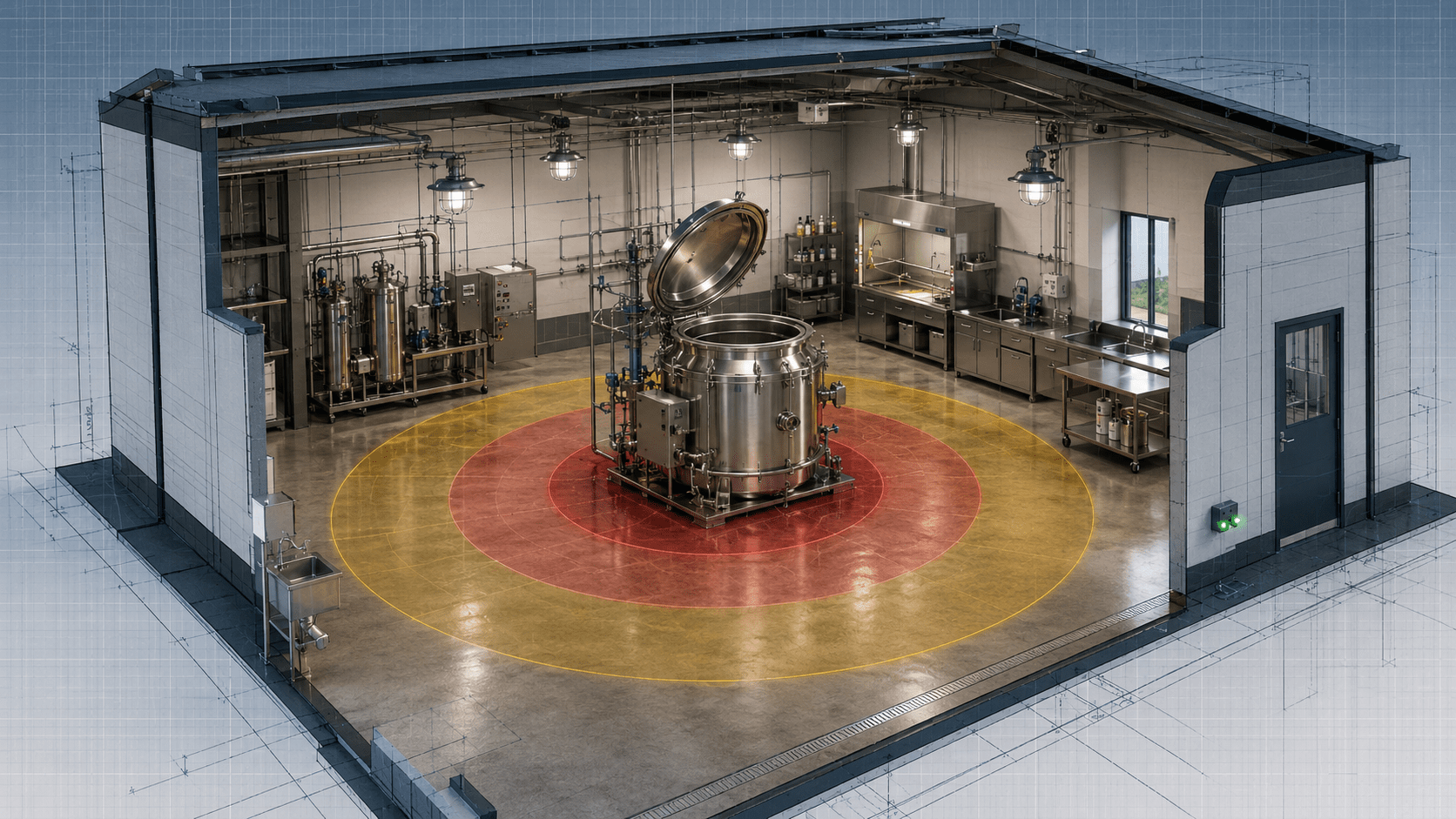
The Classification Argument That Costs Operators $200,000
Someone on the conference call says the vapor count in the room is low, so they do not need electrical classification. Someone else says the total ethanol volume is under maximum allowable quantities, so they are exempt. A third person says the equipment is closed-loop, so there is nothing to classify.
Classification keeps you legal and safe. If you plan to sell into export markets or pharmacy channels, you will also need a documented quality system on top of it. Our guide to GMP certification for cannabis extraction covers what that requires beyond C1D1, including the pressure conflict between GMP cleanliness and C1D1 fire safety.
All three are wrong. And all three arguments show up in extraction facility builds every month. The operator who believes them builds an unclassified room, passes an initial walkthrough, then fails the final fire marshal inspection when the PE reviews the drawings against NFPA 497. The retrofit costs two to five times what the correct build would have cost. The timeline adds three to six months. The license application sits dead until the CO issues.
Electrical area classification under NEC Article 500 is not decided by what the sensor reads on Tuesday morning. It is decided by what the process CAN release under credible conditions, normal and abnormal, at the point of emission. That is a code obligation, not a judgment call. And the code that governs it, NFPA 497, does not contain a volume exemption, a vapor-count threshold, or a closed-loop waiver.
This guide covers every angle of the C1D1 vs C1D2 decision: the code framework, the physics, the money, the process-specific classification for every extraction method used in cannabis and hemp, the myths operators use to skip it, and what happens when the fire marshal does not agree with your interpretation. By the end, you will know exactly which classification your process requires, what it costs, and what you are exposed to if you get it wrong.
What Electrical Area Classification Actually Is
Before touching the D1 vs D2 question, you need to understand the framework. Electrical area classification exists because flammable vapors and electrical ignition sources occupy the same rooms in extraction facilities. The code system that governs this interaction is built on three pillars.
NFPA 70 (National Electrical Code), Article 500 is the governing electrical framework. It defines three classes of hazardous locations:
- Class I: Flammable gases, vapors, or liquids. This is every cannabis extraction facility using hydrocarbon or ethanol solvents.
- Class II: Combustible dust. Relevant to biomass grinding and milling operations, not extraction.
- Class III: Combustible fibers or flyings. Not applicable to extraction.
Within Class I, the Division system answers the probability question: how likely is a flammable atmosphere to be present?
NFPA 497 is the standard that tells you HOW to classify. It provides the methodology, the figures, the zone geometries, and the release-point analysis that produces the actual classification map for your facility. If NEC Article 500 is the law, NFPA 497 is the engineering manual that applies the law to your floor plan.
NFPA 1, Chapter 38 (Marijuana Growing, Processing, or Extraction Facilities) and NFPA 420 (Standard for Fire Protection of Cannabis Growing and Processing Facilities) are the cannabis-specific overlays. They reference NFPA 497 for classification methodology and add requirements for ventilation, gas detection, and emergency shutoff specific to cannabis operations. For jurisdictions on the International Code Council system rather than NFPA, IFC Chapter 39 covers cannabis processing with similar requirements.
One more layer: NEC Article 505 offers the Zone system (Zone 0, Zone 1, Zone 2) as an IEC-aligned alternative to the Division system. Most US cannabis facilities use the Division system because that is what most American PEs, AHJs, and equipment suppliers work with. Both systems are code-compliant. The classification principles are the same.
The Authority Having Jurisdiction, your local fire marshal, has final interpretive authority over how these codes apply to your specific facility. But the fire marshal interprets the code. The fire marshal does not override the code. If NFPA 497 says a release point requires classification, the fire marshal cannot waive that requirement. Any approval that contradicts the adopted code is an approval that will not survive an incident investigation.
Division 1 vs Division 2: What the Code Actually Says
Here are the definitions from NEC Article 500, cited verbatim because the exact wording matters more than any paraphrase.
Class I, Division 1 is a location:
Once you have determined the space is Class I, Division 1, the next question is what the room physically needs to pass inspection. Our C1D1 room requirements guide breaks down the explosion-proof electrical, ventilation, gas detection, and the AHJ inspection checklist in full.
- In which ignitable concentrations of flammable gases, vapors, or liquids CAN exist under normal operating conditions, OR
- In which ignitable concentrations exist frequently because of repair, maintenance, or leakage, OR
- In which breakdown or faulty operation of equipment or processes might release ignitable concentrations AND might also cause simultaneous failure of electrical equipment in a mode that could produce arcs, sparks, or hot surfaces
Class I, Division 2 is a location:
- In which volatile flammable gases, flammable liquid-produced vapors, or combustible liquid-produced vapors are handled, processed, or used, but in which they are normally confined within closed containers or closed systems from which they can escape ONLY in case of accidental rupture or breakdown of such systems, OR
- In which ignitable concentrations are normally prevented by positive mechanical ventilation, and which might become hazardous through failure or abnormal operation of the ventilation equipment, OR
- That is adjacent to a Class I, Division 1 location, and to which ignitable concentrations of gases or vapors might occasionally be communicated
The translation is straightforward once you read it carefully:
Division 1 = a flammable atmosphere exists or can exist during normal operation. The word “normal” is the entire fight. Opening a vessel to discharge product, changing a filter element, pulling a QC sample, purging a line, transferring solvent between containers: these are normal operations. If any of them creates a vapor release, you are in Division 1 territory around that release point.
Division 2 = a flammable atmosphere exists only during abnormal operation. The solvent is confined within closed systems at all times during normal use. A vapor release requires something to break, rupture, leak, or fail. If your process truly keeps flammable material sealed from charge to discharge with no open handling events during normal operation, the room qualifies for Division 2.
The critical distinction: low vapor count during normal operation is not an argument against classification. It is the definition of Division 2. A room where flammable vapors are handled but normally confined within closed systems, with vapor present only under abnormal conditions, is exactly what D2 describes. If someone tells you “the room reads low on the sensor, so we do not need classification,” they have just described a D2 environment and argued that it should be unclassified. That argument contradicts the code it claims to follow.
The Physics That Drives Classification
The code is not arbitrary. It is built on the physical properties of the solvents you are handling. Every classification decision traces back to four numbers: flash point, lower explosive limit (LEL), vapor density, and autoignition temperature. These numbers determine whether a flammable atmosphere can form, where the vapors accumulate, and what ignites them.
| Solvent | CAS | Flash Point | LEL (% v/v) | UEL (% v/v) | Vapor Density (air=1) | Autoignition |
|---|---|---|---|---|---|---|
| Ethanol | 64-17-5 | 16.6°C / 61.9°F | 3.3 | 19.0 | 1.59 | 363°C / 685°F |
| n-Butane | 106-97-8 | -60°C / -76°F | 1.8 | 8.4 | 2.05 | 405°C / 761°F |
| Propane | 74-98-6 | -104°C / -155°F | 2.1 | 9.5 | 1.56 | 450°C / 842°F |
| Isobutane | 75-28-5 | -83°C / -117°F | 1.8 | 8.4 | 2.01 | 460°C / 860°F |
| n-Hexane | 110-54-3 | -22°C / -7.6°F | 1.1 | 7.5 | 2.97 | 225°C / 437°F |
| Isopropanol | 67-63-0 | 12°C / 53.6°F | 2.0 | 12.7 | 2.07 | 399°C / 750°F |
| Acetone | 67-64-1 | -20°C / -4°F | 2.5 | 12.8 | 2.0 | 465°C / 869°F |
| n-Heptane | 142-82-5 | -4°C / 25°F | 1.05 | 6.7 | 3.45 | 204°C / 399°F |
| Pentane | 109-66-0 | -49°C / -56°F | 1.5 | 7.8 | 2.48 | 260°C / 500°F |
All values sourced from manufacturer SDS data (Sigma-Aldrich, Fisher Scientific). Vapor density calculated as molecular weight ratio to air (MWair = 28.97 g/mol). Verify against current SDS for your specific supplier and grade before design.
Four things in this table drive every classification decision:
Flash point vs room temperature. If the flash point is below ambient temperature (typically 20-25°C / 68-77°F), the liquid produces ignitable vapor continuously at room conditions. Look at the table. Ethanol flashes at 16.6°C. Isopropanol at 12°C. Every hydrocarbon on this list flashes well below zero. At room temperature, these liquids are always producing fuel. The moment the container opens, the clock starts.
LEL as the ignition threshold. The lower explosive limit is the minimum concentration of vapor in air that sustains flame propagation. Below LEL, the mixture is too lean to ignite. Above UEL, too rich. The space between LEL and UEL is the explosive range. For butane, that range is 1.8% to 8.4%. For ethanol, 3.3% to 19%. Ethanol has a much wider explosive range, which means more opportunity for a vapor cloud to find an ignition source while still within the flammable window.
Vapor density tells you where the vapor goes. Every solvent in this table has a vapor density greater than 1.0. That means every one of them sinks. Butane at 2.05 pools at floor level. Hexane at 2.97 and heptane at 3.45 sink aggressively into any low point: floor drains, equipment pits, cable trenches, below-grade sumps. This is why LEL sensor placement at 12 inches above the floor is non-negotiable in extraction rooms. A sensor at head height will read clean while the floor-level atmosphere is above LEL.
The 80 mL proof. Operators who handle small volumes of ethanol sometimes argue that the quantity is too small to matter. Here is the math. 80 mL of ethanol at 0.789 g/mL is 63.1 grams. At a molecular weight of 46.07 g/mol, that is 1.37 moles. At 25°C and atmospheric pressure (molar volume 24.47 L/mol), that produces 33.5 liters of ethanol vapor. Released into a 1 cubic meter volume (1,000 liters), the concentration is 3.35% by volume. The LEL for ethanol is 3.3%. Eighty milliliters of ethanol, fully evaporated into a single cubic meter, reaches the lower explosive limit. A spill near a floor drain, an equipment enclosure, or any confined space reaches ignition threshold with a volume that fits in a graduated cylinder.
How Classification Zones Radiate from a Release Point
This is where most operators, and most of the competing guides online, get the analysis wrong. They think about classification as a room-level question: is the room C1D1 or C1D2? The code does not work that way. Classification radiates outward from each point of potential vapor release. A single room can contain unclassified space, Division 2 space, and Division 1 space simultaneously, depending on the distance from each emission point.
Under NFPA 497 guidance figures, a vessel vent or open handling point generates concentric classification zones:
- A 3-foot radius Division 1 zone around the emission point, where ignitable concentrations are expected during normal operation
- An additional 2-foot radius Division 2 zone beyond the D1 boundary, where vapors could migrate under abnormal conditions
- For solvents heavier than air (every solvent in the table above), the Division 2 zone extends outward along the floor to 10 feet at 18 inches above grade
- Any below-grade location within that footprint, including floor drains, sumps, and equipment pits, automatically escalates to Division 1
This geometry is the reason “the room reads low on the sensor” is not the design driver. The classification radiates from the emission point, not from the average room reading. A sensor mounted on the wall three feet from the ceiling will read zero while a vapor cloud pools around a floor drain directly below a vessel vent. The sensor is in unclassified space. The floor drain is in Division 1 space. Both conditions are true simultaneously.
Every open handling event in the extraction process creates a release point: opening a collection vessel, changing a filter, pulling a sample, draining a vessel, connecting or disconnecting a transfer line, opening a rotovap flask, changing a receiving flask on a short path system. Each one of these events generates its own classification geometry. The facility’s electrical classification map is the overlay of all of these geometries on the floor plan. If any classified zone touches a piece of standard (unclassified) electrical equipment, you have a code violation.
This is why extraction lab design requires the classification analysis before the electrical layout, not after. The equipment positions, the outlet locations, the light fixture placements, the motor locations all flow from the classification map. Designing the electrical first and classifying later is how you end up with a $150,000 retrofit.
How Each Extraction Process Gets Classified
This is the section you came here for. Process by process, here is how the classification analysis works in practice.
Hydrocarbon Extraction (Butane, Propane, Blends)
Closed-loop hydrocarbon systems are sealed during the extraction run. But the process includes planned release events during normal operation: loading the material column, opening the collection pot to recover extract, changing inline filters, disconnecting the dewax column, recovering residual solvent from the collection vessel. Each of these steps opens the system to atmosphere and creates a release point.
Classification: Division 1 inside the extraction booth or immediate operating area. The 3-foot D1 radius around each vessel opening typically covers the entire booth interior. The surrounding room, if separated by proper ventilation and distance, may be Division 2 or unclassified depending on geometry. This is almost universally required across all US jurisdictions that have adopted NFPA or IFC cannabis codes.
Ventilation requirement: 12+ air changes per hour (ACH), negative pressure relative to adjacent spaces, exhaust pickups within 12 inches of the floor, makeup air tempered to maintain room conditions. The ventilation system alone typically accounts for 20-35% of total extraction room buildout cost.
LEL monitoring: continuous monitoring with sensors at 12 inches and 36 inches above floor level. Alarm at 10% LEL (early warning). Automatic equipment shutoff and emergency ventilation activation at 25% LEL. These thresholds are standard AHJ requirements, though some jurisdictions set the alarm point at 20% LEL.
Ethanol Extraction (Cryo, Centrifugal, Falling Film)
Ethanol extraction operates in a gray area that produces the most classification arguments in the industry. The equipment is closed during the extraction cycle, which invites the D2 argument. But the process includes open handling events that create D1 zones at specific points.
At cryogenic temperatures (-40°C to -80°C), ethanol vapor pressure drops significantly, reducing but not eliminating the release potential. Cold ethanol produces less vapor per unit time than room-temperature ethanol. But the following normal operations involve ethanol at or above room temperature: charging the extraction vessel, discharging spent biomass, filter operations, solvent recovery (rotary evaporation, falling film), receiving recovered ethanol, transferring ethanol between storage and process vessels.
Solvent recovery is the highest-risk operation. The rotary evaporator or falling film heats ethanol to drive off vapor for condensation and recovery. At operating temperatures of 40-60°C, ethanol is well above its flash point and vapor pressure is aggressive. The receiving flask on a rotovap is an open emission point during flask changeout. A falling film condenser vent is a continuous emission point.
Classification: Division 2 minimum at the room level. Division 1 in the immediate radius of any open handling point and around solvent recovery equipment. The room-level D2 classification addresses the ventilation-controlled environment where vapors are normally confined. The localized D1 zones address the specific points where the closed system opens during normal operation.
Ventilation: 6-8 ACH minimum for the room, with local exhaust ventilation (LEV) at each open handling point providing additional capture velocity. Negative pressure relative to non-classified adjacent spaces.
CO2 Extraction (Supercritical, Subcritical)
CO2 is not flammable, which removes the Class I electrical classification concern for pure CO2 systems. For the complete CO2-specific room design guide including ventilation CFM calculations, gas detection placement, and build costs, see our CO2 Extraction Room Design Guide. But two factors bring classification back into play:
Co-solvent addition. Many supercritical CO2 processes add ethanol as a co-solvent to improve polar compound extraction. The moment ethanol enters the system, you are back in Class I territory. The classification analysis follows the ethanol rules above, applied to every point where ethanol-containing material is handled openly.
Asphyxiation risk. CO2 displaces oxygen. A catastrophic release of CO2 in an enclosed room drops the O2 concentration below the 19.5% OSHA minimum for safe atmosphere. This does not trigger Class I electrical classification, but it does require oxygen depletion monitoring, alarm systems, emergency ventilation, and may affect the room occupancy classification under the building code. Some jurisdictions are now applying hazardous occupancy classification to CO2 extraction rooms based on asphyxiation risk, separate from the flammable atmosphere question.
Classification: General (unclassified) for pure CO2 systems without co-solvent. Division 2 minimum when ethanol co-solvent is used. O2 monitoring required regardless of electrical classification.
Solventless Extraction (Rosin Press, Ice Water Hash)
No flammable solvent means no Class I classification requirement for the extraction process itself. Rosin pressing uses heat and pressure. Ice water hash uses water and ice. Neither produces flammable vapors.
This is the correct answer for operators asking “can I avoid C1D1 entirely?” Yes, if your process is truly solventless. No hydrocarbon, no ethanol, no flammable liquid at any step. The capital savings are significant: no explosion-proof electrical, no continuous LEL monitoring, no sealed conduit, no XP light fixtures. This is one of the major cost advantages of solventless extraction.
Caveat: if you are doing downstream processing with solvents after your solventless extraction (ethanol winterization of rosin, for example), the downstream process area still requires classification. The solventless exemption applies to the extraction step, not to everything that happens after it.
Distillation (Short Path, Wiped Film)
Distillation operates under vacuum, which reduces vapor pressure at the operating temperature. But vacuum does not eliminate fugitive emissions. The vacuum pump exhaust is a concentrated release point that must be piped directly to the exterior or through a cold trap system. Receiving flask changeout on a short path system opens the system to atmosphere. Wiped film feed and discharge operations involve cannabinoid-rich material that may contain residual solvent from upstream processing.
Classification: Division 2 at the room level if residual solvents are present in feed material. Division 1 in the immediate radius of vacuum pump exhaust, cold traps, and receiving flask changeout points. If the feed material is fully purged of solvents, the distillation room may be unclassified for flammable atmosphere, but verify with your PE based on the actual residual solvent analysis of your feed.
The Equipment Consequences: What Classification Costs
Classification is not just a line on a drawing. It dictates every piece of electrical equipment in the space. The cost difference between classified and unclassified equipment is the reason operators try so hard to argue their way out of classification. It is also the reason the argument fails: the cost difference reflects a real engineering difference in how the equipment handles the presence of flammable vapors.
| Equipment Category | Division 1 Requirement | Division 2 Requirement | Cost Multiplier vs Standard |
|---|---|---|---|
| Motors and drives | Explosion-proof (XP) | Non-incendive or XP | 3x to 10x |
| Light fixtures | XP rated, sealed | Non-incendive or enclosed/gasketed | 4x to 8x |
| Receptacles and switches | XP rated, sealed with spring-loaded covers | General purpose acceptable if no arcing | 5x to 12x (D1) / 1x to 2x (D2) |
| Conduit and wiring | Sealed conduit with EYS seals at boundaries | Standard conduit acceptable in most cases | 2x to 4x (D1) / 1x (D2) |
| Instrumentation and controls | Intrinsically safe (IS) with barriers | IS or non-incendive | 2x to 5x |
| Control cabinets | Purge and pressurized enclosure (Ex p) | General purpose if properly sealed | 3x to 6x (D1) / 1x (D2) |
| Gas detection system | Continuous LEL, automatic shutoff at 25% LEL | Continuous LEL, alarm at 10-25% LEL | $8,000 to $25,000 installed |
| Emergency ventilation | Fail-safe interlocked with gas detection | Required with gas detection interlock | $15,000 to $50,000 installed |
The order-of-magnitude difference between D1 and D2 equipment is real. A standard 1 HP industrial motor costs $400 to $800. The explosion-proof equivalent runs $3,500 to $8,000. A standard LED light fixture at $50 becomes an XP fixture at $200 to $400. Multiply that across every motor, fixture, switch, and outlet in a 400 to 800 square foot extraction room, and the electrical package for a D1 room runs $50,000 to $150,000 more than the equivalent unclassified space.
Division 2 is significantly less expensive than Division 1 because non-incendive equipment (designed not to produce arcs or sparks during normal operation) is acceptable in D2 locations for many equipment categories. The D2 electrical package typically adds $15,000 to $40,000 over an unclassified room, not $50,000 to $150,000.
This cost gradient is exactly why the classification argument exists. The financial incentive to push D1 down to D2, or D2 down to unclassified, is enormous. The problem is that the classification is not a budget negotiation. It is determined by the physics of the process. Under-classifying to save money works until the fire marshal reviews the drawings, the PE refuses to stamp, the insurance adjuster reads the code, or the vapor cloud finds the spark.
If you want to learn the full equipment specification process and how these costs stack up against the total lab investment, we cover it end to end in our extraction training course. The course walks through real buildout budgets, vendor selection, and the classification decisions that drive every line item.
Seven Myths That Get Labs Shut Down
“The vapor count is low, so we do not need classification.”
This is the most common argument and the easiest to demolish. A room where flammable vapors are present at low concentrations during normal operation is not an unclassified room. It is a Division 2 room. Low vapor during normal operation is the definition of D2, not an exemption from classification. The argument is self-defeating: the operator is describing a classified condition while claiming it is unclassified.
“Total solvent volume is under maximum allowable quantities, so we do not need classification.”
This conflates two different code sections. Maximum Allowable Quantities (MAQ) under NFPA 1 and IFC determine whether a room triggers occupancy reclassification to H-2 or H-3 hazardous occupancy. That is a building code question about the room’s overall use. Electrical area classification under NFPA 497 and NEC Article 500 is a completely separate question answered at the release point, not by total inventory. There is no section in NFPA 497 or NEC Article 500 that exempts electrical classification based on total room inventory below a specified volume. It does not exist.
“The equipment is closed-loop, so no classification is needed.”
Closed-loop describes the extraction run. It does not describe the entire process. Every filter change, collection pot opening, vessel discharge, and sample pull opens the loop. If these are normal operating procedures (and they are), then vapor release during normal operation occurs, and the release point requires classification. A truly closed system where the solvent never contacts atmosphere from charge to discharge may qualify the room for D2. But “closed-loop” as marketed by equipment manufacturers is not the same as “closed system” as defined by the NEC.
“Our AHJ approved it unclassified.”
The AHJ has interpretive authority, but the AHJ does not override the adopted code. An approval today does not protect the operator from enforcement tomorrow, from a different inspector on the follow-up visit, from an insurance denial after an incident, or from OSHA if there is a workplace injury. If the adopted code says the space requires classification and the AHJ approved it without classification, the operator is holding a piece of paper that will not survive an investigation.
“C1D2 is enough for everything, C1D1 is overkill.”
The classification is determined by the process, not by preference. If normal operation creates a release event (and in hydrocarbon extraction, it does, every time someone opens the collection pot), then the area around that release is Division 1. Labeling it Division 2 does not change the physics. It changes the paperwork. And when the physics and the paperwork disagree, the physics wins. Usually in the form of an incident.
“We can use standard equipment if we put it in a separate room with a wall.”
Walls matter, but only walls with proper fire ratings, sealed penetrations, and controlled air pressure differentials. An interior partition wall without fire rating does not create a classification boundary. Vapor migration through unsealed penetrations (conduit runs, HVAC ducts, cable trays, door gaps) carries the classified zone into the adjacent space. A wall without negative pressure on the classified side does not stop heavier-than-air vapors from flowing under a door. The wall only works as a classification boundary if it is rated, sealed, and the classified room maintains negative pressure relative to the other side.
“Our insurance will cover it either way.”
Standard commercial property and liability policies contain code compliance conditions. If a post-incident investigation finds that the facility was built or operated in violation of adopted fire and electrical codes, the insurer has grounds to deny the claim. This is not theoretical. Insurance denials based on code non-compliance happen routinely in industrial fire investigations. The operator pays the premium and believes they are covered. The investigation reveals the classification deficiency. The claim is denied. The operator is financially exposed for the full loss, plus any third-party liability.
The Classification Decision Framework
Knowing the code, the physics, and the myths is not enough. You need a repeatable process to arrive at the correct classification for your specific facility. Here is the framework, step by step.
Step 1: Inventory every flammable material. List every solvent and gas by name, CAS number, flash point, LEL, and vapor density. Use the table in Section 4 as your starting reference. If your flash point is below your room operating temperature, the fuel is always available.
Step 2: Map every release point. Walk through the entire process from raw material to finished product. Every point where a closed system opens to atmosphere during normal operation is a release point: vessel openings, filter changes, sample pulls, solvent transfers, waste handling, receiving flask changeouts, vacuum pump exhaust vents. Document each one on your floor plan.
Step 3: Apply NFPA 497 zone geometry. Around each release point, draw the classification radii: 3-foot D1 zone, additional 2-foot D2 zone, floor-level D2 extension to 10 feet for heavier-than-air solvents. Flag any below-grade locations within the D2 footprint for D1 escalation. The overlay of all these geometries on your floor plan is your classification map.
Step 4: Classify each zone. Division 1 where ignitable concentrations exist during normal operation. Division 2 where they exist only under abnormal conditions. Unclassified where flammable atmosphere cannot credibly form.
Step 5: Design ventilation to the classification. The ventilation system must dilute credible releases below 25% LEL at the highest anticipated emission rate. 12+ ACH for D1 spaces, 6-8+ ACH for D2 spaces, with exhaust pickups positioned at floor level for heavier-than-air vapors. Negative pressure on classified rooms relative to unclassified adjacent spaces.
Step 6: Specify electrical to the classification of each zone. Explosion-proof or intrinsically safe in D1 zones. Non-incendive acceptable in D2 zones. Standard in unclassified zones. EYS conduit seals at every boundary crossing between classified and unclassified spaces.
Step 7: Get a PE stamp. This is not optional. See next section.
The PE Stamp and Why No Operator Should Skip It
Most states that license cannabis extraction require a licensed Professional Engineer to certify that the facility design complies with applicable building, electrical, and fire codes. Maine is a clear example: Title 22, Section 2423-F requires documentation from a Maine-licensed PE or authorized official certifying compliance with all applicable codes, including the NFPA chapters relating to cannabis extraction. The state writes NFPA compliance directly into the statute. It is not optional and not subject to municipal reinterpretation.
The PE stamp is the operator’s protection in three scenarios: the fire marshal review, the insurance investigation, and the OSHA inquiry. In each case, the question is the same: was the facility designed and built to code? The PE stamp says yes, backed by a licensed professional’s assessment and legal liability. Without it, the operator is self-certifying code compliance with no professional standing to do so.
Trying to value-engineer the classification out of the design after the PE has scoped it will result in the PE walking away from the project. No PE is going to stamp drawings that skip electrical classification where the process requires it. If you find one who will, they are exposing their license, and by extension, your investment. The PE stamp is in the critical path for the Certificate of Occupancy. No stamp, no CO. No CO, no license. The classification decision is made in engineering, not in negotiation.
The gap between state C1D1 compliance and federal DEA requirements adds another layer. If your facility will require DEA registration for Schedule III manufacturing, the state classification is the floor, not the ceiling. Federal facility requirements address a different risk set (diversion, security, recordkeeping) that sits on top of the state electrical and fire codes.
What Happens When You Get This Wrong
The consequences of under-classification are not abstract. They are specific, expensive, and in some cases, irreversible.
Failed final inspection. The fire marshal reviews the electrical drawings against the classification analysis. If the analysis is missing or the equipment does not match the classification, the Certificate of Occupancy does not issue. The operator has a fully built room with equipment installed that does not meet code. Every fixture, outlet, switch, and motor in the classified zone gets replaced. The retrofit costs 2 to 5 times what the correct initial build would have cost because the labor is demolition-and-reinstall, not new construction.
Insurance denial. After an incident, the insurer’s investigation reviews the facility against adopted codes. A classification deficiency discovered post-incident gives the insurer grounds to deny the claim. The operator discovers their coverage was conditional on the code compliance they skipped.
License revocation. State cannabis regulations in most jurisdictions require facilities to maintain code compliance as a condition of licensure. A code violation discovered during a routine inspection or after an incident can trigger license suspension or revocation. The loss of the license is often the most expensive consequence: the operator loses not just the facility cost, but the license value, the inventory, the customer relationships, and the revenue stream.
OSHA and EPA exposure. Workplace injuries resulting from non-compliant facilities trigger OSHA investigation. Willful violations (where the employer knew or should have known about the hazard) carry penalties up to $156,259 per violation (2024 rate, adjusted annually). Solvent releases to the environment trigger EPA reporting and potential enforcement.
Criminal liability. In jurisdictions where cannabis manufacturing statutes specify compliance with inherently hazardous substance regulations, operating outside of classification requirements can constitute a criminal violation. This is not a fine. It is a charge.
The human cost. Flash fires, deflagrations, and vapor cloud explosions in extraction facilities have caused burn injuries and deaths. Butane extraction operations without proper classification and ventilation have produced explosions that destroyed buildings and killed operators. These are not theoretical risks. They are documented incidents with documented causes. In every case investigated, the root cause traces back to flammable vapors meeting an ignition source in a space that was not designed to prevent that interaction. That is exactly what classification is designed to prevent.
Building correctly from the start is not the expensive option. It is the only option that does not come with a multiplier attached later. Inspectors check this. Insurance adjusters check this. OSHA checks this. The code does not have a “we ran out of budget” exemption.
Classification is exactly the decision an extraction lab consultant is paid to get right, and an equipment vendor is not.
If you are classifying a real room and not just comparing definitions, this is where the expensive mistakes live: a misclassified space, a ventilation design that fails inspection, a six-figure redesign after the AHJ walks through. Designing extraction facilities so that does not happen is what WKU does. If you want that on your project before the concrete is poured, here is how to work with us.
Frequently Asked Questions
Do I need C1D1 or C1D2 for ethanol extraction?
At minimum, Division 2 for the room, with Division 1 zones around any open handling points (vessel openings, filter changes, solvent recovery flask changeout). Ethanol has a flash point of 16.6°C (61.9°F), below standard room temperature, so ignitable vapor is always available when the liquid is exposed to air. Cold ethanol at cryogenic temperatures (-40°C to -80°C) reduces vapor pressure but does not eliminate it. The solvent recovery step (rotary evaporator, falling film) operates at 40-60°C, well above flash point, and is typically the highest-classification area in an ethanol lab.
Does CO2 extraction require C1D1 classification?
Pure CO2 systems without co-solvent do not require Class I electrical classification because CO2 is not flammable. However, if ethanol is used as a co-solvent (common in supercritical CO2 extraction for polar compound recovery), the classification analysis follows the ethanol rules: Division 2 minimum with D1 zones at open handling points. CO2 rooms still require oxygen depletion monitoring (alarm at 19.5% O2) and emergency ventilation for asphyxiation risk, regardless of electrical classification. Some jurisdictions now classify CO2 rooms as hazardous occupancy based on asphyxiation risk alone.
How much does it cost to build a C1D1 extraction room vs C1D2?
Classified equipment runs 3x to 10x the cost of equivalent standard equipment. A full Division 1 electrical package for a 400-800 sq ft extraction room adds $50,000 to $150,000 over an unclassified build. Division 2 adds $15,000 to $40,000 because non-incendive equipment (less expensive than explosion-proof) is acceptable in D2 for most equipment categories. The ventilation and gas detection systems ($15,000 to $50,000 and $8,000 to $25,000 respectively) are required for both D1 and D2. The cost difference between D1 and D2 is primarily in the electrical equipment, not in the ventilation or monitoring.
Can I avoid C1D1 completely by using solventless extraction?
Yes. Rosin pressing and ice water hash use no flammable solvents, so there is no Class I classification requirement for those processes. This is one of the primary capital cost advantages of solventless extraction. However, if you perform any downstream processing with solvents (ethanol winterization of rosin, for example), the downstream processing area still requires classification. The solventless exemption applies only to the extraction step itself.
What is the difference between MAQ and electrical classification?
Maximum Allowable Quantities (MAQ) under NFPA 1 and IFC determine whether the room triggers hazardous occupancy reclassification (H-2 or H-3). This is a building code question about the room’s overall use classification. Electrical area classification under NFPA 497 and NEC Article 500 is a separate question answered at each release point based on whether a flammable atmosphere can form during normal or abnormal operation. Being under MAQ may keep your room classified as standard occupancy (F-1, B, etc.) but does not exempt release points from electrical classification. These are two different code chapters answering two different questions.
What happens if I build to C1D2 but my process actually requires C1D1?
The non-incendive equipment acceptable in D2 is not rated to contain an explosion the way D1 explosion-proof equipment is. If a vapor release during normal operation creates an ignitable atmosphere around a D2-rated device, the device may produce sufficient energy (arc, spark, hot surface) to ignite the mixture. From a regulatory standpoint, under-classification is a code violation discoverable during fire marshal inspection, insurance investigation, or OSHA inquiry. The retrofit from D2 to D1 requires replacing every piece of electrical equipment in the affected zone, at 2-5x the cost of building correctly.
Does NFPA 497 have a minimum volume threshold below which classification does not apply?
No. NFPA 497 classifies locations based on the presence of flammable vapors above their flash point where ignition sources could exist. It does not contain a volume exemption. 80 mL of ethanol (0.789 g/mL, MW 46.07) fully evaporated into 1 cubic meter of air produces a vapor concentration of 3.35%, which exceeds the LEL of 3.3%. The classification radiates from the release point based on the physics of the release, not based on the total inventory in the building.
Which states require PE certification for cannabis extraction facility classification?
Requirements vary by state. Maine (Title 22, §2423-F) explicitly requires a Maine-licensed PE to certify NFPA compliance for cannabis extraction facilities using inherently hazardous substances. Colorado, Oregon, California, and most states with mature cannabis programs require PE-stamped drawings as part of the facility permitting process, though the specific statutory language varies. Even in states without explicit PE requirements, most AHJs will not issue a Certificate of Occupancy for a classified extraction space without PE-stamped electrical and mechanical drawings. The PE requirement is effectively universal for any facility handling flammable solvents.
Ready to level up your extraction game? Contact WKU Consulting for personalized guidance on building your extraction lab.
For more deep dives into cannabis chemistry, extraction SOPs, and lab design, subscribe to the WKU Consulting YouTube channel.
