
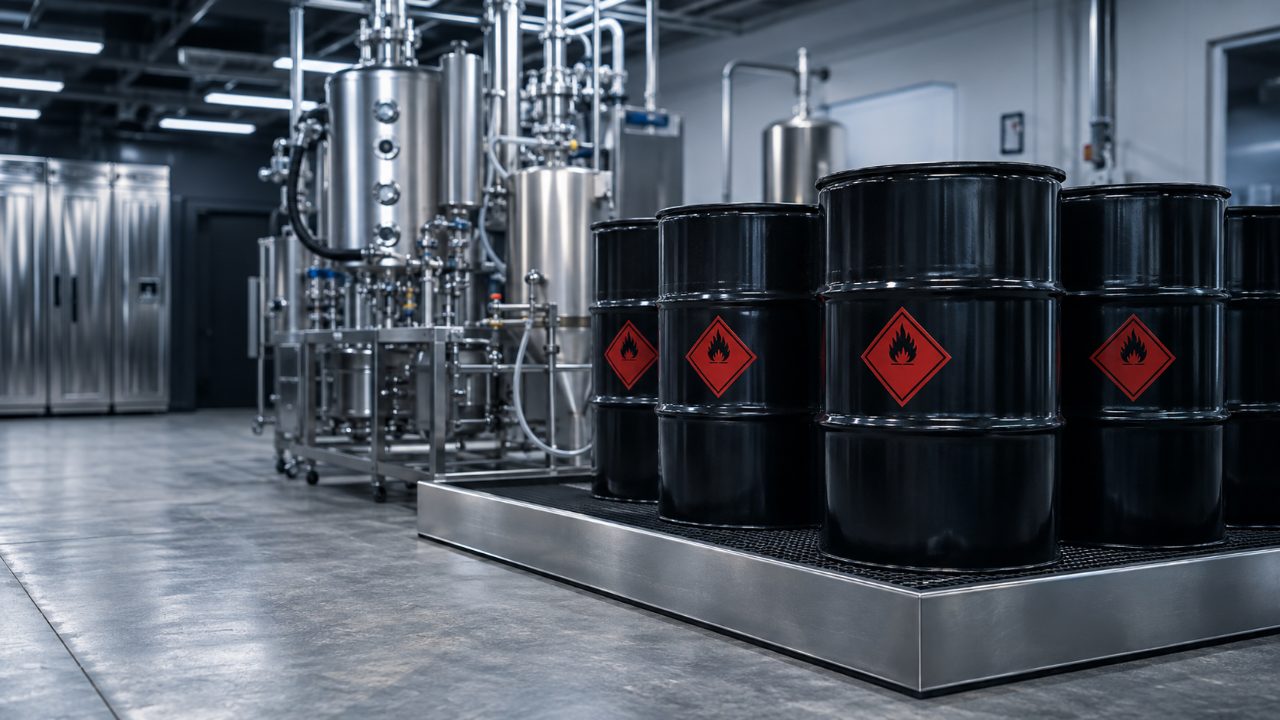
Most cannabis extraction labs treat waste as an afterthought until an EPA inspector or a state auditor treats it as a fine. Here is the number that should stop you: 100 kilograms per month. That is roughly 33 gallons of spent ethanol, and it is the line between being a Very Small Quantity Generator with almost no paperwork and a Small Quantity Generator that needs an EPA ID number, a licensed transporter, and a manifest for every drum that leaves the building. An ethanol lab running production volume blows past 33 gallons in a week. If you have been pouring wash solvent into a drum and calling a local hauler when it fills up, you are almost certainly a regulated generator who has never notified anyone.
The confusion runs deeper than volume. Your spent ethanol is hazardous waste under federal law, but it is not “F-listed” the way most disposal vendors and half the state guidance documents imply. It is D001, a characteristic waste for ignitability, and that distinction changes how it is coded, priced, and tracked. This guide covers exactly how the Resource Conservation and Recovery Act classifies cannabis extraction solvent waste, how to count your generator status without tipping into a higher tier by accident, where state cannabis waste rules and federal RCRA rules collide, and the specific mistakes that turn a routine waste stream into a violation. The chemistry of extraction is federal-agnostic. The waste it produces is not.
The Answer, Specifically: How RCRA Classifies Extraction Solvent Waste
Spent extraction solvent becomes RCRA hazardous waste the moment you decide to discard it, and the classification is driven by one property first: ignitability. RCRA defines a D001 ignitable waste as any liquid with a flashpoint below 60 degrees Celsius (140 degrees Fahrenheit), any ignitable compressed gas, any oxidizer, or any material that spontaneously combusts. Ethanol flashes at 13 C. Isopropanol at 12 C. Heptane at minus 4 C. Butane and propane are ignitable compressed gases. Every workhorse solvent in a cannabis lab clears the ignitability bar without contest, so the default classification for spent hydrocarbon and alcohol waste is D001.
The second question is whether the solvent is also “listed.” The EPA F-list (specifically F003 and F005) names spent non-halogenated solvents that carry a listing on top of any characteristic. Here is the part almost nobody gets right: ethanol, butane, propane, hexane, heptane, and pentane are not on the F-list. Only methanol, acetone, ethyl acetate, methyl isobutyl ketone, n-butyl alcohol, cyclohexanone, xylene (F003), and toluene, methyl ethyl ketone, benzene, and a handful of others (F005) are listed spent solvents. So a lab running cold ethanol generates D001 waste, full stop. A lab that uses methanol for a cleanup step or acetone to clean glassware generates F003 waste, which carries a permanent listing that a characteristic waste does not. Over-classify your ethanol as F-listed and you pay listed-waste disposal premiums forever. Under-classify it as non-hazardous and you have an illegal ignitable-waste disposal on your hands. Both errors cost money. The correct answer is usually D001, and only D001, for alcohol and hydrocarbon extraction.
| Extraction Solvent | Flashpoint | RCRA Code | Listed or Characteristic | What It Means for Disposal |
|---|---|---|---|---|
| Ethanol (190/200 proof) | 13 C (55 F) | D001 | Characteristic (ignitability) | Ignitable only. Not F-listed. Can lose the code if legitimately reclaimed on site. |
| Isopropanol (IPA) | 12 C (53 F) | D001 | Characteristic (ignitability) | Ignitable. Not listed. Common in winterization cleanup. |
| n-Butane | -60 C (gas) | D001 | Characteristic (ignitable gas) | Residual gas in purge waste and off-spec product counts. Not listed. |
| Propane | -104 C (gas) | D001 | Characteristic (ignitable gas) | Same as butane. Not listed. |
| Hexane / Heptane | -22 C / -4 C | D001 | Characteristic (ignitability) | Ignitable. Not F-listed despite n-hexane neurotoxicity. |
| Methanol | 11 C (52 F) | F003 + D001 | Listed AND characteristic | Carries a permanent F-listing. More expensive and more tracked than ethanol. |
| Acetone / Ethyl Acetate | -20 C / -4 C | F003 + D001 | Listed AND characteristic | Glassware and equipment cleaning solvents. F-listed when spent. |
| Toluene / MEK | 4 C / -9 C | F005 + D001 | Listed AND characteristic | Rare in cannabis but shows up in some remediation workflows. |
| Supercritical CO2 | Non-flammable | None (typically) | Not a RCRA hazardous waste | CO2 vents; no ignitable liquid waste stream. Lowest RCRA burden of any method. |
That last row is the quiet cost advantage nobody prices into a CO2 build. A supercritical CO2 operation generates essentially no ignitable solvent waste, which means no D001 drums, no manifest, and no generator-status math on the solvent side. Your hazardous waste burden collapses to spent filter media and cleaning solvents. When you compare buildout costs between hydrocarbon, ethanol, and CO2, the ongoing hazardous waste disposal line item belongs in that comparison, and it favors CO2 more than most consultants tell you.
Generator Status: The Count That Decides Your Entire Obligation
RCRA does not regulate you as a person or a company. It regulates you by how much hazardous waste you generate in a calendar month. There are three tiers, and the jump between them is the single most consequential compliance decision in your waste program because it determines whether you need an EPA ID, how long you can store waste, and how much reporting you owe.
| Generator Category | Monthly Hazardous Waste | EPA ID Number | On-Site Accumulation Limit | Core Obligations |
|---|---|---|---|---|
| VSQG (Very Small) | 100 kg or less (~33 gal ethanol) | Not required | 1,000 kg max on site | Identify waste, send to a permitted facility. Minimal paperwork. |
| SQG (Small) | More than 100 to less than 1,000 kg | Required | 6,000 kg max, 180 days (270 if over 200 miles to TSDF) | EPA ID, manifest, licensed transporter, basic training, emergency contact posted. |
| LQG (Large) | 1,000 kg or more (~335 gal ethanol) | Required | No quantity limit, 90 days | Full program: manifest, biennial report, written contingency plan, annual training, RCRA-compliant storage. |
Two things about this table sink labs constantly. First, the 100 kg VSQG ceiling is roughly 33 gallons of spent ethanol per month, because ethanol density is 0.789 kilograms per liter and 100 kg works out to 127 liters. Any ethanol operation processing real biomass generates more spent and off-spec solvent than that, which puts most ethanol labs at SQG or higher whether they have acknowledged it or not. Second, the count is monthly, not annual, and it resets each calendar month. One heavy production month can bump you from SQG into LQG for that month, and LQG obligations are a different universe: a written contingency plan, a biennial report to EPA, annual hands-on training, and a 90-day storage clock instead of 180.
The count also includes far more than your solvent drum. You must count every RCRA hazardous waste you generate that month: spent filter media saturated with ignitable solvent, contaminated wipes and PPE, off-spec ignitable distillate you are discarding, and spent cleaning solvents. A lab that counts only the wash-solvent drum and ignores the solvent-soaked filter pads is undercounting its generator status, and undercounting is the finding that turns a routine inspection into an enforcement action.
Where State Cannabis Waste Rules and Federal RCRA Collide
This is the trap. Cannabis waste is regulated by two different agencies that do not talk to each other, and complying with one does not satisfy the other. Your state cannabis regulator (the DCC in California, the MED in Colorado, the CCC in Massachusetts) cares about the plant material and finished product. Their rule is almost always some version of “render it unusable” by grinding and mixing cannabis waste at least 50 percent with non-cannabis material before disposal, with tracking in the seed-to-sale system. The EPA, through RCRA and your state environmental agency, cares about the hazardous solvent. These are separate obligations enforced by separate inspectors under separate statutes.
An operator who dutifully renders plant waste unusable per the cannabis rules, then pours spent ethanol down the drain, has satisfied the cannabis regulator and committed a federal RCRA violation in the same afternoon. The seed-to-sale manifest does not cover the ignitable solvent. The solvent needs a uniform hazardous waste manifest, EPA Form 8700-22, and a permitted transporter to a permitted treatment, storage, and disposal facility. Rendering it unusable in the trash is not a legal disposal path for a D001 waste.
| State | Cannabis Waste Rule (plant/product) | Environmental Authority | Solvent-Waste Note |
|---|---|---|---|
| California | DCC: render unusable (50% non-cannabis), track in Metrc | DTSC (authorized RCRA state, stricter) | CA has non-RCRA hazardous categories. Some wastes are hazardous in CA that are not federally. Assume stricter. |
| Colorado | MED: render unusable, 50% mix, documented | CDPHE (authorized RCRA state) | Solvent waste follows federal RCRA generator tiers under CDPHE. Cannabis rule does not cover it. |
| Michigan | CRA: render unusable, mixed and documented | EGLE (authorized RCRA state) | EGLE enforces RCRA. Ignitable solvent needs manifest and permitted TSDF. |
| Washington | LCB: render unusable per WAC 314-55-097 | Ecology (Dangerous Waste rules, stricter than RCRA) | WA “dangerous waste” is broader than federal hazardous waste. Solvent waste often captured more aggressively. |
The pattern holds in every legal state: the cannabis agency governs the plant, the environmental agency governs the solvent, and states that run their own authorized RCRA programs (California, Washington, and others) frequently regulate more aggressively than the federal floor. If you operate in California or Washington, do not assume the federal D001 analysis is the end of it. Their state hazardous waste definitions capture materials the federal rules leave alone. If you want the licensing side of this mapped out state by state, our cannabis extraction license requirements by state guide breaks down the facility and application standards that sit alongside these waste obligations.
Classifying a Mixed Waste Stream: The Decision Logic
The hardest calls in a cannabis lab are the mixed streams: spent ethanol still carrying dissolved crude, filter cake soaked with hydrocarbon, off-spec distillate with residual solvent. RCRA has a mixture rule, and the logic is more predictable than it looks once you run it in order.
| Waste Stream | Ignitable Solvent Present? | Listed Solvent Present? | Classification | Handling |
|---|---|---|---|---|
| Spent ethanol with dissolved crude | Yes (still flashes below 60 C) | No | D001 | Manifest as ignitable. Cannabis content does not remove ignitability. |
| Filter cake soaked with butane/ethanol | Yes (retains solvent) | No | D001 (solid) | Counts toward generator total. Do not landfill wet. |
| Methanol cleanup waste + water | Depends on final flashpoint | Yes (F003) | F003 (mixture rule) | Listed waste contaminates the mixture. Stays F003 even if diluted. |
| Fully evaporated, non-ignitable residue | No (flashpoint above 60 C) | No | May be non-hazardous | Test to confirm. D001 can be removed once genuinely non-ignitable. |
The mixture rule is where the F-list versus D001 distinction pays off. A D001 characteristic waste loses the code if it stops being ignitable, so fully evaporated ethanol residue that no longer flashes below 60 C can drop out of hazardous classification (confirm with testing, do not assume). An F-listed waste like spent methanol contaminates whatever it touches under the mixture rule and stays listed even when diluted, because the listing follows the constituent, not just the characteristic. This is the practical reason to keep methanol and acetone streams segregated from your ethanol drum: mix them and you can convert an entire drum of otherwise D001-only ethanol into F-listed waste with a permanent, more expensive classification.
We cover the full extraction workflow, including the residual-solvent side of these waste streams, in our extraction training program at extractiontraining.com, which walks through the process from crude to finished distillate with the compliance context most courses skip.
Common Failures and How to Diagnose Them
These are the waste mistakes that show up in enforcement actions and inspection findings. Each one is avoidable with a specific control.
Symptom: Spent ethanol going down the drain or into general trash.
Root cause: Treating ethanol as a benign alcohol rather than a D001 ignitable waste. Ethanol flashes at 13 C, so drain disposal is both an illegal RCRA disposal and a real sewer-line fire and vapor hazard.
Diagnostic test: Ask where your spent wash solvent physically goes. If the answer involves a drain, a mop sink, or a dumpster, you have a violation in progress.
Fix: Collect all spent solvent in DOT-rated, closed, labeled containers. Manifest through a permitted transporter to a permitted TSDF, or reclaim on site under the legitimate recycling provisions.
Symptom: Generator status calculated from the solvent drum only.
Root cause: Counting the obvious waste and ignoring solvent-soaked filter media, contaminated PPE, and off-spec ignitable product. The monthly total is the sum of all RCRA hazardous waste, not just the liquid.
Diagnostic test: Total every ignitable stream generated in your heaviest production month. If the sum exceeds 100 kg, you are at least an SQG regardless of what you reported.
Fix: Build a monthly generation log that captures every hazardous stream by weight. Reassess your generator category against the heaviest month, not the average.
Symptom: More than 55 gallons of hazardous waste sitting at the point of generation.
Root cause: Misunderstanding satellite accumulation. You can accumulate up to 55 gallons of hazardous waste at or near the point of generation under the control of the operator without starting the accumulation clock. Exceed 55 gallons and you have three days to move it to a central accumulation area, where the 90-day (LQG) or 180-day (SQG) clock applies.
Diagnostic test: Measure the volume at each collection point. Any single satellite point over 55 gallons is out of compliance.
Fix: Cap satellite containers at 55 gallons, date them the moment they hit the cap, and move to central accumulation within three days.
Symptom: State cannabis waste compliance assumed to cover the solvent.
Root cause: Conflating two regulators. Rendering plant waste unusable satisfies the cannabis agency; it does nothing for the EPA solvent obligation.
Diagnostic test: Can you produce a uniform hazardous waste manifest (EPA Form 8700-22) for your solvent shipments? If you only have seed-to-sale records, the solvent side is uncovered.
Fix: Run two parallel programs: the cannabis-waste render-unusable process for plant and product, and a RCRA program for solvent and ignitable waste with EPA ID, manifests, and a permitted TSDF.
Symptom: Ethanol drums labeled and billed as F-listed waste.
Root cause: A disposal vendor or an internal assumption that all spent solvent is F-listed. Ethanol is D001 only. Paying F-listed rates on D001 ethanol is overpayment on every drum, permanently.
Diagnostic test: Check the waste codes on your last manifest. If ethanol-only waste carries an F-code, it is miscoded.
Fix: Correct the waste profile to D001 for ethanol and hydrocarbon streams. Reserve F-codes for methanol, acetone, and other genuinely listed solvents, and keep those streams segregated.
Building a Compliant Waste Program: The Checklist
A defensible extraction waste program has the same bones regardless of scale. The depth scales with your generator status, but the structure does not.
- Waste determination on file. A written determination for every waste stream, citing the code (D001, F003, and so on) and the basis (flashpoint, listing, or test result). This is the first document an inspector asks for.
- EPA ID number if you are an SQG or LQG. Obtain it via EPA Form 8700-12 (Notification of Regulated Waste Activity). VSQGs do not need one but benefit from having it if they occasionally cross the threshold.
- Segregated collection. Ethanol and hydrocarbon (D001) in one stream; methanol, acetone, and listed solvents (F-codes) in another. Mixing converts cheap characteristic waste into expensive listed waste.
- Satellite accumulation control. 55-gallon cap at the point of generation, dated on fill, moved to central accumulation within three days.
- Central accumulation with a clock. 90 days for LQG, 180 for SQG (270 if the nearest permitted TSDF is over 200 miles away). Every container dated and labeled “Hazardous Waste.”
- Manifests and a permitted transporter. EPA Form 8700-22 for every off-site shipment, retained for at least three years.
- Training. Basic waste-handling familiarity for SQGs; annual RCRA training for LQG personnel.
- Contingency plan (LQG) covering spills, fire, and emergency coordinator contacts, coordinated with the local fire department.
This waste program is not separate from your facility design. The central accumulation area, the ventilation over ignitable-waste storage, and the segregation layout all belong in the lab plan from the start. Our guide to building an extraction laboratory covers where waste storage fits in the room layout, and the DEA Schedule III registration guide maps the federal facility obligations that sit alongside your EPA waste program.
Frequently Asked Questions
Is cannabis extraction solvent waste considered hazardous waste?
Yes. Spent extraction solvents are RCRA hazardous waste because they are ignitable. Ethanol, isopropanol, butane, propane, hexane, and heptane all flash below 60 C (140 F), which makes them D001 characteristic waste. Methanol, acetone, and a few others are additionally F-listed. Once you decide to discard the solvent, it is regulated hazardous waste and cannot go down a drain or into general trash.
Is spent ethanol F-listed under RCRA?
No. This is the most common classification error in cannabis. Ethanol is not on the EPA F-list. It is D001, a characteristic waste for ignitability only. The F-list (F003 and F005) covers methanol, acetone, ethyl acetate, methyl isobutyl ketone, toluene, MEK, and xylene, among others, but not ethanol or hydrocarbons. Coding ethanol as F-listed means overpaying for disposal on every drum.
How much solvent waste makes me a Small Quantity Generator?
More than 100 kilograms of hazardous waste in a calendar month, which is roughly 33 gallons of spent ethanol, moves you from Very Small Quantity Generator to Small Quantity Generator. At that point you need an EPA ID number, a uniform hazardous waste manifest for shipments, and a licensed transporter. At 1,000 kg per month (about 335 gallons) you become a Large Quantity Generator with a 90-day storage limit and a written contingency plan.
Does rendering cannabis waste unusable satisfy EPA solvent-waste rules?
No. Those are two separate regulatory systems. Rendering plant and product waste unusable (mixing at least 50 percent with non-cannabis material) satisfies your state cannabis agency. It does nothing for the EPA. Ignitable solvent waste still requires a RCRA manifest, a permitted transporter, and disposal at a permitted treatment, storage, and disposal facility. Complying with one agency does not cover the other.
Can I pour evaporated or diluted solvent down the drain if it is mostly water?
Only if it is genuinely no longer ignitable and no longer meets any hazardous characteristic, and even then local sewer rules may prohibit it. A D001 waste loses the code once it stops flashing below 60 C, but you must confirm that with testing, not assume it. An F-listed waste like spent methanol stays listed even when diluted, because the listing follows the constituent under the mixture rule. When in doubt, manifest it.
Does supercritical CO2 extraction reduce my hazardous waste burden?
Substantially. CO2 is not a RCRA ignitable solvent, so a CO2 operation generates essentially no D001 solvent waste. Your hazardous waste shrinks to spent cleaning solvents and any contaminated media. That lower ongoing disposal cost is a real operating advantage that rarely gets priced into the CO2-versus-hydrocarbon buildout comparison.
How long can I store hazardous solvent waste on site?
It depends on your generator status. A Small Quantity Generator can accumulate for 180 days (270 if the nearest permitted disposal facility is more than 200 miles away). A Large Quantity Generator gets 90 days. Separately, you can hold up to 55 gallons at a satellite accumulation point near where the waste is generated, but once you exceed 55 gallons you have three days to move it to central accumulation, where the main clock starts.
The Bottom Line for Extraction Operators
Waste is a solved problem the moment you stop guessing at it. Determine each stream against the flashpoint and the F-list, count your true monthly total including filter media and off-spec product, run your solvent program separately from your state cannabis-waste program, and keep listed solvents segregated from your ethanol so you never convert cheap D001 waste into expensive F-listed waste. The labs that get fined are not the ones generating the most waste. They are the ones who assumed their cannabis compliance covered their chemistry.
Ready to level up your extraction game? Contact WKU Consulting for personalized guidance on building your extraction lab.
For more deep dives into cannabis chemistry, extraction SOPs, and lab design, subscribe to the WKU Consulting YouTube channel.
Watch a related video:
