
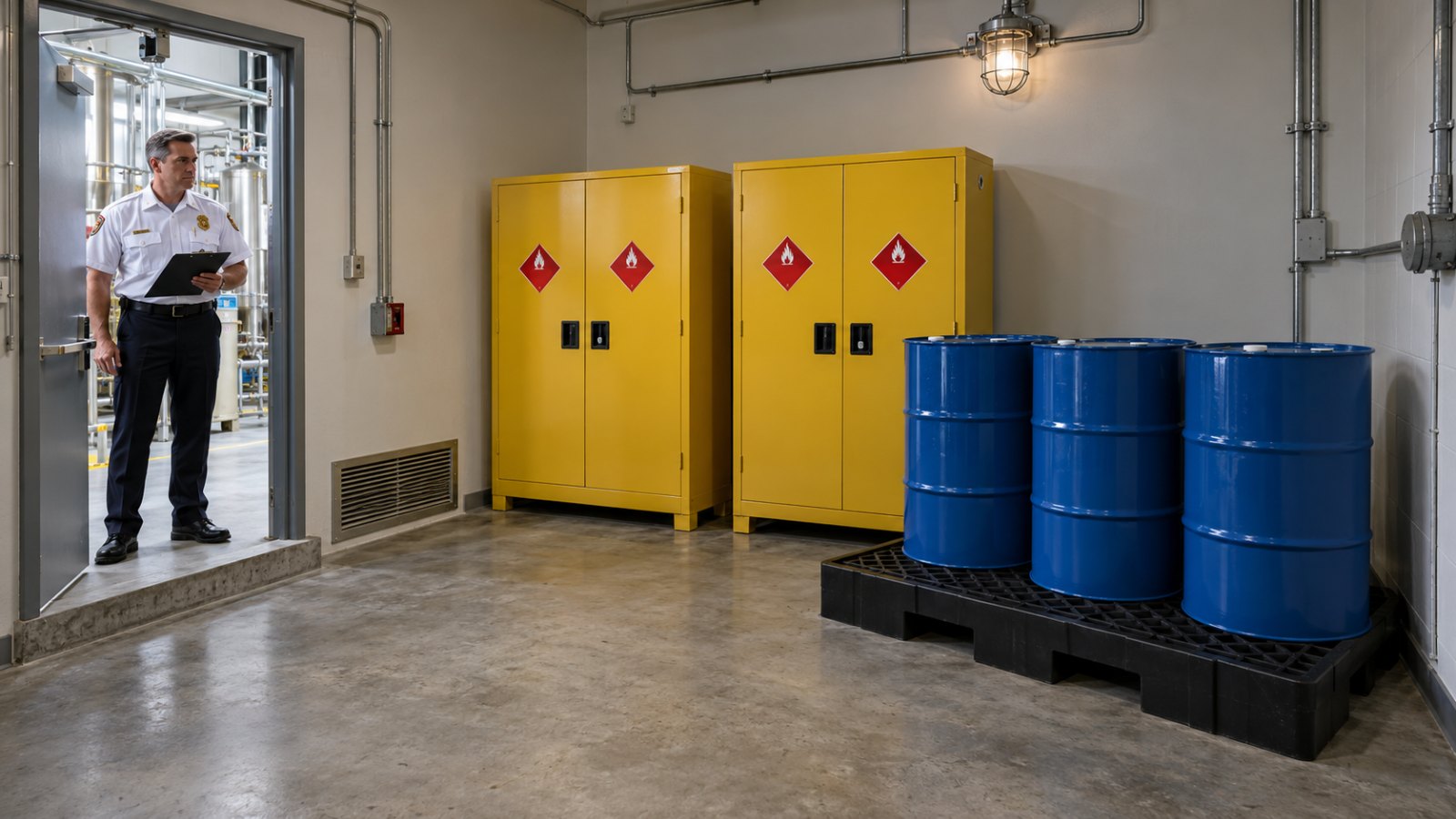
Quick answer: A compliant cannabis solvent storage setup is governed by NFPA 30 for flammable and combustible liquids (ethanol, isopropanol, heptane, pentane, acetone) and by NFPA 58 for liquefied petroleum gases (butane, propane). Carbon dioxide is neither: a CO2 extraction room is an asphyxiation and pressure-vessel problem, not an NFPA 30 one. A single flammable liquid storage cabinet holds a maximum of 60 gallons of Class I or Class II liquid. Per control area, the IFC maximum allowable quantity (MAQ) for Class IB/IC liquids is 120 gallons, which doubles to 240 with an automatic sprinkler system and doubles again to 480 when that liquid is inside listed cabinets. An inside liquid storage room needs mechanical ventilation of at least 1 CFM per square foot of floor area (never below 150 CFM) with the exhaust intake within 12 inches of the floor, because every solvent vapor you store is heavier than air. Secondary containment must hold the largest single container plus 20 minutes of sprinkler discharge. Get any one of these wrong and the room fails the fire marshal even when your C1D1 extraction booth passes clean.
The Room That Fails Inspection After the Extraction Booth Passes
Operators pour six figures into a C1D1 extraction room. Explosion-proof fixtures, sealed conduit, gas detection, negative pressure. It passes. Then the fire marshal walks ten feet down the hall, opens a supply closet, finds 55 gallons of ethanol and a case of pentane sitting next to the water heater, and the whole facility fails the final inspection. The same inspector reads the extraction room against IFC Chapter 39, which dedicates that room to extraction and nothing else; the Chapter 39 walkthrough shows where storage in the extraction room fails the permit.
Solvent storage is the single most common citation in an extraction facility inspection, and it is almost always an afterthought. The extraction room gets the engineering attention because that is where the visible hazard lives. Storage gets treated like a stockroom. But a flammable liquid storage area is its own regulated space with its own code body, its own quantity limits, its own ventilation math, and its own containment requirements. NFPA 30 does not care that your process room is flawless. If the storage fails, the license stalls, and every day you cannot open is revenue you do not get back.
This guide covers what the storage area must physically be to pass: which code governs which solvent, how much you are allowed to keep before the room reclassifies as a high-hazard occupancy, when cabinets are enough and when you need a dedicated room, how to size ventilation and containment, and the specific ways these rooms fail an AHJ walkthrough.
NFPA 30 vs NFPA 58: Know Which Code Governs What You Store
The first mistake happens before anyone measures a gallon. Operators lump every solvent under one heading and design one storage solution for all of it. That is wrong, because butane and propane are not liquids at atmospheric pressure. They are liquefied petroleum gases, and they live under NFPA 58, not NFPA 30. The container siting table, the 735 pound manifold cap and the cylinder cage distances are worked through in our NFPA 58 LP-gas storage guide. Storing LPG cylinders inside an NFPA 30 flammable liquid storage room is a code conflict, not a convenience.
NFPA 30 governs flammable and combustible liquids. It sorts them by flash point and boiling point into classes, and the class drives every quantity limit that follows. Here is where the solvents in a typical extraction facility actually land.
| Solvent | NFPA 30 Class | Flash Point | LEL (% v/v) | Vapor Density (air = 1) | Governing Code |
|---|---|---|---|---|---|
| Pentane | Class IA | -49°F (-45°C) | 1.4 | 2.48 | NFPA 30 |
| Acetone | Class IB | 0°F (-18°C) | 2.5 | 2.0 | NFPA 30 |
| Isopropyl alcohol | Class IB | 53°F (12°C) | 2.0 | 2.07 | NFPA 30 |
| Ethanol (200 proof) | Class IB | 55°F (13°C) | 3.3 | 1.59 | NFPA 30 |
| Heptane | Class IB | 25°F (-4°C) | 1.05 | 3.45 | NFPA 30 |
| Butane | Flammable gas (LPG) | -76°F (-60°C) | 1.8 | 2.0 | NFPA 58 |
| Propane | Flammable gas (LPG) | -156°F (-104°C) | 2.1 | 1.55 | NFPA 58 |
Read the vapor density column, because it drives your ventilation design later. Every solvent here is heavier than air. Ethanol vapor is 1.59 times the density of air; heptane vapor is 3.45 times. That means vapor does not rise and vent through the ceiling. It pools at the floor, flows downhill, and collects in low spots like a slow, invisible flood. Your exhaust intake goes low for exactly this reason, and your ignition sources need to be off the floor.
The practical rule: design your NFPA 30 liquid storage for ethanol, IPA, heptane, pentane, and acetone. Keep butane and propane out of that room entirely and handle LPG under NFPA 58, which usually means outdoor storage or a separate dedicated gas area. If you run a hydrocarbon line, your C1D1 room requirements and your LPG storage are separate compliance problems from the liquid room described here.
Maximum Allowable Quantity and Control Areas: How Much You Can Legally Keep
Every code question about storage reduces to one number: how much are you allowed to have before the space stops being a normal room and becomes a high-hazard occupancy. That number is the maximum allowable quantity, or MAQ, and it is defined per control area in the International Fire Code, Table 5003.1.1(1).
A control area is a space bounded by fire-rated construction where you are permitted to keep up to the full MAQ. Build two control areas separated by a one-hour to two-hour fire barrier and you get two full MAQs. This is the legitimate way to store more solvent without triggering an H-occupancy: you compartmentalize, you do not just pile it into one room.
| Liquid Class | Base MAQ per Control Area | With Sprinklers (×2) | Sprinklers + Cabinets (×4) | Example Solvent |
|---|---|---|---|---|
| Class IA | 30 gal | 60 gal | 120 gal | Pentane |
| Class IB / IC | 120 gal | 240 gal | 480 gal | Ethanol, IPA, acetone, heptane |
| Class II | 120 gal | 240 gal | 480 gal | Diesel-range carriers |
| Class IIIA | 330 gal | 660 gal | 1,320 gal | Some carrier oils |
Two multipliers stack. An automatic sprinkler system designed for the hazard doubles the MAQ. Keeping the liquid inside listed flammable liquid storage cabinets doubles it again. So a single sprinklered control area holding Class IB ethanol in cabinets legally tops out at 480 gallons. There is a hard limit inside that: the total of Class IA, IB, and IC combined cannot exceed the Class IB/IC number, and the Class IA slice cannot exceed its own 30-gallon base. Aggregate limits are real and inspectors check them.
Cross the MAQ and the room becomes a Group H occupancy. That is a different building entirely: explosion venting or deflagration relief, dedicated egress, spill control across the whole floor, blast-resistant construction in some cases, and a fire protection engineer stamp. Most extraction operators never want to go there. The right move is to size storage to stay under MAQ, use control-area compartmentalization if you genuinely need more, and reorder solvent more often rather than warehousing it. If your build is bumping the ceiling, the answer is usually a design conversation, not a bigger closet, which is exactly the kind of thing we walk through in a consulting engagement before the concrete is poured.
Flammable Liquid Storage Cabinets: The 60-Gallon Rule
Below MAQ, most small and mid-size labs store solvent in listed cabinets rather than building a dedicated room. A listed flammable liquid storage cabinet holds a maximum of 60 gallons of Class I or Class II liquids, or 120 gallons of Class III liquids. You are limited to no more than three such cabinets in a single storage group or fire area unless they are separated by at least 100 feet, per IFC 5704.3.2. OSHA 29 CFR 1910.106(e)(2)(ii)(b) adds the room-level cap most operators never hear about: no more than 25 gallons of flammable liquid in containers may sit outside an approved cabinet in any one room, so the open drum parked next to the rotovap is a citation before it is a fire.
The cabinet itself is a specification, not just a metal box. A code-compliant cabinet is built from 18-gauge steel, double-walled with a 1.5-inch air gap between walls, has a liquid-tight bottom pan raised at least 2 inches to form a sill, uses three-point self-latching doors, and is labeled in conspicuous lettering: FLAMMABLE, KEEP FIRE AWAY. Vent bungs stay capped unless local code requires venting, because an unvented cabinet contains a fire longer. The cabinet is one line on the extraction lab safety equipment checklist; the LEL detection and exhaust that guard the room where the solvent is used are the rest of it. The 2-inch sill is the detail people miss. It is there to hold a small spill inside the cabinet instead of letting it run onto the floor and find an ignition source.
Do not confuse cabinet capacity with facility capacity. The AI-generated summaries floating around the web say “60 gallons” as if that is your whole limit. It is not. Sixty gallons is the cap on a single cabinet. Your control-area MAQ is the number that actually governs how much solvent can be in the building, and with cabinets plus sprinklers a Class IB control area reaches 480 gallons across multiple cabinets.
When You Need a Dedicated Liquid Storage Room, and How to Build It
Once you outgrow cabinets, or once your throughput means you are receiving ethanol by the drum, you need an inside liquid storage room designed to NFPA 30 Chapter 9 and IFC 5704.3.7. This is where storage design starts to look like extraction-room design, because the same physics apply: flammable vapor, low pooling, ignition control, and containment.
The room is defined by five systems, and all five get inspected.
Fire-rated construction. An inside storage room is separated from the rest of the building by fire barriers. A room up to 150 square feet storing Class I liquids needs at least one-hour fire-rated construction; larger rooms and larger quantities push to two-hour construction, and room size is capped depending on whether you have sprinklers and what you store. The door is a rated, self-closing fire door with a raised sill or a ramp.
Spill containment at the floor. The room contains its own liquid. That means a liquid-tight raised sill of at least 4 inches at the door, or a floor that slopes to an internal trench or drain sized to hold the release. The goal is that a drum failure stays in the room and does not run under the door into an occupied space.
Mechanical ventilation. This is the number inspectors measure. Continuous or detection-activated mechanical exhaust at a minimum of 1 CFM per square foot of floor area, and never less than 150 CFM total. The exhaust intake is located within 12 inches of the floor because the vapor is heavier than air and lives at the bottom of the room. Makeup air comes in high. An exhaust grille mounted at the ceiling in a solvent room is a failed design; it pulls clean air off the top and leaves the vapor blanket sitting on the slab.
| Room Floor Area | Minimum Exhaust (1 CFM/ft²) | Code Floor (150 CFM min) | Design Value to Use |
|---|---|---|---|
| 80 ft² | 80 CFM | 150 CFM | 150 CFM |
| 150 ft² | 150 CFM | 150 CFM | 150 CFM |
| 300 ft² | 300 CFM | 150 CFM | 300 CFM |
| 500 ft² | 500 CFM | 150 CFM | 500 CFM |
The rule is simple: take the larger of 1 CFM per square foot or 150 CFM. Below 150 square feet, the 150 CFM floor governs. Above it, the per-square-foot number governs.
Classified electrical. Because ignitable vapor can be present, the electrical inside and around the storage room is classified. NFPA 30 and NFPA 70 treat the space as Class I, Division 2 in most storage configurations, meaning sealed fittings, rated fixtures, and no ordinary switches or receptacles at low elevation where vapor collects. This is less severe than the Division 1 rating in your extraction room, but it is not ordinary commercial wiring. If you want the full breakdown of how these zones get classified, see our guide on C1D1 vs C1D2 classification.
Ignition control and separation. No open flames, no unrated heaters, no ignition sources in the room. Solvent storage stays away from exits and away from the boundary of the property line where required. If you want to learn the full room-by-room build discipline hands-on, with the ventilation and classification math worked through on real floor plans, that is exactly what we teach in our extraction training program at extractiontraining.com.
Secondary Containment: Size It With the Formula, Not a Guess
Containment is where operators either overthink it or ignore it. The code intent is straightforward: if a container fails, the released liquid must be captured, and the capture volume has to account for firefighting water on top of the spill.
For an inside storage room, the containment volume is sized to hold the volume of the largest single container plus the design discharge of the sprinkler system over 20 minutes. That second term is the part people forget. The hazard classification and design density behind that discharge figure are worked room by room in our cannabis extraction lab sprinkler requirements guide. A drum spill plus 20 minutes of sprinkler flow is a lot more liquid than the drum alone.
Worked example. You store ethanol in 55-gallon drums. Your largest single container is 55 gallons. Your sprinkler design density for the room delivers roughly 25 gallons per minute over the containment area. Twenty minutes of that flow is 500 gallons. Your containment volume is 55 plus 500, which is 555 gallons. In a room with a 4-inch sill, that means you need at least 555 gallons of holding capacity below the sill line, so you either raise the sill, slope to a trench, or add a dedicated containment basin. Sizing containment to the drum alone, at 55 gallons, is the classic underbuild that fails a plan review the moment the reviewer asks about sprinkler contribution.
For outdoor or detached storage, the math changes: containment is typically 100 percent of the largest container plus the volume of a 24-hour rainfall event over the containment footprint, since there is no sprinkler but there is weather.
Segregation: Keep Incompatibles Apart
A flammable liquid storage room is for flammable liquids. The failure mode is convenience storage, where someone parks a pallet of hydrogen peroxide, a jug of nitric acid, or a chlorine product in the same room because it was open. Oxidizers next to flammables is how a small fire becomes an unstoppable one, because the oxidizer feeds the reaction independent of the room air.
| Store Together? | Flammable Liquids | Oxidizers | Strong Acids | LPG (Butane/Propane) |
|---|---|---|---|---|
| Flammable Liquids | Yes | No (separate 20 ft or barrier) | No | No (different code, different room) |
| Oxidizers | No | Yes | No | No |
| Strong Acids | No | No | Yes (segregate acids from bases) | No |
Separate incompatibles by at least 20 feet of open distance or by a noncombustible barrier. In practice, a small extraction facility keeps flammables in the liquid room and everything else in its own labeled area. The isomerization operators running acid catalysts have their own segregation problem, because strong acids and bases cannot share a shelf either.
Bonding, Grounding, and the Static Nobody Sees
The room can be built perfectly and still have an ignition source you designed in by accident: static electricity during transfer. Ethanol vapor has a minimum ignition energy of roughly 0.28 millijoules. A static discharge from your fingertip is on the order of 10 millijoules. The spark you cannot feel is more than 30 times the energy needed to light an ethanol vapor cloud.
When you pour or pump flammable liquid from one metal container to another, charge separates and accumulates on the liquid stream and the containers. If the two containers are at different potentials, the discharge jumps the gap, and if the vapor concentration at that gap sits above the LEL, it ignites. The fix is bonding and grounding: a bonding wire connects the two containers so they share a potential, and a ground wire ties them to building ground so the charge bleeds away. Every drum-to-vessel transfer point in the storage room needs a bonding and grounding setup, and it needs to be used, not just installed.
Common Failures and How to Diagnose Them
These are the five ways solvent storage fails an AHJ walkthrough or a real incident, drawn from what actually gets cited.
Symptom: Fire marshal red-tags the storage room ventilation.
Root cause: Exhaust intake is mounted high, at or near the ceiling, on the assumption that fumes rise. Solvent vapor is heavier than air (ethanol 1.59, heptane 3.45), so it pools at the floor while the high exhaust pulls clean air.
Diagnostic test: Measure the height of the exhaust intake. If it is more than 12 inches off the finished floor, it is non-compliant. Confirm airflow with a smoke pencil at floor level; if the smoke does not track to the intake, the vapor is not being captured.
Fix: Relocate the exhaust intake to within 12 inches of the floor, size it to the larger of 1 CFM/ft² or 150 CFM, and move makeup air high on the opposite wall to sweep the room.
Symptom: Plan review rejects the containment sizing.
Root cause: Containment was sized to the largest container volume only, ignoring the 20-minute sprinkler discharge term.
Diagnostic test: Take the largest container volume and add the sprinkler design flow times 20 minutes. Compare to the actual holding volume below the sill. If holding volume is less than that sum, it fails.
Fix: Raise the sill, add a trench to a sized basin, or reduce container size. For a 55-gallon drum with a 25 GPM sprinkler zone, target at least 555 gallons of containment.
Symptom: Storage room reclassified as a Group H occupancy mid-project, blowing the budget.
Root cause: Aggregate solvent quantity exceeded the control-area MAQ, often because someone counted only ethanol and forgot the pentane, acetone, and IPA in the same room.
Diagnostic test: Sum every flammable liquid by class in the control area. Compare Class IB/IC total against 120 gallons base, adjusted by your sprinkler and cabinet multipliers. Check the Class IA slice against its own 30-gallon cap.
Fix: Reduce on-hand inventory, split storage into two fire-separated control areas for two full MAQs, or accept the H-occupancy path with an engineer. Reordering more frequently is almost always cheaper than building H.
Symptom: A small spill ignites during routine transfer.
Root cause: No bonding and grounding at the transfer point, so static discharge ignited vapor above the LEL. Ethanol needs only 0.28 mJ.
Diagnostic test: Inspect every transfer station for a bonding wire between containers and a ground to building steel. Verify continuity with a ground-loop tester, not just a visual check of the clamp.
Fix: Install and enforce bonding and grounding at all transfer points. Transfer slowly to limit charge generation, and keep the pour spout in contact with the receiving container.
Symptom: Inspector cites incompatible storage.
Root cause: An oxidizer or strong acid was stored in the flammable liquid room for convenience, removing the safety margin the segregation rule exists to protect.
Diagnostic test: Walk the room with the compatibility matrix. Anything that is not a flammable or combustible liquid does not belong there.
Fix: Remove all non-flammable-liquid materials. Store oxidizers and acids in their own labeled, segregated areas separated by 20 feet or a noncombustible barrier.
Build the Storage Room Before You Build the Inventory
The pattern across every failed inspection is the same: the storage got sized to the solvent someone wanted to buy, instead of the solvent being sized to the room the code allows. Decide your control-area MAQ first, design ventilation and containment to the room, and let those constraints set your maximum on-hand inventory. That order keeps you under H-occupancy, keeps the fire marshal on your side, and keeps the license moving. If you are laying out a facility now and want the storage, extraction, and classification decisions engineered together instead of discovered at inspection, that is the work we do. See our cannabis extraction lab design guide for how storage fits the whole facility, and reach out for a build review before you pour concrete.
Code figures here reflect commonly adopted editions of NFPA 30, NFPA 58, and the International Fire Code and are for planning reference, not a compliance determination. Quantity limits, fire ratings, and classification thresholds change between code editions and are amended by state and local jurisdictions. Confirm every value against your adopted codes with your authority having jurisdiction and a licensed fire protection engineer before you build.
The state licensing layer that sits above these fire-code limits, application fees, facility standards, and timelines by state, is compiled in our cannabis extraction license requirements by state guide.
Frequently Asked Questions
Does NFPA 30 cover butane and propane storage in a cannabis lab?
No. NFPA 30 governs flammable and combustible liquids like ethanol, isopropanol, heptane, pentane, and acetone. Butane and propane are liquefied petroleum gases and fall under NFPA 58, which usually means outdoor or separate dedicated gas storage. Storing LPG cylinders inside your NFPA 30 flammable liquid storage room is a code conflict that inspectors flag.
How much ethanol can a cannabis extraction facility store?
Ethanol is a Class IB liquid. The base maximum allowable quantity is 120 gallons per control area. An automatic sprinkler system doubles that to 240 gallons, and keeping it in listed flammable liquid storage cabinets doubles it again to 480 gallons per control area. Build a second fire-separated control area and you get another full MAQ. Exceed the MAQ and the space becomes a high-hazard Group H occupancy.
What ventilation does a solvent storage room need?
An inside liquid storage room needs mechanical exhaust of at least 1 CFM per square foot of floor area, and never less than 150 CFM total. The exhaust intake must be within 12 inches of the floor because solvent vapors are heavier than air and pool at the bottom of the room. For a 300 square foot room, that is 300 CFM; for anything under 150 square feet, the 150 CFM floor governs.
How big does secondary containment need to be for a cannabis solvent storage room?
Indoor containment must hold the volume of the largest single container plus 20 minutes of sprinkler discharge. For a 55-gallon ethanol drum in a room with a 25 GPM sprinkler zone, that is 55 plus 500, or 555 gallons of holding capacity below the sill line. Sizing to the drum alone is the most common containment failure at plan review.
How many flammable storage cabinets can I have in one room?
A single listed cabinet holds a maximum of 60 gallons of Class I or Class II liquid, or 120 gallons of Class III. You are limited to no more than three cabinets in one storage group or fire area unless they are separated by at least 100 feet. Cabinet capacity is not the same as facility capacity; the control-area MAQ is the number that governs total on-hand solvent.
What is the difference between a flammable cabinet and a liquid storage room?
Cabinets are the solution below MAQ for small and mid-size labs: listed steel boxes capped at 60 gallons each. A dedicated inside liquid storage room is required when quantities grow, and it is a fully engineered space with fire-rated construction, floor-level exhaust ventilation, Class I Division 2 electrical, spill containment, and segregation. The room is a building system; the cabinet is a container.
Why does solvent storage fail inspection when the extraction room passes?
Because storage is a separate regulated space with its own code body, and it usually gets treated as an afterthought. NFPA 30 governs the storage area independent of your C1D1 extraction booth. The most common citations are high-mounted ventilation that ignores vapor density, undersized containment, exceeding MAQ by counting only one solvent, and missing bonding and grounding at transfer points.
Ready to level up your extraction game? Contact WKU Consulting for personalized guidance on building your extraction lab.
For more deep dives into cannabis chemistry, extraction SOPs, and lab design, subscribe to the WKU Consulting YouTube channel, where we walk through lab build and compliance topics on real floor plans.
