
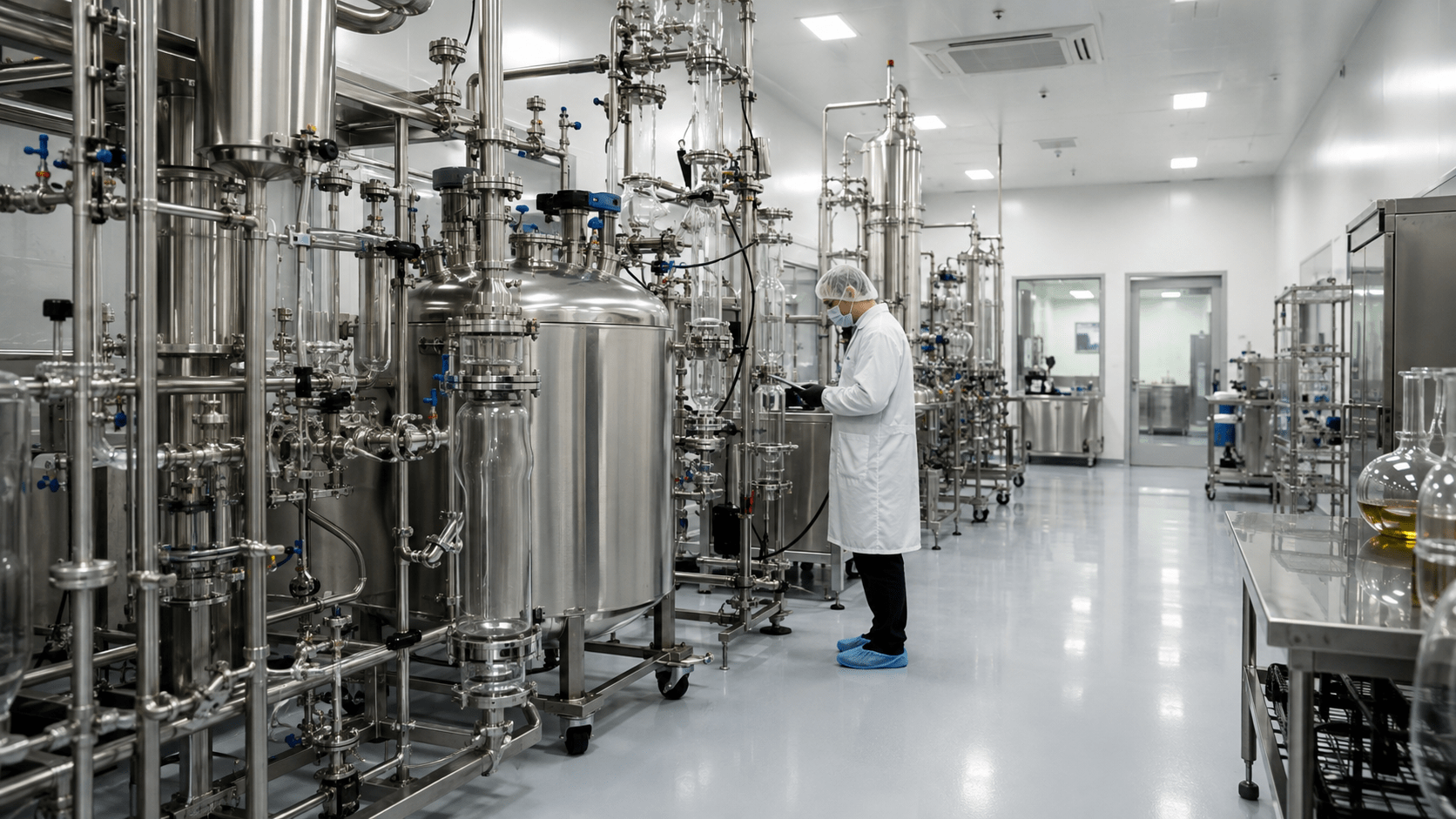
GMP certification turns a cannabis extraction lab into a pharmaceutical manufacturing operation, and most operators underestimate what that swap actually costs. To reach cGMP, you build a documented quality system under 21 CFR Part 211 (US drug standard) or EudraLex Volume 4 (EU-GMP, the export standard), qualify your processing rooms to ISO 14644 cleanliness (typically ISO 7 to ISO 8, EU-GMP Grade C to D for oral extracts), and validate every critical instrument through Installation, Operational, and Performance Qualification (IQ/OQ/PQ). Budget 12 to 24 months and, depending on your starting point, roughly $150,000 to well over $2,000,000 in facility upgrades, quality-system build-out, and validation. The single hardest engineering problem is that GMP wants clean rooms held at positive pressure while C1D1 fire code wants your solvent room held at negative pressure. Resolve that wrong and you fail either the audit or the fire inspection.
Here is what GMP certification actually requires for a cannabis extraction operation, what drives the cost, and the five places operators fail the audit. This is written from the seat of someone who builds these labs, not someone selling you the equipment or the certificate.
What GMP Actually Means for a Cannabis Extraction Lab
GMP stands for Good Manufacturing Practice. The lowercase “c” in cGMP means “current,” and it matters: the standard is a moving target that expects you to use up-to-date systems, not whatever was acceptable a decade ago. GMP is not a building. It is a quality system that proves, on paper and in practice, that every batch you make is safe, pure, correctly labeled, and reproducible. The product is only half of it. The documentation that proves how the product was made is the other half, and auditors spend most of their time there.
Cannabis sits in a strange regulatory gap. Federally, cannabis is not an FDA-regulated drug, so there is no federal cGMP mandate the way there is for pharmaceuticals. That changes the moment you cross into any of these lanes:
- State GMP mandates. New York, among others, has written GMP into adult-use manufacturing rules. When the state requires it, it is not optional.
- Export markets. Selling medical cannabis into Germany, Australia, or other EU-GMP jurisdictions requires an EU-GMP certificate issued after a regulatory inspection. This is the highest bar and the one that opens the largest markets.
- Pharmaceutical partnerships and Schedule III. If cannabis moves to Schedule III, cannabis drug products would fall under FDA drug cGMP (21 CFR 210/211). Any operator positioning for that future is building GMP now. We break down that shift in our guide to Schedule III reclassification for extraction labs.
- Contract manufacturing and retail buyers. Large MSOs and white-label buyers increasingly demand GMP as a condition of supply.
The reason to care is money. GMP is the credential that separates a commodity extractor competing on price from a manufacturer that can sell into pharmacy channels, export markets, and pharmaceutical supply chains at pharmaceutical margins. It is also the credential most operators quote themselves badly on, because they confuse it with the compliance they already have.
The Standards That Apply: cGMP, EU-GMP, and the Certification Bodies
There is no single “cannabis GMP” standard. There are several frameworks, and which one you chase depends entirely on which market you are selling into. Choosing the wrong target is the most expensive early mistake, because a US state-GMP build and a full EU-GMP export build are different projects with different price tags.
| Framework | Reference | Who Requires It | Relative Cost/Effort | Best For |
|---|---|---|---|---|
| US drug cGMP | 21 CFR Parts 210 & 211 | FDA-regulated drug products (post-Schedule III scenario) | Highest | Pharmaceutical cannabis, Schedule III positioning |
| US dietary supplement GMP | 21 CFR Part 111 | Hemp-derived supplements marketed as supplements | Moderate | Hemp CBD supplement brands |
| EU-GMP | EudraLex Volume 4 | Medical cannabis export to EU/Australia; issued after inspection | Highest | Export-market producers, largest addressable markets |
| State GMP mandate | State rule (e.g., NY OCM) | Operators licensed in GMP-mandate states | Moderate to high | In-state adult-use manufacturers |
| Third-party certification (ASTM/CSQ, others) | Private scheme audited by a certifying body | Buyers/retailers who want a badge, not a regulator | Moderate | Market signaling, buyer requirements, a stepping stone |
One clarification that saves operators from expensive confusion: a third-party GMP certificate from a private scheme is not the same as an EU-GMP certificate issued by a competent authority after inspection. Both can be worth having, but only the regulatory certificate opens export. Know which one your buyer is actually asking for before you spend a dollar.
Facility and Cleanroom Requirements
GMP does not require a hospital operating theater for cannabis oral extracts. It requires classified, controlled, monitored space that is appropriate to the risk of the product. For non-sterile oral products (tinctures, capsules, edibles, vape formulations), that generally lands at ISO 14644 Class 7 to Class 8, which corresponds roughly to EU-GMP Grade C to Grade D. Grade A and B environments (ISO 5) are for sterile and aseptic manufacturing and are almost never needed for standard cannabis extract production. Building to a cleaner grade than your product requires is one of the most common ways operators waste six figures.
| Process Step | Typical ISO Class | EU-GMP Grade | Air Changes (typical) | Control Priority |
|---|---|---|---|---|
| Solvent extraction (C1D1 room) | Controlled, not necessarily classified | D or CNC | Driven by LEL/fire code, often high | Fire safety first (negative pressure) |
| Post-processing (winterization, distillation) | ISO 8 | Grade D | 10 to 20 | Particulate and cross-contamination |
| Formulation and compounding | ISO 7 to 8 | Grade C to D | 20 to 40 | Product exposure control |
| Filling and primary packaging | ISO 7 | Grade C | 20 to 40 | Open-product protection |
Beyond air cleanliness, GMP facility requirements pull in HVAC with HEPA filtration, defined pressure differentials between zones (commonly 10 to 15 Pa between adjacent grades), airlocks and gowning rooms, sanitary materials of construction (coved epoxy or resin floors, cleanable non-shedding wall systems, sealed penetrations), unidirectional personnel and material flow to prevent cross-contamination, and environmental monitoring for particulates and viable organisms. Water used in product or final cleaning has to meet a defined quality (often purified water) and the water system itself becomes a validated system.
If you are building the room from scratch, the cleanroom and quality requirements need to be designed in from day one, not retrofitted. We cover the physical build in the cannabis extraction lab design guide and the step-by-step in how to build an extraction laboratory.
The C1D1 Pressure Problem Nobody Warns You About
This is the single most important engineering conflict in a GMP cannabis extraction build, and it is the one equipment vendors will not tell you about because it is not something you buy your way out of.
GMP cleanliness logic says: hold clean rooms at positive pressure relative to dirtier surroundings so that air leaks outward and contamination cannot leak in. Standard pharmaceutical practice.
C1D1 fire code logic says: your hydrocarbon solvent extraction room must be held at negative pressure with high air exchange so that any flammable vapor is swept out and cannot migrate into occupied space where it could find an ignition source and reach its lower explosive limit. Butane’s LEL is about 1.8% by volume in air. Negative pressure and ventilation keep you far below that. This is a life-safety requirement, and it wins.
These two logics collide in the same building. The resolution is not to pick one. It is to zone the facility so both are satisfied:
- The solvent extraction room stays negative to its surroundings. Fire safety is non-negotiable. Cleanliness in that room is achieved through filtered supply air, gowning, and surface control, not positive pressure.
- Downstream non-solvent areas (formulation, filling, primary packaging) run positive-pressure clean cascades, stepping down from cleanest to least clean.
- Airlocks buffer the transition between the negative solvent zone and the positive clean zones, so you never have a clean room drawing air directly from a hazardous room.
Get the pressure scheme wrong and you fail one of two inspections: the fire marshal red-tags a positively pressurized solvent room, or the GMP auditor writes up a clean room that is pulling air from a hazardous zone. The classification of your extraction space is upstream of all of this. If you are not solid on that yet, start with C1D1 vs C1D2 classification.
The Quality System: Where the Real Work Lives
Operators fixate on the cleanroom because it is visible and expensive. Auditors fixate on the quality system because it is where products actually go wrong. A GMP quality system for a cannabis extraction operation includes, at minimum:
- Quality Manual and organizational structure with an independent Quality Unit that has authority to reject product. Independence is the point: the person who can quarantine a batch cannot report to the person whose bonus depends on shipping it.
- Standard Operating Procedures (SOPs) for every process, controlled by document management with version history and approval signatures.
- Batch Manufacturing Records (BMRs) completed contemporaneously for every batch, capturing materials, parameters, in-process checks, and sign-offs.
- Deviation, CAPA, and change control systems. When something goes out of spec, you document it, investigate root cause, and prove the corrective action worked. Change control means you cannot alter a validated process without a documented risk assessment.
- Data integrity to ALCOA+ principles: data must be Attributable, Legible, Contemporaneous, Original, and Accurate, plus complete, consistent, enduring, and available. This is the fastest-growing category of audit findings across the industry.
- Supplier and material qualification, including certificates of analysis on incoming biomass and reagents, and qualification of your testing lab.
- Training records proving every operator was trained on the current version of every procedure they perform.
The uncomfortable truth: you can pass a facility inspection with a beautiful cleanroom and still fail GMP because your batch records are filled in at the end of the shift from memory, your SOPs describe a process nobody actually follows, or your out-of-spec results have no documented investigation. The paper is the product. If you want the hands-on version of the process side, that is exactly what we teach in our extraction training program at extractiontraining.com, where the SOPs and batch documentation are built the way an auditor expects to see them.
Validation: IQ, OQ, PQ, and Process Validation
Validation is documented proof that your equipment and processes do what they are supposed to, every time. It is a distinct workstream from buying the equipment, and skipping or shortcutting it is the most common reason a well-funded build stalls at the audit.
- Installation Qualification (IQ): documented verification that equipment was installed correctly, to specification, with utilities connected and calibration in place.
- Operational Qualification (OQ): documented proof the equipment operates across its full intended range (temperature setpoints, vacuum levels, pressures, alarms).
- Performance Qualification (PQ): documented proof the equipment performs reproducibly under real production conditions with actual material.
- Process validation: proof the manufacturing process itself consistently yields product meeting specification. Modern FDA guidance frames this as a lifecycle (process design, qualification, continued verification) rather than a one-time three-batch exercise, though demonstration batches remain the practical backbone.
Every critical instrument that affects product quality, from your wiped-film evaporator to your analytical balance, needs calibration on a defined schedule traceable to a standard. A balance that drifts and was never requalified can invalidate every potency number you reported on it.
Cost and Timeline to Certify
Anyone who quotes you a single GMP number without asking about your starting point and target market is guessing. The cost is driven by how far your current facility and systems sit from the target, and whether that target is a US state-GMP program or a full EU-GMP export certificate. That said, here is a realistic breakdown of where the money goes.
| Cost Component | Typical Range | What Drives It |
|---|---|---|
| Gap assessment and readiness plan | $10,000 to $40,000 | Facility size, number of product lines |
| Facility and cleanroom upgrades | $100,000 to $1,500,000+ | Retrofit vs new build, grade required, HVAC scope |
| Quality management system build-out | $30,000 to $150,000 | SOP set, eQMS software, consulting hours |
| Equipment and process validation (IQ/OQ/PQ) | $40,000 to $250,000 | Number of critical systems, complexity |
| Quality personnel (annual) | $80,000 to $250,000/yr | Independent Quality Unit staffing |
| Certification/inspection fees | $15,000 to $75,000+ | Scheme, auditor travel, re-inspection |
Add it up and a modest US state-GMP readiness project starts near $150,000 for an operator already running a decent facility, while a full EU-GMP export build from a standard extraction lab commonly runs past $2,000,000. Timeline is 12 to 24 months for most operators, with the quality-system maturity (you generally need months of records showing the system actually running) and validation being the long poles, not the construction. For context on the underlying facility economics, see our cannabis extraction lab cost breakdown.
Common Failures and How to Diagnose Them
GMP audits do not usually fail because a room was dirty. They fail because the system that is supposed to guarantee quality has holes in it. These are the five failure modes that sink cannabis extraction operations, and how to catch them before an auditor does.
Symptom: Batch records completed at end of shift, all in the same pen, all signed at once.
Root cause: Non-contemporaneous documentation. Records are being reconstructed from memory, which violates the “Contemporaneous” and “Original” pillars of ALCOA+.
Diagnostic test: Compare timestamped instrument logs to the times written on the batch record. Gaps and impossible sequences expose it.
Fix: Record at the point of activity. Move to an electronic batch record with enforced time-stamping if paper discipline keeps failing.
Symptom: Cleanroom was qualified once at build and never requalified.
Root cause: No periodic requalification program. Cleanroom performance drifts as filters load and door discipline slips; a one-time certificate proves nothing about today.
Diagnostic test: Ask for the last particle count and pressure-differential trend. If the most recent data is the commissioning report, you have a finding.
Fix: Schedule periodic requalification (commonly every 6 to 12 months by grade) with routine environmental monitoring in between.
Symptom: Out-of-spec potency or residual-solvent result with no investigation record.
Root cause: Missing or closed-without-root-cause deviation and CAPA. The result was quietly retested until it passed.
Diagnostic test: Pull every out-of-spec result from the last year and match each to a documented investigation and CAPA closure. Any orphan result is a finding.
Fix: Enforce a deviation trigger on every out-of-spec event, with documented root-cause analysis and effectiveness checks before closure. Retesting into compliance is a data-integrity red flag auditors specifically hunt for.
Symptom: Equipment in use with no IQ/OQ/PQ package, or calibration stickers expired.
Root cause: Incomplete validation and calibration program. The equipment may work fine, but you cannot prove it, so its output is not defensible.
Diagnostic test: Spot-check three critical instruments for a current validation package and in-date calibration traceable to a standard.
Fix: Complete validation before production use, and put every quality-critical instrument on a tracked calibration schedule.
Symptom: Incoming biomass or reagents accepted without qualification or CoA review.
Root cause: No supplier qualification program. Contamination and potency variability walk in the receiving door and become your problem downstream.
Diagnostic test: Trace a finished batch back to its inputs and check for approved-supplier status and reviewed certificates of analysis on every material.
Fix: Build an approved-supplier list, require CoAs, and quarantine incoming material until released by the Quality Unit.
Frequently Asked Questions
How do I get GMP certification for a cannabis extraction lab?
You pick the target framework (US state-GMP, dietary supplement 21 CFR 111, or EU-GMP for export), run a gap assessment against it, upgrade the facility and build the quality system to close the gaps, validate equipment through IQ/OQ/PQ, run the system long enough to generate records, then pass an audit or regulatory inspection. Expect 12 to 24 months from decision to certificate for most operators.
How much does cannabis GMP certification cost?
The certificate or inspection fee itself is often $15,000 to $75,000, but that is the smallest line item. The real cost is getting ready: facility upgrades, quality-system build-out, and validation typically total from about $150,000 for a state-GMP-ready operation to well over $2,000,000 for a full EU-GMP export build. The number is driven by how far your current operation sits from the target standard.
What is GMP for cannabis, and how is it different from my state license?
Your state extraction license and C1D1 classification prove you can operate legally and safely (fire code, security, seed-to-sale tracking). GMP is a separate, higher bar: a documented quality system proving every batch is safe, pure, consistent, and traceable. You can be fully licensed and C1D1 compliant and still be nowhere near GMP, because GMP is about product quality and documentation, not operating permission.
What are the 5 core areas of GMP?
They are often summarized as the 5 Ps: People (trained, with clear responsibilities and an independent Quality Unit), Processes (defined and validated), Procedures (controlled SOPs followed as written), Products (specified, tested, and released against spec), and Premises/Equipment (qualified, maintained, and monitored). Every audit finding maps back to one of these.
Do I need a cleanroom for cannabis GMP?
For non-sterile oral cannabis products you need classified, controlled space, typically ISO 14644 Class 7 to 8 (EU-GMP Grade C to D), not a sterile ISO 5 cleanroom. Building cleaner than your product requires wastes money. The bigger design challenge is reconciling GMP positive-pressure cleanliness with C1D1 negative-pressure fire safety in the solvent room, which is solved with zoning and airlocks rather than picking one.
Can I retrofit an existing extraction lab to GMP or do I need to build new?
Retrofit is often possible but not always cheaper once you account for HVAC rework, wall and floor systems, pressure-cascade engineering, and downtime. A gap assessment tells you whether your existing shell can carry a GMP fit-out or whether the pressure and flow requirements force a new build. Do that assessment before committing capital either way.
Is GMP required if cannabis moves to Schedule III?
If cannabis is rescheduled and marketed as an FDA-regulated drug, drug cGMP under 21 CFR 210/211 would apply to those products. Even short of that, operators positioning for pharmaceutical channels and partnerships are building GMP now because it takes 12 to 24 months, and you cannot manufacture your way into a market that requires a credential you started too late to earn.
The Bottom Line
GMP certification is the credential that moves a cannabis extraction operation out of commodity pricing and into pharmacy channels, export markets, and pharmaceutical partnerships. The build is not primarily about a shiny cleanroom. It is about a quality system that survives an auditor pulling your batch records, a validation package that proves your equipment does what you claim, and a facility that satisfies both the GMP auditor and the fire marshal at the same time. Scope it to the market you are actually selling into, resolve the C1D1 pressure conflict on paper before you pour concrete, and start early, because the timeline is measured in years, not months.
Ready to level up your extraction game? Contact WKU Consulting for personalized guidance on GMP readiness, facility design, and building your extraction lab to the standard your market demands.
For more deep dives into cannabis chemistry, extraction SOPs, and lab design, subscribe to the WKU Consulting YouTube channel.
Watch a related video:
