
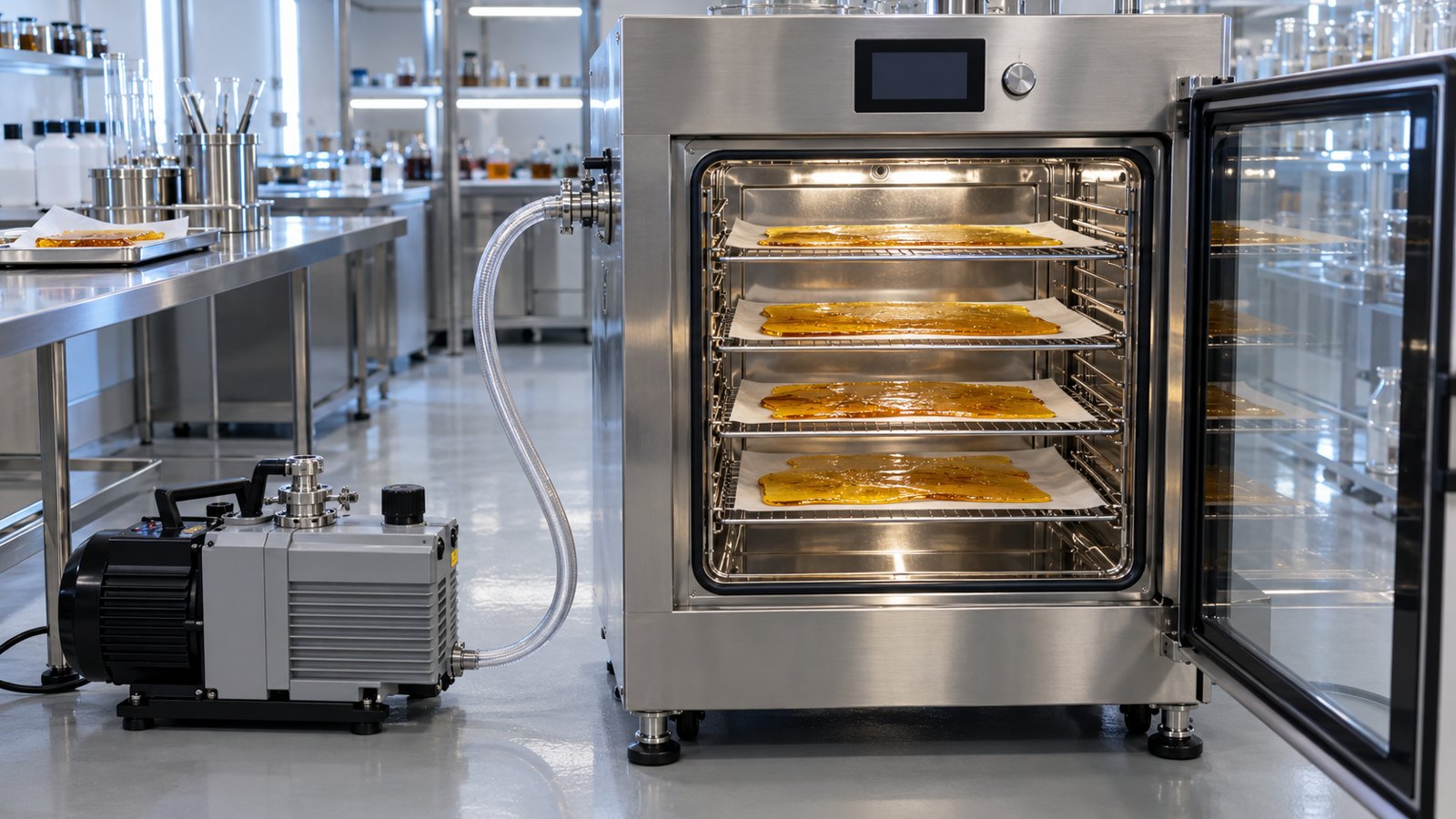
Vacuum oven purging removes residual butane, propane, or ethanol from cannabis concentrates by holding material at 100 to 115°F (38 to 46°C) under full vacuum at -29.5 inHg for 24 to 72 hours. BHO concentrates spread to 1 to 2 mm film thickness at 100°F reach compliant residual solvent levels (below 5,000 ppm total hydrocarbons per USP 467) within 24 to 48 hours. Ethanol extracts require higher temperatures (120 to 140°F) due to ethanol’s boiling point of 78.4°C at atmospheric pressure. The vacuum reduces that boiling point to approximately 34°C at -29.5 inHg, allowing solvent removal without degrading THCa (decarboxylation onset: 220°F/104°C) or volatilizing monoterpenes (myrcene bp: 167°C, limonene bp: 176°C at atmosphere, reduced to 60 to 80°C under vacuum). Four failure modes account for 90% of failed residual solvent tests: running the oven too hot, purging too thick, breaking vacuum repeatedly, and skipping cold trap maintenance.
Quick Reference: Vacuum Oven Purging Parameters by Extract Type
| Extract Type | Temp Range | Vacuum Level | Time (1-2mm film) | Failure Threshold | Key Risk |
|---|---|---|---|---|---|
| BHO Shatter | 100-110°F (38-43°C) | -29.5 inHg | 24-48 hours | Above 115°F triggers nucleation (buddering) | Terpene loss above 110°F; texture change above 115°F |
| BHO Budder/Wax | 100-115°F (38-46°C) | -29.5 inHg | 24-48 hours | Above 120°F accelerates decarb | Minor terpene loss acceptable; texture already nucleated |
| Live Resin | 90-100°F (32-38°C) | -29.5 inHg | 48-72 hours | Above 100°F destroys monoterpene profile | Longest purge time; monoterpene preservation critical |
| Ethanol Extract (Crude) | 120-140°F (49-60°C) | -29.5 inHg | 24-48 hours | Above 150°F degrades cannabinoids | Higher temps needed due to ethanol bp; pre-rotovap recommended |
| CO2 Extract | 100-120°F (38-49°C) | -29.5 inHg | 12-24 hours | Above 130°F darkens product | Lower solvent load than BHO; shorter purge typically sufficient |
| RSO/FECO | 130-150°F (54-66°C) | -29.5 inHg | 24-48 hours | Decarb begins above 220°F; ethanol removal is priority | Full decarb often intended; focus on complete ethanol removal |
What Is Devolatilization and Why Does It Matter?
Need the broader troubleshooting framework around failed solvent endpoints? Read Residual Solvent Purging in Cannabis for the full decision logic on vacuum depth, film thickness, rescue purges, and why some batches still taste chemical after they technically pass.
Ask any cannabis processor what separates a compliant product from a recalled batch, and the answer almost always comes back to one step: devolatilization. It is the controlled removal of volatile compounds from cannabis concentrates after extraction, primarily residual extraction solvents like butane, propane, and ethanol.
Every state-regulated cannabis market sets maximum allowable residual solvent limits. For butane, most jurisdictions follow USP <467> guidelines or state-specific limits, typically requiring less than 5,000 ppm total residual hydrocarbons in the final product. Ethanol limits are generally more permissive (often 5,000 ppm or higher) due to its lower toxicity profile.
Devolatilization is not optional. It is a regulatory requirement and a product safety obligation. Get it wrong and you fail compliance testing, lose product, and potentially harm consumers. Get it right and you produce clean, terpene-rich concentrates that pass testing consistently.
Devolatilization vs. Decarboxylation: Understanding the Difference
These two processes are frequently confused because they share overlapping temperature ranges and often occur in the same equipment (vacuum ovens). They are fundamentally different operations.
Devolatilization targets the removal of residual solvents and volatile impurities. The goal is to drive off compounds with boiling points below your target cannabinoid range. For BHO concentrates, this means removing butane (bp: -1°C), propane (bp: -42°C), and any trace co-solvents.
Decarboxylation is the thermally driven removal of a carboxyl group (-COOH) from acidic cannabinoids, converting THCa to THC, CBDa to CBD, and so on. This is a chemical reaction with specific activation energy requirements, not a simple phase change.
In a typical processing workflow:
- Devolatilization happens first (lower temperatures, shorter duration)
- Decarboxylation happens second (higher temperatures, longer duration), but only if required by your target product
If you are making shatter, live resin, or any product where you want to preserve the acidic cannabinoid form, you perform devolatilization WITHOUT decarboxylation. If you are making distillate, vape oil, or edibles, you typically decarboxylate as a separate downstream step. For a deeper look at sequencing these two processes, see our guide on devolatilization and decarboxylation before distillation.
The Physics of Solvent Removal
Removing residual solvent from a viscous cannabis matrix is fundamentally a mass transfer problem. The solvent molecules are trapped within the concentrate, and you need to provide enough energy and low enough pressure to drive them to the surface and into the gas phase.
Three variables control this process:
Temperature
Higher temperature increases molecular kinetic energy, making it easier for trapped solvent molecules to overcome intermolecular forces and escape the matrix. However, excessive temperature causes terpene degradation and loss, color darkening from oxidation, and premature decarboxylation.
Vacuum (Reduced Pressure)
Lowering the pressure above the concentrate reduces the boiling point of the trapped solvent. Butane boils at -1°C at atmospheric pressure, but under vacuum at -29 inHg, its boiling point drops significantly further. This allows solvent removal at lower temperatures, preserving heat-sensitive compounds.
Time
Diffusion of solvent molecules through a viscous concentrate matrix is slow. Even at optimal temperature and vacuum, complete purging requires adequate time for solvent to migrate from the interior of the material to the surface.
The practical challenge is optimizing all three variables simultaneously: high enough temperature to drive mass transfer, deep enough vacuum to lower boiling points, and long enough duration to achieve complete purging. All of this without exceeding the thermal degradation threshold of your target terpenes.
Vacuum Oven Parameters: The Complete Protocol
The following protocol is designed for BHO concentrates (shatter, badder, crumble, wax) in a standard vacuum oven with controllable temperature and a vacuum pump capable of reaching -29.5 inHg or better.
Equipment Requirements
- Vacuum oven with digital temperature control (accuracy to ±1°F)
- Vacuum pump capable of reaching -29.5 inHg (deep vacuum)
- Vacuum gauge (digital preferred for precision)
- PTFE (Teflon) release sheets or silicone mats
- Parchment paper for handling
- Inline cold trap with dry ice or mechanical chiller
Phase 1: Initial Solvent Flash (Muffin Top)
Temperature: 90–100°F (32–38°C)
Vacuum: Full vacuum (-29.5 inHg)
Duration: 30–60 minutes
When you first pull vacuum on fresh BHO crude, you will see aggressive bubbling and expansion. This is the “muffin top” phase, where the bulk of the free residual butane rapidly boils off under reduced pressure. The concentrate will expand significantly in volume.
Critical: Do not exceed 100°F during this phase. Higher temperatures cause violent outgassing that can splatter material onto oven walls and contaminate the chamber.
Let the muffin top rise, stabilize, and begin to collapse before proceeding. When bubbling slows noticeably (usually 30–60 minutes), the bulk solvent has been removed.
Phase 2: Deep Purge
Temperature: 100–115°F (38–46°C)
Vacuum: Full vacuum (-29.5 inHg)
Duration: 24–72 hours (product dependent)
This is where the real work happens. The remaining residual solvent is trapped within the concentrate matrix and must diffuse out slowly. Thin-film spreading accelerates this process significantly.
Thin-film technique: After Phase 1, remove the concentrate from the oven, flip it on parchment, spread it as thin as practical (1–2 mm), and return to the oven. This dramatically increases surface area and reduces the diffusion path length for trapped solvent molecules.
Monitor bubble activity through the oven window:
- Large, lazy bubbles: still significant residual solvent
- Small, uniform micro-bubbles: getting close
- No visible bubble activity under full vacuum: purge is likely complete
Phase 3: Verification
Never assume the purge is complete based on visual inspection alone. Submit a sample for residual solvent testing before releasing any batch for sale. State-accredited labs use headspace GC-FID or GC-MS to quantify individual solvent residuals.
If the test comes back over limit, return to Phase 2 with thinner film and additional time. Do not increase temperature above 115°F as a shortcut. This causes terpene loss and can initiate unwanted decarboxylation.
Product-Specific Devolatilization Parameters
Not all concentrates respond the same way in the vacuum oven. The viscosity, surface area, and target texture of your final product dictate adjustments to the base protocol.
| Product Type | Phase 1 Temp (°F) | Phase 2 Temp (°F) | Typical Duration | Notes |
|---|---|---|---|---|
| Shatter | 90–95 | 100–110 | 48–72 hours | Thin-film critical. Keep low to maintain glass-like clarity. |
| Badder / Budder | 95–100 | 105–115 | 24–48 hours | Nucleation begins during purge. Whipping after Phase 1 accelerates texture. |
| Crumble | 95–100 | 110–115 | 36–60 hours | Higher temps acceptable since crumble texture tolerates slight decarb. |
| Live Resin | 85–90 | 90–100 | 48–96 hours | Ultra-low temps mandatory. Terpene preservation is the entire point. |
| Sauce / Diamonds | 80–90 | 85–95 | 72–120+ hours | Minimal heat. Extended time. Often cold-purged to protect volatile terp fraction. |
The key insight here is that your target product defines the upper temperature boundary. Shatter needs to stay glassy and clear, so it demands lower temperatures and longer times. Crumble is more forgiving on heat exposure because the final texture does not depend on maintaining an amorphous glass state.
Terpene Preservation During Devolatilization
This is the fundamental tension in devolatilization: the same conditions that drive solvent removal (heat and vacuum) also strip volatile terpenes from the concentrate.
Terpene Boiling Points vs. Solvent Boiling Points
The reason terpene preservation is possible at all is the boiling point gap between residual solvents and terpenes:
| Compound | Boiling Point (°C) | Boiling Point (°F) | Type |
|---|---|---|---|
| Propane | -42 | -44 | Solvent |
| Butane | -1 | 30 | Solvent |
| Ethanol | 78 | 173 | Solvent |
| β-Caryophyllene | 263 | 505 | Sesquiterpene |
| Myrcene | 167 | 333 | Monoterpene |
| Limonene | 176 | 349 | Monoterpene |
| Linalool | 198 | 388 | Monoterpene |
Under vacuum, all of these boiling points decrease proportionally. But the relative gap remains: solvents boil off well below terpene thresholds, creating a processing window where solvents can be removed while terpenes are retained.
Note that β-caryophyllene sits closest to the solvent range among common cannabis terpenes. This sesquiterpene is the most vulnerable to loss during aggressive purging, which is why operations that push temperatures above 120°F often report losing the “peppery” and “woody” notes from their profiles.
Strategies for Maximum Terpene Retention
- Keep temperatures as low as possible. Every degree above the minimum effective purge temperature costs you terpenes. The 90–115°F range is the sweet spot for BHO.
- Use full vacuum at all times. Deep vacuum lowers the required temperature for solvent removal, keeping you further from terpene volatilization thresholds.
- Minimize purge duration. Longer purge times mean more cumulative terpene loss, even at low temperatures. Thin-film spreading reduces required purge time by accelerating diffusion.
- Never open the oven to check progress. Each time you break vacuum and open the door, you expose the concentrate to atmospheric pressure and ambient air. The rush of air across the warm concentrate surface strips volatile terpenes and introduces oxidation.
- Cold-trap your vacuum exhaust. Terpenes that do volatilize during purging can be captured in a cold trap between the oven and vacuum pump. This is standard practice in terpene recovery operations and doubles as pump protection.
- Stage your purge. Start at the lowest effective temperature and only increase if residual solvent testing shows incomplete removal. Progressive temperature stepping preserves more terpenes than starting at the maximum temperature.
Scaling Devolatilization for Production Facilities
Small-batch operators with a single vacuum oven face a different set of challenges than production facilities processing hundreds of pounds per week. Scaling devolatilization introduces bottlenecks that are not obvious at bench scale.
A bank of vacuum ovens venting butane into a shared purge room is where the gas detection and LEL monitoring requirements stop being theoretical, and it is the point in a build where an independent extraction consultant earns the fee by sizing the exhaust before the ovens are bought rather than after the first alarm.
Throughput Calculations
A standard 1.9 cubic foot vacuum oven holds approximately 500–800 grams of concentrate per shelf (spread to 1–2 mm thin film). With a 48-hour purge cycle and one shelf, that is roughly 1.5 pounds per week of finished, tested product from a single oven. Production facilities targeting 50+ pounds per week need either multiple ovens running in parallel or larger multi-shelf units with staggered loading schedules.
Staggered Loading
Rather than loading all shelves simultaneously, stagger loads by 12–24 hours. This allows you to pull compliant batches on a rolling basis rather than waiting for the slowest shelf to finish. It also smooths your testing lab submission schedule, preventing bottlenecks at the analytical lab.
Environmental Controls
In production environments, the room housing your vacuum ovens matters. High ambient humidity introduces moisture into the oven each time you load material. Excessive ambient heat can shift your oven’s actual shelf temperature above the setpoint, especially in facilities without climate control. Keep your purge room temperature-controlled at 65–72°F with low humidity for consistent results.
Documentation and Batch Tracking
For GMP-compliant operations, every purge cycle needs documentation: oven ID, shelf position, load time, temperature setpoints, vacuum depth readings at load and throughout the cycle, unload time, and the associated residual solvent test result. This traceability is mandatory for state compliance and essential for troubleshooting when a batch fails.
Common Devolatilization Mistakes
Running the oven too hot
The most common mistake in the industry. Operators set the oven to 140–150°F “to speed things up” and end up with a purged product that has no nose and has partially decarboxylated. Low and slow wins every time.
Purging too thick
A 1 cm thick slab of shatter takes exponentially longer to purge than a 1 mm thin film. The solvent trapped in the center of a thick slab has to diffuse through the entire matrix to reach the surface. Spread thin, flip, spread thin again.
Breaking vacuum repeatedly
Every time you open the oven door, you lose vacuum, introduce oxygen (causing oxidation and color darkening), and create a pressure spike that can re-dissolve partially liberated solvent molecules back into the matrix. Plan your work so the oven stays sealed.
Skipping residual solvent testing
Visual inspection (no more bubbles) is not a reliable indicator of compliance. Residual solvent can be trapped in the matrix below detectable bubble formation levels. Always test. A failed batch on the shelf costs far less than a failed batch on the market.
Using the wrong vacuum pump
A refrigeration vacuum pump or HVAC pump may not reach deep enough vacuum for effective low-temperature purging. Use a pump rated for -29.9 inHg or better, and maintain it regularly with oil changes and valve checks; the oil-change interval and the capped-inlet test are in our equipment maintenance schedule. For more on equipping your lab properly, see our cannabis extraction lab safety guide.
Ignoring cold trap maintenance
A saturated cold trap loses its ability to condense volatiles, meaning solvents pass through to your pump oil and terpenes are lost instead of captured. Empty and clean your cold trap between every batch cycle. Replace dry ice or check mechanical chiller temps before each run.
Equipment Considerations
Vacuum Oven Sizing
Size your oven based on throughput requirements. A single shelf oven (1.9 cubic feet) handles small batches for craft operations. Multi-shelf ovens (3.2 to 7.5+ cubic feet) serve production facilities. Ensure adequate shelf spacing for muffin top expansion during Phase 1.
Vacuum Pump Selection
For cannabis devolatilization, you need:
- Ultimate vacuum: -29.9 inHg or better
- Oil-sealed rotary vane pumps are the standard
- Size the pump CFM to your oven volume (minimum 3 CFM for small ovens, 6–12 CFM for production)
- Add inline cold traps to protect the pump from solvent contamination
Temperature Uniformity
Cheap vacuum ovens have poor temperature uniformity across shelves. A 10°F gradient between the front and back of a shelf means inconsistent purging. Invest in an oven with verified thermal uniformity specifications, or map your oven’s hot and cold spots and rotate material accordingly.
Regulatory Compliance: Residual Solvent Limits by State
Residual solvent limits vary by jurisdiction. Common standards include:
| State | Butane Limit (ppm) | Total Residual Solvent Standard | Notes |
|---|---|---|---|
| California (DCC) | 5,000 | USP <467> Category 2 | Applies to all inhaled products |
| Colorado (MED) | 5,000 | USP <467> Class 3 | Separate limits for medical vs. recreational |
| Oregon (OLCC) | 1,000 total HC | State-specific | Stricter than most states |
| Washington (WSLCB) | 500 per solvent | State-specific | Among the strictest nationwide |
| Michigan (CRA) | 5,000 | USP <467> | Follows federal pharmacopeia standards |
| Massachusetts (CCC) | 5,000 | USP <467> | Testing required for all inhaled and oral products |
Always verify current limits with your state regulatory body. Limits change, and some states differentiate between inhaled products and oral or topical products. If a batch fails testing, our cannabis remediation decision matrix walks through when to remediate versus scrap.
Ethanol Devolatilization: Key Differences
While the principles are the same, ethanol extraction presents unique devolatilization challenges compared to hydrocarbon extraction:
- Higher boiling point: Ethanol boils at 78.4°C (173°F) at atmospheric pressure, significantly higher than butane. This requires more aggressive temperature or deeper vacuum for complete removal.
- Greater affinity for the matrix: Ethanol is polar and forms hydrogen bonds with cannabinoids and other polar compounds in the extract. These intermolecular interactions make ethanol harder to fully remove compared to nonpolar butane.
- Rotary evaporation first: Most ethanol extraction workflows use a rotary evaporator (rotovap) to remove 90–95% of the ethanol before transferring to a vacuum oven for final purging. This is far more efficient than oven purging alone.
- Higher oven temperatures needed: Ethanol purging in a vacuum oven typically requires 120–140°F, which puts more terpene content at risk compared to BHO purging at 90–115°F.
- Water co-extraction: Ethanol pulls water from plant material during extraction. This water must also be removed during devolatilization and can complicate purging by forming an azeotrope with ethanol at 95.6% concentration.
For a comparison of how different extraction solvents affect downstream processing, see our guide to making ethanol shatter.
We cover vacuum oven protocols, temperature ramp schedules, and residual solvent compliance in our extraction training course at extractiontraining.com.
Troubleshooting: When Your Purge Fails Testing
A failed residual solvent test does not necessarily mean your process is broken. Use this decision framework:
| Test Result | Likely Cause | Fix |
|---|---|---|
| Slightly over limit (5,000–7,000 ppm) | Insufficient purge time or material too thick | Return to oven, spread thinner, add 24 hours at same temp |
| Significantly over (7,000–15,000 ppm) | Inadequate vacuum depth or pump failure | Check pump oil level, verify gauge reads -29+ inHg, check for leaks |
| Extremely over (15,000+ ppm) | Process failure: insufficient initial flash or oven malfunction | Full restart from Phase 1. Check oven heating elements and thermocouple calibration |
| Multiple solvents detected | Cross-contamination from shared equipment or solvent blend | Audit solvent supply chain. Clean oven thoroughly between different solvent batches |
Failure Mode Diagnostic Framework
When your vacuum oven purge fails residual solvent testing, use this diagnostic framework to identify the root cause before re-purging. Each failure mode has a specific signature that distinguishes it from the others.
| Symptom | Root Cause | Diagnostic Test | Corrective Action | Prevention |
|---|---|---|---|---|
| Shatter turns to budder/crumble during purge | Temperature exceeded nucleation threshold (115°F+ for BHO) | Check oven thermocouple calibration with external probe; log temp history | Cannot reverse nucleation. Re-classify as budder. Adjust pricing. | Use external temp verification. Set oven 5°F below target to account for overshoot. |
| Residual solvent 5,000-7,000 ppm (marginal fail) | Material too thick (>3mm) or insufficient purge time | Measure slab thickness with calipers. Check purge duration log. | Spread to 1-2mm on fresh parchment. Return to oven for 24 additional hours at same temp. | Always spread to 1-2mm max. Use multiple shelves for throughput, not thicker slabs. |
| Residual solvent 7,000-15,000 ppm (significant fail) | Vacuum leak or pump degradation | Spray soapy water on all fittings while pump runs. Check pump oil clarity (cloudy = contaminated). | Replace pump oil. Tighten or replace fittings. Re-purge full cycle. | Change pump oil every 100 hours. Leak test weekly. |
| Residual solvent 15,000+ ppm (gross fail) | Oven malfunction, thermocouple failure, or Phase 1 flash skipped | Verify heating element function. Calibrate thermocouple against known standard. Review SOP compliance. | Full restart from Phase 1 initial flash. Recalibrate all sensors before re-purge. | Monthly oven calibration. Mandatory Phase 1 flash for all batches. |
| Multiple solvents detected (butane + propane + unknown) | Cross-contamination from shared equipment or mixed solvent blend | Audit solvent certificates of analysis. Check if equipment was cleaned between batches. | Deep clean oven interior with isopropanol wipe. Dedicate equipment to single solvent type. | Batch segregation protocol. Solvent COA verification on receipt. |
| Terpene profile degraded (flat, muted flavor/aroma) | Temperature too high or purge time too long for product type | Compare pre-purge and post-purge terpene panel via GC-MS. Calculate monoterpene loss %. | Reduce temp by 10°F. Shorten purge by 25%. Accept marginal solvent increase if terpene preservation is priority. | Use live resin protocol (90-100°F) for high-terpene products. Monitor mass loss: stop at 0.1% change per hour. |
| Dark product color post-purge | Oxidation from vacuum breaks or excessive heat exposure | Count vacuum break events in log. Check if oven was opened during purge. | Cannot reverse oxidation. Product is still compliant if it passes testing. Adjust for darker market category. | Minimize vacuum breaks to zero during deep purge. Never open oven “to check” during Phase 2. |
Mass loss tracking rule: Monitor total mass loss during purge. A 3-5% mass loss is typical for BHO with moderate solvent loads. If mass loss exceeds 8%, you are likely losing terpenes along with solvents. If mass loss is below 1% after 24 hours, the purge is either complete or your vacuum is not reaching adequate depth.
Related Guide: Before material reaches the vacuum oven, it should be properly winterized to remove fats and waxes. Our complete winterization guide covers ethanol ratios, filtration SOPs, and troubleshooting for every extraction method.
For solvent-specific purge protocols with exact temperature ramps, vacuum staging, and state compliance limits, see our residual solvent purging SOP.
Frequently Asked Questions
How long does it take to purge BHO in a vacuum oven?
A typical BHO purge takes 24 to 72 hours at 100–115°F under full vacuum (-29.5 inHg). The exact time depends on the thickness of your material, the initial solvent load, and your oven’s vacuum depth. Thin-film spreading (1–2 mm) dramatically reduces purge time compared to thick slabs. Always verify completion with lab testing rather than relying on visual cues alone.
What temperature should I set my vacuum oven for devolatilization?
For BHO concentrates, start at 90–100°F for the initial flash phase (30–60 minutes), then increase to 100–115°F for the deep purge phase. Never exceed 115°F for BHO. Higher temperatures destroy terpenes and can trigger unwanted decarboxylation. For ethanol extracts, you may need 120–140°F due to ethanol’s higher boiling point.
Can you devolatilize without a vacuum oven?
Technically, yes. A standard convection oven can remove residual solvents, but you would need significantly higher temperatures to compensate for the lack of reduced pressure. Those higher temperatures destroy terpene content, darken the product, and risk decarboxylation. Vacuum ovens are not optional for quality commercial production. The vacuum is what allows low-temperature purging.
What is the difference between devolatilization and curing?
“Curing” in the concentrate world typically refers to controlled nucleation and texture changes (turning sauce into sugar, for example). Devolatilization specifically refers to the removal of volatile solvents to meet safety and compliance standards. They are different processes with different goals, though they may overlap in timing during production.
How do I know if my purge is complete?
The only reliable method is laboratory residual solvent testing using headspace GC-FID or GC-MS. Visual indicators (no bubbling under vacuum) suggest the purge is close but are not definitive. Some residual solvent remains trapped in the matrix below the threshold of visible bubble formation. Submit samples to a state-accredited testing lab before releasing any batch.
Does devolatilization affect potency?
Proper devolatilization at the recommended temperatures (90–115°F for BHO) does not significantly affect cannabinoid potency. THCa and CBDa remain in their acidic forms at these temperatures. If you overheat the product (above 220°F for extended periods), you will trigger decarboxylation, which converts THCa to THC. This changes the cannabinoid profile but does not reduce total cannabinoid content.
Why does my shatter turn to budder in the vacuum oven?
This is nucleation, not a purge failure. Agitation from vacuum cycling, temperature fluctuations, or residual moisture can trigger THCa crystallization, which converts transparent shatter to an opaque, waxy budder texture. To prevent this: maintain steady temperature (no cycling), avoid breaking vacuum, and keep humidity low. Some strains are more prone to nucleation than others due to their cannabinoid and terpene ratios.
Summary
Devolatilization is a straightforward process governed by well-understood physics: temperature, pressure, and time control the removal of volatile solvents from a viscous matrix. The challenge is executing it with enough precision to preserve the terpene profile that defines product quality.
The protocol outlined here (90–115°F, full vacuum, thin-film technique, 24–72 hours, verified by lab testing) has been validated across hundreds of commercial batches. It is conservative by design because a failed residual solvent test costs far more than an extra day in the oven.
For more on downstream processing after devolatilization, see our guides on color remediation chromatography (CRC) and decarboxylation before distillation.
For operators building or optimizing purge protocols for their specific products and state requirements, WKU Consulting provides SOP development and process validation services.
Join the WKU community:
- Subscribe to our newsletter: Sign up here
- Join our Discord: discord.gg/wku
If your crude still runs dirty after wax removal, the missing step is often phospholipid control. See Cannabis Crude Oil Degumming: The Complete Guide to Removing Phospholipids Before Distillation for the chemistry and SOP.
