
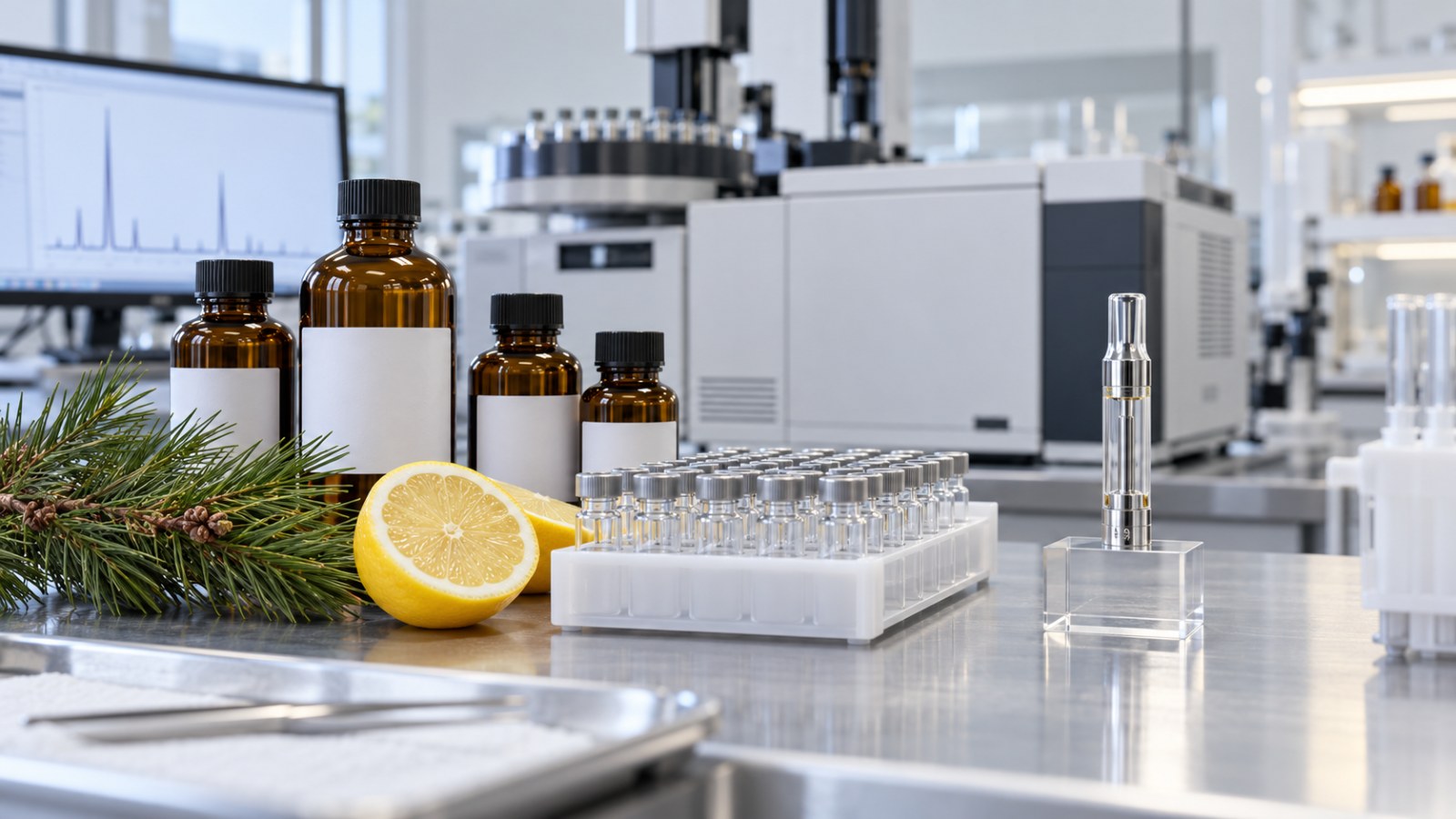
A terpene supplier COA only protects a vape line if it carries a residual solvent panel run on that exact lot, down to a limit low enough to survive dilution into the finished cart. California treats methylene chloride as a Category I residual solvent with a 1 ppm action level in cannabis goods, while the pharmaceutical USP <467> limit is 600 ppm and federal food rules let a spice oleoresin carry up to 30 ppm. At a 10 percent terpene load, a lot at 30 ppm puts 3 ppm in the cart and fails California three times over; to pass, the terpene lot has to test under 10 ppm. Colorado learned this the expensive way: its September 25, 2026 advisory covered 87 production batches across 11 vape lines made with an ingredient containing methylene chloride, traced in the manufacturer’s own recall notice to a “botanically derived” alpha-pinene, and the state’s expanded panel of 17 additional solvents only took effect on September 28.
“Botanical” on a terpene label tells you where the molecule came from. It says nothing about what touched it on the way. That gap is the whole story of the Colorado advisory, and it is sitting in most vape labs’ ingredient shelves right now under a spec sheet nobody verified.
What a “Botanical” Claim Covers, and What It Does Not
| The claim says | It does tell you | It does not tell you |
|---|---|---|
| Botanically derived | The terpene molecule was isolated from a plant (pine, citrus, clove) rather than synthesized | Which solvents were used to extract, fractionate, clean equipment, or dilute it, or what the drum held before |
| Natural flavor (food usage) | The flavor was derived from plant or animal material by distillation, extraction, roasting or similar processes | That it is free of extraction solvents: federal rules allow some solvents at measurable residues in food ingredients |
| Steam distilled | The primary isolation step used steam, not a hydrocarbon or chlorinated solvent | How the fraction was purified afterward, or whether it was blended with a solvent-extracted fraction |
| Cannabis-derived terpenes (CDT) | The terpene fraction came from cannabis | Its residual solvent profile, which depends on the extraction and recovery that produced it |
| Food grade or GRAS | The ingredient is accepted for eating at food levels | Anything about inhalation: heating and inhaling an ingredient is a different exposure from swallowing it |
The food-grade row is where most supplier conversations go wrong. Under 21 CFR 173.255, methylene chloride is a permitted extraction solvent for spice oleoresins at up to 30 ppm residue, for decaffeinated coffee at up to 10 ppm, and for hops extract at up to 2.2 percent. A food-legal botanical extract can therefore be fully compliant on its own paperwork and still fail a cannabis inhalable panel by an order of magnitude. The supplier is not lying. The two rulebooks were written for different routes into the body.
The Limits Your Terpene Lot Has to Clear
Residual solvent limits for the finished cannabis product are the target. The terpene lot is diluted into that product, so its own limit has to be tighter by the dilution factor. The table puts the pharmaceutical reference next to California’s cannabis action levels for the solvents most likely to ride in on a terpene or flavor ingredient.
| Solvent | USP <467> class and limit | California cannabis category and action level | Where it comes from in a terpene or flavor lot |
|---|---|---|---|
| Methylene chloride | Class 2: 600 ppm | Category I: 1 ppm | Extraction or cleaning solvent; food-legal in some oleoresins at up to 30 ppm |
| Benzene | Class 1: 2 ppm | Category I: 1 ppm | Contaminated petrochemical solvents; aromatic impurities |
| Chloroform | Class 2: 60 ppm | Category I: 1 ppm | Chlorinated solvent carryover |
| Trichloroethylene | Class 2: 80 ppm | Category I: 1 ppm | Degreasing and equipment cleaning residues |
| Hexane | Class 2: 290 ppm | Category II: 290 ppm | Hexane-extracted botanical oils and fractions |
| Methanol | Class 2: 3,000 ppm | Category II: 3,000 ppm | Denatured ethanol carriers; some flavor solutions |
| Toluene | Class 2: 890 ppm | Category II: 890 ppm | Industrial-grade solvent contamination |
| Ethanol, acetone, heptane, isopropanol | Class 3: 5,000 ppm | Category II: 5,000 ppm | Flavor carriers and dilution solvents |
The pattern matters more than any single row. For the chlorinated solvents, California’s cannabis limit is 60 to 600 times tighter than the pharmaceutical reference, because a cart is heated and inhaled, not swallowed. A supplier COA that reports “passes USP <467>” can be true and useless for an inhalable sold in California.
Dilution Math: The Maximum a Terpene Lot Can Carry
| Terpene or flavor load in the cart | Max methylene chloride in the lot (to stay under 1 ppm) | Max hexane in the lot (to stay under 290 ppm) | Max ethanol in the lot (to stay under 5,000 ppm) |
|---|---|---|---|
| 5 percent | 20 ppm | 5,800 ppm | 100,000 ppm |
| 8 percent | 12.5 ppm | 3,625 ppm | 62,500 ppm |
| 10 percent | 10 ppm | 2,900 ppm | 50,000 ppm |
| 15 percent | 6.7 ppm | 1,933 ppm | 33,333 ppm |
Read the first column as the lever. At 5 percent load the lot can carry 20 ppm of a Category I solvent and the cart still clears 1 ppm; at 15 percent it can carry under 7 ppm. This assumes the distillate itself contributes nothing, which is why the lot spec should sit below these ceilings with margin, not at them. Hexane and ethanol rarely bind at these loads; the chlorinated solvents are the ones that decide whether a lot is usable. How much terpene a capped blend can take before the cart leaks is covered in our THC cap formulation guide.
The Supplier Qualification Checklist
This is the incoming-ingredient control that would have caught the Colorado lot at the receiving dock. It belongs in the supply-chain section of your HACCP plan as a preventive control, with a named owner and a record per lot.
| Require | Specifically | Red flag |
|---|---|---|
| Lot-specific COA | Batch number, manufacture date and test date matching the drum label; issued by an ISO/IEC 17025 accredited lab | A “typical analysis” or a COA with no lot number |
| Residual solvent panel | Headspace GC-MS covering USP Class 1 and Class 2 plus your state’s cannabis list, with methylene chloride, chloroform, benzene and trichloroethylene reported at a limit of quantitation at or below 1 ppm | Panel lists only Class 3 solvents, or reports chlorinated solvents only as “pass” |
| Process disclosure | Isolation method (steam distillation, fractional distillation, solvent extraction), any solvent used anywhere in the process, and the carrier or diluent | “Proprietary process” with no solvent disclosure |
| Identity profile | GC-FID or GC-MS composition (for example, alpha-pinene percent and the major impurities) | Composition that shifts lot to lot with no explanation |
| Flavor ingredient list | Every component of a flavor blend, natural and synthetic, checked against your state’s approved and prohibited inhalable ingredient lists | A flavor sold as a single trade name with no component list |
| Change notification | Written commitment to notify you before any change in source, process, solvent, or toll processor | No change-control clause in the supply agreement |
| Verification testing | Your own third-party test on the first three lots from a new supplier, then on a schedule (for example every fifth lot) once history is clean | No independent test ever run on a supplier’s ingredient |
| Retain sample | A sealed retain from every lot held through the shelf life of every product it went into | No retain, so a complaint cannot be traced to the ingredient |
If you want the incoming-QC workflow built hands-on, with the receiving SOP and the ingredient records your team can run tomorrow, that is exactly what we built extractiontraining.com for.
The Inactive-Ingredient Inventory: One Line Per Ingredient, Per SKU
The Colorado advisory turned on two questions a regulator can ask any vape manufacturer in an afternoon: which ingredients went into this batch, and can you prove each one was tested? The inventory below answers both. Keep it per SKU, update it at every lot change, and the recall scope for a bad ingredient becomes a filter on a spreadsheet instead of a week of digging.
| Field | Example entry | Why the regulator asks |
|---|---|---|
| SKU and batch | Pine cart 1 g, batch 2610-14 | Ties the ingredient to every unit it reached |
| Ingredient and function | Alpha-pinene, terpene flavor, 7 percent w/w | Function and load set the dilution math |
| Supplier and toll processor | Supplier name; processor if different | Most contamination enters at an undisclosed processor |
| Lot number and COA date | Lot AP-2291, COA dated before receipt | Proves the test applied to what you actually used |
| Solvent panel and LOQ | State cannabis list plus USP Class 1 and 2; chlorinated solvents at 1 ppm LOQ | A pass at a 50 ppm LOQ proves nothing at a 1 ppm limit |
| State list status | Approved inhalable ingredient: yes / no / not listed | An unlisted synthetic flavor can pull a product with no solvent at all |
| Verification test | Your third-party result, date, lab | Shows you checked the supplier instead of trusting them |
| Retain sample location | Shelf R-4, sealed, held to the product expiry | The only way to prove or clear an ingredient after a complaint |
Receiving SOP for a Terpene or Flavor Lot
- Quarantine the drum on arrival; nothing goes to production on a supplier COA alone.
- Match the drum label lot number to the COA lot number and confirm the COA test date predates shipment.
- Check the panel against the purchase spec: analyte list, LOQ for each chlorinated solvent, accredited lab.
- Run the dilution check: maximum planned load times the reported value must sit under your finished-product limit with margin.
- Pull a retain and, for a new supplier or a changed process, a verification sample for your own lab.
- Release to production only with a signed receiving record; log the lot in the inactive-ingredient inventory.
None of this is exotic. It is the same receiving discipline a food plant runs on spices, applied to an ingredient that is about to be heated and inhaled, which is the strongest argument for running it tighter than a food plant does.
Why a Methylene Chloride Hit Is Real and an Acetone Hit Might Not Be
Terpenes are fragile in a hot headspace vial. Heated to 70 to 200C during conventional headspace analysis, monoterpenes can degrade and oxidize into small oxygenated fragments, so a terpene sample can show acetone, methanol or isopropanol that was never in the drum. That is a known false-positive mode for botanical terpene testing, and a lab that understands terpene matrices will confirm with a lower-temperature method or full evaporation technique before it fails a lot.
Methylene chloride is different. It contains two chlorine atoms; no terpene degradation pathway produces a chlorinated solvent. A methylene chloride, chloroform or trichloroethylene result on a terpene lot is contamination, not artifact. Treat an oxygenated-solvent hit as a question for the lab and a chlorinated-solvent hit as a rejected lot.
Common Failures and How to Diagnose Them
Finished carts fail methylene chloride while the distillate COA is clean.
Root cause: A terpene or flavor ingredient carried the solvent, and the ingredient was accepted on a spec sheet or a USP-only COA.
Diagnostic test: Test the retain from each ingredient lot used in the failing batch; the ingredient with the hit is the source. No retain means the source cannot be proven.
Fix: Reject the lot, quarantine every batch it went into, and require a 1 ppm-LOQ chlorinated-solvent panel on every incoming lot from then on.
A terpene lot passes at the supplier and fails your verification test.
Root cause: Different methods or different limits: the supplier ran a pharmaceutical Class 3 screen or a high-LOQ method; your lab ran the state cannabis list.
Diagnostic test: Compare the two reports line by line: analytes covered, LOQ for each, and headspace temperature.
Fix: Write the analyte list and LOQ into the purchase specification so the supplier tests to your panel, not theirs.
Acetone or methanol appears on a terpene lot that was steam distilled.
Root cause: Thermal degradation of terpenes in a hot headspace vial producing oxygenated fragments.
Diagnostic test: Ask the lab to rerun at a lower incubation temperature or by a full evaporation technique; a real residue survives the change, an artifact does not.
Fix: Keep the lot on hold until the confirmatory run; do not reject on a single high-temperature headspace result.
A flavor blend passes residual solvents and the product is still pulled.
Root cause: An unapproved synthetic flavoring compound in the blend, not a solvent.
Diagnostic test: Compare the full component list against the state’s approved inhalable ingredients; a blend sold by trade name alone cannot pass this check.
Fix: Require full component disclosure before purchase and keep an inactive-ingredient inventory per SKU.
The same supplier’s lots start drifting in composition.
Root cause: A change in source, toll processor, or process that the supplier did not report.
Diagnostic test: Overlay the GC identity profiles of the last five lots; new impurity peaks are the signature of a process change.
Fix: Invoke the change-notification clause, run full verification on the new lot, and requalify the supplier if the change is material.
Two related reads: how residual solvents get out of your own extracts is in our residual solvent purge SOP, and what a residual solvent pattern on a distillate COA says about where that oil came from is in our converted THC detection guide. For terpene fractions you make yourself, the methods and what each keeps are compared in our terpene extraction guide.
Frequently Asked Questions
What should a terpene supplier COA include?
A lot number matching the drum, a test date, an ISO/IEC 17025 accredited lab, a composition profile, and a residual solvent panel covering USP Class 1 and Class 2 plus your state cannabis list, with methylene chloride, chloroform, benzene and trichloroethylene reported at a limit of quantitation of 1 ppm or lower. A typical-analysis sheet without a lot number is not a COA.
Can botanical terpenes contain residual solvents?
Yes. Botanical describes where the molecule came from, not how it was processed. Federal food rules allow methylene chloride residues of up to 30 ppm in spice oleoresins, which is legal in food and fails California’s 1 ppm cannabis action level by a wide margin once the terpene is a meaningful share of a cart.
How much methylene chloride can a terpene lot contain for a vape?
It depends on the terpene load. To keep the finished cart under a 1 ppm limit, a lot used at 5 percent can carry at most 20 ppm, at 10 percent at most 10 ppm, and at 15 percent under 7 ppm, assuming the distillate contributes none. Set the purchase spec below those ceilings.
What caused the 2026 Colorado vape advisory?
State regulators found 87 production batches across 11 vape product lines made with an ingredient containing methylene chloride; the manufacturer’s recall notice traced it to a botanically derived alpha-pinene. An expanded advisory added an unapproved synthetic flavoring ingredient. Colorado’s expanded panel of 17 additional solvents took effect September 28, 2026.
Is a USP 467 pass enough for terpenes used in cannabis vapes?
No. USP <467> sets methylene chloride at 600 ppm and chloroform at 60 ppm for pharmaceuticals, while California sets both at 1 ppm for cannabis goods. A USP pass says nothing about whether the lot survives a cannabis inhalable panel after dilution.
Can terpene testing give false positives for residual solvents?
Yes, for oxygenated solvents. Heating terpenes to 70 to 200C in a headspace vial can produce acetone, methanol or isopropanol fragments that were never in the lot. Chlorinated solvents like methylene chloride cannot form that way, so a chlorinated hit is real contamination.
Ready to level up your extraction game? Contact WKU Consulting for personalized guidance on building your extraction lab.
For more deep dives into cannabis chemistry, extraction SOPs, and lab design, subscribe to the WKU Consulting YouTube channel.
Watch a related video:
