
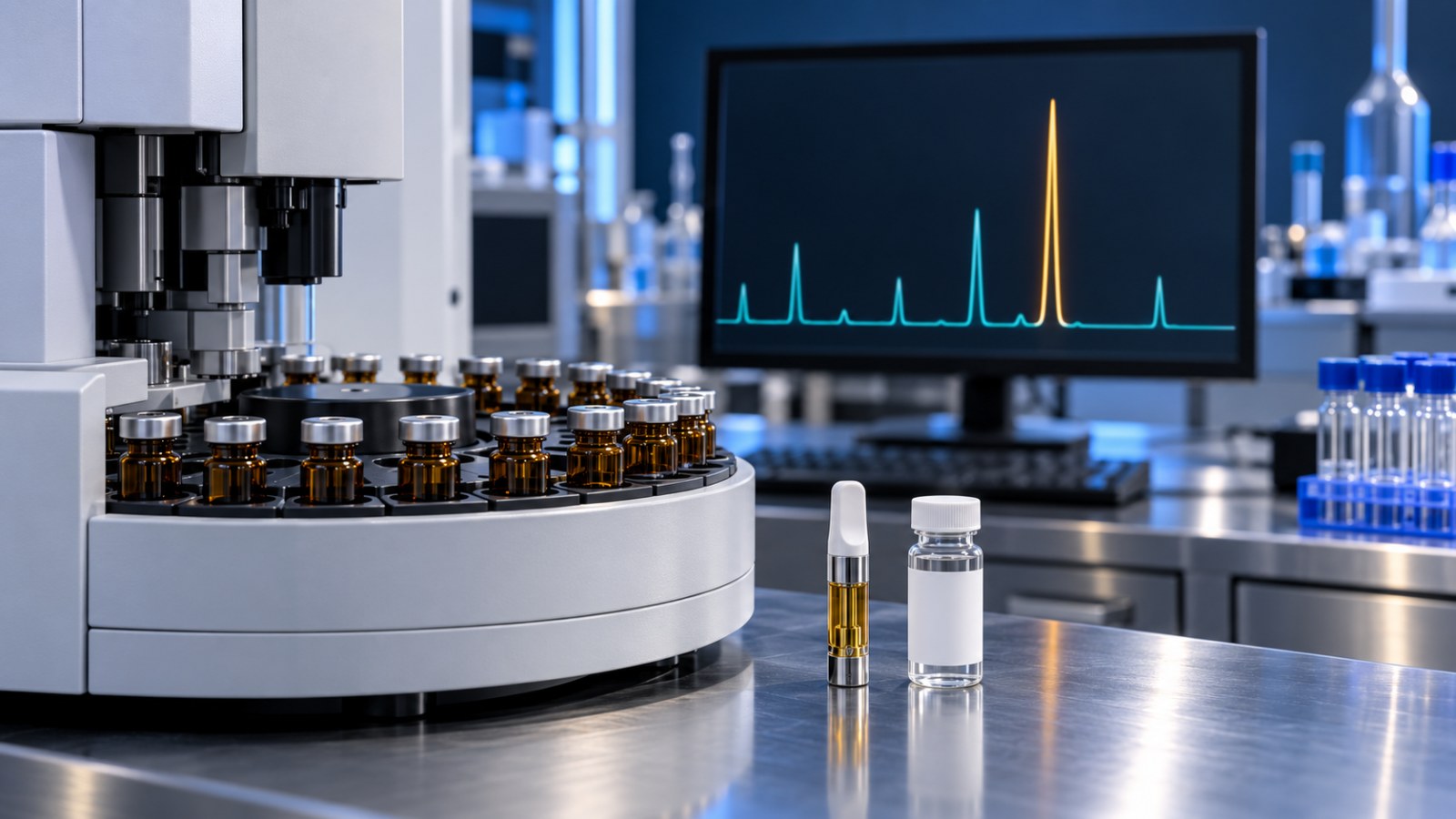
A converted THC product leaves three kinds of evidence: a solvent that no extraction process uses, an isomer profile the plant does not make, and a catalyst residue the standard panels never look for. Methylene chloride at any level above the 600 ppm USP Class 2 limit, delta-8 THC above 1 percent, delta-10 or iso-THC at any level, or zinc on a metals screen each point to a CBD-to-THC conversion rather than a botanical extract. The Colorado StayCon recall of September 2026 is the working example: 49 vape products, sold at 405 stores for up to 18 months, were pulled after a third-party lab found methylene chloride during a routine pesticide and mold screen. The solvent was never on the residual solvent panel the state requires, which is exactly why it went unnoticed for a year and a half.
This guide is written for the people who have to make the call: QA leads releasing product, labs choosing what to run, regulators reading a COA, and buyers deciding whether a distillate lot is what the paperwork says. It covers the routes converters actually use, the residues each route leaves, the thresholds that separate a botanical extract from a converted one, and the failures that let converted oil through a compliant testing program.
What Conversion Is and Why It Shows Up in Regulated Markets
Conversion means taking cannabidiol, usually as hemp-derived CBD isolate at 99 percent purity, and closing its open ring with an acid catalyst so it rearranges into a tetrahydrocannabinol. Depending on the catalyst and conditions the product is mostly delta-9 THC, mostly delta-8 THC, or a mix, along with byproducts the plant never produces. The chemistry is covered route by route in the acid catalyst comparison and its failure modes in the isomerization troubleshooting guide. The economics are the reason it appears inside licensed markets: hemp CBD isolate trades for a small fraction of the price of licensed THC distillate, so a converted kilogram sold as botanical distillate carries a margin no honest extraction can match. When a converted oil is filled into carts and labeled as state-licensed cannabis, the practice is called inversion, and Colorado, like most licensed states, prohibits both the conversion process and the solvent the recall exposed.
What Is Conversion Oil?
Conversion oil is THC distillate made by isomerizing hemp CBD isolate with an acid catalyst instead of extracting it from THC-dominant cannabis. A typical lot runs 70 to 95 percent total THC, carries 1 to 15 percent delta-8 in a product labeled delta-9, shows percent-level unreacted CBD, has none of the minor cannabinoids a plant extract carries (CBG, CBC, THCV, CBN at 0.1 to 3 percent each in botanical distillate), and brings the catalyst and workup solvent along with it. It is sold three ways: openly as hemp-derived delta-9 or delta-8, quietly as inverted material filled into state-licensed cartridges, and increasingly inside blends whose certificates list only the carrier. Under Section 781 of Public Law 119-37 every cannabinoid the plant cannot naturally produce loses hemp status on November 12, 2026, which puts conversion oil on the same clock as HHC and the oxime cannabinoids; our hemp ban breakdown covers the two dates.
The table below is the release-desk version of this whole guide: what a botanical distillate looks like on each line of a certificate, what conversion oil looks like on the same line, and the test that shows the difference. Every row below it is explained in the sections that follow.
| Indicator | Botanical THC distillate | Converted (conversion oil) signature | Test that shows it | Decision threshold |
|---|---|---|---|---|
| Delta-8 THC | Below 1 percent of total cannabinoids, usually below the reporting limit (forms slowly from delta-9 on shelf) | 1 to 15 percent in a “delta-9” product; 80 to 95 percent in a delta-8 product | Cannabinoid potency panel (HPLC-UV) with a delta-8 standard | Above 1 percent = catalysis, not shelf aging |
| Delta-10, iso-THC, exo-THC | Not detected | 0.5 to 15 percent of chromatogram area, route dependent | LC-MS/MS or HPLC with isomer standards (not on most state panels) | Any confirmed peak |
| Unreacted CBD | Not detected to 0.5 percent in a THC-dominant extract | 1 to 5 percent in a product sold as delta-9 distillate | Potency panel | Above 1 percent CBD next to 70+ percent THC |
| Minor cannabinoid profile | CBG, CBC, THCV, CBN each present at 0.1 to 3 percent | Absent: the feed was 99 percent CBD isolate and the catalyst does not make them | Potency panel, read the whole row, not the THC cell | Zero minors with percent-level CBD |
| Olivetol and ring-opened byproducts | Not detected | Detectable after mineral acid and Lewis acid routes | GC-MS or LC-MS/MS; olivetol is not a required analyte | Any confirmed olivetol |
| Methylene chloride, toluene, chloroform | Not detected; no extraction or formulation step uses them | Present from the workup; methylene chloride above 600 ppm or toluene above 890 ppm fails USP 467 Class 2 outright, but any detection is the flag | Full USP 467 Class 1 and 2 run, not the state minimum list | Any detection |
| Catalyst metals (zinc, boron) | Not detected | Zinc from zinc chloride routes; boron from BF3 etherate | ICP-MS with zinc and boron added to the four-metal state panel | Any detection above blank |
| Chirality | (6aR,10aR) trans-delta-9 THC only | Identical. CBD-derived THC keeps the plant CBD stereocenters through the ring closure | Chiral chromatography | Not a conversion test: it only flags a total synthesis run with a racemic terpene |
Read the last row twice, because it is the one most summaries get wrong. A chiral column separates enantiomers. Converted THC made from plant CBD is the same enantiomer as plant THC, so chirality tells you nothing about CBD conversion. It flags a different product: THC built from olivetol and a racemic terpene, which is a total synthesis and a different detection problem. For CBD-derived conversion the evidence is the isomer set, the missing minors, and the solvent, in that order.
Evidence Type 1: The Solvent Fingerprint
Extraction uses a short list of solvents: butane, propane, ethanol, carbon dioxide, and occasionally heptane, pentane, or isopropanol for post-processing. Conversion uses a different list, because a Lewis or Bronsted acid reaction and its workup need a solvent that dissolves the catalyst, tolerates the acid, and separates cleanly from water. Methylene chloride (dichloromethane), toluene, hexane, and chloroform are the working solvents of conversion, and none of them has any place in a legal extraction lab. Finding one is not a purge failure. It is a route disclosure.
| Conversion route | Catalyst | Solvents typically used | Main product | Residues that flag it |
|---|---|---|---|---|
| Lewis acid, delta-9 selective | Boron trifluoride etherate (BF3·Et2O) | Methylene chloride, sometimes toluene; aqueous bicarbonate wash | Delta-9 THC (70 to 85 percent conversion) | Methylene chloride on the solvent panel; 5 to 15 percent byproducts incl. delta-8 and iso-THC; boron is not on any standard panel |
| Bronsted acid, delta-8 selective | p-Toluenesulfonic acid (pTSA) or camphorsulfonic acid | Toluene or heptane at reflux; bicarbonate wash | Delta-8 THC (80 to 95 percent) | Toluene above 890 ppm; delta-8 as the dominant cannabinoid; delta-9 plus delta-10 as minor peaks |
| Mineral acid, mixed product | Sulfuric or hydrochloric acid | Methylene chloride, hexane, or ethanol; water washes | Mixed delta-8 / delta-9 (60 to 80 percent) | 15 to 30 percent byproducts: delta-10, iso-THC isomers, olivetol, unknown peaks above 0.5 percent of chromatogram area; low pH extract |
| Zinc Lewis acid | Zinc bromide or zinc chloride | Methylene chloride or toluene | Delta-9 THC (55 to 80 percent) | Zinc on an extended metals panel (the standard four-metal panel of arsenic, cadmium, lead, and mercury will not see it); 8 to 20 percent byproducts |
| Solid acid resin | Amberlyst-15 (sulfonic resin) | Neat or in heptane / ethanol | Delta-8 THC (60 to 75 percent) | No conversion-specific solvent; detection rests entirely on the isomer profile and the unreacted CBD left in a “THC” product |
The catalyst loadings, temperatures, and conversion figures in that table are the same ones a converter works from; they are published in the acid catalyst comparison. Read them from the other side and they become a detection key.
Residual solvent limits that matter for detection
USP General Chapter 467 sorts solvents into three classes by toxicity, and most state cannabis panels borrow the numbers even when they do not borrow the full list. Class 1 solvents are to be avoided entirely, Class 2 are limited by a permitted daily exposure, and Class 3 are considered low risk with a 5,000 ppm ceiling.
| Solvent | USP 467 class | Limit (ppm) | Legitimate cannabis use | What a detection above trace means |
|---|---|---|---|---|
| Benzene | 1 | 2 | None | Contaminated toluene or hexane; hard fail in every market |
| Methylene chloride | 2 | 600 | None | Conversion workup solvent (BF3, mineral acid, or zinc routes); the StayCon recall solvent |
| Chloroform | 2 | 60 | None | Bench-scale conversion or analytical carryover |
| Toluene | 2 | 890 | None | Reflux solvent for the sulfonic acid routes |
| Hexane | 2 | 290 | Rare (some winterization and crystallization) | Ambiguous alone; decisive next to an isomer flag |
| Methanol | 2 | 3,000 | Rare (analytical, some crystallization) | Ambiguous alone |
| Heptane | 3 | 5,000 | Yes (crystallization, wiped film feed prep) | Not a conversion flag on its own |
| Ethanol, isopropanol, acetone, ethyl acetate, pentane | 3 | 5,000 | Yes | Purge quality, not route |
| Butane, propane | Not in USP 467; state-set | Commonly 5,000 total, tighter for inhalables in some states | Yes | Purge quality, not route |
Two things follow from the table. A residual solvent panel that copies only the hydrocarbon and ethanol lines will never see a conversion solvent, and a lab that runs the full USP list on a headspace GC sees it in the same injection at no extra cost. The state’s list is a floor. Release testing that stops at the floor is how a converted cart sits on 405 shelves for 18 months.
Evidence Type 2: The Isomer Signature
Cannabis biosynthesis makes THCA, and decarboxylation makes delta-9 THC from it. The plant does not make delta-10 THC, it does not make the iso-THC isomers, and it makes delta-8 only as a trace oxidation and isomerization product, well under 1 percent of total cannabinoids in fresh flower and rarely much above it even in aged distillate. Acid catalysis is not that selective. Every conversion route produces a spread of isomers because the same carbocation intermediate can close and lose a proton in several positions, and a converter cannot fully remove them without the chromatography step that would erase the cost advantage.
| Indicator | Botanical extract | Converted product | How to measure it | Weight of the evidence |
|---|---|---|---|---|
| Delta-8 THC | Under 1 percent of total cannabinoids; often below the reporting limit | 1 to 10 percent in delta-9 conversions; dominant in delta-8 products | HPLC-DAD potency run with a delta-8 standard; delta-8 and delta-9 must be resolved, not co-reported | Strong above 1 percent; conclusive above 3 percent in a product labeled as botanical delta-9 |
| Delta-10 THC, delta-6a(10a) THC (exo-THC), iso-THC isomers | Absent | Present, typically 0.5 to 5 percent combined | HPLC with reference standards for each isomer; GC-MS confirmation | Conclusive at any quantifiable level |
| Olivetol | Absent | Trace to 1 percent when the acid ran too hot or too long and cleaved the CBD side chain | HPLC or GC-MS with an olivetol standard | Conclusive when present; absence proves nothing |
| Residual CBD in a “THC distillate” | Tracks the cultivar: a Type I flower gives well under 1 percent CBD in distillate | Unreacted starting material, 2 to 20 percent depending on conversion efficiency | Standard potency panel | Strong when the label claims a high-THC cultivar source |
| Minor cannabinoids (CBG, CBC, THCV) and terpenes | Present in ratios that follow the cultivar; distillate keeps CBG and CBC at tenths of a percent | Absent, because 99 percent CBD isolate carried none of them in | Full cannabinoid panel plus terpene profile | Supporting; a clean isolate-like profile in a product sold as botanical is a red flag |
| Unidentified peaks | Few, small, consistent between lots | Several peaks above 0.5 percent of area that match no cannabinoid standard | Chromatogram review, not the summary table | Strong in combination; the summary table hides it, so ask the lab for the trace |
| Zinc | Trace, at the level of the biomass | Elevated after zinc bromide or zinc chloride catalysis with a poor wash | ICP-MS with zinc added to the panel; not on the standard four-metal screen | Route-specific; decisive for the zinc routes only |
Chirality adds one more layer for a lab that wants it. Plant THC is essentially all the (6aR,10aR) trans enantiomer. Conversion from CBD preserves those two stereocenters, so enantiomeric purity does not by itself separate converted delta-9 from botanical delta-9; what it does catch is the cis-THC that appears in some acid-catalyzed products and never in flower. Treat chiral analysis as confirmation on a flagged sample, not as a screen.
Evidence Type 3: What the Panels Do Not Run
Most state programs require potency, residual solvents from a fixed list, pesticides, microbials, mycotoxins, and four heavy metals. That program was designed to catch a bad extraction, not a different synthesis. Boron from BF3 is not screened anywhere. Zinc is not on the four-metal panel. Delta-10 and the iso-THC isomers are not required analytes, so a lab that does not stock the standards reports them as nothing. A converted product can therefore pass a compliant panel on every line while carrying three or four independent tells, and it will keep passing until someone runs the one test that is not required. In Colorado that test turned out to be a pesticide screen whose method happened to see methylene chloride.
The Colorado StayCon Recall as a Case Study
The timeline matters more than the headline. In August 2026, Denver-based Bona Fides Laboratory detected methylene chloride in StayCon vape oil during routine pesticide and mold screening, and its owner notified the manufacturer and the state Marijuana Enforcement Division. Roughly six weeks later StayCon voluntarily recalled 49 vape products sold under the Maui Wowie and Grape Gorilla names, some of which had been on shelves at more than 400 stores for over 18 months. The company’s recall notice attributed the solvent to a botanically derived flavoring compound. The state had not issued its own advisory at the time of the recall, and its investigation was described as ongoing. A licensed cultivator had supplied regulators with 2024 third-party results indicating a StayCon vape was made from chemically synthesized hemp material; the state said its own tests found no synthetically derived THC and took no action at the time.
Read against the two tables above, the recall reads as a route disclosure rather than a contamination accident. Methylene chloride is a Class 2 solvent with no role in flavoring, extraction, or formulation; it is the workup solvent for the Lewis acid and mineral acid conversion routes. Whether the solvent arrived in a purchased input or in the manufacturer’s own reactor is a question the release testing should have answered before the first cart shipped, and a full USP 467 headspace run would have answered it in one injection.
Common Failures and How to Diagnose Them
Symptom: Every COA line passes and a downstream lab, a competitor, or a regulator still finds a conversion solvent.
Root cause: The release panel copies the state’s minimum solvent list, which was written around butane, propane, and ethanol. Class 2 conversion solvents are not on it.
Diagnostic test: Ask your lab for the solvent list it actually calibrates for. If methylene chloride, toluene, chloroform, and hexane are not on it, the panel cannot see a conversion.
Fix: Specify the full USP 467 Class 1 and Class 2 list on every release lot. Headspace GC runs it in the same injection; the incremental cost is the standards, not the instrument time.
Symptom: Potency is on target, the product is labeled a named cultivar, and the terpene profile is nearly empty with CBD at 3 percent or more.
Root cause: Unreacted starting material in a converted oil. A Type I cultivar cannot produce a distillate with several percent CBD and no CBG or CBC.
Diagnostic test: Run the full cannabinoid panel with delta-8, delta-10, and iso-THC standards and compare the minor cannabinoid ratios to the cultivar’s flower COA.
Fix: Quarantine the lot, request the supplier’s input COA with a Class 2 solvent line, and treat any delta-10 or iso-THC detection as conclusive.
Symptom: Delta-8 reports at 1.5 to 4 percent in a delta-9 distillate and the lab calls it “normal degradation.”
Root cause: Delta-9 does isomerize to delta-8 under heat and acid, but a botanical distillate that was never acid-treated stays well under 1 percent. Percent-level delta-8 with a matching delta-10 peak is catalysis, not shelf age.
Diagnostic test: Check for delta-10 and the iso-THC isomers on the same chromatogram; degradation does not make those. Confirm delta-8 with a reference standard rather than a retention-time guess.
Fix: Escalate to GC-MS confirmation and a Class 2 solvent run before release.
Symptom: The supplier’s COA shows a clean solvent panel and the product still fails a Class 2 screen downstream.
Root cause: Reliance on an input COA that was scoped to the minimum list, or to a sample the supplier chose.
Diagnostic test: Compare the solvent list on the supplier COA against USP 467; a panel without methylene chloride and toluene lines is silent, not clean.
Fix: Retest incoming distillate at your own lab on the full list before it touches a cart. The license holder owns the result regardless of whose reactor produced it.
Symptom: A metals panel passes and the delta-9 distillate still shows the isomer spread of a Lewis acid route.
Root cause: The four-metal panel (arsenic, cadmium, lead, mercury) cannot see zinc or boron.
Diagnostic test: Add zinc to the ICP-MS run on any lot that fails the isomer screen; boron requires a dedicated method that most cannabis labs do not offer.
Fix: Use the isomer profile as the primary screen and metals as route confirmation, not the other way around.
A harder version of this problem arrives when the active ingredient has no reference standard at all. Material sold as EPN routinely reports as an unidentified peak, or gets left off the results table entirely, which is covered in our breakdown of how Euphorinol is made and why labs cannot name it. A non-detect from a panel that was never calibrated for the compound is not a finding.
A Release Protocol That Actually Catches Conversion
Run the full cannabinoid panel with delta-8, delta-10, exo-THC, and iso-THC standards on every distillate lot, and read the chromatogram, not just the table. Run residual solvents against the complete USP 467 Class 1 and Class 2 list, with methylene chloride, toluene, chloroform, and hexane calibrated and reported. Flag any lot with delta-8 above 1 percent, any quantifiable delta-10, iso-THC, or olivetol, any Class 2 solvent above its reporting limit, or a minor cannabinoid profile that does not match the claimed cultivar. Confirm flagged lots by GC-MS and, where the isomer spread points at a zinc route, by ICP-MS with zinc added. Keep the retained sample. A protocol like this costs a few hundred dollars per lot more than the state minimum and would have stopped the Colorado product at the first release.
This is the testing and compliance material we teach inside the extraction training program, where the COA reading module walks a real converted-distillate chromatogram against a botanical one: extractiontraining.com.
If you are a license holder, a lab, or a regulator trying to write this into a release specification, a supplier qualification program, or an enforcement method, that is consulting work we do: contact WKU Consulting.
Frequently Asked Questions
What is conversion oil?
THC distillate produced by isomerizing hemp CBD isolate with an acid catalyst rather than extracting it from THC-dominant cannabis. On a certificate it reads as 70 to 95 percent total THC with 1 to 15 percent delta-8, percent-level unreacted CBD, no CBG, CBC, THCV or CBN, and often a Class 2 solvent or a catalyst metal the state panel never screened. It loses federal hemp status on November 12, 2026 under Section 781 of Public Law 119-37.
Can chiral chromatography tell converted THC from plant THC?
Not when the feed was plant CBD. The ring closure that turns CBD into THC leaves the two stereocenters where the plant put them, so CBD-derived delta-9 is the same (6aR,10aR) enantiomer as botanical delta-9 and a chiral column sees one peak either way. Chiral analysis only exposes THC made by total synthesis with a racemic terpene. For conversion from CBD, look at delta-8 above 1 percent, delta-10 or iso-THC at any level, the missing minor cannabinoids, and the workup solvent.
Can a converted THC product pass a state compliance panel?
Yes, and that is the problem. Potency, the state’s minimum solvent list, pesticides, microbials, mycotoxins, and four heavy metals do not include the analytes that expose a conversion: Class 2 solvents like methylene chloride and toluene, delta-10 and iso-THC isomers, olivetol, and zinc.
What residual solvent proves THC was converted from CBD?
Methylene chloride is the clearest single flag because it has no use in extraction, flavoring, or formulation and is the standard workup solvent for the Lewis acid and mineral acid routes. Toluene and chloroform carry the same weight. Hexane and methanol are ambiguous on their own and decisive next to an isomer flag.
How much delta-8 is normal in a botanical delta-9 distillate?
Under 1 percent of total cannabinoids, and usually below the reporting limit. Percent-level delta-8 with delta-10 or iso-THC on the same chromatogram is catalysis, not shelf degradation.
What is hemp inversion?
Selling hemp-derived material, usually CBD isolate that has been chemically converted to THC, as if it were state-licensed cannabis. It is illegal in licensed markets because the licensed supply chain, the testing, and the tax stamp all assume the THC was grown, not synthesized.
What was found in the Colorado StayCon vapes?
Methylene chloride, detected by Bona Fides Laboratory in August 2026 during routine pesticide and mold screening. The manufacturer recalled 49 vape products in September 2026 and attributed the solvent to a botanically derived flavoring; Colorado bans both the conversion process and the solvent.
Which test should a buyer request before accepting a distillate lot?
A full USP 467 Class 1 and 2 residual solvent run plus a cannabinoid panel that resolves delta-8, delta-10, and iso-THC with reference standards. Together they cost a few hundred dollars and catch every route in the table above except a perfectly washed solid-resin conversion, which the residual CBD and missing minor cannabinoids still expose.
