
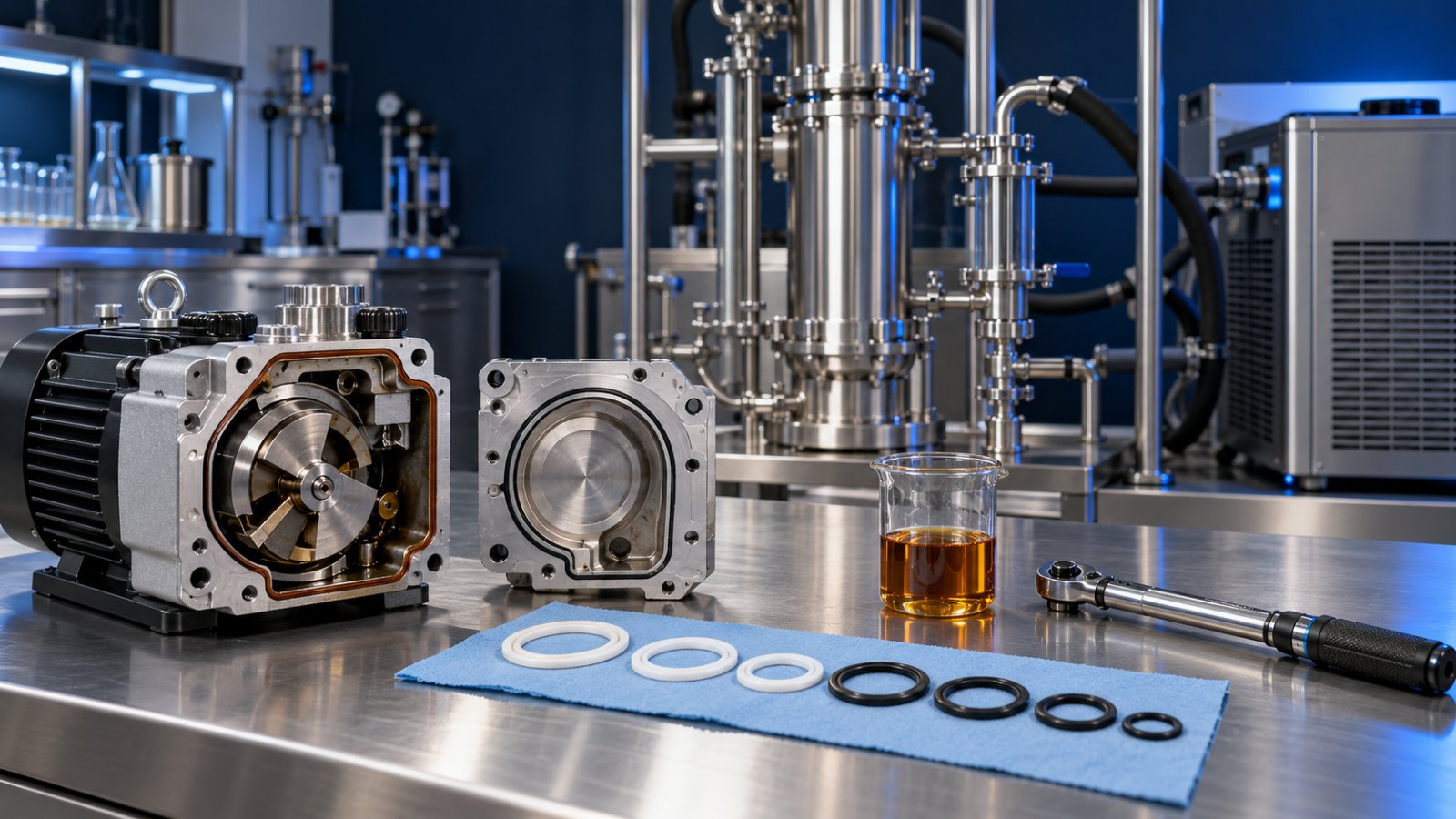
A rotary vane pump that should see new oil every 500 to 1,000 hours runs about 3 months on a one-shift extraction floor, and the first sign most labs get that the interval passed is a vacuum oven that stalls at 28 inHg with a slab that will not finish purging. Edwards specifies 3,000 hours for its RV series and a full overhaul at 15,000; Welch tells you to change at 500 to 1,000 or the moment the oil darkens. The spread between those two numbers is the whole maintenance problem: the manufacturer’s interval assumes clean air, and your pump breathes butane, ethanol vapor, and water from every purge. This guide puts intervals, gasket materials, and the cost of skipping each one in three tables, then walks the five failures that show up when the calendar is ignored.
Why Extraction Equipment Fails on a Schedule Nobody Wrote Down
Every piece of equipment in an extraction lab has two maintenance intervals: the one in the manual, written for the duty the manufacturer tested, and the real one, set by what your process pushes through it. A vacuum pump on a purge oven condenses solvent and water into its oil. A recovery pump on a closed loop cycles hundreds of times a week with cold, wet gas on the suction side. A rotovap seal runs against a vapor duct carrying hot ethanol. A wiped film wiper basket turns in crude that still has waxes in it because winterization was rushed. None of those duties appear in the manual, which is why the manual interval is the ceiling and never the schedule.
The economics are lopsided. A pump oil change is 20 minutes and a few dollars of oil. A seized pump is a replacement unit, a shipping lead time, and every batch that was supposed to purge in the meantime sitting in a tray oxidizing. A tri-clamp gasket is a $2 part. A gasket that has gone hard in propane service is a leak that your gas detection finds before you do, and the room evacuation that follows costs a day. Preventive maintenance in this industry is cheap because the failures are expensive, which is the same reason it gets skipped: nothing looks broken until the day it is.
Maintenance Interval Table by Equipment
Intervals below are stated as hours of operation or cycles where the manufacturer publishes one, and as calendar time where the wear is driven by exposure rather than runtime. Where the manual and field practice disagree, both are shown. Treat the shorter number as the schedule and the longer one as the limit.
| Equipment | Service item | Interval | Cost to do it | Cost of skipping it |
|---|---|---|---|---|
| Rotary vane vacuum pump (oven, rotovap, short path backing) | Oil change; exhaust mist filter element with it | 500 to 1,000 h or when the oil darkens (Welch); 3,000 h manual limit (Edwards RV); gas ballast run 20 to 30 min after every solvent-heavy purge | 20 min, 1 L of pump oil | Ultimate vacuum drifts from 29.9 to 28 inHg; purges stall above 500 ppm; sludged oil scores the vanes and the pump seizes |
| Rotary vane vacuum pump | Vanes, shaft seal, full overhaul kit | 15,000 h (Edwards RV), or when ultimate vacuum will not recover after fresh oil and a ballast run | Rebuild kit plus 3 to 4 h of bench time | New pump plus the lead time, and every tray that waited |
| Vacuum oven | Door gasket, shelf-to-controller temperature check with an IR thermometer, cold trap emptied | Gasket inspect weekly, replace at the first flat spot or at 12 months in daily use; shelf check monthly; trap every run | Gasket under $100; 15 min | Leak-rate stall (pressure rises over 0.5 inHg in a 15 min isolation test); outer shelves run 3 to 5C cold and fail residual solvent |
| Closed-loop hydrocarbon system | Tri-clamp gaskets, sight-glass gaskets, hoses, pressure test | Gaskets visually every run, replace any that are flattened, nicked, or hard; full gasket set at 6 months in propane service, 12 in butane; rated hoses at 24 months or any kink; leak and pressure test after every reassembly | Gasket set under $100; hose set a few hundred dollars | A 300 PSI system weeping gas into a C1D1 room: evacuation, a lost day, and the LEL event in your log |
| Solvent recovery pump | Diaphragm or piston kit, valve plates, inlet filter | By the hour meter: every manufacturer publishes a kit interval in hours; log the meter at every run and schedule the kit at 90 percent of it | Kit plus 2 h | Recovery rate falls from 1 lb per minute to a crawl; runs double in length; the pump fails mid-recovery with solvent in the system |
| Recirculating chiller | Condenser coils, pump strainer, glycol concentration and pH, full flush | Coils and strainer monthly; refractometer and pH (7.0 to 8.5) quarterly; flush and recharge annually in dirty service, 3 to 5 years in clean service or when pH drops below 6.5 | 1 h monthly; glycol by the gallon annually | A chiller that holds -40C empty drifts to -20C under load; dark extract, extra winterization, and a compressor running past its duty |
| Rotary evaporator | PTFE vapor-duct vacuum seal, bath water, glass joint grease | Seal by leak test: isolate at working vacuum, a rise over 10 mbar in 5 min is the seal first; bath water weekly; joints regreased every run | Seal under $100; 10 min | Ethanol recovery drops, the bath runs hotter to compensate, and the crude decarboxylates in the flask |
| Wiped film evaporator | Wiper blades, mechanical seal, drive bearings, diffusion pump oil | Blades and seal on the manufacturer’s hour interval, extended by running the lowest rotor speed that holds the film; rate-of-rise leak test weekly (50 micron hold, over 10 micron per minute means chase a seal); diffusion pump oil when ultimate vacuum will not reach spec with a clean backing pump | Blade set and seal: hundreds; bearings: a service call | Film breaks, cannabinoid fraction cross-contaminates with terpenes, and the distillate darkens from residence time at a vacuum that never got there |
| Short path distillation | Vacuum grease on every joint, mantle check, cold trap, pump oil | Joints every run; mantle resistance check quarterly; trap every run; pump oil as above but twice as often, since short path pushes terpenes straight into it | Minutes per run | A leak at 100 micron looks like a bad crude; you blame the feed and raise the mantle, and the main body comes over dark |
| CO2 compressor and system | Compressor oil, inlet and co-solvent filters, seals, relief valves | Oil and filters on the manufacturer’s hour interval; relief valves tested or replaced on the vessel’s inspection cycle; seals at any pressure-hold loss | Oil and filters: low hundreds per cycle | A 5,000 PSI system with a tired relief valve is an inspection failure before it is a safety event |
The pattern across the table: calendar intervals belong to parts that age from exposure (gaskets, glycol, grease), and hour intervals belong to parts that wear from motion (vanes, diaphragms, bearings, seals). A lab that logs run hours on a whiteboard next to every pump already has the hard half of a maintenance program.
Gasket and Seal Materials by Solvent
Most “mystery leaks” on extraction equipment are the wrong elastomer in the wrong solvent. A gasket that swells goes soft and extrudes under clamp pressure; a gasket that is attacked goes hard and cracks when the clamp is cycled. Both leak, and both get blamed on the clamp.
| Material | Butane / propane | Ethanol / isopropanol | Temperature range | Where it belongs | Where it fails |
|---|---|---|---|---|---|
| PTFE (solid or envelope) | Excellent, no swelling | Excellent | About -100F to 500F (-73C to 260C) | Rotovap vapor-duct seals, hot ethanol service, any joint that sees both solvent and heat | Cold flow under clamp load: it does not spring back, so a reused PTFE gasket seals worse every time it is cycled |
| Viton (FKM) | Excellent | Excellent with pure ethanol; denaturants and ketone-bearing solvents can attack it | Rated to about -15F to 400F (-26C to 204C); stiffens below that | Tri-clamp joints on hydrocarbon systems at ambient and above; sight glasses | Cryogenic columns: at -40C a standard FKM gasket is a hockey puck and seals on luck. Use a low-temperature grade or PTFE on the cold side |
| Buna-N (nitrile) | Good | Fair with ethanol, poor with ketones | About -30F to 250F (-34C to 121C) | The gasket that ships in the box; fine for dry hydrocarbon joints at room temperature | Hot ethanol and any ketone wipe-down; ozone cracking in storage |
| Silicone | Poor: swells in aliphatic hydrocarbons | Fair | About -70F to 450F (-57C to 232C) | Vacuum oven doors and dry, hot, solvent-free joints | Anywhere liquid butane or propane touches it; the gasket that extrudes out of a tri-clamp after one run is usually silicone |
| EPDM | Poor | Excellent with alcohols and ketones | About -60F to 300F (-51C to 149C) | Ethanol-only lines, glycol loops, chilled water | Any hydrocarbon or oil contact |
Two rules cover most of the table. Cold joints on a hydrocarbon system get PTFE or a cryogenic-grade fluoroelastomer, because standard Viton loses its elasticity near -26C and the column is running colder than that. Hot ethanol joints get PTFE, because nitrile and silicone both soften. Buy gaskets by the bag and replace on a schedule, because the part costs less than the time spent diagnosing it.
The Downtime Arithmetic
Use your own numbers, but run the example once so the shape of the answer is clear. Take a hydrocarbon lab producing 1,500 g of crude a day that it sells or converts at a value of $4 per gram, so a day of output is worth $6,000. The three recurring costs look like this.
| Event | Preventive cost | Reactive cost | Ratio |
|---|---|---|---|
| Vacuum pump oil, every 500 h (about 4 changes a year at one shift) | 4 changes, 20 min each, about $100 of oil and filters a year | One seized pump: $2,000 to $4,000 replacement, 3 to 5 days of lead time, 3 to 5 days of purge output ($18,000 to $30,000 at the example rate) | Over 100 to 1 |
| Closed-loop gasket set, every 6 months in propane service | Two sets, under $200 a year, 1 h each | One LEL alarm evacuation: a lost day ($6,000), a logged event your insurer and AHJ will read, and the leak hunt afterward | About 30 to 1 |
| Chiller coils and strainer monthly, glycol quarterly | 12 h of labor a year, glycol top-ups | A compressor that runs hot all summer and fails in August: $5,000 to $15,000 and a week; every run in between produced darker extract that needed winterization it should not have | Well over 20 to 1 |
The ratio is the point, not the dollar figures. Change the output value to $2 a gram and the pump ratio is still above 50 to 1. There is no realistic set of inputs where reactive maintenance wins, which is why the labs that skip it are not making a calculation. They are making an assumption that the equipment will keep working, and the equipment does not know about the assumption.
How to Build the Calendar
Three columns on a whiteboard or a spreadsheet, nothing more sophisticated is required. Column one is every piece of equipment with a motor, a pump, a seal, or a gasket. Column two is the interval from the table above, converted into a date or an hour-meter reading. Column three is who signed off the last service and when. Pumps get an hour meter or a log line per run; gaskets get a date on tape on the clamp. The weekly job is a 10-minute walk down the list. The monthly job is the chiller and the oven shelf check. The quarterly job is glycol, mantles, and a look at every hose. If the lab is working toward GMP, this list becomes the equipment maintenance log the auditor asks for first, and a lab that has been keeping it for a year walks into that audit with the hardest document already written. The GMP certification guide covers what else that audit wants.
Running the schedule is an operator skill, not a manager’s. The technician who notices the pump sounds different on Tuesday is worth more than the calendar. The extraction training course teaches operators to read a vacuum gauge, a recovery rate, and a gasket the way a mechanic reads an engine, which is the difference between maintenance that happens on time and maintenance that happens after the alarm.
Common Failures and How to Diagnose Them
Each of these looks like a process problem and is a maintenance problem.
| Symptom | What gets blamed | Root cause | Diagnostic | Fix |
|---|---|---|---|---|
| Vacuum oven will not pull past 28 inHg; slabs fail residual solvent at 72 h | The recipe, the slab thickness | Pump oil saturated with condensed solvent and water | Pull the dipstick: milky or dark oil. Cap the pump inlet and read ultimate vacuum; under 29.5 inHg with a capped inlet is the pump, not the oven | Oil change plus a 30 min gas-ballast run; new mist filter element |
| Recovery on the closed loop takes twice as long as last month | The chiller, the ambient temperature | Recovery pump diaphragm or valve plates worn; inlet filter loaded | Hour meter against the kit interval; inlet filter inspection; pump discharge pressure against the commissioning number | Kit and filter; log the meter reading as the new baseline |
| Gas detector reads 5 to 8 percent LEL at rest with nothing running | The sensor | A hardened gasket or a hose weeping under static pressure | Soap test every joint under static pressure; the false-high table rules out the pump seal, wipe-down vapor, and zero drift first | Replace the gasket set, pressure test, re-zero the sensor |
| Extract comes out dark on a run that used to be blonde | The biomass | Chiller cannot hold setpoint under load: dirty condenser, weak glycol, tired compressor | Glycol return temperature during the recovery peak: more than a 10F rise over supply means the chiller is the bottleneck | Coils, strainer, glycol concentration; if it still drifts, the compressor is on its way out |
| Distillate main body comes over dark on the short path or WFE | The crude | A vacuum leak at a dry joint, a tired vapor seal, or backing pump oil full of terpenes | Rate-of-rise test at operating vacuum before every run; a rise over 10 micron per minute from a 50 micron hold is a seal, not the feed | Regrease joints, replace the seal, change the pump oil; then re-run the same crude before changing anything in the recipe |
What the Manuals Leave Out
Three things the published intervals never account for. First, solvent in the oil: a vacuum pump that backs a purge oven or a short path ingests terpenes and solvent vapor every run, and the oil degrades on exposure, not on hours, which is why the Welch band is a third of the Edwards number. Run the gas ballast after every solvent-heavy job and change the oil by color, not by the calendar. Second, cold: elastomers rated for your solvent at room temperature may not be rated at the -40C your column runs, and the gasket that sealed on the bench leaks on the first cold injection. Third, reassembly: most gasket damage happens during cleaning, when a tri-clamp is reseated on a gasket that was pinched or dry. A dab of compatible lubricant on a new gasket and a torque habit on the clamp outlast any interval.
If the lab is being designed now, the maintenance plan belongs in the lab design, with pump placement that leaves room to pull a cover and a spares shelf sized for a year of gaskets, oil, and filters. Labs that need a maintenance program built around their specific equipment list and shift pattern can work with us on the SOP and the training behind it.
Frequently Asked Questions
How often should a vacuum pump in an extraction lab get an oil change?
Every 500 to 1,000 hours of operation, or sooner if the oil darkens or turns milky, which on a one-shift purge oven is roughly every 3 months. The Edwards RV manual allows 3,000 hours in clean service, but a pump that breathes solvent and water from purging never sees clean service. Run the gas ballast for 20 to 30 minutes after every solvent-heavy job to drive condensed vapor out of the oil between changes.
What gasket material should a closed-loop extractor use?
PTFE or a cryogenic-grade fluoroelastomer on the cold side of the system, since standard Viton stiffens near -26C and a cryo column runs colder than that. Viton is fine on ambient-temperature hydrocarbon joints and sight glasses. Silicone swells in liquid butane and propane and should not be on any wetted hydrocarbon joint.
How do I know whether a purge problem is the oven or the pump?
Cap the pump inlet and read its ultimate vacuum. A healthy rotary vane pump pulls below 29.5 inHg with a capped inlet. If it cannot, the pump is the problem: change the oil, run the ballast, and re-test before touching the oven. If the pump is fine, isolate the oven at working vacuum and watch the gauge for 15 minutes; a rise over 0.5 inHg is a door gasket or fitting leak.
When should chiller glycol be replaced?
Check concentration with a refractometer and pH quarterly, keep pH between 7.0 and 8.5, and flush and recharge annually in dirty service or every 3 to 5 years in clean service. Replace immediately when pH drops below 6.5, because acidic glycol is corroding the loop. Clean condenser coils and the pump strainer monthly; a dirty condenser is the most common reason a chiller that holds -40C empty cannot hold -20C under a recovery load.
How do I test a wiped film or short path system for leaks before a run?
Pull the system to working vacuum, isolate it from the pump, and watch the gauge. From a 50 micron hold, a rise over 10 micron per minute means a leak worth chasing before you heat the feed. Regrease dry joints, check the vapor seal, and change the backing pump oil, then re-run the same crude before you change a recipe parameter.
What does an extraction equipment maintenance log need for a GMP audit?
Equipment identity, the service item, the interval, the date and hour-meter reading at service, the parts used, and who did it. An auditor wants to see the interval was defined before the service, not written in afterward. A lab that keeps the three-column calendar described above has the log; it only needs to be kept where the auditor can read it.
