
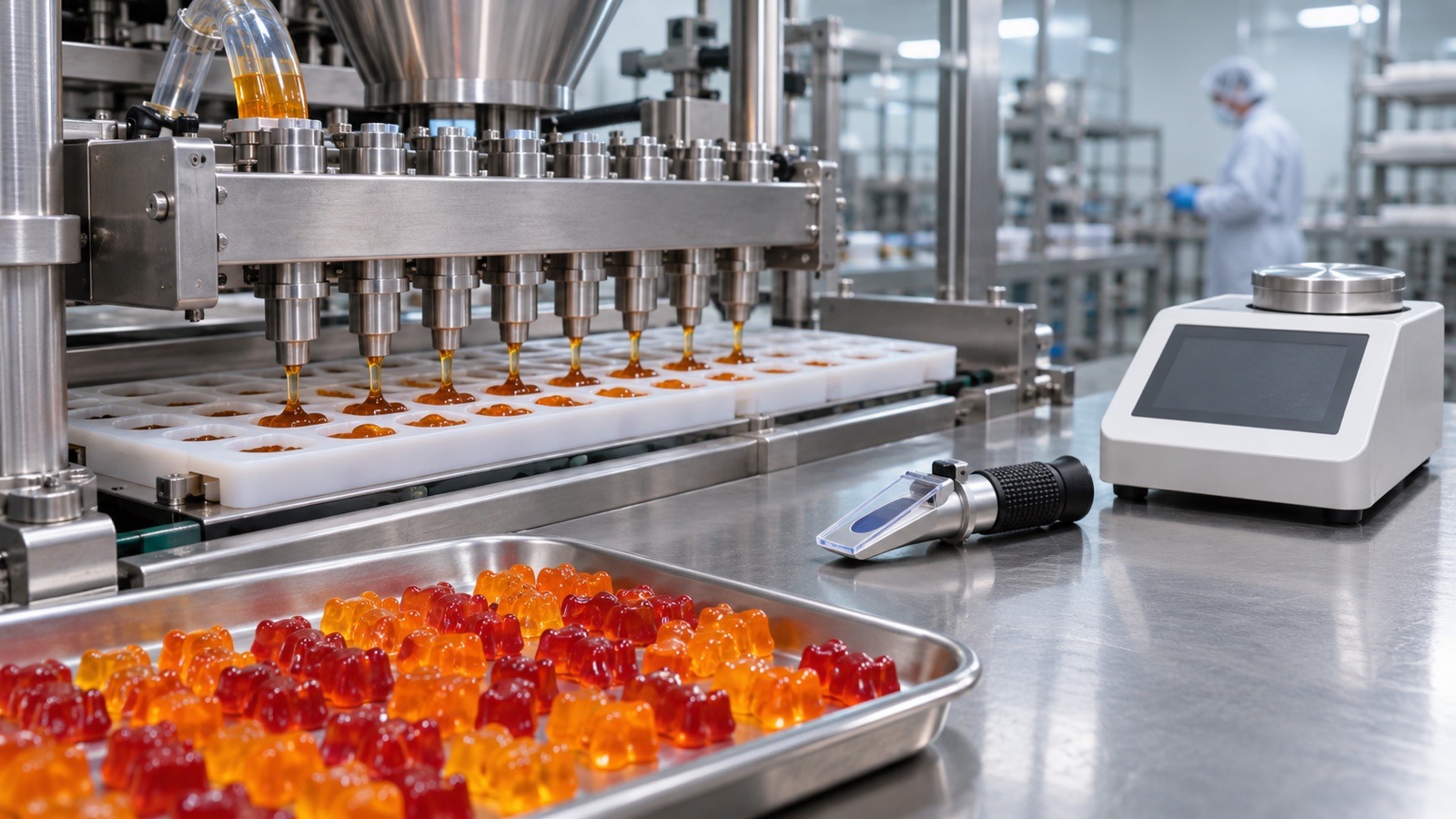
Commercial cannabis gummy manufacturing is a sugar-confection process with one extra failure mode: the cannabinoid is an oil at about 1.0 g/mL dropped into a syrup at about 1.39 g/mL. High-methoxyl pectin gummies set only above 60 percent soluble solids and at a pH of roughly 2.8 to 3.5, so the acid goes in just before depositing; gelatin gummies use 250 to 275 Bloom gelatin, set on cooling, and are stoved at about 27 to 35C under 50 percent relative humidity for 8 to 24 hours. The finished piece should sit below a water activity of 0.60, under the 0.61 floor where xerophilic molds still grow. The lot then has to pass a potency window (plus or minus 10 percent of label in California, Michigan and Massachusetts) and, in Colorado, an RSD under 10 percent across servings. A failed lot is a process signal, and the causes below can be diagnosed on the line before a sample ever ships.
Cannabis gummy manufacturing is the job everybody thinks is easy until the first lot comes back from the lab with one piece at 6 milligrams and the next at 14. The candy side of this is a hundred years old and well understood. The cannabis side adds a hydrophobic active, a regulator with a dose window, and a customer who will feel the difference between 5 and 15 milligrams. What follows is the process with the numbers attached: the gelling chemistry, where the cannabinoid goes and when, why oil separates, what the state rules actually say, how to hit a safe water activity, and the failures that kill lots.
Cannabis Gummy Manufacturing Starts With the Gelling System: Pectin or Gelatin
The gelling agent is not a texture choice. It decides your pH, your hold times, your deposit window and how much heat the cannabinoid sees.
High-methoxyl (HM) pectin gels through sugar and acid together. It needs soluble solids above 60 percent and a pH of roughly 2.8 to 3.5 before the chains associate, and the lower the pH, the lower the solids it will tolerate. That acid dependence is the operational problem: add the acid too early or let the slurry cool below its setting temperature and it gels in the kettle or the hopper. Buffer salts such as sodium citrate exist to control that setting temperature and buy a usable depositing window. The standard move is to cook the base, then add the acid solution at the last step, immediately before depositing. Finished HM pectin gummies typically land at pH 3.2 to 3.6.
Gelatin sets thermally. Cool it and it gels; warm it and it melts. No acid is required for the set, so acid in a gelatin gummy is a flavor decision. Confectionery gelatin runs from 125 to 300 Bloom, with 250 to 275 the common standard. The weakness is time at temperature: gelatin loses gel strength and viscosity during prolonged heating in solution above 40C, and pH extremes speed that up, because the protein chains are being hydrolyzed. The rule is to add the hydrated gelatin near the end of the cook and keep the hot hold short. Gelatin pieces are then stoved, commonly at about 27 to 35C under 50 percent relative humidity for 8 to 24 hours.
| Parameter | HM pectin gummy | Gelatin gummy | What it means for the cannabinoid |
|---|---|---|---|
| How it sets | Sugar plus acid: solids above 60%, pH about 2.8 to 3.5 | Thermal: gels on cooling, remelts on heating | Pectin forces an acidic matrix; gelatin does not |
| Finished pH | Typically 3.2 to 3.6 | Set by the flavor acid, not the gel | CBD is most stable at pH 4 to 6 in published kinetics; pectin sits below that |
| Critical timing | Acid added just before deposit; buffer salt sets the setting temperature | Hydrated gelatin added late; short hot hold | Add the active at the same late step, at the lowest workable temperature |
| Grade spec | Rapid-set vs slow-set HM grades, buffered | 125 to 300 Bloom; 250 to 275 standard | n/a |
| Cure | Starch trays: about 24 to 72 h; starchless: minutes to set | Stoving about 27 to 35C, under 50% RH, 8 to 24 h | Long warm cures are oxygen and light exposure for the active |
| Heat behavior in the bag | Holds shape in a hot car | Softens and sticks above its melting point | Melted and re-set pieces fuse, deform and lose their dose shape |
| Main failure | Pre-gel in the hopper | Weak gel from overheating (hydrolysis) | Both stall the line while the active sits hot |
Note what neither ingredient supplier will put on a data sheet: the cannabinoid has its own pH and temperature preferences. In the most useful published kinetic study (Jaidee and co-workers, 2022), CBD and delta-9 THC degraded fastest at 70C and pH 2, CBD was most stable between pH 4 and 6, and THC between pH 4 and 12. An HM pectin gummy is built below both windows by design. That does not make pectin wrong. It makes the order of addition and the time the active spends hot and acidic a process variable you control on purpose.
Starch Mogul vs Starchless Depositing
A starch mogul deposits into impressions pressed in trays of conditioned starch. The starch shapes the piece and pulls water out of it while it cures, typically over 24 to 72 hours, which is why mogul lines tolerate higher-moisture deposits. The costs are flat-bottomed shapes only, starch dust to manage, and starch that is reused lot after lot, which is a cross-contact question when the deposit contains a controlled active.
Starchless depositing goes into silicone or metal molds. Pieces can set in minutes rather than a day, three-dimensional shapes are possible, and there is no starch recirculating between lots. Metal molds cool faster and release a cleaner finish; silicone works only if ejection is complete every time, because a piece left in the cavity is a dose that ends up in the next one. Starchless lines need a recipe that is closer to final solids at the deposit, since there is no starch bed to pull water out afterward.
Either way, the depositor is the most important piece of dosing equipment in the building. If a 4.0 gram piece carries 10 milligrams, the slurry is dosed at 2.5 mg per gram, and a deposit-weight spread of plus or minus 0.2 grams is already a potency spread of 9.5 to 10.5 milligrams before a single droplet of oil has moved. Weigh deposits from the start, middle and end of every hopper and log them next to the potency results.
Homogeneity: Why the Oil Moves and How to Stop It
Cannabis distillate comes in at about 1.0 g/mL. A sugar syrup at 78 percent solids is about 1.39 g/mL. Put a free oil droplet into that syrup and it rises, and the physics that decides how fast is Stokes’ law: the rise velocity scales with the density difference and with the square of the droplet diameter, and inversely with viscosity. Viscosity works for you once the slurry cools and thickens, and against you in a hot kettle or a heated hopper, which is exactly where the slurry sits longest.
The square on the diameter is the lever. A 1 micron droplet rises 100 times slower than a 10 micron droplet. A 200 nanometer emulsion droplet rises 2,500 times slower than the 10 micron one. That is the entire case for pre-emulsifying the cannabinoid before it meets the syrup, and it is why “stir the distillate in harder” stops working at production scale: a mixer can disperse oil into the syrup, but it cannot hold it there once the agitation stops. One patent filing comparing emulsion-infused to distillate-infused gummies reported a per-gummy standard deviation about eight times tighter for the emulsion. That is the applicant’s own data, so treat it as directional, but the mechanism behind it is not in doubt. Our guide to nano-emulsified distillate covers how to tell a real emulsion from a cloudy one, and the nano emulsion tutorial covers making one.
| Droplet diameter | Relative rise speed (Stokes, same syrup) | What it means in a hopper |
|---|---|---|
| 10 microns (stirred-in distillate) | 1 (reference) | Visible separation during a long deposit run; first and last trays dose differently |
| 1 micron (coarse emulsion) | 100 times slower | Holds through a normal run if agitation continues |
| 200 nanometers (nanoemulsion) | 2,500 times slower | Effectively stable for the life of the hopper |
| Large unemulsified pools | Fastest | Oil film on the hopper wall; hot spots, then a low-dosed tail |
How bad is the problem in the market? In a 2015 JAMA study of 75 edibles from 47 brands, 17 percent were within 10 percent of the label, 23 percent contained more THC than labeled and 60 percent contained less. A 2025 study of 56 CBD gummy products found 70 percent more than 10 percent off label, and inside a single product the gummy-to-gummy variation ran from 2.1 to 27.1 percent CV for CBD and 3.1 to 23.5 percent for delta-9 THC. A 27 percent CV fails Colorado’s homogeneity test almost three times over.
The test that catches it before the lab does is cheap. Pull pieces from the first, middle and last trays of every hopper, run potency on each, and calculate the RSD. If the end-of-run pieces trend low or high instead of scattering randomly, the oil is moving. Our potency audit guide has the sampling statistics regulators use when they come looking.
What the State Rules Actually Require
Potency tolerance and homogeneity are two different tests, and states mix them in different ways. Tolerance compares the measured dose to the label. Homogeneity compares servings to each other. A lot can pass one and fail the other.
| State | Potency vs label | Homogeneity test | Serving / package cap | Rule |
|---|---|---|---|---|
| California | Within plus or minus 10.0% of label claim | No separate edible homogeneity test found in current text | 10 mg / 100 mg | 4 CCR 15724(h); 15307.1; 17304(a) |
| Colorado | Plus or minus 15% above 2.5 mg per serving; the greater of 0.5 mg or 40% at 2.5 mg or less | At least 4 servings from 2 units; RSD under 10%, and each serving inside the variance | 10 mg / 100 mg | 1 CCR 212-3, Rule 4-210(E) |
| Michigan | Total THC within 10% of the package label | None in the bulletin | 10 mg / 100 mg | MRA Technical Bulletin, Oct 11, 2021; R 420.404 |
| Massachusetts | Plus or minus 10% | Fails if any 10% of the infused portion holds more than 20% of the total THC | 5.5 mg per serving; 20 servings or 110 mg per package, variance included | 935 CMR 500.150(4); 500.160(12) |
| New York | 85 to 115% of label | Each serving within 25% of the lot mean (within 0.5 mg below 2 mg per serving) | 10 mg / 100 mg | 9 NYCRR 123.6(f) |
| Illinois | 85 to 115% of labeled amount | No separate test found | 100 mg per package, 10 mg servings marked | 8 Ill. Adm. Code 1300.930; 410 ILCS 705/55-21 |
| Washington | Not specified in the rules cited | Intermediate product must be homogenized before QA testing | 10 mg / 100 mg | WAC 314-55-095; 314-55-102 |
Read the New York row next to the Colorado row and the design consequence is obvious. New York lets a 10 mg serving range from 7.5 to 12.5 mg around the lot mean; Colorado wants the spread small enough that the RSD stays under 10 percent. A process that passes New York comfortably can still fail Colorado. Build to the strictest market you sell into. Rule text changes; confirm the current version with your state before a validation run.
Hemp gummies are about to face a much harder number. Under the federal hemp redefinition, finished hemp products are capped at 0.4 mg of total THC per container, with the effective date moved to December 11, 2026; cannabinoids the plant cannot make at all, such as THC-O, lose hemp status earlier, on November 12, 2026. That is per container, not per piece. The same 2025 study found 16 percent of CBD gummy products already carried more than 0.4 mg of delta-9 THC in a single gummy. Our hemp ban breakdown covers the two dates and what each one removes.
If you want the formulation and dosing math worked through on real batches, with SOPs you can put on the floor, that is what we built extractiontraining.com for.
Water Activity, pH and Preservatives: Shelf Life Is Set at the Depositor
Moisture content tells you how much water is in the gummy. Water activity tells you how much of it a microbe can use, and that is the number that decides spoilage. The growth floors are well established:
| Organism group | Approximate lowest water activity for growth | Relevance to a gummy |
|---|---|---|
| Most gram-negative bacteria | 0.97 | Not a gummy problem |
| Clostridium botulinum | about 0.93 | Not a gummy problem at confection solids |
| Most gram-positive bacteria | 0.90 | Only in an undercooked, wet piece |
| Most yeasts | 0.88 | Fermented, sour smell in a soft piece |
| Washington legal ceiling for solid edibles | fails above 0.85 | A compliance line, not a shelf-life target |
| Most molds | 0.80 | Jams and jellies sit at 0.75 to 0.80 and still mold once opened |
| Xerophilic molds, osmophilic yeasts | about 0.61 to 0.62 | The organisms that spoil sugar confections |
Target a finished water activity below 0.60 and nothing on that list can grow. Between 0.61 and 0.80 you have ruled out bacteria and most molds but not the organisms that specialize in sugar. Measure water activity on the finished, cured piece with a calibrated meter, not on the slurry, and record it per lot. If the topic is new to your team, our water activity guide covers the physics on the extraction side.
Preservatives help only in the acid form. Sorbic acid has a pKa of about 4.76 and benzoic acid about 4.2, and the undissociated molecule does most of the antimicrobial work. At pH 3.3, about 97 percent of sorbic acid and 89 percent of benzoic acid is in the active form. At pH 5.0 that drops to about 37 and 14 percent. A pectin gummy gets that advantage for free; a low-acid gelatin gummy does not, and it needs its water activity to do more of the work.
| Preservative | pKa | Active (undissociated) at pH 3.3 | Active at pH 4.0 | Active at pH 5.0 |
|---|---|---|---|---|
| Sorbic acid (potassium sorbate) | about 4.76 | about 97% | about 85% | about 37% |
| Benzoic acid (sodium benzoate) | about 4.2 | about 89% | about 61% | about 14% |
The arithmetic is the Henderson-Hasselbalch fraction, 1 divided by (1 plus 10 to the power of pH minus pKa). Run it for your own finished pH before choosing the preservative and the dose.
Where the Potency Goes Between the Kettle and the Bag
Start with the mass balance, because most “potency loss” is arithmetic. A 10,000-piece lot at 10 mg per piece needs 100 grams of THC. Distillate at 88 percent total THC delivers that in 113.6 grams. Dose the slurry to that number, weigh the slurry, and you know the target mg per gram before anything is deposited. Now assay the slurry and assay the finished pieces. If the slurry is on target and the pieces are low, the loss happened in depositing, curing or storage. If the slurry is already low, it happened in the kettle or in your math.
There is no published study that measures cannabinoid loss across a gummy cook specifically, and a National Institute of Justice research grant on edible stability noted that no publications existed on cannabinoid storage stability in edible matrices at all. What is published points in one direction: the kinetic data show degradation accelerating with temperature and with low pH, and oxidation of THC to CBN in air. So the controls are the ones you would choose anyway. Add the active at the last step, at the lowest temperature the slurry will still flow at, shorten the hot hold, and package with low oxygen and no light. Then measure your own loss, because your recipe is the only one that matters.
Adsorption to process surfaces is the other unmeasured loss. There is no edible-specific data, but forensic labs know that THC in blood samples is lost to plastic far faster than to glass. Treat silicone molds, plastic hoppers and liners as surfaces that can hold some active until your own slurry-versus-piece numbers prove otherwise. Every one of these checks belongs in the food-safety plan; our HACCP plan for cannabis lines shows where they sit as control points.
Common Cannabis Gummy Manufacturing Failures and How to Diagnose Them
1. Hot and cold pieces in the same lot. Symptom: homogeneity RSD above 10 percent, or New York servings outside 25 percent of the mean. Root cause: free oil rising out of the syrup during the deposit run, the density gap of roughly 0.39 g/mL doing its work while the hopper sits hot. Diagnostic test: potency on first, middle and last trays; a trend, not scatter, confirms separation. Fix: pre-emulsify the active, keep the hopper agitated, and shorten the run per batch.
2. The whole lot reads low. Symptom: every piece 10 to 20 percent under label with a tight RSD. Root cause: a dosing calculation on label potency instead of the distillate’s measured total THC, or time hot and acidic before deposit. Diagnostic test: assay the slurry before depositing. Fix: dose from the certificate of analysis on the actual drum, add the active last, and set an overage only from your own measured loss.
3. The slurry gels in the hopper. Symptom: stringy deposits, tails, a hopper that has to be scraped. Root cause: HM pectin pre-gelling, either because the acid went in too early or the slurry dropped below its setting temperature. Diagnostic test: log the acid addition time and the hopper temperature against the first sign of tailing. Fix: acid at the last step, a buffered pectin grade, and a temperature-controlled hopper.
4. Soft gelatin pieces that will not hold shape. Symptom: weak set, pieces deform in the bag. Root cause: gelatin hydrolysis from a long hot hold above 40C, worse at low pH. Diagnostic test: compare set strength of a fresh small batch made with a short hold against the production batch. Fix: add hydrated gelatin late, cut the hold, and add flavor acid after the gelatin is in.
5. Gritty, grainy texture after a few weeks. Symptom: crunchy or sandy pieces. Root cause: sucrose recrystallizing out of the glass. Diagnostic test: a white bloom or grit that worsens with humidity cycling. Fix: raise the glucose syrup share, which acts as the crystallization inhibitor, and control storage humidity.
6. Sticky pieces fused in the bag. Symptom: pieces welded together, sugar sanding dissolved. Root cause: moisture uptake at the surface from an under-cured piece or a humid pack-out. Diagnostic test: water activity of the surface layer vs the core, and room RH at packaging. Fix: finish the cure, package below the room humidity your water activity target implies, and use a barrier pouch.
7. Mold in sealed product. Symptom: fuzz or spots weeks after packing. Root cause: finished water activity in the 0.61 to 0.80 band where xerophilic molds grow, or a preservative at a pH where it is mostly dissociated. Diagnostic test: water activity of retained samples from the same lot; finished pH. Fix: cure to below 0.60, verify pH, and re-check the preservative’s active fraction at that pH.
| Symptom | Most likely cause | First test | Fix |
|---|---|---|---|
| RSD above 10%, trend from first to last tray | Oil separating in the hopper | Potency on first, middle, last trays | Pre-emulsify; agitate; shorter runs |
| Whole lot low, tight RSD | Dosing math or heat and acid time | Assay the slurry | Dose from the drum COA; add active last |
| Tailing, gel in the hopper | Pectin pre-gel | Acid time vs hopper temperature log | Acid last; buffered grade; heated hopper |
| Soft gelatin pieces | Hydrolysis from long hot hold | Short-hold test batch | Gelatin late; shorter hold |
| Grainy texture | Sucrose recrystallization | Bloom that grows with humidity | More glucose syrup; humidity control |
| Pieces fused in the bag | Surface moisture uptake | Surface vs core water activity | Finish cure; dry pack-out; barrier pouch |
| Mold in sealed bags | Water activity 0.61 to 0.80, or high pH | Retained-sample water activity and pH | Cure below 0.60; check preservative fraction |
Frequently Asked Questions
How are cannabis gummies made commercially?
A sugar and glucose syrup base is cooked to high solids, the gelling agent (HM pectin or gelatin) is incorporated, the cannabinoid is added as an emulsion or distillate late in the process, and the slurry is deposited into starch trays or starchless molds and cured. HM pectin sets only above 60 percent soluble solids and at a pH of roughly 2.8 to 3.5, so the acid goes in just before depositing; gelatin sets on cooling and is stoved at about 27 to 35C under 50 percent relative humidity for 8 to 24 hours.
Why do THC gummies fail potency or homogeneity testing?
The two usual causes are oil separating before the slurry sets and dosing math done on label potency instead of the measured potency of the drum. Cannabis distillate is about 1.0 g/mL while a 78 percent sugar syrup is about 1.39 g/mL, so undispersed oil rises in the hopper and the first and last trays dose differently. Colorado fails a lot above 10 percent RSD across servings, and New York fails any serving more than 25 percent from the lot mean.
Is pectin or gelatin better for cannabis gummies?
Pectin is shelf-stable in heat and vegan but forces a pH of roughly 3.2 to 3.6 and an acid addition that has to be timed to the deposit; gelatin sets thermally with no acid requirement but loses gel strength with long hot holds and softens in a hot car. For cannabinoid stability the pH matters: published kinetics put CBD most stable at pH 4 to 6, so a pectin gummy sits below that window and the active should spend as little time hot and acidic as possible.
What water activity should cannabis gummies be?
Below 0.60 if you want to be under every microbe that can grow on sugar. Most molds stop near 0.80, most yeasts near 0.88, and xerophilic molds and osmophilic yeasts keep growing down to about 0.61. Washington fails solid edibles above 0.85, which is a legal ceiling, not a shelf-life target.
How much THC can a hemp gummy have after December 11, 2026?
No more than 0.4 mg of total THC in the entire container, under the federal hemp redefinition whose effective date was moved to December 11, 2026; cannabinoids the plant cannot make at all, such as THC-O, lose hemp status earlier, on November 12, 2026. A 2025 analysis of 56 CBD gummy products found 16 percent already carried more than 0.4 mg of delta-9 THC in a single gummy.
How accurate are cannabis gummy labels?
Historically, not very. A 2015 JAMA study of 75 edibles found 17 percent within 10 percent of the label, 23 percent underlabeled and 60 percent overlabeled. A 2025 study of 56 CBD gummy products found 70 percent more than 10 percent off the label, with gummy-to-gummy variation inside one product as high as 27 percent CV.
Do preservatives work in cannabis gummies?
Sorbate and benzoate work through the undissociated acid, so they depend on pH. At pH 3.3, about 97 percent of sorbic acid and 89 percent of benzoic acid is in the active form; at pH 5.0 that falls to about 37 and 14 percent. A preservative is a backstop for a low water activity, never a substitute for it.
Sources: Cargill, “Pectin: Creating a Yummy Gummy”; USDA AMS Pectin Technical Report (2015); Sigma-Aldrich / GMIA gelatin product information; PMCA, “Advancements in Gummies”; US Patent 4,704,293; Jaidee et al., Cannabis and Cannabinoid Research (2022), doi:10.1089/can.2021.0004; Vandrey et al., JAMA 313(24) (2015), doi:10.1001/jama.2015.6613; Johnson et al., Cannabis and Cannabinoid Research (2025), doi:10.1089/can.2024.0167; Manitoba Agriculture, Water Content and Water Activity; FDA Inspection Technical Guide 39; the state rules cited in the table; CRS LSB11496 (October 28, 2026).
Ready to level up your extraction game? Contact WKU Consulting for personalized guidance on building your extraction lab.
For more deep dives into cannabis chemistry, extraction SOPs, and lab design, subscribe to the WKU Consulting YouTube channel.
Watch a related video:
