Deep dives into cannabinoid chemistry, isomerization, conversion reactions, and molecular science behind cannabis processing.

Nano Emulsified Distillate: What It Actually Is, Why Most Products Fail, and How to Tell the Difference

Nano emulsified distillate is cannabis distillate processed into an oil-in-water emulsion with droplet sizes between 20 and 200 nanometers, a polydispersity index below 0.3, and a zeta potential beyond negative 30 mV. When built correctly, it delivers 3 to 5 times the bioavailability of standard oil-based edibles, shifts onset from 60 to 90 minutes down [...]
By |2026-10-05T21:11:52+00:00April 7th, 2026|Cannabis Chemistry, Cannabis Education|Comments Off on Nano Emulsified Distillate: What It Actually Is, Why Most Products Fail, and How to Tell the Difference

How to Make THCA Flower from Hemp: Chemistry, Compliance, and the Regulatory Clock

The conversation around THCA flower has been dominated by compliance anxiety for so long that the actual science barely gets airtime anymore. I find that frustrating. Not because compliance is unimportant, it is critically important right now, but because operators who do not understand the chemistry underneath the product are going to get crushed when [...]

By |2026-06-25T18:35:05+00:00March 27th, 2026|Cannabis Chemistry, Cannabis Education, Extraction Techniques, Post-Processing|Comments Off on How to Make THCA Flower from Hemp: Chemistry, Compliance, and the Regulatory Clock

Full Spectrum vs Distillate: The Chemistry Behind Cannabis Extract Types

What Is the Difference Between Full Spectrum and Distillate? What is the difference between full spectrum and distillate cannabis extracts? Full spectrum extract is a minimally refined cannabis oil that retains the plant’s complete chemical profile, including cannabinoids, terpenes, flavonoids, and other native compounds. Distillate is a highly purified extract produced through vacuum distillation, typically [...]

By |2026-05-20T10:02:59+00:00March 26th, 2026|Cannabis Chemistry, Cannabis Education, Extraction Techniques|Comments Off on Full Spectrum vs Distillate: The Chemistry Behind Cannabis Extract Types

How to Make Piatella from CBD

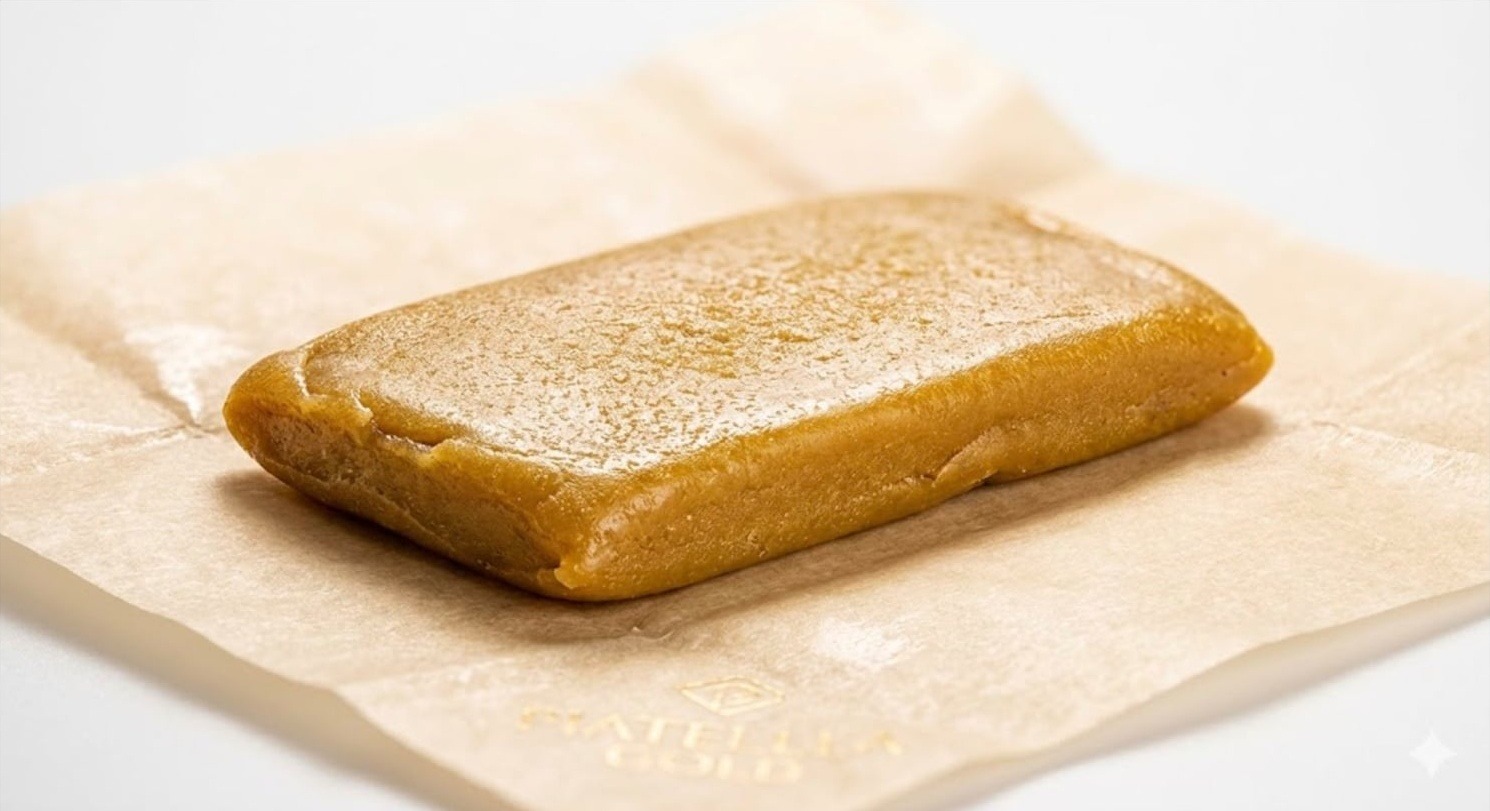
A comprehensive technical guide to authentic solventless piatella production and the CBD-derived alternative pathway, from first principles of trichome chemistry through finished product. https://youtu.be/ARQ7Ke7Stz8 Introduction What is piatella? Piatella is not a strain and not a product category. It is a cold-cure technique applied to full-melt ice water hash: fresh-frozen flower (frozen within 15 to [...]

By |2026-10-05T16:12:13+00:00March 25th, 2026|Cannabis Chemistry, Cannabis Education, Extraction Techniques, Post-Processing|Comments Off on How to Make Piatella from CBD

Why Your Cannabis Concentrates Taste Wrong: Every Off-Flavor Traced to Its Cause

What are off-flavors in cannabis concentrates? Off-flavors are undesirable taste and aroma characteristics in cannabis extracts that deviate from the expected terpene profile of the source material. They range from sulfurous, burnt, or chemical tastes to flat, muted profiles where expected flavors are entirely absent. Off-flavors are the single most common quality complaint in concentrate [...]

By |2026-10-06T16:10:44+00:00March 24th, 2026|Cannabis Chemistry, Lab Techniques|Comments Off on Why Your Cannabis Concentrates Taste Wrong: Every Off-Flavor Traced to Its Cause

Rosin Diamonds: The Complete Guide to Solventless THCa Crystallization

What Are Rosin Diamonds? Rosin diamonds are crystallized THCa isolate produced entirely through heat, pressure, and mechanical separation. No solvents. No chemical catalysts. No CRC media. The end product is a near-pure THCa crystal structure that rivals the potency and visual clarity of solvent-based diamonds at a fraction of the overhead cost. In dispensaries, THCa [...]

By |2026-10-21T16:11:21+00:00March 20th, 2026|Cannabis Chemistry, Lab Techniques|Comments Off on Rosin Diamonds: The Complete Guide to Solventless THCa Crystallization

Convert CBD to THC Without Solvents: The Amberlyst 15 Method

Why the Traditional CBD to THC Conversion Method Falls Short Converting CBD isolate into THC has become one of the most discussed processes in the cannabis and hemp processing industry. The traditional approach relies on dissolving CBD isolate in a solvent like heptane, adding a Lewis acid catalyst such as pTSA (para-toluenesulfonic acid) or hydrochloric [...]

By |2026-06-15T17:46:33+00:00March 19th, 2026|Cannabis Chemistry|Comments Off on Convert CBD to THC Without Solvents: The Amberlyst 15 Method

How To Convert CBD to THC (at scale)

Stop Fighting Kinetics: A Three-Stage Route to ∆9-THC via Regioselective Elimination What Is CBD Isomerization Troubleshooting? CBD isomerization troubleshooting is the diagnosis of a failed acid-catalyzed CBD-to-THC conversion from the numbers the batch produced: the ratio of delta-9 to delta-8, the delta-10 and iso-THC byproducts, the unreacted CBD, the color and the residual acid. Each [...]

By |2026-10-05T21:12:03+00:00March 14th, 2026|Cannabis Chemistry, Lab Techniques|Comments Off on How To Convert CBD to THC (at scale)

Is Yeast Replacing Cannabis? De Novo Cannabinoid Biosynthesis Explained

Cannabinoid Biosynthesis Is Changing Everything Cannabinoid biosynthesis is no longer a theoretical concept confined to academic papers — it's an industrial reality that's forcing the entire cannabis industry to pay attention. Scientists have successfully engineered yeast to produce THC, CBD, and rare cannabinoids like THCV and CBGV from nothing more than simple sugars. No plants. [...]

By |2026-03-08T15:11:21+00:00March 8th, 2026|Cannabis Chemistry|Comments Off on Is Yeast Replacing Cannabis? De Novo Cannabinoid Biosynthesis Explained

How to Convert CBD to THC at Home: Delta 9 & Delta 8 Isomerization SOP

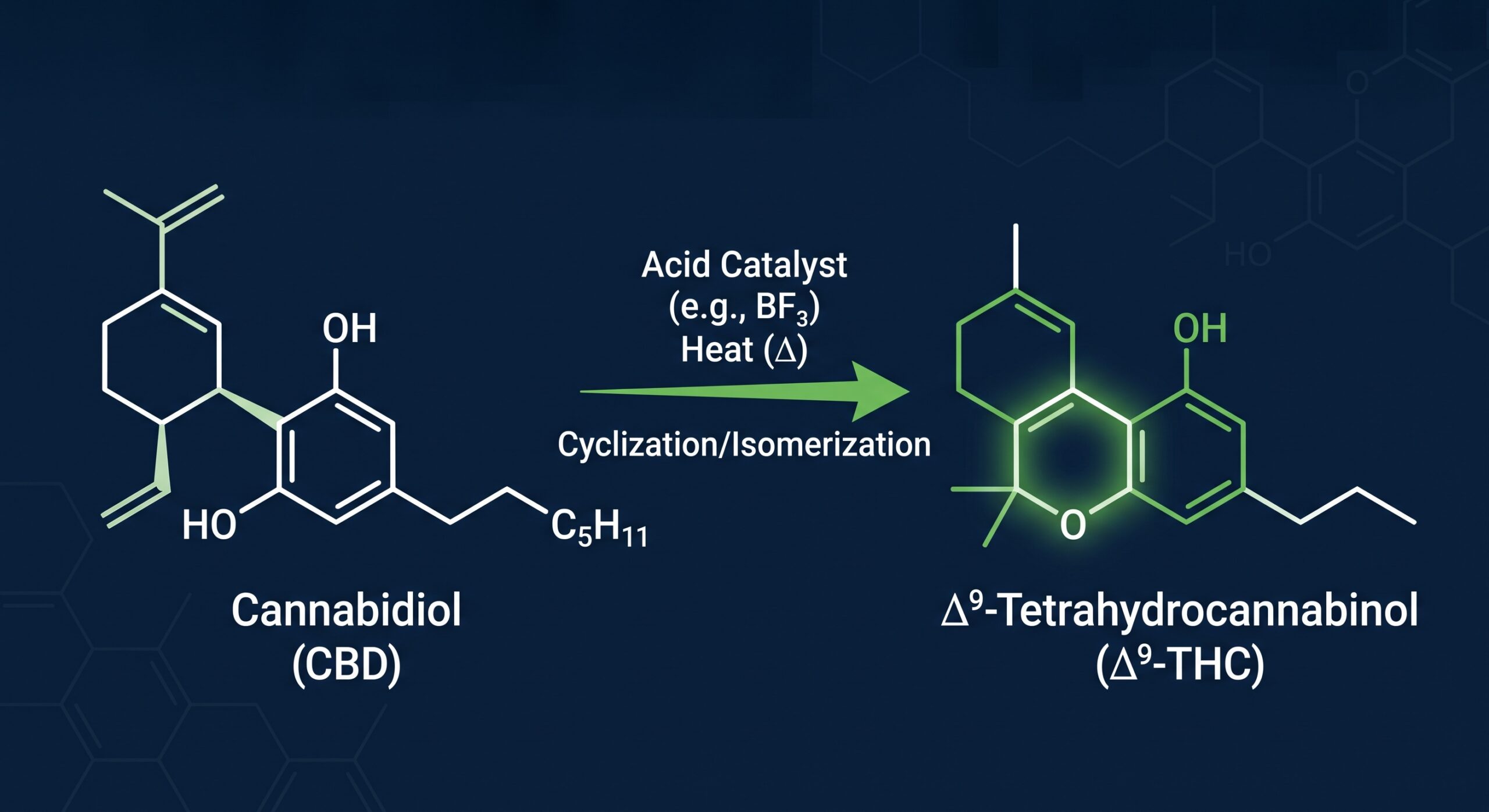
CBD converts to THC through acid-catalyzed isomerization: a Lewis acid rearranges the molecular structure of CBD (C21H30O2) into delta-9-THC or delta-8-THC by cyclizing the open ring. The catalyst used in this procedure is boron trifluoride acetic acid complex (BF3·AcOH) at 11.3 mol% loading in n-heptane at 0°C for one hour, yielding 50-60% delta-9-THC with the [...]

By |2026-10-16T16:09:03+00:00February 28th, 2026|Cannabis Chemistry|Comments Off on How to Convert CBD to THC at Home: Delta 9 & Delta 8 Isomerization SOP
Go to Top