
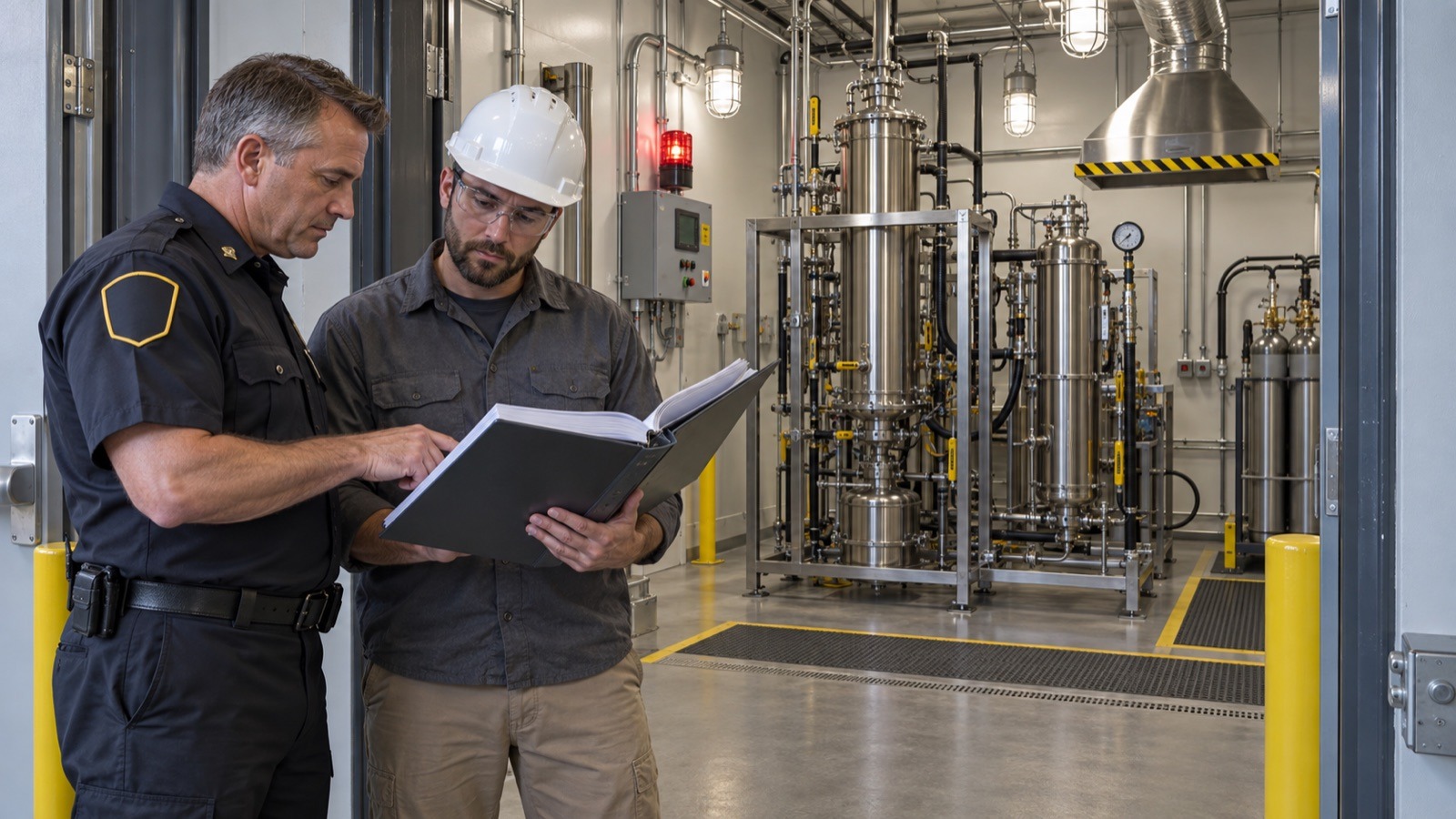
IFC Chapter 39 is the chapter of the International Fire Code your fire marshal opens when a cannabis extraction permit lands on the desk, and it gives you exactly two ways to put an extractor in a building: the equipment is listed and labeled to UL 1389 (Section 3904.2.1), or a registered design professional writes a 14-item technical report (the hazardous materials inventory statement and HMMP travel with it) that the fire code official approves before the machine is even placed in the room (Section 3904.2.2). Everything else in the chapter hangs off those two paths. Flammable gas extraction is banned from any building with a Group A, E, I or R occupancy. Hydrocarbon extraction goes in a room dedicated to extraction and nothing else. Post-processing that heats or pressurizes miscella has to run in an appliance listed for that use, which removes every household oven and unlisted rotovap from the building. Gas detection trips at 25 percent of the lower flammable limit and has to kill the heaters, start the exhaust, and de-energize the outlets and light switches automatically. This guide walks the chapter in the order an inspector reads it, then covers the seven ways operators fail it at plan review.
What Chapter 39 Actually Governs
Section 3901.1 defines the extraction process broadly on purpose: extraction of the oils and fats by solvent, desolventizing the raw material, production of the miscella, distillation of the solvent from the miscella, and solvent recovery. Miscella is the code’s word for your solution of oil in solvent, the tincture in the collection pot or the ethanol crude before the rotovap. That definition is why the chapter reaches past the extractor. Your recovery pump, your rotovap, your falling film, your vacuum oven, and the room they sit in are all inside the scope, because every one of them handles miscella or the solvent that comes off it.
Section 3901.2 is the one that catches existing labs. An existing facility used for plant processing has to comply with the chapter, and an existing extraction process where the medium of extraction or solvent is changed has to comply with the chapter. Read that sentence twice before you move a CO2 room to ethanol or add a hydrocarbon skid next to an ethanol line. The solvent change re-opens the entire chapter on a room that already passed inspection under the old solvent. Operators treat a solvent swap as a process decision. The code treats it as a new facility.
Section 3901.3 sends you to Sections 105.5 and 105.6 for permits, which means an operational permit for the hazardous materials and a construction permit for the systems. The permit is not paperwork you file after the build. It is the mechanism that triggers plan review, and plan review is where the technical report gets read.
| Section | What the code says | What it means on the floor | Where operators fail it |
|---|---|---|---|
| 3901.2 | Existing facilities comply; a solvent change re-triggers the chapter | Switching ethanol to butane or adding a solvent line is a new permit and a new plan review | Skid arrives before the permit; room was approved for a different solvent |
| 3903.2 | No flammable gas or flammable cryogenic extraction in buildings with Group A, E, I or R occupancy | No hydrocarbon lab under apartments, next to a school, in a mixed-use building with a restaurant | Lease signed on a strip-mall unit with residential above |
| 3903.3 | Hydrocarbon extraction equipment and process in a room or area dedicated to extraction | No packaging, no storage, no office desk, no second process sharing the room | Solvent cylinders or biomass totes stored in the extraction room |
| 3903.4 | Post-processing and winterization that heat or pressurize miscella run in an appliance listed for that use; no domestic or commercial cooking appliances | Vacuum ovens, rotovaps, hot plates and freezers touching solvent-wet material need a listing for that duty | Kitchen oven for decarb; chest freezer for winterization; unlisted vac oven purging hydrocarbon |
| 3903.5 | Flammable liquids boiled, distilled or evaporated inside a hazardous exhaust fume hood; no open-flame heating | Ethanol rotovap and short path run under a hood rated for flammable vapors, with electrical rated for the atmosphere inside it | Benchtop rotovap on an open table; unrated heating mantle with no documentation |
| 3903.6 | No release of liquefied petroleum gas to atmosphere except per NFPA 58 Section 7.3 | Closed-loop recovery is mandatory; no venting the last few PSI out a window | Open blasting; purging lines to the room |
| 3904.2.1 or 3904.2.2 | Equipment is UL 1389 listed and labeled, or approved on a technical report by a registered design professional | Buy listed, or budget an engineer and 14 report items before the equipment is placed | Unlisted import extractor bought first, engineer called second |
| 3904.2.2.3 | Engineer of record inspects the installed equipment and confirms model and serial number match the report | The unit in the room must be the unit in the report, down to the serial plate | Vendor ships a different model or revision than the one evaluated |
| 3905.1 | Gas detection per Section 916 for flammable gas solvents, with four automatic actions on alarm | Sensors at 25 percent LFL that shut heat, start exhaust, kill outlets and switches, sound and flash in the room | Detector alarms but is not wired to the heaters or outlets |
| 3905.2 | Emergency shutoff per Section 5803.1.3 for gaseous hydrocarbon solvents | Manual or automatic shutoff at each point of use and at the source | Shutoff only at the tank; nothing at the extractor |
Building and Room Rules: Sections 3903.1 to 3903.3
Section 3903.1 puts the process in a building that complies with the International Building Code, and the IBC classifies plant oil extraction or processing as Factory Industrial Group F-1 in Section 306.2. That is the baseline occupancy. The moment your solvent inventory in a control area passes the maximum allowable quantity, the room becomes a Group H occupancy and the construction requirements jump: rated separation, spill control, explosion control, and the rest of IBC Chapter 4. Where the H line falls is a quantity question, and it is the reason the solvent storage room gets designed before the extraction room, not after.
Section 3903.2 is a site-selection rule and it is absolute. Flammable gas and flammable cryogenic fluid extraction cannot be in any building that contains an assembly, educational, institutional or residential occupancy. Not separated by a rated wall, not on a different floor. In the building. A lease on a mixed-use property with apartments upstairs disqualifies hydrocarbon extraction before you draw a single line. Ethanol is a flammable liquid, not a flammable gas, so 3903.2 does not reach it, but the liquid rules in 3903.5 and the quantity limits in IFC Chapter 57 do.
Section 3903.3 requires hydrocarbon extraction equipment and processes to sit in a room or area dedicated to extraction. Dedicated means the room does one job. The inspector who walks in and finds pallets of biomass, a packaging table, or solvent cylinders in the extraction room writes it up, and they are right to: every added item is fuel load, an ignition source, or an obstruction in the egress path. Storage lives in its own room with its own rules. The electrical classification of that dedicated room is a separate code body, NFPA 70 Article 500, and it is where the C1D1 versus C1D2 decision gets made. Chapter 39 does not classify the room for you. It assumes the room was classified correctly and inspects the process inside it.
Post-Processing Is Not Exempt: Sections 3903.4 and 3903.5
Most operators read Chapter 39 as an extractor rule. The inspector reads 3903.4 first, because that is where the equipment list falls apart. Post-processing and winterization that involve heating or pressurizing the miscella to other than normal pressure or temperature have to be approved and performed in an appliance listed for that use, and domestic or commercial cooking appliances are prohibited outright. A vacuum oven purging hydrocarbon from shatter is heating miscella under vacuum. A rotovap is heating and depressurizing miscella. A chest freezer holding ethanol crude at minus 40 C for winterization is a domestic appliance full of flammable vapor next to an unrated compressor relay. The residential convection oven in the corner for decarb is a cooking appliance and is gone the day the inspector sees it. Section 3903.4.1 sends industrial ovens to IFC Chapter 30, which adds its own ventilation, interlock, and combustion-safety requirements to every oven in the building.
Section 3903.5 covers the ethanol side. Where a flammable or combustible liquid is boiled, distilled or evaporated in the extraction process, that step happens inside a hazardous exhaust fume hood rated for flammable vapors, and any electrical equipment inside the hood is rated for flammable atmospheres. Heating over an open flame is prohibited. The one exception is a heating element that is not rated for flammable atmospheres but carries manufacturer or testing-laboratory documentation that it is rated for heating flammable liquids. That exception is written for the mantle under a short path and the bath under a rotovap. Keep the document in the binder; the inspector asks for it.
Section 3903.6 closes the hydrocarbon loop: no release of liquefied petroleum gas to the atmosphere except as allowed by NFPA 58 Section 7.3. Every closed-loop operator already runs recovery, but the section also governs the last two PSI in a line, the purge on a filter swap, and the residual in a column after a run. Those get recovered, not vented into a room with a gas detector.
The Two Equipment Paths: Section 3904.2
Section 3904.2 gives systems or equipment used for the extraction of oils from plant material two routes, and only two. Section 3904.2.1: the system is listed and labeled in accordance with UL 1389 and installed per the listing and the manufacturer’s installation instructions. Section 3904.2.2: the system is approved for the specific use after review by a registered design professional, with a technical report submitted to and approved by the fire code official, prepared by a firm or individual the fire code official approved before the analysis started.
UL 1389 is the Standard for Safety for Plant Oil Extraction Equipment, a binational U.S. and Canada standard that covers preparatory equipment, extractors using flammable or nonflammable solvents, extraction booths and pods, post-processing equipment, and plant oil utilization equipment. A listing is verified on UL Product iQ by category code: extractors sit under QMBR, QMCY and QMDG, extraction booths under QMBH, QMCV and QMDD, post-processing equipment under QMBL, QMCW and QMDE. A vendor telling you a machine is “built to UL standards” or “uses UL-listed components” is not a listing. The listing is a category code and a label on the frame, and the inspector will look for the label.
| Decision point | Path A: UL 1389 listed (3904.2.1) | Path B: approved on technical report (3904.2.2) |
|---|---|---|
| What you submit | Listing record (Product iQ category code), the label, and the manufacturer’s installation instructions | 14-item technical report signed by a registered design professional, plus the field inspection report after install |
| Who has to be approved first | Nobody; the listing is the approval | The report preparer, by the fire code official, before the analysis is performed |
| When the equipment can enter the building | After the construction permit, installed per the listing | Only after the report is approved (3904.2.2.1: required prior to the equipment being located or installed) |
| Installation constraint | Exactly as listed; any field modification voids the listing on that unit | Exactly as analyzed; serial number on the frame must match the report at the site inspection |
| Post-processing equipment | Must carry its own listing for the duty (QMBL / QMCW / QMDE class) | Must appear in the report’s process flow diagram (item 8) and be analyzed |
| Change after approval | Swap to another listed unit installed per its listing; re-permit if the solvent changes | Report revision (item 3 tracks revision history), re-inspection, and a solvent change re-opens the chapter |
| Typical failure | “Listed components” sold as a listed system; booth listed, extractor not | Report written after the skid is bolted down; preparer never approved; fabricated vessel with no analysis |
The path decision is a procurement decision, and it has to be made before the purchase order. A listed system costs more up front and buys you a plan review that reads like a checklist. An unlisted system buys you an engineer, a report, and a schedule that depends on how fast your fire code official reads. Neither path is wrong. Buying the unlisted machine and finding out about Path B from the inspector is the wrong path.
The 14-Item Technical Report: Section 3904.2.2.2
The report is the document the fire code official approves, and the code lists its contents item by item. Every one of the 14 is mandatory. Here is what the operator has to produce for each, because the engineer cannot invent the inputs.
| Item | Code requirement (3904.2.2.2) | What you hand the engineer | Where it stalls |
|---|---|---|---|
| 1 | Manufacturer information | Legal manufacturer name, address, contact; not the reseller | Import units with a distributor and no reachable manufacturer |
| 2 | Preparer of record | The firm the fire code official approved before the work started | Report commissioned from an engineer the AHJ never approved |
| 3 | Date of review and revision history | Every change to the skid after the first draft | Vendor firmware or valve changes not fed back to the report |
| 4 | Signature page: author, date, and the registered design professional performing the design or peer review | Nothing; this is the engineer’s stamp | Out-of-state engineer not licensed in the project state |
| 5 | Model number, and serial number for verification at site inspection | The serial plate photo from the unit that will actually ship | Report written on a demo unit; production unit has a different serial |
| 6 | Methodology, basis of design, code analysis and code path | Solvent, pressures, temperatures, room classification, adopted code edition and local amendments | Report cites the model IFC while the jurisdiction runs NFPA 1 or an amended edition |
| 7 | Equipment description: every component and subassembly (fittings, hose, quick disconnects, gauges, sight glass, gaskets, valves, pumps, vessels, switches) with manufacturer, model, material and solvent compatibility, plus data sheets | A bill of materials with data sheets, down to gasket elastomer and hose rating | Vendor cannot produce data sheets for the vessels or the sight glass |
| 8 | Process flow diagram including post-processing and winterization, with operating temperature, pressure and solvent state at each step, and a P&ID | Your actual SOP conditions: run pressure, recovery pressure, bath and chiller temperatures, where the solvent is liquid, vapor, or supercritical | Post-processing left off the diagram; no P&ID exists for the skid |
| 9 | Analysis of every vessel pressurized above atmospheric, purchased and fabricated | Vessel drawings, wall thickness, material certs, rating basis for each column, collection pot, and jacket | Shop-fabricated columns with no drawings and no rating; welded jackets nobody analyzed |
| 10 | Structural analysis of the frame supporting the equipment | Frame drawings, loaded weights with full columns and pots | Frame built from unistrut on site; no drawing |
| 11 | Process safety analysis from raw product in to end of extraction | Step-by-step SOP with the hazard at each step and the control on it | SOP does not exist yet; the engineer writes one and it does not match how the room is run |
| 12 | Comprehensive process hazard analysis of failure modes and points of failure, including the manufacturer’s emergency procedures (not the building’s) | The manufacturer’s emergency procedure document for the machine itself | Manufacturer supplies nothing; report has to state that and the AHJ has to accept it |
| 13 | Review of assembly instructions, operation and maintenance manuals | The manuals, in English, for the exact model | A two-page quick start guide standing in for a manual |
| 14 | List of references | Nothing; the engineer cites the codes and standards from item 6 | Rarely |
Read items 7, 9, and 12 together and you understand why unlisted import extractors stall at plan review. The report needs a data sheet for every valve and gasket, a pressure analysis for every fabricated vessel, and the manufacturer’s own emergency procedures. A manufacturer that cannot produce those documents cannot be reported on, and no engineer can stamp what they cannot analyze. The machine is not illegal. It is unapprovable, which for your permit is the same thing.
Section 3904.2.2.1 sets the timing: the approved report is required prior to the equipment being located or installed at the facility. Then 3904.2.2.3 closes the loop. Where the fire code official requires it, the engineer of record inspects the installed equipment for compliance with the report and the building analysis, files a report of findings, and that field report has to include the serial number of the equipment in the room and confirm it is the same model and type identified in the technical report. A vendor that ships a “newer revision” of the model you were approved on has just handed you a serial-number mismatch, and the inspection fails on the plate before anyone looks at a fitting.
We walk the technical-report package, the AHJ pre-application meeting, and the plan-review sequence step by step in the lab-build module at extractiontraining.com, with the document checklists you can hand straight to your engineer.
Safety Systems: Section 3905
Section 3905.1 requires a gas detection system complying with Section 916 for any extraction process using flammable gases as solvents. Section 916.8 sets the activation point at 25 percent of the lower flammable limit for flammable gases. For butane, the LFL is roughly 1.8 percent by volume in air, so the sensors alarm at about 0.45 percent, long before a room is anywhere near ignitable. Section 3905.1.1 then dictates what activation has to do, and this is where most installed systems are wrong.
| Trigger | Required automatic response | How to test it at commissioning |
|---|---|---|
| Gas detected at 25 percent LFL (3905.1.1) | 1. Distinct audible and visual alarm in the extraction room. 2. Deactivate all heating systems in the room. 3. Activate the mechanical ventilation where interlocked. 4. De-energize all light switches and electrical outlets (egress illumination stays on where the jurisdiction adds that exception) | Calibration gas on each sensor with the inspector watching the heater contactors drop, the exhaust fan prove flow, and the receptacles go dead |
| Detector fault or loss of signal (3905.1.2) | Heating systems deactivate, ventilation activates where interlocked, trouble signal sounds at an approved location | Unplug a sensor head; the room must go to the same safe state, and the trouble signal must reach the panel, not just the room |
| Emergency shutoff (3905.2 via 5803.1.3) | Approved manual or automatic emergency shutoff valves at each point of use and at each source | Close the point-of-use valve with the system pressurized; verify the extractor is isolated from the supply, then the source valve isolates the tank |
The fault rule in 3905.1.2 is the one that separates a code-compliant system from a detector on the wall. A gas detection system that fails silent is worse than no detector, because everyone in the room believes they are protected. The code makes the fault state identical to the alarm state for the heaters and the exhaust. If your controls integrator has not wired the fault relay, the panel passes the calibration-gas test and fails the unplug test. Ask for both tests in writing. The C1D1 room requirements guide covers sensor placement and the air-exchange math that keeps the room under 25 percent LFL in the first place; Chapter 39 only tells you what has to happen when the number is crossed.
Local Amendments Change the Answer
Chapter 39 is model code. The document your fire marshal enforces is the edition your state or city adopted, with amendments, and some jurisdictions never adopted the IFC at all and run NFPA 1 instead, where extraction lives in Chapter 38. The report’s code path (item 6) has to name the adopted document, so check before the engineer starts.
| Jurisdiction or document | How it differs from model Chapter 39 | Operator consequence |
|---|---|---|
| Denver Fire Code | Extraction equipment is approved on an engineering analysis signed and sealed by a licensed professional engineer, historically based on NFPA 58 for hydrocarbon systems; a local hydrocarbon detector is required for butane and a local CO2 alarm for CO2 systems; open butane release is prohibited. The Denver Fire Department counted seven butane extraction explosions starting January 2014, and reports fire code violations as more prevalent in marijuana occupancies than any other occupancy type in the city. | Budget the PE analysis for CO2 skids too, not just hydrocarbon; expect a fire department that has seen every shortcut |
| Seattle Fire Code 2021 | Adopts Chapter 39 text intact; adds an exception that required means-of-egress illumination stays on when gas detection de-energizes lighting circuits | Egress lighting on a circuit the gas detection relay does not touch |
| NFPA 1 jurisdictions | Extraction is regulated under NFPA 1 Chapter 38, with the same listing-or-engineering structure, interlock of lighting and equipment with the hazardous exhaust, and emergency backup power for the mechanical system, extraction room lighting and gas detection | Standby power for exhaust and detection is a line item, not an option |
| NFPA 420 (in development) | Standard on Fire Protection of Cannabis Growing and Processing Facilities, moving through public input with a first edition targeted for 2027; consolidates cannabis-specific requirements into one document | Until it publishes and is adopted, Chapter 39 or NFPA 1 Chapter 38 is what gets enforced |
| State cannabis regulators | Licensing rules often require a fire department sign-off or a PE letter as a condition of the manufacturing license, on top of the fire code | Two approvals, two timelines; the state licensing hub lists what each state asks for |
Building a lab and the fire marshal is already asking questions? The cheapest point to fix a Chapter 39 problem is before the equipment purchase order. An independent cannabis extraction consultant settles the solvent, the room classification, and the listed-or-reported decision first, then hands the engineer a package that gets approved on the first submission. Book a consult before the skid ships.
Common Failures at Plan Review and Inspection
These are the Chapter 39 failures that stop permits. Each one is avoidable, and each one is expensive after the equipment is on the floor.
1. The unlisted extractor bought before the code path was chosen
Symptom: Plan reviewer asks for the UL 1389 listing; the vendor sends a letter saying the unit “uses listed components.”
Root cause: Section 3904.2 requires the system to be listed, not its parts. Listed valves on an unlisted assembly are an unlisted assembly.
Diagnostic test: Search UL Product iQ for the manufacturer under the extractor category codes (QMBR, QMCY, QMDG). No record means no listing.
Fix: Move to Path B: get the report preparer approved by the fire code official, then commission the 14-item report. If the manufacturer cannot supply vessel drawings and data sheets (items 7 and 9), the machine cannot be reported on; sell it and buy a listed system.
2. The technical report written after installation
Symptom: Skid is plumbed and bolted down; the engineer is asked to “sign off.”
Root cause: Section 3904.2.2.1 requires the approved report before the equipment is located or installed. Retroactive reports invert the process the code was written to enforce.
Diagnostic test: Compare the report’s approval date to the delivery date on the freight bill.
Fix: Some fire code officials accept a report and a field inspection after the fact; many do not. Ask before submitting, and expect to move the equipment out of the room if the answer is no.
3. The vacuum oven with no listing for the duty
Symptom: Inspector flags the purge oven, the rotovap, or the winterization freezer, not the extractor.
Root cause: Section 3903.4 requires post-processing that heats or pressurizes miscella to run in an appliance listed for that use. A general-purpose lab vacuum oven is listed as a lab oven, not as a flammable-solvent purge oven, and a domestic chest freezer is prohibited outright as a domestic appliance.
Diagnostic test: Read the listing on the nameplate. If it does not state flammable-solvent or hazardous-location duty, it is not listed for this use.
Fix: Replace with post-processing equipment listed under UL 1389 (QMBL, QMCW, QMDE class) or include the unit in the Path B report’s process flow diagram (item 8) and hazard analysis (item 12) so it is approved with the system.
4. The gas detector that only alarms
Symptom: Calibration gas trips the horn and strobe; nothing else in the room changes.
Root cause: Section 3905.1.1 requires four responses: alarm, heaters off, exhaust on where interlocked, outlets and light switches de-energized. A detector that is not wired to contactors satisfies one of four.
Diagnostic test: Trip the sensor and put a meter on the heater feed and a receptacle.
Fix: Controls integrator adds the relay outputs to the heater contactors, the exhaust starter, and a shunt-trip or contactor on the room’s receptacle and lighting circuits, with egress illumination on an untouched circuit where the jurisdiction requires it. Then run the 3905.1.2 fault test by disconnecting a sensor head.
5. The report preparer the fire code official never approved
Symptom: Report is complete and stamped; plan review rejects it without technical comments.
Root cause: Section 3904.2.2 requires the firm or individual preparing the report to be approved by the fire code official prior to performing the analysis. The stamp is not the approval.
Diagnostic test: Ask for the written pre-approval of the preparer. If there is none, the report was never eligible.
Fix: Request preparer approval first, in writing, with the engineer’s license and relevant project list. Only then start the analysis.
6. Solvent inventory in the extraction room
Symptom: Inspection fails on the cylinders and drums stacked along the wall of an otherwise compliant room.
Root cause: Section 3903.3 dedicates the room to extraction; storage belongs in a room built to NFPA 30 or NFPA 58 with its own quantity limits, containment, and ventilation.
Diagnostic test: Count the solvent in the extraction room against what a single run consumes. Anything beyond the connected supply is storage.
Fix: Build the solvent storage room and keep only the connected cylinder or day tank in the extraction room.
7. The serial number that does not match
Symptom: Engineer of record’s site inspection report cannot confirm the installed unit is the unit in the technical report.
Root cause: Section 3904.2.2.3 requires the field report to include the serial number and confirm the same model and type as the technical report. Vendors ship revisions, swap columns, and change valve brands between quote and delivery.
Diagnostic test: Photograph the serial plate and every component nameplate at delivery and compare to item 5 and item 7 of the report before the unit leaves the crate.
Fix: Revise the report (item 3 revision history) for any substitution before the field inspection, or refuse delivery of a unit that does not match the approved model.
The Order to Do This In
Chapter 39 rewards sequence. Pick the solvent, because 3901.2 makes a later change a new project. Pick the building against 3903.2, because no rated wall fixes a prohibited occupancy. Classify the room under NFPA 70 and size the solvent storage under NFPA 30 or 58, because the fire code assumes both are done before it starts asking about the machine. Then choose Path A or Path B before the purchase order, get the preparer approved if it is Path B, and hand the engineer your SOP conditions, your bill of materials with data sheets, and the manufacturer’s manuals and emergency procedures. Commission the gas detection with both the alarm test and the fault test in front of the inspector. The extraction lab design guide lays out the room-by-room build around this sequence, and the lab cost breakdown shows what each of these line items runs when they are planned instead of retrofitted.
Frequently Asked Questions
What does IFC Chapter 39 cover for cannabis extraction?
IFC Chapter 39, Processing and Extraction Facilities, governs the extraction of oils and fats from plant material by solvent, desolventizing, production of the miscella, distillation of the solvent from the miscella, and solvent recovery. It sets permit requirements (3901.3), prohibits flammable gas extraction in buildings with Group A, E, I or R occupancies (3903.2), requires a dedicated room for hydrocarbon extraction (3903.3), requires listed appliances for post-processing that heats or pressurizes miscella (3903.4), and gives extraction equipment two approval paths: UL 1389 listing or a technical report by a registered design professional (3904.2).
Does extraction equipment have to be UL listed under Chapter 39?
No. Section 3904.2 allows either a UL 1389 listing and label (3904.2.1) or approval for the specific use on a technical report prepared by a registered design professional and approved by the fire code official (3904.2.2). The report has 14 required items, the preparer must be approved by the fire code official before the analysis starts, and the approved report is required before the equipment is located or installed at the facility. Unlisted equipment is permitted; unreported unlisted equipment is not.
What has to be in the Chapter 39 technical report?
Section 3904.2.2.2 lists 14 items: manufacturer information, preparer of record, date and revision history, a signature page with the registered design professional’s signature, model and serial number, methodology with a code analysis and code path, a complete component list with data sheets and solvent compatibility, a process flow diagram including post-processing with temperatures, pressures and solvent state at each step plus a P&ID, analysis of every pressurized vessel including fabricated ones, structural analysis of the frame, a process safety analysis from raw material to finished extraction, a process hazard analysis including the manufacturer’s emergency procedures, a review of the assembly, operation and maintenance manuals, and a list of references.
At what gas concentration does the Chapter 39 gas detection system have to alarm?
Section 3905.1 requires a gas detection system complying with Section 916 for flammable gas solvents, and Section 916.8 sets activation at 25 percent of the lower flammable limit. For butane, with an LFL near 1.8 percent by volume, that is about 0.45 percent butane in air. On activation, Section 3905.1.1 requires a distinct audible and visual alarm in the room, deactivation of all heating systems in the room, activation of the mechanical ventilation where interlocked, and de-energizing of all light switches and electrical outlets. A detector fault must produce the same heater and ventilation response plus a trouble signal (3905.1.2).
Can I use a regular vacuum oven or kitchen oven for post-processing under Chapter 39?
Not for any step that heats or pressurizes miscella. Section 3903.4 requires post-processing and winterization involving heating or pressurizing of the miscella to other than normal pressure or temperature to be approved and performed in an appliance listed for such use, and it prohibits domestic or commercial cooking appliances outright. Industrial ovens are sent to IFC Chapter 30 by Section 3903.4.1. A vacuum oven purging hydrocarbon from an extract needs a listing for that duty or inclusion in the technical report’s process flow diagram and hazard analysis.
Does Chapter 39 apply to ethanol extraction?
Yes. The prohibited-occupancy rule in 3903.2 names flammable gases and flammable cryogenic fluids, so it does not reach ethanol, but 3903.5 requires any step where a flammable or combustible liquid is boiled, distilled or evaporated to happen inside a hazardous exhaust fume hood rated for flammable vapors, with electrical equipment inside the hood rated for flammable atmospheres, and it prohibits open-flame heating. The equipment approval paths in 3904.2 apply to ethanol extraction systems the same way they apply to hydrocarbon systems, and ethanol storage quantities fall under IFC Chapter 57 and NFPA 30. The room exhaust is sized the same way for either solvent; the C1D1 ventilation calculator returns the CFM, ACH, and alarm point for a given room and inventory.
Is a solvent change on an existing extraction room a new permit?
Yes. Section 3901.2 states that existing extraction processes where the medium of extraction or solvent is changed shall comply with the chapter. A room approved for ethanol that adds a butane skid, or a CO2 room converted to hydrocarbon, is reviewed as a new process: new permit under 3901.3, a new listing or technical report under 3904.2, and the prohibited-occupancy and dedicated-room checks in 3903.2 and 3903.3 applied to the new solvent.
Ready to level up your extraction game? Contact WKU Consulting for personalized guidance on building your extraction lab.
For more deep dives into cannabis chemistry, extraction SOPs, and lab design, subscribe to the WKU Consulting YouTube channel.
Watch a related video:

Leave A Comment