
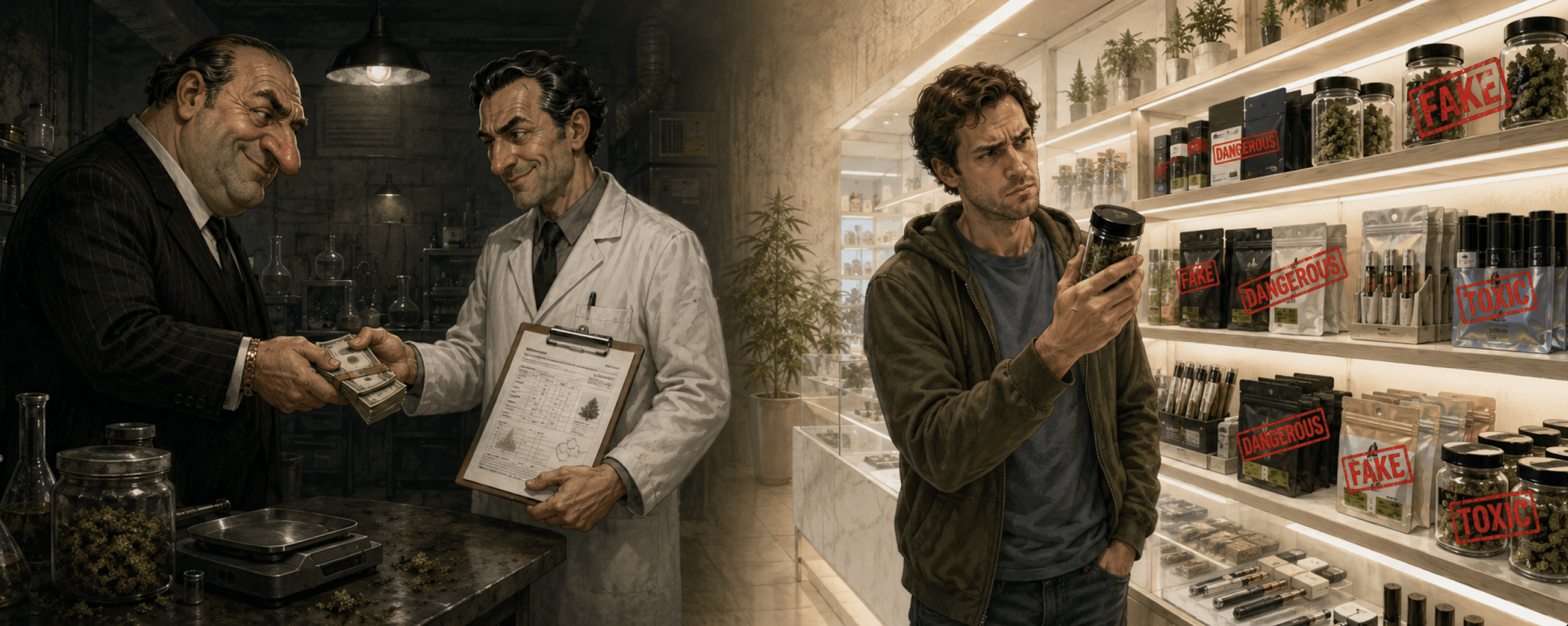
Nearly half of all licensed cannabis products on dispensary shelves carry THC labels that are wrong by more than 20%. A 2026 study found that 48% of licensed cannabis products deviated by more than 20% from their labeled THC concentration. A peer-reviewed PLOS One study of Colorado dispensary samples found average observed THC potency was 23.1% lower than the lowest value on the label. In New Jersey, the Safe Leaf Society independently tested 25 pre-rolls from licensed dispensaries: seven exceeded microbial contamination limits, five had labels claiming pathogen levels of zero while independent testing found counts exceeding 100,000 colony-forming units per gram, and every pre-roll tested for potency came back below the labeled THC level.
This is not a one-off finding. This is the market right now. And if you are a producer running conversion chemistry, a consumer trusting a label, or an honest lab competing against fraudulent ones, this affects you directly.
How a Whistleblower Exposed 1,200 Falsified Samples
A lab technician at Praxis Laboratory in Washington state logged THC potency results at the end of a shift. The next morning, the numbers in the system were different. Higher. Not by a lot. Just enough that you would miss it if you were not looking.
A coworker in the data team noticed the same pattern in his own results. Someone was going into the system after hours and changing the recorded data. Rather than report it immediately, he built a case. He installed software on the lab’s computers that recorded every change made to every result. Timestamped. Logged.
That software ran for months. It captured dozens of instances of altered THC potency results. The method was straightforward: recorded sample weights were changed, made smaller. When the sample weight decreases but the measured cannabinoid mass stays the same, the reported concentration increases. Basic math producing a number technically derived from real instrument data with a manipulated denominator.
The Washington State Liquor and Cannabis Board found over 1,200 falsified samples. The lab owner attempted to destroy evidence during the investigation.
One lab. One state. Over a thousand fraudulent results that made it onto retail product labels. And the only reason it was caught is because one employee decided to build his own monitoring system on his own time.
What Consumers Need to Know Right Now
If you are buying cannabis from a licensed dispensary, you are doing what the system asked you to do. You left the unregulated market. You pay taxes on your purchase. You trust the label because that is the entire point of a regulated supply chain. And right now, that trust is not being honored.
The product in your hand may contain less THC than you paid for, more microbial contamination than the law allows, or pesticide residues that were never flagged because the lab that signed off on it was either incompetent or complicit. None of that is your fault. But it is your risk.
Until the testing infrastructure is held to the same standard as the products it certifies, the best thing you can do is verify:
- Look for labs with ISO 17025 accreditation. This is the international standard for testing laboratory competence. It requires documented procedures, proficiency testing, and external audits. A lab without ISO 17025 is operating on the honor system.
- Check that the batch number on the COA matches your product. If the batch numbers do not match, the COA may have been applied to a different product entirely.
- Scan the QR code and confirm it resolves to the lab’s own system, not a brand-hosted PDF. If the COA cannot be independently verified through the lab’s website, the COA is not protecting you.
- Be skeptical of THC percentages above 30% on flower. While it is possible, it is rare. The genetics, growing conditions, and curing process required to produce flower consistently above 30% total THC are uncommon. If every product on the menu is above 30%, the lab is the problem.
How Potency Fraud Works at the Bench Level: Six Methods
Praxis is not an isolated case. It is a documented case. There is a difference. The method they used is one of at least six distinct techniques being used to inflate COA numbers across the cannabis industry.
| Fraud Method | How It Works | Detection Difficulty | Documented Example |
|---|---|---|---|
| Moisture Manipulation | Hyper-dry sample before analysis. Same THC mass in lighter sample = higher reported %. Flower at 22% proper moisture tests 28% when water is baked out. | Nearly impossible without moisture data (most states do not require it) | Industry-wide; no single documented case because states do not track it |
| Sample Cherry-Picking / Dusting | Producer selects top colas instead of representative sample. In extreme cases, samples are dusted with kief or distillate before submission. | Moderate (requires field sampling programs) | Multiple state investigations; common in producer-submitted sample states |
| HPLC Method Manipulation | Adjust injection volumes, mobile phase, column selection, or integration parameters to produce higher numbers. No standardized cannabis HPLC protocol exists. | Very difficult without interlaboratory comparison (rare in cannabis) | Systemic; documented in proficiency test failures across multiple states |
| Direct Data Manipulation | Change recorded sample weights or results in LIMS after analysis. Smaller weight + same cannabinoid mass = higher concentration. | Requires audit trail review or insider reporting | Praxis Laboratory (WA): 1,200+ falsified samples. California Cannabis Testing Labs (CA): 20 violations, license canceled. |
| COA Forgery | Edited PDFs, legitimate results applied to different products, or entirely fabricated documents with invented lab names. | Extremely difficult; industry CEOs confirm Photoshop quality is professional-grade | Multiple states; no centralized COA verification system exists |
| Lab Shopping | Send same sample to multiple labs. Use whichever result is highest. Some labs actively solicit this by promising favorable numbers. | Requires tracking sample submission patterns across labs | KCA Labs publicly confirmed clients request falsified results; they refuse but others do not |
Moisture Manipulation: The Invisible Inflation
Cannabinoid potency is reported as a percentage of dry weight. Hyper-dry the sample before analysis and the percentage climbs. Same amount of THC in a lighter sample produces a higher number on the report. Most states do not require moisture content to be reported alongside potency, so there is no way for anyone downstream to contextualize the result. Flower that would test at 22% at proper moisture content will test at 28% when the water is baked out. Both numbers are technically accurate. Only one of them is honest.
Sample Cherry-Picking and Dusting
In many states, the producer selects which buds go to the lab. Those samples are supposed to be representative of the batch. In practice, they are the top colas. In documented cases, samples have been physically dusted with kief or high-potency distillate before submission. The lab tests what it receives. If what it receives is not representative of what ends up on the shelf, the COA is meaningless before the instrument even turns on.
HPLC Method Manipulation
THC potency is most commonly tested using High Performance Liquid Chromatography (HPLC). There is no single standardized protocol for how cannabis labs run this analysis. Injection volumes, mobile phase compositions, column selection, and integration parameters can all be adjusted. A lab that wants to produce higher numbers has a wide margin of tunable variables and very little external oversight. In pharmaceutical testing, the absence of proficiency testing programs and interlaboratory comparison studies would be disqualifying. In cannabis, it is standard.
Direct Data Manipulation: The Praxis Method
Change the numbers after the technician enters them. In 2024, California Cannabis Testing Labs in Northridge had their license canceled after investigators documented 20 violations including retesting samples to inflate THC, faking bench sheet records for mycotoxins and pesticides, and physically tampering with laboratory equipment so that instruments could not detect certain pesticides and solvents. The lab director signed a COA reporting no chlorfenapyr detected. The state later found the product contained nearly 600 times the legal limit. That product was sold to consumers at a licensed dispensary.
COA Forgery
This does not require a lab at all. One testing lab CEO publicly stated that the Photoshop and PDF alteration work on forged COAs is so good that even professionals who review them daily have trouble identifying fakes. Forged COAs include edited PDFs, legitimate test results applied to entirely different products, and fabricated documents with invented lab names and accreditation numbers.
Lab Shopping: The Structural Problem Underneath Everything
A producer sends the same sample to multiple labs and uses whichever result comes back highest. KCA Labs has publicly confirmed that clients request falsified COA results. KCA refuses and tells them to reformulate and retest. The fact that the request is being made tells you everything about what is happening at the labs that say yes.
What This Does to Your Chemistry
If you run conversion chemistry, whether CBD to delta-nine, CBD to delta-eight, or any novel cannabinoid synthesis pathway, your SOP specifies reagent quantities, molar ratios, reaction times, and temperature profiles based on a known substrate concentration. That known concentration comes from a COA.
You purchase CBD isolate. The COA says 99.9% purity. You build your synthesis around that number. But if the material is actually 92% or 88%, every calculation in your process is wrong. Molar ratios are off. Reagent quantities are calibrated to a phantom concentration. Expected yields become unreachable.
So you troubleshoot. Adjust temperature profiles. Extend reaction times. Increase catalyst loading. Spend days or weeks chasing a yield target that was never achievable because your feedstock purity was a fiction. You are not debugging your chemistry. You are debugging someone else’s COA.
It compounds. Isomerization reactions produce byproducts in predictable ratios. When you convert CBD to delta-eight THC, you also generate delta-nine, delta-ten, and other isomers in characteristic proportions. If a delta-eight distillate COA shows 95% delta-eight with no other THC isomers present, that is either an extraordinarily refined product or manipulated test results. Now you have two layers of COA fraud stacking on each other. The input was not what it claimed. The output testing does not reflect what came out of the reactor. Your SOP looks broken. It is not broken. It was designed for inputs it never received.
This is why incoming material verification should be non-negotiable in your quality system. If you are not independently confirming the potency and purity of every feedstock lot before it enters your process, you are building quality on someone else’s word. That word is unreliable roughly half the time.
COA Verification Checklist for Producers
| Check | What to Look For | Red Flag |
|---|---|---|
| Lab accreditation | ISO 17025 certification, state license number | No accreditation listed, or accreditation from unrecognized body |
| Batch number match | COA batch number matches product packaging exactly | Mismatch, partial number, or generic “sample” designation |
| QR code verification | Resolves to the lab’s own domain, not the brand’s website | Links to brand-hosted PDF or dead link |
| Test date relevance | Testing date within 90 days of product packaging date | COA dated 6+ months before product was packaged |
| Cannabinoid profile plausibility | Total THC below 35% for flower; minor cannabinoids present in expected ratios | THC above 35% on flower, 100%+ total cannabinoids on any product, zero minor cannabinoids |
| Full panel completeness | Potency, pesticides, heavy metals, microbials, residual solvents, moisture, mycotoxins all tested | Missing panels, especially pesticides or microbials marked “N/T” (not tested) |
| Moisture content reported | 8-13% moisture for properly cured flower | No moisture reported (impossible to verify if potency was inflated via hyper-drying) |
The Pressure on Honest Producers
There is a specific group of people who need to hear this.
Potency fraud is one way a COA lies; a converted distillate passing a minimum solvent panel is the other. The converted THC detection checklist adds the Class 2 solvent lines and the delta-8 / delta-10 thresholds that belong on the same verification pass.
You grow clean flower. You maintain your facility. You test honestly. Your COA comes back at 22% THC and you know that is excellent cannabis. Then you look at the dispensary menu and the operation down the road is listing 30%. Numbers that are not typical of the genetics being grown in your region. But there they are. Higher price point. Moving faster off the shelf.
Your marketing suffers. Your placement drops. Revenue declines. Eventually someone on your team suggests finding a different lab.
This is how the cycle perpetuates. Honest labs and honest producers get outcompeted by dishonest ones. The dishonest labs gain market share because they tell clients what they want to hear. The honest labs lose business and either lower their standards or close. The consumer pays premium prices for product that was mislabeled before it left the facility.
If you are the operator watching competitors post fantasy numbers while you do the work with honest results, you are not doing anything wrong. The system around you is broken. The answer is not to join the race to the bottom. The answer is to build processes and SOPs that consistently produce the quality you are targeting, verified through independent incoming material testing, so that when enforcement catches up, you are the one still standing.
The Enforcement Wave Is Already Here
California lost 27% of its licensed testing labs in a single year because the state finally started auditing. Massachusetts has active lawsuits filed by MCR Labs against eight competitors for potency inflation and passing contaminated product. Washington shut down Praxis. The federal government is moving forward with rescheduling cannabis to Schedule III while multi-state operators file DEA applications ahead of a June 27th deadline, all on top of a testing infrastructure where half of licensed products cannot accurately report what is in the package.
Vape cartridges in New York have been labeled at cannabinoid concentrations exceeding 100%, which is not physically possible. Pre-rolls with five times the legal mold limit have been sold to medical patients. Equipment has been deliberately tampered with so it cannot detect pesticides classified as dangerous by the CDC.
Building Process Integrity From the Ground Up
The solution starts at the process level. Whether you are running hydrocarbon extraction, ethanol processing, or producing RSO, every downstream quality outcome depends on verified inputs.
- Verify every incoming feedstock lot independently. Do not trust supplier COAs as your sole quality gate. Send splits to a second lab. Compare results. If they diverge by more than 10%, one of them is wrong.
- Choose labs based on methodology, not on their willingness to deliver a number you like. Ask about their HPLC method validation. Ask if they participate in proficiency testing. A lab that cannot answer those questions is not a lab you should be trusting with your quality system.
- Document your incoming material specifications. Define acceptable ranges for potency, moisture, residual solvents, and microbials. Reject lots that fall outside those ranges. This protects your winterization and purging processes from garbage-in-garbage-out failures.
- Build SOPs around verified inputs, not assumed ones. If your isomerization SOP assumes 99.9% CBD isolate, build a verification step that confirms purity before the reaction starts. A 7% purity deficit cascades through every reagent calculation.
If you want to learn how to build extraction and post-processing SOPs that produce consistent, verified results from crude to finished product, that is exactly what we built extractiontraining.com for. The full course walks through every process step with the quality controls that separate professional operations from the ones that end up in enforcement actions.
Frequently Asked Questions
How common is cannabis potency fraud?
A 2026 study found that 48% of licensed cannabis products deviated by more than 20% from labeled THC concentration. A peer-reviewed PLOS One study of Colorado samples found observed potency was 23.1% lower than the lowest label value on average. This is not a fringe problem. It affects roughly half of all products on legal dispensary shelves.
How can I verify if a cannabis COA is legitimate?
Check three things: confirm the lab has ISO 17025 accreditation, verify the batch number on the COA matches your product packaging, and scan the QR code to confirm it resolves to the lab’s own verification system rather than a brand-hosted PDF. If any of these checks fail, the COA should not be trusted.
What is moisture manipulation in cannabis testing?
Cannabinoid potency is reported as a percentage of dry weight. By hyper-drying a sample before analysis, the same mass of THC in a lighter sample produces a higher percentage. Flower that tests at 22% THC at normal 10-12% moisture will test at 28% when dried to 2-3% moisture. Most states do not require moisture content to be reported alongside potency.
Why does potency fraud matter for extraction labs?
Extraction and conversion SOPs specify reagent quantities, molar ratios, and reaction parameters based on known input concentrations. If a CBD isolate COA says 99.9% but the material is actually 88-92%, every calculation in the process is wrong. Molar ratios are off, expected yields become unreachable, and producers waste days troubleshooting chemistry that was never broken.
Which states have taken enforcement action against cannabis testing labs?
Washington shut down Praxis Laboratory after finding 1,200+ falsified samples. California lost 27% of its licensed testing labs in a single year of audits and canceled the license of California Cannabis Testing Labs after 20 violations. Massachusetts has active lawsuits from MCR Labs against eight competitors. New York has documented vape cartridges labeled at over 100% cannabinoid concentration.
How do I choose an honest cannabis testing lab?
Look for ISO 17025 accreditation, participation in proficiency testing programs, willingness to discuss their HPLC method validation, and transparency about their quality management system. A lab that resists answering methodology questions is not a lab that should be certifying your products.
Can a lab legally inflate potency numbers?
No. Falsifying test results violates state cannabis regulations in every legal market and can result in license revocation, criminal charges, and civil liability. However, some methods like moisture manipulation and HPLC parameter optimization exist in a gray area because no standardized testing protocol exists across the industry.
