
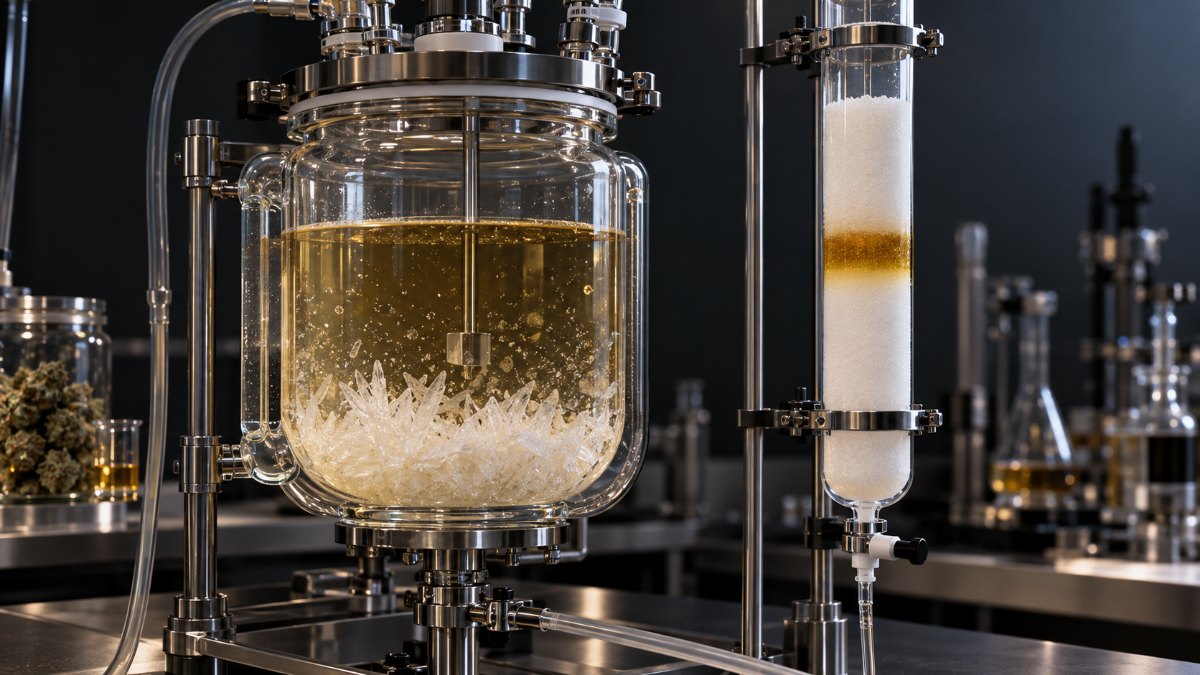
THC remediation is the step that turns a hemp extract you cannot legally sell into one you can. The math forces it: biomass at 8% CBD and 0.3% total THC carries a 27:1 CBD-to-THC ratio, and extraction preserves that ratio, so an 80% CBD distillate from compliant flower lands at roughly 3.0% total THC. That is ten times the federal limit. To reach 0.3% you remove 90% of the THC; to reach non-detect at a 0.01% limit of quantitation you remove 99.7%. Three methods do the work. Crystallization pulls CBD out as a solid at 98% or better purity and leaves THC behind in the mother liquor, recovering 60 to 75% of the CBD per pass. Reversed-phase flash chromatography separates THC from CBD in solution and reaches non-detect in a single pass at 85 to 95% CBD recovery. Degradation converts THC to CBN by oxidation and takes a slice of your CBD with it. Distillation is not on the list, and the reason it is not on the list is the first thing worth understanding.
Why a Compliant Field Produces a Hot Extract
The 0.3% number is a dry-weight concentration on the plant. Nothing about it survives extraction. When you strip cannabinoids out of biomass, the solvent does not discriminate between CBD and THC; both are neutral, lipophilic terpenophenolics with the same molecular formula, C21H30O2, and the same 314.5 g/mol molecular weight. Whatever ratio was in the flower is the ratio in the crude. Crude at 55% CBD from that same 8% biomass carries about 2.1% total THC. Distill it to 80% CBD and you concentrate the THC in step: 3.0%. Push to a 90% CBD distillate and you are at 3.4%. The only way an extract from compliant hemp ends up compliant without remediation is if the biomass CBD-to-THC ratio is above 267:1, which is a 0.03% THC plant at 8% CBD. Those exist in breeding programs and almost nowhere in commercial fields.
Two more numbers make it worse. First, total THC on a COA is delta-9 THC plus 0.877 times THCA, the mass-corrected sum after decarboxylation. An extract that was never fully decarbed hides THC as THCA and pays for it on the next heated step. Second, the federal hemp definition tightens on December 11, 2026: the hemp definition counts total THC (delta-9 plus THCA) rather than delta-9 alone, and a 0.4 mg per container cap on total THC applies to finished consumer products. Intermediate hemp-derived products above 0.3% total THC fall outside the hemp definition entirely, which makes a hot distillate a controlled intermediate until it is remediated. If you have been treating 0.3% delta-9 on the distillate COA as the finish line, the finish line moved. The operator playbook for the 2026 hemp rule walks the dates and the definitions; this page is about the chemistry that gets you under them.
The Chemistry That Makes THC Separable From CBD
Same formula, same mass, similar boiling behavior. What differs is a single ring closure. CBD is an open molecule: the terpene ring hangs off a resorcinol with two free phenolic hydroxyls. Delta-9 THC is CBD after one of those hydroxyls has attacked the terpene ring’s isopropenyl group and closed a pyran ring, which is exactly the acid-catalyzed step you run on purpose when you convert CBD to THC. The closure consumes one hydroxyl. THC has one free phenolic OH; CBD has two. That one hydroxyl is the whole separation. It makes CBD measurably more polar, which chromatography exploits, and it gives CBD a rigid, hydrogen-bonding geometry that packs into a crystal lattice. CBD is a crystalline solid with a melting point of 66 to 67 C. THC has no practical melting point; it is a glassy resin at room temperature and an oil above it. Cool a concentrated CBD solution and CBD leaves the solution as a solid while THC stays dissolved. That is crystallization. Push both through a stationary phase and the extra hydroxyl on CBD changes its retention relative to THC. That is chromatography.
Distillation has neither lever. Under the 0.05 to 0.1 mmHg vacuum a short path or wiped film runs at, THC and CBD travel in the same main-body fraction with a separation factor far too small to move a 3% feed anywhere near 0.3%. You can shave a fraction of a percent by taking very narrow cuts and throwing away most of your product. Nobody does that at scale because the arithmetic is worse than either real method. What distillation does do is decarboxylate completely, strip terpenes and residual solvent, and hand you a clean, high-concentration feed. That is why the correct sequence is distill first, then remediate. The wiped film distillation guide covers the front half; everything below assumes you are starting from distillate.
Method 1: CBD Crystallization
Crystallization is the cheapest route and the only one of the three that makes isolate. Dissolve CBD distillate in a nonpolar solvent at a 1:1 to 1:2 distillate-to-solvent ratio by weight, warm to 35 to 40 C to get everything into solution (below the 36 C boiling point of pentane you need a closed, chilled-condenser vessel, and pentane is a Class IA flammable, so this runs in a classified, ventilated space; heptane at 98 C gives you headroom), then cool on a controlled ramp: room temperature to -20 C over 12 to 24 hours, then a hold at -20 to -40 C for another 12 to 24 hours. Slow cooling grows large, clean crystals that trap little mother liquor. Crash-cooling grows a fine powder that traps a lot of it, and mother liquor is where the THC is. Filter cold, wash the cake with cold solvent, and vacuum-dry at 40 to 50 C, safely under the 66 C melting point, until residual pentane or heptane is under the 5,000 ppm Class 3 solvent limit.
| Crystallization Variable | Working Setpoint | What Happens Outside It |
|---|---|---|
| Feed CBD concentration | 80% or higher (distillate, fully decarbed) | Below about 70% CBD the solution does not supersaturate cleanly; crude at 55% gives an oily, THC-rich sludge instead of crystals |
| Solvent | Pentane (bp 36 C) or heptane (bp 98 C) | Ethanol dissolves CBD too well at low temperature; crystal yield collapses. Hexane works but carries a stricter 290 ppm residual limit under USP Class 2 |
| Distillate-to-solvent ratio (w/w) | 1:1 to 1:2 | Too dilute: CBD stays in solution, low first-crop yield. Too concentrated: THC and minors get trapped in a fast-forming cake |
| Cooling ramp | Ambient to -20 C over 12 to 24 h; hold at -20 to -40 C for 12 to 24 h | Crash cooling nucleates a fine powder that holds far more mother liquor per gram of crystal than slow-grown crystals; purity drops into the low 90s |
| First-crop CBD purity | 98 to 99.5% | Purity is set by how much liquor the cake holds; a cold-solvent wash is what gets you the last point |
| First-pass CBD recovery as isolate | 60 to 75% of feed CBD | The remainder stays in the mother liquor with essentially all of the THC, at a THC concentration 3 to 5 times the feed |
| THC in the isolate | Below 0.3% on the first crop; below the limit of quantitation after a recrystallization | Second and third crops pulled from concentrated liquor run 1 to 3% THC and are not compliant without reprocessing |
| Drying | Vacuum, 40 to 50 C, 24 to 48 h | Above 60 C the cake sinters and traps solvent; a wet cake fails the 5,000 ppm pentane or heptane limit |
The consequence people miss: crystallization does not remove THC from a broad-spectrum extract. It removes CBD from a THC-containing extract. The product is isolate. The THC does not go away; it concentrates in a mother liquor that is now hotter than anything you started with, and that liquor has to be managed as a THC-bearing intermediate. If your target product is broad spectrum, crystallization gets you a clean CBD backbone and then you rebuild the spectrum by adding back a THC-free minor cannabinoid and terpene fraction, which usually means chromatography did the actual THC removal on the minors anyway. If you want the deeper mechanics of nucleation, supersaturation, and seeding, the THCa crystallization reactor guide covers the same physics on the other cannabinoid.
Method 2: Chromatography
Chromatography is the only method that removes THC from an extract while leaving the rest of the spectrum in place. Three formats show up in hemp processing, and they trade throughput against resolution.
Reversed-phase flash. The workhorse. Distillate is dissolved and loaded onto a C18-bonded silica cartridge at 5 to 10% of the stationary-phase mass, then eluted with an ethanol-and-water or methanol-and-water mobile phase, either isocratic around 75 to 85% alcohol or on a gradient. On reversed phase, the more hydrophobic molecule is retained longer. THC, with its closed ring and single hydroxyl, is more hydrophobic than CBD, so CBD elutes first and THC comes off behind it. You collect the CBD-and-minors fraction, cut before the THC front, and send the THC-rich tail to a waste or conversion stream. Done with a correct cut, a single pass takes a 3% feed to non-detect at a 0.01% LOQ with 85 to 95% CBD recovery; the loss is the overlap zone you throw away to protect the spec. Mobile-phase consumption runs 20 to 50 liters per kilogram of distillate depending on load and cut width, which is why every serious flash installation includes solvent recovery.
Normal-phase flash. Bare silica with a nonpolar mobile phase such as heptane with a few percent ethyl acetate. Retention flips: the more polar molecule is held longer, so THC elutes first and CBD, with its extra hydroxyl, comes off later. Resolution is workable but the free silanols are mildly acidic, and an acidic surface plus heat plus CBD is the recipe for isomerizing CBD into THC on the column. It is used, but it is the format where the failure mode in the diagnostics section below shows up most often.
Centrifugal partition chromatography. No solid stationary phase at all: two immiscible liquids, commonly a heptane and acetonitrile pairing with a methanol or water modifier, held in a spinning rotor. Loading capacity is high, there is no silica to foul or acidify, and solvent can be recovered, but capital cost is higher and method development takes longer. CPC earns its place at facilities running multiple tonnes of distillate a year where flash cartridge consumption becomes the dominant cost.
| Chromatography Format | Elution Order | Load (% of stationary phase) | THC Floor, One Pass | CBD Recovery | Where It Fits |
|---|---|---|---|---|---|
| Reversed-phase flash (C18) | CBD first, THC last | 5 to 10% | Non-detect at 0.01% LOQ | 85 to 95% | Broad spectrum and T-free distillate; 1 to 20 kg per day per system |
| Normal-phase flash (silica) | THC first, CBD last | 2 to 5% | Below 0.3%; non-detect needs a second pass | 80 to 90% | Legacy setups; watch for on-column isomerization |
| Centrifugal partition (CPC) | Depends on phase system; typically CBD before THC in descending mode | 5 to 15% of rotor volume | Non-detect | 90% or higher | Multi-tonne annual volumes where cartridge cost dominates |
| Preparative HPLC | As reversed-phase flash, higher resolution | 1 to 3% | Non-detect, with minor cannabinoid isolation possible | 90% or higher | Minor cannabinoid isolation (CBG, CBC, CBN) more than bulk remediation |
Method 3: Degradation and Conversion
The third category does not separate THC. It destroys it in place. Delta-9 THC oxidizes to cannabinol through aromatization of the cyclohexene ring: heat, oxygen, UV light, and certain catalysts all push the reaction, and CBN is not counted in any total-THC definition. So a heated, aerated, or irradiated hold on the distillate drives THC down and CBN up, and the COA comes back compliant. Commercial systems sold as THC conversion or remediation reactors are doing a version of this.
Two problems. The reaction is not selective. CBD oxidizes under the same conditions, to cannabielsoin and to the CBD hydroxyquinone, and it does not do so slowly; plan on losing 15 to 30% of your CBD to get the THC where it needs to be, and expect a darker, more bitter product with a heavier CBN load than your buyers signed up for. Second, and this is the one that ends careers, some of the same conditions run the reaction you do not want. Acid plus heat cyclizes CBD to THC. If the feed is acidic, if the catalyst is acidic, if the vessel has residual acid from a previous conversion run, you can come out of a remediation step with more THC than you went in with, plus a delta-8 peak you did not have. The extract pH guide puts the isomerization window below pH 4 on a 10% ethanol slurry; check it before you heat anything. Degradation has a narrow legitimate use: cleaning up a small, low-value stream where CBD loss does not matter and the CBN is wanted. It is not a remediation strategy for a product you plan to sell as CBD.
The Comparison Every Vendor Page Skips
| Method | What It Produces | THC Floor | CBD Recovery | Solvent per kg Feed | Capital (list price by scale) | Where the THC Ends Up |
|---|---|---|---|---|---|---|
| Crystallization | CBD isolate, 98 to 99.5% | Below 0.3% first crop; non-detect on recrystallization | 60 to 75% per pass as isolate; 85% or higher with liquor recycling | 1 to 2 kg pentane or heptane, recoverable | $15,000 to $80,000 (jacketed reactor, chiller, filter, vacuum oven) | Mother liquor, at 3 to 5 times feed concentration |
| Reversed-phase flash | Broad-spectrum or T-free distillate | Non-detect at 0.01% LOQ, one pass | 85 to 95% | 20 to 50 L alcohol-water, recoverable | $60,000 to $250,000 plus solvent recovery | A THC-rich tail fraction, 10 to 30% THC |
| CPC | Broad-spectrum or T-free distillate; minor cannabinoid cuts | Non-detect | 90% or higher | 10 to 30 L biphasic system, recoverable | $150,000 to $500,000 | A THC fraction in the mobile phase |
| Degradation to CBN | CBN-enriched, darker distillate | Below 0.3% with enough time and heat | 70 to 85% | None | $5,000 to $60,000 (reactor, UV or oxidant dosing) | Converted to CBN and oxidation byproducts in the product |
| Fractional distillation | Not a remediation method | Fractions of a percent at best, with most of the product discarded | Low if you chase the cut | None | You already own it | Still in the main body |
Crude or Distillate: Where to Remediate
Distillate, every time, for three reasons that all trace back to the same fact: crude is a mixture and distillate is a concentrate. First, crude at 55% CBD does not supersaturate cleanly in pentane; the waxes, chlorophyll, and residual terpenes hold CBD in solution and the crop comes out oily and dark. Second, crude on a C18 cartridge fouls it; the lipids and pigments load onto the stationary phase, cut usable capacity by half or more, and shorten cartridge life from dozens of runs to a handful. Third, crude is not fully decarbed, and any THCA that rides through the process shows up as THC the first time the product is heated, on a total-THC COA that counts it at 0.877 times its mass. Distillation solves all three at once: it winterizes and decolorizes by exclusion, decarbs completely, and delivers 80 to 90% cannabinoids. The feed preparation guide tells you what the distillate should look like before it goes anywhere near a remediation step. The one case for remediating earlier is a facility that runs CPC on winterized crude to pull a minor cannabinoid fraction ahead of distillation, and that is a minor-isolation strategy, not a THC-compliance one.
Choosing by Target Specification
The right method is set by the product you are selling, not by the equipment you own.
| Target Product | THC Spec | Method | Why |
|---|---|---|---|
| Compliant full-spectrum distillate | Under 0.3% total THC, and under 0.4 mg per finished container after Dec 11, 2026 | Reversed-phase flash with a wide cut, or blend with T-free distillate | You are removing 90% of the THC, not all of it; a wide cut keeps recovery in the mid 90s. Blending a compliant lot with T-free distillate lowers total THC by dilution; confirm how your state treats the pre-blend lot before relying on it |
| Broad-spectrum distillate (T-free) | Non-detect, LOQ stated on the COA | Reversed-phase flash or CPC | Only chromatography removes THC while keeping CBG, CBC, and terpenes in place |
| CBD isolate | Non-detect | Crystallization, with recrystallization for non-detect | Cheapest route to a 99% product; THC leaves with the mother liquor |
| Minor cannabinoid isolates (CBG, CBC, CBN) | Non-detect | CPC or preparative HPLC | Resolution between minors is the job; THC removal comes free with it |
| Mother liquor or THC-rich tail fraction | Not sellable as hemp; 10 to 30% THC | Second crop for more isolate, then destruction or transfer under whatever your state allows | This stream is a controlled intermediate the moment it exists; plan its custody before you make it |
The Cost Math on 100 kg of Distillate
Take 100 kg of 80% CBD distillate at 3.0% total THC. That is 80 kg of CBD and 3 kg of THC going in.
Crystallization to isolate. First crop at 70% recovery yields 56 kg of 99% isolate carrying under 170 g of THC in total, which is 0.3% or less on the crop. The mother liquor holds 24 kg of CBD and nearly all 3 kg of THC in roughly 100 to 150 kg of solvent-and-cannabinoid liquor, so the liquor is now 10% or more THC on a solvent-free basis. A second crop after concentrating the liquor recovers another 10 to 12 kg of CBD, but at 1 to 3% THC that crop is not compliant and goes back through as feed for a later recrystallization. Solvent recovery returns 90 to 95% of the pentane. Consumables are the solvent make-up, filter media, and chiller run time; the labor is the cooling ramp.
Reversed-phase flash to T-free distillate. At 90% CBD recovery you take 72 kg of CBD forward in a non-detect distillate and give up 8 kg of CBD in the overlap and tail fractions along with the 3 kg of THC. Mobile phase at 30 L per kg is 3,000 L of ethanol-water, of which 85 to 90% comes back through recovery. Cartridge or column life sets the rest of the cost: a C18 bed at 10% loading processes 10 times its own mass per run, so 100 kg of feed is 10 runs on a 10 kg bed or 100 runs on a 1 kg bed, and the number of runs before resolution degrades is the single biggest variable in cost per kilogram. Ask a vendor for that number before you ask for anything else.
The comparison that matters. Isolate at 56 kg from a 100 kg run versus broad-spectrum distillate at 90 kg from the same run is a 34 kg swing in sellable product. Isolate sells for more per kilogram and costs less to make; broad spectrum sells as a premium ingredient and keeps the minors. The mother liquor from crystallization and the tail from chromatography are both THC-bearing waste streams you cannot sell as hemp, and the facility has to have a documented disposition for them before the first run. This is the point at which most operators call for a process design rather than a piece of equipment. If you want to understand the whole sequence hands-on, from crude QC through distillation into a remediation step you can defend on a COA, that is the workflow we teach at extractiontraining.com.
Common Failures and How to Diagnose Them
1. THC creeping up in the isolate over successive batches.
Symptom: First-crop isolate that tested 0.1% THC in month one is testing 0.4% in month three on the same feed.
Root cause: Mother liquor is being recycled into fresh feed. Each pass concentrates THC in the liquor, and a small fraction of that liquor is retained in every cake. The THC in the crystal is not in the lattice; it is in the liquor wetting the crystal surface, and the liquor is getting hotter every cycle.
Diagnostic test: Trend THC on the mother liquor, not the isolate. If liquor THC climbs batch over batch, the recycle loop is the cause.
Fix: Cap the recycle at two passes, bleed the liquor to a separate THC-rich stream, and add a cold-solvent cake wash at the filter. Purity on the wash step is worth more than an extra crop.
2. Non-detect on delta-9, hot on total THC.
Symptom: The remediation COA reads non-detect for delta-9 THC. The finished gummy or tincture tests at 0.5% total THC.
Root cause: The feed was not fully decarboxylated, and THCA rode through the remediation step. THCA is more polar than THC and behaves differently on the column, so a cut set against the delta-9 peak does not catch it. The formulation step then heated the product and decarbed the THCA into delta-9.
Diagnostic test: Run the full acid-and-neutral panel on the feed and on the remediated fraction and calculate total THC as delta-9 plus 0.877 times THCA. Any THCA above the LOQ on a remediated fraction is a failed process.
Fix: Remediate distillate, never crude, and confirm decarboxylation is complete by a THCA reading below LOQ on the distillate COA before it goes to remediation.
3. THC breakthrough into the CBD fraction on flash.
Symptom: The CBD fraction that used to test non-detect is testing 0.2 to 0.5% THC with no change in the method.
Root cause: Either loading crept above 10% of the stationary-phase mass, or the C18 bed has lost capacity through fouling and the effective loading rose without the operator changing anything. In both cases the THC band broadens forward into the CBD band.
Diagnostic test: Overlay the in-line UV trace from the failing run on a trace from a passing run. Loss of baseline return between the CBD and THC peaks is the signature. If the load is unchanged, the bed is spent.
Fix: Drop loading to 5%, widen the cut, and replace the cartridge. Log runs per cartridge from now on so the replacement is scheduled, not discovered.
4. More THC out than in.
Symptom: Feed at 3.0% THC; product at 3.5% with a new delta-8 peak.
Root cause: Acid-catalyzed cyclization of CBD to THC during the remediation step. Sources: an acidic feed from a prior wash or degumming step, acidic silanols on a normal-phase silica column run warm, or residual acid catalyst in a reactor shared with a conversion process. CBD closes its ring and becomes the molecule you were trying to remove.
Diagnostic test: Check the feed pH on a 10% ethanol slurry; below 4 is the isomerization window. Check the delta-8 peak: it does not occur naturally in meaningful amounts, so its appearance is a fingerprint for acid isomerization.
Fix: Neutralize and water-wash the feed, use end-capped reversed-phase media instead of bare silica, keep column temperature under 30 C, and never share vessels between conversion and remediation lines.
5. Non-detect at your lab, detected at the buyer’s.
Symptom: Your COA says ND. The buyer’s COA on the same lot says 0.03% THC and rejects the shipment.
Root cause: Non-detect means below the limit of quantitation, and the LOQ is a property of the lab’s method, not the product. Cannabinoid LOQs on HPLC commonly sit anywhere between 0.01 and 0.05% by weight. Your lab reported ND at 0.05%; theirs quantified at 0.01%.
Diagnostic test: Read the LOQ line on both COAs. If it is not printed, the COA is not fit for a T-free claim.
Fix: Write the LOQ into the product specification and the purchase contract, and remediate to the tightest LOQ your buyers use, not to your own.
6. Isolate fails on residual solvent, not THC.
Symptom: THC is non-detect. Pentane comes back at 8,000 ppm against a 5,000 ppm limit.
Root cause: A wet cake or a crash-cooled, fine-grained crop that holds solvent between crystals, dried too fast or too hot so the surface sintered and trapped the interior.
Diagnostic test: Weigh the cake before and after drying. Mass loss below 8 to 10% on a pentane-wet cake means solvent is still in there.
Fix: Vacuum-dry at 40 to 50 C for 24 to 48 hours with the cake spread thin, and slow the cooling ramp on the next batch so the crystals grow large enough to drain. The residual solvent purging SOPs cover the drying curve by solvent.
7. The COA passes and the product is ruined.
Symptom: Total THC dropped from 3% to 0.2%. CBD dropped from 80% to 62%. CBN went from 0.5% to 4%. The distillate is dark and bitter.
Root cause: A degradation-based remediation ran long enough to hit the THC spec and took a quarter of the CBD with it. The CBN and the color are the oxidation products.
Diagnostic test: Mass balance on the full cannabinoid panel before and after. A separation method conserves cannabinoids across the fractions; a degradation method does not.
Fix: Stop using degradation on product intended for sale as CBD. Route that feed to flash or crystallization.
COAs, Non-Detect, and the Documentation That Survives an Audit
A remediation step generates three lots where there was one: the compliant product, the THC-rich waste or tail stream, and any intermediate crop or fraction that is going back through. Every one of them needs its own COA with the full acid-and-neutral cannabinoid panel, total THC calculated and printed, the LOQ stated, and the residual solvent panel on anything that touched pentane, heptane, or an alcohol-water mobile phase. The THC-rich stream is the one that gets a facility in trouble, because it is a concentrated THC intermediate sitting in a hemp facility, and the custody chain for it has to exist on paper before the first run. Whether it is destroyed on site, transferred to a licensed marijuana processor where the state permits it, or held for a second crop, that decision is a compliance decision made ahead of time, not a disposal problem discovered afterward. If a failed batch is what sent you here in the first place, the remediate, reprocess, or destroy framework is the decision layer above this page.
Frequently Asked Questions
What is THC remediation?
THC remediation is the removal or reduction of delta-9 THC from a hemp extract so the extract meets a legal or product specification, usually under 0.3% total THC or non-detect. It is done by crystallizing the CBD out as a solid, by separating THC from the other cannabinoids with chromatography, or by degrading THC to CBN. Distillation does not remediate THC because THC and CBD distill together.
Can you remove THC with a short path or wiped film still?
No. THC and CBD have the same molecular formula and mass and travel in the same main-body fraction under the 0.05 to 0.1 mmHg vacuum a still runs at. The separation factor is too small to take a 3% THC feed to 0.3% without discarding most of the product. Distillation is the step before remediation: it decarboxylates, strips solvent and terpenes, and concentrates the feed to 80% or more cannabinoids.
Which THC remediation method reaches non-detect?
Reversed-phase flash chromatography reaches non-detect at a 0.01% LOQ in one pass at 85 to 95% CBD recovery, and CPC does the same at higher volumes. Crystallization reaches under 0.3% on the first crop and non-detect after a recrystallization, but the product is isolate, not a spectrum extract. Degradation can reach 0.3% but at the cost of 15 to 30% of the CBD and a heavy CBN load.
How much CBD is lost during THC remediation?
Crystallization leaves 25 to 40% of the CBD in the mother liquor on a single pass, most of which is recoverable in later crops. Reversed-phase flash loses 5 to 15% in the overlap and tail fractions that are discarded to protect the spec. CPC and preparative HPLC lose under 10%. Degradation loses 15 to 30% and converts it to oxidation products rather than leaving it recoverable.
Should THC remediation be done on crude or on distillate?
Distillate. Crude at 55% CBD does not crystallize cleanly, fouls chromatography media and cuts cartridge life by half or more, and carries THCA that rides through the step and decarboxylates into THC later. Distillation removes all three problems and delivers a fully decarbed 80 to 90% cannabinoid feed.
Does total THC include THCA after remediation?
Yes. Total THC on a COA is delta-9 THC plus 0.877 times THCA, and the federal hemp rule effective December 11, 2026 defines hemp and hemp-derived products by total THC rather than delta-9 alone, with a 0.4 mg total THC cap per finished consumer container. Any THCA that survives remediation counts. Confirm THCA is below the limit of quantitation on the distillate before it goes to remediation.
Is converting THC to CBN a legitimate THC remediation method?
It lowers total THC, and CBN is not counted in the total-THC calculation, but the oxidation is not selective. It degrades CBD at the same time, darkens the extract, and adds CBN the buyer did not order. It is defensible for a small low-value stream where CBN is wanted. For a product sold as CBD, use a separation method.
Ready to level up your extraction game? Contact WKU Consulting for personalized guidance on building your extraction lab.
For more deep dives into cannabis chemistry, extraction SOPs, and lab design, subscribe to the WKU Consulting YouTube channel.
Watch a related video:
