
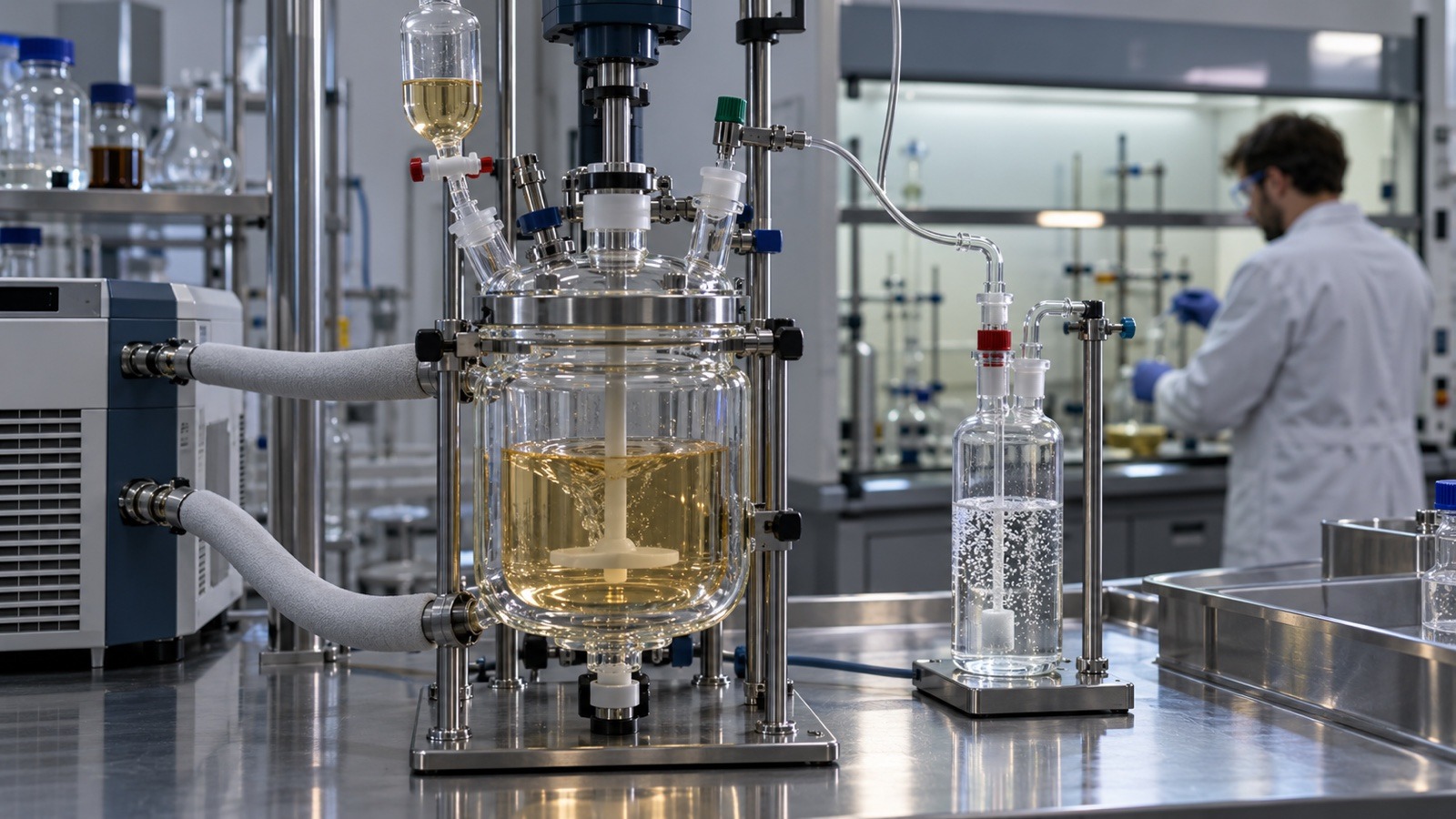
Euphorinol was not discovered in a super sativa and it is not extracted from anything. It is built from scratch in seven chemical steps, and the starting material is 3′,5′-dimethoxyacetophenone, an industrial ketone with no relationship to cannabis until a chemist forces one. The route runs protect, demethylate, couple, cyclize, deprotect, modify, purify. Two of those steps use boron reagents that fume on contact with air, one generates methyl bromide as a byproduct, and one uses a silver salt to tear a protecting group off a molecule that would otherwise be destroyed by the catalyst that built it. The last chemical step is the one that defines the compound: a hydroxylamine reagent condenses with a methyl ketone to form an oxime ether, a carbon-nitrogen double bond carrying an oxygen-linked side chain where a simple carbonyl used to sit. No cannabis plant makes that bond. No enzyme in the plant has ever made that bond. That single modification is why third-party labs keep reporting an unidentified peak at mass 368 on products sold as EPN, when THC sits at 314 and HHC at 316, and why no reference standard exists to name it.
Everything written about this molecule in the retail market is either marketing copy or a guess. This article is the chemistry.
What Euphorinol Actually Is
Start by throwing out the product page language. Euphorinol is described across the hemp market as a “newly discovered hemp compound,” a “proprietary terpene-rich multi-cannabinoid blend,” and a product of “advanced molecular refinement of super sativa strains.” Those three descriptions are mutually exclusive, and none of them describes a synthesis.
Euphorinol is a semi-synthetic cannabinoid in the structural sense that matters: it carries the tricyclic benzochromene framework that defines the cannabinoid class, built by the same ring-closure logic that produces THC from a resorcinol and a terpene, and then it carries a functional group that cannabis biosynthesis has no pathway to. The core is cannabinoid. The decoration is not.
That distinction controls everything downstream. A cannabinoid skeleton means it fits the general shape that the CB1 binding pocket recognizes. An oxime ether on a cannabinoid skeleton means no plant material, no reference standard, no toxicology package, and no chromatographic method that was ever validated against it. Analytical chemistry can only find what it has been taught to look for, and nobody taught the instruments this one.
For comparison, the semi-synthetics the industry already knows are modifications of a cannabinoid that already existed. HHC is THC with the double bond hydrogenated away. Delta-8 is delta-9 with the olefin slid one position downhill. THCP is the same scaffold with a longer side chain. We cover those routes in detail in our guide to novel cannabinoid synthesis from CBD. Every one of them starts with a cannabinoid and edits it. Euphorinol starts with a benzene ring that is not a cannabinoid, assembles the cannabinoid, and then edits that. It is a longer road and a completely different kind of work.
The Starting Material Nobody Expects
3′,5′-dimethoxyacetophenone is a small, cheap, commercially available molecule. An aromatic ring sits in the middle. Two methyl ether groups hang off it, one at each end. A ketone hangs off the side, a carbon double bonded to oxygen with a methyl cap.
It gets chosen for one reason: the substitution pattern is already right. Those two oxygens sit exactly where a cannabinoid A-ring needs its oxygens. Buy the pattern instead of building it, and you skip an entire synthetic campaign.
The problem is that both features are in the wrong state at the same time. The oxygens are locked behind methyl caps, so they cannot participate in a ring closure. The ketone is wide open, so it will be attacked by the Lewis acid catalyst that performs the ring closure. You cannot fix both at once, and the order you fix them in is the entire design of the route. Fix the ketone first and the demethylation that follows leaves it untouched. Fix the ring first and the ketone sits exposed through four more steps waiting to be destroyed.
The Seven Steps and Why Each One Exists
Here is the route, the purpose of each operation, and what happens to the batch when an operator decides a step looks optional.
| Step | Operation | Why It Is There | What Happens If You Skip It |
|---|---|---|---|
| 1 | Dithiolane protection of the ketone, ethanedithiol under BF3 catalysis | Hides the carbonyl from the Lewis acid used five steps later | The ring closure catalyst coordinates the free ketone and wrecks the molecule before cyclization |
| 2 | Boron tribromide demethylation of both aryl methyl ethers | Unmasks the resorcinol that becomes the cannabinoid A-ring | The ring has no free phenol, so the terpene has nothing electron rich to attack and the pyran oxygen does not exist |
| 3 | pTSA-catalyzed coupling with a monoterpenoid alcohol | Installs the carbon skeleton that becomes the C-ring, one new carbon-carbon bond | No terpene, no cannabinoid, only a substituted resorcinol |
| 4 | BF3-promoted intramolecular cyclization | Closes the pyran ring and creates the tricyclic benzochromene framework | The product is an open-chain adduct, not a cannabinoid at all |
| 5 | Silver nitrate removal of the dithiolane in aqueous ethanol | Regenerates the methyl ketone that the final step needs | The thioacetal survives into the condensation and there is no carbonyl for the hydroxylamine to attack |
| 6 | Oxime ether formation with an O-alkylhydroxylamine in pyridine and acetic acid | Converts the ketone to a C=N-O linkage, the modification that defines the compound | You have an unremarkable tricyclic methyl ketone, not Euphorinol |
| 7 | Flash chromatography, hexane and ethyl acetate gradient | Separates the major geometric isomer from the minor one and from reaction byproducts | You ship a mixture of two geometric isomers plus pyridine carryover and call it a single compound |
Step 1: Protect the Ketone Before It Becomes a Liability
1,2-ethanedithiol is a two-carbon chain with a sulfur atom on each end. Under boron trifluoride catalysis, those two sulfurs displace the ketone oxygen and close around the carbonyl carbon to form a five-membered ring, a 1,3-dithiolane.
The question any chemist should ask is why sulfur and not oxygen. An ordinary acetal protecting group uses a diol and gives a dioxolane, which is easier to install and easier to remove. It is also useless here. Dioxolanes are cleaved by Lewis acids, and this route runs a Lewis acid through the molecule at the ring closure. The protecting group would come off exactly when it is needed most.
Sulfur solves it through hard and soft acid-base behavior. Boron reagents are hard acids and they bind preferentially to hard donors, which means oxygen. Sulfur is soft and large and polarizable, and the boron catalyst walks straight past it. The dithiolane sits on the molecule for four more steps, chemically invisible to the one reagent that would otherwise destroy the carbonyl it protects. That is the whole reason the first step of a cannabinoid synthesis involves a thiol that smells like a gas leak at concentrations below one part per billion.
Step 2: Boron Tribromide Takes the Caps Off
Those two methyl ethers are blocking the positions the molecule needs. Boron tribromide removes them.
The mechanism is worth stating precisely, because the usual shorthand gets it wrong. BBr3 coordinates to the ether oxygen through its empty p orbital, which turns that oxygen into a leaving group assembly. A bromide ion then attacks the methyl carbon and displaces it as methyl bromide gas. What remains on the ring is not yet a phenol. It is an aryl dibromoborinate ester, and the free phenol only appears when the reaction is quenched and that boron ester is hydrolyzed. Both methyl ethers are cleaved in the same pot by excess reagent, not one after the other. When both are gone and the quench is complete, the dimethoxyphenyl has become a resorcinol, two free hydroxyls on the ring, and that resorcinol is the future A-ring of the cannabinoid.
This is the most hazardous step in the procedure, and the reason has nothing to do with the cannabinoid. BBr3 reacts violently with water. Not liquid water in a beaker. Moisture. Humidity on glass. A joint that was not dried properly. Every piece of glassware is oven dried and cooled under nitrogen in a desiccator before the reagent is unsealed, and the reactor is purged with dry nitrogen before anything goes into it.
The off-gas problem is the part operators underestimate. The reaction generates hydrogen bromide, and the quench generates far more of it in a short window. A mineral oil bubbler cannot absorb that gas load and will blow out. A caustic gas scrubber with a backflow trap between it and the reactor is the only acceptable configuration, and the scrubber stays connected through the end of the quench, not just during the addition.
Then there is the methyl bromide. OSHA sets a ceiling limit of 20 ppm with a skin notation, and NIOSH does not publish a recommended exposure limit at all, because it classifies methyl bromide as a potential occupational carcinogen and advises reducing exposure to the lowest feasible concentration. The part that gets missed is simpler than either number: standard acid gas respirator cartridges do not capture alkyl halides. An operator wearing a full-face respirator with acid gas and organic vapor cartridges is protected against the hydrogen bromide and is not protected against the methyl bromide. The fume hood is the primary engineering control for that exposure, and no cartridge substitutes for it. If you take one piece of hazard information away from this article, make it that one.
Step 3: Attach the Terpene
With the resorcinol exposed and the ketone still hidden, the terpene goes on. The partner is a monoterpenoid alcohol carrying an isopropenyl group, and it supplies the carbon skeleton that becomes the C-ring.
Under p-toluenesulfonic acid catalysis in dichloromethane, the terpene’s tertiary alcohol ionizes and leaves as water, generating a tertiary carbocation. Resorcinol rings are strongly electron rich, because two hydroxyl groups donate into the ring and light up the positions between and beside them. That electron-rich ring attacks the carbocation in a Friedel-Crafts type alkylation and forms one new carbon-carbon bond.
The product at this point is still an open chain. It has the aromatic ring, it has the terpene, and it is not a cannabinoid. Anyone who has run a CBD isomerization recognizes the position immediately, because CBD is also an open-chain resorcinol-terpene adduct waiting for a ring closure. The chemistry that converts CBD to THC is the same ring closure, which is why the choice of acid catalyst drives selectivity in both cases.
Step 4: Close the Ring and Control Where the Double Bond Lands
Boron trifluoride etherate promotes the intramolecular cyclization. A resorcinol oxygen swings in, attacks an electrophilic carbon on the terpene fragment, and closes the pyran ring. The molecule folds into the tricyclic benzochromene framework, and that framework is the cannabinoid skeleton.
Temperature governs the outcome and nothing else does. Keep the reactor cold while the Lewis acid goes in, then warm it gently. Let the exotherm run and the olefin migrates from the delta-9 position to the delta-8 position, which is the thermodynamically favored location. This is the same energy landscape that decides whether a conversion reactor produces delta-9 or drifts to delta-8, covered in our CBD to THC isomerization guide. The molecule always wants to slide downhill. Control the heat and you control where it stops.
This is the step where the dithiolane earns its place in the route. The Lewis acid that closes this ring would have coordinated a free ketone and taken the batch apart. It walks past the thioacetal without noticing it.
Step 5: Silver Pulls the Protecting Group Off
The dithiolane has done its job and now it is in the way, because the final step needs the ketone back.
Silver nitrate in aqueous ethanol handles the removal. Silver is thiophilic, meaning it has a strong affinity for sulfur, and silver ions coordinate to both sulfur atoms of the thioacetal and weaken the carbon-sulfur bonds until the ring falls apart and the carbonyl returns. A dark precipitate forms and drops out of solution as the reaction proceeds, which is silver binding sulfur and dragging it out of the equilibrium. Filtering that solid through a Celite pad leaves the methyl ketone clean in the filtrate.
Two operational notes that matter more than they look. The filter cake is heavy metal waste of uncharacterized composition. It is commonly assumed to be silver sulfide, and assuming is not the same as knowing, so it goes to a labeled heavy metal waste stream wet, immediately, and it does not dry on the filter. And silver-contaminated glassware gets rinsed with water first, never acetone. Residual silver also becomes a release specification problem later, which is why ICP-MS for silver belongs on the final product test panel and not on a wish list.
Step 6: The Step That Makes It Euphorinol
Everything up to this point produced a tricyclic methyl ketone, a competent cannabinoid-type molecule that is not yet the target. The sixth step is the one that separates this compound from every cannabinoid in the plant.
An O-alkylhydroxylamine reagent condenses with that ketone in pyridine with acetic acid. The nitrogen of the hydroxylamine attacks the carbonyl carbon, water leaves, and what forms is an oxime ether: a carbon-nitrogen double bond with an oxygen-linked side chain, sitting where a simple carbonyl used to be. Pyridine acts as the base and the solvent, acetic acid catalyzes the dehydration, and the equilibrium is driven by removing water.
Cannabis has no biosynthetic route to a carbon-nitrogen double bond on a cannabinoid skeleton. There is no enzyme for it, no precursor pool for it, and no reason for a plant to build one. The marketing language about a compound “discovered in super sativa strains” dies on this step. This is a designed molecule and the design is deliberate.
The condensation also produces two geometric isomers, because a carbon-nitrogen double bond has two faces the way a carbon-carbon double bond does. In the E isomer the substituents sit on opposite sides of that double bond, and in the Z isomer they sit on the same side. Thermodynamics strongly favors E for O-alkyloximes of methyl aryl ketones, so E dominates the crude mixture and Z shows up as the minor component. Both are real compounds. Both end up in the product if nobody separates them.
Step 7: Separate the Isomers or Admit You Did Not
Flash chromatography on silica gel with a hexane and ethyl acetate gradient resolves the two isomers and strips the byproducts. Fractions get checked analytically before pooling, and the purified major isomer is Euphorinol.
The step is not optional and it is the one most likely to be skipped at commercial scale, because chromatography is slow, consumes solvent, and costs recovery. Skipping it means shipping a two-component mixture under a single-compound name, with whatever pyridine survived the workup riding along. If you want to understand why that residual pyridine matters at release, our guide on purging residual solvents covers the class limits that apply.
Why This Is the Most Dangerous Route in Cannabinoid Chemistry
Isomerization labs handle acids and flammable solvents. This route handles a violently water-reactive reagent, a thiol that is acutely toxic by every route of exposure, a heavy metal oxidizer, and two halogenated solvents, and it generates two toxic gases as byproducts of normal operation.
| Hazard Source | What It Does | Primary Control | The Mistake Operators Make |
|---|---|---|---|
| Boron tribromide | Reacts violently with moisture, generates hydrogen bromide, classified fatal if swallowed | Oven-dried glassware cooled under nitrogen, caustic gas scrubber with backflow trap, fume hood | Trusting a mineral oil bubbler to handle the quench gas load |
| Methyl bromide byproduct | Acute inhalation toxin, OSHA ceiling 20 ppm with skin notation, NIOSH potential occupational carcinogen | Fume hood containment, full stop | Assuming an acid gas cartridge covers it. It does not capture alkyl halides |
| 1,2-ethanedithiol | Acutely toxic by all routes, odor detectable below one part per billion | Closed-system transfers under nitrogen inside the hood | Bleaching acid-contaminated glassware, which generates chlorine gas. Water rinse comes first |
| Boron trifluoride etherate | Corrosive, moisture sensitive, lachrymator | Fume hood, gauntlet gloves over nitrile inners | Treating it like the catalyst bottle on an isomerization bench |
| Silver nitrate | Oxidizer, burns, permanent staining, heavy metal waste stream | Dedicated glassware, water rinse, segregated waste | Letting the filter cake dry on the frit and rinsing silver residue with acetone |
| Dichloromethane and chloroform | Central nervous system depressants, both suspected carcinogens | Fume hood and a methylene chloride program under OSHA 29 CFR 1910.1052 | Running halogenated solvent at volume with no exposure monitoring program on file |
Read that table as a staffing document, not a shopping list. A facility that runs hydrocarbon extraction has engineering controls built for flammability. This route needs controls built for acute toxicity and gas handling, which is a different competency, a different hood specification, and a different waste contract. The two skill sets overlap less than people assume.
If you want the fundamentals behind this kind of work taught properly, with the lab walkthroughs and the documentation practice that makes it transferable to your own bench, that is what we built extractiontraining.com for.
Why Your Lab Report Says Unknown Cannabinoid
Here is where the chemistry collides with the market. Independent analysts tracking “super sativa” products through 2025 and 2026 kept finding the same thing on third-party certificates: a peak the instrument could see clearly and could not name, reported as an unknown cannabinoid at mass 368. For scale, THC sits at 314 and HHC at 316. A 368 entity is a substantially heavier and more decorated molecule than anything the plant produces.
The same analytical signature has surfaced under at least four different commercial labels, and in several cases under none at all. One certificate carried the disclaimer “naming and standard provided by the customer,” which is a laboratory telling you in writing that the compound name on the report came from the person selling the product. In other reports on the same product lines, the peak is absent from the results table entirely, leaving a certificate that shows only CBD and CBG and presents a clean compliance picture for material whose effects come from something that was left off the page.
| Analytical Method | What It Proves | What It Cannot Prove |
|---|---|---|
| HPLC area percent | Relative detector response across the peaks present | Mass fraction. Potency requires a validated quantitative method against a reference standard, and area percent is not that |
| Standard cannabinoid potency panel | Concentration of the cannabinoids in the calibration set | Anything outside that set. A compound with no standard reports as absent, not as present and unnamed |
| GC-MS or LC-MS without a reference standard | That a distinct entity is present and what it weighs | Its identity. Mass plus retention time narrows the field and does not name the molecule |
| High-resolution MS | Molecular formula assignment | Stereochemistry. Isomers sharing a formula are indistinguishable by formula alone |
| 1H NMR | Connectivity and functional group identity, including the oxime geometry | Trace-level impurity profile at the concentrations that matter for a residual specification |
| ICP-MS | Residual metal content, which for this route means silver | Anything organic. It is the only test that catches the Step 5 failure and it is almost never run |
Put those rows together and the “no detectable THC” claim on an EPN certificate becomes readable. It may be perfectly true and still tell you nothing, because the panel that produced it was calibrated for plant cannabinoids and the active ingredient was never in the calibration set. A non-detect for a compound the method cannot see is not a finding. This is the same structural problem we documented in our work on cannabis lab testing fraud, except here it does not require anyone to cheat. The method simply was not built for the molecule.
The analytical gap is not unique to this compound either. A 2025 paper in Drug Testing and Analysis identified three previously unknown tetrahydrocannabinol analogs circulating in the European market under trade names, and the authors noted the same structural problem: the compounds have no spectroscopic or chromatographic reference data, have never been found in cannabis plants, and cannot be identified by standard forensic chromatographic methods without spectroscopic work. Naming a molecule in a catalog does not create a method for it.
One more point, stated plainly because the market will not state it. Material sold under the EPN name is not consistent. Buyers have reported receiving product that failed on the exact specification it was sold against. A trade name is not a specification, and a certificate without a named standard behind it is a document, not evidence.
Common Failures and How to Diagnose Them
Seven ways this route goes wrong, in the order you will meet them.
Symptom: The demethylation turns into a dark tar instead of a clean product.
Root cause: Moisture. Boron tribromide hydrolyzes on contact with trace water, which consumes reagent and generates acid in the pot that attacks the substrate.
Diagnostic test: Karl Fischer titration on the solvent lot and a review of the glassware drying record. Tar that appears immediately on addition points at the glassware, tar that develops over the aging period points at the solvent.
Fix: Fresh oven-dried glassware cooled under nitrogen, verified dry solvent, and restart. There is no recovering the batch.
Symptom: The cyclization produces the wrong double bond position, delta-8 where delta-9 was intended.
Root cause: The exotherm got away during Lewis acid addition. The delta-8 position is thermodynamically downhill and heat is the permission slip.
Diagnostic test: The olefinic region of the proton NMR separates the two, and chromatographic retention against a qualified reference confirms it.
Fix: Control the addition rate so the jacket stays ahead of the reaction, and keep the warming gentle afterward. Do not try to isomerize it back.
Symptom: Residual thioacetal survives the silver step, and the next step stalls.
Root cause: Insufficient silver charge relative to the actual mass carried forward, or not enough contact time for the precipitate to drive the equilibrium.
Diagnostic test: Thin layer chromatography shows the protected spot persisting alongside the ketone product spot.
Fix: Additional silver charge and extended contact. Calculate the charge from the measured mass entering the step, never from the original starting material.
Symptom: The oxime condensation stalls with ketone still present long after it should have converted.
Root cause: Degraded hydroxylamine reagent. These reagents are not shelf-stable indefinitely and the hydrochloride salt can carry water.
Diagnostic test: Run NMR on the reagent itself before blaming the reaction. Most teams spend a day troubleshooting the pot when the bottle was the problem.
Fix: Verify reagent identity and purity on receipt and before each campaign, and replace it rather than pushing the reaction harder.
Symptom: Pyridine shows up in the chromatography fractions and in the final residual solvent panel.
Root cause: Inadequate acid washing during the workup. Pyridine is basic and it does not leave on the rotary evaporator alone at the scale this reaction uses it.
Diagnostic test: Residual solvent GC against the ICH Q3C class limits, plus the smell, which arrives before the data does.
Fix: Additional acid washing of the crude, then re-dry and re-chromatograph. Strip the bulk of the base before the acid wash rather than relying on the wash alone.
Symptom: The gas scrubber solution changes color or its pH falls during the demethylation.
Root cause: The caustic charge is exhausted and the scrubber is passing acid gas instead of capturing it.
Diagnostic test: Monitor the scrubber liquid continuously during addition and quench, not just at setup.
Fix: Replace the charge before continuing. If the frit stops bubbling entirely, stop the addition or quench immediately and vent through a secondary purged line. Never clear a blocked frit while the reactor is live.
Symptom: Residual silver exceeds specification at release, after everything else passed.
Root cause: Silver carried through the filtration and survived the workup and the column.
Diagnostic test: ICP-MS. Nothing else on a normal release panel will see it.
Fix: Additional aqueous washing of the organic phase and re-chromatography, then re-test. Build the test into the release panel permanently rather than running it once to prove a point.
What a Buyer Should Demand Before Writing a Check
If you are sourcing this material rather than making it, the questions below separate a real supply chain from a sales deck. None of them are unreasonable and all of them are answerable by anyone who actually made the compound.
- A named compound with a structure, not a trade code. EPN, HPC, and STV are commercial labels. Ask for the structure and the systematic name. A supplier who cannot draw the molecule did not make it.
- Identity by spectroscopy, not retention time. Proton NMR for connectivity and oxime geometry, high-resolution MS for formula. Retention time alone identifies nothing when no standard exists.
- A stated isomer ratio with the method behind it. The condensation makes two geometric isomers. A certificate that never mentions a minor isomer was not looking for one.
- Residual silver by ICP-MS. This route puts a heavy metal in the pot. If the panel has no metal on it, the panel was written for plant extract.
- Residual solvents against the ICH Q3C classes, including pyridine and the halogenated solvents. A standard cannabis panel does not include them, so a clean standard panel is not an answer.
- Batch records that show the mass carried into each step. This route calculates reagent charges from measured intermediate mass, not from the starting material. A supplier with no intermediate masses ran it blind.
Any supplier who answers all six is running a real process. Most of what circulates under this name will not clear the first bullet.
Frequently Asked Questions
How is Euphorinol made?
Euphorinol is made by total construction of a cannabinoid skeleton followed by a functional group modification, in seven steps from 3′,5′-dimethoxyacetophenone. The ketone is protected as a dithiolane, both aryl methyl ethers are removed with boron tribromide to expose a resorcinol, a monoterpenoid alcohol is coupled under acid catalysis, boron trifluoride closes the pyran ring to form the tricyclic cannabinoid framework, silver nitrate removes the protecting group to regenerate the ketone, a hydroxylamine reagent converts that ketone to an oxime ether, and chromatography separates the major geometric isomer. It is a synthesis, not an extraction.
What is EPN cannabinoid?
EPN is the trade code attached to material sold as Euphorinol. The chemistry behind the name is an oxime ether on a cannabinoid skeleton, a carbon-nitrogen double bond carrying an oxygen-linked side chain where a carbonyl would normally sit. That bond does not occur in cannabis. The complication is that EPN functions as a commercial label rather than a specification, and the same analytical signature has appeared on certificates under several different names and, in some reports, under no name at all.
Is Euphorinol natural or synthetic?
Synthetic in the part that matters. The starting material is an industrial ketone with no cannabis origin, and the cannabinoid skeleton is assembled in the reactor rather than harvested. Suppliers describe it as semi-synthetic or as a product of molecular refinement of specific cannabis strains. Refinement implies you started with the compound and purified it, and nothing in this route starts with a cannabinoid.
Why does Euphorinol show up as an unknown cannabinoid on a COA?
Because no certified reference standard exists for it. A cannabinoid potency panel quantifies the compounds in its calibration set and reports everything else as either absent or as an unidentified peak, depending on how the laboratory writes its reports. Analysts tracking these products have repeatedly reported the same unidentified entity at mass 368, against 314 for THC and 316 for HHC. The instrument can see it. The method cannot name it.
Does Euphorinol contain THC?
The compound described by this route is not THC and does not contain THC as a structural component. Whether a given product contains THC is a separate question that depends on the manufacturer, and buyers have reported material sold as THC-free that tested otherwise. A non-detect result from a panel that was never validated for the active ingredient is a weak basis for any compliance claim.
Why is a dithiolane used instead of an ordinary acetal?
Because the route runs a Lewis acid at the ring closure, and ordinary oxygen acetals are cleaved by Lewis acids. The protecting group would come off exactly when it is needed. Sulfur is a soft donor and boron reagents are hard acids, so a thioacetal is effectively invisible to the catalyst and survives to the deprotection step.
Is Euphorinol safe?
There is no published toxicology package, no human pharmacokinetic data, and no peer-reviewed safety literature on this compound. Absence of evidence is not evidence of safety, and the honest answer is that nobody knows. The industry made the same assumption about several semi-synthetic cannabinoids that later drew regulatory control, and the analytical gap here is wider than it was for those.
How is this different from making HHC or delta-8?
Both of those start with a cannabinoid and edit it, usually in one or two steps, with reagents most conversion labs already own. This route builds the cannabinoid first, over four steps, before it modifies anything, and the reagent list includes a water-reactive boron halide, a toxic thiol, and a silver salt. The engineering controls, the waste streams, and the analytical burden are all in a different category.
Ready to level up your extraction game? Contact WKU Consulting for personalized guidance on building your extraction lab.
For more deep dives into cannabis chemistry, extraction SOPs, and lab design, subscribe to the WKU Consulting YouTube channel.
Watch a related video:
