
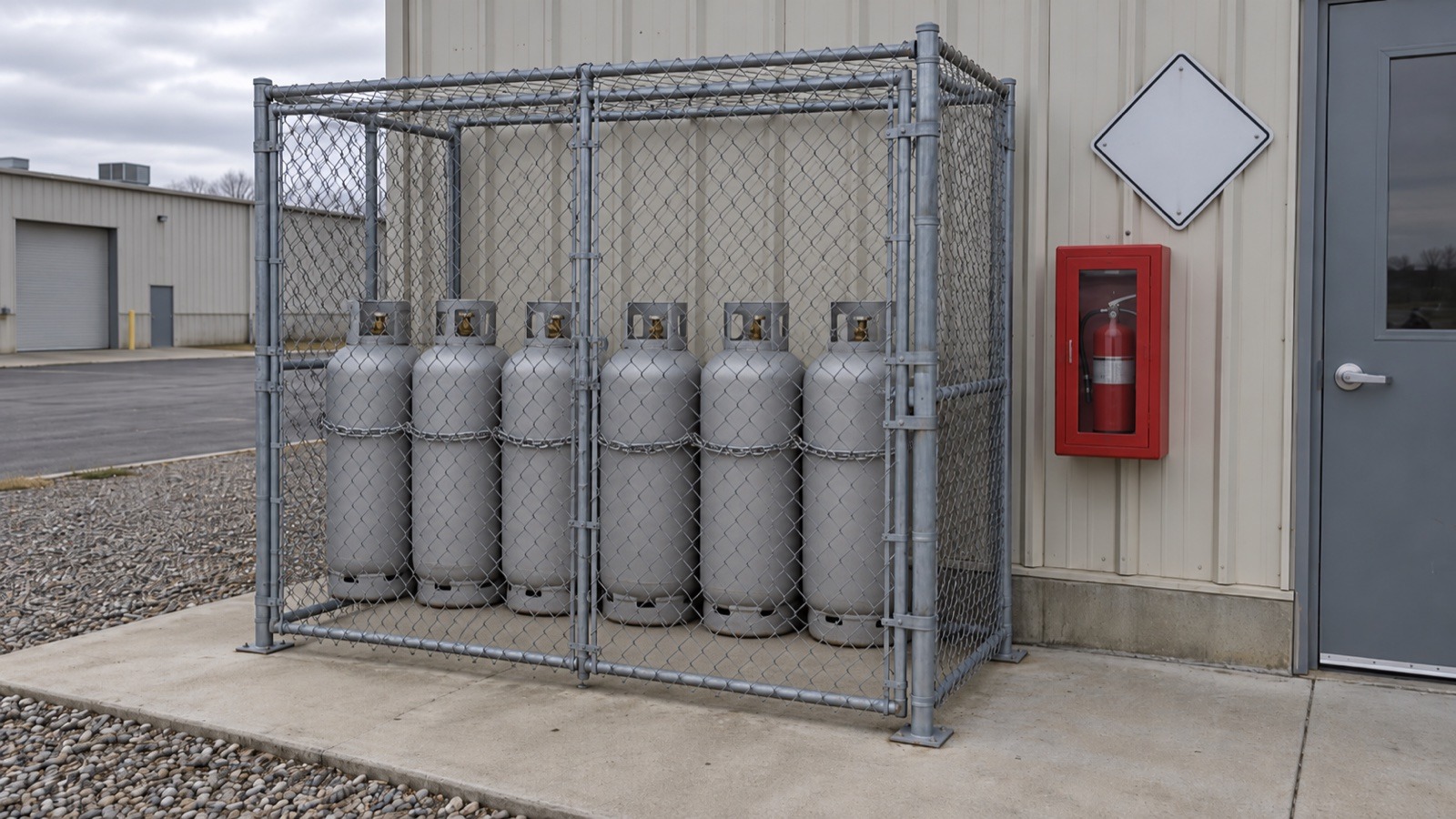
NFPA 58 is the code that decides where your butane and propane can sit, how much can be inside the building, and what the fire marshal re-inspects after the certificate of occupancy. Inside the wall the piping belongs to NFPA 54, and a solvent change re-opens the room classification; both rules are in the C1D1 room requirements guide. The numbers that matter for a cannabis extraction lab: a manifold of connected cylinders inside an industrial building is capped at 735 pounds of water capacity (a nominal 300 pounds of LP-gas, which is three of the cylinders sold as 100-pound propane bottles), a second manifold has to sit 20 feet from the first, unconnected cylinders in storage are capped at the same 735 pounds per location with 300 feet between locations, an aboveground tank between 501 and 2,000 gallons stands 25 feet from the building, cylinders in an outdoor cage with 720 pounds or less of gas can touch the wall but must stay 5 feet from a doorway with two exits and 10 feet from a doorway with one, and the gas detector in the room alarms at 25 percent of the lower flammability limit. Everything below is the section number behind each of those figures, the arithmetic for your cylinder count, and the list of changes after move-in that put you back in front of the inspector.
Which Code Governs LP-Gas at an Extraction Lab
Three documents hand the question to each other, and the order matters at plan review. The International Fire Code starts in Chapter 39, Processing and Extraction Facilities. Section 3901.1 says the use, storage, transfilling and handling of hazardous materials in these facilities comply with Chapter 39 and the other applicable provisions of the code. For a flammable gas solvent the applicable provision is Chapter 61, Liquefied Petroleum Gases, because Section 5801.1 Exception 2 pulls LP-gas out of the general flammable-gas chapter and sends it there. Chapter 61 then hands the technical content to NFPA 58: Section 6101.1 requires that storage, handling and transportation of LP-gas and the installation of LP-gas equipment comply with Chapter 61 and NFPA 58, and Section 6104.1 makes storage and handling subject to NFPA 58 and the approval of the fire code official.
So the siting table, the cylinder rules, the piping pressure ratings and the electrical classification all come from NFPA 58, read through the fire code. NFPA 30 is not in this chain. Butane, isobutane and propane are gases under OSHA 1910.110(a)(7), which defines LP-gas as material composed predominantly of propane, propylene, butanes and butylenes. NFPA 30 and IFC Chapter 57 govern the ethanol and pentane you use in winterization and post-processing, which is why the solvent storage room guide is a separate document from this one. Two Chapter 39 rules are specific to the gas side and worth memorizing: Section 3903.6 prohibits releasing LP-gas to the atmosphere except as allowed by Section 7.3 of NFPA 58, which ends the practice of venting a recovery tank out the back door, and Section 3901.2 brings an existing extraction process back under the chapter the moment the solvent or medium changes.
Oklahoma shows how a state turns NFPA 58 into enforcement. OAC 420:10-1-14 adopts NFPA 58 by statute and substitutes the Liquefied Petroleum Gas Administrator wherever the standard says authority having jurisdiction. Texas adopts the 2017 edition through 16 TAC 9.401. Your own state’s adoption year decides which edition’s section numbers the inspector is reading, and editions since 2017 carry the separation table at Table 6.4.1.1 where older editions had it at 6.3.1.
How Much LP-Gas Can Be Inside the Building
The question has two answers because the code treats cylinders connected for use differently from cylinders waiting in storage. Both answers are written in water capacity, the weight of water the container would hold, because that is what is stamped on the cylinder. The code’s own conversion is that 735 pounds of water capacity holds a nominal 300 pounds of LP-gas, which is the 42 percent filling density used for propane.
| Situation | Limit | Section | What it means for a lab |
|---|---|---|---|
| Cylinders connected for use in a Group F building, per manifold | 735 lb water capacity (nominal 300 lb LP-gas) | IFC 6103.2.1.3; NFPA 58 industrial occupancy rule | Three 239 lb water-capacity cylinders (the “100 lb propane” size) total 717 lb and fit. A fourth is 956 lb and does not. |
| Second manifold in the same building | 20 ft from any other manifold | IFC 6103.2.1.3 | Two closed-loop systems each get their own manifold only if the room geometry gives 20 ft. |
| Research or experimental quantities | Smallest practical quantity | NFPA 58 industrial occupancy rule (B) | A development bench is not a loophole for a fourth cylinder. |
| Cylinders in storage, not connected, building not open to the public | 735 lb water capacity per location; 300 ft between locations | IFC 6109.10; OSHA 1910.110(f)(4)(i) | OSHA states the same ceiling as 300 lb of gas, about 2,550 cubic feet of vapor. Empties count as full (IFC 6109.5). |
| Dedicated LP-gas storage room | 10,000 lb; Group H construction; vents 5 ft from building openings; area classified per NFPA 58 Section 6.25 | IFC 6109.11.1 and 6109.11.2; OSHA 1910.110(f)(5) | OSHA adds 2-hour walls and 10 percent explosion-relieving area. Rarely worth building; a cage outside is cheaper than an H room. |
| Building open to the public | 200 lb total, 2.7 lb water-capacity torch cylinders only | IFC 6109.9 | A dispensary with a back-room extraction booth has no legal cylinder count. |
| Basements, pits, underfloor spaces | No use or storage unless approved ventilation | IFC 6103.2.1.1; 6109.7 | Vapor density 1.55 to 2.11 times air; a pit is a reservoir. |
The maximum allowable quantity table most operators know, IFC Table 5003.1.1(1), lists flammable gas at 1,000 cubic feet or 150 pounds liquefied per control area, doubled for sprinklers and doubled again for approved cabinets or gas rooms. Because Section 5801.1 routes LP-gas to Chapter 61, that MAQ does not formally bound your propane; the operative indoor numbers are the 735 pound rows above. Many fire code officials apply the MAQ by analogy anyway, and the arithmetic is unforgiving: one 100 pound propane cylinder is about 850 cubic feet of vapor at 8.5 cubic feet per pound, so the second cylinder already clears 1,000. If your plan reviewer uses the MAQ, the sprinkler and gas-cabinet multipliers in the sprinkler design guide and the control-area math in the hazardous materials inventory statement are how you buy headroom; if the reviewer uses Chapter 61, the headroom is a second manifold 20 feet away.
Outdoor Container Siting: The Separation Table
The table below is the one the plan reviewer reads first. The same values appear in IFC Table 6104.3, NFPA 58 Table 6.4.1.1, and OSHA Table H-23, so there is no edition-shopping around it.
| Container water capacity (gal) | Underground or mounded, to building or lot line | Aboveground, to building or lot line | Between aboveground containers |
|---|---|---|---|
| Less than 125 | 10 ft | 5 ft (IFC); 0 ft in NFPA 58 and OSHA, subject to the cylinder relief-discharge rules | None |
| 125 to 250 | 10 ft | 10 ft | None |
| 251 to 500 | 10 ft | 10 ft | 3 ft |
| 501 to 2,000 | 10 ft | 25 ft | 3 ft |
| 2,001 to 30,000 | 50 ft | 50 ft | 5 ft |
| 30,001 to 70,000 | 50 ft | 75 ft | One quarter of the sum of the diameters |
The notes under the table are where labs win or lose a site plan:
- The 1,200 gallon reduction. IFC Table 6104.3 note f lets the 25 foot distance for a 501 to 2,000 gallon tank drop to 10 feet for a single container of 1,200 gallons or less, provided it sits at least 25 feet from any other LP-gas container over 125 gallons. A single 1,000 gallon bulk tank 10 feet off the wall is legal; two 500 gallon tanks 10 feet off the wall and 3 feet apart are also legal; a 1,000 gallon tank plus a cage of 100 pound cylinders 15 feet away is not.
- Aggregation. Note d says multiple containers each under 125 gallons that total 500 gallons or more are sited on their aggregate capacity, and separate installations stay 25 feet apart. The gallons in that rule are water capacity, and a 100 pound propane cylinder holds 28.6 gallons of water. Seventeen of them are 486 gallons and are still sited as individual cylinders; the eighteenth takes the group to 515 gallons and the whole cage is sited as a 501 to 2,000 gallon installation, 25 feet from the building.
- Public ways. Note g: aboveground containers of 2,000 gallons or less stay at least 5 feet from a public way.
- The cylinder-at-the-wall rules. Note e, mirrored in NFPA 58 6.4: the relief valve discharge of a DOT cylinder stays at least 3 feet horizontally from any building opening below the discharge level, at least 5 feet from exterior ignition sources, direct-vent appliance openings and mechanical air intakes, and the filling connection and fixed liquid level gauge vent stay at least 10 feet from exterior ignition sources. The 5 foot rule is the one that moves cages, because the condensing unit for your chiller counts as an ignition source and the make-up air intake for the C1D1 room counts as an intake.
- Plan submittal triggers. IFC 6101.3, NFPA 58 4.3.1 and Oklahoma OAC 420:10-1-14 all require construction documents when a single container exceeds 2,000 gallons water capacity or the aggregate exceeds 4,000. IFC 6104.2 caps aggregate storage within limits established by law at 2,000 gallons water capacity unless the jurisdiction says otherwise.
- Housekeeping distances. No stationary containers on roofs (6104.3.1); no smoking within 25 feet of a point of transfer (6107.2); combustibles kept 10 feet from containers (6107.3); vehicle impact protection per NFPA 58 (6107.4); engines within 15 feet of a transfer point shut down during transfer (NFPA 58 7.2.3).
If you want this worked through for your own site plan before the submittal, with the cylinder count, the cage location and the technical report lined up the way a plan reviewer reads them, that is the kind of pre-review we build into extractiontraining.com.
Cylinder Storage: The Cage, the Doorway, and the Distances
Most extraction labs never own a bulk tank. They own a cage of DOT cylinders, and the cage has its own table. IFC Table 6109.12 (NFPA 58 Table 8.4.1.1 in current editions) sets distances by the weight of LP-gas stored:
| LP-gas stored (lb) | Nearest building or lot line | Doorway of a building with two or more exits | Doorway of a building with one exit | Combustible materials | Motor fuel dispenser |
|---|---|---|---|---|---|
| 720 or less | 0 ft | 5 ft | 10 ft | 10 ft | 20 ft |
| 721 to 2,500 | 0 ft (10 ft from schools, worship, hospitals, busy thoroughfares and sidewalks) | 5 ft | 10 ft | 10 ft | 20 ft |
| 2,501 to 6,000 | 10 ft | 10 ft | 10 ft | 10 ft | 20 ft |
| 6,001 to 10,000 | 20 ft | 20 ft | 20 ft | 10 ft | 20 ft |
| Over 10,000 | 25 ft | 25 ft | 25 ft | 10 ft | 20 ft |
A cage holding four 100 pound cylinders is 400 pounds of gas, which lands in the first row: it can stand against the wall, but it needs 5 feet from the door if the building has two exits and 10 feet if it has one, and nothing combustible within 10 feet, which includes the pallet of empty solvent boxes someone leans against the fence. Eight cylinders is 800 pounds and moves to row two, where the only new rule is 10 feet from a school, place of worship, hospital or sidewalk. Over 720 pounds, NFPA 58 Chapter 8 also calls for an 18 pound B:C rated extinguisher within 50 feet of the storage.
The handling rules that go with the cage, all from IFC 6109 and OSHA 1910.110(f): cylinders over 2.7 pounds water capacity stand with the relief valve in the vapor space, which means upright for every size a lab buys (6109.3); valve caps or collars stay on whether the cylinder is full, partly full or empty, and outlet valves stay closed or plugged (6109.8), with OSHA requiring the cap to withstand a 30 pound weight dropped 4 feet; no storage near exit doors, stairways or any path used as a means of egress (6109.4); no storage in basements, pits or anywhere heavier-than-air gas collects (6109.7); storage inside a suitable enclosure or otherwise protected against tampering, with the vehicle impact protection requirement waived for lockable, ventilated metal cabinets (6109.13); and storage arranged to limit temperature rise, physical damage and tampering (6109.2). One figure you will hear from suppliers that is not in any of these sections is a 20 foot setback from ignition sources for stored cylinders. The verified distances are 5 feet from a relief discharge to an ignition source, 10 feet for a filling connection, 20 feet only to a motor fuel dispenser, and 25 feet for smoking at a transfer point. If a local policy imposes 20 feet, get it in writing with the section number.
Un-Odorized Gas and the Supply Chain
Extraction-grade butane and propane are un-odorized, and the code allows that on purpose. NFPA 58 Section 4.2 requires odorant at a concentration detectable at one fifth of the lower flammability limit, and then says odorization is not required if it is harmful in the use or further processing of the LP-gas. OSHA 1910.110(b)(1) carries the same exception and names the standard dose, 1.0 pound of ethyl mercaptan per 10,000 gallons, that your gas does not get. That exception is why your gas detector is the only warning system in the room: nobody will smell the leak.
Un-odorized gas also has its own chain of custody in states that regulate LP-gas dealers. Oklahoma OAC 420:10-1-5 requires a Class I dealer to file the complete list of facilities and delivery locations receiving un-odorized gas, allows sales only to properly permitted Oklahoma facilities, and gives cylinder-only Class III dealers an un-odorized endorsement with placarded vehicles and the same list. The facility side of that list is the Class 8 permit covered below.
The cylinders themselves are federal. 49 CFR 173.304a(d)(3) lists the specifications LP-gas may ship in: DOT 3, 3A, 3AA, 3B, 3E, 3AL, 4B, 4BA, 4B240ET, 4BW, 4E or 39, and it caps a DOT-39 cylinder at 75 cubic inches, about 1.2 liters, which is the camping canister. The 20 to 100 pound cylinders solvent vendors deliver are refillable 4BA or 4BW specification cylinders, and the stamp on the collar tells you which. The rules that follow from the stamp: a DOT-39 is marked with the federal refilling prohibition and its penalty, up to $500,000 and 5 years under 49 U.S.C. 5124, so no lab refills one (178.65); a 4B, 4BA, 4BW or 4E in non-corrosive service requalifies by volumetric expansion every 12 years, or by proof pressure every 10 years after the first 12 (180.209); NFPA 58 7.2.2 forbids filling any container that does not meet the requirements for continued service, and 5.2.1 sends a fire-exposed cylinder back to the manufacturer or a DOT-approved requalifier before it is filled again. The practical read: a cylinder with a requalification date more than 12 years old or scorch marks on the collar is a cylinder your supplier will refuse, and should.
Inside the Room: Detection, Shutoff, Hoses, Piping and Listing
Once the gas crosses the wall, Chapter 39 takes over again. Section 3905.1 requires a gas detection system complying with Section 916 for any flammable-gas extraction, and Section 916.8 sets the alarm point at 25 percent of the lower flammability limit. For propane with an LFL of 2.1 percent by volume, the alarm fires at 0.53 percent, or 5,250 ppm; for n-butane at 1.9 percent, it fires at 0.48 percent. Section 3905.1.1 scripts what happens at alarm: an audible and visual alarm in the extraction room, deactivation of all heating systems in the room, activation of the mechanical ventilation where it is interlocked, and de-energizing all light switches and electrical outlets. Section 3905.1.2 scripts detector failure the same way, plus a trouble signal. Section 916.11 requires inspection and testing at least annually with calibration at installation and per the manufacturer, and 916.5 requires standby power or a trouble signal on power loss. The safety equipment checklist walks the sensor placement and the reading bands.
Shutoff and hardware come from Chapters 39, 58 and OSHA. Section 3905.2 applies the emergency shutoff rules of 5803.1.3: a manual or automatic emergency shutoff valve at each point of use and at each source, fail-safe at the cylinder or bulk source. OSHA 1910.110(c)(5) requires excess-flow valves on any system fed from containers over 2.5 pounds water capacity, manifolds and fittings designed for at least 250 psig, and protection for valves on containers over 50 pounds water capacity while in use. NFPA 58 limits hose inside a building to the minimum practical length not exceeding 6 feet, not through walls and not concealed, with a shutoff valve immediately upstream of the hose (6.18 in older editions). Piping is rated by service: liquid pump discharge at 350 psig, vapor above 125 psig and all other liquid piping at 250 psig, vapor at or below 125 psig at 125 psig, with welding and brazing qualified to ASME Section IX (NFPA 58 piping chapter). Every one of those pressures is above the 174 psig a propane cylinder reaches at 38 C, which is the point.
Electrical classification for the gas side comes from NFPA 58 Section 6.25, which both IFC 6107.2 and 6109.11.2 point to, read with NFPA 70. OSHA Table H-28 gives the shape of it: Division 1 within 5 feet of transfer connections and in the direct path of relief discharge, and for pumps, compressors and vaporizers indoors without ventilation, the entire room and any adjacent room not separated by a gastight partition is Division 1. That is the reason the C1D1 room and the gas supply are designed together rather than in sequence, and it is why Oklahoma’s Class 8 checklist asks for a peer review of the booth against NFPA 58 6.25.2 and NFPA 70 before it issues anything.
The equipment itself takes one of two paths under Section 3904.2: listed and labeled to UL 1389 and installed per the listing (3904.2.1), or approved through a registered design professional’s technical report that the fire code official reviews before the equipment is located or installed (3904.2.2.1). The report contents in 3904.2.2.2 include the component list with solvent compatibility, the piping and instrumentation diagram, pressure vessel and structural analyses, and the process safety and process hazard analyses; 3904.2.2.3 then requires the engineer’s site inspection report to carry the serial number of the installed unit and confirm it matches the report. The serial number line is the one that bites later, and it is covered in the IFC Chapter 39 guide. Ventilation rates do not live in Chapter 39 at all; they come from Chapter 50, where 5004.3.1 sets 1 cubic foot per minute per square foot of floor area, continuous, with exhaust within 12 inches of the floor for heavier-than-air vapors and a break-glass shutoff labeled for the ventilation system.
The Oklahoma Class 8 Un-Odorized LPG Permit
Oklahoma is the state where LP-gas permitting for extraction is spelled out in a form, and after the Sand Springs explosion it is the one other states are reading. The Class VIII Un-Odorized LPG Permit is item 9 of the twelve permit classes in 52 O.S. 420.4, and OAC 420:10-1-5(b)(9) defines it: facilities obtaining un-odorized LP-gas in approved DOT cylinders or otherwise for use must obtain the permit, which requires written plans describing the use, the cylinder storage location and all LP-gas plumbing, approval of those plans, and a successful on-site inspection by a Safety Code Enforcement Officer before gas is introduced into the system. It is an end-user permit to possess and use un-odorized gas at one physical location. It is not a cannabis license, it does not allow the holder to sell gas, and it is not the fire marshal’s operational permit; it sits beside both.
| Class 8 element | Requirement | Source |
|---|---|---|
| New application cost | $500 permit + $250 plan review + $250 site inspection + $10 filing = $1,010 | Class 8 application form; OAC 420:10-1-5(b)(9) |
| Term | Expires August 31 every year; 25 percent late fee after; no renewal after September 30 without the Administrator’s approval | Application and renewal forms; 52 O.S. 420.4(B)(2) |
| Renewal | $500 + $250 annual on-site re-inspection = $750; the form asks whether the facility, the C1D1 room or the extraction equipment has been modified since the original inspection | Class 8 renewal form |
| Prerequisites on the checklist | Site plan showing the C1D1 room; peer review of the extraction equipment; peer review of the C1D1 booth against NFPA 58 (2024) 6.25.2 and NFPA 70; certificate of liability insurance; a State Fire Marshal permit number or a certificate of occupancy from the AHJ. “LP Gas Administration will not permit a facility without a COO.” | Class 8 permit checklist |
| Inspections | Any time, with or without notice; every inspection including failed ones and annual re-inspections is billed at $250 | Application form; OAC 420:10-1-5(b)(9) |
| Scope | Issued for a physical location, not a company; not transferable; the applicant lists every company it buys un-odorized gas from | Checklist; 52 O.S. 420.4(A) |
| Count | 33 hazardous processing facilities held active permits as of September 14, 2026; the State Fire Marshal has 13 officers statewide | Oklahoma Watch, September 30, 2026 |
One discrepancy to know before you argue a fee: OAC 420:10-1-14(b)(2)(D) still prints $100 plan review and $100 inspection for un-odorized facilities, while 420:10-1-5(b)(9) and the current forms say $250 and $250. The forms are what the Administration bills.
Other states do not have a Class 8 analog, and the gap is worth naming on your own licensing map. Texas licenses LP-gas dealers, installers and cylinder operations under 16 TAC Chapter 9 but exempts the ultimate consumer who stores product for personal consumption, so a Texas lab is regulated through its licensed installer and dealer plus the local fire code official. Colorado puts the burden on MED Rule 5-315, where an industrial hygienist or professional engineer certifies the equipment, the premises and the SOPs, sets the maximum flammable solvent quantity and the electrical classification, and must re-certify after any material change. Michigan R 420.208 requires a permanent certificate of occupancy before operation and a Bureau of Fire Services prelicensure inspection, with annual or biannual BFS inspections and the authority to require LP-gas operational and construction permits. Washington WAC 314-55-104 requires 99 percent purity solvent in a commercially manufactured closed-loop system with a permanent serial number and a licensed engineer’s stamped certification. The state-by-state view is in the licensing hub.
What Changes After the Certificate of Occupancy Trigger a New Review
The certificate of occupancy is a snapshot of the building on inspection day. Section 105.3.1 of the fire code says operational permits are not transferable and any change in occupancy, operation, tenancy or ownership requires a new permit; Section 105.4 lets the official revoke a permit used for a condition or activity other than the one listed. The changes a growing lab makes in its first year map onto specific sections:
| Change after the CO | What it triggers | Section |
|---|---|---|
| Adding cylinders or a larger container | Construction permit for modification of the LP-gas system; re-check against the 735 lb manifold and storage rows and the siting tables; in Oklahoma, plan approval and a $250 inspection before gas is introduced | IFC 105.6.15; 6103.2.1.3; 6109.10; Table 6104.3; OAC 420:10-1-14(b)(2)(D) |
| Moving the cylinder cage | Same LP-gas modification permit; Table 6109.12 doorway, combustible and lot-line distances re-measured from the new spot; relief-discharge distances to intakes and ignition sources re-measured | IFC 105.6.15; Table 6109.12; Table 6104.3 note e |
| Adding a second closed-loop system | Construction permit for modification of a plant extraction system; a new technical report or addendum because the site inspection report must carry the serial number of the installed unit; second manifold needs 20 ft | IFC 105.6.17; 3904.2.2.3; 6103.2.1.3 |
| Switching from butane to a propane blend | The existing process comes back under Chapter 39; the technical report’s component solvent-compatibility list has to be re-run at the higher vapor pressure (174 psig vs 37 psig at 38 C); Colorado requires re-certification by the IH or PE and written approval for a non-listed solvent | IFC 3901.2; 3904.2.2.2; MED Rule 5-315(D)(1)(d) and (D)(4)(a)(ii) |
| Adding or replacing gas detection | Construction permit for the gas detection system; annual test and calibration record | IFC 105.6.10; 916.11 |
| Change of ownership or tenant | New operational permits; in Oklahoma the Class 8 permit is tied to the location and the application lists the operating company, so the file is re-opened | IFC 105.3.1; 52 O.S. 420.4(A) |
| Michigan: any change to extraction methods, process rooms or storage | Additional BFS plan review and inspection, pre- or post-licensure | BFS Cannabis Plan Review Checklist; R 420.208 |
Sand Springs is the case that made this table urgent. On August 27, 2026, at about 1 a.m., an explosion at the Morrow-Gill business complex in Sand Springs, Oklahoma, killed two workers at a marijuana processing facility, damaged at least 25 businesses, and was described by investigators as related to chemicals used in the THC extraction process. Reporting by Oklahoma Watch and News On 6 since then has established the sequence: the city fire marshal had told the operator in January to shut down the extraction booth over an outdated sprinkler system; after the explosion, fire marshals found a large amount of liquid propane and other equipment that had not been present at earlier inspections; the facility’s state license had not been transferred to the new owner; and the owner has been charged with two counts of first-degree murder. Oklahoma Watch also documented the structural gap: between 2018 and 2024 Oklahoma did not require a certificate of occupancy for marijuana buildings, and once a fire marshal issues one there is nothing in the current rules that requires a return visit unless the business changes location or use. The State Fire Marshal’s chief agent has said the office could write a rule requiring a yearly operational permit for hazardous processing facilities, or the medical marijuana authority could require an annual fire marshal inspection; as of mid-October that is an official’s suggestion, not a filed rule. Until it is, the annual Class 8 re-inspection, which checks that the facility still has the correct amount of gas and the proper system, is the only recurring look at the LP-gas side of an Oklahoma lab.
LP-Gas Physical Properties for the Plan Reviewer
The table that ends most arguments about whether a vent, a relief valve or a cage location is adequate.
| Property | Propane | n-Butane | Isobutane |
|---|---|---|---|
| Boiling point at 1 atm | -42.1 C | -0.5 C | -11.7 C |
| Vapor pressure at 21 C | 110 psig | 16 psig | 30 psig |
| Vapor pressure at 38 C | 174 psig | 37 psig | 58 psig |
| Flammable range in air (LFL to UFL, percent by volume) | 2.1 to 9.5 | 1.9 to 8.5 | 1.8 to 8.4 |
| 25 percent LFL alarm point | 5,250 ppm | 4,750 ppm | 4,500 ppm |
| Autoignition temperature | 450 C | 287 C (NFPA 325; some data sheets list 365 C) | 460 C |
| Liquid density at 25 C | 0.493 g/mL | 0.573 g/mL | 0.551 g/mL |
| Vapor density, air = 1 | 1.55 | 2.11 | 2.06 |
| Liquid to vapor expansion at 15.6 C and 1 atm | 271 to 1 | 238 to 1 | 229 to 1 |
Two consequences fall straight out of the table. A 100 pound propane cylinder that loses its liquid contents into a 1,000 square foot room with a 10 foot ceiling puts roughly 850 cubic feet of vapor into 10,000 cubic feet of air, which is 8.5 percent by volume, inside the flammable range for the whole room rather than a corner of it. And at 38 C a propane cylinder sits at 174 psig while a butane cylinder sits at 37 psig, which is why a lab that swaps solvents without re-running the technical report has changed the pressure rating question on every fitting in the building.
Common Failures and How to Diagnose Them
These are the patterns in the incident reporting and the enforcement files, tied to the sections that get cited.
1. The installation grew after the inspection.
Symptom: more cylinders inside than the plan showed, a fourth cylinder on the manifold, a cage that moved closer to the door, or, in the Sand Springs reporting, propane and equipment found after the explosion that were not present at earlier inspections.
Root cause: throughput went up and nobody re-read the plan. A Tonkawa police chief quoted by Oklahoma Watch put it plainly: after the inspectors are gone, they change things.
Diagnostic test: count water capacity on the manifold against 735 pounds (IFC 6103.2.1.3) and in storage against 735 pounds per location (6109.10); tape the cage distances against Table 6109.12.
Fix: file the LP-gas modification permit (105.6.15) before the gas arrives, not after; in Oklahoma, plan approval and the $250 inspection are prerequisites to introducing gas.
2. Operating without, or after loss of, approval.
Symptom: extraction running in a building with no certificate of occupancy, a lapsed Class 8 permit, or after a shutdown order. The 2023 Releaf Labs fire in Sand Springs happened in a new, unlicensed building; the 2026 facility had a January shutdown order on the booth.
Root cause: the license from the cannabis regulator was treated as the only permission that mattered. In Oklahoma the medical marijuana authority’s checklist covers testing, track-and-trace and paperwork, not fire or LP-gas.
Diagnostic test: three documents on the wall with current dates: the CO, the fire code operational permit for plant extraction (105.5.40) and LP-gas (105.5.29), and the state LP-gas permit where one exists.
Fix: no gas on site until all three exist; 105.4 lets the official revoke a permit used for an activity other than the one listed, and a revoked permit does not come back by renewal.
3. Gas detection missing, disabled or uncalibrated.
Symptom: no alarm before ignition. In the 2023 Releaf incident, butane released from an extractor with the gas clamps open and the alarms did not sound because the system was not up to code, according to court documents cited by Oklahoma Watch.
Root cause: sensors installed at install-day calibration and never touched, or alarms silenced because un-odorized gas gives false confidence.
Diagnostic test: bump-test with calibration gas at 25 percent LFL and confirm the 3905.1.1 actions actually happen: heat off, ventilation on, outlets dead.
Fix: annual test and calibration logged per 916.11; standby power or trouble signal per 916.5; sensors where gas accumulates per 916.6, which for a vapor 1.5 to 2.1 times heavier than air means low.
4. An ignition source inside the classified area.
Symptom: the 2023 ignition source was a battery-powered screwdriver.
Root cause: the room is classified on paper and treated as a shop in practice; portable tools, phones and unrated chillers migrate in.
Diagnostic test: walk the Division 1 envelope from OSHA Table H-28 (5 feet from transfer connections, the relief discharge path, the whole room for an unventilated indoor pump or compressor) and list every item inside it that is not rated.
Fix: classification per NFPA 58 6.25 and NFPA 70, enforced by a door rule, not a drawing.
5. Unlisted or unreviewed equipment and lapsed fire protection.
Symptom: a closed-loop with no UL 1389 listing and no technical report, a serial number that does not match the report on file, or, as in the January 2026 order, an outdated sprinkler system.
Root cause: equipment bought used or swapped without telling the engineer of record.
Diagnostic test: the serial number on the unit against 3904.2.2.3’s site inspection report; the sprinkler inspection tag against the NFPA 13 design numbers for the room’s hazard class.
Fix: a report addendum before the swap; in Washington, Colorado and Oklahoma the engineer’s or hygienist’s certification is a licensing condition, so the addendum is a licensing document.
The Order to Do This In
- Decide the solvent and the maximum gas on site before the architect draws anything. The siting table, the manifold cap and the technical report all depend on it, and 3901.2 means changing it later restarts the review.
- Pick the cylinder count against 735 pounds of water capacity per manifold and per storage location, and place the cage against Table 6109.12 and the 3, 5 and 10 foot relief-discharge rules. Put the chiller condenser and the air intake on the drawing before you place the cage.
- Commission the technical report (3904.2.2) or buy UL 1389 listed equipment, and record the serial number that will be on the site inspection report.
- Design gas detection to 916 with the 3905.1.1 interlocks, and write the annual calibration into the SOP set that the inspector reads first.
- Submit the HMIS and the construction permits for the LP-gas system (105.6.15), the extraction system (105.6.17) and gas detection (105.6.10) together, then get the CO.
- Where the state has an LP-gas permit, apply after the CO and before the first delivery; in Oklahoma the Administration will not issue Class 8 without the CO, and the dealer cannot deliver un-odorized gas without the permit on its list.
- Calendar the annual items: gas detection test, LP-gas permit renewal and re-inspection, sprinkler inspection, and a self-audit against this page’s two tables every time a cylinder is added or moved.
Frequently Asked Questions
What are the NFPA requirements for propane storage tanks at a cannabis extraction lab?
NFPA 58 Table 6.4.1.1 (IFC Table 6104.3) sets the distance from an aboveground tank to the building and the property line by water capacity: 10 feet for tanks of 125 to 500 gallons, 25 feet for 501 to 2,000 gallons, and 50 feet for 2,001 to 30,000 gallons, with 3 feet between tanks up to 2,000 gallons. A single tank of 1,200 gallons or less can sit 10 feet from the building if it is 25 feet from any other container over 125 gallons. Plans go to the fire code official when a single container exceeds 2,000 gallons or the aggregate exceeds 4,000.
What is the minimum distance an NFPA 58 propane cylinder must be from a window or door?
For a DOT cylinder at the building, the relief valve discharge must be at least 3 feet horizontally from any building opening below the level of the discharge and at least 5 feet from exterior ignition sources, direct-vent appliance openings and mechanical air intakes. For a storage cage, IFC Table 6109.12 adds 5 feet from a doorway of a building with two or more exits and 10 feet from a doorway of a building with one exit, at any stored quantity up to 2,500 pounds.
How many propane or butane cylinders can be inside an extraction building?
Cylinders connected for use in an industrial building are limited to 735 pounds of water capacity per manifold, a nominal 300 pounds of LP-gas, with 20 feet between manifolds (IFC 6103.2.1.3). Three cylinders of the size sold as 100 pound propane bottles total 717 pounds of water capacity; a fourth exceeds the limit. Unconnected cylinders in storage are limited to 735 pounds of water capacity per location with 300 feet between locations (IFC 6109.10), and empties count as full.
Does NFPA 30 or NFPA 58 govern butane storage for extraction?
NFPA 58. Butane, isobutane and propane are liquefied petroleum gases under IFC Chapter 61 and OSHA 1910.110, and IFC 5801.1 Exception 2 routes them out of the flammable-gas chapter into Chapter 61, which requires compliance with NFPA 58. NFPA 30 governs the ethanol, pentane and other flammable liquids used in winterization and post-processing, which need their own storage room or cabinets under IFC Chapter 57.
What is the Oklahoma Class 8 LP-gas permit?
The Class VIII Un-Odorized LPG Permit under 52 O.S. 420.4 and OAC 420:10-1-5(b)(9) is the end-user permit a facility needs to obtain, store and use un-odorized LP-gas at one location. It costs $1,010 on first application ($500 permit, $250 plan review, $250 site inspection, $10 filing), expires August 31 each year, renews for $750 after an annual on-site re-inspection, and requires a certificate of occupancy, a site plan showing the C1D1 room, and peer reviews of the extraction equipment and the booth before it is issued. Thirty-three hazardous processing facilities held one as of September 14, 2026.
Can an extraction lab refill its own butane cylinders?
Not the small ones and not without a dealer license for the large ones. A DOT-39 cylinder, capped by 49 CFR 178.65 at 75 cubic inches, is marked with the federal refilling prohibition and a penalty of up to $500,000 and 5 years. The 20 to 100 pound 4BA and 4BW cylinders vendors deliver are refillable only by a licensed filler, only if they are within their 12 year requalification window (49 CFR 180.209), and never after fire exposure without requalification (NFPA 58 5.2.1). In Oklahoma a Class 8 permit explicitly does not allow the holder to sell or fill un-odorized gas.
At what gas concentration must the extraction room alarm?
IFC 916.8 sets the alarm at 25 percent of the lower flammability limit: 5,250 ppm for propane (LFL 2.1 percent), about 4,750 ppm for n-butane (LFL 1.9 percent) and 4,500 ppm for isobutane (LFL 1.8 percent). On alarm, IFC 3905.1.1 requires an audible and visual alarm in the room, shutdown of all heating in the room, activation of interlocked ventilation, and de-energizing light switches and outlets. The system must be tested and calibrated at least annually under 916.11.
What changes after the certificate of occupancy require a new inspection?
Adding or enlarging LP-gas containers or moving the cylinder cage requires a construction permit for modification of the LP-gas system (IFC 105.6.15); adding a second extraction system requires a plant extraction system modification permit (105.6.17) and a technical report addendum carrying the new serial number (3904.2.2.3); changing solvents brings the process back under Chapter 39 (3901.2) and re-opens the solvent compatibility review; a change of ownership or tenant voids the operational permits (105.3.1). In Oklahoma the Class 8 renewal form asks directly whether the facility, the C1D1 room or the equipment has been modified since the original inspection.
Ready to level up your extraction game? Contact WKU Consulting for personalized guidance on building your extraction lab.
For more deep dives into cannabis chemistry, extraction SOPs, and lab design, subscribe to the WKU Consulting YouTube channel.
Watch a related video:
