
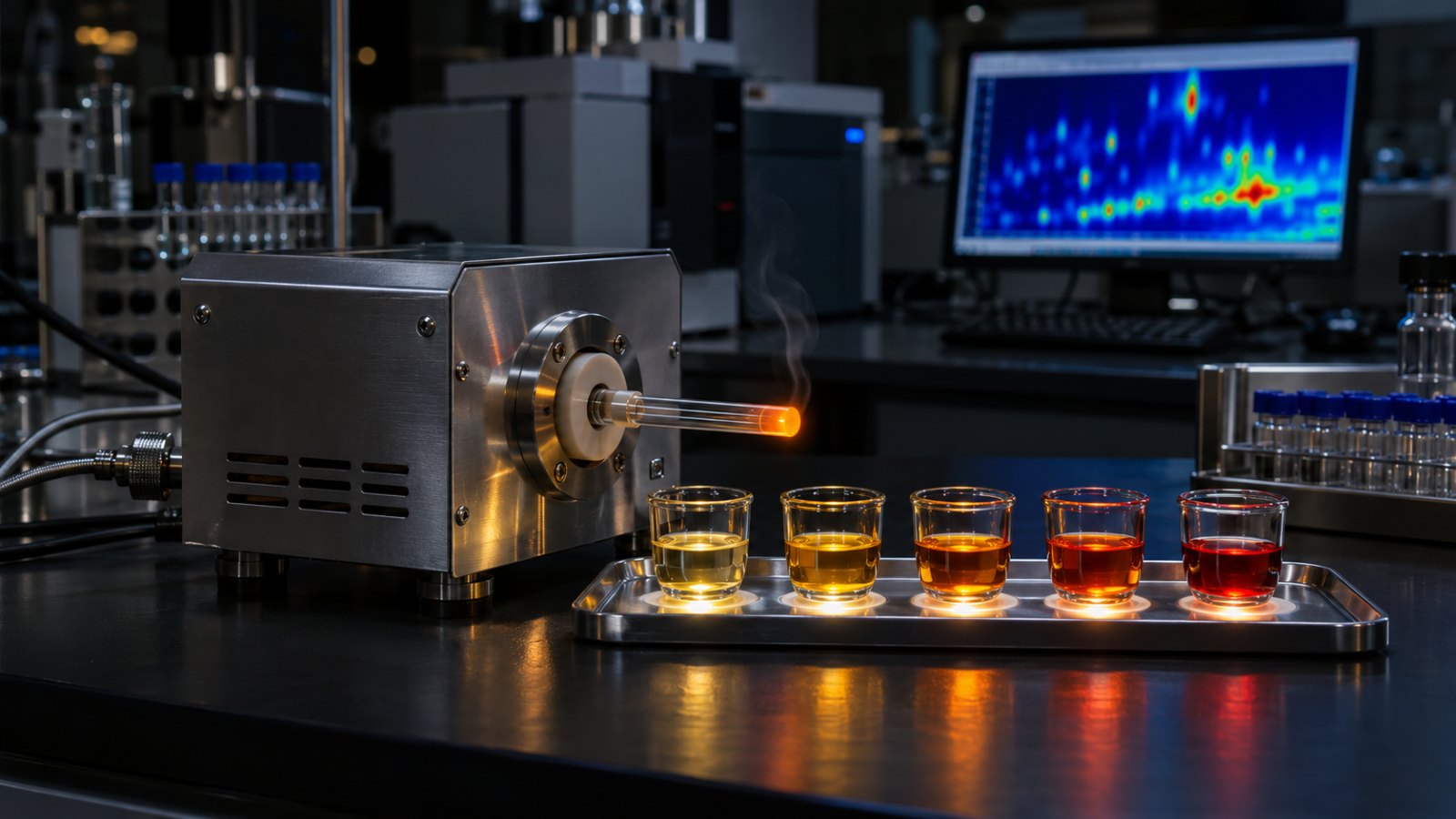
What happens to THC when heated comes down to one number, the temperature: past about 400 C, it stops being THC. In the first temperature-resolved map of THC pyrolysis (Nichols, Dane and Musah, Journal of Cannabis Research, September 2026), 0.25 mg of pure delta-9 THC made 3 small-molecule products at 400 C, 22 at 500 C, 34 at 600 C and 58 at 700 C. Toluene and the xylenes show up from 500 C; benzene only at 700 to 800 C. Of 79 products, 75 were identified and 34 were already known from cannabis smoke, and 20 of those have been linked to adverse effects such as genotoxicity and neurotoxicity. Below about 230 C, a vaporizer delivers 55 to 83 percent of the loaded THC intact. Acetylated cannabinoids fail on a separate mechanism: their acetyl group turns into ketene at over 99 percent efficiency in a vape, 1 to 4 percent of the cannabinoid mass (Evans et al., Analyst, 2026).
Every number in that paragraph comes from a lab that heated a pure standard and read what came out. None of it is a dose. The THC study is qualitative, run without oxygen for 30 seconds per shot, so it tells you which compounds form in which temperature band, not how many micrograms reach a lung. That still settles the question most of the industry argues about: whether the temperature a product meets matters more than the oil in it. A clean distillate on a coil running 543 C is sitting in the same band where THC alone makes toluene and xylenes. A dirty extract dabbed at 320 C never gets there.
This guide lays the 2026 data out by temperature, puts real measured cart, battery, nail and joint temperatures on top of it, adds the terpene side from the Portland State dabbing work, and closes on acetates, where the mechanism is different and the answer is simpler.
What Happens to THC When Heated: The Four Temperature Bands
THC does four different things depending on how hot it gets, and each band has a home device. The first band is decarboxylation: THCA sheds one carbon dioxide and becomes delta-9 THC, which is why 25 percent THCA flower reads 21.9 percent THC after the 0.877 factor. The second is evaporation: THC leaves the plant or the oil as vapor, mostly intact. The third is where terpenes and the oil matrix start breaking down and THC itself begins to shed fragments. The fourth is cracking, where carbon-carbon bonds in the THC molecule break and the pieces recombine into small aromatics.
Table 1. What THC does in each temperature band, and where you meet that band
| Band | Where you meet it | What happens to THC | Evidence |
|---|---|---|---|
| 100 to 150 C | Decarb oven, edible infusion | THCA loses CO2 and becomes delta-9 THC (mass factor 0.877). THC itself is intact; slow oxidation to CBN is the long-term loss | Stoichiometry; storage data in our stability guide |
| 160 to 230 C | Dry-herb vaporizer settings | THC evaporates largely intact. Four electric vaporizers delivered 54.6 to 82.7% of the loaded THC; one vaporizer had a better cannabinoid-to-by-product ratio at 200 and 230 C than at 170 C, and both of those beat a joint | Lanz 2016; Pomahacova 2009 |
| 250 to 570 C | Cart coils, dab nails and bangers | Terpenes break down first (methacrolein, benzene, isoprene). THC alone raises isoprene in vape aerosol. The THC cracking map starts at 400 C | Meehan-Atrash 2017, 2019, 2021; Oar 2022; Lynch 2021 |
| 400 to 800 C | The zone just behind the burn line of a joint (combustion above 800 C) | THC cracks into small hydrocarbons and aromatics: 3 products at 400 C, 58 at 700 C | Nichols, Dane and Musah 2026 |
One correction before the map. The “THC boils at 157 C (315 F)” figure printed on half the internet traces back to a 2001 reference table, not to any measurement we could find. The best available number is a NIST prediction: Lovestead and Bruno (Forensic Chemistry, 2017) put the normal boiling temperature of delta-9 THC at 690 K, about 417 C, with CBD at 695 K. THC vaporizes well below that for the same reason water evaporates from a pan at 60 C: a vaporizer pulls vapor off the surface, so the oil never has to reach its boiling point. What it does mean is that pushing temperature toward 400 C to “vaporize faster” walks THC straight into the band where it starts to crack.
The Pyrolysis Map: What 0.25 mg of THC Made at Each Temperature
The Louisiana State University group dried 0.25 mg of delta-9 THC (98.44 percent purity) into a micro-furnace cup, shot it into a pyrolyzer at 400, 500, 600, 700 and 800 C for 30 seconds each, and read the products on two-dimensional gas chromatography with high-resolution mass spectrometry, three replicates per temperature. A compound only counted if it appeared in all three. They stopped at 800 C on purpose, because above it THC burns to carbon dioxide and water, and they started at 400 C because below that, thermal desorption dominates over chemical change. Fifty of the 75 identities were confirmed against purchased reference standards.
Table 2. The THC pyrolysis map: 0.25 mg of pure delta-9 THC, 30 seconds per temperature, no oxygen (Nichols, Dane and Musah, J Cannabis Res, 2026)
| Temperature | Products detected (C3 to C10) | First appearances worth knowing |
|---|---|---|
| 400 C | 3 | m-cymene, 6-methyl-5-hepten-2-one, acetic acid |
| 500 C | 22 | Toluene, o-xylene, p-xylene, 1,3-pentadiene, p-cymene, 1,2-diethylbenzene |
| 600 C | 34 | 1,2,4- and 1,3,5-trimethylbenzene, 2-methylbenzofuran, (Z)-2-butene, 1-ethenyl-3-methylbenzene |
| 700 C | 58 (the most) | Benzene, styrene, benzofuran, indane, alpha-methylstyrene, 3-methylphenol, acetophenone |
| 800 C | 49 | Phenol, 2-methylphenol, ethylbenzene, propylbenzene, 1,3-cyclopentadiene |
The curve is steep. Going from 400 to 500 C multiplies the product count by seven, and the first aromatic solvents show up in that step. Benzene does not appear until 700 C, which is joint territory, not cart territory. The count dips to 49 at 800 C, closer to full combustion. At 700 C, the largest peaks included toluene, both xylenes, and the cymenes. The paper is explicit that peak area is only a rough proxy, since no quantitation was done.
Table 3. THC cracking products the paper flags for toxicity, and the temperatures where each appeared
| Compound | Flag in the paper | Appeared at |
|---|---|---|
| Toluene | Genotoxic, neurotoxic | 500 to 800 C |
| o-Xylene and p-xylene | Genotoxic, neurotoxic | 500 to 800 C |
| 1,3-Pentadiene | Genotoxic | 500 to 800 C |
| 1,2,4-Trimethylbenzene | Genotoxic, neurotoxic, other | 600 to 800 C |
| Benzene | Genotoxic, neurotoxic | 700 to 800 C |
| Styrene | Other adverse effects (irritant) | 700 to 800 C |
| Benzofuran | Genotoxic | 700 to 800 C |
| Phenol | Genotoxic | 800 C |
| Ethylbenzene | Genotoxic | 800 C |
The paper states the pattern directly: every THC cracking product found in cannabis smoke that carries a genotoxic or neurotoxic report is a benzene derivative. The same chemistry runs on CBD. The group’s companion CBD study (May 2026) counted 7 products at 400 C, 33 at 500 C, 48 at 600 C, 47 at 700 C and 50 at 800 C, and 47 of the 79 THC products also appear in the CBD set. A hemp cart does not dodge this map by being CBD.
Three limits keep this honest. The experiment ran without oxygen to model the zone just behind a joint’s glowing tip, and earlier CBD work found that oxygen changes the proportions of products more than their identities. It covers only the C3 to C10 fraction, the first 19 minutes of a 90-minute run; the later regions, dominated by polycyclic aromatics and cannabinoid-like scaffolds, are not covered in this part 1 paper. And it measured a pure standard, not an oil with terpenes, lipids and cutting agents, all of which have breakdown chemistry of their own.
Where Your Device Sits on the Map
A temperature map is only useful if you know the temperature, and most consumers and a lot of brands do not. Two measurement studies fill that in for carts. The PAX-funded Oar study (PLoS One, 2022) put an infrared camera on coils across device types. The FDA’s Lynch study (Frontiers in Chemistry, 2021) measured ceramic-coil cartridges at elevated power. Portland State measured nails.
Table 4. Measured device temperatures, and the band each one lands in
| Device and setting | Measured temperature | Band | Source |
|---|---|---|---|
| Temperature-controlled pen, lowest setting (270 C nominal) | 246 ± 5 C at the coil | Vapor | Oar 2022 (funded by the device maker) |
| Temperature-controlled pen, highest setting | 420 ± 9.5 C | Edge of the cracking map | Oar 2022 |
| Variable-voltage 510 battery at 2.4 V | 443 ± 56 C | Cracking map | Oar 2022 |
| Fixed 3.2 V battery | 450 ± 61 C | Cracking map | Oar 2022 |
| Variable-voltage 510 battery at 4.0 V | 543 ± 96 C | Toluene and xylene range | Oar 2022 |
| Ceramic-coil carts at elevated power | Mean peak above 430 C; 375 to 569 C across units | Cracking map | Lynch 2021 (FDA) |
| E-nail, user-preferred setting | About 378 C (710 F); users cite 340 to 482 C | Terpene breakdown | Meehan-Atrash 2017 |
| Joint | Pyrolysis zone about 300 to 800 C behind a burn line above 800 C | The whole map | Nichols 2026, citing Baker 1975 |
Read the 510 battery rows against Table 2. At 2.4 V a variable battery averaged 443 C, inside the cracking map. At 4.0 V it averaged 543 C, with a standard deviation of 96 C, so a share of hits ran past 600 C, into the band where trimethylbenzenes and benzofurans appear. The temperature-controlled device at its lowest setting stayed at 246 C, which is vapor. The same oil can land on either side of the 400 C line depending on a button the customer presses. That is the case for shipping carts on hardware with a temperature ceiling, and for printing “use the lowest setting” on the box instead of leaving it to forum advice.
The coil also gets hotter when the wick runs dry. A cart that cannot re-wick between puffs, because the oil is too thick for the intake holes or the wick is starved at the end of the fill, heats a partly empty coil, and the temperature climbs past the measured averages above. Our live resin cart guide sets the 3,000 to 5,000 centipoise viscosity window for that reason, and the liquid diamonds guide covers the HTE ratios that keep a decarbed THCA cart inside it.
If you want to learn cart formulation, viscosity targets and hardware selection hands-on with SOPs you can run in your own lab, that is exactly what we built extractiontraining.com for.
The Terpene Side: Methacrolein and Benzene at the Nail
Terpenes break before THC does, and that is where the dabbing data lives. Meehan-Atrash, Luo and Strongin (ACS Omega, 2017) dabbed terpene standards on a ceramic nail measured with a thermal camera. Methacrolein, a respiratory irritant, climbed with every step in nail temperature, and benzene appeared only in the hottest range.
Table 5. Terpene breakdown at the nail: methacrolein per dab by median nail temperature (Meehan-Atrash, Luo and Strongin, ACS Omega 2017)
| Median nail temperature | Methacrolein per dab | Benzene |
|---|---|---|
| 322 C (612 F) | Not detected | Not detected |
| 403 C (757 F) | 131 ± 9 ppb | Not detected |
| 455 C (851 F) | 157 ± 2 ppb | Not detected |
| 526 C (979 F) | 185 ± 11 ppb | About 17 ng per dab (15 ppb), hottest range only |
Per milligram of terpene in the hottest range, limonene gave 261 ng of methacrolein and 63 ng of benzene, myrcene 81 and 60, and linalool 103 with no benzene. The follow-up work found the same products, methacrolein, benzene and methyl vinyl ketone, in both cart vapor and dabs; THC alone raised isoprene; added terpenes raised gas-phase products overall; and the totals stayed significantly below cannabis smoke (ACS Omega 2019). A 2021 paper (RSC Advances) found that four small compounds formed from both THC and myrcene, isoprene among them, made up 18 to 30 percent of the aerosol gas phase and climbed with the power applied to the device.
The operator consequence is direct. Every point of terpene you back-blend into a cart is more methacrolein feedstock at a hot coil, and a high-terp formulation on a 4.0 V battery is the worst combination on this page. Our off-flavor troubleshooting guide uses the same 322 C versus 403 C line as a diagnostic: if a burnt, rubbery taste disappears when the same extract is dabbed on a clean banger at 260 to 290 C, the problem was the temperature, not the oil.
Why Acetylated Cannabinoids Never Belong in a Cart
Everything above is about how hot you run a molecule that is otherwise fine to vaporize. Acetates fail at any temperature a vape reaches, because the acetyl group is the problem. The mechanism was first proposed for vitamin E acetate after the 2019 EVALI outbreak: Wu and O’Shea (PNAS, 2020) showed that heating vitamin E acetate makes products consistent with ketene, a highly reactive lung toxicant with an OSHA exposure limit of 0.5 ppm. Munger, Jensen and Strongin (Chemical Research in Toxicology, 2022) then detected ketene directly from vaped delta-8 THC acetate, CBN acetate, CBD acetate and a commercial delta-8 THC-O product. Most of these acetates never show up on a COA in the first place, because a standard potency panel has no reference standard for them; how labs identify them is in how to detect converted and masked THC.
The 2026 paper from UC Davis (Evans et al., Analyst) put numbers on the whole family and ran each acetate against its own parent cannabinoid.
Table 6. Ketene and carbonyls from vaped cannabinoids, with and without an acetyl group (Evans et al., Analyst, June 2026)
| Cannabinoid | Acetylated? | Ketene | Carbonyls (aldehydes and ketones) |
|---|---|---|---|
| Delta-8 THC-O, delta-9 THC-O, HHC-O | Yes, one acetyl | Acetyl group converts at over 99%; ketene 1 to 4% of cannabinoid mass across the set | 0.1 to 1.5% of cannabinoid mass |
| CBD-di-O, CBG-di-O | Yes, two acetyls | Highest combined output in the set (CBD-di-O) | Included in the 0.1 to 1.5% range |
| Delta-8 THC, delta-9 THC, HHC, CBD, CBG (parents) | No | None detected | 0.1 to 7% of cannabinoid mass |
Run that on a real product. A 1 g THC-O cart at 90 percent cannabinoid carries 900 mg of acetate; at 1 to 4 percent conversion, vaping it to empty makes 9 to 36 mg of ketene, delivered one puff at a time. The parents made no ketene at all. Two details from the same study keep the comparison honest: non-acetylated cannabinoids still made 0.1 to 7 percent carbonyls, so a regular cart is not carbonyl-free, and opening the device’s airflow vent lowered ketene but raised carbonyls. A 2024 follow-up (JACS Au) explained why ketene forms at lower temperatures than gas-phase theory predicts, because oxygen in real vaping conditions opens a lower-energy route, and showed that even the flavorant ethyl acetate can produce it.
The regulatory side has caught up with the chemistry. THC-O and every other cannabinoid the plant cannot naturally produce lose hemp status on November 12, 2026, the earlier of the two federal clocks in our 2026 hemp ban guide. Watch the abbreviation on incoming COAs: “THCO” is also used for THC butanenitrile oxime, the Euphorinol molecule in our EPN guide, which shares the letters and nothing else.
Common Failures and How to Diagnose Them
1. Carts turn black and burn the throat partway through the fill.
- Symptom: Oil darkens near the coil, hits turn harsh, the customer blames the brand.
- Root cause: A starved wick on a high-voltage battery heats a partly dry coil into the 450 to 550 C range, where the oil chars and THC is in its cracking band.
- Diagnostic test: Fill two carts from one lot. Run one at 2.4 V and one at 4.0 V on the same puff schedule. If only the 4.0 V cart darkens, the device is the failure. If both darken, check viscosity at fill temperature against the 3,000 to 5,000 cP window.
- Fix: Ship on temperature-limited hardware or print a voltage ceiling on the package; bring viscosity into the wick’s range before the next fill run.
2. A dab tastes burnt and rubbery, but only some of the time.
- Symptom: Same jar, different results from session to session.
- Root cause: Banger temperature above about 400 C, where terpene breakdown produces methacrolein; methacrolein was not detected at 322 C.
- Diagnostic test: Dab the same extract on a clean quartz banger cooled to 260 to 290 C. If the off-taste is gone, it was heat.
- Fix: Cold-start or a set e-nail temperature below 320 C; clean carbon film off the quartz.
3. The COA is clean, the product is harsh.
- Symptom: Potency, residual solvents, pesticides and heavy metals all pass, and reviews still say “burnt.”
- Root cause: No release panel tests what the product turns into at the coil. Thermal degradants are made in the device, after the lab saw the oil.
- Diagnostic test: The voltage split in failure 1, plus a terpene load check: compare a 5 percent terp fill against your production load on the same battery.
- Fix: Treat hardware and terpene load as formulation variables with a spec, not as packaging choices.
4. A “hemp” cart arrives with THC-O, HHC-O or CBD-di-O on the label.
- Symptom: An acetate ester on the ingredient list or COA, often sold as stronger.
- Root cause: The acetyl group converts to ketene at over 99 percent efficiency when vaped; there is no safe coil temperature for it.
- Diagnostic test: Read the COA analyte list for acetate esters and confirm which “THCO” the lab means.
- Fix: Do not formulate, fill or stock it. Inventory has no hemp status after November 12, 2026.
5. Terpene supplier changes and the same cart suddenly hits harder on the throat.
- Symptom: Harshness tracks a new terpene lot, not the oil.
- Root cause: A different terpene profile (limonene-heavy blends gave the most methacrolein and benzene per mg in the nail study) or an unlisted carrier or flavorant, including acetate flavorants such as ethyl acetate.
- Diagnostic test: Pull the supplier COA and the terpene breakdown; screen for solvents and esters the supplier did not declare.
- Fix: Qualify terpene and flavor suppliers to a written spec; our terpene supplier COA guide lays out the panel.
What to Change at the Formulation Bench
The data points to a short list of controls a brand owns. Pick hardware with a measured coil temperature at your fill viscosity, and ask the supplier for that number at the default setting, not just a resistance in ohms. Set a default voltage at the low end and say so on the package. Keep added terpenes at the level the flavor actually needs, since each point is breakdown feedstock at the coil. Ban acetylated cannabinoids and acetate flavorants from every inhaled SKU. For oil that will sit before it sells, slow the THC to CBN drift with the storage controls in our extract stability guide; a degraded oil does not fix itself at the coil.
For consumers the same map reads simply: the lower the temperature that still gives you vapor, the less of Table 2 you inhale. A dry-herb vaporizer at 200 to 230 C sits below the cracking map entirely. A cart on a temperature-limited battery at its lowest setting sits near 250 C. A 4.0 V battery and a joint sit inside it.
Frequently Asked Questions
What happens to THC when heated?
THC goes through four bands. THCA decarboxylates to THC at about 100 to 150 C, losing 12.3 percent of its mass as CO2. THC vaporizes largely intact at dry-herb vaporizer settings of 160 to 230 C. Above 400 C it starts cracking: a 2026 study found 3 breakdown products at 400 C, 22 at 500 C including toluene and xylenes, and 58 at 700 C including benzene.
What temperature destroys THC?
Chemical breakdown of THC becomes measurable at 400 C, where pure THC made 3 small-molecule products in 30 seconds, and it accelerates sharply: 22 products at 500 C and 58 at 700 C. Below 400 C, THC mostly evaporates rather than breaking apart; the slow loss is oxidation to CBN in storage.
Does THC boil at 157 C?
No reliable measurement supports 157 C. A NIST study (Lovestead and Bruno, 2017) predicts a normal boiling temperature of about 417 C (690 K) for delta-9 THC. THC still vaporizes at 160 to 230 C because a vaporizer draws vapor off the surface well below the boiling point, the same way water evaporates below 100 C.
What temperature is too hot for dabs?
In the Portland State dabbing study, methacrolein was not detected at a median nail temperature of 322 C (612 F) and measured 131 ppb per dab at 403 C (757 F), rising to 185 ppb at 526 C (979 F), where benzene also appeared. Keeping the nail below about 320 C avoids the measured terpene breakdown products.
How hot does a vape cart get?
Measured coil temperatures run from 246 C on a temperature-controlled pen at its lowest setting to 443 C on a 510 battery at 2.4 V and 543 C at 4.0 V. FDA measurements of ceramic-coil carts at elevated power found peaks of 375 to 569 C. Everything above 400 C overlaps the band where THC begins to crack.
Is THC-O safe to vape?
No. Acetylated cannabinoids such as THC-O, HHC-O and CBD-di-O convert their acetyl group to ketene at over 99 percent efficiency when vaped, producing ketene equal to 1 to 4 percent of the cannabinoid mass, according to a 2026 Analyst study; the same cannabinoids without the acetyl group made none. Ketene is a reactive lung toxicant with a 0.5 ppm OSHA exposure limit.
Is vaping THC cleaner than smoking it?
Chemically, it produces less, as long as the device stays out of the cracking map. Studies of cart and dab aerosols found methacrolein, benzene and isoprene at levels significantly below cannabis smoke, and a vaporizer at 200 to 230 C showed a better cannabinoid-to-by-product ratio than a joint, whose pyrolysis zone runs about 300 to 800 C. A cart on a 4.0 V battery gives back much of that advantage.
Sources
- Nichols N.A., Dane A.J., Musah R.A. Detection and identification of small-molecule delta-9 tetrahydrocannabinol pyrolysis products part 1: C3 to C10 compounds. J. Cannabis Res. (2026). doi:10.1186/s42238-026-00505-w
- Nichols N.A., Dane A.J., Musah R.A. Small-molecule cracking products of cannabidiol pyrolysis part 1. J. Cannabis Res. 8:90 (2026). doi:10.1186/s42238-026-00442-8
- Evans R.L. et al. Effect of O-acetylation on ketene and carbonyl yields from conventional and emerging cannabinoids. Analyst 151:3239 (2026). doi:10.1039/d6an00190d
- Munger K.R., Jensen R.P., Strongin R.M. Vaping cannabinoid acetates leads to ketene formation. Chem. Res. Toxicol. 35:1202 (2022). doi:10.1021/acs.chemrestox.2c00170
- Munger K.R. et al. JACS Au 4:2403 (2024). doi:10.1021/jacsau.4c00436
- Wu D., O’Shea D.F. Potential for release of pulmonary toxic ketene from vaping pyrolysis of vitamin E acetate. PNAS 117:6349 (2020). doi:10.1073/pnas.1920925117
- Meehan-Atrash J., Luo W., Strongin R.M. Toxicant formation in dabbing: the terpene story. ACS Omega 2:6112 (2017). doi:10.1021/acsomega.7b01130
- Meehan-Atrash J. et al. ACS Omega 4:16111 (2019). doi:10.1021/acsomega.9b02301; RSC Adv. 11:11714 (2021). doi:10.1039/d1ra00934f
- Oar M.A. et al. PLoS One 17:e0262265 (2022). Coil temperatures by device type.
- Lynch J. et al. Front. Chem. 9:734793 (2021). Ceramic-coil cartridge temperatures and THC delivery.
- Lovestead T.M., Bruno T.J. Forensic Chem. 5:79 (2017). doi:10.1016/j.forc.2017.06.003
- Lanz C. et al. PLoS One 11:e0147286 (2016); Pomahacova B. et al. Inhal. Toxicol. 21:1108 (2009).
Ready to level up your extraction game? Contact WKU Consulting for personalized guidance on building your extraction lab.
For more deep dives into cannabis chemistry, extraction SOPs, and lab design, subscribe to the WKU Consulting YouTube channel.
Watch a related video:

Leave A Comment