To calculate total THC, multiply THCA by 0.877 and add delta-9 THC: Total THC = Delta-9 THC + (0.877 x THCA). The 0.877 is a molecular weight ratio. THCA weighs 358.48 g/mol, THC weighs 314.47 g/mol, and the 44.01 g/mol difference is the CO2 that leaves during decarboxylation, 12.3% of the acid’s mass. A hemp flower COA showing 0.30% THCA and 0.05% delta-9 works out to 0.313% total THC, which reads over the 0.3% line before measurement uncertainty, on a sample a delta-9-only reading would have passed with room to spare. For hemp compliance the number has to be on a dry weight basis. From December 11, 2026, the federal hemp definition runs on total THC, and finished products are capped at 0.4 mg total THC per container.
The formula is one line of arithmetic. Most total THC errors happen in the inputs: a moisture basis nobody converted, a GC result that was already decarboxylated and gets multiplied again, a non-detect treated as zero in a product where the cap works out to 3 parts per million. This page covers the formula, the factor for every acid cannabinoid, the dry weight conversion, the measurement uncertainty test producers are judged by, and the container math that decides whether a finished product is still hemp after December 11.
The Total THC Formula and Where 0.877 Comes From
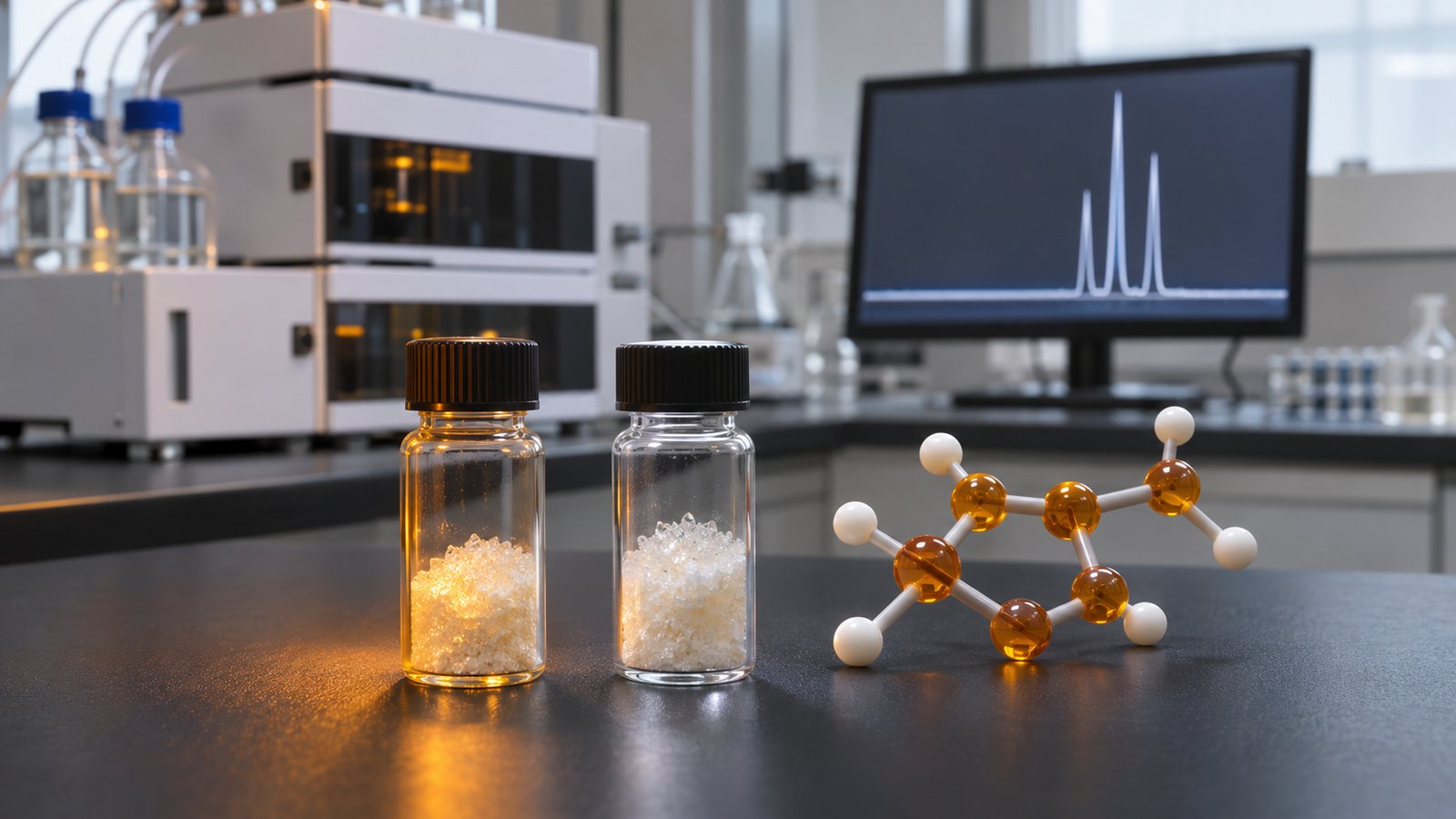
THCA is the form the plant actually makes. A raw flower testing “25% THC” on a dispensary label is usually under 1% delta-9 and about 27% THCA (0.877 x 27.4 + 1.0 = 25.0), and the label number is the calculated total. Heat breaks the carboxyl group off THCA as carbon dioxide, and what is left is delta-9 THC. Because one molecule of THCA becomes one molecule of THC, the mass you end up with is the acid mass multiplied by the ratio of the two molecular weights:
314.47 / 358.48 = 0.8772
So 100 mg of THCA can become at most 87.7 mg of THC. The formula adds that potential THC to the THC already present:
Total THC (%) = Delta-9 THC (%) + 0.877 x THCA (%)
The same equation works in milligrams. A 1 g dab of THCA isolate at 99% purity holds 990 mg THCA, which is 868 mg of potential THC. A lab that reports 990 mg of “THC” for that gram has skipped the factor and overstated the number by 14%.
Worked example from a real-format COA line:
- THCA: 23.2%
- Delta-9 THC: 1.0%
- 0.877 x 23.2 = 20.35%
- Total THC = 20.35 + 1.0 = 21.35%
Adding 23.2 and 1.0 straight gives 24.2%, which is the inflated number you still see on some menus. The gap between those two answers is 2.85 percentage points of THC that does not exist.
Decarboxylation Factors for Every Acid Cannabinoid
0.877 is right for THCA, CBDA and CBCA because those three share the formula C22H30O4. The other acid cannabinoids have different side chains and different molecular weights, so their factors move. Using 0.877 for THCVA overstates total THCV by about 1.2%. That error is small, but on a formulation spec sheet it compounds across every batch.
WKU Decarboxylation Factor Table (molecular weights from atomic masses; factor = neutral MW / acid MW)
| Acid form (MW, g/mol) | Neutral form (MW, g/mol) | Factor | Total formula |
|---|---|---|---|
| THCA (358.48) | Delta-9 THC (314.47) | 0.877 | Total THC = THC + 0.877 x THCA |
| CBDA (358.48) | CBD (314.47) | 0.877 | Total CBD = CBD + 0.877 x CBDA |
| CBGA (360.49) | CBG (316.48) | 0.878 | Total CBG = CBG + 0.878 x CBGA |
| CBCA (358.48) | CBC (314.47) | 0.877 | Total CBC = CBC + 0.877 x CBCA |
| THCVA (330.42) | THCV (286.41) | 0.867 | Total THCV = THCV + 0.867 x THCVA |
| CBDVA (330.42) | CBDV (286.41) | 0.867 | Total CBDV = CBDV + 0.867 x CBDVA |
| CBNA (354.45) | CBN (310.44) | 0.876 | Total CBN = CBN + 0.876 x CBNA |
Total CBD uses the same 0.877. A full spectrum hemp extract at 62% CBDA and 4% CBD holds 58.4% total CBD, and the same COA has to carry its THCA through the THC formula separately. CBDA does not count toward total THC, but crude that has been heated or stored hot will show some CBDA conversion and, on acidic surfaces, some CBD to THC isomerization. The pH and stability guide covers why acidic residues push that drift.
Dry Weight Basis: The Conversion Most Growers Never Run
Federal hemp limits are written on a dry weight basis, and the USDA rule at 7 CFR 990 requires labs to determine and report total THC that way. Dry weight means the THC percentage after moisture is excluded from the sample mass. Water dilutes the percentage. A sample tested as-is at 10% moisture reads lower than the same plant tested dry, and the compliance number is the dry one.
Dry weight total THC = as-is total THC / (1 – moisture fraction)
Same Plant, Five Moisture Levels: As-Is vs Dry Weight Total THC (dry weight = as-is / (1 – moisture fraction))
| Moisture in the tested sample | As-is total THC on the report | Dry weight total THC | Read against 0.3% |
|---|---|---|---|
| 0% (already dry basis) | 0.270% | 0.270% | Under |
| 8% | 0.270% | 0.293% | Under, thin margin |
| 10% | 0.270% | 0.300% | At the line |
| 12% | 0.270% | 0.307% | Over before uncertainty |
| 15% | 0.270% | 0.318% | Over before uncertainty |
The table is the same plant tested at five moisture levels. A grower who sees 0.27% on an as-is screening test from a cheap in-house unit and calls the field clean is reading a number that sits on the line at 10% moisture and goes over at 12%. If the COA does not state the basis, ask the lab before you read it against 0.3%. If it lists moisture, convert it yourself.
Dry weight applies to plant material and intermediates. Finished edibles, tinctures and beverages after December 11 are judged in milligrams per container, where moisture does not enter the math.
Measurement Uncertainty: How Producers Are Actually Judged
No lab measures 0.300% exactly. Every validated method carries an expanded measurement uncertainty, and the USDA rule requires labs to estimate it and report it with the result. Under 7 CFR 990.1, the acceptable hemp THC level is met when the uncertainty is applied to the reported total THC and the resulting range includes 0.3% or less. The rule’s own example is 0.35% ±0.06%: the range runs 0.29% to 0.41%, it includes 0.3%, and the lot is acceptable.
Measurement Uncertainty Decision Table (producer pre-harvest testing under 7 CFR 990)
| Reported total THC (dry wt) | Lab MU | Range | USDA reading |
|---|---|---|---|
| 0.28% | ±0.04% | 0.24 to 0.32% | Acceptable (range includes 0.3% or less) |
| 0.35% | ±0.06% | 0.29 to 0.41% | Acceptable (the 7 CFR 990.1 example) |
| 0.35% | ±0.03% | 0.32 to 0.38% | Not acceptable: whole range above 0.3% |
| 0.42% | ±0.06% | 0.36 to 0.48% | Not acceptable |
| 1.10% | ±0.10% | 1.00 to 1.20% | Not acceptable; above 1.0% the negligence threshold is in play |
Two consequences fall out of this. A lab with a tighter uncertainty fails more borderline lots. A 0.35% result passes at ±0.06% and fails at ±0.03%, on the same plant. The second consequence is the one that bites: measurement uncertainty covers what happens inside the lab, and the USDA itself noted in the interim rule that it does not account for sampling variability in the field. If the sampler cuts top colas from the sunniest row, the uncertainty band does nothing for you. The potency audit and sampling guide walks through how sample selection moves a result more than the instrument does.
Producer samples under the USDA rule are pulled within 30 days before harvest. Above 1.0% total THC on a dry weight basis, a failed lot is no longer treated as a non-negligent miss.
HPLC vs GC: Why the Method Changes What You Multiply
HPLC runs at room temperature, so THCA and delta-9 THC come off the column as separate peaks and the lab applies 0.877 to the THCA number. This is why almost every cannabis potency lab runs HPLC.
GC heats the sample in the inlet, typically at 250C or higher, and THCA decarboxylates on the way in. A GC result for “THC” from an acid-rich sample is already a partial total, and the conversion is incomplete. Dussy and colleagues (Forensic Science International, 2005) found that thermal conversion of THCA topped out near 70% THC under optimized conditions, with CBN and other degradation products taking the rest. So an underivatized GC number understates total THC, and multiplying it by 0.877 a second time understates it again. GC labs that report THCA properly derivatize the sample first (silylation), which protects the carboxyl group so the acid can be measured intact and run through the formula like an HPLC result.
If your COA says GC and does not mention derivatization, ask how the lab accounted for THCA. The USDA rule accepts post-decarboxylation methods only when the reported total accounts for the THCA conversion.
Total THC After December 11: What Changes in the Math
The federal hemp definition in Section 781 of P.L. 119-37 replaces the old delta-9-only test with total THC, and the operative date for the total THC definition and the per-container cap is December 11, 2026. Three things change in the calculation.
First, THCA counts in the definition itself. USDA pre-harvest testing has used total THC since the 2021 final rule, but the statutory definition read delta-9 only, which is how THCA flower sold downstream of the farm was judged on its delta-9 number. The 0.30% THCA / 0.05% delta-9 flower from the opening reads 0.05% on that old test and 0.313% under the new definition, at every point in the supply chain.
Second, the definition counts total tetrahydrocannabinols, including THCA. A COA that lists delta-8, delta-10, THCP or other THC isomers has to have those added in. A CBD distillate that reads 0.2% delta-9 and 0.25% delta-8 is 0.45% total tetrahydrocannabinols, not 0.2%.
Third, final products carry a hard cap of 0.4 mg total THC per container, counting THCA and any other cannabinoid with similar effects or marketed that way. “Container” means the innermost packaging in direct contact with the product. This is where a 0.3% concentration habit breaks.
The 0.4 mg Per Container Math: What 0.3% Means Inside a Finished Product
| Container | Contents by mass | Total THC at 0.3% w/w | Max concentration to stay at 0.4 mg per container |
|---|---|---|---|
| 30 mL tincture (MCT, about 0.94 g/mL) | 28.2 g | 84.6 mg | 0.0014% (14 ppm) |
| Jar of 30 gummies at 4 g each | 120 g | 360 mg | 0.00033% (3.3 ppm) |
| Single 4 g gummy in its own wrapper | 4 g | 12 mg | 0.010% (100 ppm) |
| 12 oz beverage can (about 355 g) | 355 g | 1,065 mg | 0.00011% (1.1 ppm) |
| 50 mL topical lotion (about 50 g) | 50 g | 150 mg | 0.0008% (8 ppm) |
A 30 mL full spectrum tincture made from 0.3% oil holds 84.6 mg of total THC, 211 times the cap. To stay under 0.4 mg, the oil has to be at 14 ppm or less, which means THC-free (broad spectrum or isolate based) inputs and a lab that can quantify at that level. On a 30-count gummy jar the allowed concentration is 3.3 ppm. Most potency methods tuned for flower cannot report below their LOQ at that level, so the COA has to come from a method validated for trace THC in the finished matrix. For the operator side of the transition, inventory, reformulation and what to do with existing stock, see the December 11 hemp ban playbook.
Calculating Total THC in Milligrams for Edibles and Flower
Percent to milligrams is one conversion: mg = percent x grams x 10. A 4 g gummy at 0.25% total THC holds 10 mg. A 1 g joint of flower at 21.35% total THC holds 213.5 mg of potential THC.
For a homemade infusion, run the math on the starting material and then apply an efficiency you can defend:
- Flower mass x total THC % x 10 = potential THC in mg. 7 g at 20% total THC = 1,400 mg.
- Decarboxylation does not run to 100%. In an oven, 115C for 40 minutes gets most of the THCA across, and some of it degrades on the way.
- Extraction into butter or oil leaves cannabinoids in the spent plant material. Squeeze it and weigh what you lose.
- Divide the defensible total by the number of servings. If the batch is 1,400 mg potential and you plan for 70% recovery, 980 mg over 49 gummies is 20 mg each, not 28.6.
If you run edibles or tinctures commercially, potency on the label has to come from a COA on the finished batch. The THC dosing calculator handles serving math once you have that number.
What Total THC Does Not Tell You About Effects
Total THC is a potential: the THC you would have if every THCA molecule decarboxylated with no loss. Smoking and vaping do not deliver that. Heating THCA produces CBN and other degradation products alongside THC, and in Dussy’s heating experiments the conversion ceiling was around 70%. Some THCA also pyrolyzes or goes out with sidestream smoke. A 21% total THC flower is a 21% potential, and what reaches the lungs is a fraction of it that depends on the device, the temperature and how the user smokes. The guide to what happens to THC when heated lays out the temperature bands.
This is why two jars at 28% and 22% total THC can feel similar. The number measures inventory. For compliance, inventory is the right thing to measure. For dosing, it is a ceiling.
If you want to learn how potency carries through every step from biomass to finished product, with the mass balance sheets and SOPs we use in the lab, that is what we built extractiontraining.com for.
How to Read a COA for Total THC
| Number on the COA | What it is | What to do with it |
|---|---|---|
| THCA % | Acid form measured intact (HPLC, or GC after derivatization) | Multiply by 0.877 |
| Delta-9 THC % | Neutral THC already present | Add as-is |
| Total THC % | Lab-calculated Delta-9 + 0.877 x THCA | Check the lab used 0.877, not 1.0 |
| Total potential THC / Max THC | Usually the same as Total THC; some labs use this label | Confirm the formula in the method notes |
| Moisture % or “dry weight basis” | Tells you which basis the percentages are on | Convert as-is to dry weight before any 0.3% read |
| ND / <LOQ | Below the lab’s quantitation limit, not proven zero | Carry the LOQ value into container math |
| MU or ± | Expanded measurement uncertainty for that analyte | Apply to the total THC result for producer compliance |
| Delta-8, Delta-10, THCP, other THC isomers | Tetrahydrocannabinols beyond delta-9 | Add them in for the Dec 11 total THC read |
Common Failures and How to Diagnose Them
Failure 1: Reading an as-is result against a dry weight limit
Symptom: In-house screening says the field is at 0.27% and the state test comes back at 0.31%.
Root cause: The screening number was on wet material. Water in the sample diluted the percentage.
Diagnostic test: Run loss on drying on a split of the same sample (105C to constant weight) and convert with as-is / (1 – moisture).
Fix: Screen on a dry weight basis or convert every screening result before you make a harvest call. Budget a margin: a dry weight screen above 0.25% is a harvest-now signal.
Failure 2: Adding THCA without the factor
Symptom: Label potency runs 2 to 4 points higher than a competitor’s on similar flower, and a state cross-test comes back low.
Root cause: THCA was added to THC at 1.0 instead of 0.877, overstating the acid’s contribution by 14%.
Diagnostic test: Recompute total from the THCA and delta-9 lines on the COA. If the lab total matches straight addition, the factor is missing.
Fix: Relabel from the corrected total. Sticker a jar whose label overstates potency and you have a labeling violation in most adult-use states.
Failure 3: Multiplying a GC result by 0.877
Symptom: A GC lab and an HPLC lab disagree by 20% or more on the same lot, the GC result lower.
Root cause: The GC inlet decarboxylated THCA incompletely, so the “THC” peak was already a partial total, and someone applied the factor again.
Diagnostic test: Check the method summary for derivatization. If there is none and THCA is not reported as its own line, the number is a partial total.
Fix: Use HPLC, or a GC method with silylation, for any compliance number.
Failure 4: Treating ND as zero in container math
Symptom: A gummy jar “has no THC” on the COA and a regulator’s retest finds 0.6 mg per container.
Root cause: The method’s LOQ was 0.01% (100 ppm). On a 120 g jar that LOQ alone is 12 mg, 30 times the cap. ND meant “below 100 ppm,” not zero.
Diagnostic test: Multiply the LOQ printed on the COA by the container mass. If that product is above 0.4 mg, the COA cannot prove compliance.
Fix: Use a trace-THC method validated in the finished matrix with an LOQ low enough that LOQ x container mass sits well under 0.4 mg.
Failure 5: Counting only delta-9 and THCA after December 11
Symptom: A distillate or vape that met the old 0.3% delta-9 test is flagged on total THC.
Root cause: Delta-8 and other tetrahydrocannabinols on the COA were left out of the total.
Diagnostic test: Sum every THC isomer line on the COA plus 0.877 x THCA.
Fix: Spec raw materials on total tetrahydrocannabinols, not delta-9. For converted material, the converted THC detection guide shows what isomer signatures a lab will see.
Failure 6: Using total THC to set a dose
Symptom: Homemade edibles test or feel 30 to 40% weaker than the batch math predicted.
Root cause: The batch math assumed 100% decarboxylation and 100% extraction into the fat. Neither happens.
Diagnostic test: Weigh the spent plant material and compare the expected mg per serving with a lab result on one finished piece.
Fix: Plan servings on 70% of potential until you have a lab number from your own process.
Frequently Asked Questions
How do you calculate total THC?
Total THC = Delta-9 THC + (0.877 x THCA). A COA with 23.2% THCA and 1.0% delta-9 THC gives 0.877 x 23.2 + 1.0 = 21.35% total THC. For hemp compliance the inputs must be on a dry weight basis.
Why is THCA multiplied by 0.877?
THCA (358.48 g/mol) loses CO2 (44.01 g/mol) when it decarboxylates into THC (314.47 g/mol). 314.47 / 358.48 = 0.877, so each milligram of THCA can become at most 0.877 mg of THC. The same factor applies to CBDA and CBCA; THCVA uses 0.867 and CBGA uses 0.878.
Is total THC the same as the THC percentage on a dispensary label?
On most flower labels the headline THC number is the calculated total. Raw flower is usually under 1% delta-9 and over 90% of its THC content is THCA, so a 25% label is mostly THCA multiplied by 0.877. Check the COA: if the total equals THCA plus THC with no factor, the label is inflated by up to 14%.
Does total THC include delta-8 after December 11?
The federal hemp definition that applies from December 11, 2026 counts total tetrahydrocannabinols, including THCA, so delta-8, delta-10 and other THC isomers on the COA belong in the total. Finished products are capped at 0.4 mg total THC per container. State laws can be stricter and some started earlier.
How do you calculate total THC in milligrams?
Milligrams = percent x grams x 10. A 4 g gummy at 0.25% total THC holds 10 mg. For the December 11 cap, the whole container counts: a 120 g gummy jar must stay at or below 3.3 ppm total THC to hold 0.4 mg or less.
Does smoking convert all the THCA into THC?
No. Heating converts THCA incompletely and produces CBN and other degradation products alongside THC. In Dussy et al. (2005) thermal conversion topped out near 70% under optimized conditions. Total THC is the potential, and delivered THC is lower.
What does dry weight basis mean for total THC?
It is the THC percentage with the sample’s water excluded: dry weight = as-is / (1 – moisture fraction). A sample at 0.27% as-is with 10% moisture is 0.300% on a dry weight basis. Federal hemp limits are dry weight numbers.
Ready to level up your extraction game? Contact WKU Consulting for personalized guidance on building your extraction lab.
For more deep dives into cannabis chemistry, extraction SOPs, and lab design, subscribe to the WKU Consulting YouTube channel.
Watch a related video:
Sources: 7 CFR 990.1 and 990.25 (USDA Domestic Hemp Production Program: dry weight basis, measurement uncertainty, acceptable hemp THC level); Dussy F.E. et al., Forensic Science International 149 (2005) 3-10 (thermal conversion of THCA); P.L. 119-37 Section 781 and CRS LSB11496 (federal hemp definition and effective dates). Molecular weights calculated from IUPAC atomic masses.