
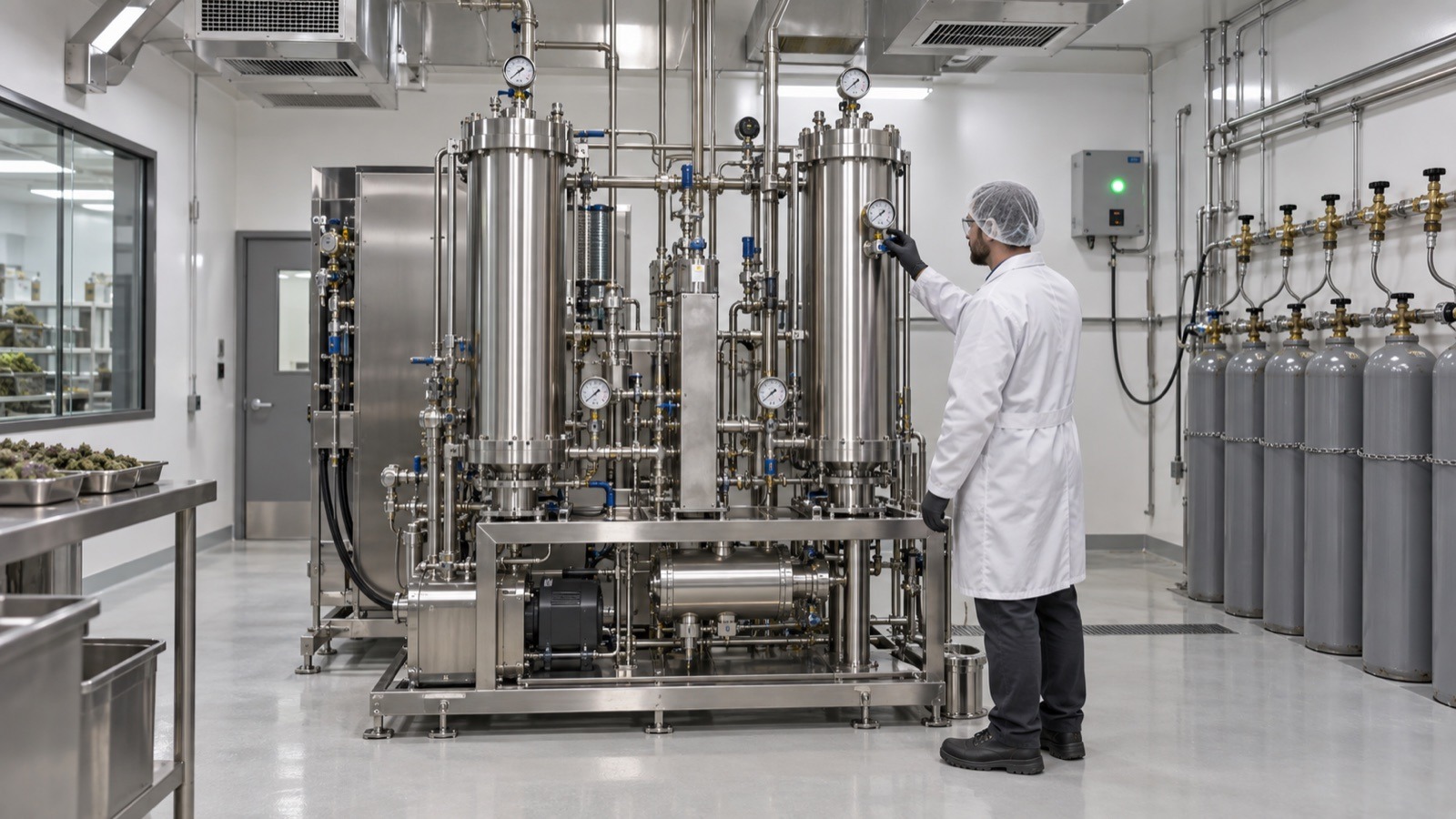
CO2 extraction rooms operate at 1,071 to 5,000 PSI above the carbon dioxide critical point (31.1C, 73.8 atm), with asphyxiation as the primary hazard rather than fire or explosion. They are NOT classified as C1D1 or C1D2. Those classifications apply to flammable solvents like butane and ethanol under NFPA 30 and NEC Article 500. CO2 is non-flammable. The classification framework is entirely different: Group F-1 under the IBC (carbon dioxide is an inert compressed gas with no maximum allowable quantity in IFC Table 5003.1.1(1), so CO2 inventory alone never makes the room a Group H occupancy; the ethanol stored in the same control area can; see the HMIS and MAQ worked example), OSHA PEL at 5,000 ppm TWA, CO2 gas detection at floor level (specific gravity 1.53, sinks), and ASME Section VIII for every pressure vessel above 15 PSI. Getting this wrong costs $40,000 to $120,000 in retrofit after a failed inspection.
What Occupancy Classification Is a CO2 Extraction Room?
Group F-1, Factory Industrial, in almost every case. Carbon dioxide is an inert compressed gas, and IFC Table 5003.1.1(1) lists inert gases as NL, not limited, for the maximum allowable quantity per control area, so no amount of CO2 by itself pushes the room into a Group H occupancy. Three other numbers decide what the room has to carry: above 100 lb of insulated liquid CO2 indoors, IFC 5307 requires mechanical ventilation that keeps the room at negative pressure or a gas detection system that alarms at 5,000 ppm with sensors within 12 inches of the floor; every vessel above 15 PSI falls under ASME Section VIII; and the ethanol stored in the same control area for winterization is what changes the occupancy group, at 120 gal for a Class IB liquid (240 gal with sprinklers), to H-3. Classify the CO2 as inert, classify the solvent honestly, and the plan review goes through.
Why CO2 Extraction Rooms Are Not C1D1 or C1D2
This is the most expensive misconception in cannabis lab design. Operators building CO2 extraction rooms apply C1D1 requirements because that is what they know from hydrocarbon extraction. The result: $80,000 spent on explosion-proof electrical, gas-tight construction, and flammable vapor detection systems that address the wrong hazard entirely.
C1D1 (Class I, Division 1) under NEC Article 500 applies to locations where ignitable concentrations of flammable gases or vapors exist under normal operating conditions. Butane, propane, ethanol vapor: those are Class I hazards. CO2 is not flammable. It does not ignite. It does not explode. Applying C1D1 to a CO2 room is like installing a sprinkler system in a swimming pool.
The actual hazards in a CO2 extraction room are:
- Asphyxiation: CO2 displaces oxygen. At 40,000 ppm (4%), OSHA classifies the atmosphere as Immediately Dangerous to Life and Health (IDLH). A single catastrophic seal failure on a 20L vessel can raise room CO2 above IDLH in under 90 seconds in a 400 sq ft room with no ventilation.
- Pressure vessel failure: Supercritical CO2 systems operate at 1,071 to 5,000 PSI. A rupture disc failure, cracked fitting, or over-pressurized vessel at those pressures is a ballistic event. The energy release from a 5L vessel at 3,000 PSI is roughly equivalent to a hand grenade.
- Cold burns: When liquid CO2 escapes a high-pressure system, it depressurizes instantly to -78.5C (-109.3F), forming dry ice particles and extremely cold gas. A hose failure causes instant frostbite on contact with exposed skin.
None of these are addressed by C1D1 construction. All of them are addressed by the correct classification framework: IBC occupancy classification, OSHA CO2 exposure limits, ASME pressure vessel codes, and CO2-specific gas detection.
Room Classification for Supercritical CO2 Systems
The International Building Code (IBC) classifies CO2 extraction rooms based on the pressure vessel contents and quantities, not on flammability. Two classifications apply depending on your system pressure and vessel volume:
| Classification | Applies When | Key Requirements | Typical CO2 System |
|---|---|---|---|
| F-1 (Factory Industrial, Moderate Hazard) | Any quantity of CO2: IFC Table 5003.1.1(1) lists inert gases as NL (not limited). Above 100 lb of insulated liquid CO2 indoors, IFC 5307 adds mechanical ventilation at negative pressure, or a gas detection system alarming at 5,000 ppm with sensors within 12 inches of the floor. | Standard mechanical ventilation, CO2 detection, emergency exhaust, ASME-rated vessels | Small to mid systems (5L to 20L extraction vessels, single-stage) |
| Group H-2 or H-3 (High Hazard), triggered by the solvents, not the CO2 | Flammable liquid in the same control area above its MAQ (ethanol, Class IB: 120 gal, 240 gal with sprinklers), or flammable gas above 1,000 cu ft. Vessel size and pressure change the ASME and relief-piping scope, never the occupancy group | Fire barriers around the control area, spill control and secondary containment, explosion control where the code calls for it, a hazardous-materials inventory statement at plan review, AHJ notification | Large production systems (40L+ vessels, multi-stage, high-pressure pumps) |
| C1D1 / C1D2 (NEC Article 500) | Flammable gas or vapor present (butane, propane, ethanol) | Explosion-proof electrical, gas-tight construction, LEL detection, purge systems | Does NOT apply to CO2 extraction. CO2 is non-flammable. |
Nearly every cannabis CO2 room is F-1, at any vessel size. Adding a second large vessel or running above 3,000 PSI changes the ASME scope and the relief piping, not the occupancy group. What moves a CO2 room into Group H is the ethanol stored beside it for winterization: cross the maximum allowable quantity for the control area (120 gal of a Class IB liquid, 240 gal with sprinklers) and the room is H-3 regardless of how much CO2 is in it. Group H construction adds $30,000 to $60,000 to the buildout for the fire barriers, spill control, and the plan-review process that come with it.
Check your local Authority Having Jurisdiction (AHJ) first. Oregon’s extraction rules treat a CO2 extraction room as a Group F-1 occupancy when nothing else in the control area exceeds its MAQ, and most AHJs follow the same logic. Where a Group H classification shows up on a CO2 facility, it is the solvent inventory in the same control area that produced it, not the CO2. Your jurisdiction determines your classification, not a blog post. The state licensing requirements that run alongside the occupancy question are compiled in our cannabis extraction license requirements by state guide. But knowing the framework prevents your architect from defaulting to C1D1 and billing you for electrical work you do not need. For a complete guide to cannabis extraction lab layout and workflow optimization, see our Extraction Lab Design Guide.
Ventilation Design: CFM Calculations for CO2 Displacement Risk
Ventilation in a CO2 room serves one purpose: preventing CO2 accumulation above OSHA’s permissible exposure limit of 5,000 ppm TWA (8-hour) and 30,000 ppm STEL (15-minute). Since CO2 is 1.53 times denser than air, it sinks to floor level. Standard ceiling exhaust designed for hydrocarbon vapor (which is lighter than air for some solvents) does not work. CO2 ventilation must exhaust from the lowest point in the room.
The minimum ventilation rate is driven by two factors: normal operating leakage and worst-case catastrophic release.
Normal Operating Ventilation
ASHRAE 62.1 and most cannabis-specific building codes require a minimum of 6 air changes per hour (ACH) for industrial processing rooms. For CO2 specifically, Oregon OSHA (OAR 437-002-0382) requires maintaining at least 1 CFM per square foot of floor area with continuous mechanical exhaust. Most AHJs require 6 to 12 ACH depending on the CO2 inventory in the room. The C1D1 ventilation calculator has a CO2 branch that returns the CFM, the ACH, and the time to clear a full-inventory release back under 5,000 ppm.
| Room Size (sq ft) | Ceiling Height | Room Volume (cu ft) | 6 ACH (CFM) | 8 ACH (CFM) | 12 ACH (CFM) | Recommended |
|---|---|---|---|---|---|---|
| 200 | 10 ft | 2,000 | 200 | 267 | 400 | 8 ACH minimum for small systems |
| 400 | 10 ft | 4,000 | 400 | 533 | 800 | 8 ACH for single vessel systems |
| 600 | 12 ft | 7,200 | 720 | 960 | 1,440 | 12 ACH for multi-vessel production |
| 1,000 | 14 ft | 14,000 | 1,400 | 1,867 | 2,800 | 12 ACH for large production facilities |
These numbers are your starting point. Your HVAC engineer sizes the system based on the actual CO2 inventory (total volume of CO2 in all vessels, supply tanks, and piping at operating conditions) and the worst-case release scenario. The calculation: if 100% of the CO2 in the largest vessel released instantaneously, how many air changes does the room need to bring the concentration below 5,000 ppm within 15 minutes?
Exhaust Placement
CO2 is 1.53 times heavier than air. It pools at floor level. Exhaust grilles must be placed within 12 inches of the finished floor. Intake air enters at ceiling level or high on the wall to create a top-down sweep that pushes CO2 toward the floor exhaust. This is the opposite of hydrocarbon ventilation, where lighter-than-air vapors (butane SG 0.6) rise and are captured at ceiling level. If your HVAC contractor installs ceiling exhaust for CO2, fire it and start over. The system will not prevent floor-level CO2 accumulation.
Run exhaust ductwork with rigid galvanized steel or stainless steel. No flex duct. CO2 at high concentrations is corrosive to some materials and flex duct sags, creating dead spots where CO2 accumulates inside the duct instead of being evacuated.
Gas Detection and Alarm Systems
CO2 gas detection in an extraction room is a two-zone system: breathing zone and floor level. One detector is not enough. CO2 stratifies. The floor can be at 15,000 ppm while breathing zone reads 2,000 ppm. A single detector at one height gives false confidence.
| Alarm Level | CO2 Concentration | Physiological Effect | Response | Automated Action |
|---|---|---|---|---|
| Normal | <1,000 ppm | No physiological effect | None | None |
| Alert (Low) | 5,000 ppm (OSHA TWA) | Headache, dizziness at sustained exposure | Visual alert (amber strobe). Investigate source. | Increase ventilation to maximum. Log event. |
| Warning (High) | 15,000 ppm | Respiratory acidosis, increased heart rate | Audible alarm + red strobe. Begin evacuation. | Emergency exhaust activates. Shut down CO2 supply. |
| Danger (IDLH) | 40,000 ppm (OSHA IDLH) | Loss of consciousness within minutes | Evacuate immediately. Do not re-enter without SCBA. | Full emergency shutdown. AHJ notification. |
Sensor placement: one NDIR (non-dispersive infrared) CO2 sensor at breathing zone height (4 to 5 feet from floor) and one at 6 to 12 inches from the floor on the wall opposite the exhaust grille. NDIR sensors are the only technology accurate enough for continuous CO2 monitoring. Electrochemical sensors drift too fast in high-CO2 environments. Budget $800 to $2,500 per sensor depending on the manufacturer and data logging capabilities. Calibrate every 6 months with certified span gas at 5,000 ppm and 10,000 ppm.
Wire the gas detection system to the ventilation interlock. When the floor sensor hits 5,000 ppm, the emergency exhaust fan activates automatically. When it hits 15,000 ppm, the CO2 supply solenoid closes. This interlock is not optional. Manual response times (operator hears alarm, walks to valve, shuts it off) are too slow for catastrophic releases. Automated shutdown within 3 seconds of detection is the engineering standard.
Pressure Vessel Requirements: ASME and Beyond
Every pressure vessel in a supercritical CO2 extraction system operating above 15 PSI must comply with ASME Boiler and Pressure Vessel Code (BPVC), Section VIII, Division 1 or Division 2. This is federal law under OSHA 29 CFR 1910.169, not a suggestion.
What this means for your room design:
- Pressure relief routing: Every vessel has a rupture disc or pressure relief valve (PRV). That relief device must vent to a safe location, not into the room. Route relief piping to the building exterior, pointed away from air intakes, walkways, and adjacent buildings. A PRV dumping 3,000 PSI CO2 into the extraction room creates an IDLH atmosphere in seconds and a cold burn hazard from the Joule-Thomson cooling effect (CO2 drops to -78.5C during rapid decompression).
- Vessel anchorage: A vessel at 3,000 PSI that separates from its mounting generates a reaction force from the escaping gas. Secure all vessels to structural members rated for the maximum thrust force. The calculation: force (lbs) = pressure (PSI) x area of the opening (sq in). A 1-inch opening at 3,000 PSI = 2,356 lbs of thrust. That vessel becomes a projectile if the mounting fails.
- Hydrostatic testing: All vessels must be hydrostatically tested to 1.5x their maximum allowable working pressure (MAWP) before commissioning. A vessel rated for 3,000 PSI gets tested at 4,500 PSI. This test must be documented and the documentation must be available for inspection. No hydro test certificate = no operation.
- Annual inspection: Most jurisdictions require annual visual inspection and periodic (typically 5-year) internal inspection by a certified inspector. Build access clearance around vessels for inspection: 36 inches minimum on all accessible sides.
If you want to learn the full pressure vessel engineering and room design process with real buildout walkthroughs and design SOPs, that is exactly what we built extractiontraining.com for.
Emergency Systems and Oxygen Monitoring
CO2 rooms need an oxygen depletion monitor in addition to CO2 sensors. When CO2 displaces oxygen below 19.5% (OSHA-defined oxygen-deficient atmosphere), no one enters without self-contained breathing apparatus (SCBA). This happens at approximately 10,000 ppm CO2.
Emergency system requirements for CO2 extraction rooms:
- Emergency exhaust fan: Separate from the main HVAC system, on emergency power (UPS or generator). Sized to achieve 12+ ACH independently. Wired to the gas detection interlock. If main power fails during a CO2 release, the emergency fan runs on backup.
- Emergency stop button: Located outside the extraction room, next to the entry door. Pressing it closes the CO2 supply solenoid, activates emergency exhaust, and triggers the building alarm. Operators should never have to re-enter a CO2-filled room to shut down the system.
- Self-closing door: The extraction room door must be self-closing and not propped open during operations. An open door allows CO2 to flow into adjacent spaces (remember: 1.53x heavier than air, it pours through doorways like water).
- Eyewash and safety shower: Required within 10 seconds of travel time from the CO2 system (see our Extraction Lab Safety Equipment Checklist for the full compliance list). CO2 cold burns from liquid or dry ice contact require immediate water flushing for 15+ minutes.
- Wind sock or streamer: A simple visual indicator near the exhaust grille that confirms ventilation is operating. If the streamer stops moving, the ventilation system has failed. This is a $3 safety device that has prevented more incidents than $30,000 monitoring systems because operators notice it immediately.
Build Cost: CO2 Room vs C1D1 vs C1D2
One of the reasons operators default to C1D1 construction for CO2 rooms is that their contractor only knows one way to build a cannabis extraction room. The cost difference is significant because you are paying for hazard mitigation systems that address the wrong hazard.
| Cost Category | CO2 Room (F-1) | C1D1 (Hydrocarbon) | C1D2 (Ethanol) |
|---|---|---|---|
| Electrical | Standard commercial ($8-15/sq ft) | Explosion-proof ($35-60/sq ft) | Standard with select EP fixtures ($15-25/sq ft) |
| HVAC / Ventilation | $15,000-35,000 (floor exhaust, interlock) | $25,000-60,000 (classified area ventilation) | $12,000-25,000 (standard commercial) |
| Gas Detection | $3,000-8,000 (NDIR CO2 + O2 sensors) | $5,000-15,000 (catalytic LEL sensors) | $3,000-8,000 (LEL sensors) |
| Construction | Standard commercial framing ($80-120/sq ft) | Gas-tight, fire-rated ($150-250/sq ft) | Standard with fire rating ($100-160/sq ft) |
| Pressure Relief Piping | $2,000-5,000 | N/A (no high-pressure vessels) | N/A |
| Total Buildout (400 sq ft room) | $55,000-85,000 | $120,000-200,000 | $65,000-110,000 |
A 400 sq ft CO2 room built correctly costs $55,000 to $85,000. The same room built to C1D1 specifications (wrong classification) costs $120,000 to $200,000. That is $65,000 to $115,000 wasted on explosion-proof electrical and gas-tight construction that addresses a hazard that does not exist in a CO2 system. The savings come from standard commercial electrical (CO2 is non-flammable, so standard wiring is code-compliant) and standard framing (no gas-tight membrane needed).
The CO2-specific costs that C1D1 does not cover: floor-level exhaust ducting, NDIR gas detection with ventilation interlocks, pressure relief piping to the building exterior, and ASME vessel anchorage. These are the line items that actually protect your operators from the actual hazards in the room.
Common Design Mistakes That Kill CO2 Extraction Projects
| Mistake | Why It Happens | What Goes Wrong | Fix |
|---|---|---|---|
| Ceiling exhaust instead of floor exhaust | Contractor copies C1D1 ventilation design | CO2 pools at floor level. Operators exposed to concentrations above PEL while room reads “safe” at ceiling height. | Relocate exhaust grilles to within 12 inches of floor. Add floor-level CO2 sensor. |
| Pressure relief venting into the room | Installer runs relief piping to the wall and stops | Rupture disc activation dumps CO2 directly into occupied space. Instant IDLH atmosphere. Cold burn hazard from -78.5C gas. | Route all relief devices to building exterior via rigid piping. Point away from air intakes. |
| Single CO2 sensor at one height | Cost savings or installer unfamiliarity with CO2 behavior | Floor-level CO2 concentration reaches 15,000+ ppm while breathing zone sensor reads below alarm threshold. Operator bends down to check equipment and loses consciousness. | Two sensors minimum: breathing zone (4-5 ft) and floor level (6-12 inches). |
| No emergency power for exhaust | Emergency fan wired to same breaker as main HVAC | Power outage during operation. CO2 continues to leak from seals. No ventilation. Room reaches IDLH. | Emergency exhaust on UPS or generator with automatic transfer switch. |
| Applying C1D1 to CO2 room | Architect or contractor only knows cannabis = C1D1 | $65,000-115,000 spent on explosion-proof electrical and gas-tight construction that does not address CO2 asphyxiation or pressure hazards. | Consult AHJ. Classify correctly: F-1, with Group H only if the solvent inventory in the control area exceeds its MAQ. Redirect budget to CO2-specific safety systems. |
Room design like this is what a cannabis extraction consultant owns before you buy a single vessel.
If you are building a CO2 room and not just researching it, this is where the expensive mistakes live: a misclassified space, a ventilation design that fails inspection, a six-figure redesign after the AHJ walks through. Designing extraction facilities so that does not happen is what WKU does. If you want that on your project before the concrete is poured, here is how to work with us.
Frequently Asked Questions
Is a CO2 extraction room classified as C1D1?
No. C1D1 (Class I, Division 1) under NEC Article 500 applies to locations with flammable gases or vapors like butane and propane. CO2 is non-flammable. CO2 extraction rooms are a Group F-1 (Factory Industrial) occupancy under the International Building Code: carbon dioxide is an inert compressed gas and IFC Table 5003.1.1(1) sets no maximum allowable quantity for inert gases. A CO2 room becomes Group H only when the ethanol or hydrocarbon stored in the same control area exceeds its MAQ. The primary hazard is asphyxiation from oxygen displacement, not fire or explosion.
How many air changes per hour does a CO2 extraction room need?
Minimum 6 ACH for small systems (under 10L vessel) in rooms under 300 sq ft. Standard recommendation: 8 ACH for single-vessel systems, 12 ACH for multi-vessel production rooms. The critical variable is exhaust placement: grilles must be within 12 inches of the floor because CO2 (specific gravity 1.53) sinks and pools at ground level. Ceiling exhaust does not capture CO2 effectively.
What CO2 concentration triggers an alarm in a cannabis extraction lab?
Three-stage alarm: 5,000 ppm (OSHA TWA, visual alert), 15,000 ppm (audible alarm, begin evacuation), and 40,000 ppm (IDLH, emergency shutdown and AHJ notification). Use NDIR sensors, not electrochemical. Place two sensors: one at breathing zone (4-5 ft height) and one at floor level (6-12 inches). Wire to ventilation interlock for automated exhaust activation at first alarm.
How much does it cost to build a CO2 extraction room?
A properly classified 400 sq ft CO2 extraction room (F-1 occupancy) costs $55,000 to $85,000 including ventilation, gas detection, and pressure relief piping. The same room incorrectly built to C1D1 specifications costs $120,000 to $200,000 because explosion-proof electrical ($35-60/sq ft vs $8-15/sq ft) and gas-tight construction address a flammability hazard that does not exist with CO2.
Where should pressure relief valves vent in a CO2 extraction room?
All pressure relief devices (rupture discs and PRVs) must vent to the building exterior via rigid stainless steel or carbon steel piping. The vent termination must point away from air intakes, walkways, doors, and adjacent buildings. Never vent into the room. A supercritical CO2 vessel at 3,000 PSI venting through a rupture disc into an occupied space will create an IDLH atmosphere in under 90 seconds and a cold burn hazard from Joule-Thomson cooling (-78.5C).
Do I need explosion-proof electrical in a CO2 extraction room?
No. CO2 is non-flammable and non-explosive. Explosion-proof electrical (rated for Class I hazardous locations) is required only for rooms where flammable gases or vapors are present, such as butane or propane extraction rooms. Standard commercial electrical wiring and fixtures are code-compliant for CO2 extraction rooms classified as F-1. This single difference saves $20,000 to $50,000 on a typical 400 sq ft room buildout.
Can I run CO2 extraction and hydrocarbon extraction in the same room?
If any hydrocarbon solvent (butane, propane) is present in the room, the entire room must meet the most restrictive classification: C1D1. You cannot partially classify a room. The CO2 system itself does not need explosion-proof wiring, but if a butane system shares the space, every fixture, outlet, and switch must be explosion-proof. The cost savings of correct CO2 classification only apply when the CO2 system is in a dedicated room with no flammable solvents present.
Ready to level up your extraction game? Contact WKU Consulting for personalized guidance on building your extraction lab.
For more deep dives into cannabis chemistry, extraction SOPs, and lab design, subscribe to the WKU Consulting YouTube channel.
