
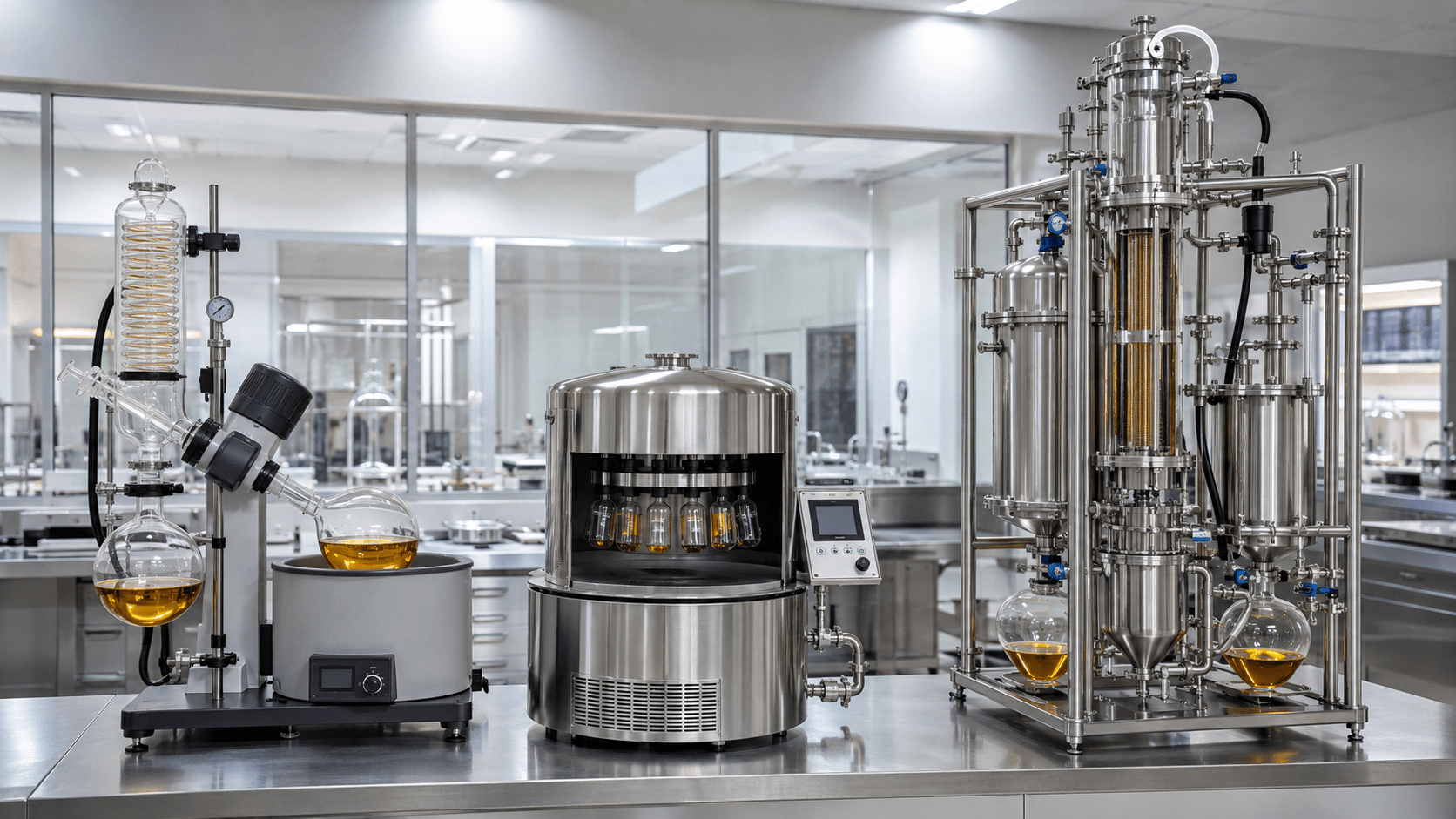
The Real Problem With Solvent Recovery
Every ethanol extraction lab hits the same bottleneck: your extraction is fast, your winterization is dialed in, and then everything stops at the rotovap. You are running a 20L rotary evaporator at 5 liters per hour while your extraction system produces 200 liters of ethanol miscella per shift. That means your recovery step takes 40 hours to process what your extractor produced in 8. The rotovap is not the problem. The mismatch between your extraction throughput and your recovery throughput is the problem.
Equipment sellers will tell you to buy a falling film evaporator. They are not wrong, but they are not unbiased either. TruSteel sells falling films. Subzero Scientific sells falling films. Ecodyst sells their EcoChyll. Every “comparison” article on page 1 of Google is written by a company that manufactures one of the options. What you will not find anywhere is an independent cost-per-liter analysis from someone who does not sell any of these machines. That is what this guide is.
I have designed 26 cannabis extraction labs. In those builds, I have spec’d rotovaps, falling film evaporators, and centrifugal evaporators at scales ranging from 5 liters per day to 2,000 liters per day. The right system depends on three variables: your daily ethanol volume, your available capital, and whether you need complete solvent stripping or just bulk recovery. Get the match wrong and you either spend $80,000 on equipment that sits idle 90% of the time or you bottleneck a $500,000 extraction line with a $3,000 rotovap.
How Each System Works
Rotary Evaporator (Rotovap)
A rotary evaporator spins a round-bottom flask in a heated water bath under vacuum. The rotation creates a thin film of solution across the interior glass surface, increasing the evaporation surface area by 3 to 5 times compared to a stationary flask. The evaporated solvent vapor travels to a condenser (typically a coil or cold finger chilled to -20C to -40C), condenses back to liquid, and collects in a receiving flask.
The key advantage is completeness. A rotovap can strip ethanol down to less than 100 ppm residual solvent in the crude oil, which means your downstream purge step is shorter or sometimes unnecessary for certain product types. The key disadvantage is throughput. A standard 20L rotovap recovers 4 to 6 liters of ethanol per hour depending on bath temperature (typically 40C to 60C), vacuum depth (50 to 100 mbar), and condenser efficiency.
At production scale, the labor cost compounds. Every batch requires loading, monitoring rotation speed and bath temperature, swapping receiving flasks, and unloading the crude. A single operator can manage two rotovaps simultaneously but not three. At $25/hr labor, that is $12.50 per rotovap-hour before you count the electricity, chiller coolant, and glassware replacement.
Falling Film Evaporator
A falling film evaporator feeds liquid solution from the top of a vertical heated tube assembly. Gravity pulls the solution down the interior walls as a thin film while the tube surface (heated to 40C to 80C) flashes the solvent into vapor. The vapor exits through a separate port to a condenser system, and the concentrated crude collects at the bottom.
Throughput is the selling point. A mid-sized falling film unit (like the TruSteel AutoVap or the Delta Separations CES-FFE) processes 30 to 120 liters of ethanol per hour depending on model size and operating parameters. That is 6 to 24 times the throughput of a 20L rotovap.
The critical limitation that equipment sellers downplay: falling films do not strip solvent completely. Typical residual ethanol in the crude oil exiting a falling film is 10% to 20% by weight. That means you still need a secondary finishing device. A rotovap, thin film evaporator, or vacuum oven to take the crude from 10 to 20% ethanol down to less than 5,000 ppm (0.5%). Every falling film installation requires a finishing step. Budget for both.
Centrifugal Evaporator
Centrifugal evaporators (like the Ecodyst EcoChyll or the Heidolph Hei-VAP Industrial) use centrifugal force to spread the solution across a heated surface instead of relying on gravity (falling film) or rotation (rotovap). The centrifugal action creates an extremely thin, uniform film thickness (typically 0.1 to 0.5 mm) that evaporates solvent faster per unit surface area than either of the other methods.
Throughput ranges from 10 to 50 liters per hour for cannabis-industry models, putting centrifugal evaporators between rotovaps and falling films in capacity. The advantage over falling films: centrifugal units can achieve much lower residual solvent levels (often below 1% ethanol) in a single pass, reducing or eliminating the need for a secondary finishing step. The advantage over rotovaps: 2 to 10 times the throughput with lower operator attention required.
The disadvantage is cost. Entry-level centrifugal evaporators start at $40,000 and industrial units run $80,000 to $120,000. Maintenance costs are also higher because centrifugal components (seals, bearings, drive motors) wear faster than the passive components in a rotovap or the gravity-fed channels in a falling film. Service intervals for seals, bearings, and vacuum pumps across all three systems are in our equipment maintenance schedule.
The Comparison That Equipment Sellers Will Not Publish
| Parameter | Rotary Evaporator (20L) | Falling Film Evaporator | Centrifugal Evaporator |
|---|---|---|---|
| Throughput (L/hr ethanol) | 4 to 6 | 30 to 120 | 10 to 50 |
| Recovery Rate | 95 to 99% | 80 to 90% (needs finishing) | 90 to 99% |
| Residual Solvent in Crude | <100 ppm (single pass) | 10 to 20% (requires secondary strip) | <1% (single pass) |
| Capital Cost | $2,000 to $15,000 | $25,000 to $80,000 | $40,000 to $120,000 |
| Operating Cost (energy/hr) | $1.50 to $3.00 | $4.00 to $8.00 | $3.00 to $6.00 |
| Cost Per Liter Recovered | $0.60 to $1.20 | $0.08 to $0.15 | $0.15 to $0.35 |
| Operator Attention | High (batch loading, monitoring) | Low (continuous feed, minimal oversight) | Low to medium |
| Maintenance Interval | Glassware: replace seals every 500 hrs, flasks every 200 to 500 batches | Gaskets and seals every 1,000 hrs. Tube cleaning every 200 hrs. | Bearings and seals every 500 to 800 hrs. Drive motor inspection every 1,000 hrs. |
| Footprint | Benchtop (3 to 5 sq ft) | Floor standing (15 to 30 sq ft, 8+ ft vertical clearance) | Benchtop to floor standing (5 to 15 sq ft) |
| Best Scale | Hobby to small commercial (<50 L/day) | Mid to large commercial (200+ L/day) | Small to mid commercial (50 to 200 L/day) |
The cost-per-liter column is the number that matters. A rotovap recovers ethanol for $0.60 to $1.20 per liter when you factor in labor, energy, and glassware replacement. A falling film does it for $0.08 to $0.15 per liter because the throughput is so high that the capital cost amortizes over a much larger volume. The crossover point where a falling film becomes cheaper than running multiple rotovaps is approximately 100 to 150 liters of ethanol per day.
Cost-Per-Liter Analysis at Three Scales
Equipment sellers quote throughput. Operators care about total cost per liter recovered, which includes capital amortization, energy, labor, consumables, and downtime. Here is the analysis for three real production scenarios.
| Cost Component | Hobby (20 L/day, Rotovap) | Small Commercial (100 L/day, Centrifugal) | Mid Commercial (500 L/day, Falling Film) |
|---|---|---|---|
| Equipment Cost | $5,000 (20L rotovap) | $60,000 (centrifugal unit) | $65,000 (falling film + $8,000 finishing rotovap) |
| Amortization (3 yr, per L) | $0.23 | $0.55 | $0.12 |
| Energy (per L) | $0.08 | $0.05 | $0.03 |
| Labor (per L) | $0.52 | $0.10 | $0.04 |
| Consumables (per L) | $0.05 | $0.03 | $0.02 |
| Total Cost Per Liter | $0.88 | $0.73 | $0.21 |
| Annual Ethanol Volume | 7,200 L | 36,000 L | 180,000 L |
| Annual Recovery Cost | $6,336 | $26,280 | $37,800 |
| Annual Recovery Cost (if using rotovap instead) | $6,336 | $31,680 (4 rotovaps needed) | $158,400 (18 rotovaps needed) |
The bottom row is the one that makes the decision for you. At 100 liters per day, a centrifugal evaporator saves $5,400 per year over four rotovaps while requiring one operator instead of two. At 500 liters per day, a falling film saves $120,600 per year over the rotovap fleet you would need to match its throughput. That $65,000 falling film pays for itself in 7 months.
What Goes Wrong: Failure Modes by System
Every recovery system fails differently. Knowing the failure modes before you buy prevents the kind of downtime that costs more than the equipment itself.
| System | Failure Mode | Root Cause | How to Diagnose | Prevention |
|---|---|---|---|---|
| Rotovap | Bumping (solution erupts into condenser) | Bath temp too high, vacuum pulled too fast, or flask overfilled past 50% | Crude oil in receiving flask. Visible splashing inside evaporation flask. | Fill flask to 40% max. Ramp vacuum slowly (10 mbar/min). Bath temp 45C max for ethanol. |
| Rotovap | Seal failure (vacuum loss) | PTFE seal worn from friction. Typically after 300 to 500 operating hours. | Vacuum gauge shows slow pressure rise when pump is off. Hissing at seal joint. | Replace seals every 500 hrs or at first sign of vacuum drift. Keep spares on hand. |
| Falling Film | Channeling (uneven film distribution) | Feed distributor clogged with wax or particulate. Tube fouling from crude buildup. | Uneven temperature readings across tube bank. Residual solvent in crude higher than baseline. | Pre-filter feed to 25 microns. CIP cleaning cycle every 100 to 200 operating hours. |
| Falling Film | Incomplete stripping (10 to 20% residual) | Inherent design limitation, not a malfunction. Single-pass falling films cannot achieve low ppm residual. | GC headspace analysis shows 10%+ ethanol in crude oil output. | Budget for a finishing device (rotovap or thin film) from day one. This is not optional. |
| Centrifugal | Bearing failure (vibration, noise) | Centrifugal forces stress bearings faster than passive systems. Imbalanced loading accelerates wear. | Increasing vibration amplitude. Grinding or squealing at operating speed. | Vibration monitoring sensor. Replace bearings at manufacturer interval (500 to 800 hrs). Do not exceed rated RPM. |
| Centrifugal | Seal leakage (solvent vapor escape) | Mechanical seals degrade from thermal cycling and solvent exposure. | Ethanol odor near seal housing. Reduced vacuum depth. | Inspect seals every 200 hrs. Replace at first sign of weeping. Use solvent-compatible seal materials (Viton or Kalrez). |
The falling film failure mode that costs people the most money is not a malfunction. It is the assumption that the falling film will strip solvent completely. I have walked into labs where the operator bought a $60,000 falling film, ran their first batch, and then discovered they still needed a $5,000 rotovap to finish the job. That $5,000 surprise becomes a $15,000 delay when you factor in ordering, shipping, installation, and the batches that sat at 15% ethanol while you waited.
The Decision Framework: Which System at Which Scale
Forget brand names. The decision is about matching your daily ethanol volume to the right recovery architecture.
| Daily Ethanol Volume | Recommended System | Capital Budget | Why |
|---|---|---|---|
| <30 L/day | Single 20L rotovap | $3,000 to $8,000 | Complete stripping in one pass. 6 hours of run time per day. One operator. |
| 30 to 80 L/day | Two 20L rotovaps OR entry-level centrifugal | $6,000 to $15,000 (rotovaps) or $40,000 to $60,000 (centrifugal) | Rotovaps if capital-constrained. Centrifugal if labor is expensive or you need unattended operation. |
| 80 to 200 L/day | Centrifugal evaporator | $60,000 to $90,000 | Sweet spot: throughput matches extraction output, near-complete stripping eliminates finishing step, single operator. |
| 200 to 500 L/day | Falling film + finishing rotovap | $55,000 to $90,000 total | Falling film handles bulk recovery at $0.08 to $0.15/L. Rotovap finishes the last 10 to 20% to compliance. |
| 500+ L/day | Falling film + thin film evaporator (wiped film) | $80,000 to $150,000 total | Rotovap cannot keep up as a finisher at this scale. Thin film evaporator handles continuous finishing at 10 to 30 L/hr. |
The Solvent You Are Recovering Matters
Everything above assumes ethanol because 80%+ of recovery systems in cannabis labs are processing ethanol miscella. But the physics change for different solvents.
Ethanol (BP 78.4C at 1 atm): Standard operating parameters. Bath/jacket temp 40 to 60C under vacuum (50 to 200 mbar) brings the boiling point down to 20 to 35C. All three systems handle ethanol well. Ethanol’s relatively high heat of vaporization (841 J/g) means energy cost per liter is the primary variable at scale.
Isopropanol (BP 82.6C at 1 atm): Similar to ethanol. Slightly higher boiling point means marginally more energy per liter recovered. The bigger concern is azeotrope formation: isopropanol forms a 87.7% azeotrope with water at 80.4C. If your starting material has more than 5% water content, the recovered isopropanol will plateau at 87.7% purity unless you use molecular sieves for final drying. None of the three recovery systems can break this azeotrope.
Hydrocarbon (butane BP -1C, propane BP -42C): Completely different recovery architecture. Rotovaps, falling films, and centrifugal evaporators are NOT used for butane/propane recovery. Hydrocarbon recovery happens inside the closed-loop extraction system itself, using passive recovery (pressure differential) or active recovery (recovery pump + heated collection pot). If you are running a BHO system, your solvent recovery is built into your extraction equipment. This article does not apply to your process.
Ethanol Recovery Rate: The Number That Actually Determines Your Margins
Food-grade ethanol costs $15 to $25 per gallon ($4 to $6.60 per liter) depending on source and volume pricing. At 500 liters per day, that is $2,000 to $3,300 per day in solvent cost if you do not recover it. At 95% recovery, you lose 25 liters per day ($100 to $165 per day lost). At 99% recovery, you lose 5 liters per day ($20 to $33 per day lost). The difference between 95% and 99% recovery is $80 to $132 per day, or $29,000 to $48,000 per year.
Rotovaps achieve 95 to 99% recovery depending on operator discipline. Falling films achieve 80 to 90% recovery in the first pass, but the finishing step brings total system recovery to 95 to 98%. Centrifugal evaporators achieve 90 to 99% recovery in a single pass. The highest total system recovery comes from a centrifugal or rotovap as the final device in the chain.
If you want to learn the full process from extraction through recovery to finished distillate with lab walkthroughs and SOPs you can actually use, that is exactly what we built extractiontraining.com for.
Installation and Facility Requirements
Equipment sellers quote the machine price. They do not quote the facility modifications required to install it.
Rotovap: Minimal facility requirements. Benchtop unit, standard 120V or 240V outlet, chiller for condenser (-20C to -40C, typically $2,000 to $5,000 for a recirculating chiller), vacuum pump ($500 to $2,000). Total ancillary cost: $2,500 to $7,000. No special ventilation required beyond standard lab exhaust.
Falling film: Significant facility requirements. Floor-mounted unit requiring 8 to 12 feet of vertical clearance (ceiling height is the most common installation blocker). 240V three-phase power in most cases. Dedicated chilled water supply (5C to 10C, high flow rate: 10 to 30 GPM). Larger vacuum pump system. Explosion-proof electrical classification if operating in a C1D1 or C1D2 space. Total ancillary cost: $15,000 to $35,000 including chiller upgrades, electrical work, and plumbing.
Centrifugal: Moderate facility requirements. Benchtop models need standard power and a chiller. Floor-standing industrial models need 240V, dedicated chilled water, and may require vibration dampening mounts. Total ancillary cost: $5,000 to $15,000.
FAQ
Can I use a rotovap for commercial-scale ethanol recovery?
You can, but above 50 liters per day you will need multiple units and multiple operators. At 100 liters per day you need 4 rotovaps running simultaneously with 2 operators. The labor cost alone exceeds the annual cost of a centrifugal evaporator at that volume. The rotovap becomes the bottleneck, not the recovery device.
Do I need a finishing device with a falling film evaporator?
Yes. Always. Falling film evaporators leave 10 to 20% residual ethanol in the crude oil output. You need a rotovap, thin film evaporator, or vacuum oven as a secondary stripping device to bring residual solvent below regulatory limits (typically 5,000 ppm for ethanol in most state programs). Budget for both from day one.
What is the ROI timeline for upgrading from rotovap to falling film?
At 200 liters per day, a $65,000 falling film plus $8,000 finishing rotovap ($73,000 total) saves approximately $10,000 to $15,000 per month in labor and ethanol loss compared to running 8 rotovaps. Payback period: 5 to 7 months. At 500 liters per day, payback drops to 3 to 4 months.
Can I recover butane or propane with a rotovap?
No. Butane (BP -1C) and propane (BP -42C) are gases at room temperature. Recovery happens inside the closed-loop extraction system using pressure differentials and heated collection vessels. Rotovaps, falling films, and centrifugal evaporators are designed for liquid solvents with boiling points above room temperature (ethanol, isopropanol, acetone, heptane).
What recovery rate should I expect from each system?
Rotovap: 95 to 99% (operator-dependent). Centrifugal: 90 to 99% (single pass). Falling film: 80 to 90% first pass, 95 to 98% total system with finishing device. The gap between 95% and 99% recovery at 500 L/day costs $29,000 to $48,000 per year in lost ethanol.
Is a centrifugal evaporator worth the premium over a falling film?
At 80 to 200 L/day, yes. The centrifugal eliminates the need for a finishing device (saving $5,000 to $15,000 in secondary equipment) and achieves near-complete stripping in a single pass. Above 200 L/day, the falling film’s throughput advantage outweighs the centrifugal’s stripping advantage. Below 50 L/day, neither is justified over a rotovap.
Need help spec’ing the right recovery system for your lab? Get in touch. We design extraction labs from blank floor to first batch, including equipment selection, facility layout, and process optimization. No equipment sales, no vendor bias. Just the system that matches your throughput.
